Eruvin 51a: Talmud study for Daf Yomi
Study the Talmud for Daf Yomi with scanned pages, Hebrew text, English translations from Sefaria and AI-generated French translations.
Passage selection and English or AI-generated French translation are available where the scan has annotations. Daf Study is independent of Torah-Box and Sefaria.
Browse Eruvin · עירובין · All tractatesEruvin 51a text and translations
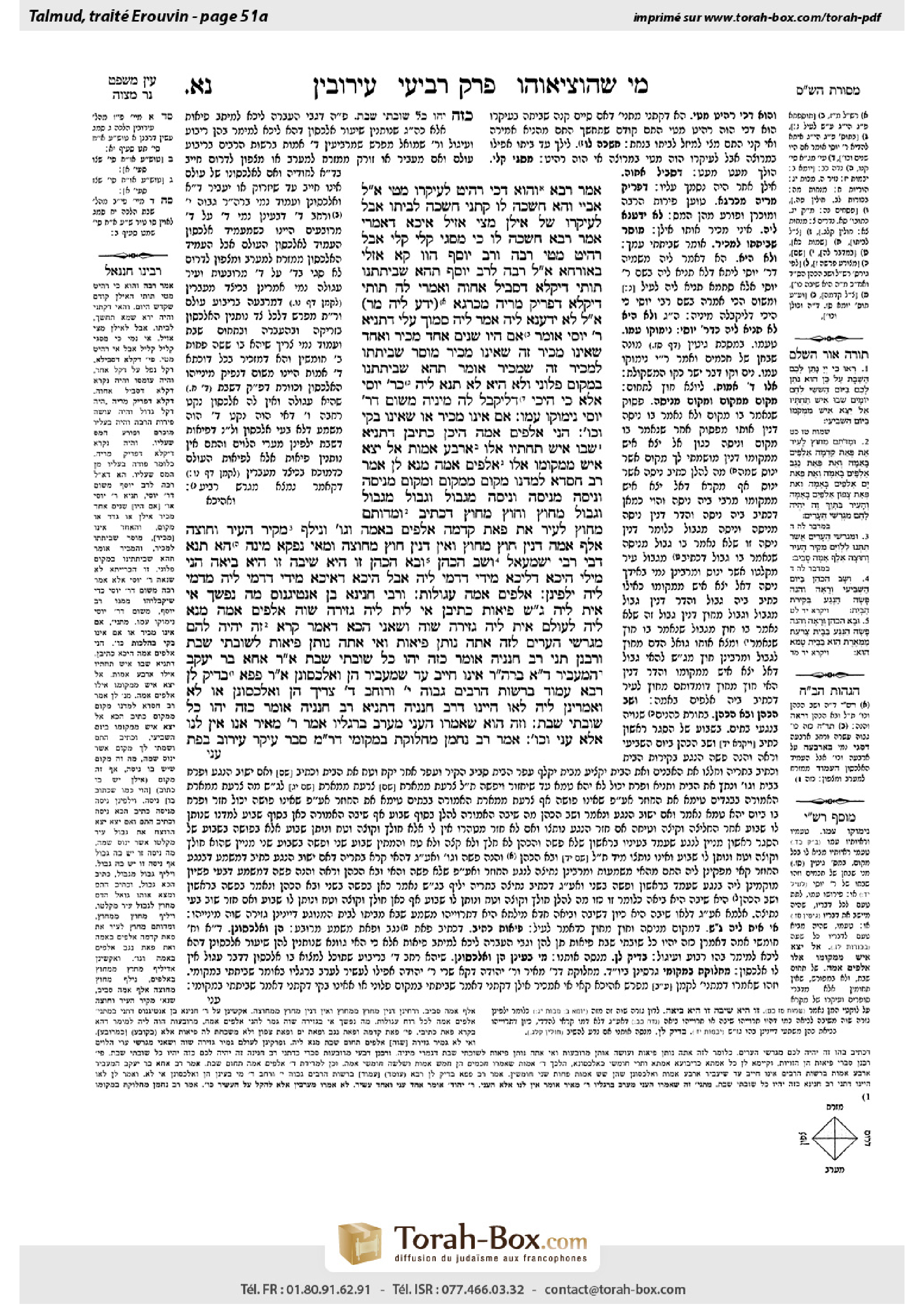
This page of Eruvin includes the Aramaic text, an English translation and an AI-generated French translation, alongside the scan above.
עירובין נ״א א · Aramaic and Hebrew text
אָמַר רָבָא: וְהוּא דְּכִי רָהֵיט לְעִיקָּרוֹ מָטֵי. אֲמַר לֵיהּ אַבָּיֵי: וְהָא ״חָשְׁכָה לוֹ״ קָתָנֵי!
״חָשְׁכָה״ — לְבֵיתוֹ, אֲבָל לְעִיקָּרוֹ שֶׁל אִילָן מָצֵי אָזֵיל. אִיכָּא דְּאָמְרִי אָמַר רָבָא: חָשְׁכָה לוֹ כִּי מְסַגֵּי קַלִּי קַלִּי, אֲבָל רָהֵיט — מָטֵי.
רַבָּה וְרַב יוֹסֵף הֲווֹ קָא אָזְלִי בְּאוֹרְחָא. אֲמַר לֵיהּ רַבָּה לְרַב יוֹסֵף: תְּהֵא שְׁבִיתָתֵנוּ תּוּתֵי דִּיקְלָא דְּסָבֵיל אֲחוּהּ. וְאָמְרִי לַהּ: תּוּתֵי דִּיקְלָא דְּפָרֵיק מָרֵיהּ מִכְּרָגָא.
יָדַע לֵיהּ מָר? אֲמַר לֵיהּ: לָא יָדַעְנָא לֵיהּ. אֲמַר לֵיהּ: סְמוֹךְ עֲלַי, דְּתַנְיָא, רַבִּי יוֹסֵי אוֹמֵר: אִם הָיוּ שְׁנַיִם, אֶחָד מַכִּיר וְאֶחָד שֶׁאֵינוֹ מַכִּיר — זֶה שֶׁאֵינוֹ מַכִּיר מוֹסֵר שְׁבִיתָתוֹ לַמַּכִּיר, זֶה שֶׁמַּכִּיר אוֹמֵר: תְּהֵא ״שְׁבִיתָתֵנוּ בְּמָקוֹם פְּלוֹנִי״.
וְלָא הִיא, לָא תְּנָא לֵיהּ כְּרַבִּי יוֹסֵי, אֶלָּא כִּי הֵיכִי דְּלִיקַבֵּל לַהּ מִינֵּיהּ, מִשּׁוּם דְּרַבִּי יוֹסֵי נִימּוּקוֹ עִמּוֹ.
אִם אֵינוֹ מַכִּיר אוֹ שֶׁאֵינוֹ בָּקִי וְכוּ׳.
הָנֵי אַלְפַּיִם אַמָּה הֵיכָן כְּתִיבָן? דְּתַנְיָא: ״שְׁבוּ אִישׁ תַּחְתָּיו״ — אֵלּוּ אַרְבַּע אַמּוֹת. ״אַל יֵצֵא אִישׁ מִמְּקוֹמוֹ״ — אֵלּוּ אַלְפַּיִם אַמָּה.
מְנָא לַן? אָמַר רַב חִסְדָּא: לָמַדְנוּ ׳מָקוֹם׳ מִ׳מָּקוֹם׳, וּ׳מָקוֹם׳ מִ׳נִּיסָה׳, וְ׳נִיסָּה׳ מִ׳נִּיסָה׳, וְ׳נִיסָּה׳ מִ׳גְּבוּל׳, וּ׳גְבוּל׳ מִ׳גְּבוּל׳, וּ׳גְבוּל׳ מִ׳חוּץ׳, וְ׳חוּץ׳ מִ׳חוּץ׳. דִּכְתִיב: ״וּמַדּוֹתֶם מִחוּץ לָעִיר אֶת פְּאַת קֵדְמָה אַלְפַּיִם בָּאַמָּה וְגוֹ׳״.
וְנֵילַף מִ״קִּיר הָעִיר וָחוּצָה אֶלֶף אַמָּה״? דָּנִין ׳חוּץ׳ מִ׳חוּץ׳, וְאֵין דָּנִין ׳חוּץ׳ מֵ׳חוּצָה׳.
וּמַאי נָפְקָא מִינַּהּ? הָא תָּנָא דְּבֵי רַבִּי יִשְׁמָעֵאל: ״וְשָׁב הַכֹּהֵן״ ״וּבָא הַכֹּהֵן״ — זוֹ הִיא שִׁיבָה, זוֹ הִיא בִּיאָה!
הָנֵי מִילֵּי הֵיכָא דְּלֵיכָּא מִידֵּי דְּדָמֵי לֵיהּ, אֲבָל הֵיכָא דְּאִיכָּא מִידֵּי דְּדָמֵי לֵיהּ — מִדָּמֵי לֵיהּ יָלְפִינַן.
אַלְפַּיִם אַמָּה עֲגוּלּוֹת. וְרַבִּי חֲנִינָא בֶּן אַנְטִיגְנוֹס מָה נַפְשָׁךְ: אִי אִית לֵיהּ גְּזֵירָה שָׁוָה — פֵּיאוֹת כְּתִיבָן, אִי לֵית לֵיהּ גְּזֵירָה שָׁוָה — אַלְפַּיִם אַמָּה מְנָא לֵיהּ?
לְעוֹלָם אִית לֵיהּ גְּזֵירָה שָׁוָה, וְשָׁאנֵי הָכָא דְּאָמַר קְרָא: ״זֶה יִהְיֶה לָהֶם מִגְרְשֵׁי הֶעָרִים״ — לָזֶה אַתָּה נוֹתֵן פֵּיאוֹת, וְאִי אַתָּה נוֹתֵן פֵּיאוֹת לְשׁוֹבְתֵי שַׁבָּת.
וְרַבָּנַן? תָּנֵי, רַב חֲנַנְיָה אוֹמֵר: כָּזֶה יְהוּ כׇּל שׁוֹבְתֵי שַׁבָּת.
אָמַר רַבִּי אַחָא בַּר יַעֲקֹב: הַמַּעֲבִיר אַרְבַּע אַמּוֹת בִּרְשׁוּת הָרַבִּים אֵינוֹ חַיָּיב עַד שֶׁמַּעֲבִיר הֵן וַאֲלַכְסוֹנָן.
אָמַר רַב פָּפָּא בָּדֵיק לַן רָבָא: עַמּוּד בִּרְשׁוּת הָרַבִּים גָּבוֹהַּ עֲשָׂרָה וְרוֹחַב אַרְבָּעָה, צָרִיךְ הֵן וַאֲלַכְסוֹנָן אוֹ לָא? וְאָמְרִינַן לֵיהּ: לָאו הַיְינוּ דְּרַב חֲנַנְיָה? דְּתַנְיָא, רַב חֲנַנְיָה אוֹמֵר: כָּזֶה יְהוּ כׇּל שׁוֹבְתֵי שַׁבָּת.
וְזֶה הוּא שֶׁאָמְרוּ הֶעָנִי מְעָרֵב בְּרַגְלָיו. אָמַר רַבִּי מֵאִיר: אָנוּ אֵין לָנוּ אֶלָּא עָנִי וְכוּ׳.
אָמַר רַב נַחְמָן: מַחֲלוֹקֶת ״בִּמְקוֹמִי״, דְּרַבִּי מֵאִיר סָבַר: עִיקָּר עֵירוּב בְּפַת,
Eruvin 51a · English translation
Rava said: This halakha applies only in a case where, were he to run to the trunk of the tree he could reach it before the onset of Shabbat. Abaye said to him: But doesn’t the mishna state: And it grew dark while he was traveling, indicating that he is farther away than that?
The Gemara answers: The mishna means that it grew dark while he was traveling so that he can no longer return to his house before nightfall; however, he is able to go to the trunk of the tree before Shabbat. Some state a different version of the previous statement. Rava said: The mishna means that it grew dark while he was traveling, so that were he to walk very slowly he could not reach his house; however, if he runs, he can still arrive before Shabbat.
Rabba and Rav Yosef were going together along the way. Rabba said to Rav Yosef: Our residence will be beneath the palm that carries its brother, the one with another palm tree leaning on it. And some say he said to him: Our residence will be beneath the palm that spared its owner from the land tax [karga], the palm which yielded enough dates for its owner to pay his entire land tax.
Rabba asked: Does the Master know of that tree? Rav Yosef said to him: No, I do not know of it. He said to him: Then rely on me, as it was taught in a baraita that Rabbi Yosei says: If two people were walking together, one of whom is familiar with a particular location in the distance, and one is not familiar with it, the one who is not familiar with it entrusts his right to designate his residence to the one who is familiar with it, and the one who is familiar with it says: My residence is in such-and-such place.
The Gemara comments: But it is not so; that is not the opinion of Rabbi Yosei. Rabba only taught it as if it is in accordance with the opinion of Rabbi Yosei so that Rav Yosef would accept it from him, due to the fact that Rabbi Yosei’s reasoning accompanies his rulings, Since the halakha is usually in accordance with Rav Yosei’s opinion, Rav Yosef would be less likely to raise doubts with regard to the ruling.
We learned in the mishna: If one is not familiar with a tree or any other noticeable landmark, or if he is not an expert in the halakha, unaware that residence can be established from a distance, and he said: My residence is at my current location, his presence at his current location acquires for him the right to walk two thousand cubits in each direction.
The Gemara raises a fundamental question: These two thousand cubits, where are they written in the Torah? The Gemara answers that it is as it was taught in a baraita: “Remain every man in his place” (Exodus 16:29); these are the four cubits, which constitute the minimum Shabbat limit, e.g., for one who ventured beyond his prescribed limit. “Let no man go out of his place” (Exodus 16:29); these are the two thousand cubits of the Shabbat limit for one who remains in his place. Unless otherwise specified, the measure of one’s place is two thousand cubits.
The Gemara asks: From where do we derive that this is the measure of one’s place? Rav Ḥisda said: We derive this by means of a verbal analogy between the term place written here: “Let no man go out of his place,” and from the term place written with regard to an unwitting murderer: “Then I will appoint you a place to where he shall flee” (Exodus 21:13). This last verse mentions both place and fleeing, and the term place is derived from the term fleeing. And the term fleeing is derived from the term fleeing, written in a different verse with regard to the unwitting murderer: “But if the slayer shall at any time come outside the border of the city of his refuge, whither he has fled” (Numbers 35:26). And the term fleeing is derived from the term border, which appears in the same verse. And the term border is derived from the term border, as it states there: “And the avenger of blood find him outside [miḥutz] the borders of the city of his refuge” (Numbers 35:27). Since this verse mentions both the term border and the term outside, the term border is derived from the term outside. And the term outside is derived from the term outside, as it is written with regard to the Levite cities, which also served as cities of refuge: “And you shall measure from outside [miḥutz] the city on the east side two thousand cubits, and on the south side two thousand cubits, and on the west side two thousand cubits, and on the north side two thousand cubits” (Numbers 35:5). From this chain of identical terms, the meaning of the term place stated in connection with Shabbat is derived from the two thousand cubits mentioned with regard to the Levite cities.
The Gemara asks: But let us derive instead by means of a verbal analogy between the term outside in the verse: “Outside the borders of the city of refuge,” and the term outside in the verse: “From the wall of the city outward [vaḥutza] a thousand cubits” (Numbers 35:4), that the Shabbat limit measures only a thousand cubits. The Gemara answers: One derives the meaning of the term outside [ḥutz] by means of a verbal analogy from another instance of the term outside [ḥutz], but one does not derive the meaning of the term outside from the term outward [ḥutza].
The Gemara raises a difficulty: What is significant about the difference between the two terms? Didn’t the school of Rabbi Yishmael teach a verbal analogy with regard to leprosy of houses between the verse: “And the priest shall return [veshav]” (Leviticus 14:39) and the verse: “And the priest shall come [uva]” (Leviticus 14:44), from which it is derived that this is the halakha with regard to returning, i.e., it is after seven days; this is the same halakha with regard to coming; it is after seven days. Obviously, the less pronounced difference of one letter between ḥutz and ḥutza, should not prevent the teaching of a verbal analogy.
Gemara rejects this argument: This applies only when there are no terms that are identical to it however, where there are terms that are identical to it, we derive the verbal analogy from terms identical to it, rather than from the terms that are not precisely identical.
The tanna’im of the mishna disagree whether the two-thousand-cubit limit granted to a person in every direction is measured as a circle or as a square tablet. The Gemara poses a question: With regard to the opinion of Rabbi Ḥanina ben Antigenos that the limit is measured as a circle, no matter what you say, it is difficult. If he is of the opinion that there is a verbal analogy from the verse written with regard to the Levite cities it is difficult, because sides is the term written, indicating squared boundaries. And if he is not of the opinion that there is a verbal analogy, from where does he derive that the Shabbat limit is two thousand cubits?
The Gemara answers: Actually, he is of the opinion that there is a verbal analogy, but here, with regard to the Levite cities, it is different, as the verse says: “This shall be to them the open space of the cities” (Numbers 35:5), from which it is inferred: To this, the open space of the city, you should provide sides and square it, but you do not provide sides to those resting on Shabbat. Instead, those who establish Shabbat residence are provided with a circular, two-thousand-cubit limit.
The Gemara asks: And how do the Rabbis understand the emphasis placed on the word this in the verse? The Gemara answers: As it was taught in a baraita that Rav Ḥananya says: Like this measure shall be the calculations of measures for all those who rest on Shabbat, i.e., square.
Rav Aḥa bar Ya’akov said: One who carries an object four cubits in the public domain is only liable if he carries it four cubits with their diagonal. The four cubits mentioned in many places is only the basic measure by which the distance beyond which it is prohibited to carry is calculated. However, in practice, a person is liable only if he carries the object the length of the diagonal of a square with four-cubit sides.
Rav Pappa said that Rava once tested us by asking: With regard to a pillar in the public domain, ten handbreadths high and four handbreadths wide, must the width be four handbreadths with their diagonal in order to be regarded a private domain, or not? And we said to him: Is this not that which was taught by Rav Ḥananya? As it was taught in a baraita: Rav Ḥananya says: Like this measure shall be that of all those who rest on Shabbat, indicating that the diagonal is the determining measure for the halakhot of rest on Shabbat.
We learned in the mishna: And this is the meaning of that which the Sages said: A pauper can establish an eiruv with his feet, i.e., one who does not have the bread required to establish an eiruv may walk anywhere within his Shabbat limit and acquire residence. We have this leniency in effect only for a pauper, who does not have food for two meals. However, one who has bread may only establish residence with bread. Rabbi Yehuda says: This leniency is in effect for both a pauper and a wealthy person.
Rav Naḥman said: This dispute between Rabbi Meir and Rabbi Yehuda is with regard to a case where the person said: My residence is in my current location. As Rabbi Meir maintains: The primary ordinance and establishment of eiruv is with bread.
Eruvin 51a · Traduction française (IA)
Rava a dit : Cette halakha s'applique uniquement dans un cas où, s'il courait vers le tronc de l'arbre, il pourrait l'atteindre avant l'entrée du sabbat. Abaye a répondu à lui : Mais ne dit pas la michna : Et il faisait nuit alors qu'il marchait, indiquant qu'il est plus loin que cela ?
Le Guemara répond : La michna signifie que le ciel s'est obscurci alors qu'il marchait, de sorte qu'il ne peut plus retourner chez lui avant le coucher du soleil ; cependant, il peut aller jusqu'au tronc de l'arbre avant le sabbat. Certains affirment une version différente de l'affirmation précédente. Rava a dit : La michna signifie que le ciel s'est obscurci alors qu'il marchait, de sorte qu'il ne pourrait pas atteindre sa maison même s'il marchait très lentement ; cependant, s'il courait, il pourrait encore arriver avant le sabbat.
Rabba et Rav Yosef marchaient ensemble. Rabba a dit à Rav Yosef : Notre résidence sera sous le palmier qui porte son frère, celui qui a un autre palmier penché sur lui. Et certains disent qu'il a dit à lui : Notre résidence sera sous le palmier qui a préservé son propriétaire de l'impôt foncier [karga], le palmier qui a produit suffisamment de dattes pour que son propriétaire paie son impôt foncier complet.
Rabba demanda : Le Maître connaît-il cet arbre ? Rav Yosef répondit à lui : Non, je ne le connais pas. Il lui dit : Alors fais confiance à moi, car il a été enseigné dans une baraïta que Rabbi Yosei dit : Si deux personnes marchaient ensemble, l'une connaissant une localisation particulière à distance, et l'autre ne connaissant pas cette localisation, celui qui ne connaît pas confie son droit de désigner sa résidence à celui qui connaît, et celui qui connaît dit : Ma résidence est à telle et telle place.
Le Guemara commente : Mais ce n'est pas ainsi ; ce n'est pas l'opinion de Rabbi Yosei. Rabba a simplement enseigné cela comme si c'était selon l'opinion de Rabbi Yosei afin que Rav Yosef l'accepte de lui, en raison du fait que la raison de Rabbi Yosei accompagne ses décisions. Puisque la halakha est généralement selon l'opinion de Rabbi Yosei, Rav Yosef serait moins enclin à poser des doutes concernant la décision.
Nous avons appris dans la mishna : Si l'on ne connaît pas un arbre ou tout autre point de repère marquant, ou s'il n'est pas expert en halakha, ignorant que la résidence peut être établie à distance, et s'il dit : Ma résidence est à mon lieu actuel, sa présence à son lieu actuel lui donne le droit de marcher deux mille coudées dans chaque direction.
Le Guemara soulève une question fondamentale : Ces deux mille coudées, où sont-elles écrites dans la Torah ? Le Guemara répond que cela a été enseigné dans une baraïta : « Restez chacun à votre place » (Exode 16:29) ; ces quatre coudées constituent la limite minimale du sabbat, c'est-à-dire pour celui qui s'est éloigné de sa limite prescrite. « Nul ne doit sortir de sa place » (Exode 16:29) ; ces deux mille coudées sont la limite du sabbat pour celui qui reste à sa place. À moins d'être spécifié autrement, la mesure de sa place est de deux mille coudées.
Le Guemara demande : D'où dérivons-nous que cette mesure est celle de la place ? Rav Ḥisda a dit : Nous dérivons cela par analogie verbale entre le terme « place » écrit ici : « Nul ne doit sortir de sa place », et le terme « place » mentionné concernant l'assassin non intentionnel : « Puis je assigner à lui un lieu où il puisse fuir » (Exode 21:13). Ce dernier verset mentionne à la fois « place » et « fuir », et le terme « place » est dérivé du terme « fuir ». Et le terme « fuir » est dérivé du terme « limite », qui apparaît dans le même verset. Et le terme « limite » est dérivé du terme « limite », comme il est écrit là : « Et l'homme qui venge la vie trouvera lui en dehors [miḥutz] des limites de la ville de refuge » (Nombres 35:27). Puisque ce verset mentionne à la fois le terme « limite » et le terme « en dehors », le terme « limite » est dérivé du terme « en dehors ». Et le terme « en dehors » est dérivé du terme « en dehors », comme il est écrit concernant les villes des lévites, qui servaient également de villes de refuge : « Et vous mesurerez à l'extérieur [miḥutz] de la ville sur le côté est deux mille coudées, et sur le côté sud deux mille coudées, et sur le côté ouest deux mille coudées, et sur le côté nord deux mille coudées » (Nombres 35:5). À partir de cette chaîne de termes identiques, le sens du terme « place » mentionné en lien avec le sabbat est dérivé des deux mille coudées mentionnés concernant les villes des lévites.
Le Guemara demande : Mais laissons-nous dériver plutôt par analogie verbale entre le terme « en dehors » dans le verset : « En dehors des limites de la ville de refuge », et le terme « en dehors » dans le verset : « De la muraille de la ville, en dehors [vaḥutza] mille coudées » (Nombres 35:4), de sorte que la limite du sabbat mesure seulement mille coudées. Le Guemara répond : On dérive le sens du terme « en dehors » [ḥutz] par analogie verbale à partir d'un autre cas du terme « en dehors » [ḥutz], mais on ne dérive pas le sens du terme « en dehors » à partir du terme « en dehors » [ḥutza].
Le Guemara soulève une difficulté : Quel est l'importance de la différence entre ces deux termes ? N'a-t-on pas appris de la maison de Rabbi Yishmael une analogie verbale concernant la lèpre des maisons entre le verset : « Et le prêtre reviendra [veshav] » (Lévitique 14:39) et le verset : « Et le prêtre viendra [uva] » (Lévitique 14:44), d'où on dérive que c'est la halakha concernant le retour, c'est-à-dire après sept jours ; c'est la même halakha concernant le venir ; c'est après sept jours. Évidemment, la différence mineure d'une lettre entre ḥutz et ḥutza ne devrait pas empêcher l'enseignement d'une analogie verbale.
Le Guemara rejette cet argument : Cela s'applique uniquement lorsque les termes identiques n'existent pas, toutefois, lorsque des termes identiques existent, on dérive l'analogie verbale à partir des termes identiques, plutôt que des termes qui ne sont pas précisément identiques.
Les tannaïm de la mésorah s'entendent différemment sur la question de savoir si la limite de deux mille coudées que l'on accorde à une personne dans toutes les directions est mesurée en cercle ou en carré. La Guemara pose une question : concernant l'opinion du Rabbi Ḥanina ben Antigenos, qui considère que cette limite est mesurée en cercle, qu'importe ce que vous dites, c'est difficile. Si son opinion est que l'on peut établir une analogie verbale à partir de la parole écrite concernant les villes des Lévites, c'est difficile, car le terme utilisé est « côtés », indiquant des limites carrées. Et si son opinion n'est pas que l'on peut établir une analogie verbale, d'où tire-t-il que la limite du Shabbat est de deux mille coudées ?
La Guemara répond : en réalité, il considère qu'il y a une analogie verbale, mais ici, concernant les villes des Lévites, c'est différent, car la parole dit : « Cela sera pour eux l'espace ouvert des villes » (Nombres 35:5), d'où on déduit : à cela, l'espace ouvert de la ville, vous devez fournir des côtés et le faire carré, mais vous ne fournissez pas de côtés à ceux qui observent le Shabbat. Au contraire, ceux qui établissent leur résidence le Shabbat sont fournis avec une limite circulaire de deux mille coudées.
La Guemara pose une question : et comment les Rabbins comprennent-ils l'insistance sur le mot « ce » dans la parole ? La Guemara répond : comme il a été enseigné dans une baraïta que Rav Ḥananya dit : « Comme cette mesure sera la mesure pour tous ceux qui observent le Shabbat », c'est-à-dire carré.
Rav Aḥa bar Ya’akov dit : celui qui transporte un objet quatre coudées dans le domaine public est seulement punissable si il le transporte quatre coudées avec leur diagonale. Les quatre coudées mentionnées dans de nombreux endroits sont seulement la mesure de base avec laquelle on calcule la distance au-delà de laquelle il est interdit de transporter. Cependant, en pratique, une personne est punissable seulement si elle transporte l'objet sur la diagonale d'un carré dont les côtés sont de quatre coudées.
Rav Pappa dit que Rava nous a un jour testés en nous demandant : concernant une colonne dans le domaine public, dix tefachim de haut et quatre tefachim de large, faut-il que la largeur soit de quatre tefachim avec leur diagonale pour qu'elle soit considérée comme un domaine privé, ou non ? Et nous avons dit à lui : n'est-ce pas ce qui a été enseigné par Rav Ḥananya ? Comme il a été enseigné dans une baraïta : Rav Ḥananya dit : « Comme cette mesure sera celle de tous ceux qui observent le Shabbat », indiquant que la diagonale est la mesure déterminante pour les halakhot de l'observation du Shabbat.
Nous avons appris dans la mésorah : et c'est la signification de ce que les Sages ont dit : un pauvre peut établir un eiruv avec ses pieds, c'est-à-dire celui qui n'a pas le pain requis pour établir un eiruv peut marcher n'importe où dans sa limite du Shabbat et acquérir une résidence. Nous avons cette indulgence en vigueur uniquement pour un pauvre, qui n'a pas de nourriture pour deux repas. Cependant, celui qui a du pain peut seulement établir une résidence avec du pain. Rabbi Yehuda dit : cette indulgence est en vigueur pour les pauvres et les riches.
Rav Naḥman dit : ce débat entre Rabbi Meir et Rabbi Yehuda porte sur un cas où la personne dit : ma résidence est à mon lieu actuel. Rabbi Meir affirme que l'ordre principal et l'établissement de l'eiruv sont liés au pain.
Traduction française générée par IA à partir de l’édition anglaise de Sefaria. Vérifie toujours un passage avec le texte source.
Text from Sefaria: William Davidson Edition - Vocalized Aramaic (CC BY NC); William Davidson Edition - English (CC BY NC).