Eruvin 51b: Talmud study for Daf Yomi
Study the Talmud for Daf Yomi with scanned pages, Hebrew text, English translations from Sefaria and AI-generated French translations.
Passage selection and English or AI-generated French translation are available where the scan has annotations. Daf Study is independent of Torah-Box and Sefaria.
Browse Eruvin · עירובין · All tractatesEruvin 51b text and translations
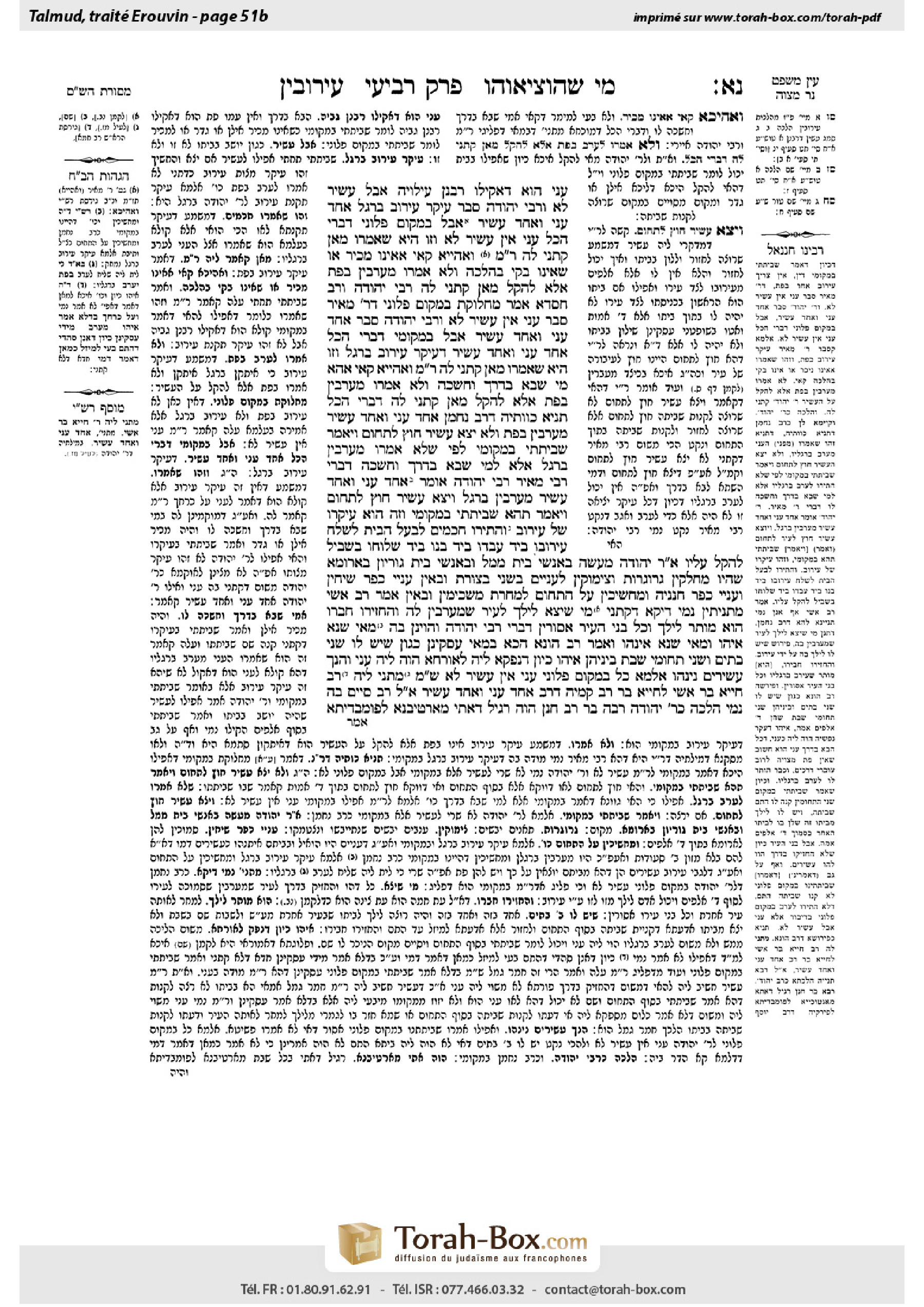
This page of Eruvin includes the Aramaic text, an English translation and an AI-generated French translation, alongside the scan above.
עירובין נ״א ב · Aramaic and Hebrew text
עָנִי הוּא דְּאַקִּילוּ רַבָּנַן עִילָּוֵיהּ, אֲבָל עָשִׁיר — לָא.
וְרַבִּי יְהוּדָה סָבַר: עִיקַּר עֵירוּב בָּרֶגֶל, אֶחָד עָנִי וְאֶחָד עָשִׁיר. אֲבָל ״בְּמָקוֹם פְּלוֹנִי״ — דִּבְרֵי הַכֹּל: עָנֵי — אִין, עָשִׁיר — לָא.
״וְזוֹ הִיא שֶׁאָמְרוּ״ מַאן קָתָנֵי לַהּ — רַבִּי מֵאִיר. וְאַהֵיָיא קָאֵי — אַ״אֵינוֹ מַכִּיר אוֹ שֶׁאֵינוֹ בָּקִי בַּהֲלָכָה״. ״וְלֹא אָמְרוּ מְעָרְבִין בְּפַת אֶלָּא לְהָקֵל״ מַאן קָתָנֵי לַהּ — רַבִּי יְהוּדָה.
וְרַב חִסְדָּא אָמַר: מַחֲלוֹקֶת ״בְּמָקוֹם פְּלוֹנִי״, דְּרַבִּי מֵאִיר סָבַר: עָנִי — אִין, עָשִׁיר — לָא, וְרַבִּי יְהוּדָה סָבַר: אֶחָד עָנִי וְאֶחָד עָשִׁיר. אֲבָל ״בִּמְקוֹמִי״, דִּבְרֵי הַכֹּל אֶחָד עָנִי וְאֶחָד עָשִׁיר, דְּעִיקַּר עֵירוּב בָּרֶגֶל.
״וְזוֹ הִיא שֶׁאָמְרוּ״ מַאן קָתָנֵי לַהּ — רַבִּי מֵאִיר. וְאַהֵיָיא קָאֵי — אַהָא: ״מִי שֶׁבָּא בַּדֶּרֶךְ וְחָשֵׁכָה״. ״וְלֹא אָמְרוּ מְעָרְבִין בְּפַת אֶלָּא לְהָקֵל״ מַאן קָתָנֵי לַהּ — דִּבְרֵי הַכֹּל.
תַּנְיָא כְּווֹתֵיהּ דְּרַב נַחְמָן: אֶחָד עָנִי וְאֶחָד עָשִׁיר מְעָרְבִין בְּפַת, וְלֹא יֵצֵא עָשִׁיר חוּץ לַתְּחוּם וְיֹאמַר: ״שְׁבִיתָתִי בִּמְקוֹמִי״ — לְפִי שֶׁלֹּא אָמְרוּ מְעָרְבִין בָּרֶגֶל אֶלָּא לְמִי שֶׁבָּא בַּדֶּרֶךְ וְחָשֵׁכָה, דִּבְרֵי רַבִּי מֵאִיר.
רַבִּי יְהוּדָה אוֹמֵר: אֶחָד עָנִי וְאֶחָד עָשִׁיר מְעָרְבִין בָּרֶגֶל, וְיֵצֵא עָשִׁיר חוּץ לַתְּחוּם: וְיֹאמַר ״תְּהֵא שְׁבִיתָתִי בִּמְקוֹמִי״, וְזֶה הוּא עִיקָּרוֹ שֶׁל עֵירוּב. וְהִתִּירוּ חֲכָמִים לְבַעַל הַבַּיִת לְשַׁלֵּחַ עֵירוּבוֹ בְּיַד עַבְדּוֹ, בְּיַד בְּנוֹ, בְּיַד שְׁלוּחוֹ בִּשְׁבִיל לְהָקֵל עָלָיו.
אָמַר רַבִּי יְהוּדָה: מַעֲשֶׂה בְּאַנְשֵׁי בֵּית מֶמֶל וּבְאַנְשֵׁי בֵּית גּוּרְיוֹן בְּאָרוֹמָא שֶׁהָיוּ מְחַלְּקִין גְּרוֹגְרוֹת וְצִימּוּקִין לַעֲנִיִּים בִּשְׁנֵי בַצּוֹרֶת, וּבָאִין עֲנִיֵּי כְּפַר שִׁיחִין וַעֲנִיֵּי כְּפַר חֲנַנְיָה וּמַחְשִׁיכִין עַל הַתְּחוּם, לַמׇּחֳרָת מַשְׁכִּימִין וּבָאִין.
אָמַר רַב אָשֵׁי: מַתְנִיתִין נָמֵי דַּיְקָא, דְּקָתָנֵי: מִי שֶׁיָּצָא לֵילֵךְ לְעִיר שֶׁמְּעָרְבִין לָהּ, וְהֶחְזִירוֹ חֲבֵרוֹ — הוּא מוּתָּר לֵילֵךְ, וְכׇל בְּנֵי הָעִיר אֲסוּרִין, דִּבְרֵי רַבִּי יְהוּדָה.
וַהֲוֵינַן בַּהּ: מַאי שְׁנָא אִיהוּ וּמַאי שְׁנָא אִינְהוּ? וְאָמַר רַב הוּנָא: הָכָא בְּמַאי עָסְקִינַן — כְּגוֹן שֶׁיֵּשׁ לוֹ שְׁנֵי בָתִּים, וּשְׁנֵי תְּחוּמֵי שַׁבָּת בֵּינֵיהֶן.
אִיהוּ, כֵּיוָן דְּנָפְקָא לֵיהּ לְאוֹרְחָא — הֲוָה לֵיהּ עָנִי.
וְהָנָךְ — עֲשִׁירִים נִינְהוּ. אַלְמָא כָּל ״בְּמָקוֹם פְּלוֹנִי״ — עָנִי אִין, עָשִׁיר לָא. שְׁמַע מִינַּהּ.
מַתְנֵי לֵיהּ רַב חִיָּיא בַּר אָשֵׁי לְחִיָּיא בַּר רַב קַמֵּיהּ דְּרַב ״אֶחָד עָנִי וְאֶחָד עָשִׁיר״. אֲמַר לֵיהּ רַב: סַיֵּים בָּהּ נָמֵי הֲלָכָה כְּרַבִּי יְהוּדָה.
רַבָּה בַּר רַב חָנָן הֲוָה רְגִיל דְּאָתֵי מֵאַרְטִיבְנָא לְפוּמְבְּדִיתָא.
Eruvin 51b · English translation
Therefore, it is only with regard to a pauper, who does not have food for two meals, that the Sages were lenient and permitted him to establish residence merely by saying: My residence is in my current location. However, with regard to a wealthy person in his own house who has bread, no, they did not permit him to do so.
And Rabbi Yehuda maintains: The primary ordinance of eiruv is by foot, i.e., by going and stating that he is establishing his residence in that location, and therefore it applies to both a pauper and a wealthy person. However, with regard a case when the person said: My residence is in such-and-such place, and he is not there, everyone, both Rabbi Meir and Rabbi Yehuda, agrees that for a pauper on the road on a Shabbat eve, yes, an eiruv may be established in that manner; however, for a wealthy person, no, an eiruv may not be established in that manner.
And as for the mishna’s statement: And this is what the Sages meant when they said that a pauper can establish an eiruv with his feet, who, which Sage, is teaching it? It is Rabbi Meir. And to which clause of the mishna is it referring? It refers to the previous statement: If he is not familiar with a tree or any other noticeable landmark, or if he is not an expert in the halakha, and therefore is unaware that a residence can be established from a distance, and said: My residence is in my current location, he acquires two thousand cubits in each direction. And as for the statement in the continuation of the mishna: The Sages said that one establishes an eiruv with bread only to be lenient with the wealthy person, who, which Sage, is teaching it? It is Rabbi Yehuda, who maintains that the option of establishing an eiruv by foot is available to the wealthy as well.
Rav Ḥisda, however, disagreed with Rav Naḥman and said: The dispute between Rabbi Meir and Rabbi Yehuda in the mishna is with regard to a person who said: My residence is in such-and-such place, in which case his residence is neither acquired by foot nor with bread. As Rabbi Meir maintains: A pauper, yes, he establishes residence with an eiruv in that manner; however, a wealthy person, no, he does not. And Rabbi Yehuda maintains: Both a pauper and a wealthy person may establish an eiruv in that manner. However, in a case where one said: My residence is in my present location, everyone, both Rabbi Meir and Rabbi Yehuda, agrees that an eiruv of this kind is effective both for a pauper and for a wealthy person, as everyone agrees agree that the primary ordinance of eiruv is by foot.
And as for the mishna’s statement: And this is what the Sages meant when they said that a pauper can establish an eiruv by foot, who is teaching it? It is Rabbi Meir. And to which clause of the mishna is it referring? It is referring to this clause: One who was coming along the way on Shabbat eve, and it grew dark while he was traveling. According to Rabbi Yehuda, he could have established an eiruv even if he was in his house. And as for the statement in the continuation of the mishna: The Sages said that one establishes an eiruv with bread only in order to be lenient with the wealthy person, who is teaching it? Everyone agrees with this halakha, and it is taught according to both opinions.
The Gemara comments: A baraita was taught in accordance with the opinion of Rav Naḥman, who said that the dispute between Rabbi Meir and Rabbi Yehuda is with regard to one who said: My residence is in my present location. It was stated in the baraita: Both a pauper and a wealthy person establish an eiruv with bread; however a wealthy person may not go out beyond the Shabbat limit and say: My residence is in my present location, because the Sages said that one can establish an eiruv by foot only in the case of a person who was coming along the way and it grew dark while he was traveling. This is the statement of Rabbi Meir.
Rabbi Yehuda says: Both a pauper and a wealthy person establish an eiruv by foot. And a wealthy person will go out beyond the Shabbat limit and say: My residence is in my present location. And this is the primary ordinance of eiruv. However, the Sages permitted a homeowner to send his eiruv in the hand of his servant, or in the hand of his son, or in the hand of his agent, in order to be lenient with him, so that he need not exert himself and go out and establish an eiruv by foot. This baraita presents the dispute between Rabbi Meir and Rabbi Yehuda as it was delineated by Rav Naḥman.
The baraita continues. Rabbi Yehuda said: There was an incident involving the members of the household of the Memel family and members of the household of Guryon family in the village of Aroma, who were distributing dried figs and raisins to the paupers in years of famine, and the paupers of the village of Siḥin and the paupers of the village of Ḥananya would come to the edge of the Shabbat limit at nightfall, which was also within the Shabbat limit of Aroma, and then go home. The following day they would rise early and go to receive their figs and raisins. Apparently, one can establish an eiruv by foot, if he says: My residence is in my present location.
Rav Ashi said: The formulation of the mishna is also precise, in accordance with Rav Naḥman’s explanation, as it teaches: If on a Shabbat eve one set out to go to a city for which an eiruv is established enabling him to go there on Shabbat, and another person caused him to return home, he himself is permitted to go to that city on Shabbat, and for all the other residents of the town it is prohibited to go there. This is the statement of Rabbi Yehuda.
And we discussed this mishna and raised a difficulty: What is different about him and what is different about them? Why is he permitted to proceed to the other town while it is prohibited for the other residents to do so? And Rav Huna said: We are dealing here with a case where he has two houses, one in each city, and there is the distance of two Shabbat limits, four thousand cubits, between them.
With regard to him, since he set out on his way, his legal status is that of a pauper, as he did not intend to return to his first house, but to continue to his other house. Therefore, he can establish residence at the end of his Shabbat limit by verbal means alone.
And the legal status of these other inhabitants of his city, is that of wealthy people, as they are in their houses and have food. Consequently, they can only establish residence at the end of their Shabbat limit by depositing food there prior the onset of Shabbat. Apparently, everything stated with regard to one who says: My residence is in such-and-such place; to a pauper, yes, it applies to a wealthy person, no, it does not apply. The Gemara concludes: Indeed, learn from this that this is the case.
Rav Ḥiyya bar Ashi was teaching the mishna to Ḥiyya bar Rav before Rav. He stated that this leniency applies both to a pauper and to a wealthy person. Rav said to him: Conclude your statement also: The halakha is in accordance with the opinion of Rabbi Yehuda.
The Gemara relates: Rabba bar Rav Ḥanan was in the habit of coming from his home in Artibbena to Pumbedita on Shabbat.
Eruvin 51b · Traduction française (IA)
Par conséquent, c'est uniquement concernant un pauvre, qui n'a pas de nourriture pour deux repas, que les Sages ont été indulgents et lui ont permis d'établir son domicile simplement en disant : Mon domicile est à mon lieu actuel. Cependant, concernant un homme riche dans sa propre maison qui a du pain, non, ils n'ont pas permis cela.
Et Rabbi Yéhuda maintient que l'ordre principal de l'eirouv est par le pied, c'est-à-dire en allant et en déclarant qu'il établit son domicile à ce lieu, et par conséquent cela s'applique à la fois au pauvre et à l'homme riche. Cependant, concernant un cas où la personne dit : Mon domicile est à tel endroit, et il n'y est pas, tout le monde, à la fois Rabbi Méir et Rabbi Yéhuda, s'accordent sur le fait que pour un pauvre en route le soir du Shabbat, oui, un eirouv peut être établi ainsi ; cependant, pour un homme riche, non, un eirouv ne peut pas être établi ainsi.
Et concernant la déclaration de la mitsva : Et c'est ce que les Sages voulaient dire lorsqu'ils ont dit qu'un pauvre peut établir un eirouv avec ses pieds, qui, quel Sage, enseigne cela ? C'est Rabbi Méir. Et à quelle clause de la mitsva fait-il référence ? Il fait référence à la précédente : Si l'homme ne connaît pas un arbre ou tout autre point de repère marquant, ou s'il n'est pas expert en halakha et donc ignorant que l'on peut établir un domicile à distance, et qu'il dit : Mon domicile est à mon lieu actuel, il acquiert deux mille coudées dans chaque direction. Et concernant la déclaration qui suit dans la mitsva : Les Sages ont dit qu'on établit un eirouv avec du pain uniquement pour être indulgent avec l'homme riche, qui, quel Sage, enseigne cela ? C'est Rabbi Yéhuda, qui maintient que l'option d'établir un eirouv par le pied est disponible à l'homme riche également.
Rav Hischda, cependant, s'est opposé à Rav Naḥman et a dit : Le débat entre Rabbi Méir et Rabbi Yéhuda dans la mitsna est concernant une personne qui dit : Mon domicile est à tel endroit, dans ce cas, son domicile n'est pas acquis par le pied ni avec du pain. Selon Rabbi Méir : Un pauvre, oui, il établit son domicile avec un eiruv ainsi ; cependant, un homme riche, non, il ne le fait pas. Et Rabbi Yéhuda maintient : à la fois le pauvre et l'homme riche peuvent établir un eiruv ainsi. Cependant, dans un cas où l'on dit : Mon domicile est à mon lieu actuel, tout le monde, à la fois Rabbi Méir et Rabbi Yéhuda, s'accordent sur le fait qu'un eiruv de ce genre est efficace à la fois pour le pauvre et pour l'homme riche, car tout le monde s'accorde sur le fait que l'ordre principal de l'eiruv est par le pied.
Et concernant la déclaration de la mitsna : Et c'est ce que les Sages voulaient dire lorsqu'ils ont dit qu'un pauvre peut établir un eiruv par le pied, qui enseigne cela ? C'est Rabbi Méir. Et à quelle clause de la mitsna fait-il référence ? Il fait référence à cette clause : Celui qui marchait sur la route le soir du Shabbat, et il faisait nuit alors qu'il marchait. Selon Rabbi Yéhuda, il aurait pu établir un eiruv même s'il était chez lui. Et concernant la déclaration qui suit dans la mitsna : Les Sages ont dit qu'on établit un eiruv avec du pain uniquement pour être indulgent avec l'homme riche, qui enseigne cela ? Tout le monde s'accorde sur cette halakha, et elle est enseignée selon les deux opinions.
La Guemara commente : Une baraïta a été enseignée selon l'opinion de Rav Naḥman, qui disait que le débat entre Rabbi Méir et Rabbi Yéhuda est concernant une personne qui dit : Mon domicile est à mon lieu actuel. Il a été dit dans la baraïta : à la fois le pauvre et l'homme riche établissent un eiruv avec du pain ; cependant, l'homme riche ne peut pas sortir au-delà de la limite du Shabbat et dire : Mon domicile est à mon lieu actuel, car les Sages ont dit qu'on peut établir un eiruv par le pied uniquement dans le cas d'une personne qui marchait sur la route et que la nuit est tombée alors qu'il marchait. C'est la déclaration de Rabbi Méir.
Rabbi Yéhuda dit : à la fois le pauvre et l'homme riche établissent un eiruv par le pied. Et l'homme riche sortira au-delà de la limite du Shabbat et dira : Mon domicile est à mon lieu actuel. Et c'est l'ordre principal de l'eiruv. Cependant, les Sages ont permis à un propriétaire de faire établir son eiruv par la main de son serviteur, ou par la main de son fils, ou par la main de son agent, afin d'être indulgent avec lui, de sorte qu'il n'ait pas besoin de se fatiguer et de sortir pour établir un eiruv par le pied. Cette baraïta présente le débat entre Rabbi Méir et Rabbi Yéhuda tel que le décrivait Rav Naḥman.
La baraïta continue. Rabbi Yéhuda dit : Il y avait un cas concernant les membres de la famille de Memel et les membres de la famille de Guryon dans le village d'Aroma, qui distribuaient des figues sèches et des raisins aux pauvres en temps de famine, et les pauvres du village de Siḥin et les pauvres du village de Ḥananya venaient à la limite du Shabbat à la tombée de la nuit, ce qui était également dans la limite du Shabbat d'Aroma, puis rentraient chez eux. Le lendemain, ils se levaient tôt pour aller récupérer leurs figues et leurs raisins. Apparemment, on peut établir un eiruv par le pied, si l'on dit : Mon domicile est à mon lieu actuel.
Rav Ashi dit : La formulation de la Michna est aussi précise, selon l'explication de Rav Naḥman, car elle enseigne : Si, le soir du Shabbat, l'on part pour une ville où un eiruv est établi permettant d'y aller le Shabbat, et qu'une autre personne l'oblige à rentrer chez lui, lui-même est autorisé à aller à cette ville le Shabbat, et pour tous les autres habitants de la ville, il est interdit d'y aller. C'est la déclaration de Rabbi Yéhuda.
Et nous avons discuté de cette Michna et avons soulevé une difficulté : Qu'est-ce qui est différent chez lui et qu'est-ce qui est différent chez eux ? Pourquoi est-il autorisé à se rendre dans l'autre ville alors qu'il est interdit aux autres habitants de le faire ? Et Rav Huna dit : Nous sommes en présence d'un cas où il a deux maisons, une dans chaque ville, et la distance entre elles est de deux limites du Shabbat, quatre mille coudées.
Concerning him, since he has set out on his way, his legal status is that of a pauper, as he did not intend to return to his first house, but to continue to his other house. Therefore, he can establish residence at the end of his Shabbat limit by verbal means alone.
And the legal status of these other inhabitants of his city is that of wealthy people, as they are in their houses and have food. Consequently, they can only establish residence at the end of their Shabbat limit by depositing food there prior to the onset of Shabbat. Apparently, everything stated with regard to one who says: My residence is in such-and-such place; to a pauper, yes, it applies to a wealthy person, no, it does not apply. The Guemara concludes: Indeed, learn from this that this is the case.
Rav Ḥiyya bar Ashi was teaching the mishna to Ḥiyya bar Rav before Rav. He stated that this leniency applies both to a pauper and to a wealthy person. Rav said to him: Conclude your statement also: The halakha is in accordance with the opinion of Rabbi Yehuda.
La Guemara rapporte : Rabba bar Rav Ḥanan avait l'habitude de venir de son domicile à Artibbena à Pumbedita le sabbat.
Traduction française générée par IA à partir de l’édition anglaise de Sefaria. Vérifie toujours un passage avec le texte source.
Text from Sefaria: William Davidson Edition - Vocalized Aramaic (CC BY NC); William Davidson Edition - English (CC BY NC).