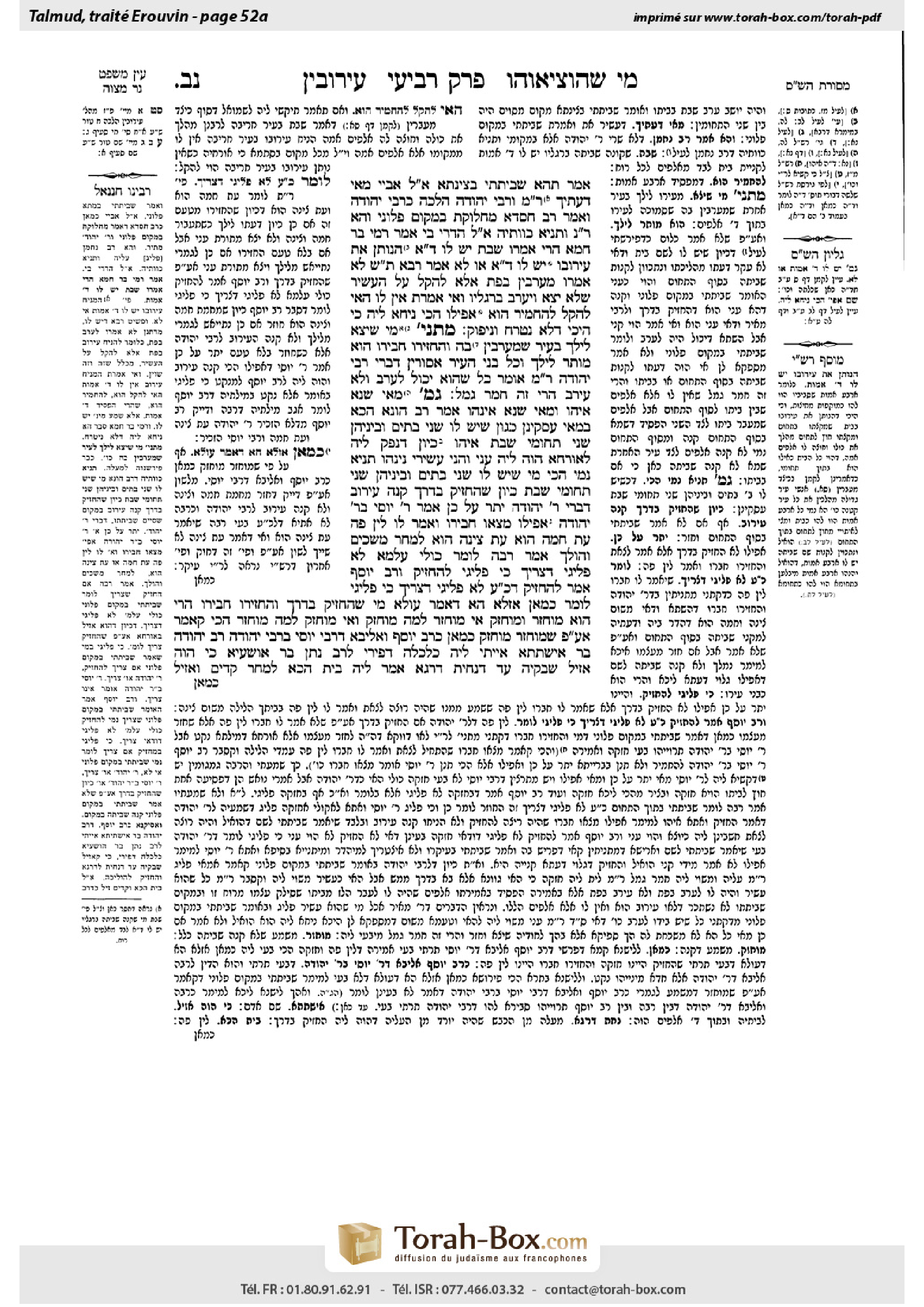
Eruvin 52a: Talmud study for Daf Yomi
Study the Talmud for Daf Yomi with scanned pages, Hebrew text, English translations from Sefaria and AI-generated French translations.
Passage selection and English or AI-generated French translation are available where the scan has annotations. Daf Study is independent of Torah-Box and Sefaria.
Browse Eruvin · עירובין · All tractatesEruvin 52a text and translations
This page of Eruvin includes the Aramaic text, an English translation and an AI-generated French translation, alongside the scan above.
עירובין נ״ב א · Aramaic and Hebrew text
אָמַר: ״תְּהֵא שְׁבִיתָתִי בְּצִינְתָא״. אֲמַר לֵיהּ אַבָּיֵי: מַאי דַּעְתָּיךְ, רַבִּי מֵאִיר וְרַבִּי יְהוּדָה — הֲלָכָה כְּרַבִּי יְהוּדָה, וְאָמַר רַב חִסְדָּא: מַחֲלוֹקֶת בְּ״מָקוֹם פְּלוֹנִי״,
וְהָא רַב נַחְמָן, וְתַנְיָא כְּווֹתֵיהּ! אֲמַר לֵיהּ: הֲדַרִי בִּי.
אָמַר רָמֵי בַּר חָמָא: הֲרֵי אָמְרוּ שָׁבַת יֵשׁ לוֹ אַרְבַּע אַמּוֹת. הַנּוֹתֵן אֶת עֵירוּבוֹ, יֵשׁ לוֹ אַרְבַּע אַמּוֹת, אוֹ לָא?
אָמַר רָבָא, תָּא שְׁמַע: לֹא אָמְרוּ מְעָרְבִין בְּפַת אֶלָּא לְהָקֵל עַל הֶעָשִׁיר, שֶׁלֹּא יֵצֵא וִיעָרֵב בְּרַגְלָיו. וְאִי אָמְרַתְּ אֵין לוֹ — הַאי לְהָקֵל?! לְהַחֲמִיר הוּא!
אֲפִילּוּ הָכִי נִיחָא לֵיהּ, כִּי הֵיכִי דְּלָא נִטְרַח וְנִיפּוֹק.
מַתְנִי׳ מִי שֶׁיָּצָא לֵילֵךְ בְּעִיר שֶׁמְּעָרְבִין בָּהּ, וְהֶחְזִירוֹ חֲבֵירוֹ — הוּא מוּתָּר לֵילֵךְ, וְכׇל בְּנֵי הָעִיר אֲסוּרִין, דִּבְרֵי רַבִּי יְהוּדָה.
רַבִּי מֵאִיר אוֹמֵר: כֹּל שֶׁהוּא יָכוֹל לְעָרֵב וְלֹא עֵירַב — הֲרֵי זֶה חַמָּר גַּמָּל.
גְּמָ׳ מַאי שְׁנָא אִיהוּ וּמַאי שְׁנָא אִינְהוּ? אָמַר רַב הוּנָא: הָכָא בְּמַאי עָסְקִינַן — כְּגוֹן שֶׁיֵּשׁ לוֹ שְׁנֵי בָתִּים, וּבֵינֵיהֶן שְׁנֵי תְּחוּמֵי שַׁבָּת.
אִיהוּ, כֵּיוָן דִּנְפַק לֵיהּ לְאוֹרְחָא — הָוֵה לֵיהּ עָנִי. וְהָנֵי עֲשִׁירֵי נִינְהוּ.
תַּנְיָא נָמֵי הָכִי: מִי שֶׁיֵּשׁ לוֹ שְׁנֵי בָתִּים, וּבֵינֵיהֶן שְׁנֵי תְּחוּמֵי שַׁבָּת, כֵּיוָן שֶׁהֶחְזִיק בַּדֶּרֶךְ — קָנָה עֵירוּב, דִּבְרֵי רַבִּי יְהוּדָה.
יָתֵר עַל כֵּן אָמַר רַבִּי יוֹסֵי בְּרַבִּי יְהוּדָה: אֲפִילּוּ מְצָאוֹ חֲבֵירוֹ וְאָמַר לוֹ: ״לִין פֹּה, עֵת חַמָּה הוּא, עֵת צִינָּה הוּא״ — לְמָחָר מַשְׁכִּים וְהוֹלֵךְ.
אָמַר רַבָּה: לוֹמַר — כּוּלֵּי עָלְמָא לָא פְּלִיגִי דִּצְרִיךְ, כִּי פְּלִיגִי — לְהַחְזִיק.
וְרַב יוֹסֵף אָמַר: לְהַחְזִיק — דְּכוּלֵּי עָלְמָא לָא פְּלִיגִי דִּצְרִיךְ, כִּי פְּלִיגִי — לוֹמַר.
כְּמַאן אָזְלָא הָא דְּאָמַר עוּלָּא: מִי שֶׁהֶחְזִיק בַּדֶּרֶךְ וְהֶחְזִירוֹ חֲבֵירוֹ — הֲרֵי הוּא מוּחְזָר וּמוּחְזָק.
אִי מוּחְזָר, לָמָּה מוּחְזָק? וְאִי מוּחְזָק, לָמָּה מוּחְזָר?
הָכִי קָאָמַר: אַף עַל פִּי שֶׁמּוּחְזָר — מוּחְזָק. כְּמַאן — כְּרַב יוֹסֵף, וְאַלִּיבָּא דְּרַבִּי יוֹסֵי בְּרַבִּי יְהוּדָה.
רַב יְהוּדָה בַּר אִישְׁתָּתָא אַיְיתִי לֵיהּ כַּלְכַּלָּה דְפֵירֵי לְרַב נָתָן בַּר אוֹשַׁעְיָא. כִּי הֲוָה אָזֵיל, שַׁבְקֵיהּ עַד דִּנְחֵית דַּרְגָּא, אֲמַר לֵיהּ: בִּית הָכָא. לִמְחַר קַדֵּים וֶאֱזִיל,
Eruvin 52a · English translation
He would declare on Shabbat eve: My residence is in Tzinta, a settlement located between the Shabbat limits of the two places. Abaye said to him: What is your opinion that led you to act in that manner? Is it because in a dispute between Rabbi Meir and Rabbi Yehuda, the halakha is in accordance with the opinion of Rabbi Yehuda, and Rav Ḥisda said: The dispute between these two Sages is in a case where the person said: My residence is in such-and-such place, and you rely on Rabbi Yehuda and establish residence at a place between the two cities even though you are still at home?
But didn’t Rav Naḥman explain the dispute between Rabbi Meir and Rabbi Yehuda differently, and furthermore, a baraita was taught in accordance with his opinion. Rabba bar Rav Ḥanan said to him: I retract my opinion and will no longer do so.
Rami bar Ḥama said: The Sages have said that one who establishes residence by foot has four cubits at that location, and another two thousand cubits beyond. However, with regard to one who deposits his eiruv in a certain place, there is a dilemma whether he has four cubits from the site of his eiruv, or not.
Rava said: Come and hear a resolution from the mishna: The Sages said that one establishes an eiruv with bread only to be lenient with the wealthy person, so that he need not exert himself and go out and establish an eiruv with his feet. And if you say that one who establishes an eiruv with bread does not have four cubits, is this really a leniency? It is a stringency. Based on the mishna, apparently, all leniencies that apply to one who establishes an eiruv by foot must also apply to one who establishes an eiruv with bread.
The Gemara rejects this argument: No proof can be cited from there, as even if he without the four cubits, this is preferable to him, so that he need not exert himself and go out and establish an eiruv by foot. Therefore, it can be said that establishing an eiruv with bread constitutes a leniency even if it entails the loss of four cubits.
MISHNA: If a person set out to go on a Shabbat eve to a town for which an eiruv is established in order to go there on Shabbat, and another person caused him to return home, he himself is permitted to go to that city on Shabbat, and for all the other residents of the town it is prohibited to go there. This is the statement of Rabbi Yehuda.
Rabbi Meir says: Anyone who can establish an eiruv, and negated his residence in his original place, and did not establish an eiruv, i.e., he did not at least state that he seeks to establish residence somewhere else, is likened to both a donkey driver, who walks behind the animal and prods it, and a camel driver, who walks before the animal and leads it, in the sense that he is pulled in two opposite directions. Due to the uncertainty with regard to the location of his Shabbat limit, his movement is restricted as though his residence was established in both his city and at a location along the way to the other city. He may not venture beyond two thousand cubits from either location.
GEMARA: With regard to the mishna’s statement that according to Rabbi Yehuda, he himself is permitted to go to the other city, while for all the rest of the residents of his city it is prohibited to do so, the Gemara asks: What is different about him and what is different about them? Why is he permitted to proceed to the other city, while they are not? Rav Huna said: We are dealing here with a case where that person has two houses, one in each town, with the distance of two Shabbat limits, four thousand cubits, between them.
With regard to him, since he set out on his way, his legal status is that of a pauper, as he did not intend to return to his first house but to continue to his other house, and he can therefore establish residence at the end of his Shabbat limit simply by declaring that he wishes to acquire residence in such-and-such place. And the legal status of these other inhabitants of his city, is that of wealthy people, as they are in their houses and have food. Consequently, they can only establish residence at the end of their Shabbat limit by depositing food there prior the onset of Shabbat.
That was also taught in a baraita: With regard to one who has two houses, with the distance of two Shabbat limits between them, once he set out on the way, clearly demonstrating his intention to leave, although he did not explicitly say: My residence is at the end of my Shabbat limit, he acquired an eiruv there. This is the statement of Rabbi Yehuda.
Furthermore, Rabbi Yosei, son of Rabbi Yehuda said: Even if another found him before he left, and said to him: Spend the night here, it is a hot period, or it is a cold period and inadvisable to set out now, on the following day he may rise early and go to the other town, as his intention to walk is sufficient.
Rabba said: With regard to saying that he is establishing residence at the end of his Shabbat limit, everyone agrees that this is necessary, as otherwise it could be understood that he is returning to his house because he changed his mind about establishing residence elsewhere. When they disagree is with regard to whether or not it is necessary for him actually to set out on his way. Rabbi Yehuda maintains that he must have set out on his way, whereas Rabbi Yosei, son of Rabbi Yehuda, maintains that he need not even set out on his way, as his intention to leave is sufficient.
And Rav Yosef said: With regard to actually setting out on his way, everyone agrees that this is necessary. Where they disagree is with regard to whether or not it is necessary for him to say that he is establishing his residence at the end of his Shabbat limit.
The Gemara asks: In accordance with whose opinion is this halakha that Ulla stated? If a person set out on his way, and another persuaded him to return home, he is considered returned and is considered set out on his way.
The Gemara analyzes Ulla’s statement itself: If he is considered returned, with the same legal status as the rest of the residents of his city and has not established residence elsewhere, why is he described as set out on his way? And if he is considered set out on his way, indicating that he established residence at the end of his Shabbat limit, why is he described as returned?
The Gemara answers: Emend Ulla’s statement and explain that this is what he is saying: Although he was returned to his original place, he is nonetheless regarded as having set out on his way. In accordance with whose opinion did he state this ruling? According to the opinion of Rav Yosef, that everyone agrees he must set out on his way, and in accordance with the opinion of Rabbi Yosei, son of Rabbi Yehuda, that he need not declare he is establishing his residence at the end of his Shabbat limit.
The Gemara relates that Rav Yehuda bar Ishtata once brought a basket of fruit to Rav Natan bar Oshaya in a nearby town, four thousand cubits away, on Shabbat eve. When he was going, Rav Natan left him until he descended one step, and then said to him: Lodge here tonight. He allowed him start his journey so that he would be considered as having set out on his way. On the following day Rav Yehuda bar Ishtata rose early and went home.
Eruvin 52a · Traduction française (IA)
Il déclarait le soir du sabbat : Mon domicile est à Tzinta, une ville située entre les limites sabbatiques des deux lieux. Abaye lui dit : Quel est ton avis qui t’a conduit à agir ainsi ? Est-ce parce que dans un débat entre Rabbi Meir et Rabbi Yéhuda, la halakha suit l’opinion de Rabbi Yéhuda, et Rav Ḥisda dit : Le débat entre ces deux Sages est dans un cas où la personne dit : Mon domicile est à tel endroit, et vous vous appuyez sur Rabbi Yéhuda et établissez votre domicile à un endroit entre les deux villes, même si vous restez chez vous ?
Mais n’a-t-il pas expliqué Rav Naḥman le débat entre Rabbi Meir et Rabbi Yéhuda d’une autre manière, et de plus, une baraïta a été enseignée selon son avis. Rabba bar Rav Ḥanan lui dit : Je retire mon avis et je ne le ferai plus ainsi.
Rami bar Ḥama dit : Les Sages ont dit que celui qui établit son domicile à pieds a quatre cubits à cet endroit, et deux mille cubits au-delà. Cependant, concernant celui qui dépose son eiruv à un endroit déterminé, il y a un dilemme : a-t-il quatre cubits à partir du site de son eiruv ou non ?
Rava dit : Viens écouter une résolution tirée de la Michna : Les Sages ont dit qu'on établit un eiruv avec du pain uniquement pour être plus indulgent envers la personne aisée, afin qu'il n'ait pas à se fatiguer et à sortir pour établir un eiruv avec ses pieds. Et si tu dis que celui qui établit un eiruv avec du pain n'a pas quatre cubits, est-ce vraiment une indulgence ? C'est une stricte exigence. Selon la Michna, apparemment, toutes les indulgences qui s'appliquent à celui qui établit un eiruv à pieds doivent aussi s'appliquer à celui qui établit un eiruv avec du pain.
La Guemara rejette cet argument : On ne peut pas en tirer une preuve, car même s'il n'a pas les quatre cubits, cela lui est préférable, afin qu'il n'ait pas à se fatiguer et à sortir pour établir un eiruv à pieds. Ainsi, on peut dire qu'établir un eiruv avec du pain constitue une indulgence même s'il implique la perte des quatre cubits.
Michna : Si une personne partait le soir du sabbat pour une ville où un eiruv est établi afin d'y aller le sabbat, et qu'une autre personne l'obligeait à rentrer chez lui, il lui est permis d'aller à cette ville le sabbat, et pour tous les autres habitants de la ville, il est interdit d'y aller. C'est l'opinion de Rabbi Yéhuda.
Rabbi Meir dit : Quiconque peut établir un eiruv, et a renoncé à son domicile dans son lieu d’origine, et n’a pas établi un eiruv, c’est-à-dire qu’il n’a pas au moins déclaré qu’il cherche à établir son domicile ailleurs, est comparé à la fois à un conducteur de bête de somme, qui marche derrière l’animal et le pousse, et à un conducteur de chameau, qui marche devant l’animal et le guide, dans le sens où il est tiré dans deux directions opposées. En raison de l’incertitude concernant la limite sabbatique de son domicile, son mouvement est restreint comme si son domicile était établi à la fois dans sa ville et à un endroit sur le chemin vers l’autre ville. Il ne peut pas sortir au-delà de deux mille cubits de l’un ou de l’autre de ces endroits.
GUEMARA : Concernant la déclaration de la mitsna que selon Rabbi Yéhuda, il lui est permis d’aller à l’autre ville, tandis que pour tous les autres habitants de sa ville il est interdit d’y aller, la Guemara pose la question : Qu’est-ce qui est différent chez lui et qu’est-ce qui est différent chez eux ? Pourquoi est-il permis de se rendre à l’autre ville, tandis qu’eux ne le sont pas ? Rav Huna dit : Nous sommes dans un cas où cette personne a deux maisons, une dans chaque ville, avec une distance de deux limites sabbatiques, quatre mille cubits, entre elles.
Concernant lui, puisqu’il est parti sur le chemin, son statut juridique est celui d’un pauvre, car il n’a pas l’intention de retourner à sa première maison mais de continuer vers sa deuxième maison, et il peut donc établir son domicile à la fin de sa limite sabbatique simplement en déclarant qu’il souhaite acquérir un domicile à tel endroit. Le statut juridique de ces autres habitants de sa ville est celui de personnes aisées, car ils sont chez eux et ont de la nourriture. Ainsi, ils peuvent seulement établir leur domicile à la fin de leur limite sabbatique en déposant de la nourriture là avant le début du sabbat.
Cela a également été enseigné dans une baraïta : Concernant celui qui a deux maisons, avec une distance de deux limites sabbatiques entre elles, une fois qu’il est parti sur le chemin, clairement montrant son intention de partir, même s’il n’a pas explicitement dit : Mon domicile est à la fin de ma limite sabbatique, il a acquis un eiruv là. C’est l’opinion de Rabbi Yéhuda.
De plus, Rabbi Yosei, fils de Rabbi Yéhuda dit : Même si un autre le trouve avant qu’il ne parte, et lui dit : Reste ici pour la nuit, c’est une période chaude, ou c’est une période froide et il n’est pas conseillé de partir maintenant, le lendemain il peut se lever tôt et aller à l’autre ville, car son intention de marcher est suffisante.
Rabba dit : Concernant la déclaration qu’il établit son domicile à la fin de sa limite sabbatique, tout le monde est d’accord sur le fait que cela est nécessaire, car autrement on pourrait comprendre qu’il revient à sa maison parce qu’il a changé d’avis concernant l’établissement de son domicile ailleurs. Le point de désaccord est concernant le fait que ce soit nécessaire qu’il parte effectivement sur le chemin. Rabbi Yéhuda maintient qu’il doit avoir parti sur le chemin, tandis que Rabbi Yosei, fils de Rabbi Yéhuda, maintient qu’il n’a pas besoin même de partir sur le chemin, car son intention de partir est suffisante.
Et Rav Yosef dit : Concernant le fait de partir effectivement en voyage, tout le monde est d’accord sur le fait que cela est nécessaire. Le point de désaccord est concernant le fait que ce soit nécessaire qu’il déclare qu’il établit son domicile à la fin de sa limite sabbatique.
La Guemara pose la question : Selon l’opinion de qui est cette halakha que Ulla a émise ? Si une personne est partie en voyage, et qu’une autre l’a convaincu de rentrer chez lui, il est considéré comme rentré et comme parti en voyage.
La Guemara analyse la déclaration d’Ulla elle-même : Si l’homme est considéré comme étant rentré, avec le même statut juridique que les autres habitants de sa ville et s’il n’a pas établi de résidence ailleurs, pourquoi est-il décrit comme étant parti en route ? Et si l’homme est considéré comme étant parti en route, indiquant qu’il a établi sa résidence à la fin de sa limite de sabbat, pourquoi est-il décrit comme étant rentré ?
La Guemara répond : Corrigez la déclaration d’Ulla et expliquez que c’est ce qu’il dit : Bien qu’il soit rentré à son lieu d’origine, il est néanmoins considéré comme étant parti en route. Selon quel avis a-t-il formulé cette décision ? Selon l’avis de Rava, qui affirme que tout le monde convient qu’il doit être considéré comme étant parti en route, et selon l’avis de Rabbi Yosei, fils de Rabbi Yéhuda, qui affirme qu’il n’est pas nécessaire de déclarer qu’il établit sa résidence à la fin de sa limite de sabbat.
La Guemara rapporte que Rava ben Ishtata une fois apporta un panier de fruits à Rava Natan ben Oshaya dans une ville voisine, à quatre mille coudées de distance, le soir du sabbat. En chemin, Rava Natan le laissa jusqu’à ce qu’il descende une marche, puis lui dit : Restez ici cette nuit. Il lui permit de commencer son voyage afin qu’il soit considéré comme étant parti en route. Le lendemain, Rava ben Ishtata se leva tôt et rentra chez lui.
Traduction française générée par IA à partir de l’édition anglaise de Sefaria. Vérifie toujours un passage avec le texte source.
Text from Sefaria: William Davidson Edition - Vocalized Aramaic (CC BY NC); William Davidson Edition - English (CC BY NC).