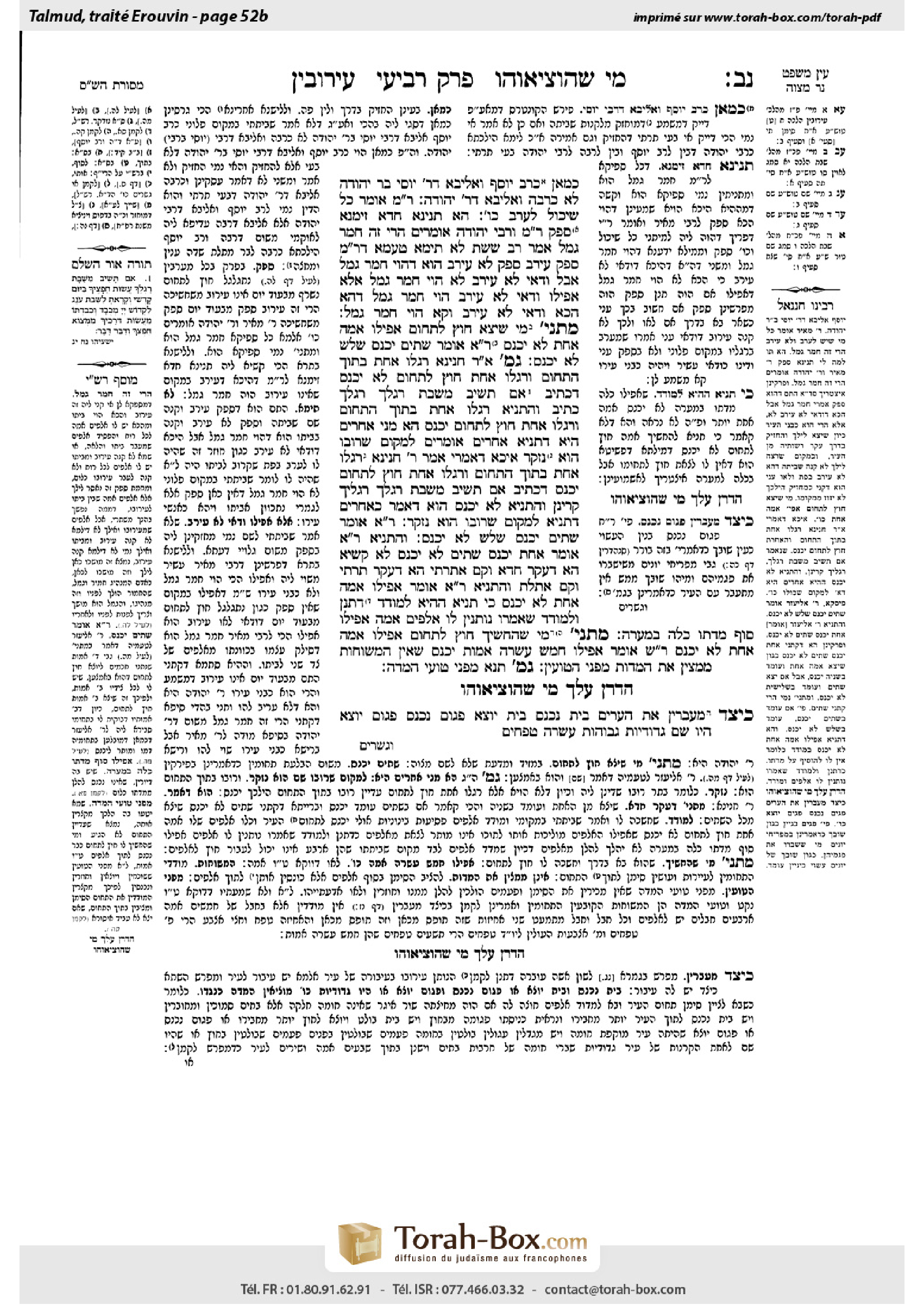
Eruvin 52b: Talmud study for Daf Yomi
Study the Talmud for Daf Yomi with scanned pages, Hebrew text, English translations from Sefaria and AI-generated French translations.
Passage selection and English or AI-generated French translation are available where the scan has annotations. Daf Study is independent of Torah-Box and Sefaria.
Browse Eruvin · עירובין · All tractatesEruvin 52b text and translations
This page of Eruvin includes the Aramaic text, an English translation and an AI-generated French translation, alongside the scan above.
עירובין נ״ב ב · Aramaic and Hebrew text
כְּמַאן — כְּרַב יוֹסֵף, וְאַלִּיבָּא דְּרַבִּי יוֹסֵי בַּר יְהוּדָה?
לָא, כְּרַבָּה, וְאַלִּיבָּא דְּרַבִּי יְהוּדָה.
רַבִּי מֵאִיר אוֹמֵר כֹּל שֶׁיָּכוֹל לְעָרֵב כּוּ׳. הָא תְּנֵינָא חֲדָא זִימְנָא: סָפֵק, רַבִּי מֵאִיר וְרַבִּי יְהוּדָה אוֹמְרִים: הֲרֵי זֶה חַמָּר גַּמָּל.
אָמַר רַב שֵׁשֶׁת לָא תֵּימָא טַעְמָא דְּרַבִּי מֵאִיר סָפֵק עֵירַב סָפֵק לֹא עֵירַב הוּא דְּהָוֵי חַמָּר גַּמָּל, אֲבָל וַדַּאי לֹא עֵירַב — לָא הָוֵי חַמָּר גַּמָּל.
אֶלָּא: אֲפִילּוּ וַדַּאי לֹא עֵירַב הָוֵי חַמָּר גַּמָּל. דְּהָא הָכָא וַדַּאי לֹא עֵירַב, וְקָא הָוֵי חַמָּר גַּמָּל.
מַתְנִי׳ מִי שֶׁיָּצָא חוּץ לַתְּחוּם אֲפִילּוּ אַמָּה אַחַת לֹא יִכָּנֵס. רַבִּי אֱלִיעֶזֶר אוֹמֵר: שְׁתַּיִם — יִכָּנֵס, שָׁלֹשׁ — לֹא יִכָּנֵס.
גְּמָ׳ אָמַר רַבִּי חֲנִינָא: רַגְלוֹ אַחַת בְּתוֹךְ הַתְּחוּם, וְרַגְלוֹ אַחַת חוּץ לַתְּחוּם — לֹא יִכָּנֵס, דִּכְתִיב: ״אִם תָּשִׁיב מִשַּׁבָּת רַגְלֶךָ״. ״רַגְלְךָ״ כְּתִיב.
וְהָתַנְיָא: רַגְלוֹ אַחַת בְּתוֹךְ הַתְּחוּם וְרַגְלוֹ אַחַת חוּץ לַתְּחוּם — יִכָּנֵס! הָא מַנִּי? אֲחֵרִים הִיא, דְּתַנְיָא: אֲחֵרִים אוֹמְרִים: לִמְקוֹם שֶׁרוּבּוֹ הוּא נִזְקָר.
אִיכָּא דְאָמְרִי, אָמַר רַבִּי חֲנִינָא: רַגְלוֹ אַחַת בְּתוֹךְ הַתְּחוּם וְרַגְלוֹ אַחַת חוּץ לַתְּחוּם — יִכָּנֵס, דִּכְתִיב: ״אִם תָּשִׁיב מִשַּׁבָּת רַגְלֶךָ״ — ״רַגְלֶיךָ״ קָרֵינַן.
וְהַתַּנְיָא: לֹא יִכָּנֵס! הוּא דְּאָמַר כַּאֲחֵרִים, דְּתַנְיָא: לִמְקוֹם שֶׁרוּבּוֹ הוּא נִזְקָר.
רַבִּי אֱלִיעֶזֶר אוֹמֵר שְׁתַּיִם יִכָּנֵס שָׁלֹשׁ לֹא יִכָּנֵס. וְהָתַנְיָא, רַבִּי אֱלִיעֶזֶר אוֹמֵר: אַחַת — יִכָּנֵס, שְׁתַּיִם — לֹא יִכָּנֵס. לָא קַשְׁיָא: הָא דַּעֲקַר חֲדָא וְקָם אַתַּרְתֵּי. הָא דַּעֲקַר תַּרְתֵּי וְקָם אַתְּלָת.
וְהָתַנְיָא, רַבִּי אֱלִיעֶזֶר אוֹמֵר: אֲפִילּוּ אַמָּה אַחַת לֹא יִכָּנֵס! כִּי תַּנְיָא הָהִיא לְמוֹדֵד, דִּתְנַן: וְלַמּוֹדֵד שֶׁאָמְרוּ נוֹתְנִין לוֹ אַלְפַּיִם אַמָּה — אֲפִילּוּ סוֹף מִדָּתוֹ כָּלֶה בִּמְעָרָה.
מַתְנִי׳ מִי שֶׁהֶחֱשִׁיךְ חוּץ לַתְּחוּם אֲפִילּוּ אַמָּה אַחַת לֹא יִכָּנֵס. רַבִּי שִׁמְעוֹן אוֹמֵר: אֲפִילּוּ חֲמֵשׁ עֶשְׂרֵה אַמּוֹת יִכָּנֵס, שֶׁאֵין הַמָּשׁוֹחוֹת מְמַצִּין אֶת הַמִּדּוֹת מִפְּנֵי הַטּוֹעִין.
גְּמָ׳ תָּנָא: מִפְּנֵי טוֹעֵי הַמִּדָּה.
הַדְרָן עֲלָךְ מִי שֶׁהוֹצִיאוּהוּ
מַתְנִי׳ כֵּיצַד מְעַבְּרִין אֶת הֶעָרִים? בַּיִת נִכְנָס בַּיִת יוֹצֵא, פִּגּוּם נִכְנָס פִּגּוּם יוֹצֵא, הָיוּ שָׁם גְּדוּדִיּוֹת גְּבוֹהוֹת עֲשָׂרָה טְפָחִים,
Eruvin 52b · English translation
The Gemara comments: In accordance with whose opinion did Rav Natan bar Oshaya act? Apparently, it was in accordance with the opinion of Rav Yosef that everyone agrees that he must set out on his way, and in accordance with the opinion of Rabbi Yosei bar Yehuda that he need not declare that he is establishing his residence at the end of his Shabbat limit.
The Gemara rejects this suggestion: No, that is not necessarily so, as it is possible to say that he acted according to the opinion of Rabba, and in accordance with the opinion of Rabbi Yehuda, and Rav Yehuda bar Ishtata declared that he establishes his residence at the end of his Shabbat limit.
We learned in the mishna that Rabbi Meir says: Anyone who can establish an eiruv, and negated his residence in his original place, and did not establish an eiruv, is likened to both a donkey driver and a camel driver. The Gemara asks: Didn’t we have already learned it once before in another mishna: In a case of uncertainty, Rabbi Meir and Rabbi Yehuda say: This person is likened to both a donkey driver and a camel driver. Here too, it is obvious that the same applies, as that is Rabbi Meir’s opinion with regard to all uncertain cases.
Rav Sheshet said: It is necessary to state this ruling here as well, so that you will not say the reason for Rabbi Meir’s statement only applies in a case where there is uncertainty whether one established an eiruv or did not establish an eiruv, and in that case he is in likened to both a donkey driver and a camel driver. However, in a case where there is certainty that he did not establish an eiruv he is not likened to both a donkey driver and a camel driver, but his Shabbat limit is the same as the rest of the residents of his city.
Rather, say that even in a case where there is certainty that he did not establish an eiruv he is sometimes likened to both a donkey driver and a camel driver, as here he certainly did not establish an eiruv, and yet he is likened to both a donkey driver and a camel driver. It was therefore necessary to state that even in that case, where there is no uncertainty whether or not he established the eiruv, but only with regard to the location of his residence, he nonetheless has the status of both a donkey driver and a camel driver.
MISHNA: One who intentionally, not for the purpose of performing a mitzva, went out beyond his Shabbat limit, even if only one cubit, may not reenter. Rabbi Eliezer says: If he went out two cubits he may reenter; however, if he went out three cubits he may not reenter.
GEMARA: Rabbi Ḥanina said: If one of his feet was within the Shabbat limit, and his other foot was beyond the Shabbat limit, he may not reenter, as it is written: “If you turn away your feet [raglekha] due to Shabbat” (Isaiah 58:13). The word raglekha is written in defective form without the letter yod, and can therefore be read as your foot in the singular, indicating that Shabbat can be desecrated by the reentry of even a single foot.
The Gemara raises a difficulty: But wasn’t the opposite taught in a baraita? If one of his feet was within the Shabbat limit, and his other foot was beyond the Shabbat limit, he may reenter. The Gemara answers: In accordance with whose opinion is this taught? It is in accordance with the opinion of Aḥerim, as it was taught in a baraita: Aḥerim say: He is attributed to the place where the majority of his body lies, and therefore, it is permitted for him to enter, as he stepped out with only one foot.
The Gemara cites a different version of the previous discussion. Some say that Rabbi Ḥanina said: If one of his feet was within the Shabbat limit, and his other foot was beyond the Shabbat limit, he may reenter, as it is written: “If you turn away your feet due to Shabbat” (Isaiah 58:13). We read the word raglekha as your feet, in the plural, indicating that the entry of a single foot is permitted.
The Gemara raises a difficulty. But wasn’t the opposite taught in a baraita: He may not reenter? The Gemara answers: Rabbi Ḥanina stated his opinion in accordance with the opinion of Aḥerim, as it was taught in a baraita: He is attributed to the place where the majority of his body is located, and it is therefore permitted to enter, as most of his body remains within the Shabbat limit.
We learned in the mishna that Rabbi Eliezer says: If he went out two cubits he may reenter; however, if he went out three cubits he may not reenter. The Gemara asks: But wasn’t it taught otherwise in a baraita? Rabbi Eliezer says: If he went out one cubit he may reenter; however, if he went out two cubits he may not reenter. The Gemara answers: That is not a difficulty. This, the mishna, is referring to a case where he moved from the first cubit and is now standing two cubits out, and therefore it is permitted for him to reenter; however, that, the baraita, is referring to a case where he moved from the second cubit and is now standing three cubits out. Consequently, it is prohibited for him to reenter.
The Gemara raises another difficulty. But wasn’t it taught in a different baraita that Rabbi Eliezer says: Even if he went one cubit out, he may not enter. The Gemara answers: When that baraita was taught it was with regard to one measuring his limit by counting two thousand steps. As we learned in a mishna: And for one established residence in a particular place, and is now measuring his limit by counting out steps, with regard to whom the Sages said one provides him with two thousand cubits, even if his measurement ended in a cave he may not walk even one cubit beyond his measurement.
MISHNA: With regard to one for whom it grew dark while he was traveling outside the Shabbat limit of the town where he was heading, even if he was only one cubit outside the limit he may not enter the town. Rabbi Shimon says: Even if he was fifteen cubits beyond the limit he may enter the town, because the surveyors do not precisely demarcate the measures; rather, they mark the Shabbat limit within the two thousand cubits, due to those who err.
GEMARA: With regard to the mishna’s statement: Due to those who err, it is taught in a baraita: Due to those who err in their measurement. In other words, because the surveyors are concerned that they might have erred in their measurements, they are stringent and do not position the mark at the edge of the limit, but move it several cubits within the limit.
MISHNA: How does one extend the boundaries of cities in order to ensure that all its protrusions are included within the borders of the city? He extends a straight line across the edge of the city, and if a house is recessed and another house protrudes, or a turret [pagum] is recessed and another turret protrudes from that line, and similarly, if there were remnants of walls ten handbreadths high,
Eruvin 52b · Traduction française (IA)
La Guemara commente : Selon l'opinion de qui l'acte de Rav Natan bar Oshaya a-t-il été accompli ? Apparemment, il s'agissait de l'opinion de Rav Yosef selon laquelle tout le monde convient qu'il doit partir en chemin, et selon l'opinion de Rabbi Yosei bar Yehuda selon laquelle il n'est pas nécessaire de déclarer qu'il établit son domicile à la fin de sa limite de Shabbat.
La Guemara rejette cette suggestion : Non, cela n'est pas nécessairement vrai, car il est possible de dire qu'il s'est conformé à l'opinion de Rabba, et à l'opinion de Rabbi Yehuda, et Rav Yehuda bar Ishtata a déclaré qu'il établit son domicile à la fin de sa limite de Shabbat.
Nous avons appris dans la mitsna que Rabbi Meir dit : Quiconque peut établir un eiruv, et a annulé son domicile à son lieu d'origine, et n'a pas établi un eiruv, est comparé à la fois à un conducteur de chameau et à un conducteur de mule. La Guemara pose la question : N'avons-nous pas déjà appris cela une fois auparavant dans une autre mitsna : Dans un cas d'incertitude, Rabbi Meir et Rabbi Yehuda disent : Cette personne est comparée à la fois à un conducteur de chameau et à un conducteur de mule. Ici aussi, il est évident que cela s'applique de la même manière, car c'est l'opinion de Rabbi Meir concernant tous les cas d'incertitude.
Rav Sheshet a dit : Il est nécessaire d'énoncer cette décision ici également, afin que vous ne disiez pas que la raison de l'affirmation de Rabbi Meir s'applique uniquement dans un cas où il y a incertitude quant à l'établissement d'un eiruv ou non, et dans ce cas-là il est comparé à la fois à un conducteur de chameau et à un conducteur de mule. Cependant, dans un cas où il y a certitude qu'il n'a pas établi un eiruv, il n'est pas comparé à la fois à un conducteur de chameau et à un conducteur de mule, mais sa limite de Shabbat est la même que celle des autres habitants de sa ville.
Plutôt, disons que même dans un cas où il y a certitude qu'il n'a pas établi un eiruv, il est parfois comparé à la fois à un conducteur de chameau et à un conducteur de mule, comme ici il est certain qu'il n'a pas établi un eiruv, et pourtant il est comparé à la fois à un conducteur de chameau et à un conducteur de mule. Il était donc nécessaire d'énoncer cela même dans ce cas-là, où il n'y a pas d'incertitude quant à l'établissement de l'eiruv, mais seulement concernant la localisation de son domicile, il possède néanmoins le statut de la fois à un conducteur de chameau et à un conducteur de mule.
MICHNA : Celui qui est sorti intentionnellement, non pour l'accomplissement d'une mitsva, au-delà de sa limite de Shabbat, même si ce n'est qu'un cubit, ne peut pas revenir. Rabbi Eliezer dit : Si l'on est sorti deux cubits, l'on peut revenir ; cependant, si l'on est sorti trois cubits, l'on ne peut pas revenir.
GUEMARA : Rabbi Ḥanina a dit : Si l'un de ses pieds était à l'intérieur de la limite de Shabbat, et l'autre pied était au-delà de la limite de Shabbat, il ne peut pas revenir, car il est écrit : « Si vous tournez vos pieds [raglekha] à cause du Shabbat » (Yachin 58:13). Le mot raglekha est écrit dans une forme défectueuse sans la lettre yod, et peut donc être lu comme votre pied au singulier, indiquant que le Shabbat peut être déshonoré par l'entrée même d'un seul pied.
La Guemara soulève une difficulté : N'avait-on pas appris l'opposé dans une baraïta ? Si l'un de ses pieds était à l'intérieur de la limite de Shabbat, et l'autre pied était au-delà de la limite de Shabbat, il peut revenir. La Guemara répond : Selon l'opinion de qui est-ce enseigné ? C'est selon l'opinion d'Aḥerim, car il a été enseigné dans une baraïta : Aḥerim disent : Il est attribué au lieu où la majorité de son corps se trouve, et par conséquent, il est permis de rentrer, car il a marché avec seulement un pied.
La Guemara cite une autre version de la discussion précédente. Certains disent que Rabbi Ḥanina a dit : Si l'un de ses pieds était à l'intérieur de la limite de Shabbat, et l'autre pied était au-delà de la limite de Shabbat, il peut revenir, car il est écrit : « Si vous tournez vos pieds à cause du Shabbat » (Yachin 58:13). Nous lisons le mot raglekha comme vos pieds, au pluriel, indiquant que l'entrée d'un seul pied est permise.
La Guemara soulève une difficulté. N'avait-on pas appris l'opposé dans une baraïta : Il ne peut pas revenir ? La Guemara répond : Rabbi Ḥanina a exprimé son opinion selon l'opinion d'Aḥerim, car il a été enseigné dans une baraïta : Il est attribué au lieu où la majorité de son corps se trouve, et par conséquent, il est permis d'entrer, car la majorité de son corps reste à l'intérieur de la limite de Shabbat.
Nous avons appris dans la mitsna que Rabbi Eliezer dit : Si il est sorti deux cubits, il peut revenir ; cependant, si il est sorti trois cubits, il ne peut pas revenir. La Guemara pose la question : Mais n'avait-on pas appris autrement dans une baraïta ? Rabbi Eliezer dit : Si il est sorti un cubit, il peut revenir ; cependant, si il est sorti deux cubits, il ne peut pas revenir. La Guemara répond : Ce n'est pas une difficulté. Cette mitsna fait référence à un cas où il est passé du premier cubit et est maintenant debout à deux cubits, et par conséquent, il est permis de revenir ; cependant, cette baraïta fait référence à un cas où il est passé du deuxième cubit et est maintenant debout à trois cubits. Par conséquent, il est interdit de revenir.
La Guemara soulève une autre difficulté. N'avait-on pas appris dans une autre baraïta que Rabbi Eliezer dit : Même s'il est sorti un cubit, il ne peut pas entrer. La Guemara répond : Lorsque cette baraïta a été enseignée, c'était concernant une personne qui mesure sa limite en comptant deux mille pas. Comme nous avons appris dans une mitsna : Et pour celui qui a établi son domicile dans un lieu particulier, et qui est maintenant en train de mesurer sa limite en comptant les pas, concernant qui les Sages ont dit qu'on lui donne deux mille cubits, même si sa mesure s'arrête dans une grotte, il ne peut pas marcher même un cubit au-delà de sa mesure.
MICHNA : Concernant celui qui a vu l'obscurité s'installer alors qu'il voyageait en dehors de la limite du sabbat de la ville vers laquelle il se dirigeait, même s'il était seulement un cubit en dehors de la limite, il ne peut pas entrer dans la ville. Rabbi Shimon dit : Même s'il était quinze cubits au-delà de la limite, il peut entrer dans la ville, car les arpenteurs ne marquent pas précisément les mesures ; plutôt, ils marquent la limite du sabbat à l'intérieur des deux mille cubits, en raison de ceux qui commettent une erreur.
GUEMARA : Concernant l'affirmation de la mishna : En raison de ceux qui commettent une erreur, il est enseigné dans une baraïta : En raison de ceux qui commettent une erreur dans leur mesure. Autrement dit, parce que les arpenteurs craignent qu'ils puissent avoir commis une erreur dans leurs mesures, ils sont stricts et ne positionnent pas le marqueur à la limite, mais le déplacent plusieurs cubits à l'intérieur de la limite.
MICHNA : Comment étend-on les limites des villes afin de s'assurer que toutes ses protrusions sont incluses dans les limites de la ville ? On trace une ligne droite à l'extrémité de la ville, et si une maison est en retrait et une autre maison saillante, ou un tourelle est en retrait et une autre tourelle saillante sort de cette ligne, et de même, si des restes de murs de dix tefachim de haut,
Traduction française générée par IA à partir de l’édition anglaise de Sefaria. Vérifie toujours un passage avec le texte source.
Text from Sefaria: William Davidson Edition - Vocalized Aramaic (CC BY NC); William Davidson Edition - English (CC BY NC).