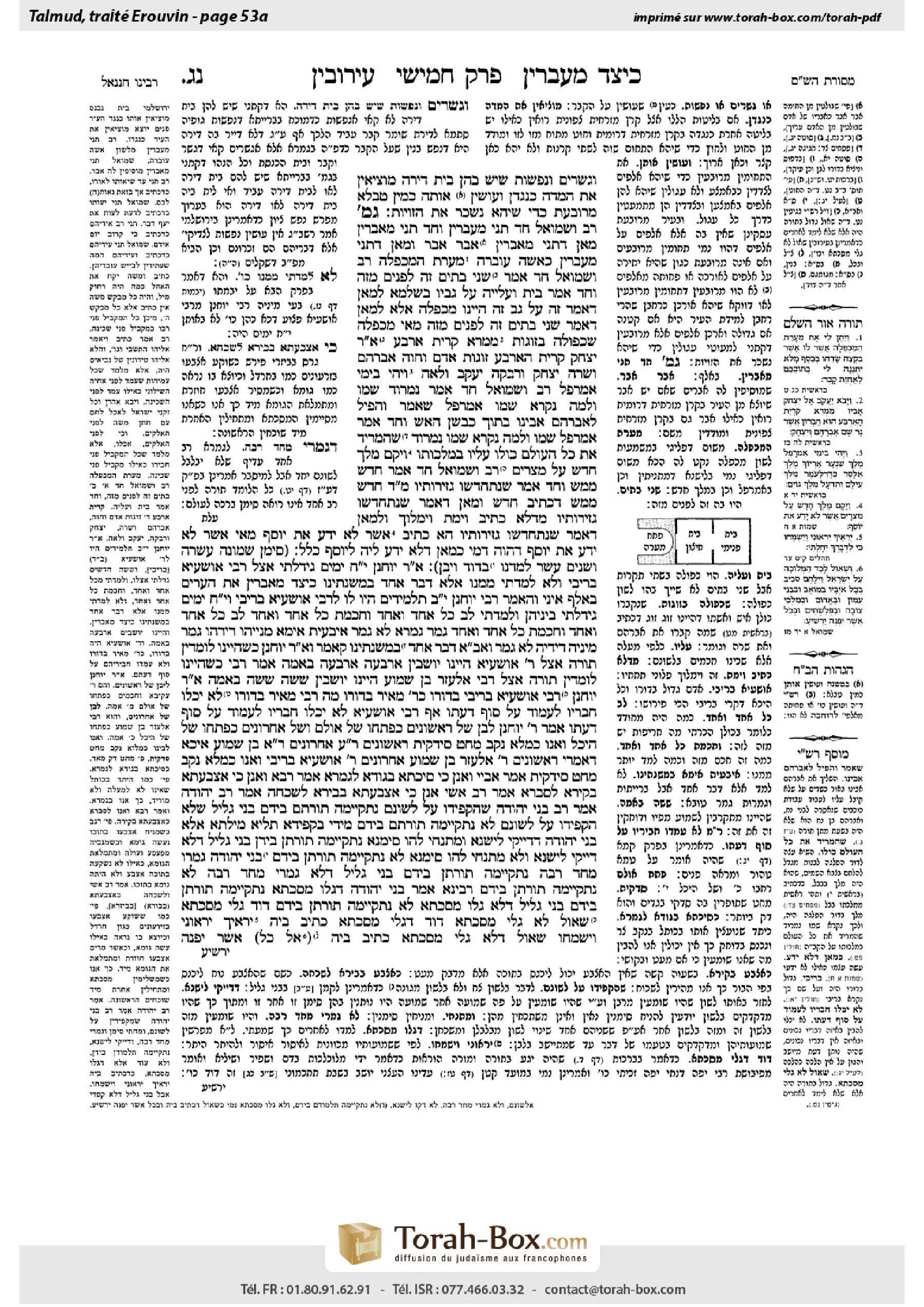
Eruvin 53a: Talmud study for Daf Yomi
Study the Talmud for Daf Yomi with scanned pages, Hebrew text, English translations from Sefaria and AI-generated French translations.
Passage selection and English or AI-generated French translation are available where the scan has annotations. Daf Study is independent of Torah-Box and Sefaria.
Browse Eruvin · עירובין · All tractatesEruvin 53a text and translations
This page of Eruvin includes the Aramaic text, an English translation and an AI-generated French translation, alongside the scan above.
עירובין נ״ג א · Aramaic and Hebrew text
וּגְשָׁרִים וּנְפָשׁוֹת שֶׁיֵּשׁ בָּהֶן בֵּית דִּירָה — מוֹצִיאִין אֶת הַמִּדָּה כְּנֶגְדָּן. וְעוֹשִׂין אוֹתָהּ כְּמִין טַבְלָא מְרוּבַּעַת, כְּדֵי שֶׁיְּהֵא נִשְׂכָּר אֶת הַזָּוִיּוֹת.
גְּמָ׳ רַב וּשְׁמוּאֵל: חַד תָּנֵי ״מְעַבְּרִין״ וְחַד תָּנֵי ״מְאַבְּרִין״.
מַאן דְּתָנֵי ״מְאַבְּרִין״ — אֵבֶר אֵבֶר, וּמַאן דְּתָנֵי ״מְעַבְּרִין״ — כְּאִשָּׁה עוּבָּרָהּ.
מְעָרַת הַמַּכְפֵּלָה, רַב וּשְׁמוּאֵל, חַד אָמַר: שְׁנֵי בָתִּים זֶה לִפְנִים מִזֶּה, וְחַד אָמַר: בַּיִת וַעֲלִיָּיה עַל גַּבָּיו.
בִּשְׁלָמָא לְמַאן דְּאָמַר זֶה עַל גַּב זֶה — הַיְינוּ ״מַכְפֵּלָה״. אֶלָּא לְמַאן דְּאָמַר שְׁנֵי בָתִּים זֶה לִפְנִים מִזֶּה, מַאי ״מַכְפֵּלָה״?
שֶׁכְּפוּלָה בְּזוּגוֹת. ״מַמְרֵא קִרְיַת אַרְבַּע״, אָמַר רַבִּי יִצְחָק, קִרְיַת הָאַרְבַּע זוּגוֹת: אָדָם וְחַוָּה, אַבְרָהָם וְשָׂרָה, יִצְחָק וְרִבְקָה, יַעֲקֹב וְלֵאָה.
״וַיְהִי בִּימֵי אַמְרָפֶל״, רַב וּשְׁמוּאֵל, חַד אָמַר: נִמְרוֹד שְׁמוֹ. וְלָמָּה נִקְרָא שְׁמוֹ אַמְרָפֶל? שֶׁאָמַר וְהִפִּיל לְאַבְרָהָם אָבִינוּ בְּתוֹךְ כִּבְשַׁן הָאֵשׁ, וְחַד אָמַר: אַמְרָפֶל שְׁמוֹ, וְלָמָּה נִקְרָא שְׁמוֹ נִמְרוֹד? שֶׁהִמְרִיד אֶת כָּל הָעוֹלָם כּוּלּוֹ עָלָיו בְּמַלְכוּתוֹ.
״וַיָּקׇם מֶלֶךְ חָדָשׁ עַל מִצְרָיִם״, רַב וּשְׁמוּאֵל, חַד אָמַר: חָדָשׁ מַמָּשׁ, וְחַד אָמַר: שֶׁנִּתְחַדְּשׁוּ גְּזֵירוֹתָיו.
מַאן דְּאָמַר חָדָשׁ מַמָּשׁ — דִּכְתִיב ״חָדָשׁ״, וּמַאן דְּאָמַר שֶׁנִּתְחַדְּשׁוּ גְּזֵירוֹתָיו — מִדְּלָא כְּתִיב ״וַיָּמׇת וַיִּמְלוֹךְ״.
וּלְמַאן דְּאָמַר שֶׁנִּתְחַדְּשׁוּ גְּזֵירוֹתָיו, הָא כְתִיב ״אֲשֶׁר לֹא יָדַע אֶת יוֹסֵף״? מַאי ״אֲשֶׁר לֹא יָדַע אֶת יוֹסֵף״ — דַּהֲוָה דָּמֵי כְּמַאן דְּלָא יָדַע לֵיהּ לְיוֹסֵף כְּלָל.
(סִימָן: שְׁמוֹנֶה עֶשְׂרֵה וּשְׁנֵים עָשָׂר לָמַדְנוּ בְּדָוִד וַיִּבֶן.)
אָמַר רַבִּי יוֹחָנָן: שְׁמוֹנָה עָשָׂר יָמִים גִּידַּלְתִּי אֵצֶל רַבִּי אוֹשַׁעְיָא בְּרִיבִּי וְלֹא לָמַדְתִּי מִמֶּנּוּ אֶלָּא דָּבָר אֶחָד בְּמִשְׁנָתֵינוּ: כֵּיצַד מְאַבְּרִין אֶת הֶעָרִים — בְּאָלֶף.
אִינִי?! וְהָאָמַר רַבִּי יוֹחָנָן שְׁנֵים עָשָׂר תַּלְמִידִים הָיוּ לוֹ לְרַבִּי אוֹשַׁעְיָא בְּרִיבִּי, וּשְׁמוֹנָה עָשָׂר יָמִים גִּידַּלְתִּי בֵּינֵיהֶן, וְלָמַדְתִּי לֵב כׇּל אֶחָד וְאֶחָד, וְחׇכְמַת כׇּל אֶחָד וְאֶחָד?
לֵב כׇּל אֶחָד וְאֶחָד וְחׇכְמַת כׇּל אֶחָד וְאֶחָד גְּמַר, גְּמָרָא — לָא גְּמַר. אִיבָּעֵית אֵימָא: מִנַּיְיהוּ דִּידְהוּ — גְּמַר, מִינֵּיהּ דִּידֵיהּ — לָא גְּמַר. וְאִיבָּעֵית אֵימָא: דָּבָר אֶחָד בְּמִשְׁנָתֵינוּ קָאָמַר.
וְאָמַר רַבִּי יוֹחָנָן: כְּשֶׁהָיִינוּ לוֹמְדִין תּוֹרָה אֵצֶל רַבִּי אוֹשַׁעְיָא, הָיִינוּ יוֹשְׁבִין אַרְבָּעָה אַרְבָּעָה בְּאַמָּה. אָמַר רַבִּי: כְּשֶׁהָיִינוּ לוֹמְדִין תּוֹרָה אֵצֶל רַבִּי אֶלְעָזָר בֶּן שַׁמּוּעַ, הָיִינוּ יוֹשְׁבִין שִׁשָּׁה שִׁשָּׁה בְּאַמָּה.
אָמַר רַבִּי יוֹחָנָן: רַבִּי אוֹשַׁעְיָא בְּרִיבִּי בְּדוֹרוֹ כְּרַבִּי מֵאִיר בְּדוֹרוֹ, מָה רַבִּי מֵאִיר בְּדוֹרוֹ לֹא יָכְלוּ חֲבֵרָיו לַעֲמוֹד עַל סוֹף דַּעְתּוֹ — אַף רַבִּי אוֹשַׁעְיָא לֹא יָכְלוּ חֲבֵרָיו לַעֲמוֹד עַל סוֹף דַּעְתּוֹ.
אָמַר רַבִּי יוֹחָנָן: לִבָּן שֶׁל רִאשׁוֹנִים כְּפִתְחוֹ שֶׁל אוּלָם, וְשֶׁל אַחֲרוֹנִים כְּפִתְחוֹ שֶׁל הֵיכָל, וְאָנוּ — כִּמְלֹא נֶקֶב מַחַט סִידְקִית.
רִאשׁוֹנִים — רַבִּי עֲקִיבָא, אַחֲרוֹנִים — רַבִּי אֶלְעָזָר בֶּן שַׁמּוּעַ. אִיכָּא דְּאָמְרִי: רִאשׁוֹנִים — רַבִּי אֶלְעָזָר בֶּן שַׁמּוּעַ, אַחֲרוֹנִים — רַבִּי אוֹשַׁעְיָא בְּרִיבִּי. וְאָנוּ כִּמְלֹא נֶקֶב מַחַט סִידְקִית.
אָמַר אַבָּיֵי: וַאֲנַן, כִּי סִיכְּתָא בְּגוּדָּא לִגְמָרָא. אָמַר רָבָא: וַאֲנַן, כִּי אֶצְבַּעְתָּא בְּקִירָא לִסְבָרָא. אָמַר רַב אָשֵׁי: אֲנַן, כִּי אֶצְבַּעְתָּא בְּבֵירָא לְשִׁכְחָה.
אָמַר רַב יְהוּדָה אָמַר רַב: בְּנֵי יְהוּדָה שֶׁהִקְפִּידוּ עַל לְשׁוֹנָם, נִתְקַיְּימָה תּוֹרָתָם בְּיָדָם. בְּנֵי גָלִיל שֶׁלֹּא הִקְפִּידוּ עַל לְשׁוֹנָם, לֹא נִתְקַיְּימָה תּוֹרָתָם בְּיָדָם.
מִידֵּי בִּקְפֵידָא תַּלְיָא מִילְּתָא? אֶלָּא: בְּנֵי יְהוּדָה דְּדָיְיקִי לִישָּׁנָא, וּמַתְנְחִי לְהוּ סִימָנָא, נִתְקַיְּימָה תּוֹרָתָן בְּיָדָן. בְּנֵי גָלִיל דְּלָא דָּיְיקִי לִישָּׁנָא, וְלָא מַתְנְחִי לְהוּ סִימָנָא, לֹא נִתְקַיְּימָה תּוֹרָתָן בְּיָדָם.
בְּנֵי יְהוּדָה גְּמַרוּ מֵחַד רַבָּה, נִתְקַיְּימָה תּוֹרָתָן בְּיָדָם. בְּנֵי גָלִיל דְּלָא גָּמְרִי מֵחַד רַבָּה, לֹא נִתְקַיְּימָה תּוֹרָתָן בְּיָדָם.
רָבִינָא אָמַר: בְּנֵי יְהוּדָה דְּגַלּוֹ מַסֶּכְתָּא, נִתְקַיְּימָה תּוֹרָתָן בְּיָדָם. בְּנֵי גָלִיל דְּלָא גַּלּוֹ מַסֶּכְתָּא, לֹא נִתְקַיְּימָה תּוֹרָתָן בְּיָדָם.
דָּוִד גַּלִּי מַסֶּכְתָּא, שָׁאוּל לָא גַּלִּי מַסֶּכְתָּא. דָּוִד דְּגַלִּי מַסֶּכְתָּא, כְּתִיב בֵּיהּ: ״יְרֵאֶיךָ יִרְאוּנִי וְיִשְׂמָחוּ״. שָׁאוּל דְּלָא גַּלִּי מַסֶּכְתָּא, כְּתִיב בֵּיהּ: ״(אֶל כׇּל) אֲשֶׁר יִפְנֶה
Eruvin 53a · English translation
and bridges and monuments over graves in which there is a residence, one extends the measure of that side of the city as though there were other structures opposite them in the adjacent corner of the city. And prior to measuring the Shabbat limit, one renders the city like a square tablet so that it gains the corners, although there are actually no houses in those corners.
GEMARA: The Gemara cites a dispute with regard to the mishna’s terminology. Rav and Shmuel disagreed: One taught that the term in the mishna is me’abberin, with the letter ayin, and one taught that the term in the mishna is me’abberin, with the letter alef.
The Gemara explains: The one who taught me’abberin with an alef explained the term in the sense of limb [ever] by limb. Determination of the city’s borders involves the addition of limbs to the core section of the city. And the one who taught me’abberin with an ayin explained the term in the sense of a pregnant woman [ubbera] whose belly protrudes. In similar fashion, all the city’s protrusions are incorporated in its Shabbat limit.
Apropos this dispute, the Gemara cites similar disputes between Rav and Shmuel. With regard to the Machpelah Cave, in which the Patriarchs and Matriarchs are buried, Rav and Shmuel disagreed. One said: The cave consists of two rooms, one farther in than the other. And one said: It consists of a room and a second story above it.
The Gemara asks: Granted, this is understandable according to the one who said the cave consists of one room above the other, as that is the meaning of Machpelah, double. However, according to the one who said it consists of two rooms, one farther in than the other, in what sense is it Machpelah? Even ordinary houses contain two rooms.
Rather, it is called Machpelah in the sense that it is doubled with the Patriarchs and Matriarchs, who are buried there in pairs. This is similar to the homiletic interpretation of the alternative name for Hebron mentioned in the Torah: “Mamre of Kiryat Ha’Arba, which is Hebron” (Genesis 35:27). Rabbi Yitzḥak said: The city is called Kiryat Ha’Arba, the city of four, because it is the city of the four couples buried there: Adam and Eve, Abraham and Sarah, Isaac and Rebecca, and Jacob and Leah.
They disagreed about this verse as well: “And it came to pass in the days of Amraphel” (Genesis 14:1). Rav and Shmuel both identified Amraphel with Nimrod. However, one said: Nimrod was his name. And why was his name called Amraphel? It is a contraction of two Hebrew words: As he said [amar] the command and cast [hippil] our father Abraham into the fiery furnace, when Abraham rebelled against and challenged his proclaimed divinity. And one said: Amraphel was his name. And why was his name called Nimrod? Because he caused the entire world to rebel [himrid] against God during his reign.
They also disagreed about this verse: “There arose a new king over Egypt, who knew not Joseph” (Exodus 1:8). Rav and Shmuel disagreed. One said: He was actually a new king, and one said: He was in fact the old king, but his decrees were new.
The Gemara explains. The one who said he was actually a new king based his opinion on the fact that it is written in the verse that he was new. And the one who said that his decrees were new derived his opinion from the fact that it is not written: And the king died, and his successor reigned, as it is written, for example, with regard to the kings of Edom (Genesis 36).
The Gemara asks: And according to the one who said that his decrees were new, isn’t it written: “Who knew not Joseph”? If it were the same king, how could he not know Joseph? The Gemara explains: What is the meaning of the phrase: “Who knew not Joseph”? It means that he conducted himself like one who did not know Joseph at all.
The Gemara cites a mnemonic of key words from a series of traditions cited below: Eighteen and twelve we studied, with regard to David, and he will understand.
Rabbi Yoḥanan said: I spent eighteen days with Rabbi Oshaya the Distinguished [Beribbi], and I learned from him only one matter in our Mishna. In the phrase: How does one extend cities, the word me’abberin is spelled with an alef.
The Gemara asks: Is this so? Didn’t Rabbi Yoḥanan say: Rabbi Oshaya the Distinguished had twelve students, and I spent eighteen days among them, and I learned the heart of each and every one, i.e., the nature and character of each student, and the extent of the wisdom of each and every one? How could Rabbi Yoḥanan say that he learned only one matter?
The Gemara answers: It is possible that he learned the heart of each and every one and the wisdom of each and every one, but he did not learn substantive tradition. And if you wish, say instead: From the students themselves he learned many things; from Rabbi Oshaya himself he did not learn anything beyond that one matter. And if you wish, say instead: Rabbi Yoḥanan meant to say that he learned only one matter in our Mishna from Rabbi Oshaya, but he learned other matters from him based on baraitot and other sources.
And Rabbi Yoḥanan said about that period: When we were studying Torah with Rabbi Oshaya, it was so crowded with students that we would sit four in each square cubit. Similarly, Rabbi Yehuda HaNasi said: When we were studying Torah with Rabbi Elazar ben Shamua, we would sit six in each square cubit.
Rabbi Yoḥanan said about his teacher: Rabbi Oshaya the Distinguished was as great in his generation as Rabbi Meir was in his generation: Just as with regard to Rabbi Meir, in his generation his colleagues were unable to fully grasp the profundity of his thinking due to the subtlety of his great mind, so it was with Rabbi Oshaya; his colleagues were unable to fully grasp the profundity of his thinking.
Similarly, Rabbi Yoḥanan said: The hearts, i.e., the wisdom, of the early Sages were like the doorway to the Entrance Hall of the Temple, which was twenty by forty cubits, and the hearts of the later Sages were like the doorway to the Sanctuary, which was ten by twenty cubits. And we, i.e., our hearts, are like the eye of a fine needle.
He explains: The term early Sages is referring to Rabbi Akiva, and the term later Sages is referring to his student, Rabbi Elazar ben Shamua. Some say that the term early Sages refers to Rabbi Elazar ben Shamua and that the term the later Sages refers to Rabbi Oshaya the Distinguished. And we are like the eye of a fine needle.
On the topic of the steady decline of the generations, Abaye said: And we, as far as our capabilities are concerned, are like a peg in the wall with regard to Torah study. Just as a peg enters a wall with difficulty, our studies penetrate our minds only with difficulty. Rava said: And we are like a finger in wax [kira] with regard to logical reasoning. A finger is not easily pushed into wax, and it extracts nothing from the wax. Rav Ashi said: We are like a finger in a pit with regard to forgetfulness. Just as a finger easily enters a large pit, similarly, we quickly forget our studies.
The Gemara continues the discussion relating to study and comprehension, and cites that which Rav Yehuda said that Rav said: With regard to the people of Judea, who were particular in their speech and always made certain that it was both precise and refined, their Torah knowledge endured for them; with regard to the people of the Galilee, who were not particular in their speech, their Torah knowledge did not endure for them.
The Gemara asks: Is this matter at all dependent on being particular with one’s language? Rather, with regard to the people of Judea, who were precise in their language and who would formulate mnemonics for their studies, their Torah knowledge endured for them; with regard to the people of the Galilee, who were not precise in their language and who would not formulate mnemonics, their Torah knowledge did not endure for them.
Furthermore, with regard to the people of Judea, who studied from one teacher, their Torah knowledge endured for them, as their teacher provided them with a consistent approach; however, with regard to the people of the Galilee, who did not study from one teacher, but rather from several teachers, their Torah knowledge did not endure for them, as it was a combination of the approaches and opinions of a variety of Sages.
Ravina said: With regard to the people of Judea, who would publicly disclose the tractate to be studied in the coming term so that everyone could prepare and study it in advance (ge’onim), their Torah knowledge endured for them; with regard to the people of the Galilee, who would not disclose the tractate to be studied in the coming term, their Torah knowledge did not endure for them.
The Gemara relates that King David would disclose the tractate to be studied in advance, whereas Saul would not disclose the tractate to be studied. With regard to David, who would disclose the tractate, it is written: “Those who fear You will see me and be glad” (Psalms 119:74), since all were prepared and could enjoy his Torah. With regard to Saul, who would not disclose the tractate to be studied, it is written: “And wherever he turned himself
Eruvin 53a · Traduction française (IA)
et les ponts et les monuments sur les tombes dans lesquels il y a une résidence, on étend la mesure de ce côté de la ville comme si des structures étaient présentes en face d'eux dans l'angle adjacent de la ville. Et avant de mesurer la limite du Shabbat, on considère la ville comme un tablette carrée afin qu'elle gagne ses angles, même si en réalité il n'y a pas de maisons dans ces angles.
GUEMARA : La Guemara cite un désaccord concernant le vocabulaire de la mitsna. Rav et Shmuel étaient en désaccord : l'un enseignait que le terme dans la mitsna est me'abberin avec la lettre ayin, et l'autre enseignait que le terme dans la mitsna est me'abberin avec la lettre alef.
La Guemara explique : celui qui enseignait me'abberin avec un alef expliquait le terme au sens de membre [ever] par membre. La détermination des limites de la ville implique l'ajout de membres au noyau de la ville. Et celui qui enseignait me'abberin avec un ayin expliquait le terme au sens d'une femme enceinte [ubbera] dont le ventre saillait. De la même manière, toutes les saillies de la ville sont incorporées dans sa limite du Shabbat.
À propos de ce désaccord, la Guemara cite des désaccords similaires entre Rav et Shmuel. Concernant la Caverne de Machpelah, où les Patriarches et les Matriarches sont enterrés, Rav et Shmuel étaient en désaccord. L'un disait : la caverne comprend deux chambres, l'une plus profonde que l'autre. Et l'autre disait : elle comprend une chambre et un étage au-dessus.
La Guemara demande : Cela est compréhensible selon celui qui disait que la caverne comprend une chambre au-dessus de l'autre, car c'est la signification de Machpelah, double. Cependant, selon celui qui disait qu'elle comprend deux chambres, l'une plus profonde que l'autre, en quel sens est-elle Machpelah ? Même les maisons ordinaires contiennent deux chambres.
En réalité, elle est appelée Machpelah au sens où elle est doublée avec les Patriarches et les Matriarches, qui y sont enterrés par paires. C'est semblable à l'interprétation homiletique du nom alternatif d'Hebron mentionné dans la Torah : « Mamre de Kiryat Ha'Arba, qui est Hebron » (Genèse 35:27). Rabbi Yitzḥak dit : la ville est appelée Kiryat Ha'Arba, la ville de quatre, parce qu'elle est la ville des quatre couples enterrés là : Adam et Ève, Abraham et Sarah, Isaac et Rebecca, et Jacob et Rachel.
Ils étaient en désaccord à propos de cette verset également : « Et il arriva aux jours d'Amraphel » (Genèse 14:1). Rav et Shmuel identifiaient tous deux Amraphel à Nimrod. Cependant, l'un disait : son nom était Nimrod. Et pourquoi était-il appelé Amraphel ? C'est une contraction de deux mots hébreux : lorsqu'il dit [amar] la commande et jeta [hippil] notre père Abraham dans le fourneau de feu, lorsque Abraham s'est rebelle contre et a défiant sa divinité proclamée. Et l'autre disait : Amraphel était son nom. Et pourquoi était-il appelé Nimrod ? Parce qu'il a causé que l'ensemble du monde se rebelle [himrid] contre Dieu durant son règne.
Ils étaient également en désaccord à propos de cette verset : « Il y eut un nouveau roi sur l'Égypte, qui ne connaissait pas Joseph » (Exode 1:8). Rav et Shmuel étaient en désaccord. L'un disait : il était effectivement un nouveau roi. Et l'autre disait : il était en réalité le roi ancien, mais ses décrets étaient nouveaux.
La Guemara explique. Celui qui disait qu'il était effectivement un nouveau roi s'appuyait sur le fait que le verset indique qu'il était nouveau. Et celui qui disait que ses décrets étaient nouveaux s'appuyait sur le fait que ce n'est pas écrit : « Et le roi mourut, et son successeur régna », comme il est écrit, par exemple, concernant les rois d'Edom (Genèse 36).
La Guemara demande : Et selon celui qui disait que ses décrets étaient nouveaux, n'est-il pas écrit : « Qui ne connaissait pas Joseph » ? Si c'était le même roi, comment pouvait-il ne pas connaître Joseph ? La Guemara explique : Quelle est la signification de la phrase : « Qui ne connaissait pas Joseph » ? Cela signifie qu'il se comportait comme s'il ne connaissait pas Joseph du tout.
La Guemara cite un mnémonique des mots clés d'une série de traditions citées ci-dessous : dix-huit et douze nous avons étudié, concernant David, et il comprendra.
Rabbi Yoḥanan dit : J'ai passé dix-huit jours avec Rabbi Oshaya le Distingué [Beribbi], et j'ai appris d'eux seulement une seule chose dans notre Michna. Dans la phrase : Comment étend-on les villes, le mot me'abberin est orthographié avec un alef.
La Guemara demande : Est-ce ainsi ? N’a-t-il pas dit Rabbi Yoḥanan : Rabbi Oshaya le Distingué avait douze élèves, et j’ai passé dix-huit jours parmi eux, et j’ai appris la nature et la personnalité de chacun, ainsi que l’étendue de la sagesse de chacun ? Comment Rabbi Yoḥanan peut-il dire qu’il a appris seulement une seule chose ?
La Guemara répond : Il est possible qu’il ait appris la nature et la personnalité de chacun ainsi que l’étendue de la sagesse de chacun, mais il n’a pas appris de tradition substantielle. Et si vous voulez, dites plutôt : d’après les élèves eux-mêmes, il a appris beaucoup de choses ; de Rabbi Oshaya lui-même, il n’a appris rien au-delà de cette seule chose. Et si vous voulez, dites plutôt : Rabbi Yoḥanan voulait dire qu’il a appris seulement une seule chose dans notre Michna de Rabbi Oshaya, mais il a appris d’autres choses d’eux basé sur des baraitot et d’autres sources.
Et Rabbi Yoḥanan a dit à propos de cette période : Lorsque nous étudiions la Torah avec Rabbi Oshaya, il était si plein d’élèves qu’on s’asseyait quatre par chaque cubit carré. De même, Rabbi Yehuda HaNasi a dit : Lorsque nous étudiions la Torah avec Rabbi Elazar ben Shamua, nous nous asseyions six par chaque cubit carré.
Rabbi Yoḥanan a dit à propos de son maître : Rabbi Oshaya le Distingué était aussi grand dans sa génération que Rabbi Meir était dans la sienne : Tout comme, concernant Rabbi Meir, dans sa génération ses collègues n'ont pas pu pleinement comprendre la profondeur de sa pensée en raison de la subtilité de son grand esprit, ainsi était-ce avec Rabbi Oshaya ; ses collègues n'ont pas pu pleinement comprendre la profondeur de sa pensée.
De même, Rabbi Yoḥanan a dit : Les cœurs, c'est-à-dire la sagesse, des Sages anciens étaient comme la porte d'entrée de la Cour du Temple, qui mesurait vingt par quarante coudées, et les cœurs des Sages plus récents étaient comme la porte du Saint des Saints, qui mesurait dix par vingt coudées. Et nous, c'est-à-dire nos cœurs, sont comme l'œil d'une aiguille fine.
Il explique : Le terme « Sages anciens » fait référence à Rabbi Akiva, et le terme « Sages plus récents » fait référence à son disciple, Rabbi Elazar ben Shamua. Certains disent que le terme « Sages anciens » fait référence à Rabbi Elazar ben Shamua et que le terme « Sages plus récents » fait référence à Rabbi Oshaya le Distingué. Et nous sommes comme l'œil d'une aiguille fine.
Sur le sujet de la déclivité progressive des générations, Abaye a dit : Et nous, en ce qui concerne nos capacités, sommes comme un clou dans le mur en ce qui concerne l'étude de la Torah. Comme un clou entre dans un mur avec difficulté, nos études pénètrent nos esprits seulement avec difficulté. Rava a dit : Et nous sommes comme un doigt dans de la cire [kira] en ce qui concerne la raison logique. Un doigt n'est pas facilement poussé dans de la cire, et il n'en extrait rien. Rav Ashi a dit : Nous sommes comme un doigt dans un puits en ce qui concerne l'oubli. Comme un doigt entre facilement dans un puits profond, de même, nous oublions rapidement nos études.
La Guemara poursuit la discussion concernant l'étude et la compréhension, et cite ce que Rav Yehuda a rapporté que Rav a dit : En ce qui concerne les habitants de Juda, qui étaient précis dans leur langage et qui veillaient toujours à ce qu'il soit à la fois précis et raffiné, leur connaissance de la Torah a duré pour eux ; en ce qui concerne les habitants de la Galilée, qui n'étaient pas précis dans leur langage, leur connaissance de la Torah n'a pas duré pour eux.
La Guemara pose la question : Cette affaire dépend-elle du fait d'être précis dans son langage ? Plutôt, en ce qui concerne les habitants de Juda, qui étaient précis dans leur langage et qui formaient des mnémoniques pour leurs études, leur connaissance de la Torah a duré pour eux ; en ce qui concerne les habitants de la Galilée, qui n'étaient pas précis dans leur langage et qui ne formaient pas de mnémoniques, leur connaissance de la Torah n'a pas duré pour eux.
De plus, en ce qui concerne les habitants de Juda, qui étudiaient auprès d'un seul maître, leur connaissance de la Torah a duré pour eux, car leur maître leur donnait une approche cohérente ; toutefois, en ce qui concerne les habitants de la Galilée, qui n'étudiaient pas auprès d'un seul maître, mais auprès de plusieurs maîtres, leur connaissance de la Torah n'a pas duré pour eux, car c'était une combinaison des approches et des opinions de plusieurs Sages.
Ravina a dit : En ce qui concerne les habitants de Juda, qui divulgeaient publiquement le tractat à étudier dans le prochain terme afin que tout le monde puisse se préparer et étudier à l'avance (géonim), leur connaissance de la Torah a duré pour eux ; en ce qui concerne les habitants de la Galilée, qui ne divulgeaient pas le tractat à étudier dans le prochain terme, leur connaissance de la Torah n'a pas duré pour eux.
La Guemara rapporte que le roi David divulgeait le tractat à étudier à l'avance, tandis que Saül ne divulgeait pas le tractat à étudier. En ce qui concerne David, qui divulgeait le tractat, il est écrit : « Ceux qui craignent Vous verront et seront joyeux » (Psaumes 119:74), car tous étaient préparés et pouvaient profiter de sa Torah. En ce qui concerne Saül, qui ne divulgeait pas le tractat à étudier, il est écrit : « Et partout qu'il se retournait »
Traduction française générée par IA à partir de l’édition anglaise de Sefaria. Vérifie toujours un passage avec le texte source.
Text from Sefaria: William Davidson Edition - Vocalized Aramaic (CC BY NC); William Davidson Edition - English (CC BY NC).