Eruvin 53b: Talmud study for Daf Yomi
Study the Talmud for Daf Yomi with scanned pages, Hebrew text, English translations from Sefaria and AI-generated French translations.
Passage selection and English or AI-generated French translation are available where the scan has annotations. Daf Study is independent of Torah-Box and Sefaria.
Browse Eruvin · עירובין · All tractatesEruvin 53b text and translations
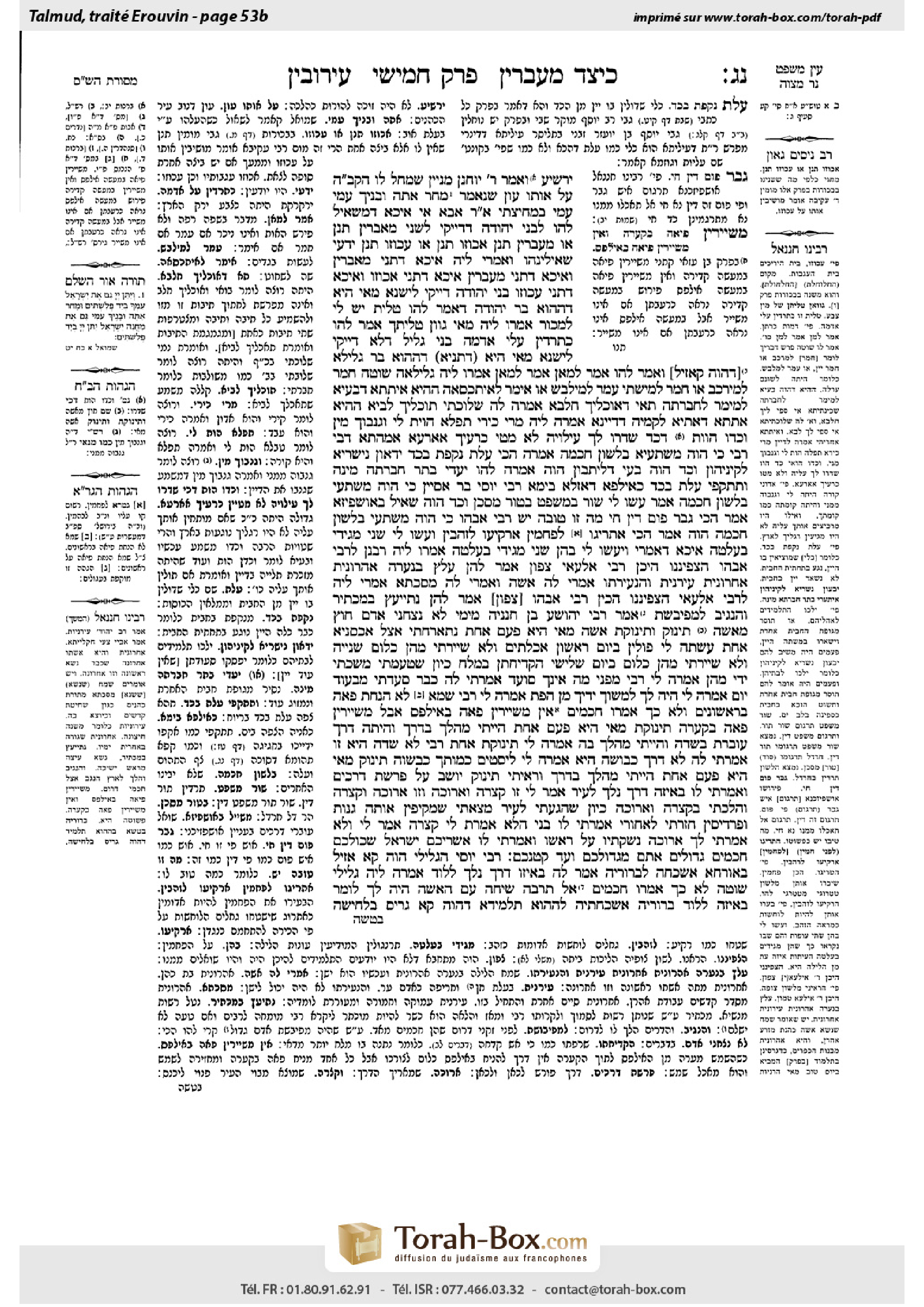
This page of Eruvin includes the Aramaic text, an English translation and an AI-generated French translation, alongside the scan above.
עירובין נ״ג ב · Aramaic and Hebrew text
יַרְשִׁיעַ״.
וְאָמַר רַבִּי יוֹחָנָן: מִנַּיִין שֶׁמָּחַל לוֹ הַקָּדוֹשׁ בָּרוּךְ הוּא עַל אוֹתוֹ עָוֹן — שֶׁנֶּאֱמַר: ״מָחָר אַתָּה וּבָנֶיךָ עִמִּי״. עִמִּי — בִּמְחִיצָתִי.
אָמַר רַבִּי אַבָּא: אִי אִיכָּא דִּמְשַׁאֵיל לְהוּ לִבְנֵי יְהוּדָה דְּדָיְיקִי לִשָּׁנֵי — מְאַבְּרִין תְּנַן אוֹ מְעַבְּרִין תְּנַן, אַכּוּזוֹ תְּנַן אוֹ עַכּוּזוֹ תְּנַן, יָדְעִי.
שְׁאֵילִינְהוּ וְאָמְרִי לֵיהּ: אִיכָּא דְּתָנֵי מְאַבְּרִין, וְאִיכָּא דְּתָנֵי מְעַבְּרִין. אִיכָּא דְּתָנֵי אַכּוּזוֹ וְאִיכָּא דְּתָנֵי עַכּוּזוֹ.
בְּנֵי יְהוּדָה דָּיְיקִי לִישָּׁנָא מַאי הִיא? דְּהָהוּא בַּר יְהוּדָה דַּאֲמַר לְהוּ: טַלִּית יֵשׁ לִי לִמְכּוֹר. אֲמַרוּ לֵיהּ: מַאי גּווֹן טַלִּיתְךָ? אֲמַר לְהוּ: כִּתְרָדִין עֲלֵי אֲדָמָה.
בְּנֵי גָלִיל דְּלָא דָּיְיקִי לִישָּׁנָא מַאי הִיא? (דְּתַנְיָא) דְּהָהוּא בַּר גָּלִילָא [דַּהֲוָה קָאָזֵיל] וַאֲמַר לְהוּ: ״אֲמַר לְמַאן, אֲמַר לְמַאן?״ אֲמַרוּ לֵיהּ: גָּלִילָאָה שׁוֹטֶה, חֲמַר לְמִירְכַּב אוֹ חֲמַר לְמִישְׁתֵּי? עֲמַר לְמִילְבַּשׁ אוֹ אִימַּר לְאִיתְכַּסָּאָה?
הָהִיא אִיתְּתָא דְּבָעֲיָא לְמֵימַר לַחֲבֶרְתַּהּ: ״תָּאִי דְּאוֹכְלִיךְ חֲלָבָא״, אֲמַרָה לַהּ: ״שְׁלוּכָתִי, תּוֹכְלִיךָ לָבִיא״.
הַהִיא אִתְּתָא דְּאָתְיָא לְקַמֵּיהּ דְּדַיָּינָא, אֲמַרָה לֵיהּ: ״מָרִי כִּירִי, תַּפְלָא הֲוָית לִי וְגַנְבוּךְ מִין. וְכַדּוּ הֲווֹת, דְּכַד שָׁדְרוּ לָךְ עִילָּוַיהּ — לָא מָטֵי כַּרְעָיךְ אַאַרְעָא״.
אַמְהֲתָא דְּבֵי רַבִּי כִּי הֲוָה מִשְׁתַּעְיָא בִּלְשׁוֹן חׇכְמָה, אָמְרָה הָכִי: עֶלֶת נְקַפַת בְּכַד, יִדְאוֹן נִישְׁרַיָּא לְקִינֵּיהוֹן.
וְכַד הֲוָה בָּעֵי דְּלִיתְּבוּן, הֲוָה אָמְרָה לְהוּ: יִעְדֵּי בָּתַר חֲבֶרְתַּהּ מִינַּהּ, וְתִתְקְפֵי עֶלֶת בְּכַד, כְּאִילְפָא דְּאָזְלָא בְּיַמָּא.
רַבִּי יוֹסֵי בַּר אָסְיָין כִּי הֲוָה מִשְׁתַּעֵי בִּלְשׁוֹן חׇכְמָה, אֲמַר: עֲשׂוּ לִי שׁוֹר בְּמִשְׁפָּט בְּטוּר מִסְכֵּן.
וְכַד הֲוָה שָׁאֵיל בְּאוּשְׁפִּיזָא, אָמַר הָכִי: גְּבַר פּוּם דֵּין חַי, מַה זּוֹ טוֹבָה יֵשׁ?
רַבִּי אֲבָהוּ כִּי הֲוָה מִשְׁתַּעֵי בִּלְשׁוֹן חׇכְמָה, הֲוָה אָמַר הָכִי: אַתְרִיגוּ לְפֶחָמִין, אַרְקִיעוּ לִזְהָבִין, וַעֲשׂוּ לִי שְׁנֵי מַגִּידֵי בַּעֲלָטָה. אִיכָּא דְּאָמְרִי: וְיַעֲשׂוּ לִי בָּהֶן שְׁנֵי מַגִּידֵי בַּעֲלָטָה.
אֲמַרוּ לֵיהּ רַבָּנַן לְרַבִּי אֲבָהוּ: הַצְפִּינֵנוּ הֵיכָן רַבִּי אִלְעַאי צָפוּן. אָמַר לָהֶן: עָלַץ בְּנַעֲרָה אַהֲרוֹנִית אַחֲרוֹנִית עֵירָנִית וְהִנְעִירַתּוּ.
אָמְרִי לַהּ אִשָּׁה.
וְאָמְרִי לַהּ מַסֶּכְתָּא.
אָמְרִי לֵיהּ לְרַבִּי אִלְעַאי: הַצְפִּינֵנוּ הֵיכָן רַבִּי אֲבָהוּ [צָפוּן]. אָמַר לָהֶן: נִתְיָיעֵץ בַּמַּכְתִּיר וְהִנְגִּיב לִמְפִיבֹשֶׁת.
אָמַר רַבִּי יְהוֹשֻׁעַ בֶּן חֲנַנְיָה: מִיָּמַי לֹא נִצְּחַנִי אָדָם חוּץ מֵאִשָּׁה תִּינוֹק וְתִינוֹקֶת. אִשָּׁה מַאי הִיא? פַּעַם אַחַת נִתְאָרַחְתִּי אֵצֶל אַכְסַנְיָא אַחַת, עָשְׂתָה לִי פּוֹלִין בְּיוֹם רִאשׁוֹן — אֲכַלְתִּים וְלֹא שִׁיַּירְתִּי מֵהֶן כְּלוּם. שְׁנִיָּיה, וְלֹא שִׁיַּירְתִּי מֵהֶן כְּלוּם. בְּיוֹם שְׁלִישִׁי הִקְדִּיחָתַן בְּמֶלַח, כֵּיוָן שֶׁטָּעַמְתִּי — מָשַׁכְתִּי יָדַי מֵהֶן.
אָמְרָה לִי: רַבִּי, מִפְּנֵי מָה אֵינְךָ סוֹעֵד? אָמַרְתִּי לָהּ: כְּבָר סָעַדְתִּי מִבְּעוֹד יוֹם. אָמְרָה לִי: הָיָה לְךָ לִמְשׁוֹךְ יָדֶיךָ מִן הַפַּת!
אָמְרָה לִי: רַבִּי, שֶׁמָּא לֹא הִנַּחְתָּ פֵּאָה בָּרִאשׁוֹנִים? וְלֹא כָּךְ אָמְרוּ חֲכָמִים: אֵין מְשַׁיְּירִין פֵּאָה בָּאִלְפָּס, אֲבָל מְשַׁיְּירִין פֵּאָה בַּקְּעָרָה.
תִּינוֹקֶת מַאי הִיא? פַּעַם אַחַת הָיִיתִי מְהַלֵּךְ בַּדֶּרֶךְ, וְהָיְתָה דֶּרֶךְ עוֹבֶרֶת בַּשָּׂדֶה, וְהָיִיתִי מְהַלֵּךְ בָּהּ. אָמְרָה לִי תִּינוֹקֶת אַחַת: רַבִּי, לֹא שָׂדֶה הִיא זוֹ? אָמַרְתִּי לָהּ: לֹא, דֶּרֶךְ כְּבוּשָׁה הִיא. אָמְרָה לִי: לִיסְטִים כְּמוֹתְךָ כְּבָשׁוּהָ.
תִּינוֹק מַאי הִיא? פַּעַם אַחַת הָיִיתִי מְהַלֵּךְ בַּדֶּרֶךְ, וְרָאִיתִי תִּינוֹק יוֹשֵׁב עַל פָּרָשַׁת דְּרָכִים. וְאָמַרְתִּי לוֹ: בְּאֵיזֶה דֶּרֶךְ נֵלֵךְ לָעִיר? אָמַר לִי: זוֹ קְצָרָה וַאֲרוּכָּה, וְזוֹ אֲרוּכָּה וּקְצָרָה. וְהָלַכְתִּי בִּקְצָרָה וַאֲרוּכָּה, כֵּיוָן שֶׁהִגַּעְתִּי לָעִיר מָצָאתִי שֶׁמַּקִּיפִין אוֹתָהּ גַּנּוֹת וּפַרְדֵּיסִין.
חָזַרְתִּי לַאֲחוֹרַי. אָמַרְתִּי לוֹ: בְּנִי, הֲלֹא אָמַרְתָּ לִי קְצָרָה? אָמַר לִי: וְלֹא אָמַרְתִּי לְךָ אֲרוּכָּה? נְשַׁקְתִּיו עַל רֹאשׁוֹ, וְאָמַרְתִּי לוֹ: אַשְׁרֵיכֶם יִשְׂרָאֵל שֶׁכּוּלְּכֶם חֲכָמִים גְּדוֹלִים אַתֶּם, מִגְּדוֹלְכֶם וְעַד קְטַנְּכֶם.
רַבִּי יוֹסֵי הַגְּלִילִי הֲוָה קָא אָזֵיל בְּאוֹרְחָא, אַשְׁכְּחַהּ לִבְרוּרְיָה אֲמַר לַהּ: בְּאֵיזוֹ דֶּרֶךְ נֵלֵךְ לְלוֹד? אֲמַרָה לֵיהּ: גָּלִילִי שׁוֹטֶה, לֹא כָּךְ אָמְרוּ חֲכָמִים: אַל תַּרְבֶּה שִׂיחָה עִם הָאִשָּׁה?! הָיָה לְךָ לוֹמַר: ״בְּאֵיזֶה לְלוֹד״.
בְּרוּרְיָה אַשְׁכַּחְתֵּיהּ לְהַהוּא תַּלְמִידָא דַּהֲוָה קָא גָרֵיס בִּלְחִישָׁה.
Eruvin 53b · English translation
he did them mischief” (i Samuel 14:47).
The Gemara concludes the mention of Saul on a positive note. And Rabbi Yoḥanan said: From where is it derived that the Holy One, Blessed be He, forgave him for that sin, the massacre of Nov, the city of priests? As it is stated that the spirit of Samuel said to him: “And the Lord will also deliver Israel with you into the hand of the Philistines, and tomorrow shall you and your sons be with me” (i Samuel 28:19); the phrase “with me” means within my partition together with me in heaven, i.e., on the same level as the righteous prophet Samuel.
The Gemara returns to the earlier question with regard to the correct reading of the word me’abberin. Rabbi Abba said: If there is anyone who can ask the people of Judea, who are precise in their language, whether the term in the mishna that we learned is me’abberin with an alef or me’abberin with an ayin, he should ask them. Similarly, with regard to the blemishes of a firstborn animal, was the term meaning its hindquarters that we learned in the mishna akkuzo with an alef, or did we learn akkuzo with an ayin? They would know.
The Gemara answers: One asked the people of Judea, and they said to him: Some teach me’abberin with an alef, and some teach me’abberin with an ayin. Some teach akkuzo with an alef, and some teach akkuzo with an ayin. Both versions are well founded and neither one is erroneous.
Having mentioned that the people of Judea are precise in their speech, the Gemara asks: What is the meaning of this? The Gemara answers with an example: As in the case of a certain person from Judea who said to those within earshot: I have a cloak to sell. They said to him: What color is your cloak? He said to them: Like beets on the ground, providing an exceedingly precise description of the exact shade of the cloak, the green tint of beet greens when they first sprout.
The Gemara returns to the people of the Galilee, who are not precise in their speech. What is the meaning of this? The Gemara cites examples: As it was taught in a baraita that there was a certain person from the Galilee who would walk and say to people: Who has amar? Who has amar? They said to him: Foolish Galilean, what do you mean? Galileans did not pronounce the guttural letters properly, so it was unclear whether he sought a donkey [ḥamor] to ride, or wine [ḥamar] to drink, wool [amar] to wear, or a lamb [imar] to slaughter. This is an example of the lack of precision in the Galileans’ speech.
The Gemara cites another example of the lack of linguistic precision of the Galileans: There was a certain woman who wanted to say to her friend: My neighbor, come and I will feed you milk [ta’i de’okhlikh ḥelba]; however, due to the imprecise articulation of her words, she said to her: My neighbor, may a lioness eat you [tokhlikh lavya].
The Gemara cites another example of the ignorance and incivility of the Galileans: There was a certain woman who came before a judge intending to say: Master, sir [Mari kiri, spelled with a kuf], I had a board, and they stole it from me [tavla havet li ugenavuha mimeni]. But instead she said to him: Master, servant [Mari kiri, spelled with a kaf], I had a beam and they stole you from me [tafla havet li ugenavukh min]. And it was so large, that when they would hang you upon it, your feet would not reach the ground.
In contrast to the speech of the Galileans, which indicates ignorance and loutishness, the Gemara cites examples of the clever phraseology of the inhabitants of Judea and the Sages: The maidservant in the house of Rabbi Yehuda HaNasi, when she would speak enigmatically, employing euphemistic terminology or in riddles, she would say as follows: The ladle used for drawing wine from the jug is already knocking against the bottom of the jug, i.e., the wine jug is almost empty. Let the eagles fly to their nests, i.e., let the students return home, as there is nothing left for them to drink.
And when Rabbi Yehuda HaNasi wanted them to sit, she would say to them: Let us remove the stopper from another jug, and let the ladle float in the jug like a ship sailing in the sea.
The Gemara also relates that when Rabbi Yosei bar Asyan would speak enigmatically, he would say: Prepare for me an ox in judgment on a poor mountain. His method was to construct words by combining words from Aramaic translations of Hebrew words or Hebrew translations of Aramaic words. Ox is tor in Aramaic; judgment is din. Combined they form teradin, beets. Mountain in Hebrew is har, which they pronounced ḥar; poor is dal. Together it spells ḥardal, mustard. Thus, Rabbi Yosei bar Asyan was requesting beets in mustard.
And when he would inquire about an inn, he would say as follows: This man here is raw; what is this good that there is? The phrase “this man here is raw” is used in a similar syllable-by-syllable translation: man in Hebrew is ish; here is po; this is zeh; and raw is na. All together, they sound like ushpazikhna, i.e., an innkeeper (Rabbeinu Ḥananel). In other words, Rabbi Yosei bar Asyan was asking after the innkeeper.
When Rabbi Abbahu would speak enigmatically, he would say as follows: Make the coals the color of an etrog; beat the golden ones, i.e., spread out the coals, which redden like gold when they glow; and make me two speakers-in-the-dark, i.e., roosters, which announce the dawn when it is still dark. Some say a slightly different version: And they shall make me in them, on the coals, i.e., roast for me on top of the coals, two speakers-in-the-dark.
In a similarly clever manner, the Sages said to Rabbi Abbahu: Show us [hatzpinenu] where Rabbi Elai is hiding [tzafun], as we do not know his whereabouts. He said to them: He rejoiced with the latter [aḥaronit] Aharonic [Aharonit] girl; she is lively [eiranit] and kept him awake [vehiniratu].
There are two ways to understand this cryptic statement: Some say it refers to a woman, i.e., he married a young girl from a priestly family [Aharonic], who is his second [latter] wife, from a village [eiranit], and he is sleeping now because she kept him awake during the night.
And some say it refers to a tractate. The term girl refers to the tractate; Aharonic indicates that it is a tractate from the order of Kodashim, which deals with the priestly service. The phrase the latter means that it is his latest course of study, and lively alludes to the challenging nature of the subject matter. Since he was awake all night studying, he is presently sleeping.
The Gemara continues: They said to Rabbi Elai: Show us where Rabbi Abbahu is hiding, as we do not know where he is. He said to them: He has taken counsel with the one who crowns, i.e., the Nasi, who appoints the Sages, and has gone south [hingiv] to Mephibosheth, i.e., he has headed to the Sages of the south, referred to here as Mephibosheth, who was King Saul’s grandson and a great Sage of his time.
Having discussed the clever speech of various Sages, the Gemara relates that Rabbi Yehoshua ben Ḥananya said as follows: In all my days, no person defeated me in a verbal encounter except for a woman, a young boy, and a young girl. What is the encounter in which a woman got the better of me? One time I was staying at a certain inn and the hostess prepared me beans. On the first day I ate them and left nothing over, although proper etiquette dictates that one should leave over something on his plate. On the second day I again ate and left nothing over. On the third day she over-salted them so that they were inedible. As soon as I tasted them, I withdrew my hands from them.
She said to me: My Rabbi, why aren’t you eating beans as on the previous days? Not wishing to offend her, I said to her: I have already eaten during the daytime. She said to me: You should have withdrawn your hand from bread and left room for some beans.
She then said to me: My Rabbi, perhaps you did not leave a remainder of food on your plate on the first days, which is why you are leaving over food today. Isn’t this what the Sages said: One need not leave a remainder in the pot [ilpas], but one must leave a remainder on the plate as an expression of etiquette (Tosafot). This is the incident in which a woman got the better of Rabbi Yehoshua ben Ḥananya.
What is the incident with a young girl? One time I was walking along the path, and the path passed through a field, and I was walking on it. A certain young girl said to me: My Rabbi, isn’t this a field? One should not walk through a field, so as not to damage the crops growing there. I said to her: Isn’t it a well-trodden path in the field, across which one is permitted to walk? She said to me: Robbers like you have trodden it. In other words, it previously had been prohibited to walk through this field, and it is only due to people such as you, who paid no attention to the prohibition, that a path has been cut across it. Thus, the young girl defeated Rabbi Yehoshua ben Ḥananya in a debate.
What is the incident with a young boy? One time I was walking along the path, and I saw a young boy sitting at the crossroads. And I said to him: On which path shall we walk in order to get to the city? He said to me: This path is short and long, and that path is long and short. I walked on the path that was short and long. When I approached the city I found that gardens and orchards surrounded it, and I did not know the trails leading through them to the city.
I went back and met the young boy again and said to him: My son, didn’t you tell me that this way is short? He said to me: And didn’t I tell you that it is also long? I kissed him on his head and said to him: Happy are you, O Israel, for you are all exceedingly wise, from your old to your young.
Having discussed wise speech and the wisdom of Jewish women, the Gemara cites the following story: Rabbi Yosei HaGelili was walking along the way, and met Berurya. He said to her: On which path shall we walk in order to get to Lod? She said to him: Foolish Galilean, didn’t the Sages say: Do not talk much with women? You should have said your question more succinctly: Which way to Lod?
The Gemara relates more of Berurya’s wisdom: Berurya came across a certain student who was whispering his studies rather than raising his voice.
Eruvin 53b · Traduction française (IA)
« Il leur fit du mal » (1 Samuel 14:47).
La Guemara conclut la mention de Saül sur une note positive. Et Rabbi Yoḥanan dit : D'où tire-t-on que le Saint, le Très-Haut, a pardonné à Saül pour ce péché, l'assassinat des Noé, la ville des prêtres ? Comme il est dit que l'esprit de Samuel dit à lui : « Et l'Éternel livrera Israël avec toi entre les mains des Philistins, et demain tu et tes fils seras avec moi » (1 Samuel 28:19) ; la phrase « avec moi » signifie dans ma partition, ensemble avec moi au ciel, c'est-à-dire au même niveau que le prophète juste Samuel.
La Guemara revient à la question précédente concernant la lecture correcte du mot me’abberin. Rabbi Abba dit : Si quelqu'un peut demander aux habitants de Juda, qui sont précis dans leur langage, si le terme dans la mitsva que nous avons appris est me’abberin avec un alef ou me’abberin avec un ayin, il devrait le demander. De même, concernant les défauts d'un animal prématuré, était-ce le terme signifiant ses fesses que nous avons appris dans la mitsva akkuzo avec un alef, ou avons-nous appris akkuzo avec un ayin ? Ils le sauraient.
La Guemara répond : On a interrogé les habitants de Juda, et ils ont répondu : Certains enseignent me’abberin avec un alef, d'autres me’abberin avec un ayin. Certains enseignent akkuzo avec un alef, d'autres akkuzo avec un ayin. Les deux versions sont bien fondées et aucune n'est erronée.
Ayant mentionné que les habitants de Juda sont précis dans leur langage, la Guemara pose la question : De quoi cela signifie-t-il ? La Guemara répond avec un exemple : Comme dans le cas d'une certaine personne de Juda qui disait à ceux qui l'entendaient : J'ai une cape à vendre. Ils lui dirent : De quelle couleur est ta cape ? Il leur répondit : Comme les betteraves sur le sol, fournissant une description extrêmement précise de la teinte exacte de la cape, le vert des feuilles de betteraves lorsqu'elles commencent à pousser.
La Guemara revient aux habitants du Galilé, qui ne sont pas précis dans leur langage. De quoi cela signifie-t-il ? La Guemara cite des exemples : Comme il a été enseigné dans une baraïta qu'il y avait un certain homme du Galilé qui marchait et disait aux gens : Qui a amar ? Qui a amar ? Ils lui dirent : Fous du Galilé, de quoi veux-tu parler ? Les Galiléens ne prononçaient pas correctement les lettres gutturales, donc il était indéterminé s'il cherchait un âne [ḥamor] à monter, ou du vin [ḥamar] à boire, ou de la laine [amar] à porter, ou un agneau [imar] à sacrifier. C'est un exemple de l'insuffisance de précision dans le langage des Galiléens.
La Guemara cite un autre exemple de l'insuffisance de précision linguistique des Galiléens : Il y avait une certaine femme qui voulait dire à sa amie : Mon voisin, viens et je te ferai boire du lait [ta’i de’okhlikh ḥelba] ; cependant, en raison de l'articulation imprecise de ses paroles, elle dit à sa : Mon voisin, que la lionne te mange [tokhlikh lavya].
La Guemara cite un autre exemple de l'ignorance et de l'incivilité des Galiléens : Il y avait une certaine femme qui s'adressait à un juge en voulant dire : Maître, mon serviteur [Mari kiri, écrit avec un kuf], j'avais une planche, et ils me l'ont volée [tavla havet li ugenavuha mimeni]. Mais au lieu de cela, elle dit à lui : Maître, mon maître [Mari kiri, écrit avec un kaf], j'avais une poutre et ils t'ont volé [tafla havet li ugenavukh min]. Et elle était si grande, que lorsqu'ils l'auraient suspendue, tes pieds ne toucheraient pas le sol.
Contrairement au langage des Galiléens, qui indique l'ignorance et la bêtise, la Guemara cite des exemples de la formule habile des habitants de Juda et des Sages : La servante dans la maison de Rabbi Yehuda HaNasi, lorsqu'elle parlait enigmaticalement, en utilisant des termes euphemiques ou en énigmes, disait comme suit : La cuiller utilisée pour tirer le vin du bidon frappe déjà le fond du bidon, c'est-à-dire que le bidon de vin est presque vide. Fais voler les aigles vers leurs nids, c'est-à-dire que les étudiants rentrent chez eux, car il n'y a plus rien à boire pour eux.
Et lorsqu'Rabbi Yehuda HaNasi voulait qu'ils s'assoient, elle disait à eux : Retirons le bouchon d'un autre bidon, et la cuiller flotte dans le bidon comme un bateau sur la mer.
La Guemara rapporte également que lorsqu'Rabbi Yosei bar Asyan parlait enigmaticalement, il disait : Préparez-moi un taureau en jugement sur une montagne pauvre. Sa méthode était de construire des mots en combinant des mots de traductions araméennes des mots hébreux ou des traductions hébreuses des mots araméens. Taureau est tor en araméen ; jugement est din. Ensemble, ils forment teradin, betteraves. Montagne en hébreu est har, qu'ils prononçaient ḥar ; pauvre est dal. Ensemble, ils forment ḥardal, moutarde. Ainsi, Rabbi Yosei bar Asyan demandait des betteraves en moutarde.
Et lorsqu'il demandait à propos d'un auberge, il disait comme suit : Ce homme-ci est cru ; qu'est-ce qui est bon là ? La phrase « ce homme-ci est cru » est utilisée dans une traduction syllabique similaire : homme en hébreu est ish ; ici est po ; ceci est zeh ; et cru est na. Ensemble, ils sonnent comme ushpazikhna, c'est-à-dire un aubergiste (Rabbeinu Ḥananel). En d'autres termes, Rabbi Yosei bar Asyan demandait après l'aubergiste.
Lorsque Rabbi Abbahu parlait enigmaticalement, il disait comme suit : Faites que les braises soient de la couleur d'un citron ; étendez les braises, c'est-à-dire étendez les braises, qui rougissent comme l'or lorsqu'elles brillent ; et faites-moi deux parleurs dans l'obscurité, c'est-à-dire des coqs, qui annoncent l'aube quand il fait encore sombre. Certains disent une version légèrement différente : Et ils feront de moi, sur les braises, c'est-à-dire cuisent-moi sur les braises, deux parleurs dans l'obscurité.
De manière aussi habile, les Sages dirent à Rabbi Abbahu : Montre-nous [hatzpinenu] où Rabbi Elai se cache [tzafun], car nous ne savons pas où il est. Il dit à eux : Il s'est réjoui avec la dernière [aḥaronit] fille Aharonique [Aharonit] ; elle est vive [eiranit] et l'a gardé éveillé [vehiniratu].
Il y a deux façons d'interpréter cette déclaration cryptique : Certains disent qu'il s'agit d'une femme, c'est-à-dire qu'il a épousé une jeune fille d'une famille sacerdotale [Aharonique], qui est sa deuxième [dernière] épouse, d'un village [eiranit], et il dort maintenant parce qu'elle l'avait gardé éveillé toute la nuit.
Et d'autres disent qu'il s'agit d'un tractat. Le terme « jeune fille » fait référence au tractat ; « Aharonique » indique qu'il s'agit d'un tractat de l'ordre des Kodashim, qui traite du service sacerdotal. L'expression « le dernier » signifie qu'il s'agit de son dernier cours d'étude, et « vivant » fait allusion à la difficulté du sujet. Puisqu'il était éveillé toute la nuit à l'étude, il dort présentement.
La Guemara continue : Ils dirent à Rabbi Elai : Montre-nous où Rabbi Abbahu se cache, car nous ne savons pas où il est. Il leur dit : Il a pris conseil avec celui qui couronne, c'est-à-dire le Nasi, qui désigne les Sages, et est parti vers le sud [hingiv] vers Mephibosheth, c'est-à-dire qu'il s'est dirigé vers les Sages du sud, désignés ici comme Mephibosheth, qui était le petit-fils du roi Saül et un grand Sage de son époque.
Après avoir discuté de la parole habile de divers Sages, la Guemara rapporte que Rabbi Yéhoshua ben Hananyah dit ceci : Durant toute ma vie, personne n'a réussi à me battre dans un débat verbal, sauf une femme, un jeune garçon et une jeune fille. Quel est le débat dans lequel une femme m'a battu ? Une fois, je logeais dans une auberge et la patronne m'avait préparé des haricots. Le premier jour, j'ai mangé tous les haricots et n'ai laissé rien sur mon plat, bien que la bienséance exige que l'on laisse quelque chose sur son plat. Le deuxième jour, j'ai à nouveau mangé et laissé rien sur mon plat. Le troisième jour, elle les a trop salés pour qu'ils soient comestibles. Aussitôt que j'ai goûté, j'ai retiré mes mains de ce plat.
Elle m'a dit : Mon Rabbi, pourquoi ne manges-tu pas de haricots comme les jours précédents ? Ne voulant pas la froisser, j'ai dit à elle : J'ai déjà mangé pendant la journée. Elle m'a dit : Tu aurais dû retirer ta main du pain et laisser de la place pour des haricots.
Elle m'a ensuite dit : Mon Rabbi, peut-être que tu n'as pas laissé un reste de nourriture sur ton plat les jours précédents, ce qui explique que tu laisses du nourriture aujourd'hui. N'est-ce pas ce que les Sages ont dit : On n'a pas besoin de laisser un reste dans la marmite [ilpas], mais on doit laisser un reste sur le plat comme expression de bienséance (Tosafot). C'est cet incident dans lequel une femme a battu Rabbi Yéhoshua ben Hananyah.
Quel est l'incident avec une jeune fille ? Une fois, je marchais sur un chemin, et ce chemin passait par un champ, et je marchais dessus. Une jeune fille m'a dit : Mon Rabbi, ce n'est pas un champ ? On ne doit pas marcher dans un champ, afin de ne pas endommager les cultures qui y poussent. J'ai dit à elle : Ce n'est pas un chemin bien frayé dans le champ, par lequel on est autorisé à marcher ? Elle m'a dit : Les voleurs comme toi l'ont frayé. En d'autres termes, ce champ était précédemment interdit à la marche, et c'est seulement grâce aux personnes comme toi, qui n'ont pas respecté l'interdiction, que ce chemin a été frayé. Ainsi, la jeune fille a battu Rabbi Yéhoshua ben Hananyah dans un débat.
Quel est l'incident avec un jeune garçon ? Une fois, je marchais sur un chemin, et j'ai vu un jeune garçon assis au carrefour. Et j'ai dit à lui : Sur quel chemin devons-nous marcher pour arriver en ville ? Il m'a dit : Ce chemin est court et long, et celui-ci est long et court. J'ai marché sur le chemin qui était court et long. Lorsque j'ai approché de la ville, j'ai trouvé qu'elle était entourée de jardins et d'orangers, et je ne connaissais pas les sentiers menant à la ville.
Je suis retourné et ai rencontré à nouveau le jeune garçon et lui ai dit : Mon fils, ne m'as-tu pas dit que ce chemin était court ? Il m'a dit : Et n'ai-je pas dit que c'était aussi long ? J'ai baisé sa tête et lui ai dit : Heureux es-tu, ô Israël, car vous êtes tous extrêmement sages, du plus âgé au plus jeune.
Après avoir discuté de la parole habile et de la sagesse des femmes juives, la Guemara cite l'histoire suivante : Rabbi Yosei HaGelili marchait sur le chemin et a rencontré Berurya. Il lui a dit : Sur quel chemin devons-nous marcher pour arriver à Lod ? Elle lui a répondu : Faussement galiléen, n'as-tu pas entendu les Sages dire : Ne parle pas beaucoup avec les femmes ? Tu aurais dû poser ta question plus brièvement : Quel chemin pour Lod ?
La Guemara rapporte davantage de la sagesse de Berurya : Berurya a rencontré un certain étudiant qui murmurait ses études plutôt que de les prononcer à voix haute.
Traduction française générée par IA à partir de l’édition anglaise de Sefaria. Vérifie toujours un passage avec le texte source.
Text from Sefaria: William Davidson Edition - Vocalized Aramaic (CC BY NC); William Davidson Edition - English (CC BY NC).