Eruvin 54a: Talmud study for Daf Yomi
Study the Talmud for Daf Yomi with scanned pages, Hebrew text, English translations from Sefaria and AI-generated French translations.
Passage selection and English or AI-generated French translation are available where the scan has annotations. Daf Study is independent of Torah-Box and Sefaria.
Browse Eruvin · עירובין · All tractatesEruvin 54a text and translations
This page of Eruvin includes the Aramaic text, an English translation and an AI-generated French translation, alongside the scan above.
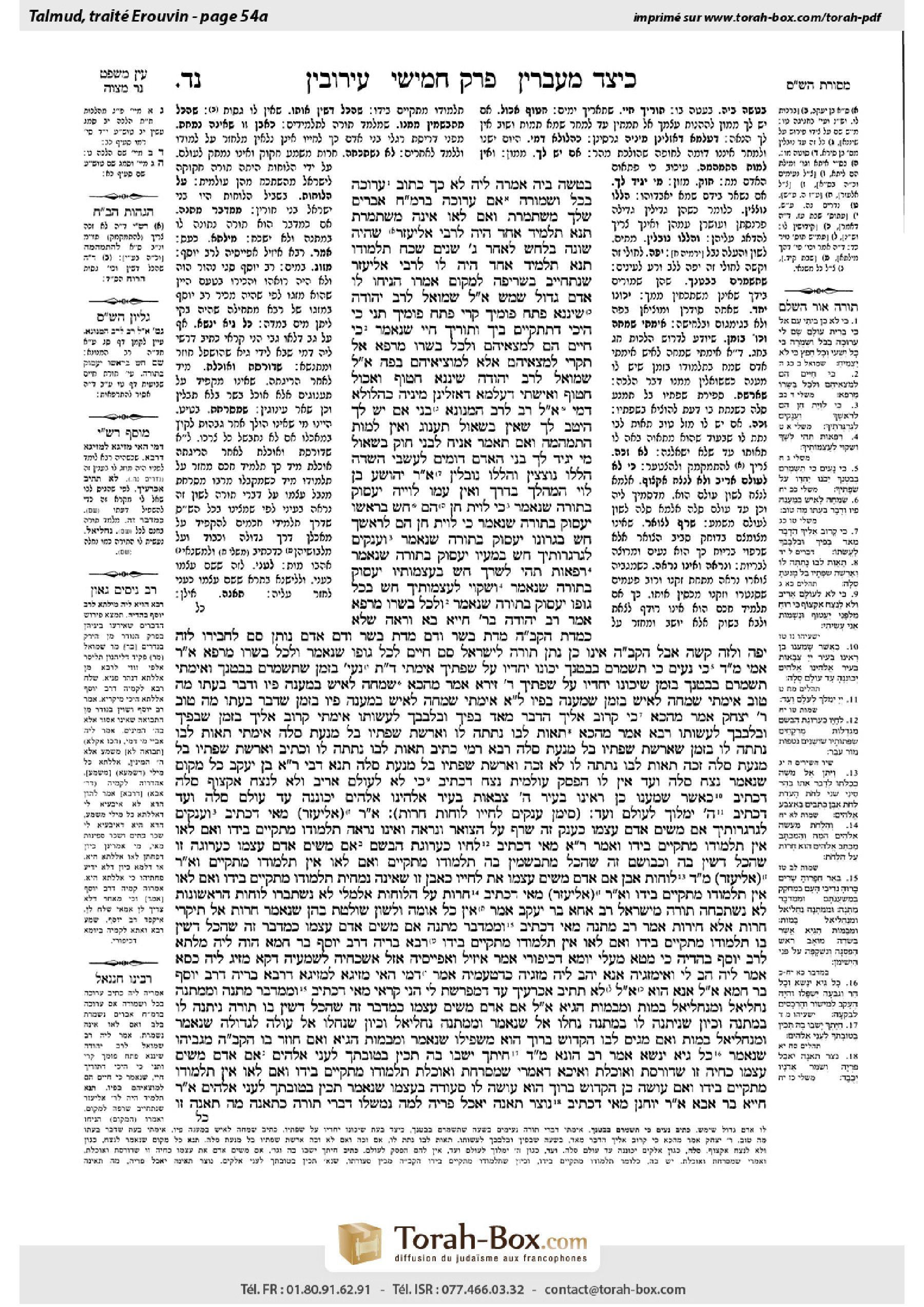
עירובין נ״ד א · Aramaic and Hebrew text
בְּטַשָׁה בֵּיהּ, אֲמַרָה לֵיהּ: לֹא כָּךְ כָּתוּב ״עֲרוּכָה בַכֹּל וּשְׁמוּרָה״, אִם עֲרוּכָה בִּרְמַ״ח אֵבָרִים שֶׁלְּךָ — מִשְׁתַּמֶּרֶת, וְאִם לָאו — אֵינָהּ מִשְׁתַּמֶּרֶת. תָּנָא: תַּלְמִיד אֶחָד הָיָה לְרַבִּי אֱלִיעֶזֶר שֶׁהָיָה שׁוֹנֶה בְּלַחַשׁ, לְאַחַר שָׁלֹשׁ שָׁנִים שָׁכַח תַּלְמוּדוֹ.
תָּנָא, תַּלְמִיד אֶחָד הָיָה לוֹ לְרַבִּי אֱלִיעֶזֶר שֶׁנִּתְחַיֵּיב בִּשְׂרֵיפָה לַמָּקוֹם. אָמְרוּ: הַנִּיחוּ לוֹ אָדָם גָּדוֹל שִׁמֵּשׁ.
אֲמַר לֵיהּ שְׁמוּאֵל לְרַב יְהוּדָה: שִׁינָּנָא, פְּתַח פּוּמָּיךְ קְרִי, פְּתַח פּוּמָּיךְ תְּנִי, כִּי הֵיכִי דְּתִתְקַיַּים בָּיךְ וְתוֹרִיךְ חַיֵּי, שֶׁנֶּאֱמַר: ״כִּי חַיִּים הֵם לְמֹצְאֵיהֶם וּלְכׇל בְּשָׂרוֹ מַרְפֵּא״, אַל תִּקְרֵי ״לְמֹצְאֵיהֶם״ אֶלָּא ״לְמוֹצִיאֵיהֶם בַּפֶּה״.
אֲמַר לֵיהּ שְׁמוּאֵל לְרַב יְהוּדָה: שִׁינָּנָא, חֲטוֹף וֶאֱכוֹל חֲטוֹף וְאִישְׁתִּי, דְּעָלְמָא דְּאָזְלִינַן מִינֵּיהּ כְּהִלּוּלָא דָּמֵי.
אֲמַר לֵיהּ רַב לְרַב הַמְנוּנָא: בְּנִי אִם יֵשׁ לָךְ — הֵיטֵב לָךְ, שֶׁאֵין בַּשְּׁאוֹל תַּעֲנוּג, וְאֵין לַמָּוֶת הִתְמַהְמֵהַּ. וְאִם תֹּאמַר אַנִּיחַ לְבָנַי — חוֹק בַּשְּׁאוֹל מִי יַגִּיד לָךְ: בְּנֵי הָאָדָם דּוֹמִים לְעִשְׂבֵי הַשָּׂדֶה הַלָּלוּ נוֹצְצִין וְהַלָּלוּ נוֹבְלִין.
אָמַר רַבִּי יְהוֹשֻׁעַ בֶּן לֵוִי: הַמְהַלֵּךְ בַּדֶּרֶךְ וְאֵין עִמּוֹ לְוָיָיה — יַעֲסוֹק בַּתּוֹרָה, שֶׁנֶּאֱמַר: ״כִּי לִוְיַת חֵן הֵם״.
חָשׁ בְּרֹאשׁוֹ — יַעֲסוֹק בְּתוֹרָה, שֶׁנֶּאֱמַר: ״כִּי לִוְיַת חֵן הֵם לְרֹאשֶׁךָ״. חָשׁ בִּגְרוֹנוֹ — יַעֲסוֹק בַּתּוֹרָה, שֶׁנֶּאֱמַר: ״וַעֲנָקִים לְגַרְגְּרוֹתֶיךָ״. חָשׁ בְּמֵעָיו — יַעֲסוֹק בַּתּוֹרָה, שֶׁנֶּאֱמַר: ״רִפְאוּת תְּהִי לְשָׁרֶּךָ״. חָשׁ בְּעַצְמוֹתָיו — יַעֲסוֹק בַּתּוֹרָה, שֶׁנֶּאֱמַר: ״וְשִׁקּוּי לְעַצְמוֹתֶיךָ״. חָשׁ בְּכׇל גּוּפוֹ — יַעֲסוֹק בַּתּוֹרָה, שֶׁנֶּאֱמַר: ״וּלְכׇל בְּשָׂרוֹ מַרְפֵּא״.
אָמַר רַב יְהוּדָה בְּרַבִּי חִיָּיא: בֹּא וּרְאֵה, שֶׁלֹּא כְּמִדַּת הַקָּדוֹשׁ בָּרוּךְ הוּא מִדַּת בָּשָׂר וְדָם. מִדַּת בָּשָׂר וָדָם: אָדָם נוֹתֵן סַם לַחֲבֵירוֹ — לָזֶה יָפֶה, וְלָזֶה קָשֶׁה. אֲבָל הַקָּדוֹשׁ בָּרוּךְ הוּא אֵינוֹ כֵּן: נָתַן תּוֹרָה לְיִשְׂרָאֵל — סַם חַיִּים לְכׇל גּוּפוֹ, שֶׁנֶּאֱמַר: ״וּלְכׇל בְּשָׂרוֹ מַרְפֵּא״.
אָמַר רַב אַמֵּי: מַאי דִּכְתִיב ״כִּי נָעִים כִּי תִשְׁמְרֵם בְּבִטְנֶךָ יִכּוֹנוּ יַחְדָּיו עַל שְׂפָתֶיךָ״, אֵימָתַי דִּבְרֵי תוֹרָה נְעִימִים — בִּזְמַן שֶׁתִּשְׁמְרֵם בְּבִטְנֶךָ, וְאֵימָתַי תִּשְׁמְרֵם בְּבִטְנֶךָ — בִּזְמַן שֶׁיִּכּוֹנוּ יַחְדָּו עַל שְׂפָתֶיךָ.
רַבִּי זֵירָא אָמַר מֵהָכָא: ״שִׂמְחָה לָאִישׁ בְּמַעֲנֵה פִיו וְדָבָר בְּעִתּוֹ מַה טּוֹב״, אֵימָתַי שִׂמְחָה לָאִישׁ — בִּזְמַן שֶׁמַּעֲנֶה בְּפִיו. לָשׁוֹן אַחֵר: אֵימָתַי שִׂמְחָה לָאִישׁ בְּמַעֲנֵה פִיו — בִּזְמַן שֶׁדָּבָר בְּעִתּוֹ מַה טּוֹב.
רַבִּי יִצְחָק אָמַר מֵהָכָא: ״כִּי קָרוֹב אֵלֶיךָ הַדָּבָר מְאֹד בְּפִיךָ וּבִלְבָבְךָ לַעֲשׂוֹתוֹ״, אֵימָתַי קָרוֹב אֵלֶיךָ — בִּזְמַן שֶׁבְּפִיךָ וּבִלְבָבְךָ לַעֲשׂוֹתוֹ.
רָבָא אָמַר מֵהָכָא: ״תַּאֲוַת לִבּוֹ נָתַתָּה לּוֹ וַאֲרֶשֶׁת שְׂפָתָיו בַּל מָנַעְתָּ סֶּלָה״, אֵימָתַי תַּאֲוַת לִבּוֹ נָתַתָּה לּוֹ — בִּזְמַן שֶׁאֲרֶשֶׁת שְׂפָתָיו בַּל מָנַעְתָּ סֶּלָה.
רָבָא רָמֵי: כְּתִיב ״תַּאֲוַת לִבּוֹ נָתַתָּה לּוֹ״. וּכְתִיב ״וַאֲרֶשֶׁת שְׂפָתָיו בַּל מָנַעְתָּ סֶּלָה״. זָכָה — תַּאֲוַת לִבּוֹ נָתַתָּה לוֹ. לֹא זָכָה — וַאֲרֶשֶׁת שְׂפָתָיו בַּל מָנַעְתָּ סֶּלָה.
תָּנָא דְּבֵי רַבִּי אֱלִיעֶזֶר בֶּן יַעֲקֹב: כׇּל מָקוֹם שֶׁנֶּאֱמַר ״נֶצַח״ ״סֶלָה״ ״וָעֶד״ — אֵין לוֹ הֶפְסֵק עוֹלָמִית. נֶצַח, דִּכְתִיב: ״כִּי לֹא לְעוֹלָם אָרִיב וְלֹא לָנֶצַח אֶקְּצוֹף״.
סֶלָה, דִּכְתִיב: ״כַּאֲשֶׁר שָׁמַעְנוּ כֵּן רָאִינוּ בְּעִיר ה׳ צְבָאוֹת בְּעִיר אֱלֹהֵינוּ אֱלֹהִים יְכוֹנְנֶהָ עַד עוֹלָם סֶלָה״. וָעֶד, דִּכְתִיב: ״ה׳ יִמְלוֹךְ לְעוֹלָם וָעֶד״.
(סִימָן: ״עֲנָקִים״ ״לְחָיָיו״ ״לוּחוֹת״ ״חָרוּת״). אָמַר רַבִּי (אֱלִיעֶזֶר): מַאי דִּכְתִיב ״וַעֲנָקִים לְגַרְגְּרוֹתֶיךָ״, אִם מֵשִׂים אָדָם עַצְמוֹ כַּעֲנָק זֶה שֶׁרָף עַל הַצַּוָּאר וְנִרְאֶה וְאֵינוֹ נִרְאֶה — תַּלְמוּדוֹ מִתְקַיֵּים בְּיָדוֹ. וְאִם לָאו — אֵין תַּלְמוּדוֹ מִתְקַיֵּים בְּיָדוֹ.
וְאָמַר רַבִּי אֱלִיעֶזֶר: מַאי דִּכְתִיב ״לְחָיָו כַּעֲרוּגַת הַבּוֹשֶׂם״, אִם מֵשִׂים אָדָם עַצְמוֹ כַּעֲרוּגָה זוֹ שֶׁהַכֹּל דָּשִׁין בָּהּ, וּכְבוֹשֶׂם זֶה שֶׁהַכֹּל מִתְבַּשְּׂמִין בָּהּ — תַּלְמוּדוֹ מִתְקַיֵּים, וְאִם לָאו — אֵין תַּלְמוּדוֹ מִתְקַיֵּים.
וְאָמַר רַבִּי (אֱלִיעֶזֶר): מַאי דִּכְתִיב ״לוּחוֹת אֶבֶן״, אִם אָדָם מֵשִׂים עַצְמוֹ אֶת לְחָיָיו כְּאֶבֶן זוֹ שֶׁאֵינָהּ נִמְחֵית — תַּלְמוּדוֹ מִתְקַיֵּים בְּיָדוֹ, וְאִם לָאו — אֵין תַּלְמוּדוֹ מִתְקַיֵּים בְּיָדוֹ.
וְאָמַר רַבִּי (אֱלִיעֶזֶר): מַאי דִּכְתִיב ״חָרוּת עַל הַלּוּחוֹת״, אִלְמָלֵי לֹא נִשְׁתַּבְּרוּ לוּחוֹת הָרִאשׁוֹנוֹת — לֹא נִשְׁתַּכְּחָה תּוֹרָה מִיִּשְׂרָאֵל.
רַב אַחָא בַּר יַעֲקֹב אָמַר: אֵין כׇּל אוּמָּה וְלָשׁוֹן שׁוֹלֶטֶת בָּהֶן, שֶׁנֶּאֱמַר: ״חָרוּת״ — אַל תִּיקְרֵי ״חָרוּת״, אֶלָּא חֵירוּת.
אָמַר רַב מַתְנָה: מַאי דִּכְתִיב ״וּמִמִּדְבָּר מַתָּנָה״, אִם מֵשִׂים אָדָם עַצְמוֹ כְּמִדְבָּר זֶה שֶׁהַכֹּל דָּשִׁין בּוֹ — תַּלְמוּדוֹ מִתְקַיֵּים בְּיָדוֹ. וְאִם לָאו — אֵין תַּלְמוּדוֹ מִתְקַיֵּים בְּיָדוֹ.
רָבָא בְּרֵיהּ דְּרַב יוֹסֵף בַּר חָמָא הֲוָה לֵיהּ מִלְּתָא לְרַב יוֹסֵף בַּהֲדֵיהּ, כִּי מְטָא מַעֲלֵי יוֹמָא דְכִיפּוּרֵי אֲמַר: אֵיזִיל וַאֲפַיְּיסֵיהּ. אֲזַל, אַשְׁכְּחֵיהּ לְשַׁמָּעֵיהּ דְּקָא מָזֵיג לֵיהּ כָּסָא. אֲמַר: הַב לִי וְאֶימְזְגֵיהּ אֲנָא. יְהַב לֵיהּ, מַזְגֵיהּ. כִּדְטַעְמֵיהּ אָמַר: דָּמֵי הַאי מְזִיגָא לִמְזִיגָא דְּרָבָא בְּרֵיהּ דְּרַב יוֹסֵף בַּר חָמָא. אֲמַר לֵיהּ: אֲנָא הוּא.
אֲמַר לֵיהּ: לָא תִּתֵּיב אַכַּרְעָיךָ עַד דִּמְפָרְשַׁתְּ לִי הָנֵי קְרָאֵי. מַאי דִּכְתִיב: ״וּמִמִּדְבָּר מַתָּנָה וּמִמַּתָּנָה נַחֲלִיאֵל וּמִנַּחֲלִיאֵל בָּמוֹת וּמִבָּמוֹת הַגַּיְא״?
אֲמַר לֵיהּ: אִם אָדָם מֵשִׂים עַצְמוֹ כְּמִדְבָּר זֶה שֶׁהַכֹּל דָּשִׁין בּוֹ — תּוֹרָה נִיתְּנָה לוֹ בְּמַתָּנָה. וְכֵיוָן שֶׁנִּיתְּנָה לוֹ בְּמַתָּנָה — נְחָלוֹ אֵל, שֶׁנֶּאֱמַר: ״וּמִמַּתָּנָה נַחֲלִיאֵל״. וְכֵיוָן שֶׁנְּחָלוֹ אֵל — עוֹלֶה לִגְדוּלָּה, שֶׁנֶּאֱמַר: ״וּמִנַּחֲלִיאֵל בָּמוֹת״.
וְאִם מֵגֵיס לִבּוֹ — הַקָּדוֹשׁ בָּרוּךְ הוּא מַשְׁפִּילוֹ, שֶׁנֶּאֱמַר: ״וּמִבָּמוֹת הַגַּיְא״. וְאִם חוֹזֵר בּוֹ — הַקָּדוֹשׁ בָּרוּךְ הוּא מַגְבִּיהוֹ, שֶׁנֶּאֱמַר: ״כׇּל גֶּיא יִנָּשֵׂא״.
אָמַר רַב הוּנָא: מַאי דִּכְתִיב: ״חַיָּתְךָ יָשְׁבוּ בָהּ תָּכִין בְּטוֹבָתְךָ לֶעָנִי אֱלֹהִים״, אִם אָדָם מֵשִׂים עַצְמוֹ כְּחַיָּה זוֹ שֶׁדּוֹרֶסֶת וְאוֹכֶלֶת, וְאִיכָּא דְּאָמְרִי שֶׁמַּסְרַחַת וְאוֹכֶלֶת — תַּלְמוּדוֹ מִתְקַיֵּים בְּיָדוֹ. וְאִם לָאו — אֵין תַּלְמוּדוֹ מִתְקַיֵּים בְּיָדוֹ. וְאִם עוֹשֶׂה כֵּן — הַקָּדוֹשׁ בָּרוּךְ הוּא עוֹשֶׂה לוֹ סְעוּדָה בְּעַצְמוֹ, שֶׁנֶּאֱמַר: ״תָּכִין בְּטוֹבָתְךָ לֶעָנִי אֱלֹהִים״.
אָמַר רַבִּי חִיָּיא בַּר אַבָּא אָמַר רַבִּי יוֹחָנָן: מַאי דִּכְתִיב ״נוֹצֵר תְּאֵנָה יֹאכַל פִּרְיָהּ״, לָמָּה נִמְשְׁלוּ דִּבְרֵי תוֹרָה כִּתְאֵנָה, מָה תְּאֵנָה זוֹ
Eruvin 54a · English translation
She kicked him and said to him: Isn’t it written as follows: “Ordered in all things and secure” (ii Samuel 23:5), which indicates that if the Torah is ordered in your 248 limbs, i.e., if you exert your entire body in studying it, it will be secure, and if not, it will not be secure. The Gemara relates that it was similarly taught in a baraita: Rabbi Eliezer had a student who would study quietly, and after three years he forgot his studies.
Incidental to the story cited above involving a student of Rabbi Eliezer, the Gemara cites the following episode: It was taught in a baraita: Rabbi Eliezer had a student who was liable for the punishment of death by burning, for his sins against God, but the Rabbis said: Let him alone and do not punish him as he deserves, because he served a great person.
The Gemara cites instructions issued by Shmuel that are similar to those of Berurya. Shmuel said to Rav Yehuda: Keen scholar [shinnana], open your mouth and read from the Torah, open your mouth and study the Talmud, in order that your studies should endure in you and that you should live a long life, as it is stated: “For they are life to those who find them, and health to all their flesh” (Proverbs 4:22). Do not read: “To those who find them [lemotzeihem],” but rather “to those who express them [lemotzi’eihem],” with their mouth.
The Gemara cites additional instructions issued by Shmuel: Shmuel said to Rav Yehuda, his beloved student: Keen scholar, grab and eat, grab and drink, as the world from which we are departing is like a wedding feast, whose joy is only temporary, and one who does not take pleasure in it now will not be able to do so in the future.
Similarly, Rav said to Rav Hamnuna: My son, if you have money, do well for yourself. There is no point waiting, as there is no pleasure in the netherworld, and death does not tarry. And if you say: I will save up in order to leave for my children, who told you the law of the netherworld, i.e., how do you know which of you will die first (Arukh)? People are similar to grass of the field, in that these blossom, i.e., grow, and their actions are blessed, and these wither and die.
Having expounded the verse “For they are life to those who find them” as referring to the Torah, the Gemara cites another teaching related to this verse that praises the Torah. Rabbi Yehoshua ben Levi said: One who is walking along the way without a companion and is afraid should engage in Torah study, as it is stated with regard to the words of Torah: “For they shall be a graceful wreath [livyat ḥen] for your head, and chains about your neck” (Proverbs 1:9). The word livyat is understood here as a reference to levaya, accompaniment, so that the verse is interpreted to mean that Torah is a graceful accompaniment to one who is traveling.
One who feels pain in his head should engage in Torah study, as it is stated: “For they shall be a graceful wreath for your head.” One who feels pain in his throat should engage in Torah study, as it is stated: “And chains about your neck.” One who feels pain in his intestines should engage in Torah study, as it is stated: “It shall be health to your navel” (Proverbs 3:8). One who feels pain in his bones should engage in Torah study, as it is stated: “And marrow to your bones” (Proverbs 3:8). One who feels pain in his entire body should engage in Torah study, as it is stated: “And health to all their flesh” (Proverbs 4:22).
Rav Yehuda, son of Rabbi Ḥiyya, said: Come and see that the attribute of flesh and blood is unlike the attribute of the Holy One, Blessed be He. The attribute of flesh and blood is that when a person gives a drug to his fellow, it is good for this part of his body and it is harmful to that other part of his body. But the attribute of the Holy One, Blessed be He, is not so; He gave the Torah to the Jewish people, and it is a drug of life for one’s entire body, as it is stated: “And health to all their flesh.”
The Gemara continues with praise for Torah study and knowledge. Rav Ami said: What is the meaning of that which is written: “For it is a pleasant thing if you keep them within you; let them be firmly attached together to your lips” (Proverbs 22:18)? When are words of Torah pleasant? When you keep them within you and know them. And when will you keep them within you? When they will be attached together to your lips, i.e., when you articulate them audibly and expound them.
Rabbi Zeira said that this idea is derived from here: “A man has joy in the answer of his mouth; and a word in due season, how good it is” (Proverbs 15:23). When does a man have joy? When an answer related to Torah study is in his mouth. Another version: When does a man have joy in the answer of his mouth? When he experiences the fulfillment of: A word in due season, how good it is, i.e., when he knows when and how to address each issue.
Rabbi Yitzḥak said that this idea is derived from here: “But the matter is very near to you, in your mouth and in your heart, that you may do it” (Deuteronomy 30:14). When is it very near to you? When it is in your mouth and in your heart, that you may do it, i.e., when you articulate your Torah study.
Rava said that this idea is actually derived from here: “You have given him his heart’s desire, and have not withheld the request of his lips, Selah” (Psalms 21:3). When have You given him his heart’s desire? When You have not withheld the request of his lips, Selah, i.e., when he converses in words of Torah.
Rava raised an internal contradiction in that very verse: In the beginning of the verse it is written: “You have given him his heart’s desire,” implying that it is enough for one to request in his heart, whereas in the end of the verse it is written: “And You have not withheld the request of his lips, Selah,” indicating that one must express his prayers verbally. Rava himself resolved the contradiction: If one is fortunate, “You have given him his heart’s desire,” even if he does not give verbal expression to his wants. But if he is not fortunate, at least “You have not withheld the request of his lips, Selah.”
With regard to the end of this verse, a Sage of the school of Rabbi Eliezer ben Ya’akov taught the following baraita: Wherever it states netzaḥ, Selah, or va’ed, the matter will never cease. Netzaḥ, as it is written: “For I will not contend forever; neither will I be eternally [lanetzaḥ] angry” (Isaiah 57:16), which demonstrates that netzaḥ bears a similar meaning to forever.
Selah, as it is written: “As we have heard, so have we seen in the city of the Lord of Hosts, in the city of our God; may God establish it forever, Selah” (Psalms 48:9), which demonstrates that Selah means forever. Va’ed, as it is written: “The Lord shall reign forever and ever [va’ed]” (Exodus 15:18).
In light of the previous discussion, the Gemara cites several expositions of verses proposed by Rabbi Eliezer, while first providing them with a mnemonic: Chains, cheeks, tablets, engraved. Rabbi Eliezer said: What is the meaning of that which is written: “And chains about your neck” (Proverbs 1:9)? If a person makes himself like a chain that hangs loosely on the neck, i.e., if a scholar is not pushy and disruptive to others, and he is also seen but not seen, i.e., just as a chain is covered by clothes and hair, so too, the scholar does not let himself be seen, his Torah study will endure. But if not, if he acts in a rude and arrogant manner, his Torah study will not endure.
And Rabbi Eliezer also said: What is the meaning of that which is written: “His cheeks are like a bed of spices” (Song of Songs 5:13)? If a person makes himself humble like this garden bed upon which everyone treads, and like this spice with which everyone perfumes himself, i.e., which benefits not only the one who wears it, his Torah study will endure. But if not, his Torah study will not endure.
And Rabbi Eliezer further said: What is the meaning of that which is written: “Tablets [luḥot] of stone” (Exodus 31:18)? If a person makes his cheeks [leḥayav] like this stone that does not wear away, his Torah study will endure. But if not, i.e., if he is not diligent in his studies, his Torah study will not endure.
And, lastly, Rabbi Eliezer said: What is the meaning of that which is written: “And the tablets were the work of God, and the writing was the writing of God, engraved upon the tablets” (Exodus 32:16)? This teaches that had the first tablets, the subject of this verse, not been broken, the Torah would never have been forgotten from the Jewish people, as the Torah would have been engraved upon their hearts.
Rav Aḥa bar Ya’akov said: Had the tablets not been broken, no nation or tongue would ever have ruled over them, as it is stated: “Engraved”; do not read it engraved [ḥarut] but rather freedom [ḥeirut].
Similarly, Rav Mattana said: What is the meaning of that which is written: “The well that the princes dug out, that the nobles of the people delved, with the scepter, with their staves. And from the wilderness they went to Mattanah” (Numbers 21:18)? If a person makes himself humble like this wilderness, which is open to all and upon which everyone treads, his Torah study will endure and be given to him as a gift [mattana]. And if not, his Torah study will not endure.
The Gemara relates that Rav Yosef had a grievance against Rava, son of Rav Yosef bar Ḥama, who is usually referred to in the Gemara simply as Rava, and as a result of the grievance the two would never meet. When the eve of Yom Kippur arrived, Rava said: I will go and appease him. He went and found Rav Yosef’s attendant mixing him a cup of wine. He said to the attendant: Give it to me, and I will mix it. He gave it to Rava, and Rava mixed it. Rav Yosef was blind and could not see his visitor, but when he tasted the wine he said: This mixture is similar to the mixture of Rava, son of Rav Yosef bar Ḥama, who would add extra water to the wine. Rava said to him: It is I.
Rav Yosef said to him: Do not sit on your knees until you have explained these verses to me: What is the meaning of that which is written: “And from the wilderness to Mattanah; and from Mattanah to Nahaliel; and from Nahaliel to Bamoth; and from Bamoth to the valley in the field of Moab, to the top of Pisgah, which looks out toward the desert” (Numbers 21:19–20)?
Rava said to him: If a person makes himself humble like this wilderness, which is open to all and upon which everyone treads, the Torah will be given to him as a gift [mattana]. And once it is given to him as a gift, he inherits it [neḥalo] and God [El] makes it His inheritance, as it is stated: “And from Mattanah to Nahaliel.” And once God has made it His inheritance, he rises to greatness, as it is stated: “And from Nahaliel to Bamoth,” which means heights.
And if he becomes haughty, the Holy One, Blessed be He, lowers him, as it is stated: “And from Bamoth to the valley.” And if he repents, the Holy One, Blessed be He, raises him back up, as it is stated: “Every valley shall be exalted” (Isaiah 40:4).
Rav Huna said: What is the meaning of that which is written: “Your flock found a dwelling in it; You, O God, prepare of Your goodness for the poor” (Psalms 68:11)? If a person makes himself like an animal that tramples its prey and eats it immediately, without being particular about its food, i.e., if a scholar immediately reviews what he has heard from his teacher; and some say, like an animal that soils and eats, i.e., if a scholar is not particular about maintaining his honor during his Torah study, just as an animal is not particular about the quality of its food, his Torah study will endure. And if not, his Torah study will not endure. And if he does so, the Holy One, Blessed be He, will Himself prepare him a feast, as it is stated: “You, O God, prepare of Your goodness for the poor,” indicating that God in His goodness will Himself prepare a feast for that pauper.
Rabbi Ḥiyya bar Abba said that Rabbi Yoḥanan said: What is the meaning of that which is written: “He who guards the fig tree shall eat its fruit” (Proverbs 27:18)? Why were matters of Torah compared to a fig tree? Just as this fig tree,
Eruvin 54a · Traduction française (IA)
Elle l’a frappé et lui a dit : N’est-ce pas écrit ainsi : « Ordonné en toutes choses et sûr » (II Samuel 23:5), ce qui indique que si la Torah est ordonnée dans vos 248 membres, c’est-à-dire si vous dépensez tout votre corps pour l’étudier, elle sera sûre, et si ce n’est pas le cas, elle ne le sera pas. La Guemara rapporte que cela a été enseigné de la même manière dans une baraïta : Rabbi Elézer avait un élève qui étudiait en silence, et après trois ans, il avait oublié ses études.
Incidental à l’histoire citée ci-dessus concernant un élève de Rabbi Elézer, la Guemara cite l’exemple suivant : Il a été enseigné dans une baraïta : Rabbi Elézer avait un élève qui était punissable de la peine de mort par le feu, pour ses péchés contre Dieu, mais les Rabbins dirent : Laissez-le tranquille et ne le punissez pas comme il le mérite, car il sert une grande personne.
La Guemara cite des instructions données par Shmuel qui sont similaires à celles de Berouria. Shmuel dit à Rav Yéhuda : Étudiant persévérant [shinnana], ouvre ta bouche et lis la Torah, ouvre ta bouche et étudie le Talmud, afin que tes études durent en toi et que tu vives longtemps, comme il est dit : « Car elles sont la vie pour ceux qui les trouvent, et la santé pour toute leur chair » (Proverbes 4:22). Ne lis pas : « Pour ceux qui les trouvent [lemotzeihem], » mais plutôt : « Pour ceux qui les expriment [lemotzi’eihem], » avec leur bouche.
La Guemara cite d'autres instructions données par Shmuel : Shmuel dit à Rav Yéhuda, son élève chéri : Étudiant distingué, prends et mange, prends et bois, car le monde d'où nous quittons est comme un festin de mariage, dont la joie est seulement temporaire, et celui qui ne prend pas plaisir à cela maintenant ne pourra pas le faire à l'avenir.
De même, Rav dit à Rav Hamnuna : Mon fils, si tu as de l'argent, fais-le bien. Il n'y a pas de raison d'attendre, car il n'y a pas de plaisir dans l'au-delà, et la mort n'attend pas. Et si tu dis : Je veux économiser pour laisser à mes enfants, qui t'a-t-il dit la loi de l'au-delà, c'est-à-dire comment sais-tu qui de vous mourra le premier (Arukh) ? Les gens sont comme l'herbe du champ, car celles-ci fleurissent, c'est-à-dire grandissent, et leurs actions sont bénies, et celles-ci dépérissent et meurent.
Ayant expliqué la verset « Car elles sont la vie pour ceux qui les trouvent » comme se rapportant à la Torah, la Guemara cite une autre enseignement lié à cette verset qui loue la Torah. Rabbi Yéhoshua ben Lévi dit : Celui qui marche seul sur la route et a peur devrait étudier la Torah, comme il est dit concernant les paroles de Torah : « Car elles seront un diadème gracieux pour ta tête, et des chaînes autour de ton cou » (Proverbes 1:9). Le mot « livyat » est ici compris comme faisant référence à « levaya », accompagnement, de sorte que la verset signifie que la Torah est un accompagnement gracieux pour celui qui voyage.
Celui qui ressent de la douleur à la tête devrait étudier la Torah, car il est dit : « Car elles seront un diadème gracieux pour ta tête. » Celui qui ressent de la douleur à la gorge devrait étudier la Torah, car il est dit : « Et des chaînes autour de ton cou. » Celui qui ressent de la douleur dans les intestins devrait étudier la Torah, car il est dit : « Il sera la santé pour ton nombril » (Proverbes 3:8). Celui qui ressent de la douleur dans ses os devrait étudier la Torah, car il est dit : « Et la moelle pour tes os » (Proverbes 3:8). Celui qui ressent de la douleur dans tout son corps devrait étudier la Torah, car il est dit : « Et la santé pour toute leur chair » (Proverbes 4:22).
Rav Yéhuda, fils de Rabbi Chiyah, dit : Viens voir que l'attribut de la chair et du sang est différent de l'attribut du Saint, le Très Haut. L'attribut de la chair et du sang est que lorsque une personne donne un médicament à son camarade, cela est bon pour cette partie de son corps et nuisible pour une autre partie. Mais l'attribut du Saint, le Très Haut, n'est pas ainsi ; Il a donné la Torah au peuple juif, et c'est un médicament de vie pour tout son corps, comme il est dit : « Et la santé pour toute leur chair. »
La Guemara continue avec l'éloge de l'étude de la Torah et de la connaissance. Rav Ami dit : Quelle est la signification de ce qui est écrit : « Car c'est agréable si tu les gardes en toi ; qu'ils soient fermement attachés à tes lèvres » (Proverbes 22:18) ? Quand les paroles de la Torah sont agréables ? Quand tu les gardes en toi et que tu les connais. Et quand tu les gardes en toi ? Quand ils seront fermement attachés à tes lèvres, c'est-à-dire quand tu les prononces oralement et les expliques.
Rabbi Zéira dit que cette idée est tirée de là : « Un homme a de la joie dans la réponse de sa bouche ; et un mot à l'époque convenable, combien il est bon » (Proverbes 15:23). Quand un homme a-t-il de la joie ? Quand une réponse liée à l'étude de la Torah est dans sa bouche. Une autre version : Quand un homme a-t-il de la joie dans la réponse de sa bouche ? Quand il éprouve la réalisation de : Un mot à l'époque convenable, combien il est bon, c'est-à-dire quand il sait quand et comment aborder chaque question.
Rabbi Yitzhak dit que cette idée est tirée de là : « Mais la chose est très proche de toi, dans ta bouche et dans ton cœur, afin que tu la fasses » (Deutéronome 30:14). Quand la chose est-elle très proche de toi ? Quand elle est dans ta bouche et dans ton cœur, afin que tu la fasses, c'est-à-dire quand tu prononces ton étude de la Torah.
Rava dit que cette idée est en réalité tirée de là : « Tu as donné à lui son désir de cœur, et tu n'as pas refusé la demande de ses lèvres, Selah » (Psaumes 21:3). Quand as-tu donné à lui son désir de cœur ? Quand tu n'as pas refusé la demande de ses lèvres, Selah, c'est-à-dire quand il parle en mots de Torah.
Rava a soulevé une contradiction interne dans la même versette : Au début de la versette, il est écrit : « Tu as donné à son désir de cœur », ce qui implique que suffit à une personne de demander en son cœur, tandis qu'à la fin de la versette, il est écrit : « Et Tu n'as pas refusé la prière de ses lèvres, Selah », ce qui indique qu'il faut exprimer ses prières verbalement. Rava lui-même a résolu cette contradiction : Si une personne est chanceuse, « Tu as donné à son désir de cœur », même s'il ne donne pas d'expression verbale à ses désirs. Mais si elle n'est pas chanceuse, au moins « Tu n'as pas refusé la prière de ses lèvres, Selah. »
En ce qui concerne la fin de cette versette, un Sage de la maison de Rabbi Eliezer ben Ya'akov a enseigné la suivante baraïta : Où il est dit netzaḥ, Selah ou va'ed, l'affaire ne cesse jamais. Netzaḥ, comme il est écrit : « Car je ne combattrai pas toujours ; ni ne serai-je éternellement [lanetzaḥ] en colère » (Yachout 57:16), ce qui démontre que netzaḥ a une signification similaire à éternel.
Selah, comme il est écrit : « Comme nous l'avons entendu, ainsi l'avons-nous vu dans la ville du Seigneur des armées, dans la ville de notre Dieu ; que Dieu l'établisse éternellement, Selah » (Psaumes 48:9), ce qui démontre que Selah signifie éternel. Va'ed, comme il est écrit : « Le Seigneur règnera éternellement et éternellement [va'ed] » (Exode 15:18).
En lumière de la discussion précédente, la Guemara cite plusieurs expositions de versets proposés par Rabbi Eliezer, tout en leur donnant d'abord un mnémonique : Chaînes, joues, tables, gravées. Rabbi Eliezer dit : Quelle est la signification de ce qui est écrit : « Et des chaînes autour de ton cou » (Proverbes 1:9) ? Si une personne se fait comme une chaîne qui pend mollement autour du cou, c'est-à-dire si un savant n'est pas importun et perturbateur pour les autres, et s'il est vu mais non vu, c'est-à-dire tout comme une chaîne est couverte par des vêtements et des cheveux, ainsi aussi le savant ne se fait pas voir, sa Torah durera. Mais si ce n'est pas le cas, c'est-à-dire s'il agit de manière grossière et arrogante, sa Torah ne durera pas.
Et Rabbi Eliezer a aussi dit : Quelle est la signification de ce qui est écrit : « Ses joues sont comme un lit de parfums » (Cantique des Cantiques 5:13) ? Si une personne se fait humble comme ce lit de parfums sur lequel tout le monde marche, et comme ce parfum avec lequel tout le monde se parfume lui-même, c'est-à-dire qui bénéficie non seulement à celui qui le porte, sa Torah durera. Mais si ce n'est pas le cas, sa Torah ne durera pas.
Et Rabbi Eliezer a encore dit : Quelle est la signification de ce qui est écrit : « Des tables [luhot] de pierre » (Exode 31:18) ? Si une personne fait ses joues [leḥayav] comme cette pierre qui ne s'effrite pas, sa Torah durera. Mais si ce n'est pas le cas, c'est-à-dire s'il n'est pas assidu dans ses études, sa Torah ne durera pas.
Et enfin, Rabbi Eliezer a dit : Quelle est la signification de ce qui est écrit : « Et les tables étaient l'œuvre de Dieu, et l'écriture était l'écriture de Dieu, gravée sur les tables » (Exode 32:16) ? Cela enseigne que si les premières tables, sujet de cette versette, n'avaient pas été brisées, la Torah ne serait jamais tombée en oubli du peuple juif, car la Torah aurait été gravée sur leurs cœurs.
Rav Aḥa bar Ya’akov a dit : Si les tables n'avaient pas été brisées, aucun peuple ou langue ne régnerait jamais sur eux, comme il est dit : « Gravées » ; ne lis pas « gravées » [ḥarut] mais plutôt « liberté » [ḥeirut].
De même, Rav Mattana a dit : Quelle est la signification de ce qui est écrit : « La source que les princes ont creusée, que les nobles du peuple ont creusée, avec le sceptre, avec leurs bâtons. Et d'la désert ils sont allés à Mattanah » (Nombres 21:18) ? Si une personne se fait humble comme ce désert, qui est ouvert à tous et sur lequel tout le monde marche, sa Torah durera et sera donnée à lui comme un cadeau [mattana]. Et si ce n'est pas le cas, sa Torah ne durera pas.
Le Guemara rapporte que Rav Yosef avait un grief contre Rava, fils de Rav Yosef bar Ḥama, qui est généralement désigné dans le Guemara simplement comme Rava, et en conséquence de ce grief, les deux ne se rencontraient jamais. Lorsque l'eve de Yom Kippur arriva, Rava dit : Je vais aller le rassurer. Il alla et trouva l'attendant de Rav Yosef qui lui préparait un verre de vin. Il dit à l'attendant : Donne-le-moi, et je le mélangerai. Il lui donna Rava, et Rava le mélangea. Rav Yosef était aveugle et ne pouvait pas voir son visiteur, mais lorsqu'il goûta le vin, il dit : Ce mélange est semblable à celui de Rava, fils de Rav Yosef bar Ḥama, qui ajoutait de l'eau supplémentaire au vin. Rava dit à lui : C'est moi.
Rav Yosef dit à lui : Ne t'assieds pas sur tes genoux jusqu'à ce que tu m'expliques ces versets : Quelle est la signification de ce qui est écrit : « Et du désert à Mattanah ; et de Mattanah à Nahaliel ; et de Nahaliel à Bamoth ; et de Bamoth à la vallée dans le champ de Moab, à la cime de Pisgah, qui domine le désert » (Nombres 21:19–20) ?
Rava dit à lui : Si une personne se fait humble comme ce désert, qui est ouvert à tous et sur lequel tout le monde marche, la Torah sera donnée à lui comme un cadeau [mattana]. Et une fois qu'elle est donnée à lui comme un cadeau, il l'héritera [neḥalo] et Dieu [El] la rendra Son héritage, comme il est dit : « Et de Mattanah à Nahaliel ». Et une fois que Dieu a rendu cela Son héritage, il monte à la grandeur, comme il est dit : « Et de Nahaliel à Bamoth », ce qui signifie les hauteurs.
Et s'il devient orgueilleux, le Saint, béni soit-Il, le baisse, comme il est dit : « Et de Bamoth à la vallée » (Michna, Eruvin 54a). Et s'il se repent, le Saint, béni soit-Il, le relève à nouveau, comme il est dit : « Chaque vallée sera exaltée » (Yachout 40:4).
Rav Huna a dit : Quelle est la signification de ce qui est écrit : « Votre troupeau a trouvé un refuge en lui ; Vous, ô Éternel, préparez de votre bonté pour les pauvres » (Psaumes 68:11) ? Si une personne se fait comme un animal qui écrase sa proie et la mange aussitôt, sans être exigeant quant à sa nourriture, c'est-à-dire si un savant reprend immédiatement ce qu'il a entendu de son maître ; et certains disent, comme un animal qui souille et mange, c'est-à-dire si un savant n'est pas exigeant quant à la conservation de son honneur pendant son étude de la Torah, tout comme un animal n'est pas exigeant quant à la qualité de sa nourriture, son étude de la Torah durera. Et si ce n'est pas le cas, son étude de la Torah ne durera pas. Et s'il agit ainsi, l'Éternel, béni soit-Il, préparera lui-même un festin pour lui, comme il est dit : « Vous, ô Éternel, préparez de votre bonté pour les pauvres », indiquant que Dieu, par sa bonté, préparera lui-même un festin pour ce pauvre-là.
Rabbi Ḥiyya bar Abba a dit que Rabbi Yoḥanan a dit : Quelle est la signification de ce qui est écrit : « Celui qui garde l'arbre à figues mangera ses fruits » (Proverbes 27:18) ? Pourquoi les choses de la Torah sont-elles comparées à un arbre à figues ? Tout comme cet arbre à figues,
Traduction française générée par IA à partir de l’édition anglaise de Sefaria. Vérifie toujours un passage avec le texte source.
Text from Sefaria: William Davidson Edition - Vocalized Aramaic (CC BY NC); William Davidson Edition - English (CC BY NC).