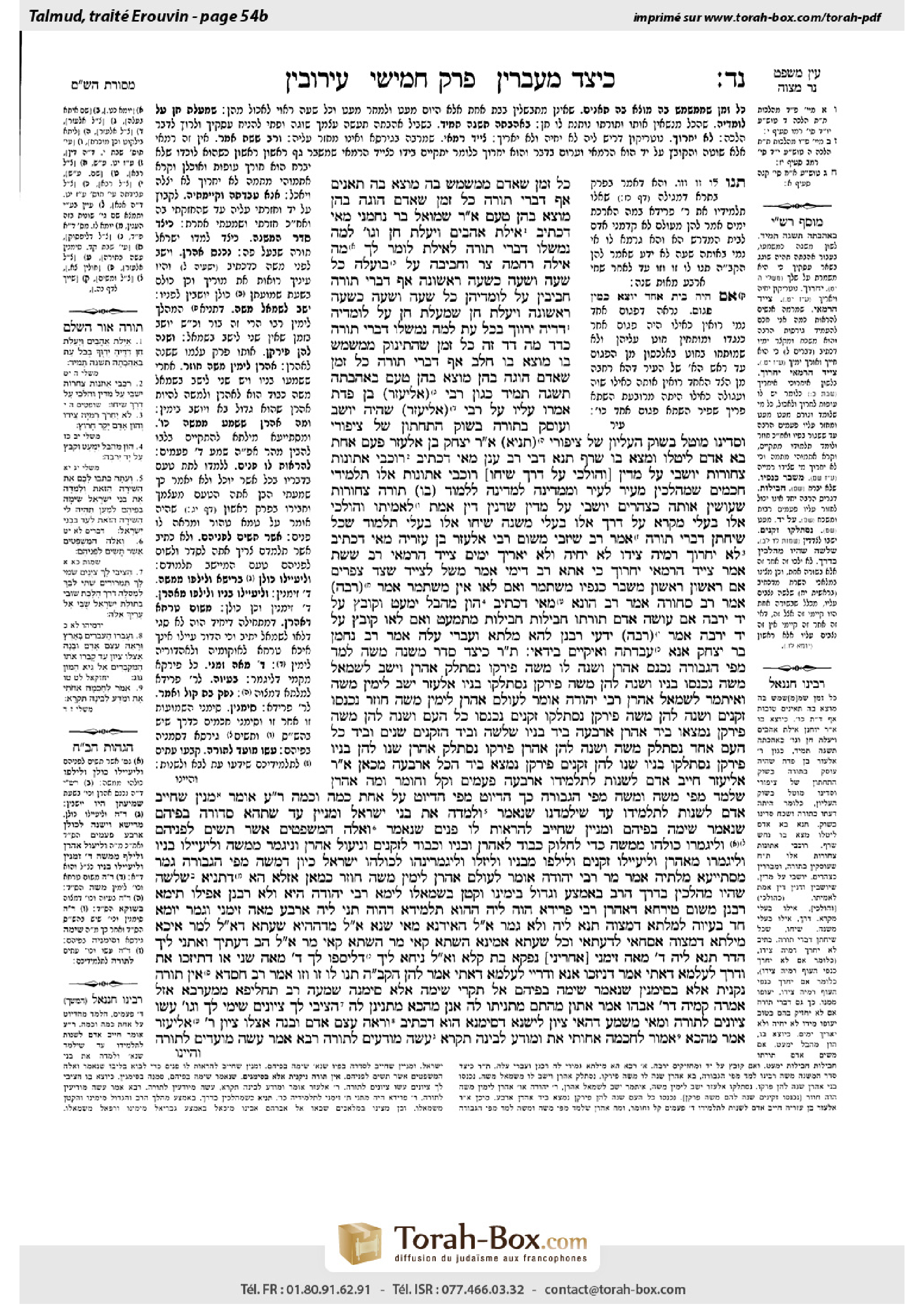
Eruvin 54b: Talmud study for Daf Yomi
Study the Talmud for Daf Yomi with scanned pages, Hebrew text, English translations from Sefaria and AI-generated French translations.
Passage selection and English or AI-generated French translation are available where the scan has annotations. Daf Study is independent of Torah-Box and Sefaria.
Browse Eruvin · עירובין · All tractatesEruvin 54b text and translations
This page of Eruvin includes the Aramaic text, an English translation and an AI-generated French translation, alongside the scan above.
עירובין נ״ד ב · Aramaic and Hebrew text
כׇּל זְמַן שֶׁאָדָם מְמַשְׁמֵשׁ בָּהּ — מוֹצֵא בָּהּ תְּאֵנִים. אַף דִּבְרֵי תוֹרָה, כׇּל זְמַן שֶׁאָדָם הוֹגֶה בָּהֶן — מוֹצֵא בָּהֶן טַעַם.
אָמַר רַבִּי שְׁמוּאֵל בַּר נַחְמָנִי: מַאי דִּכְתִיב ״אַיֶּלֶת אֲהָבִים וְיַעֲלַת חֵן וְגוֹ׳״, לָמָּה נִמְשְׁלוּ דִּבְרֵי תוֹרָה לְאַיֶּלֶת? לוֹמַר לָךְ: מָה אַיָּלָה רַחְמָהּ צַר, וַחֲבִיבָה עַל בּוֹעֲלָהּ כׇּל שָׁעָה וְשָׁעָה כְּשָׁעָה רִאשׁוֹנָה — אַף דִּבְרֵי תוֹרָה חֲבִיבִין עַל לוֹמְדֵיהֶן כׇּל שָׁעָה וְשָׁעָה כְּשָׁעָה רִאשׁוֹנָה.
״וְיַעֲלַת חֵן״ — שֶׁמַּעֲלָת חֵן עַל לוֹמְדֶיהָ. ״דַּדֶּיהָ יְרַוֻּךָ בְכׇל עֵת״ — לָמָּה נִמְשְׁלוּ דִּבְרֵי תוֹרָה כְּדַד? מָה דַּד זֶה כׇּל זְמַן שֶׁהַתִּינוֹק מְמַשְׁמֵשׁ בּוֹ — מוֹצֵא בּוֹ חָלָב, אַף דִּבְרֵי תוֹרָה, כׇּל זְמַן שֶׁאָדָם הוֹגֶה בָּהֶן — מוֹצֵא בָּהֶן טַעַם.
״בְּאַהֲבָתָהּ תִּשְׁגֶּה תָּמִיד״ — כְּגוֹן רַבִּי (אֱלִיעֶזֶר) בֶּן פְּדָת. אָמְרוּ עָלָיו עַל רַבִּי (אֱלִיעֶזֶר) שֶׁהָיָה יוֹשֵׁב וְעוֹסֵק בַּתּוֹרָה בַּשּׁוּק הַתַּחְתּוֹן שֶׁל צִיפּוֹרִי, וּסְדִינוֹ מוּטָל בַּשּׁוּק הָעֶלְיוֹן שֶׁל צִיפּוֹרִי. (תַּנְיָא) אָמַר רַבִּי יִצְחָק בֶּן אֶלְעָזָר: פַּעַם אַחַת בָּא אָדָם לִיטְּלוֹ, וּמָצָא בּוֹ שָׂרָף.
תָּנָא דְּבֵי רַב עָנָן: מַאי דִּכְתִיב ״רוֹכְבֵי אֲתוֹנוֹת צְחוֹרוֹת יוֹשְׁבֵי עַל מִדִּין [וְהוֹלְכֵי עַל דֶּרֶךְ שִׂיחוּ]״, ״רוֹכְבַי אֲתוֹנוֹת״ — אֵלּוּ תַּלְמִידֵי חֲכָמִים, שֶׁמְּהַלְּכִין מֵעִיר לְעִיר וּמִמְּדִינָה לִמְדִינָה לִלְמוֹד (בּוֹ) תּוֹרָה. ״צְחוֹרוֹת״ — שֶׁעוֹשִׂין אוֹתָהּ כְּצָהֳרַיִם. ״יֹשְׁבֵי עַל מִדִּין״ — שֶׁדָּנִין דִּין אֱמֶת לַאֲמִיתּוֹ. ״וְהוֹלְכֵי״ — אֵלּוּ בַּעֲלֵי מִקְרָא. ״עַל דֶּרֶךְ״ — אֵלּוּ בַּעֲלֵי מִשְׁנָה. ״שִׂיחוּ״ — אֵלּוּ בַּעֲלֵי תַלְמוּד, שֶׁכׇּל שִׂיחָתָן דִּבְרֵי תוֹרָה.
אָמַר רַב שֵׁיזְבִי מִשּׁוּם רַבִּי אֶלְעָזָר בֶּן עֲזַרְיָה: מַאי דִּכְתִיב ״לֹא יַחֲרוֹךְ רְמִיָּה צֵידוֹ״ — לֹא יִחְיֶה וְלֹא יַאֲרִיךְ יָמִים צַיָּיד הָרַמַּאי.
רַב שֵׁשֶׁת אָמַר: צַיָּיד הָרַמַּאי יַחֲרוֹךְ?
כִּי אֲתָא רַב דִּימִי, אָמַר: מָשָׁל לְצַיָּיד שֶׁצָּד צִפֳּרִים, אִם רִאשׁוֹן רִאשׁוֹן מְשַׁבֵּר כְּנָפָיו — מִשְׁתַּמֵּר, וְאִם לָאו — אֵין מִשְׁתַּמֵּר.
אָמַר (רַבָּה) אָמַר רַב סְחוֹרָה אָמַר רַב הוּנָא: מַאי דִּכְתִיב ״הוֹן מֵהֶבֶל יִמְעָט וְקוֹבֵץ עַל יָד יַרְבֶּה״, אִם עוֹשֶׂה אָדָם תּוֹרָתוֹ חֲבִילוֹת חֲבִילוֹת, — מִתְמַעֵט, וְאִם לָאו — קוֹבֵץ עַל יָד יַרְבֶּה.
אָמַר רַבָּה: יָדְעִי רַבָּנַן לְהָא מִלְּתָא, וְעָבְרִי עֲלַהּ. אָמַר רַב נַחְמָן בַּר יִצְחָק: אֲנָא עֲבַדְתַּהּ, וְאִיקַּיַּים בִּידַאי.
תָּנוּ רַבָּנַן, כֵּיצַד סֵדֶר מִשְׁנָה: מֹשֶׁה לָמַד מִפִּי הַגְּבוּרָה. נִכְנַס אַהֲרֹן, וְשָׁנָה לוֹ מֹשֶׁה פִּירְקוֹ, נִסְתַּלֵּק אַהֲרֹן וְיָשַׁב לִשְׂמֹאל מֹשֶׁה. נִכְנְסוּ בָּנָיו, וְשָׁנָה לָהֶן מֹשֶׁה פִּירְקָן. נִסְתַּלְּקוּ בָּנָיו, אֶלְעָזָר יָשַׁב לִימִין מֹשֶׁה, וְאִיתָמָר לִשְׂמֹאל אַהֲרֹן. רַבִּי יְהוּדָה אוֹמֵר: לְעוֹלָם אַהֲרֹן לִימִין מֹשֶׁה חוֹזֵר. נִכְנְסוּ זְקֵנִים וְשָׁנָה לָהֶן מֹשֶׁה פִּירְקָן. נִסְתַּלְּקוּ זְקֵנִים, נִכְנְסוּ כׇּל הָעָם וְשָׁנָה לָהֶן מֹשֶׁה פִּירְקָן. נִמְצְאוּ בְּיַד אַהֲרֹן אַרְבָּעָה, בְּיַד בָּנָיו שְׁלֹשָׁה, וּבְיַד הַזְּקֵנִים שְׁנַיִם, וּבְיַד כׇּל הָעָם אֶחָד.
נִסְתַּלֵּק מֹשֶׁה וְשָׁנָה לָהֶן אַהֲרֹן פִּירְקוֹ. נִסְתַּלֵּק אַהֲרֹן שָׁנוּ לָהֶן בָּנָיו פִּירְקָן. נִסְתַּלְּקוּ בָּנָיו, שָׁנוּ לָהֶן זְקֵנִים פִּירְקָן. נִמְצָא בְּיַד הַכֹּל אַרְבָּעָה.
מִכָּאן אָמַר רַבִּי אֱלִיעֶזֶר: חַיָּיב אָדָם לִשְׁנוֹת לְתַלְמִידוֹ אַרְבָּעָה פְּעָמִים. וְקַל וָחוֹמֶר, וּמָה אַהֲרֹן שֶׁלָּמַד מִפִּי מֹשֶׁה, וּמֹשֶׁה מִפִּי הַגְּבוּרָה — כָּךְ, הֶדְיוֹט מִפִּי הֶדְיוֹט — עַל אַחַת כַּמָּה וְכַמָּה.
רַבִּי עֲקִיבָא אוֹמֵר: מִנַּיִן שֶׁחַיָּיב אָדָם לִשְׁנוֹת לְתַלְמִידוֹ עַד שֶׁיִּלְמָדֶנּוּ — שֶׁנֶּאֱמַר: ״וְלַמְּדָהּ אֶת בְּנֵי יִשְׂרָאֵל״, וּמִנַּיִן עַד שֶׁתְּהֵא סְדוּרָה בְּפִיהֶם — שֶׁנֶּאֱמַר: ״שִׂימָהּ בְּפִיהֶם״,
וּמִנַּיִין שֶׁחַיָּיב לְהַרְאוֹת לוֹ פָּנִים — שֶׁנֶּאֱמַר: ״וְאֵלֶּה הַמִּשְׁפָּטִים אֲשֶׁר תָּשִׂים לִפְנֵיהֶם״.
וְלִיגְמְרוּ כּוּלְּהוּ מִמֹּשֶׁה! כְּדֵי לַחֲלוֹק כָּבוֹד לְאַהֲרֹן וּבָנָיו, וְכָבוֹד לַזְּקֵנִים.
וְנֵיעוּל אַהֲרֹן וְנִיגְמַר מִמֹּשֶׁה, וְלִיעַיְילוּ בָּנָיו וְלִיגְמְרוּ מֵאַהֲרֹן, וְלִיעַיְילוּ זְקֵנִים וְלֵילְפוּ מִבָּנָיו, וְלֵיזְלוּ וְלַיגְמְרִינְהוּ לְכוּלְּהוּ יִשְׂרָאֵל! כֵּיוָן דְּמֹשֶׁה מִפִּי הַגְּבוּרָה גָּמַר, מִסְתַּיְּיעָא מִלְּתֵיהּ.
אָמַר מָר, רַבִּי יְהוּדָה אוֹמֵר: לְעוֹלָם אַהֲרֹן לִימִין מֹשֶׁה חוֹזֵר. כְּמַאן אָזְלָא הָא דְּתַנְיָא: שְׁלֹשָׁה שֶׁהָיוּ מְהַלְּכִין בַּדֶּרֶךְ — הָרַב בָּאֶמְצַע, וְגָדוֹל בִּימִינוֹ, וְקָטָן בִּשְׂמֹאלוֹ. לֵימָא רַבִּי יְהוּדָה הִיא וְלָא רַבָּנַן?
אֲפִילּוּ תֵּימָא רַבָּנַן, מִשּׁוּם טִירְחָא דְאַהֲרֹן.
רַבִּי פְּרִידָא הֲוָה לֵיהּ הָהוּא תַּלְמִידָא דַּהֲוָה תָּנֵי לֵיהּ אַרְבַּע מְאָה זִימְנֵי וְגָמַר. יוֹמָא חַד בַּעְיוּהּ לְמִלְּתָא דְמִצְוָה. תְּנָא לֵיהּ וְלָא גְּמַר.
אֲמַר לֵיהּ: הָאִידָּנָא מַאי שְׁנָא? אֲמַר לֵיהּ: מִדְּהָהִיא שַׁעְתָּא דַּאֲמַר לֵיהּ לְמָר אִיכָּא מִילְּתָא דְּמִצְוָה — אַסְּחַאי לְדַעְתַּאי, וְכׇל שַׁעְתָּא אָמֵינָא: הַשְׁתָּא קָאֵי מָר, הַשְׁתָּא קָאֵי מָר. אֲמַר לֵיהּ: הַב דַּעְתָּיךְ וְאַתְנֵי לִיךְ. הֲדַר תְּנָא לֵיהּ אַרְבַּע מְאָה זִימְנֵי [אַחֲרִינֵי].
נְפַקָא בַּת קָלָא וַאֲמַר לֵיהּ: נִיחָא לָיךְ דְּלִיסְפּוֹ לָךְ אַרְבַּע מְאָה שְׁנֵי, אוֹ דְּתִיזְכּוֹ אַתְּ וְדָרָךְ לְעָלְמָא דְּאָתֵי? אָמַר: דְּנִיזְכּוֹ אֲנָא וְדָרַיי לְעָלְמָא דְּאָתֵי. אָמַר לָהֶן הַקָּדוֹשׁ בָּרוּךְ הוּא: תְּנוּ לוֹ זוֹ וָזוֹ.
אָמַר רַב חִסְדָּא: אֵין תּוֹרָה נִקְנֵית אֶלָּא בְּסִימָנִין, שֶׁנֶּאֱמַר: ״שִׂימָהּ בְּפִיהֶם״, אַל תִּקְרֵי ׳שִׂימָהּ׳, אֶלָּא ׳סַיְּמֶנָּהּ׳.
שַׁמְעַהּ רַב תַּחְלִיפָא מִמַּעְרְבָא, אֲזַל אַמְרַהּ קַמֵּיהּ דְּרַבִּי אֲבָהוּ, אֲמַר: אַתּוּן מֵהָתָם מַתְנִיתוּ לַהּ, אֲנַן מֵהָכָא מַתְנִינַן לַהּ: ״הַצִּיבִי לָךְ צִיּוּנִים שִׂימִי לָךְ וְגוֹ׳״ — עֲשׂוּ צִיּוּנִים לַתּוֹרָה. וּמַאי מַשְׁמַע דְּהַאי צִיּוּן לִישָּׁנָא דְסִימָנָא הוּא? דִּכְתִיב: ״וְרָאָה עֶצֶם אָדָם וּבָנָה אֶצְלוֹ צִיּוּן״.
רַבִּי אֱלִיעֶזֶר אָמַר, מֵהָכָא: ״אֱמוֹר לַחׇכְמָה אֲחוֹתִי אָתְּ וּמוֹדָע לַבִּינָה תִקְרָא״ — עֲשֵׂה מוֹדָעִים לַתּוֹרָה. רָבָא אָמַר: עֲשֵׂה מוֹעֲדִים לַתּוֹרָה.
Eruvin 54b · English translation
whenever a person searches it for figs to eat, he finds figs in it, as the figs on a tree do not ripen all at once, so that one can always find a recently ripened fig, so too, with matters of Torah. Whenever a person meditates upon them, he finds in them new meaning.
Rabbi Shmuel bar Naḥmani said: What is the meaning of that which is written: “A loving hind and a graceful roe, let her breasts satisfy you at all times, and be you ravished always with her love” (Proverbs 5:19)? Why were matters of Torah compared to a hind? To tell you that just as with a hind, its womb is narrow and it is cherished by its mate each and every hour like the first hour, so too, matters of Torah are cherished by those who study them each and every hour like the first hour.
“And a graceful roe” is expounded as follows: That the Torah bestows grace upon those who study it. “Let her breasts satisfy you at all times”; why were matters of Torah compared to a breast? Just as with a breast, whenever a baby searches it for milk to suckle, he finds milk in it, so too, with matters of Torah. Whenever a person meditates upon them, he finds new meaning in them.
“And be you ravished always with her love”; your love for Torah should always distract you from worldly matters, as was the case with Rabbi Elazar ben Pedat. They said of him, of Rabbi Elazar, that he would sit and engage in Torah study in the lower marketplace of Tzippori, and his cloak was lying in the upper marketplace of Tzippori. His mind was so focused on Torah study that he would act in this unusual manner. In this regard, the Gemara relates that it was taught in a baraita that Rabbi Yitzḥak ben Elazar said: One time a person came to take this cloak for himself and found a serpent on it guarding it.
In further praise of the Torah and those who study it, a Sage of the school of Rav Anan taught: What is the meaning of that which is written: “You that ride on white donkeys, you that sit on rich cloths, and you that walk by the way, tell of it” (Judges 5:10)? “You that ride on white donkeys”; these are Torah scholars, who travel from city to city and from province to province to study Torah. “White [tzeḥorot]” are those who make it clear as noon [tzahorayim], i.e., who make the Torah comprehensible. “You that sit on couches [midin]” refers to those who judge [danin] an absolutely true judgment. “And you that walk”; these are the masters of Bible, who are the least important of the scholars. “By the way”; these are the more important masters of Mishna. “Tell of it”; these are the masters of Talmud, the most important of all, as all their conversation is about matters of Torah.
The Gemara continues with this topic: Rav Sheizvi said in the name of Rabbi Elazar ben Azarya: What is the meaning of that which is written: “The slothful man [remiyya] will not roast [yaḥarokh] his catch” (Proverbs 12:27)? The deceitful [rammai] hunter will not live [yiḥyeh] a long life [ya’arikh]. A deceitful hunter continues to hunt more and more animals without holding on to the animals he has already caught. Similarly, someone who continues to study new material without reviewing what he has already learned will not be successful.
Rav Sheshet said: Will a deceitful hunter have something to roast? One who acts in this way is a fool, but it is hard to describe him as deceitful.
When Rav Dimi came from Eretz Yisrael to Babylonia, he said: This is comparable to a hunter who is hunting birds; if he breaks the wings of the birds one by one as he captures them so that they will be unable to fly off again, his prey will be secured, and if not, they will not be secured. According to this explanation, the word rammai is interpreted as cunning rather than deceitful. A cunning hunter secures his prey; similarly, a cunning student reviews each lesson and thereby retains that which he learns.
Similarly, Rabba said that Rav Seḥora said that Rav Huna said: What is the meaning of that which is written: “Wealth gotten through vanity [hevel] shall be diminished; but he that gathers little by little shall increase” (Proverbs 13:11)? If a person turns his Torah into bundles [ḥavilot, derived from the word hevel by replacing the heh with a ḥet], studying large amounts at the same time, his Torah will diminish. And if not, i.e., if he learns little by little and reviews what he has learned, he that gathers little by little shall increase.
Rabba said: The Sages know this, but nevertheless transgress it, i.e., they fail to heed this advice. Rav Naḥman bar Yitzḥak said: I did this, learning little by little and regularly reviewing what I had learned, and my learning has indeed endured.
The Gemara continues to discuss methods of Torah study. The Sages taught the following baraita: What was the order of teaching the Oral Law? How was the Oral Law first taught? Moses learned directly from the mouth of the Almighty. Aaron entered and sat before him, and Moses taught him his lesson as he had learned it from God. Aaron moved aside and sat to the left of Moses. Aaron’s sons entered, and Moses taught them their lesson while Aaron listened. Aaron’s sons moved aside; Elazar sat to the right of Moses and Itamar sat to the left of Aaron. Rabbi Yehuda disagreed with the first tanna with regard to the seating arrangements and said: Actually, Aaron would return to sit to the right of Moses. The elders entered and Moses taught them their lesson. The elders moved aside, and the entire nation entered and Moses taught them their lesson. Therefore, Aaron had heard the lesson four times, his sons heard it three times, the elders heard it twice, and the entire nation heard it once.
Moses then departed to his tent, and Aaron taught the others his lesson as he had learned it from Moses. Aaron then departed and his sons taught the others their lesson. His sons then departed and the elders taught the rest of the people their lesson. Hence everyone, Aaron, his sons, the elders and all the people, heard the lesson taught by God four times.
From here Rabbi Eliezer said: A person is obligated to teach his student his lesson four times. And it follows by way of an a fortiori inference: If Aaron, who learned from Moses himself, and Moses had received the Torah directly from the mouth of the Almighty, needed this regimen; an ordinary student learning from the mouth of an ordinary teacher, how much more so must he review his studies four times.
Rabbi Akiva says: From where do we derive that a person is obligated to teach his student until he learns the material and understands it? As it is stated: “Now therefore write this song for you, and teach it to the children of Israel; put it in their mouths, that this song may be a witness for me against the children of Israel” (Deuteronomy 31:19). This verse indicates that one must teach Torah to others. And from where do we derive that one must teach his students until the material is organized in their mouths? As it is stated: “Put it in their mouths,” so that they should be capable of teaching it to others.
And from where do we derive that a teacher must show his students the reasons for the teachings? As it is stated: “Now these are the judgments which you shall set before them” (Exodus 21:1), which indicates that the lesson must be set out in logical fashion for the students.
With regard to the manner in which the Oral Law was taught, the Gemara asks: They should all have studied from Moses himself four times. The Gemara answers: The teaching was divided in this manner in order to give honor to Aaron and his sons, and also to give honor to the elders.
The Gemara asks why a different method was not adopted, one which would have involved less trouble for Moses: Aaron should have entered and studied from Moses; his sons should then have entered and studied from Aaron; the elders should then have entered and studied from Aaron’s sons; and then they should have gone out and taught all of the Jewish people. The Gemara answers: Since Moses had studied directly from the mouth of the Almighty, it would be more effective for everyone to hear the Torah at least once from Moses himself.
The Master said in the baraita that Rabbi Yehuda says: Actually, Aaron would return to sit to the right of Moses, i.e., no matter how many people were present Aaron always sat to Moses’ right. The Gemara asks: In accordance with whose opinion was it taught in a baraita dealing with the rules of etiquette: If three people were walking along the way, the teacher should walk in the middle and the greater of the two students should be to his right and the lesser one should be to his left? Shall we say that it is the opinion of Rabbi Yehuda and not that of the Sages? According to the Sages, the greater of the two students should be positioned to the left of the teacher so that the student’s right side faces his teacher.
The Gemara answers: You can even say that this baraita was taught in accordance with the opinion of the Sages, and the reason they said that Aaron remained to Moses’ left even after the others entered is due to the trouble to Aaron if he would have to stand up and sit down again.
Having discussed the importance of reviewing one’s Torah study, the Gemara relates that Rabbi Perida had a certain student whom he would have to teach four hundred times, and only then would he learn the material, as he was incapable of understanding it otherwise. One day they requested Rabbi Perida’s presence for a mitzva matter after the lesson. Rabbi Perida taught his student four hundred times as usual, but this time the student did not successfully learn the material.
Rabbi Perida said to him: What is different now that you are unable to grasp the lesson? He said to him: From the time that they said to the Master that there is a mitzva matter for which he is needed, my mind was distracted from the lesson and every moment I said: Now the Master will get up, now the Master will get up to go and perform the mitzva and he will not complete the lesson. Rabbi Perida said to him: Pay attention this time and I will teach you, and know that I will not leave until you have fully mastered the lesson. He taught him again an additional four hundred times.
Due to the merit of Rabbi Perida’s great devotion to his students, a Divine Voice emerged and said to him: Is it preferable to you that four hundred years be added to your life, or that you and the rest of your generation will merit the World-to-Come? He said: I prefer that I and my generation merit the World-to-Come. The Holy One, Blessed be He, said to the angels: Give him both; he shall live a very long life and he and the rest of his generation will merit the World-to-Come.
The Gemara continues its discussion with regard to methods of Torah study: Rav Ḥisda said: The Torah can be acquired only with mnemonic signs that aid the memory, as it is stated: “Put it in their mouths.” Do not read the phrase as: Put it [simah], but rather as: Its sign [simanah], thus indicating that mnemonic signs aid in memorizing the material.
Rav Taḥalifa of the West, i.e., from Eretz Yisrael, heard this statement and went and said it before Rabbi Abbahu, who said: You learn this idea from there; we learn it from here, as the verse states: “Set up signposts [tziyyunim] for yourself; establish you markers” (Jeremiah 31:20), which is understood to mean: Establish mnemonic signs for the Torah. And from where may it be inferred that this term tziyyun denotes a sign? As it is written in a different verse: “And when they that pass through shall pass through the land, and any sees a human bone, he shall set up a sign [tziyyun] by it” (Ezekiel 39:15), i.e., a sign that there is a source of ritual impurity at that spot.
Rabbi Eliezer said that we learn this same idea from here: “Say to wisdom, you are my sister, and call understanding, your kinswoman [moda]” (Proverbs 7:4), which means: Establish signs [moda’im] that convey knowledge of the Torah. Rava said with regard to this verse: Set appointed times [mo’adim] for Torah study.
Eruvin 54b · Traduction française (IA)
Quand une personne cherche des figues pour les manger, elle en trouve toujours, car les figues ne mûrissent pas toutes en même temps, de sorte qu'on peut toujours trouver une figue récemment mûrie. De même, concernant les enseignements de la Torah, quand une personne médite dessus, elle y découvre un nouveau sens.
Rabbi Shmuel bar Naḥmani a dit : Quelle est la signification de ce qui est écrit : « Une chèvre tendre et une biche gracieuse, que ses seins te satisfont toujours, et sois toujours enivré de son amour » (Proverbes 5:19) ? Pourquoi les enseignements de la Torah sont-ils comparés à une biche ? Pour t'indiquer que, comme la biche, son ventre est étroit et elle est chérie par son compagnon chaque heure, comme la première heure, de même, les enseignements de la Torah sont chérie par ceux qui les étudient chaque heure, comme la première heure.
« Et une biche gracieuse » est expliqué ainsi : La Torah accorde de la grâce à ceux qui l'étudient. « Que ses seins te satisfont toujours » ; pourquoi les enseignements de la Torah sont-ils comparés à un sein ? Comme un sein, quand un bébé cherche du lait pour téter, il le trouve toujours, de même, concernant les enseignements de la Torah. Quand une personne médite dessus, elle y découvre un nouveau sens.
« Et sois toujours enivré de son amour » ; ton amour pour la Torah doit toujours t'occuper des affaires du monde, comme c'était le cas de Rabbi Elazar ben Pedat. On disait de lui, de Rabbi Elazar, qu'il s'asseyait pour étudier la Torah dans le marché inférieur de Tzippori, et son manteau était posé dans le marché supérieur de Tzippori. Son esprit était si concentré sur l'étude de la Torah qu'il agissait ainsi de manière inhabituelle. À ce sujet, la Guemara rapporte que cela a été enseigné dans une baraïta que Rabbi Yitzḥak ben Elazar a dit : Un jour, une personne voulait prendre ce manteau pour lui-même et a trouvé un serpent le gardant.
Pour plus d'éloge de la Torah et de ceux qui l'étudient, un Sage de la maison de Rav Anan a enseigné : Quelle est la signification de ce qui est écrit : « Vous qui montez sur des ânes blancs, vous qui êtes assis sur des tissus riches, et vous qui marchez sur la route, racontez cela » (Juges 5:10) ? « Vous qui montez sur des ânes blancs » : ce sont les savants de la Torah, qui voyagent d'une ville à l'autre et d'une province à l'autre pour étudier la Torah. « Des ânes blancs [tzeḥorot] » : ceux qui rendent la Torah claire comme le midi [tzahorayim], c'est-à-dire ceux qui rendent la Torah compréhensible. « Vous qui êtes assis sur des coussins [midin] » : ceux qui rendent un jugement absolument juste. « Et vous qui marchez » : ce sont les maîtres de la Bible, qui sont les moins importants des savants. « Sur la route » : ce sont les maîtres plus importants de la Michna. « Racontez cela » : ce sont les maîtres de la Talmud, les plus importants de tous, car toute leur conversation est sur des questions de Torah.
La Guemara poursuit sur ce sujet : Rav Sheizvi a dit au nom de Rabbi Elazar ben Azarya : Quelle est la signification de ce qui est écrit : « Le paresseux [remiyya] ne cuisinera pas [yaḥarokh] sa prise » (Proverbes 12:27) ? Le chasseur trompeur [rammai] ne vivra pas [yiḥyeh] longtemps [ya’arikh]. Un chasseur trompeur continue à chasser plus et plus d'animaux sans tenir les animaux qu'il a déjà attrapés. De même, une personne qui continue à étudier de nouveaux matériaux sans réviser ce qu'elle a déjà appris ne sera pas réussie.
Rav Sheshet a dit : Un chasseur trompeur aura-t-il quelque chose à cuire ? Celui qui agit ainsi est un imbécile, mais il est difficile de le décrire comme trompeur.
Quand Rav Dimi est venu de la Terre d'Israël vers Babylone, il a dit : Cela est comparable à un chasseur qui chasse des oiseaux ; s'il casse les ailes des oiseaux un par un alors qu'il les attrape, de sorte qu'ils ne puissent plus s'envoler, sa proie sera assurée, et si non, elle ne le sera pas. Selon cette explication, le mot rammai est interprété comme rusé plutôt que trompeur. Un chasseur rusé assure sa proie ; de même, un étudiant rusé révise chaque leçon et ainsi retient ce qu'il apprend.
De même, Rabba a dit que Rav Seḥora a dit que Rav Huna a dit : Quelle est la signification de ce qui est écrit : « La richesse obtenue par vanité [hevel] sera diminuée ; mais celui qui accumule peu à peu augmentera » (Proverbes 13:11) ? Si une personne transforme sa Torah en ballots [ḥavilot, dérivé du mot hevel en remplaçant le hei par un ḥet], en étudiant beaucoup à la fois, sa Torah diminuera. Et si non, c'est-à-dire s'il apprend peu à peu et révise ce qu'il a appris, celui qui accumule peu à peu augmentera.
Rabba a dit : Les Sages savent cela, mais néanmoins en transgressent, c'est-à-dire qu'ils négligent ce conseil. Rav Naḥman bar Yitzḥak a dit : J'ai fait cela, en apprenant peu à peu et en révisant régulièrement ce que j'avais appris, et mon apprentissage a effectivement duré.
La Guemara continue à discuter des méthodes d'étude de la Torah. Les Sages ont enseigné la suivante baraïta : Quel était l'ordre de transmission de la Loi orale ? Comment la Loi orale a-t-elle été enseignée en premier ? Moïse a appris directement de la bouche du Très Haut. Aaron est entré et s'est assis devant lui, et Moïse lui a enseigné sa leçon comme il l'avait apprise de Dieu. Aaron s'est écarté et s'est assis à gauche de Moïse. Les fils d'Aaron sont entrés, et Moïse a enseigné leur leçon pendant que Aaron écoutait. Les fils d'Aaron s'étaient écartés ; Elazar s'est assis à droite de Moïse et Itamar à gauche d'Aaron. Rabbi Yehuda a désaccordé le premier tanna concernant les dispositions et a dit : En réalité, Aaron serait revenu s'asseoir à droite de Moïse. Les anciens sont entrés et Moïse a enseigné leur leçon. Les anciens s'étaient écartés, et toute la nation est entrée et Moïse a enseigné leur leçon. Ainsi, Aaron avait entendu la leçon quatre fois, ses fils trois fois, les anciens deux fois, et toute la nation une fois.
Moïse est ensuite parti dans son tenture, et Aaron a enseigné à d'autres la leçon qu'il avait apprise de Moïse. Aaron est ensuite parti et ses fils ont enseigné à d'autres leur leçon. Ses fils sont ensuite partis et les anciens ont enseigné à tout le peuple leur leçon. Ainsi, tout le monde, Aaron, ses fils, les anciens et toute la nation, a entendu la leçon enseignée par Dieu quatre fois.
D'ici, le maître Eliezer dit : Une personne est tenue de faire apprendre à son élève son cours quatre fois. Et cela s'ensuit par une déduction a fortiori : Si Aaron, qui apprit directement de Moïse lui-même, et Moïse ayant reçu la Torah directement de la bouche du Très-Haut, avait besoin de ce système ; un élève ordinaire apprenant de la bouche d'un professeur ordinaire, combien plus encore doit-il réviser ses études quatre fois.
Rabbi Akiva dit : D'où dérivons-nous que l'on est tenu de faire apprendre à son élève jusqu'à ce qu'il comprenne le matériel ? Comme il est dit : « Maintenant donc écris ce chant pour toi, et apprends-le aux enfants d'Israël ; mets-le dans leurs bouches, afin que ce chant soit un témoin contre les enfants d'Israël » (Deutéronome 31:19). Cette versette indique que l'on doit enseigner la Torah aux autres. Et d'où dérivons-nous que l'on doit enseigner à ses élèves jusqu'à ce que le matériel soit organisé dans leurs bouches ? Comme il est dit : « Mets-le dans leurs bouches », afin qu'ils puissent enseigner à leur tour.
Et d'où dérivons-nous que le professeur doit montrer à ses élèves les raisons des enseignements ? Comme il est dit : « Ces sont les jugements que vous donnerez devant eux » (Exode 21:1), ce qui indique que le cours doit être présenté de manière logique aux élèves.
En ce qui concerne la manière dont la Loi Orale a été enseignée, la Guemara pose la question : Ils auraient tous dû étudier directement de la bouche de Moïse quatre fois. La Guemara répond : L'enseignement a été divisé ainsi afin d'honorer Aaron et ses fils, ainsi que les anciens.
La Guemara pose la question : Pourquoi ne pas avoir adopté une méthode différente, qui aurait entraîné moins de travail pour Moïse : Aaron aurait dû entrer et étudier avec Moïse ; ses fils auraient ensuite dû entrer et étudier avec Aaron ; les anciens auraient ensuite dû entrer et étudier avec les fils d'Aaron ; et ensuite ils auraient dû sortir et enseigner tout le peuple juif. La Guemara répond : Puisque Moïse avait étudié directement de la bouche du Très-Haut, il serait plus efficace que tout le monde écoute la Torah au moins une fois directement de la bouche de Moïse.
Le Maître a dit dans la baraïta que Rabbi Yéhuda dit : En réalité, Aaron revenait s'asseoir à droite de Moïse, c'est-à-dire, peu importe combien de personnes étaient présentes, Aaron s'asseyait toujours à droite de Moïse. La Guemara pose la question : Selon l'opinion de qui a-t-il été enseigné dans une baraïta concernant les règles de politesse : Si trois personnes marchaient sur la route, le professeur devait marcher au milieu et le plus grand des deux élèves à sa droite et le plus petit à sa gauche ? Devons-nous dire que c'est l'opinion de Rabbi Yéhuda et non celle des Sages ? Selon les Sages, le plus grand des deux élèves devait être placé à gauche du professeur afin que le côté droit de l'élève soit tourné vers son professeur.
Le Guemara répond : On peut même dire que cette baraïta a été enseignée selon l'opinion des Sages, et la raison pour laquelle ils disent que Aaron restait à gauche de Moïse même après que les autres entrèrent est due à l'inconfort qu'aurait eu Aaron s'il devait se lever et s'asseoir à nouveau.
Ayant discuté de l'importance de la révision des études de Torah, le Guemara rapporte que Rabbi Perida avait un élève particulier qu'il devait enseigner quatre cents fois, et seulement alors l'élève apprenait le matériel, car il ne pouvait pas le comprendre autrement. Un jour, ils demandèrent la présence de Rabbi Perida pour une affaire de mitsva après la leçon. Rabbi Perida enseigna à son élève quatre cents fois comme d'habitude, mais cette fois-ci, l'élève n'apprenait pas le matériel.
Rabbi Perida dit à l'élève : Qu'est-ce qui est différent maintenant que tu ne peux pas saisir le cours ? Il répondit : Depuis que l'on a dit au Maître qu'il y a une affaire de mitsva pour laquelle il est nécessaire, mon esprit était distrait par le cours et à chaque moment je disais : Maintenant le Maître va se lever, maintenant le Maître va se lever pour aller accomplir la mitsva et il ne terminera pas le cours. Rabbi Perida dit à l'élève : Concentre-toi cette fois-ci et je vais t'enseigner, et sais que je ne partirai pas avant que tu aies pleinement maîtrisé le cours. Il lui enseigna à nouveau quatre cents fois de plus.
En raison de la dévotion de Rabbi Perida envers ses élèves, une Voix Divine s'éleva et dit à lui : Préfères-tu que quatre cents ans soient ajoutés à ta vie, ou que toi et le reste de ta génération méritiez le Monde à Venir ? Il dit : Je préfère que moi et ma génération méritions le Monde à Venir. Le Très-Haut, béni soit-il, dit aux anges : Donnez-lui les deux ; il vivra une très longue vie et lui et le reste de sa génération mériteront le Monde à Venir.
Le Guemara continue sa discussion concernant les méthodes d'étude de la Torah : Rav Ḥisda dit : La Torah peut être acquise seulement avec des signes mnémoniques qui aident à la mémoire, comme il est dit : « Mets-le dans leurs bouches ». Ne lis pas la phrase comme : Mets [simah], mais plutôt comme : Son signe [simanah], ce qui indique que les signes mnémoniques aident à mémoriser le matériel.
Rav Taḥalifa de l'Ouest, c'est-à-dire de la Terre d'Israël, entendit cette déclaration et alla et la dit devant Rabbi Abbahu, qui dit : Tu apprends cette idée d'ici ; nous l'apprenons d'ici, comme la versette dit : « Établis des signes [tziyyunim] pour toi ; établis des repères » (Jérémie 31:20), ce qui signifie : Établis des signes mnémoniques pour la Torah. Et d'où peut-on déduire que ce terme tziyyun désigne un signe ? Comme il est écrit dans une autre versette : « Et quand ceux qui passent par là passeront par la terre, et quiconque verra un os humain, il établira un signe [tziyyun] à côté de lui » (Ezechiel 39:15), c'est-à-dire un signe indiquant qu'il y a une source de souillure rituelle à cet endroit.
Le Rabbi Eliezer a dit que nous apprenons cette même idée ici : « Dites à la sagesse : tu es ma sœur, et appelez la compréhension, ta parente [moda] » (Proverbes 7:4), ce qui signifie : Établissez des signes [moda’im] qui transmettent la connaissance de la Torah. Rava a dit concernant cette versette : Fixez des moments [mo’adim] pour l'étude de la Torah.
Traduction française générée par IA à partir de l’édition anglaise de Sefaria. Vérifie toujours un passage avec le texte source.
Text from Sefaria: William Davidson Edition - Vocalized Aramaic (CC BY NC); William Davidson Edition - English (CC BY NC).