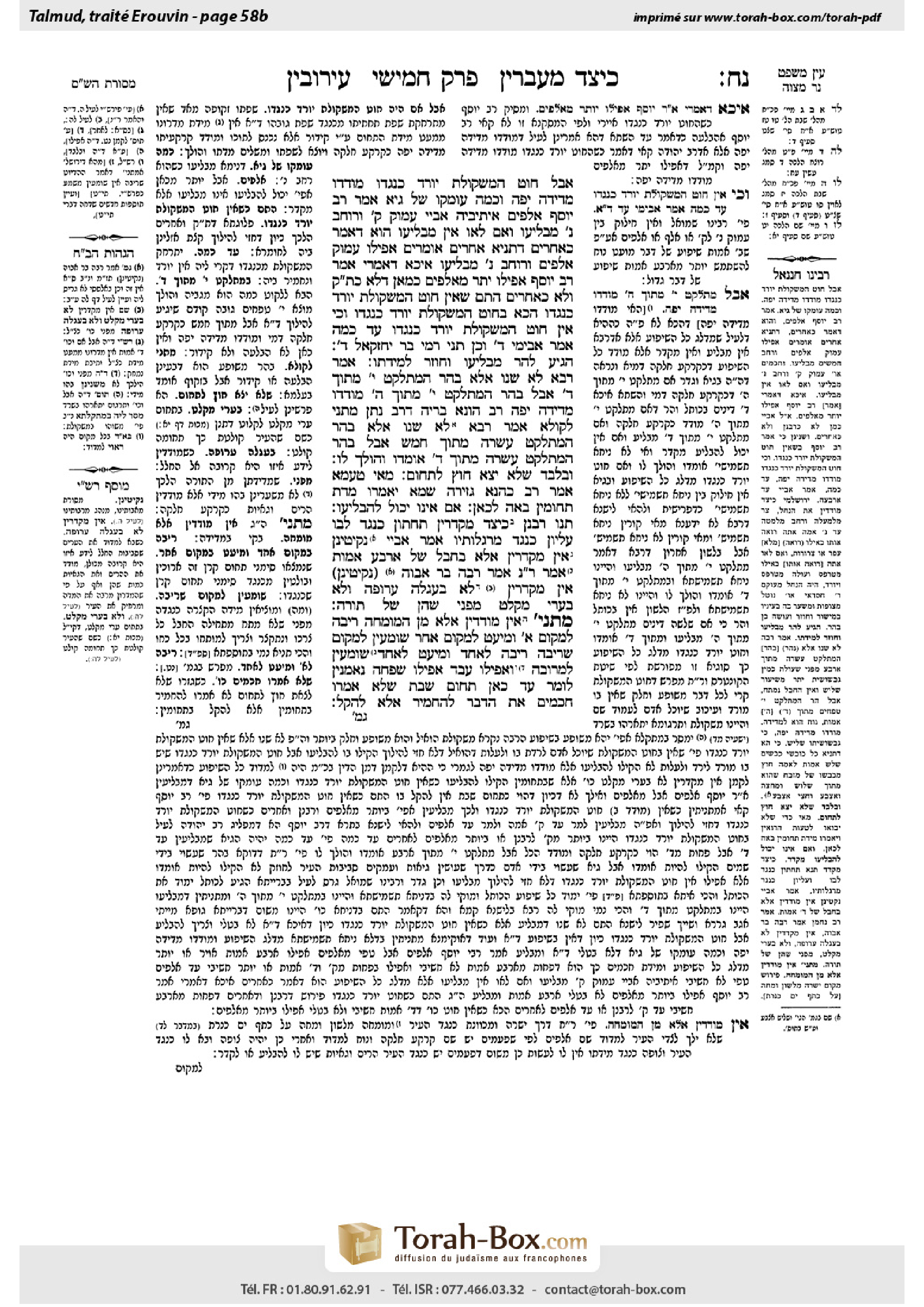
Eruvin 58b: Talmud study for Daf Yomi
Study the Talmud for Daf Yomi with scanned pages, Hebrew text, English translations from Sefaria and AI-generated French translations.
Passage selection and English or AI-generated French translation are available where the scan has annotations. Daf Study is independent of Torah-Box and Sefaria.
Browse Eruvin · עירובין · All tractatesEruvin 58b text and translations
This page of Eruvin includes the Aramaic text, an English translation and an AI-generated French translation, alongside the scan above.
עירובין נ״ח ב · Aramaic and Hebrew text
אֲבָל חוּט הַמִּשְׁקוֹלֶת יוֹרֵד כְּנֶגְדּוֹ — מוֹדְדוֹ מְדִידָה יָפָה.
וְכַמָּה עוֹמְקוֹ שֶׁל גֵּיא? אָמַר רַב יוֹסֵף: אַלְפַּיִם.
אֵיתִיבֵיהּ אַבָּיֵי: עָמוֹק מֵאָה וְרוֹחַב חֲמִשִּׁים — מַבְלִיעוֹ. וְאִם לָאו — אֵין מַבְלִיעוֹ? הוּא דְּאָמַר כַּאֲחֵרִים, דְּתַנְיָא, אֲחֵרִים אוֹמְרִים: אֲפִילּוּ עָמוֹק אַלְפַּיִם וְרוֹחַב חֲמִשִּׁים — מַבְלִיעוֹ.
אִיכָּא דְּאָמְרִי, אָמַר רַב יוֹסֵף: אֲפִילּוּ יָתֵר מֵאַלְפַּיִם. כְּמַאן? דְּלָא כְּתַנָּא קַמָּא וְלָא כַּאֲחֵרִים!
הָתָם — שֶׁאֵין חוּט הַמִּשְׁקוֹלֶת יוֹרֵד כְּנֶגְדּוֹ. הָכָא — בְּחוּט הַמִּשְׁקוֹלֶת יוֹרֵד כְּנֶגְדּוֹ.
וְכִי אֵין חוּט הַמִּשְׁקוֹלֶת יוֹרֵד כְּנֶגְדּוֹ, עַד כַּמָּה? אָמַר אֲבִימִי: אַרְבַּע. וְכֵן תָּנֵי רָמֵי בַּר יְחֶזְקֵאל: אַרְבַּע.
הִגִּיעַ לְהַר, מַבְלִיעוֹ וְחוֹזֵר לְמִידָּתוֹ. אָמַר רָבָא: לֹא שָׁנוּ אֶלָּא בְּהַר הַמִּתְלַקֵּט עֲשָׂרָה מִתּוֹךְ אַרְבַּע, אֲבָל בְּהַר הַמִּתְלַקֵּט עֲשָׂרָה מִתּוֹךְ חָמֵשׁ — מוֹדְדוֹ מְדִידָה יָפָה.
רַב הוּנָא בְּרֵיהּ דְּרַב נָתָן מַתְנֵי לְקוּלָּא. אָמַר רָבָא: לֹא שָׁנוּ אֶלָּא בְּהַר הַמִּתְלַקֵּט עֲשָׂרָה מִתּוֹךְ חָמֵשׁ, אֲבָל בְּהַר הַמִּתְלַקֵּט עֲשָׂרָה מִתּוֹךְ אַרְבַּע — אוֹמְדוֹ וְהוֹלֵךְ לוֹ.
וּבִלְבַד שֶׁלֹּא יֵצֵא חוּץ לַתְּחוּם. מַאי טַעְמָא? אָמַר רַב כָּהֲנָא: גְּזֵירָה שֶׁמָּא יֹאמְרוּ מִדַּת תְּחוּמִין בָּאָה לְכָאן.
אִם אֵינוֹ יָכוֹל לְהַבְלִיעוֹ. תָּנוּ רַבָּנַן: כֵּיצַד מְקַדְּרִין, תַּחְתּוֹן כְּנֶגֶד לִבּוֹ, עֶלְיוֹן כְּנֶגֶד מַרְגְּלוֹתָיו. אָמַר אַבָּיֵי: נְקִיטִינַן אֵין מְקַדְּרִין אֶלָּא בְּחֶבֶל שֶׁל אַרְבַּע אַמּוֹת.
אָמַר רַב נַחְמָן אָמַר רַבָּה בַּר אֲבוּהּ: (נְקִיטִינַן) אֵין מְקַדְּרִין לֹא בְּעֶגְלָה עֲרוּפָה וְלֹא בְּעָרֵי מִקְלָט — מִפְּנֵי שֶׁהֵן שֶׁל תּוֹרָה.
מַתְנִי׳ אֵין מוֹדְדִין אֶלָּא מִן הַמּוּמְחֶה. רִיבָּה לְמָקוֹם אֶחָד, וּמִיעֵט לְמָקוֹם אַחֵר — שׁוֹמְעִין לִמְקוֹם שֶׁרִיבָּה. רִיבָּה לְאֶחָד וּמִיעֵט לְאֶחָד — שׁוֹמְעִין לַמְרוּבֶּה.
וַאֲפִילּוּ עֶבֶד אֲפִילּוּ שִׁפְחָה נֶאֱמָנִין לוֹמַר עַד כָּאן תְּחוּם שַׁבָּת, שֶׁלֹּא אָמְרוּ חֲכָמִים אֶת הַדָּבָר לְהַחֲמִיר, אֶלָּא לְהָקֵל.
Eruvin 58b · English translation
However, if a plumb line drops straight down, i.e., if the canyon wall is very steep, he measures the width of the canyon properly at the bottom of the canyon, without taking its walls into account.
The Gemara asks: And what is the depth of a canyon that may be spanned if it is not more than fifty cubits wide? Rav Yosef said: Up to two thousand cubits; but if it is deeper than that, the slope must be measured as well.
Abaye raised an objection from the following baraita: If a canyon is up to one hundred cubits deep and up to fifty cubits wide, one may span it; and if not, one may not span it. How could Rav Yosef say that the canyon may be spanned if its depth is less than two thousand cubits? The Gemara answers: He stated his opinion in accordance with the opinion of Aḥerim; as it was taught in a baraita: Aḥerim say: Even if the canyon is two thousand cubits deep and fifty cubits wide, one may span it.
The Gemara cites an alternate version of the previous discussion. Some say that Rav Yosef said: Even if the canyon is more than two thousand cubits deep, it may be spanned. The Gemara asks: In accordance with whose opinion did Rav Yosef say this? It is not in accordance with the opinion of the first tanna, and it is not in accordance with the opinion of the Aḥerim.
The Gemara answers: There, where the tanna’im disagree about the depth of a canyon that may be spanned, they refer to a case where a plumb line does not drop straight down and therefore there is reason to measure the slope. Here, however, where Rav Yosef says that the canyon may be spanned even if it is more than two thousand cubits deep, he is referring to a case where a plumb line drops straight down.
The Gemara asks: And where a plumb line does not drop straight down, how much must it extend from the top of the canyon in order for the wall of the canyon to be considered a slope rather than a vertical wall? Avimi said: Four cubits. If the bed of the canyon lies four cubits beyond the top edge of the canyon, the wall is sloped and must be included in the measurement. And similarly, Rami bar Ezekiel taught, based upon a baraita, that the maximum run is four cubits.
We learned in the mishna: If he reached a hill, he does not measure its height, but rather he spans the hill as if it were not there and then resumes his measurement. Rava said: They taught this halakha only with regard to a hill that has an incline of ten handbreadths within a run of four cubits. However, with regard to a gentler hill, e.g., one that has an incline of ten handbreadths within five cubits, one must measure the hill properly, i.e., he must include the slope itself in his measurement.
The Gemara notes that Rav Huna, son of Rav Natan, teaches a lenient formulation of this halakha: Rava said that they only taught this halakha with regard to a hill that has an incline of ten handbreadths within a run of five cubits. However, with regard to a steeper hill that has an incline of ten handbreadths within four cubits, one need not take any precise measurements; instead, he estimates the length of the hill, and then leaves and continues measuring from the other side.
We learned in the mishna that one may measure a canyon or hill located within the Shabbat limit, provided that one does not go out beyond the limit. The Gemara asks: What is the reason for this restriction? Rav Kahana said: It is a decree, lest people say: The measurement of the Shabbat limit comes to here. Since people know that he set out to measure the Shabbat limit, if they see him measuring in a certain spot they will assume that the area is included in the Shabbat limit.
We learned in the mishna: If, due to the width of the canyon or hill, one cannot span it, he may pierce it. The Sages taught a baraita which explains this procedure: How does one figuratively pierce a hill? Two people hold the two ends of a measuring rope. The one who is lower down on the hill holds the rope at the level of his heart while the one who is higher holds it at the level of his feet, and they proceed to measure in this fashion. Abaye said: Based on tradition, we hold that one may pierce only with a rope of four cubits.
Rav Naḥman said that Rabba bar Avuh said: Based on tradition, we hold that one may not pierce when measuring distances for the rite of the beheaded heifer. This rite is practiced when a murder victim is found, and it is not known who killed him. Judges measure the distance from the location of the corpse to the nearest town, in order to determine which town must perform the rite (Deuteronomy 21). Similarly, one may not pierce when measuring distances with regard to cities of refuge, in order to determine the boundaries within which an accidental murderer is protected from the blood redeemer (Numbers 32). Because these measurements are from the Torah, indirect methods of measurement are insufficient. The area must be measured as though it were flat.
MISHNA: One may measure the Shabbat limit only with an expert surveyor. If it is discovered that the surveyor extended the limit in one place and reduced it in another place, so that the line marking the Shabbat limit is not straight, one accepts the measurement of the place where he extended the limit and straightens the limit accordingly. Similarly, if the surveyor extended the limit for one and reduced it for another, one accepts the extended measurement.
And furthermore, even a gentile slave and even a gentile maidservant, whose testimonies are generally considered unreliable, are trustworthy to say: The Shabbat limit extended until here; as the Sages did not state the matter, the laws of Shabbat limits, to be stringent, but rather to be lenient. The prohibition to walk more than two thousand cubits is rabbinic in origin and is therefore interpreted leniently.
Eruvin 58b · Traduction française (IA)
Cependant, si une corde à plomb tombe verticalement, c'est-à-dire si le mur du canyon est très raide, il mesure correctement la largeur du canyon au niveau du fond, sans prendre en compte ses murs.
Le Guemara pose la question : Quelle est la profondeur d'un canyon pouvant être franchi si elle ne dépasse pas cinquante coudées de largeur ? Rav Yosef a dit : Jusqu'à deux mille coudées ; mais si elle est plus profonde, la pente doit être mesurée également.
Abaye a soulevé un objet à partir de la suivante baraïta : Si un canyon est jusqu'à cent coudées de profondeur et jusqu'à cinquante coudées de largeur, on peut le franchir ; et si ce n'est pas le cas, on ne peut pas le franchir. Comment Rav Yosef peut-il dire que le canyon peut être franchi si sa profondeur est inférieure à deux mille coudées ? Le Guemara répond : Il a exprimé son opinion conformément à l'opinion des Aḥerim ; comme il a été enseigné dans une baraïta : Les Aḥerim disent : Même si le canyon est de deux mille coudées de profondeur et de cinquante coudées de largeur, on peut le franchir.
Le Guemara cite une version alternative de la discussion précédente. Certains disent que Rav Yosef a dit : Même si le canyon est plus profond que deux mille coudées, on peut le franchir. Le Guemara pose la question : Sur l'opinion de qui a-t-il dit cela ? Ce n'est pas sur l'opinion du premier tanna, et ce n'est pas sur l'opinion des Aḥerim.
Le Guemara répond : Là, où les tanna’im divergent sur la profondeur d'un canyon pouvant être franchi, ils se réfèrent à un cas où une corde à plomb ne tombe pas verticalement et donc il y a lieu de mesurer la pente. Ici, cependant, où Rav Yosef dit que le canyon peut être franchi même s'il est plus profond que deux mille coudées, il s'agit d'un cas où une corde à plomb tombe verticalement.
Le Guemara pose la question : Et là où une corde à plomb ne tombe pas verticalement, jusqu'à quelle distance doit-elle s'étendre depuis le haut du canyon pour que le mur du canyon soit considéré comme une pente plutôt qu'un mur vertical ? Avimi a dit : Quatre coudées. Si le lit du canyon se trouve quatre coudées au-delà du bord supérieur du canyon, le mur est incliné et doit être inclus dans la mesure. De même, Rami bar Ézéchiel a enseigné, fondé sur une baraïta, que la distance maximale est de quatre coudées.
Nous avons appris dans la michna : Si l'on arrive à une colline, on ne mesure pas sa hauteur, mais on franchit la colline comme si elle n'était pas là et on reprend alors la mesure. Rava a dit : Ils ont enseigné cette halakha uniquement concernant une colline qui a une inclinaison de dix handbreadths dans une distance de quatre coudées. Cependant, concernant une colline plus douce, par exemple, celle qui a une inclinaison de dix handbreadths dans cinq coudées, on doit mesurer la colline correctement, c'est-à-dire inclure la pente elle-même dans la mesure.
Le gemara note que Rav Huna, fils de Rav Natan, enseigne une formulation plus clémente de cette halakha : Rava a dit que cette halakha a été enseignée uniquement concernant une colline qui a une inclinaison de dix handbreadths dans une distance de cinq coudées. Cependant, concernant une colline plus raide qui a une inclinaison de dix handbreadths dans quatre coudées, on n'a pas besoin de prendre des mesures précises ; au contraire, on estime la longueur de la colline, puis on quitte et on reprend la mesure de l'autre côté.
Nous avons appris dans la michna que l'on peut mesurer un canyon ou une colline situés dans la limite du Shabbat, à condition qu'on ne sorte pas au-delà de la limite. Le gemara pose la question : Quel est le motif de cette restriction ? Rav Kahana a dit : C'est un décret, afin que les gens ne disent pas : La mesure de la limite du Shabbat s'étend jusqu'ici. Puisque les gens savent qu'il est parti mesurer la limite du Shabbat, s'ils le voient mesurer à un certain endroit, ils supposeront que la zone est incluse dans la limite du Shabbat.
Nous avons appris dans la mishna que si, en raison de la largeur du canyon ou de la colline, on ne peut pas franchir, on peut percer. Les Sages ont enseigné une baraïta qui explique cette procédure : Comment percer figurativement une colline ? Deux personnes tiennent les deux extrémités d'une corde de mesure. La personne qui est en bas de la colline tient la corde au niveau du cœur, tandis que celle qui est en haut la tient au niveau des pieds, et ils procèdent ainsi à la mesure. Abaye a dit : Selon la tradition, nous considérons que l'on peut percer uniquement avec une corde de quatre coudées.
Rav Naḥman a dit que Rabba bar Avuh a dit : Selon la tradition, nous considérons que l'on ne peut pas percer lors de la mesure des distances pour le rite de la bête décapitée. Ce rite est pratiqué lorsqu'un corps de victime de meurtre est trouvé, et qu'on ne sait pas qui l'a tué. Les juges mesurent la distance du lieu du corps au plus proche ville, afin de déterminer quelle ville doit pratiquer le rite (Deutéronome 21). De même, on ne peut pas percer lors de la mesure des distances concernant les villes de refuge, afin de déterminer les limites dans lesquelles un meurtrier accidentel est protégé du vengeur de sang (Nombres 32). Ces mesures sont issues de la Torah, donc les méthodes indirectes de mesure ne sont pas suffisantes. L'aire doit être mesurée comme si elle était plate.
MICHNA : On peut mesurer la limite du Shabbat uniquement avec un expert géomètre. Si on découvre que le géomètre a étendu la limite dans un endroit et l'a réduite dans un autre, de sorte que la ligne marquant la limite du Shabbat n'est pas droite, on accepte la mesure de l'endroit où il a étendu la limite et on rectifie la limite en conséquence. De même, si le géomètre a étendu la limite pour un et l'a réduite pour un autre, on accepte la mesure étendue.
Et de plus, même un esclave païen et même une servante païenne, dont les témoignages sont généralement considérés comme peu fiables, sont considérés comme fiables pour dire : La limite du Shabbat s'étend jusqu'ici ; car les Sages n'ont pas énoncé cette affaire afin de rendre les lois des limites du Shabbat strictes, mais plutôt pour être cléments. L'interdiction de marcher plus de deux mille coudées est d'origine rabbinique et est donc interprétée de manière clémente.
Traduction française générée par IA à partir de l’édition anglaise de Sefaria. Vérifie toujours un passage avec le texte source.
Text from Sefaria: William Davidson Edition - Vocalized Aramaic (CC BY NC); William Davidson Edition - English (CC BY NC).