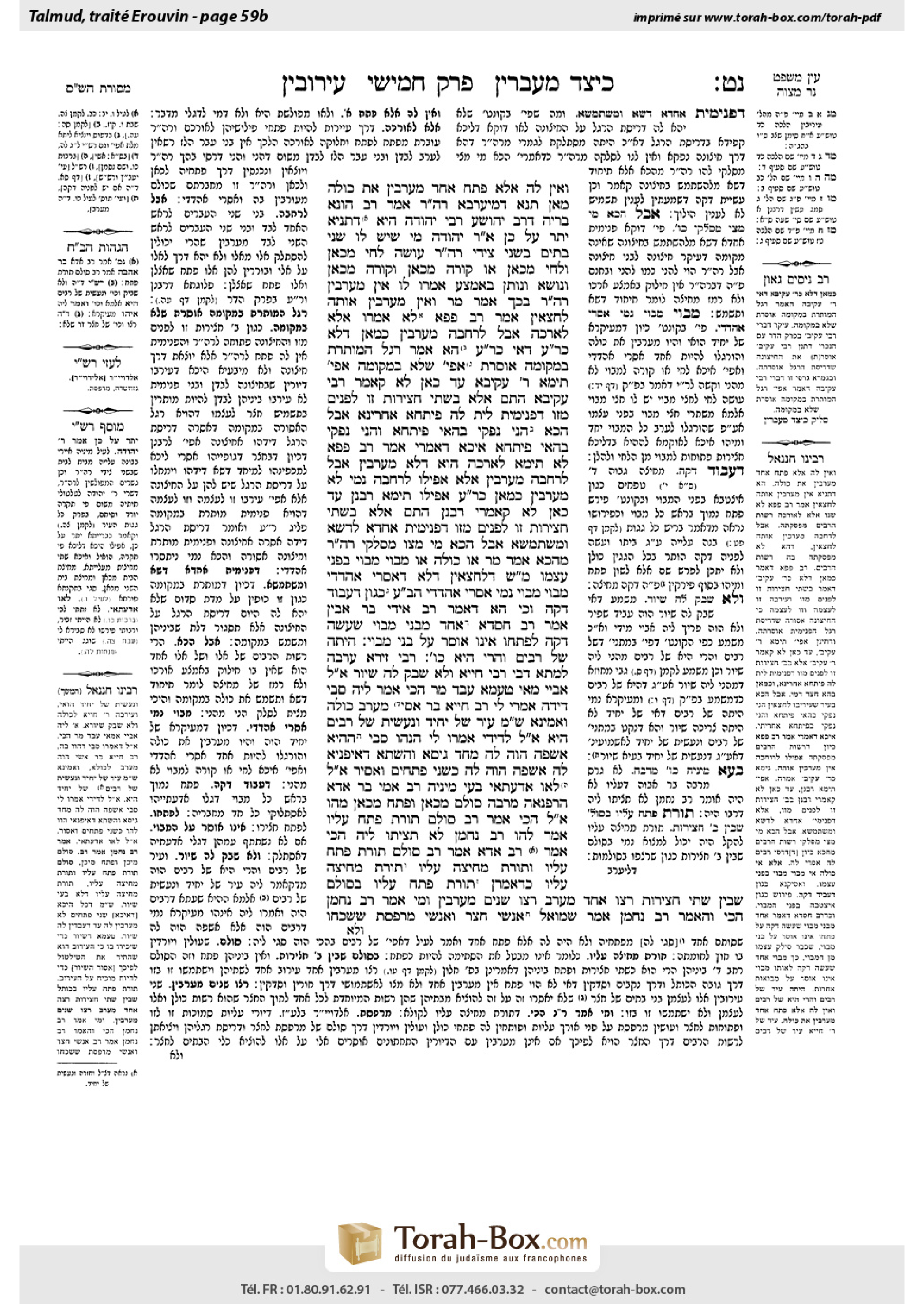
Eruvin 59b: Talmud study for Daf Yomi
Study the Talmud for Daf Yomi with scanned pages, Hebrew text, English translations from Sefaria and AI-generated French translations.
Passage selection and English or AI-generated French translation are available where the scan has annotations. Daf Study is independent of Torah-Box and Sefaria.
Browse Eruvin · עירובין · All tractatesEruvin 59b text and translations
This page of Eruvin includes the Aramaic text, an English translation and an AI-generated French translation, alongside the scan above.
עירובין נ״ט ב · Aramaic and Hebrew text
וְאֵין לָהּ אֶלָּא פֶּתַח אֶחָד — מְעָרְבִין אֶת כּוּלָּהּ.
מַאן תַּנָּא דְּמִיעָרְבָא רְשׁוּת הָרַבִּים? אָמַר רַב הוּנָא בְּרֵיהּ דְּרַב יְהוֹשֻׁעַ: רַבִּי יְהוּדָה הִיא, דְּתַנְיָא: יָתֵר עַל כֵּן אָמַר רַבִּי יְהוּדָה: מִי שֶׁיֵּשׁ לוֹ שְׁנֵי בָּתִּים בִּשְׁנֵי צִידֵּי רְשׁוּת הָרַבִּים — עוֹשֶׂה לֶחִי מִכָּאן וְלֶחִי מִכָּאן, אוֹ קוֹרָה מִכָּאן וְקוֹרָה מִכָּאן, וְנוֹשֵׂא וְנוֹתֵן בָּאֶמְצַע. אָמְרוּ לוֹ: אֵין מְעָרְבִין רְשׁוּת הָרַבִּים בְּכָךְ.
אָמַר מָר: וְאֵין מְעָרְבִין אוֹתָהּ לַחֲצָאִין. אָמַר רַב פָּפָּא: לֹא אָמְרוּ אֶלָּא לְאׇרְכָּהּ, אֲבָל לְרׇחְבָּהּ — מְעָרְבִין.
כְּמַאן — דְּלָא כְּרַבִּי עֲקִיבָא. דְּאִי כְּרַבִּי עֲקִיבָא, הָא אָמַר: רֶגֶל הַמּוּתֶּרֶת בִּמְקוֹמָהּ — אוֹסֶרֶת אֲפִילּוּ שֶׁלֹּא בִּמְקוֹמָהּ.
אֲפִילּוּ תֵּימָא רַבִּי עֲקִיבָא: עַד כָּאן לָא קָאָמַר רַבִּי עֲקִיבָא הָתָם אֶלָּא בִּשְׁתֵּי חֲצֵירוֹת זוֹ לְפָנִים מִזּוֹ, דִּפְנִימִית לֵית לַהּ פִּיתְחָא אַחֲרִינָא. אֲבָל הָכָא, הָנֵי נָפְקִי בְּהַאי פִּיתְחָא, וְהָנֵי נָפְקִי בְּהַאי פִּיתְחָא.
אִיכָּא דְּאָמְרִי, אָמַר רַב פָּפָּא: לָא תֵּימָא לְאׇרְכָּהּ הוּא דְּלָא מְעָרְבִין, אֲבָל לְרׇחְבָּהּ מְעָרְבִין, אֶלָּא אֲפִילּוּ לְרׇחְבָּהּ נָמֵי לָא מְעָרְבִין.
כְּמַאן, כְּרַבִּי עֲקִיבָא! אֲפִילּוּ תֵּימָא רַבָּנַן, עַד כָּאן לָא קָאָמְרִי רַבָּנַן הָתָם אֶלָּא בִּשְׁתֵּי חֲצֵירוֹת זוֹ לִפְנִים מִזּוֹ, דִּפְנִימִית אָחֲדָא לְדַשָּׁא וּמִשְׁתַּמְּשָׁא. אֲבָל הָכָא, מִי מָצוּ מְסַלְּקִי רְשׁוּת הָרַבִּים מֵהָכָא?!
אָמַר מָר: אוֹ כּוּלָּהּ, אוֹ מָבוֹי מָבוֹי בִּפְנֵי עַצְמוֹ. מַאי שְׁנָא דְּלַחֲצָאִין דְּלָא — דְּאָסְרִי אַהֲדָדֵי, מָבוֹי מָבוֹי נָמֵי אָסְרִי אַהֲדָדֵי?!
הָכָא בְּמַאי עָסְקִינַן, כְּגוֹן דַּעֲבוּד דַּקָּה. וְכִי הָא דְּאָמַר רַב אִידִי בַּר אָבִין אָמַר רַב חִסְדָּא: אֶחָד מִבְּנֵי מָבוֹי שֶׁעָשָׂה דַּקָּה לְפִתְחוֹ — אֵינוֹ אוֹסֵר עַל בְּנֵי מָבוֹי.
הָיְתָה שֶׁל רַבִּים וַהֲרֵי הִיא כּוּ׳. רַבִּי זֵירָא עָרְבַהּ לְמָתָא דְּבֵי רַבִּי חִיָּיא, וְלָא שְׁבַק לַהּ שִׁיּוּר. אֲמַר לֵיהּ אַבָּיֵי: מַאי טַעְמָא עֲבַד מָר הָכִי?
אֲמַר לֵיהּ, סָבֵי דִּידַהּ אָמְרִי לִי: רַב חִיָּיא בַּר אַסִּי מְעָרֵב כּוּלַּהּ. וְאָמֵינָא: שְׁמַע מִינַּהּ עִיר שֶׁל יָחִיד וְנַעֲשֵׂית שֶׁל רַבִּים הִיא.
אֲמַר לֵיהּ, לְדִידִי אֲמַרוּ לִי הָנְהוּ סָבֵי: הַהִיא אַשְׁפָּה הֲוָה לַהּ מֵחַד גִּיסָא. וְהַשְׁתָּא דְּאִיפַּנְיָא לַהּ אַשְׁפָּה, הָוֵה לַהּ כִּשְׁנֵי פְּתָחִים וַאֲסִיר. אֲמַר לֵיהּ: לָאו אַדַּעְתַּאי.
בָּעֵי מִינֵּיהּ רַב אַמֵּי בַּר אַדָּא הַרְפַּנָּאָה מֵרַבָּה: סוּלָּם מִכָּאן וּפֶתַח מִכָּאן, מַהוּ? אֲמַר לֵיהּ, הָכִי אָמַר רַב: סוּלָּם תּוֹרַת פֶּתַח עָלָיו.
אֲמַר לְהוּ רַב נַחְמָן: לָא תְּצִיתוּ לֵיהּ, הָכִי אָמַר רַב אַדָּא אָמַר רַב: סוּלָּם תּוֹרַת פֶּתַח עָלָיו, וְתוֹרַת מְחִיצָה עָלָיו. תּוֹרַת מְחִיצָה עָלָיו, כְּדַאֲמַרַן. תּוֹרַת פֶּתַח עָלָיו, בְּסוּלָּם שֶׁבֵּין שְׁתֵּי חֲצֵירוֹת, רָצוּ — אֶחָד מְעָרֵב, רָצוּ — שְׁנַיִם מְעָרְבִין.
וּמִי אָמַר רַב נַחְמָן הָכִי? וְהָאָמַר רַב נַחְמָן אָמַר שְׁמוּאֵל: אַנְשֵׁי חָצֵר וְאַנְשֵׁי מִרְפֶּסֶת שֶׁשָּׁכְחוּ
Eruvin 59b · English translation
and it has only one entrance, as it is surrounded by a wall or enclosed by houses on all sides, one may establish an eiruv for all of it.
The Gemara raises a question concerning this baraita: Who is the tanna who holds that an eiruv may be established for a public domain in this manner? Rav Huna, son of Rav Yehoshua, said: It is Rabbi Yehuda, as it was taught in a baraita: Furthermore, Rabbi Yehuda said: One who has two houses opposite each other on two sides of the public domain, if he chooses, he may create a private domain for himself in the public domain. He may place a ten-handbreadth high post from here, on one side, and an additional post from there, the other side. This creates symbolic walls that provide the public domain with the legal status of a private domain. Or, one may place a beam extending from here, one end of the house, and a beam from there, the other end of the house, thereby creating symbolic partitions across the width of the street. In that way, one is permitted to carry objects and place them in the area between the symbolic partitions, as he would in a private domain. The Rabbis said to him: One may not establish an eiruv in the public domain in that way.
The Master said in the baraita quoted above: And one may not establish an eiruv for half the city. Rav Pappa said: They said this only in a case where one wishes to divide the city according to its length. Generally, a city had a public domain that ran straight across it, from the entrance on one side of the city to the entrance on its other side. The baraita rules that it is prohibited to establish an eiruv separately for the residents of each side of the public domain. But if one wants to divide the city according to its width, he may establish an eiruv for half the city. This distinction is made because in the first case the public domain that runs between the two halves is used by the residents of both halves, and therefore it joins the two into a single unit; in the second case, the residents of each half use only the half of the public domain located on their side and not the half of the public domain located on the other side.
The Gemara asks: In accordance with whose opinion is this halakha? It is not in accordance with the opinion of Rabbi Akiva. As, if it were in accordance with the opinion of Rabbi Akiva, didn’t he say that a foot that is permitted in its own place prohibits carrying even in a place that is not its own? Rabbi Akiva holds the following in the case of outer and inner courtyards, in which the residents of each courtyard established their own, independent eiruv: Since the residents of the inner courtyard, who are permitted to carry in their own courtyard, may not carry in the outer courtyard despite the fact that they have rights of passage there, it is prohibited even for the residents of the outer courtyard to carry there. By the same logic, since the residents of each half of the city are prohibited to carry in the public domain of the city’s other half, despite the fact that they may travel there, it should be prohibited for everyone to carry there, and the eiruv should not be functional.
The Gemara rejects this argument: Even if you say it is in accordance with the opinion of Rabbi Akiva, Rabbi Akiva stated his opinion there only in a case of two courtyards, one farther inside than the other, as the inner courtyard has no other entrance. Since the residents of the inner courtyard have no choice but to pass through the outer courtyard, the residents of the outer courtyard deny the residents of the inner courtyard exclusive use of their own courtyard; therefore, they can impose restrictions upon them. But here, in the case of two halves of the city, these may go out through this part of the public domain on their side of the city, leading to one entrance to the city, and these may go out through this other part of the public domain, leading to the other entrance to the city. Since the residents of each half do not have to use the portion of the public domain located in the other half, they do not impose any restrictions on the residents of the other half, even if they do in fact use it.
Some say a different version of the previous discussion. Rav Pappa said: Do not say that it is only if the city is divided according to its length that one may not establish an eiruv for half the city, but if the city is divided according to its width, one may establish a separate eiruv for each half. Rather, even if the city is divided according to its width, one may not establish an eiruv for half the city.
The Gemara asks: In accordance with whose opinion is this halakha? It is in accordance with the opinion of Rabbi Akiva. The Gemara rejects this argument: Even if you say it is in accordance with the opinion of the Rabbis, it is possible that the Rabbis stated their opinion there only in the case of two courtyards, one inside the other, as the residents of the inner courtyard can close the door to the outer courtyard and use only their own courtyard. In doing so, they impose no restrictions on the residents of the outer courtyard. But here, with regard to the division of a city, are they able to move the public domain from here? Since the residents of each half cannot be prevented from using the public domain located in the other half, even the Rabbis would agree that the eiruv is ineffective.
The Master said in the previously cited baraita that an eiruv must either be established for all of it or for each alleyway separately. The Gemara asks: What is different about an eiruv for half the city, which is not permissible? The residents of each half prohibit residents of the other from carrying, due to the fact that all the residents may use both halves. Similarly, even if they establish a separate eiruv for each alleyway, the residents should still prohibit residents of the other from carrying, as residents of one alleyway commonly enter other alleyways as well.
The Gemara answers: With what are we dealing here? We are dealing with a case where the residents erected a partition at the entrance to the alleyway as an indication that they do not want to be connected to the other alleyways. And it is like that which Rav Idi bar Avin said that Rav Ḥisda said: One of the residents of an alleyway, who made a partition for his entrance to the alleyway as a sign that he does not intend to carry from his house to the alleyway, does not prohibit the other residents of the alleyway from carrying there if he does not join in their eiruv. The reason for this is that this resident has demonstrated his desire to renounce his share of the alleyway.
It was taught in the baraita: If it was originally a public city and it is still a public city, and it has only one entrance to the public domain, one may establish an eiruv for the entire city. The Gemara relates: Rabbi Zeira established an eiruv for Rabbi Ḥiyya’s city and did not leave any section of the city out of the eiruv. Abaye said to him: What is the reason that the Master acted in this manner? Why didn’t you exclude a section of the city from the eiruv, as required in a public city?
Rabbi Zeira said to Abaye: The city Elders told me that Rav Ḥiyya bar Asi used to establish an eiruv for the entire city without excluding any section of it, and I said to myself: If he would establish an eiruv for the whole city, I can learn from this that it was originally a private city and later becomes a public one. Therefore, it is permitted to establish an eiruv for the entire city.
Abaye said to him: Those same Elders told me that the reason was different: There was a particular garbage dump on one side of the public domain, which blocked one of the entrances, leaving only one entrance to the public domain. However, now that the garbage dump has been cleared away, it has two entrances, and it is therefore prohibited to establish an eiruv for the whole city without excluding a section from the eiruv. Rabbi Zeira said to him: It was not on my mind, i.e., I was unaware that this was the situation.
Rav Ami bar Adda from Harpanya raised a dilemma before Rabba: If a public domain has a ladder on one side, to allow people to scale the wall that blocks it, and an entrance on the other side, what is the halakha? Is it considered a public domain that is open on both sides? Rabba said to him that Rav said as follows: A ladder has the status of an entrance, and therefore the public domain is considered open on both sides.
Rav Naḥman said to them: Do not listen to him. Rav Adda said that Rav said as follows: A ladder has the status of an entrance in certain cases, and it has the status of a partition in other cases. It has the status of a partition in the case that we mentioned, where there is a ladder at the end of a public domain. In this case, the ladder is not considered an entrance and therefore the public domain is considered closed at that end. It has the status of an entrance in the case of a ladder between two courtyards. If the residents of the courtyards wish, they may join the two courtyards by means of the ladder and establish one eiruv; if they wish, the two courtyards may each establish a separate eiruv.
The Gemara asks: Did Rav Naḥman actually say this? Didn’t Rav Naḥman say that Shmuel said: With regard to residents of the ground floor of a courtyard and residents of a balcony, i.e., the floor above the ground floor, who forgot
Eruvin 59b · Traduction française (IA)
et il n'a qu'une entrée, car il est entouré d'un mur ou enfermé par des maisons de tous les côtés, on peut établir un eiruv pour tout cela.
La Guemara soulève une question concernant ce baraïta : Qui est le tanna qui affirme qu'un eiruv peut être établi pour un domaine public de cette manière ? Rav Huna, fils de Rav Yéhoshua, dit : C'est Rabbi Yéhuda, comme il a été enseigné dans un autre baraïta : De plus, Rabbi Yéhuda a dit : Celui qui a deux maisons face à face sur deux côtés du domaine public, s'il le souhaite, peut créer un domaine privé pour lui-même dans le domaine public. Il peut placer un poteau de dix tefachim de haut d'ici, sur un côté, et un autre poteau d'ici, sur l'autre côté. Cela crée des murs symboliques qui donnent au domaine public le statut juridique d'un domaine privé. Ou bien, on peut placer une poutre s'étendant d'ici, de l'extrémité de la maison, et une poutre d'ici, de l'autre extrémité de la maison, créant ainsi des cloisons symboliques à travers la largeur de la rue. Ainsi, on est autorisé à transporter des objets et à les placer dans la zone entre les cloisons symboliques, comme on le ferait dans un domaine privé. Les Rabbins lui dirent : On ne peut pas établir un eiruv dans le domaine public de cette manière.
Le Maître dit dans la baraïta citée ci-dessus : Et on ne peut pas établir un eiruv pour la moitié de la ville. Rav Pappa dit : Ils ont dit cela uniquement dans le cas où l'on souhaite diviser la ville selon sa longueur. Généralement, une ville avait un domaine public qui traversait tout le long de la ville, de l'entrée d'un côté à l'entrée de l'autre côté. La baraïta stipule que l'on ne peut pas établir un eiruv séparément pour les habitants de chaque côté du domaine public. Mais si l'on souhaite diviser la ville selon sa largeur, on peut établir un eiruv pour la moitié de la ville. Cette distinction est faite car, dans le premier cas, le domaine public qui se trouve entre les deux moitiés est utilisé par les habitants des deux moitiés, et donc il unit les deux en un seul unité ; dans le second cas, les habitants de chaque moitié utilisent uniquement la moitié du domaine public située sur leur côté et non la moitié du domaine public située sur l'autre côté.
La Guemara pose une question : Selon l'opinion de qui est cette halakha ? Ce n'est pas selon l'opinion de Rabbi Akiva. Car, si c'était selon l'opinion de Rabbi Akiva, n'a-t-il pas dit qu'un pied qui est permis dans son propre lieu interdit le transport même dans un lieu qui n'est pas le sien ? Rabbi Akiva affirme que dans le cas des courtyards intérieur et extérieur, où les habitants de chaque courtille ont établi leur propre eiruv indépendant : Puisque les habitants du courtille intérieur, qui sont autorisés à transporter dans leur propre courtille, ne peuvent pas transporter dans le courtille extérieur malgré le fait qu'ils y ont des droits de passage, il est interdit même aux habitants du courtille extérieur de transporter là. Par la même logique, puisque les habitants de chaque moitié de la ville sont interdits de transporter dans le domaine public de l'autre moitié, malgré le fait qu'ils peuvent y aller, cela devrait être interdit pour tout le monde de transporter là, et l'eiruv ne devrait pas être fonctionnel.
La Guemara rejette cet argument : Même si vous dites qu'il s'agit de l'opinion de Rabbi Akiva, Rabbi Akiva a exprimé son opinion là-bas uniquement dans le cas de deux courtyards, l'un plus intérieur que l'autre, car le courtille intérieur n'a pas d'autre entrée. Puisque les habitants du courtille intérieur n'ont pas le choix mais de passer par le courtille extérieur, les habitants du courtille extérieur refusent aux habitants du courtille intérieur l'usage exclusif de leur propre courtille ; donc, ils peuvent imposer des restrictions. Mais ici, dans le cas de deux moitiés de la ville, ceux-ci peuvent sortir par cette partie du domaine public sur leur côté de la ville, menant à une entrée à la ville, et ceux-ci peuvent sortir par cette autre partie du domaine public, menant à l'autre entrée à la ville. Puisque les habitants de chaque moitié n'ont pas besoin d'utiliser la partie du domaine public située dans l'autre moitié, ils n'imposent aucune restriction aux habitants de l'autre moitié, même s'ils y ont effectivement accès.
Certains donnent une version différente de la discussion précédente. Rav Pappa dit : Ne dites pas que c'est seulement si la ville est divisée selon sa longueur que l'on ne peut pas établir un eiruv pour la moitié de la ville, mais si la ville est divisée selon sa largeur, l'on peut établir un eiruv séparé pour chaque moitié. En réalité, même si la ville est divisée selon sa largeur, l'on ne peut pas établir un eiruv pour la moitié de la ville.
La Guemara pose une question : Selon l'opinion de qui est cette halakha ? C'est selon l'opinion de Rabbi Akiva. La Guemara rejette cet argument : Même si vous dites qu'il est selon l'opinion des Rabbins, il est possible que les Rabbins aient formulé leur opinion là-bas uniquement dans le cas de deux courtyards, l'un à l'intérieur de l'autre, comme les habitants du courtille intérieur peuvent fermer la porte du courtille extérieur et utiliser uniquement leur propre courtille. En faisant cela, ils n'imposent aucune restriction aux habitants du courtille extérieur. Mais ici, concernant la division d'une ville, sont-ils en mesure de déplacer le domaine public d'ici ? Puisque les habitants de chaque moitié ne peuvent pas être empêchés d'utiliser le domaine public situé dans l'autre moitié, même les Rabbins seraient d'accord que l'eiruv est inefficace.
Le Maître a dit dans le baraïta cité précédemment que l'eiruv doit être établi pour tout cela ou pour chaque allée séparément. La Guemara pose une question : Qu'est-ce qui diffère dans un eiruv pour la moitié de la ville, qui n'est pas permis ? Les habitants de chaque moitié interdisent aux habitants de l'autre de transporter, car tous les habitants peuvent utiliser les deux moitiés. De même, même s'ils établissent un eiruv séparé pour chaque allée, les habitants devraient encore interdire aux habitants de l'autre de transporter, car les habitants d'une allée entrent souvent dans d'autres allées également.
La Guemara répond : De quoi sommes-nous en train de parler ? Nous parlons d’un cas où les habitants ont érigé une cloison à l’entrée de la rue pour indiquer qu’ils ne souhaitent pas être connectés aux autres rues. Et cela ressemble à ce que Rav Idi bar Avin a dit que Rav Ḥisda avait dit : Un des habitants d’une rue, qui a érigé une cloison à l’entrée de la rue comme signe qu’il ne souhaite pas porter des objets de sa maison vers la rue, ne bloque pas les autres habitants de la rue de porter des objets là-bas s’il ne participe pas à leur eiruv. La raison de cela est que cet habitant a montré son désir de renoncer à sa part de la rue.
Il a été enseigné dans une baraïta : Si c’était initialement une ville publique et qu’elle reste une ville publique, et qu’elle n’a qu’une seule entrée vers le domaine public, on peut établir un eiruv pour toute la ville. La Guemara rapporte : Rabbi Zeira a établi un eiruv pour la ville de Rabbi Ḥiyya et n’a laissé aucune partie de la ville hors de l’eiruv. Abaye a dit à lui : Quelle est la raison pour laquelle le Maître a agi ainsi ? Pourquoi n’as-tu pas exclu une partie de la ville de l’eiruv, comme requis dans une ville publique ?
Rabbi Zeira a dit à Abaye : Les anciens de la ville m’ont dit que Rav Ḥiyya bar Asi avait l’habitude d’établir un eiruv pour toute la ville sans exclure aucune de ses parties, et j’ai pensé à moi-même : Si il établissait un eiruv pour toute la ville, je peux apprendre de cela que c’était initialement une ville privée et qu’elle est devenue ensuite une ville publique. Par conséquent, il est permis d’établir un eiruv pour toute la ville.
Abaye a dit à lui : Ces mêmes anciens m'ont dit que la raison était différente : Il y avait un tas de déchets sur un côté du domaine public, qui bloquait l'une des entrées, laissant seulement une entrée vers le domaine public. Cependant, maintenant que ce tas de déchets a été nettoyé, il y a deux entrées, et il est donc interdit d'établir un eiruv pour toute la ville sans exclure une partie de l'eiruv. Rabbi Zeira a dit à lui : Ce n'était pas dans mon esprit, c'est-à-dire que je ne savais pas que c'était le cas.
Rav Ami bar Adda de Harpanya a posé un dilemme devant Rabba : Si un domaine public a une échelle sur un côté, permettant aux gens de monter sur le mur qui le bloque, et une entrée sur l'autre côté, quelle est la halakha ? Est-ce qu'on considère cela comme un domaine public ouvert des deux côtés ? Rabba a dit à lui que Rav a dit comme suit : Une échelle a le statut d'une entrée, et par conséquent le domaine public est considéré comme ouvert des deux côtés.
Rav Naḥman a dit à eux : Ne l'écoutez pas. Rav Adda a dit que Rav a dit comme suit : Une échelle a le statut d'une entrée dans certains cas, et celui d'une cloison dans d'autres. Elle a le statut d'une cloison dans le cas que nous avons mentionné, où il y a une échelle à la fin d'un domaine public. Dans ce cas, l'échelle n'est pas considérée comme une entrée et par conséquent le domaine public est considéré comme fermé à cet endroit. Elle a le statut d'une entrée dans le cas d'une échelle entre deux courtyards. Si les habitants des courtyards souhaitent, ils peuvent relier les deux courtyards grâce à l'échelle et établir un seul eiruv ; s'ils le souhaitent, les deux courtyards peuvent chacun établir un eiruv séparé.
La Guemara pose la question : Rav Naḥman a-t-il vraiment dit cela ? N’a-t-il pas dit que Rav Naḥman a affirmé que Shmuel a dit : En ce qui concerne les habitants du rez-de-chaussée d’un cour d’immeuble et les habitants d’un balcon, c’est-à-dire le niveau au-dessus du rez-de-chaussée, qui ont oublié
Traduction française générée par IA à partir de l’édition anglaise de Sefaria. Vérifie toujours un passage avec le texte source.
Text from Sefaria: William Davidson Edition - Vocalized Aramaic (CC BY NC); William Davidson Edition - English (CC BY NC).