Eruvin 60a: Talmud study for Daf Yomi
Study the Talmud for Daf Yomi with scanned pages, Hebrew text, English translations from Sefaria and AI-generated French translations.
Passage selection and English or AI-generated French translation are available where the scan has annotations. Daf Study is independent of Torah-Box and Sefaria.
Browse Eruvin · עירובין · All tractatesEruvin 60a text and translations
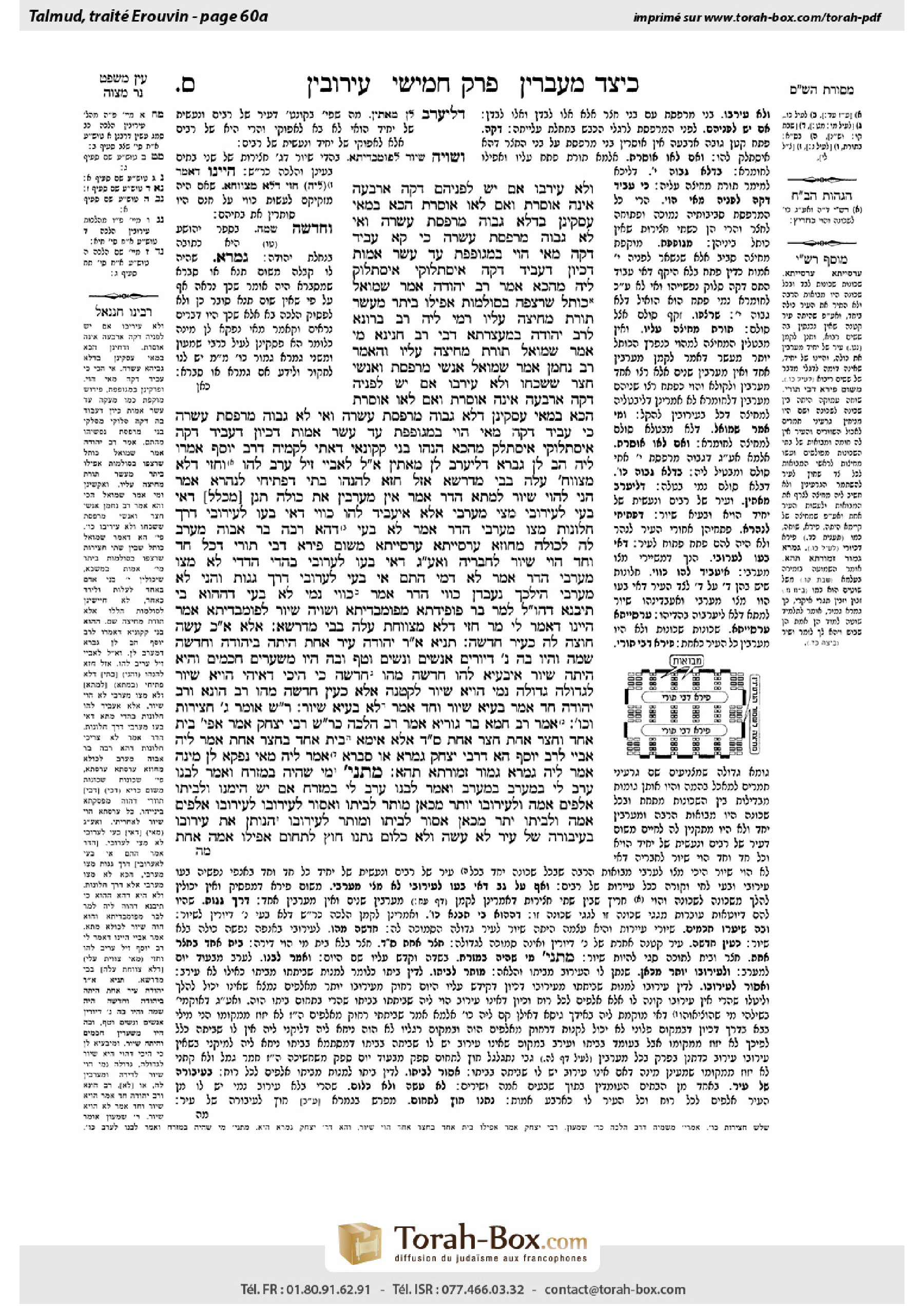
This page of Eruvin includes the Aramaic text, an English translation and an AI-generated French translation, alongside the scan above.
עירובין ס׳ א · Aramaic and Hebrew text
וְלֹא עֵירְבוּ, אִם יֵשׁ לִפְנֵיהֶם דַּקָּה אַרְבָּעָה — אֵינָהּ אוֹסֶרֶת, וְאִם לָאו — אוֹסֶרֶת.
הָכָא בְּמַאי עָסְקִינַן, בִּדְלֹא גְּבוֹהָ מִרְפֶּסֶת עֲשָׂרָה.
וְאִי לֹא גְּבוֹהָ מִרְפֶּסֶת עֲשָׂרָה, כִּי קָא עָבֵיד דַּקָּה, מַאי הָוֵי? בִּמְגוּפֶּפֶת עַד עֶשֶׂר אַמּוֹת, דְּכֵיוָן דְּעָבֵיד דַּקָּה — אִיסְתַּלּוֹקֵי אִיסְתַּלּוּק לֵיהּ מֵהָכָא.
אָמַר רַב יְהוּדָה אָמַר שְׁמוּאֵל: כּוֹתֶל שֶׁרְצָפָהּ בְּסוּלָּמוֹת, אֲפִילּוּ בְּיָתֵר מֵעֶשֶׂר — תּוֹרַת מְחִיצָה עָלָיו.
רָמֵי לֵיהּ רַב בְּרוֹנָא לְרַב יְהוּדָה בְּמַעְצַרְתָּא דְּבֵי רַב חֲנִינָא: מִי אָמַר שְׁמוּאֵל תּוֹרַת מְחִיצָה עָלָיו? וְהָאָמַר רַב נַחְמָן אָמַר שְׁמוּאֵל: אַנְשֵׁי מִרְפֶּסֶת וְאַנְשֵׁי חָצֵר שֶׁשָּׁכְחוּ וְלֹא עֵירְבוּ, אִם יֵשׁ לְפָנֶיהָ דַּקָּה אַרְבָּעָה אֵינָהּ אוֹסֶרֶת, וְאִם לָאו — אוֹסֶרֶת.
הָכָא בְּמַאי עָסְקִינַן, דְּלֹא גְּבוֹהָ מִרְפֶּסֶת עֲשָׂרָה. וְאִי לֹא גְּבוֹהָ מִרְפֶּסֶת עֲשָׂרָה, כִּי עָבֵיד דַּקָּה מַאי הָוֵי? בִּמְגוּפֶּפֶת עַד עֶשֶׂר אַמּוֹת, דְּכֵיוָן דְּעָבֵיד דַּקָּה — אִיסְתַּלּוֹקֵי אִיסְתַּלַּק מֵהָכָא.
הָנְהוּ בְּנֵי קָקוּנָאֵי דְּאָתֵי לְקַמֵּיהּ דְּרַב יוֹסֵף, אֲמַרוּ לֵיהּ: הַב לַן גַּבְרָא דְּלִיעָרֵב לַן מָאתִין. אֲמַר לֵיהּ לְאַבָּיֵי: זִיל עָרֵב לְהוּ, וַחֲזִי דְּלָא מְצַוְוחַתְּ עֲלַהּ בְּבֵי מִדְרְשָׁא. אֲזַל, חֲזָא לְהָנְהוּ בָּתֵּי דִּפְתִיחִי לְנַהֲרָא. אָמַר: הָנֵי לֶהֱוֵי שִׁיּוּר לְמָתָא.
הֲדַר אָמַר: ״אֵין מְעָרְבִין אֶת כּוּלָּהּ״ תְּנַן, [מִכְּלָל] דְּאִי בָּעֵי לְעָירוֹבֵי, מָצֵי מְעָרְבִי. אֶלָּא אֶיעְבֵּיד לְהוּ כַּוֵּוי, דְּאִי בָּעוּ לְעָירוֹבֵי דֶּרֶךְ חַלּוֹנוֹת מָצוּ מְעָרְבִי.
הֲדַר אָמַר: לָא בָּעֵי, דְּהָא רַבָּה בַּר אֲבוּהּ מְעָרֵב לַהּ לְכוּלַּהּ מָחוֹזָא עַרְסְיָיתָא עַרְסְיָיתָא מִשּׁוּם פֵּירָא דְּבֵי תוֹרֵי, דְּכׇל חַד וְחַד הָוֵי שִׁיּוּר לְחַבְרֵיהּ. וְאַף עַל גַּב דְּאִי בָּעוּ לְעָרוֹבֵי בַּהֲדֵי הֲדָדֵי, לָא מָצוּ מְעָרְבִי.
הֲדַר אָמַר: לָא דָּמֵי. הָתָם, אִי בָּעֵי — לְעָרוֹבֵי דֶּרֶךְ גַּגּוֹת, וְהָנֵי לָא מְעָרְבִי, הִילְכָּךְ נַעְבְּדַן כַּוֵּוי.
הֲדַר אָמַר: כַּוֵּוי נָמֵי לָא בָּעֵי, דְּהָהוּא בֵּי תִיבְנָא דַּהֲוָה לֵיהּ לְמָר בַּר פּוֹפִידְתָּא מִפּוּמְבְּדִיתָא, וְשַׁוְּיַהּ שִׁיּוּר לְפוּמְבְּדִיתָא.
אֲמַר, הַיְינוּ דְּאָמַר לִי מָר: ״חֲזִי דְּלָא מְצַוְוחַתְּ עֲלַהּ בְּבֵי מִדְרְשָׁא״.
אֶלָּא אִם כֵּן עָשָׂה חוּצָה לָהּ כָּעִיר חֲדָשָׁה. תַּנְיָא, אָמַר רַבִּי יְהוּדָה: עִיר אַחַת הָיְתָה בִּיהוּדָה וַחֲדָשָׁה שְׁמָהּ, וְהָיוּ בָּהּ חֲמִשִּׁים דָּיוֹרִים אֲנָשִׁים וְנָשִׁים וָטַף, וּבָהּ הָיוּ מְשַׁעֲרִים חֲכָמִים, וְהִיא הָיְתָה שִׁיּוּר.
אִיבַּעְיָא לְהוּ: חֲדָשָׁה מַהוּ? חֲדָשָׁה, כִּי הֵיכִי דְּאִיהִי הָוְיָא שִׁיּוּר לִגְדוֹלָה — גְּדוֹלָה נָמֵי הָוְיָא שִׁיּוּר לִקְטַנָּה.
אֶלָּא כְּעֵין חֲדָשָׁה, מַהוּ? רַב הוּנָא וְרַב יְהוּדָה, חַד אָמַר: בָּעֲיָא שִׁיּוּר, וְחַד אָמַר: לָא בָּעֲיָא שִׁיּוּר.
רַבִּי שִׁמְעוֹן אוֹמֵר שָׁלֹשׁ חֲצֵירוֹת וְכוּ׳. אָמַר רַב חָמָא בַּר גּוּרְיָא אָמַר רַב: הֲלָכָה כְּרַבִּי שִׁמְעוֹן. רַבִּי יִצְחָק אָמַר: אֲפִילּוּ בַּיִת אֶחָד וְחָצֵר אַחַת. חָצֵר אַחַת סָלְקָא דַּעְתָּךְ?! אֶלָּא אֵימָא: בַּיִת אֶחָד בְּחָצֵר אַחַת.
אֲמַר לֵיהּ אַבָּיֵי לְרַב יוֹסֵף: הָא דְּרַבִּי יִצְחָק, גְּמָרָא אוֹ סְבָרָא? אֲמַר לֵיהּ: מַאי נָפְקָא לַן מִינַּהּ? אֲמַר לֵיהּ: גְּמָרָא גְּמוֹר, זְמוֹרְתָּא תְּהֵא?!
מַתְנִי׳ מִי שֶׁהָיָה בַּמִּזְרָח וְאָמַר לִבְנוֹ: ״עָרֵב לִי בַּמַּעֲרָב״, בַּמַּעֲרָב וַאֲמַר לִבְנוֹ: ״עָרֵב לִי בַּמִּזְרָח״, אִם יֵשׁ הֵימֶנּוּ וּלְבֵיתוֹ אַלְפַּיִם אַמָּה, וּלְעֵירוּבוֹ יוֹתֵר מִכָּאן — מוּתָּר לְבֵיתוֹ, וְאָסוּר לְעֵירוּבוֹ.
לְעֵירוּבוֹ אַלְפַּיִם אַמָּה, וּלְבֵיתוֹ יָתֵר מִכָּאן — אָסוּר לְבֵיתוֹ, וּמוּתָּר לְעֵירוּבוֹ.
הַנּוֹתֵן אֶת עֵירוּבוֹ בְּעִיבּוּרָהּ שֶׁל עִיר, לֹא עָשָׂה וְלֹא כְלוּם.
נְתָנוֹ חוּץ לַתְּחוּם, אֲפִילּוּ אַמָּה אַחַת —
Eruvin 60a · English translation
and did not establish a joint eiruv, if there is a partition four handbreadths wide in front of the entrance to the balcony, the balcony does not prohibit the residents of the courtyard from carrying, as each area is considered to be independent. And if not, the balcony prohibits the residents of the courtyard from carrying in the courtyard. This indicates that a ladder between two courtyards is always considered an entrance, even when that policy leads to a stringent ruling, unless the two areas are separated by a partition.
The Gemara answers: With what are we dealing here? With a case where the balcony is not ten handbreadths high from the ground. Consequently, it does not constitute a domain in its own right, and it is part of the courtyard.
The Gemara asks: If the balcony is not ten handbreadths high and is therefore part of the courtyard, when one places a partition, what of it? The balcony should nevertheless be considered part of the courtyard. The Gemara answers: We are dealing here with a balcony that is entirely fenced off except for a section up to ten cubits wide, which serves as an entrance. In that case, since the residents of the balcony place a partition at this entrance, they thereby remove themselves entirely from the courtyard.
Rav Yehuda said that Shmuel said: With regard to a wall that one lined with ladders, even along a length of more than ten cubits, it still retains the status of a partition. The ladders do not constitute an opening that is more than ten cubits wide, which would cause the wall to be regarded as breached and would invalidate the wall as a partition.
Rav Beruna raised a contradiction to Rav Yehuda in the winepress at Rav Ḥanina’s house: Did Shmuel actually say that such a wall has the status of a partition? Didn’t Rav Naḥman say that Shmuel said: With regard to the residents of a balcony and the residents of a courtyard who forgot and did not establish a joint eiruv, if there is a partition four handbreadths wide in front of the entrance to the balcony, the balcony does not prohibit the residents of the courtyard to carry; and if not, it prohibits the residents of the courtyard from carrying? This indicates that a ladder is considered an entrance, as the courtyard and the balcony are considered connected.
Rav Yehuda replied in the same manner as above: With what are we dealing here? We are dealing with a case where the balcony is not ten handbreadths high, and that is why it is regarded as connected to the courtyard. The Gemara asks: If the balcony is not ten handbreadths high, when he places a partition, what of it? The balcony should nevertheless be considered part of the courtyard. The Gemara answers: We are dealing here with a balcony that is entirely fenced off except for a section up to ten cubits wide, which serves as an entrance. In that case, since the residents of the balcony place a partition at this entrance, they thereby remove themselves entirely from the courtyard.
The Gemara relates that certain residents of the city of Kakunya came before Rav Yosef and said to him: Provide us with someone who will establish an eiruv for our city. The city had originally been a public city and had turned into a private one, requiring that part of the city be excluded from the eiruv. Rav Yosef said to Abaye: Go, establish an eiruv for them, and see to it that there is no outcry against it in the study hall, i.e., make sure the eiruv is valid beyond any doubt. He went and saw that certain houses opened to the river and not to the city. He said: Let these houses serve as the section excluded from the eiruv for the city.
Abaye subsequently retracted and said: This cannot be done, as we learned in the mishna: One may not establish an eiruv for all of it; by inference, if they wanted to establish an eiruv for the entire city, they would have been able to establish such an eiruv, if not for the requirement to exclude a section of the city from the eiruv. However, these houses, which do not open to the city, could not have joined in an eiruv with the rest of the city in any case, and therefore they cannot serve as the excluded section. Rather, I will create windows for them between the courtyards of their houses and the rest of the city, so that if they want to establish an eiruv with the rest of the city by way of the windows, they can establish such an eiruv, and then these houses will be fit to serve as the excluded section.
He subsequently retracted again and said: This is not necessary, as Rabba bar Avuh established an eiruv for the entire city of Meḥoza, which was a public city that had become a private one, neighborhood by neighborhood, due to the fact that the neighborhoods were separated by ditches from which the cattle would feed. In other words, Rabba bar Avuh established a separate eiruv for each neighborhood without excluding any of them, as he maintained that each one was an excluded section for the other. And although the neighborhoods would not have been able to establish an eiruv together even if they wanted to, due to the ditches separating them, the neighborhoods were still able to serve as excluded areas for each other.
He subsequently retracted once again and said: The two cases are not really comparable. There, in Meḥoza, if they wanted, they could have established a single eiruv by way of the roofs; but these houses cannot establish an eiruv with the other houses of the city, and therefore we must create windows for them.
He subsequently retracted yet again and said: Windows are also not necessary. As, that storehouse of straw which belonged to Mar bar Pofidata from Pumbedita was designated as the section excluded from the eiruv arranged for the city of Pumbedita, which proves that it is not necessary for the excluded section to be one that could have been included in an eiruv with the rest of the city.
Abaye said to himself: This is what the Master meant when he said to me: See to it that there is no outcry against it in the study hall. Abaye now understood the many factors that had to be considered and how wary one must be of reaching a hasty conclusion.
The mishna stated that if a public city becomes a private city, one may not establish an eiruv for all of it unless he maintains an area outside the eiruv which is like the size of the city of Ḥadasha in Judea. It was taught in a baraita that Rabbi Yehuda said: There was a certain city in Judea and its name was Ḥadasha, and it had fifty residents including men, women, and children. And the Sages would use it to measure the size of the section that must be excluded from an eiruv, and it itself was the excluded section of the eiruv of a larger city that was adjacent to it.
A dilemma was raised before the Sages: As for Ḥadasha, what is the halakha? Is it permissible to establish an eiruv for Ḥadasha itself without excluding a section of the city from the eiruv? The Gemara answers: With regard to Ḥadasha, just as it was the excluded section of the larger city, the larger city was also the excluded section of the smaller city.
Rather, the question pertains to a small city like Ḥadasha that stands by itself, not in proximity to a larger city: What is the halakha? Does a small city require an excluded section or not? Rav Huna and Rav Yehuda disagreed about this issue. One said: It requires an excluded section; and one said: It does not require an excluded section.
It is stated in the mishna that Rabbi Shimon says: The excluded area must be large enough to include at least three courtyards with two houses each. Rav Ḥama bar Gurya said that Rav said: The halakha is in accordance with the opinion of Rabbi Shimon. However, Rabbi Yitzḥak said: Even one house and one courtyard suffice. The Gemara expresses surprise at the wording of this statement: Can it enter your mind that one courtyard even without a house is sufficient? Rather, correct it and say as follows: One house in one courtyard.
Abaye said to Rav Yosef: Is that ruling of Rabbi Yitzḥak based on oral tradition or his own logic? Rav Yosef said to him: What practical difference does Rabbi Yitzḥak’s source make to us? Abaye said to him, quoting a well-known adage: When you study Talmud is it merely a song?; Is the material you study like the lyrics of a song that you do not understand? It is proper to investigate all aspects of the statements of the Sages, regardless of the practical ramifications.
MISHNA: One who was to the east of his home when Shabbat began, and he had said to his son before Shabbat: Establish an eiruv for me to the west; or, if he was to the west of his home and he had said to his son: Establish an eiruv for me to the east, the halakha is as follows: If there is a distance of two thousand cubits from his current location to his house, and the distance to his eiruv is greater than this, he is permitted to walk to his house, and from there he may walk two thousand cubits in every direction, but it is prohibited for him to walk to the spot where his son had deposited his eiruv.
If the distance from one’s current location to his eiruv is two thousand cubits, and the distance to his house is greater than this, he is prohibited from walking to his house, and he is permitted to walk to the spot of his eiruv, and from there he may walk two thousand cubits in every direction. In other words, with regard to the Shabbat limit, one’s place of residence for Shabbat cannot be more than two thousand cubits from his physical location when Shabbat begins.
One who places his eiruv in the outskirts of the city, i.e., within an area of slightly more than seventy cubits surrounding the city, it is as though he has not done anything. The two thousand cubits of one’s Shabbat limit are measured from the edge of the outskirts of the city even if there is no eiruv, and one therefore gains nothing from placing an eiruv within this area.
If, however, he placed his eiruv outside the city’s boundary, even if he placed it only one cubit beyond the city,
Eruvin 60a · Traduction française (IA)
et ils n'ont pas établi un eiruv commun, si une cloison de quatre tefachim de large est placée devant l'entrée du balcon, le balcon ne prohibe pas les habitants du courtil de porter, car chaque zone est considérée comme indépendante. Et si ce n'est pas le cas, le balcon prohibe les habitants du courtil de porter dans le courtil. Cela montre que l'échelle entre deux courtils est toujours considérée comme une entrée, même lorsque cela conduit à une décision stricte, à moins que les deux zones ne soient séparées par une cloison.
La Guemara répond : De quel cas sommes-nous en train de parler ? D'un cas où le balcon n'est pas à dix tefachim de haut du sol. Ainsi, il ne constitue pas un domaine à part entière, et il fait partie du courtil.
La Guemara pose la question : Si le balcon n'est pas à dix tefachim de haut et est donc partie du courtil, quand on place une cloison, qu'en est-il ? Le balcon devrait tout de même être considéré comme faisant partie du courtil. La Guemara répond : Nous sommes en train de parler d'un balcon entièrement clôturé sauf pour une section jusqu'à dix tefachim de large, qui sert d'entrée. Dans ce cas, puisque les habitants du balcon placent une cloison à cette entrée, ils se retirent ainsi entièrement du courtil.
Rav Yehuda a dit que Shmuel a dit : En ce qui concerne un mur qui est recouvert de échelles, même sur une longueur supérieure à dix cubits, il conserve le statut de cloison. Les échelles ne constituent pas une ouverture plus large que dix cubits, ce qui ferait du mur un mur percé et invaliderait la cloison.
Rav Beruna a soulevé une contradiction contre Rav Yehuda dans la vigne de Rav Ḥanina : Shmuel a-t-il vraiment dit que ce mur a le statut de cloison ? N'a-t-il pas dit Rav Naḥman que Shmuel a dit : En ce qui concerne les habitants du balcon et les habitants du courtil qui ont oublié et n'ont pas établi un eiruv commun, si il y a une cloison de quatre tefachim de large devant l'entrée du balcon, le balcon ne prohibe pas les habitants du courtil de porter ; et si non, il prohibe les habitants du courtil de porter ? Cela montre que l'échelle est considérée comme une entrée, car le courtil et le balcon sont considérés comme connectés.
Rav Yehuda a répondu de la même manière qu'au-dessus : De quel cas sommes-nous en train de parler ? Nous sommes en train de parler d'un cas où le balcon n'est pas à dix tefachim de haut, et c'est pourquoi il est considéré comme connecté au courtil. La Guemara pose la question : Si le balcon n'est pas à dix tefachim de haut, quand il place une cloison, qu'en est-il ? Le balcon devrait tout de même être considéré comme faisant partie du courtil. La Guemara répond : Nous sommes en train de parler d'un balcon entièrement clôturé sauf pour une section jusqu'à dix cubits de large, qui sert d'entrée. Dans ce cas, puisque les habitants du balcon placent une cloison à cette entrée, ils se retirent ainsi entièrement du courtil.
La Guemara rapporte que certains habitants de la ville de Kakunya se sont adressés à Rav Yosef et lui ont dit : Fournissez-nous quelqu'un qui établira un eiruv pour notre ville. La ville avait été initialement une ville publique et avait fini par devenir une ville privée, nécessitant que certaines parties de la ville soient exclues de l'eiruv. Rav Yosef a dit à Abaye : Allez, établissez un eiruv pour eux, et veillez à ce qu'il n'y ait pas de protestation contre cela dans la salle de study, c'est-à-dire assurez-vous que l'eiruv est valide sans tout doute. Il est allé et a vu que certaines maisons s'ouvraient vers le fleuve et non vers la ville. Il a dit : Fassent ces maisons servir de section exclue de l'eiruv pour la ville.
Abaye a ensuite rétracté et a dit : Cela ne peut pas être fait, car nous avons appris dans la mishna : On ne peut pas établir un eiruv pour tout ; par conséquent, si ils voulaient établir un eiruv pour toute la ville, ils auraient pu le faire, si ce n'était pas pour la nécessité d'exclure une section de la ville de l'eiruv. Cependant, ces maisons, qui ne s'ouvraient pas vers la ville, ne pourraient pas avoir participé à un eiruv avec le reste de la ville de toute façon, et par conséquent, elles ne peuvent pas servir de section exclue. Plutôt, je créerai des fenêtres pour eux entre les courtils de leurs maisons et le reste de la ville, de sorte qu'ils puissent établir un eiruv avec le reste de la ville par les fenêtres, et alors ces maisons seront adaptées pour servir de section exclue.
Il a ensuite rétracté à nouveau et a dit : Cela n'est pas nécessaire, car Rabba bar Avuh a établi un eiruv pour toute la ville de Meḥoza, qui était une ville publique devenue privée, quartier par quartier, en raison du fait que les quartiers étaient séparés par des canaux où les bêtes paissaient. En d'autres termes, Rabba bar Avuh a établi un eiruv séparé pour chaque quartier sans exclure aucun d'entre eux, car il maintenait que chaque quartier était une section exclue pour l'autre. Et bien que les quartiers ne pussent pas établir un eiruv ensemble même s'ils le voulaient, en raison des canaux les séparant, les quartiers pouvaient tout de même servir de sections exclues les uns pour les autres.
Il a ensuite rétracté une fois de plus et a dit : Les deux cas ne sont pas vraiment comparables. Là-bas, à Meḥoza, s'ils le voulaient, ils auraient pu établir un seul eiruv par les toits ; mais ces maisons ne peuvent pas établir un eiruv avec les autres maisons de la ville, et par conséquent, nous devons créer des fenêtres pour elles.
Il a ensuite rétracté encore une fois et a dit : Les fenêtres ne sont pas non plus nécessaires. Car, ce grenier de paille qui appartenait à Mar bar Pofidata de Pumbedita a été désigné comme la section exclue de l'eiruv organisé pour la ville de Pumbedita, ce qui prouve que la section exclue n'a pas besoin d'être une section qui aurait pu être incluse dans un eiruv avec le reste de la ville.
Abaye dit à lui-même : C'est ce que le Maître voulait dire lorsqu'il m'a dit : Veille à ce qu'il n'y ait pas de bruit contre cela dans la salle de study. Abaye comprit alors les nombreux facteurs à prendre en compte et la prudence nécessaire pour éviter d'arriver à une conclusion hâtive.
La mitsva a déclaré que si une ville publique devient une ville privée, on ne peut pas établir un eiruv pour toute la ville à moins qu'on maintienne une zone en dehors de l'eiruv, de la taille de la ville de Ḥadasha en Judée. Il a été enseigné dans une baraïta que Rabbi Yehuda a dit : Il y avait une certaine ville en Judée, dont le nom était Ḥadasha, et elle comptait cinquante habitants, hommes, femmes et enfants. Et les Sages l'utilisaient pour mesurer la taille de la section à exclure de l'eiruv, et elle-même était la section exclue de l'eiruv d'une ville plus grande qui était adjacente à elle.
Un dilemme a été soulevé devant les Sages : En ce qui concerne Ḥadasha, quelle est la halakha ? Est-il permis d'établir un eiruv pour Ḥadasha elle-même sans exclure une section de la ville de l'eiruv ? La Guemara répond : En ce qui concerne Ḥadasha, tout comme elle était la section exclue de la ville plus grande, la ville plus grande était aussi la section exclue de la ville plus petite.
En réalité, la question porte sur une petite ville comme Ḥadasha, qui se trouve seule, sans proximité d'une ville plus grande : Quelle est la halakha ? Une petite ville a-t-elle besoin d'une section exclue ou non ? Rav Huna et Rav Yehuda étaient d'avis divergents à cet égard. L'un a dit : Elle a besoin d'une section exclue ; et l'autre a dit : Elle n'a pas besoin d'une section exclue.
Il est dit dans la mitsna que Rabbi Shimon dit : La section exclue doit être suffisamment grande pour inclure au moins trois courtyards avec deux maisons chacun. Rav Ḥama bar Gurya a dit que Rav a dit : La halakha suit l'opinion de Rabbi Shimon. Cependant, Rabbi Yitzḥak a dit : Même une seule maison et un seul courtyard suffisent. La Guemara exprime de la surprise à l'égard de la formulation de cette déclaration : Est-ce que cela entre dans votre esprit que même un courtyard sans maison suffise ? Plutôt, corrigez cela et dites comme suit : Une maison dans un seul courtyard.
Abaye a dit à Rav Yosef : Cette décision de Rabbi Yitzḥak est-elle basée sur la tradition orale ou sur sa propre logique ? Rav Yosef a répondu à lui : Quelle différence pratique la source de Rabbi Yitzḥak nous fait-elle ? Abaye a dit à lui, citant une adage bien connue : Lorsque vous étudiez le Talmud, c'est simplement une chanson ? ; Est-ce que le matériel que vous étudiez est comme les paroles d'une chanson que vous ne comprenez pas ? Il est convenable d'investiguer toutes les aspects des déclarations des Sages, indépendamment des ramifications pratiques.
MICHNA : Celui qui était à l'est de sa maison lorsqu'il a commencé le Shabbat, et qui a dit à son fils avant le Shabbat : Établis un eiruv pour moi à l'ouest ; ou, s'il était à l'ouest de sa maison et qu'il a dit à son fils : Établis un eiruv pour moi à l'est, la halakha est la suivante : Si la distance de son lieu actuel à sa maison est de deux mille cubits, et que la distance à son eiruv est supérieure à cela, il est permis de marcher jusqu'à sa maison, et d'y marcher deux mille cubits dans toutes les directions, mais il est interdit de marcher jusqu'au lieu où son fils avait déposé son eiruv.
Si la distance de son lieu actuel à son eiruv est de deux mille cubits, et que la distance à sa maison est supérieure à cela, il est interdit de marcher jusqu'à sa maison, et il est permis de marcher jusqu'au lieu de son eiruv, et d'y marcher deux mille cubits dans toutes les directions. En d'autres termes, en ce qui concerne la limite du Shabbat, le lieu de résidence du Shabbat ne peut pas être plus de deux mille cubits éloigné de son lieu physique lorsqu'il commence le Shabbat.
Celui qui place son eiruv aux abords de la ville, c'est-à-dire dans une zone légèrement supérieure à soixante-dix cubits autour de la ville, c'est comme s'il n'avait rien fait. Les deux mille cubits de sa limite du Shabbat sont mesurés depuis le bord des abords de la ville même s'il n'y a pas d'eiruv, et on ne gagne donc rien en plaçant un eiruv dans cette zone.
Si, cependant, il place son eiruv en dehors des limites de la ville, même s'il le place seulement d'un cubit au-delà de la ville,
Traduction française générée par IA à partir de l’édition anglaise de Sefaria. Vérifie toujours un passage avec le texte source.
Text from Sefaria: William Davidson Edition - Vocalized Aramaic (CC BY NC); William Davidson Edition - English (CC BY NC).