Eruvin 5b: Talmud study for Daf Yomi
Study the Talmud for Daf Yomi with scanned pages, Hebrew text, English translations from Sefaria and AI-generated French translations.
Passage selection and English or AI-generated French translation are available where the scan has annotations. Daf Study is independent of Torah-Box and Sefaria.
Browse Eruvin · עירובין · All tractatesEruvin 5b text and translations
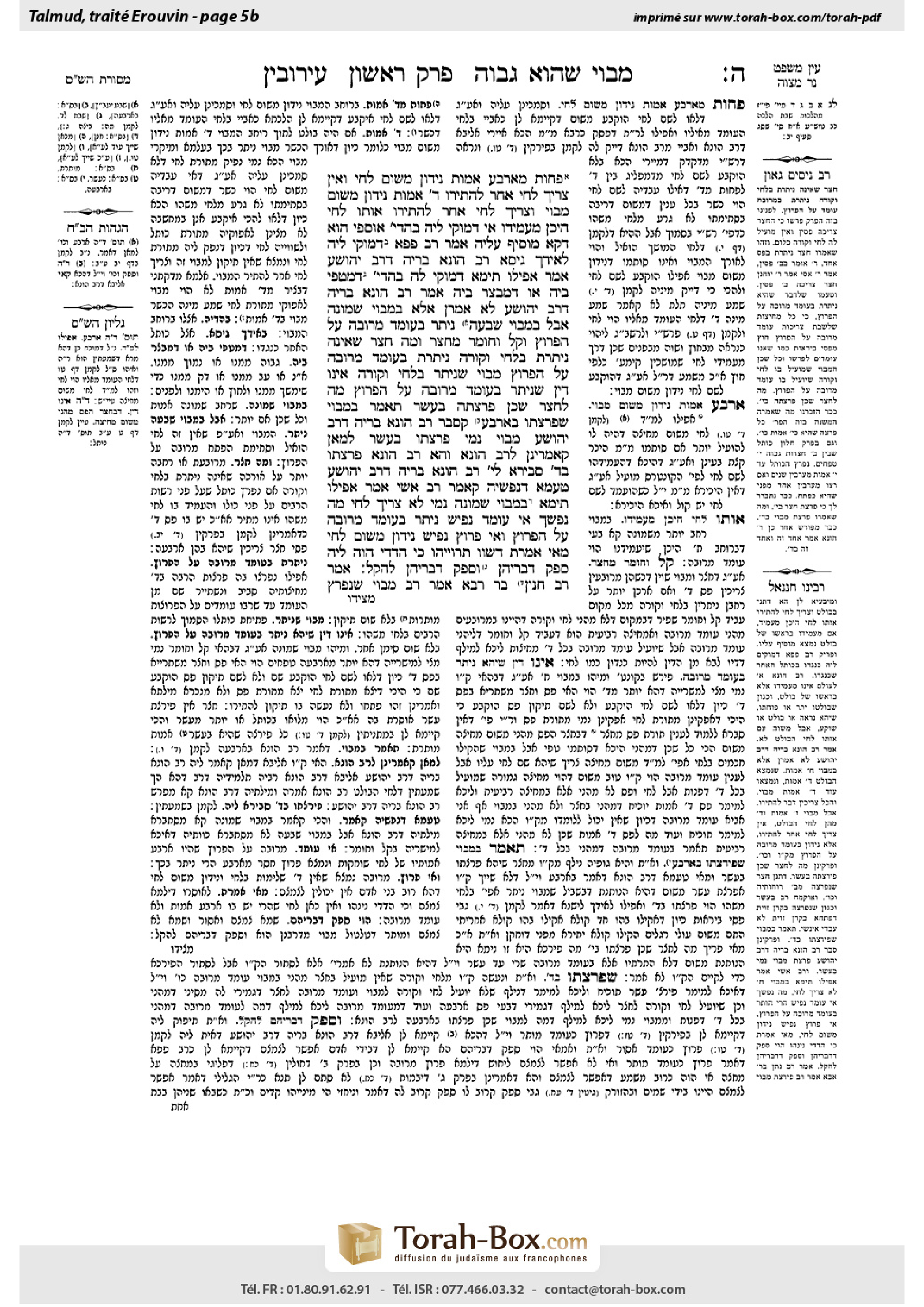
This page of Eruvin includes the Aramaic text, an English translation and an AI-generated French translation, alongside the scan above.
עירובין ה׳ ב · Aramaic and Hebrew text
פָּחוֹת מֵאַרְבַּע אַמּוֹת — נִידּוֹן מִשּׁוּם לֶחִי, וְאֵין צָרִיךְ לֶחִי אַחֵר לְהַתִּירוֹ. אַרְבַּע אַמּוֹת — נִידּוֹן מִשּׁוּם מָבוֹי, וְצָרִיךְ לֶחִי אַחֵר לְהַתִּירוֹ.
אוֹתוֹ לֶחִי, הֵיכָן מַעֲמִידוֹ? אִי דְּמוֹקֵי לֵיהּ בַּהֲדֵיהּ, אוֹסֹפֵי הוּא דְּקָא מוֹסִיף עֲלֵיהּ.
אָמַר רַב פָּפָּא: דְּמוֹקֵי לֵיהּ לְאִידַּךְ גִּיסָא. רַב הוּנָא בְּרֵיהּ דְּרַב יְהוֹשֻׁעַ אָמַר: אֲפִילּוּ תֵּימָא דְּמוֹקֵי לֵהּ בַּהֲדֵיהּ דִּמְטַפֵּי בֵּיהּ, אוֹ דִּמְבַצַּר בֵּיהּ.
אָמַר רַב הוּנָא בְּרֵיהּ דְּרַב יְהוֹשֻׁעַ: לָא אֲמַרַן, אֶלָּא בְּמָבוֹי שְׁמוֹנָה. אֲבָל בְּמָבוֹי שִׁבְעָה — נִיתָּר בְּעוֹמֵד מְרוּבֶּה עַל הַפָּרוּץ.
וְקַל וָחוֹמֶר מֵחָצֵר: וּמָה חָצֵר שֶׁאֵינָהּ נִיתֶּרֶת בְּלֶחִי וְקוֹרָה — נִיתֶּרֶת בְּעוֹמֵד מְרוּבֶּה עַל הַפָּרוּץ, מָבוֹי שֶׁנִּיתָּר בְּלֶחִי וְקוֹרָה — אֵינוֹ דִּין שֶׁנִּיתָּר בְּעוֹמֵד מְרוּבֶּה עַל הַפָּרוּץ?
מָה לֶחָצֵר שֶׁכֵּן פִּרְצָתָהּ בְּעֶשֶׂר, תֹּאמַר בְּמָבוֹי שֶׁפִּרְצָתוֹ בְּאַרְבַּע!
קָסָבַר רַב הוּנָא בְּרֵיהּ דְּרַב יְהוֹשֻׁעַ: מָבוֹי נָמֵי, פִּרְצָתוֹ בְּעֶשֶׂר. לְמַאן קָאָמְרִינַן? לְרַב הוּנָא, וְהָא רַב הוּנָא פִּרְצָתוֹ בְּאַרְבַּע סְבִירָא לֵיהּ?!
רַב הוּנָא בְּרֵיהּ דְּרַב יְהוֹשֻׁעַ טַעְמָא דְנַפְשֵׁיהּ קָאָמַר.
רַב אָשֵׁי אָמַר: אֲפִילּוּ תֵּימָא בְּמָבוֹי שְׁמוֹנֶה נָמֵי לָא צְרִיךְ לֶחִי, מָה נַפְשָׁךְ: אִי עוֹמֵד נְפִישׁ נִיתָּר בְּעוֹמֵד מְרוּבֶּה עַל הַפָּרוּץ, וְאִי פָּרוּץ נְפִישׁ נִידּוֹן מִשּׁוּם לֶחִי.
מַאי אָמְרַתְּ, דְּשָׁווּ תַּרְוַיְיהוּ כִּי הֲדָדֵי — הָוֵה לֵיהּ סְפֵק דִּבְרֵיהֶן, וּסְפֵק דִּבְרֵיהֶן לְהָקֵל.
אָמַר רַב חָנִין בַּר רָבָא אָמַר רַב: מָבוֹי שֶׁנִּפְרַץ
Eruvin 5b · English translation
if its protrusion is less than four cubits, it is deemed a side post that renders it permitted to carry in the alleyway, and no other side post is required to render it permitted. However, if it protrudes four cubits, that section is deemed an alleyway, and another side post is required to render it permitted to carry in it.
The Gemara poses a question: That side post, which is added in order to permit carrying within the alleyway that was formed by the four-cubit side post, where does one position it such that one may carry within the alleyway? The Gemara clarifies its difficulty: If one positions it alongside the first side post as an addition to it, it looks as if he is merely extending the original side post, and it is not noticeable that an extra side post is present.
Rav Pappa said: He should position it, the extra side post, on the other side of the alleyway, near the opposite wall. Rav Huna, son of Rav Yehoshua, said: Even if you say that he positions it alongside the first side post, it is valid, so long as he adds to it or diminishes from it in thickness or height, so that it will be noticeable that it is a side post of its own.
The Gemara limits the application of Rami bar Ḥama’s ruling: Rav Huna, son of Rav Yehoshua, said: We stated this halakha with regard to a side post protruding four cubits into the alleyway only in the case of an alleyway that is at least eight cubits wide. However, in the case of an alleyway that is only seven cubits wide, it is permitted to carry within the alleyway without an additional side post, not because the original side post functions as a side post but rather because it sufficiently seals off the entrance to the alleyway such that the standing segment is greater than the breached segment. The alleyway is now closed off from all four sides, and the remaining opening to the public domain is regarded as an entrance, as most of that side is closed and only a small part of it is open.
And this is derived by means of an a fortiori inference from a courtyard: Just as in a courtyard, which is not rendered a permitted domain by means of a side post or a cross beam, but actual partitions are required, it is nevertheless rendered a permitted domain even if there are gaps in the partitions, as long as the standing segment is greater than the breached segment in an alleyway, with regard to which the Sages were lenient, as it is rendered a permitted domain by means of a side post or a cross beam, is it not right that it is rendered a permitted domain when the standing segment of the partition is greater than the breached segment?
The Gemara refutes this a fortiori inference that was based on the fact that the legal status of a courtyard is more lenient than that of an alleyway, as it is in fact more stringent than that of an alleyway in at least one respect. With regard to what is true of a courtyard, that as long as its breach is less than ten cubits it remains a permitted domain, can you say the same of an alleyway, which is more stringent, as in a case where its breach is only four handbreadths it is not permitted to carry in the alleyway? Therefore, the halakha of an alleyway cannot be derived from the halakha of a courtyard.
The Gemara answers: Rav Huna, son of Rav Yehoshua, holds that the breach of an alleyway is also ten cubits. The Gemara raises a difficulty: But in accordance with whose opinion did we state this a fortiori inference? It is in accordance with the opinion of Rav Huna. But doesn’t Rav Huna himself hold that the breach of an alleyway is four handbreadths.
The Gemara answers: Rav Huna, son of Rav Yehoshua, did not come to explain Rav Huna’s position. Rather, he stated his own view, and he does not accept Rav Huna’s opinion with regard to the law of a breach in an alleyway.
Rav Ashi went further than Rav Huna, son of Rav Yehoshua, and said: Even if you say that the law with regard to a side post protruding four cubits into the alleyway applies in the case of an alleyway that is exactly eight cubits wide, in that it too does not require an additional side post. Whichever way you look at it, you are forced to arrive at this conclusion: If you say that the standing segment is greater, then the alleyway is permitted, because its standing segment is greater than the breached segment; and if you say that the breached segment is greater, then the protrusion is deemed a side post, as its width must be less than four cubits.
What might you say that would require an additional side post? Would you suggest that there is yet another possibility, that the two are exactly equal, the standing portion and the breach? This is an uncertainty with regard to rabbinic law, as carrying in an alleyway is forbidden only by rabbinic law, and the principle is that where there is an uncertainty with regard to a rabbinic law, one may assume the lenient position, as opposed to an uncertainty arising with respect to a Torah law, where one assumes the stringent position.
The Gemara considers a new case: Rav Ḥanin bar Rava said that Rav said: With regard to an alleyway that was breached,
Eruvin 5b · Traduction française (IA)
Si sa protrusion est inférieure à quatre cubits, on la considère comme un poteau latéral qui permet de porter dans l'allée, et aucun autre poteau latéral n'est requis pour permettre le port. Cependant, si elle saillait quatre cubits, cette section est considérée comme une allée, et un autre poteau latéral est requis pour permettre le port dans celle-ci.
Le Guemara pose une question : Ce poteau latéral, qui est ajouté afin de permettre le port dans l'allée formée par le poteau latéral saillant quatre cubits, où doit-on le placer afin de permettre le port dans l'allée ? Le Guemara clarifie sa difficulté : Si on le place à côté du premier poteau latéral comme une extension, cela semble simplement prolonger le poteau latéral original, et il n'est pas perceptible qu'un poteau latéral supplémentaire est présent.
Rav Pappa a dit : On doit le placer, ce poteau latéral supplémentaire, de l'autre côté de l'allée, près du mur opposé. Rav Huna, fils de Rav Yehoshua, a dit : Même si vous dites qu'on le place à côté du premier poteau latéral, cela est valide, à condition qu'on l'ajoute ou qu'on le diminue en épaisseur ou en hauteur, de sorte qu'il soit perceptible qu'il s'agit d'un poteau latéral distinct.
Le Guemara limite l'application de la décision de Rami bar Ḥama : Rav Huna, fils de Rav Yehoshua, a dit : Nous avons énoncé cette halakha concernant un poteau latéral saillant quatre cubits dans l'allée uniquement dans le cas d'une allée d'au moins huit cubits de large. Cependant, dans le cas d'une allée de sept cubits de large seulement, il est permis de porter dans l'allée sans poteau latéral supplémentaire, non parce que le poteau latéral original fonctionne comme tel, mais plutôt parce qu'il suffit de fermer l'entrée de l'allée de sorte que la partie debout soit plus grande que la partie brisée. L'allée est désormais entourée de tous les côtés, et l'ouverture restante vers le domaine public est considérée comme une entrée, car la majorité de ce côté est fermée et seule une petite partie est ouverte.
Et cela est déduit par une inférence a fortiori à partir d'un cour d'entrée : Tout comme dans un cour d'entrée, qui n'est pas rendu un domaine permis par un poteau latéral ou une poutre transversale, mais des parois réelles sont nécessaires, il est toutefois rendu un domaine permis même s'il y a des ouvertures dans les parois, à condition que la partie debout soit plus grande que la partie brisée dans une allée, concernant laquelle les Sages sont plus indulgents, comme il est rendu un domaine permis par un poteau latéral ou une poutre transversale, n'est-ce pas justifié qu'il soit rendu un domaine permis lorsque la partie debout de la paroi est plus grande que la partie brisée ?
Le Guemara réfute cette inférence a fortiori basée sur le fait que le statut juridique d'un cour d'entrée est plus indulgent que celui d'une allée, car il est en fait plus strict que celui d'une allée en au moins un aspect. Concernant ce qui est vrai d'un cour d'entrée, que tant que sa brèche est inférieure à dix cubits il reste un domaine permis, pouvez-vous dire la même chose d'une allée, qui est plus strict, comme dans le cas où sa brèche est seulement quatre tefachim, il n'est pas permis de porter dans l'allée ? Par conséquent, la halakha d'une allée ne peut pas être déduite de la halakha d'un cour d'entrée.
Le Guemara répond : Rav Huna, fils de Rav Yehoshua, considère que la brèche d'une allée est également de dix cubits. Le Guemara soulève une difficulté : Mais selon l'opinion de qui avons-nous énoncé cette inférence a fortiori ? C'est selon l'opinion de Rav Huna. Mais ne tient-il pas lui-même que la brèche d'une allée est de quatre tefachim ?
Le Guemara répond : Rav Huna, fils de Rav Yehoshua, n'est pas venu expliquer la position de Rav Huna. Plutôt, il a énoncé sa propre opinion, et il ne reconnaît pas l'opinion de Rav Huna concernant la loi de la brèche dans une allée.
Rav Ashi est allé plus loin que Rav Huna, fils de Rav Yehoshua, et a dit : Même si vous dites que la loi concernant un poteau latéral saillant quatre cubits dans l'allée s'applique au cas d'une allée de huit cubits de large exactement, dans lequel elle ne nécessite pas non plus un poteau latéral supplémentaire. Quel que soit l'angle sous lequel on le considère, on est contraint d'arriver à cette conclusion : Si vous dites que la partie debout est plus grande, alors l'allée est permise, car sa partie debout est plus grande que la partie brisée ; et si vous dites que la partie brisée est plus grande, alors la saillie est considérée comme un poteau latéral, car sa largeur doit être inférieure à quatre cubits.
Quel pourrait être l'argument qui exigerait un poteau latéral supplémentaire ? Suggérerez-vous qu'il existe une autre possibilité, celle où les deux sont exactement égaux, la partie debout et la brèche ? C'est une incertitude concernant la loi rabbinique, car le port dans une allée est interdit uniquement par la loi rabbinique, et le principe est que, dans le cas d'une incertitude concernant une loi rabbinique, on adopte la position la plus indulgente, contrairement à une incertitude concernant une loi de la Torah, où on adopte la position la plus stricte.
Le Guemara considère un nouveau cas : Rav Ḥanin bar Rava a dit que Rav a dit : Concernant une allée percée,
Traduction française générée par IA à partir de l’édition anglaise de Sefaria. Vérifie toujours un passage avec le texte source.
Text from Sefaria: William Davidson Edition - Vocalized Aramaic (CC BY NC); William Davidson Edition - English (CC BY NC).