Eruvin 6a: Talmud study for Daf Yomi
Study the Talmud for Daf Yomi with scanned pages, Hebrew text, English translations from Sefaria and AI-generated French translations.
Passage selection and English or AI-generated French translation are available where the scan has annotations. Daf Study is independent of Torah-Box and Sefaria.
Browse Eruvin · עירובין · All tractatesEruvin 6a text and translations
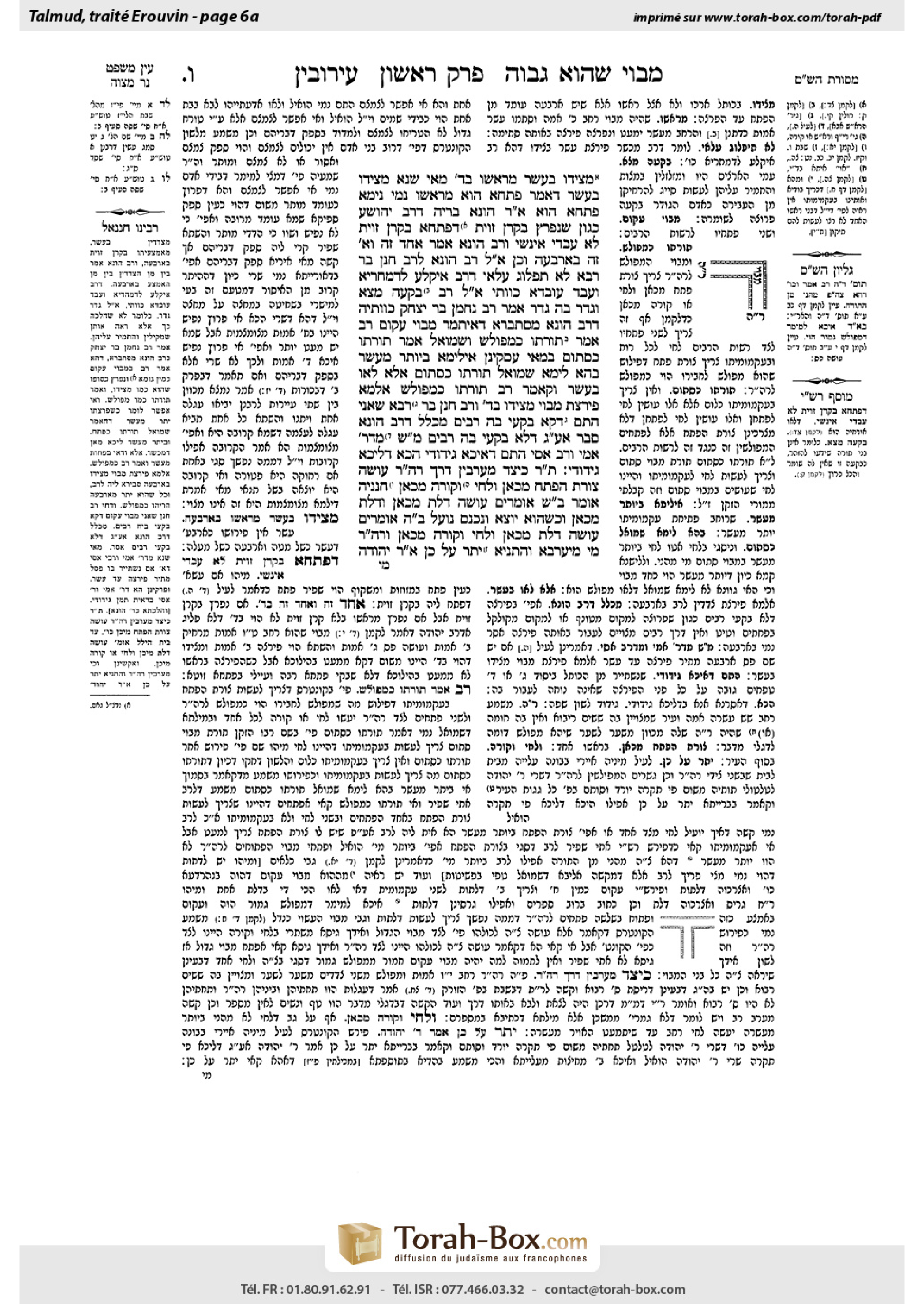
This page of Eruvin includes the Aramaic text, an English translation and an AI-generated French translation, alongside the scan above.
עירובין ו׳ א · Aramaic and Hebrew text
מִצִּידּוֹ — בְּעֶשֶׂר, מֵרֹאשׁוֹ — בְּאַרְבָּעָה.
מַאי שְׁנָא מִצִּידּוֹ בְּעֶשֶׂר — דְּאָמַר פִּתְחָא הוּא, מֵרֹאשׁוֹ נָמֵי נֵימָא פִּתְחָא הוּא!
אָמַר רַב הוּנָא בְּרֵיהּ דְּרַב יְהוֹשֻׁעַ: כְּגוֹן שֶׁנִּפְרַץ בְּקֶרֶן זָוִית, דְּפִתְחָא בְּקֶרֶן זָוִית לָא עָבְדִי אִינָשֵׁי.
וְרַב הוּנָא אָמַר: אֶחָד זֶה וְאֶחָד זֶה בְּאַרְבָּעָה. וְכֵן אֲמַר לֵיהּ רַב הוּנָא לְרַב חָנָן בַּר רָבָא: לָא תִּפְלוֹג עִלַּאי דְּרַב אִיקְּלַע לְדַמְחַרְיָא וַעֲבַד עוֹבָדָא כְּווֹתִי. אֲמַר לֵיהּ: רַב בִּקְעָה מָצָא וְגָדַר בָּהּ גָּדֵר.
אָמַר רַב נַחְמָן בַּר יִצְחָק: כְּווֹתֵיהּ דְּרַב הוּנָא מִסְתַּבְּרָא, דְּאִיתְּמַר: מָבוֹי עָקוֹם — רַב אָמַר: תּוֹרָתוֹ כִּמְפוּלָּשׁ. וּשְׁמוּאֵל אָמַר: תּוֹרָתוֹ כְּסָתוּם.
בְּמַאי עָסְקִינַן? אִילֵימָא בְּיוֹתֵר מֵעֶשֶׂר — בְּהָא לֵימָא שְׁמוּאֵל תּוֹרָתוֹ כְּסָתוּם?
אֶלָּא לָאו בְּעֶשֶׂר, וְקָאָמַר רַב תּוֹרָתוֹ כִּמְפוּלָּשׁ, אַלְמָא פִּירְצַת מָבוֹי מִצִּידּוֹ בְּאַרְבָּעָה!
וְרַב חָנָן בַּר רָבָא, שָׁאנֵי הָתָם דְּקָא בָּקְעִי בַּהּ רַבִּים.
מִכְּלָל דְּרַב הוּנָא סָבַר אַף עַל גַּב דְּלָא בָּקְעִי בַּהּ רַבִּים, מַאי שְׁנָא מִדְּרַבִּי אַמֵּי וְרַבִּי אַסִּי?
הָתָם דְּאִיכָּא גִּידּוּדֵי, הָכָא דְּלֵיכָּא גִּידּוּדֵי.
תָּנוּ רַבָּנַן: כֵּיצַד מְעָרְבִין דֶּרֶךְ רְשׁוּת הָרַבִּים? עוֹשֶׂה צוּרַת הַפֶּתַח מִכָּאן, וְלֶחִי וְקוֹרָה מִכָּאן. חֲנַנְיָה אוֹמֵר: בֵּית שַׁמַּאי אוֹמְרִים: עוֹשֶׂה דֶּלֶת מִכָּאן וְדֶלֶת מִכָּאן וּכְשֶׁהוּא יוֹצֵא וְנִכְנָס נוֹעֵל. בֵּית הִלֵּל אוֹמְרִים: עוֹשֶׂה דֶּלֶת מִכָּאן, וְלֶחִי וְקוֹרָה מִכָּאן.
וּרְשׁוּת הָרַבִּים מִי מִיעָרְבָא?! וְהָתַנְיָא: יָתֵר עַל כֵּן אָמַר רַבִּי יְהוּדָה,
Eruvin 6a · English translation
if it was breached from its side, the side wall of the alleyway, carrying within the alleyway is prohibited if the breach is ten cubits wide. But if it was breached from its front, the wall that faces the public domain, carrying within the alleyway is prohibited even if the breach is only four handbreadths wide.
The Gemara poses a question: What is the difference such that carrying is prohibited due to a breach from the side only if the breach is ten cubits? This is because you say that up to ten cubits it is deemed an entrance. If the breach is in the front, let us also say it is an entrance, and carrying should be permitted if the breach is less than ten cubits.
Rav Huna, son of Rav Yehoshua, said: We are dealing with a case where the breach is in a corner. Since people do not make an entrance in a corner, a breach of this kind cannot be viewed as an entrance, and if the breach is larger than four handbreadths it must be sealed.
Rav Huna disagreed with Rav Ḥanin bar Rava and said: There is no distinction between the side and the front, for in both this case and that, a breach of up to four handbreadths is allowed. And so Rav Huna said to Rav Ḥanan bar Rava: Do not dispute me, as Rav himself arrived at a place called Damḥarya and performed an action, i.e., issued a practical ruling, in accordance with my opinion. Rav Ḥanan bar Rava said in response to him: No proof can be brought from that incident, for in that case Rav found an unguarded valley and fenced it in, i.e., Rav saw the need to add a safeguard and was therefore stringent in this case. His ruling, however, was not generally applied.
Rav Naḥman bar Yitzḥak said: Rav Huna’s opinion stands to reason, as it was stated that the amora’im disagree about the following issue: With regard to a crooked, L-shaped alleyway that opens onto the public domain at both ends, Rav said: Its law is like that of an alleyway that is open on two opposite sides, and it must be treated in a manner suitable for such an alleyway, i.e., an opening in the form of a doorway must be constructed at both ends, or else such an opening must be constructed at the point where the two arms of the alleyway meet and a side post or a cross beam must be placed at each end. And Shmuel said: Its law is like that of an alleyway that is closed on one side, and all that is necessary is a side post or a cross beam at each end.
The Gemara clarifies the particular circumstances of the case: With what are we dealing? If you say that the width of the alleyway at the point of the turn is more than ten cubits wide, in this case, would Shmuel say that its law is like that of an alleyway that is closed on one side? With an opening of that size, it must be considered like an alleyway that is open on both ends.
Rather, are we not dealing with a case where the width of the alleyway at the point of the turn is ten cubits or less, and Rav nonetheless said that the law of such an alleyway is like that of an alleyway that is open on both ends. Apparently, a breach in the side wall of an alleyway renders it prohibited to carry even if it is only four handbreadths wide, in accordance with the opinion of Rav Huna.
And Rav Ḥanan bar Rava argues that the cases cannot be compared: It is different there, in the case of the L-shaped alleyway, for many people cross through the opening from one arm to the other. Since in practice the alleyway is open to regular traffic, the ruling is stringent even with regard to a small breach.
The Gemara asks: Can it be inferred from this that Rav Huna holds that even if many people do not cross through the opening, a breach of four handbreadths still prohibits carrying? What is the difference between this case and the case of the ruling of Rabbi Ami and Rabbi Asi cited earlier, that an upright board of four handbreadths suffices in order to allow a breach of up to ten cubits?
The Gemara answers: There, there are remnants of a wall that render it difficult to pass through the breach, and therefore that breach does not annul the partitions. However, here, there are no remnants of a wall.
The Sages taught in a baraita: How does one render a public thoroughfare fit for carrying by means of an eiruv? He constructs an opening in the form of a doorway from here, on one side of the thoroughfare, and a side post or a cross beam from here, on the other side. Ḥananya disagrees and says: This is the subject of an early dispute between tanna’im, for Beit Shammai say: He constructs a door from here, on one side, and a door from here, on the other side, and when he exits and enters, he must lock the door. It is not sufficient to construct a symbolic door; rather, there must be a door that actually closes. And Beit Hillel say: He constructs a door from here, on one side, and a side post or a cross beam from here, on the other side.
The Gemara raises a fundamental question: Can a public domain be rendered fit for carrying by means of an eiruv? Wasn’t it taught in a baraita: Furthermore, Rabbi Yehuda said:
Eruvin 6a · Traduction française (IA)
Si la faille est faite du côté, c'est-à-dire du mur latéral de la rue, le transport à l'intérieur de la rue est interdit si la faille est de dix coudées de large. Mais si la faille est faite de la face, c'est-à-dire du mur qui fait face au domaine public, le transport à l'intérieur de la rue est interdit même si la faille est seulement de quatre tefachim de large.
La Guemara pose une question : Quelle est la différence qui fait que le transport est interdit en raison d'une faille du côté uniquement si la faille est de dix coudées ? C'est parce que l'on dit que jusqu'à dix coudées, cela est considéré comme une entrée. Si la faille est à l'avant, disons aussi qu'il s'agit d'une entrée, et le transport devrait être autorisé si la faille est inférieure à dix coudées.
Rav Huna, fils de Rav Yéhoshua, dit : Nous sommes en présence d'un cas où la faille est dans un coin. Puisque les gens n'ont pas l'habitude de faire une entrée dans un coin, une faille de ce genre ne peut pas être considérée comme une entrée, et si la faille est plus grande que quatre tefachim, elle doit être comblée.
Rav Huna contesta l'opinion de Rav Ḥanin bar Rava et dit : Il n'y a pas de différence entre le côté et l'avant, car dans les deux cas, une faille de jusqu'à quatre tefachim est permise. Et ainsi Rav Huna dit à Rav Ḥanan bar Rava : Ne discute pas contre moi, car Rav lui-même est arrivé à un lieu appelé Damḥarya et a rendu un jugement pratique, c'est-à-dire a émis un avis pratique conformément à mon opinion. Rav Ḥanan bar Rava répondit à lui en disant : On ne peut pas établir une preuve à partir de cet incident, car dans ce cas, Rav a trouvé un vallon non gardé et l'a entouré, c'est-à-dire Rav a vu la nécessité d'ajouter une protection et a donc été strict dans ce cas. Son jugement, cependant, n'était pas généralement appliqué.
Rav Naḥman bar Yitzḥak dit : L'opinion de Rav Huna est raisonnable, car il a été dit que les amoraïm s'entretiennent sur le sujet suivant : En ce qui concerne une rue en L qui s'ouvre sur le domaine public aux deux extrémités, Rav dit : Sa loi est comme celle d'une rue qui est ouverte sur deux côtés opposés, et il doit être traité comme une rue de ce type, c'est-à-dire qu'on doit construire une ouverture en forme de porte aux deux extrémités, ou bien on doit construire une ouverture au point où les deux bras de la rue se rejoignent et on doit placer un poteau latéral ou une poutre transversale à chaque extrémité. Et Shmuel dit : Sa loi est comme celle d'une rue qui est fermée sur un côté, et il suffit de placer un poteau latéral ou une poutre transversale à chaque extrémité.
La Guemara clarifie les circonstances particulières du cas : De quoi sommes-nous en train de parler ? Si vous dites que la largeur de la rue au point de virage est supérieure à dix coudées, dans ce cas, Shmuel dirait-il que sa loi est comme celle d'une rue qui est fermée sur un côté ? Avec une ouverture de cette taille, il faut la considérer comme une rue ouverte sur les deux côtés.
Plutôt, ne sommes-nous pas en train de parler d'un cas où la largeur de la rue au point de virage est de dix coudées ou moins, et Rav dit toutefois que la loi de cette rue est comme celle d'une rue ouverte sur les deux côtés. Apparemment, une faille dans le mur latéral d'une rue rend le transport interdit même si elle est seulement de quatre tefachim de large, conformément à l'opinion de Rav Huna.
Et Rav Ḥanan bar Rava conteste que les cas puissent être comparés : C'est différent là-bas, dans le cas de la rue en L, car beaucoup de gens traversent l'ouverture d'un bras à l'autre. Puisque la rue est en pratique ouverte à la circulation régulière, le jugement est strict même en ce qui concerne une petite faille.
La Guemara pose une question : Peut-on en déduire de cela que Rav Huna considère que même si beaucoup de gens ne traversent pas l'ouverture, une faille de quatre tefachim interdit le transport ? Quelle est la différence entre ce cas et le cas du jugement de Rabbi Ami et de Rabbi Asi cité plus tôt, selon lequel un poteau vertical de quatre tefachim suffit pour permettre une faille jusqu'à dix coudées ?
La Guemara répond : Là-bas, il y a des restes de mur qui rendent difficile de traverser la faille, et donc cette faille n'annule pas les cloisons. Cependant, ici, il n'y a pas de restes de mur.
Les Sages ont enseigné dans une baraïta : Comment rendre un domaine public adapté au transport par le biais d'un eiruv ? On construit une ouverture en forme de porte d'un côté de la rue, et un poteau latéral ou une poutre transversale de l'autre côté. Ḥananya conteste et dit : C'est la matière d'un débat précoce entre les tannaïm, car Beit Shammai disent : On construit une porte d'un côté, et une porte de l'autre côté, et lorsqu'on sort et entre, on doit fermer la porte. Il n'est pas suffisant de construire une porte symbolique ; il faut une porte qui ferme effectivement. Et Beit Hillel disent : On construit une porte d'un côté, et un poteau latéral ou une poutre transversale de l'autre côté.
La Guemara soulève une question fondamentale : Peut-on rendre un domaine public adapté au transport par le biais d'un eiruv ? N'était-ce pas enseigné dans une baraïta : De plus, Rabbi Yéhuda a dit :
Traduction française générée par IA à partir de l’édition anglaise de Sefaria. Vérifie toujours un passage avec le texte source.
Text from Sefaria: William Davidson Edition - Vocalized Aramaic (CC BY NC); William Davidson Edition - English (CC BY NC).