Eruvin 60b: Talmud study for Daf Yomi
Study the Talmud for Daf Yomi with scanned pages, Hebrew text, English translations from Sefaria and AI-generated French translations.
Passage selection and English or AI-generated French translation are available where the scan has annotations. Daf Study is independent of Torah-Box and Sefaria.
Browse Eruvin · עירובין · All tractatesEruvin 60b text and translations
This page of Eruvin includes the Aramaic text, an English translation and an AI-generated French translation, alongside the scan above.
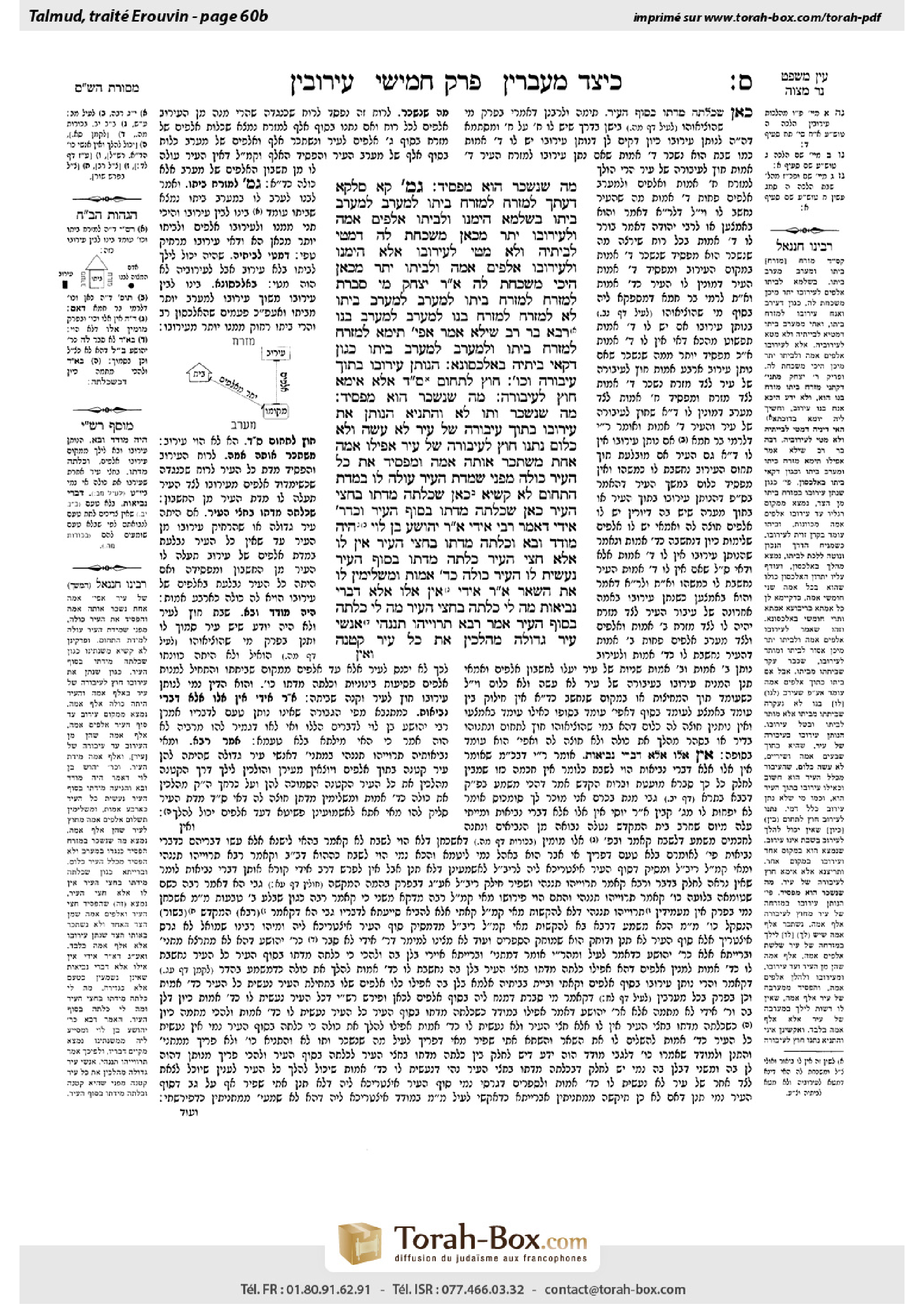
עירובין ס׳ ב · Aramaic and Hebrew text
מַה שֶּׁנִּשְׂכַּר הוּא מַפְסִיד.
גְּמָ׳ קָא סָלְקָא דַּעְתָּךְ: ״לַמִּזְרָח״, לְמִזְרַח בֵּיתוֹ. ״לַמַּעֲרָב״, לְמַעֲרַב בֵּיתוֹ.
בִּשְׁלָמָא ״הֵימֶנּוּ וּלְבֵיתוֹ אַלְפַּיִם אַמָּה וּלְעֵירוּבוֹ יָתֵר מִכָּאן״ — מַשְׁכַּחַתְּ לַהּ, דְּמָטֵי לְבֵיתֵיהּ וְלָא מָטֵי לְעֵירוּבוֹ, אֶלָּא ״הֵימֶנּוּ וּלְעֵירוּבוֹ אַלְפַּיִם אַמָּה וּלְבֵיתוֹ יָתֵר מִכָּאן״ — הֵיכִי מַשְׁכַּחַתְּ לַהּ?
אָמַר רַבִּי יִצְחָק: מִי סָבְרַתְּ ״לַמִּזְרָח״ — לְמִזְרַח בֵּיתוֹ, ״לַמַּעֲרָב״ — לְמַעֲרַב בֵּיתוֹ?! לֹא, ״לַמִּזְרָח״ — לְמִזְרַח בְּנוֹ, ״לַמַּעֲרָב״ — לְמַעֲרַב בְּנוֹ.
רָבָא בַּר רַב שֵׁילָא אָמַר: אֲפִילּוּ תֵּימָא ״לַמִּזְרָח״ — לְמִזְרַח בֵּיתוֹ, וְ״לַמַּעֲרָב״ — לְמַעֲרַב בֵּיתוֹ, כְּגוֹן דְּקָאֵי בֵּיתֵיהּ בַּאֲלַכְסוֹנָא.
הַנּוֹתֵן עֵירוּבוֹ בְּתוֹךְ עִיבּוּרָהּ וְכוּ׳. חוּץ לַתְּחוּם סָלְקָא דַּעְתָּךְ? אֶלָּא אֵימָא: חוּץ לְעִיבּוּרָהּ.
מַה שֶּׁנִּשְׂכַּר הוּא מַפְסִיד. מָה שֶּׁנִּשְׂכַּר וְתוּ לָא?! וְהָתַנְיָא: הַנּוֹתֵן אֶת עֵירוּבוֹ בְּתוֹךְ עִיבּוּרָהּ שֶׁל עִיר, לֹא עָשָׂה וְלֹא כְלוּם. נְתָנוֹ חוּץ לְעִיבּוּרָהּ שֶׁל עִיר אֲפִילּוּ אַמָּה אַחַת, מִשְׂתַּכֵּר אוֹתָהּ אַמָּה וּמַפְסִיד אֶת כָּל הָעִיר כּוּלָּהּ, מִפְּנֵי שֶׁמִּדַּת הָעִיר עוֹלָה לוֹ בְּמִדַּת הַתְּחוּם!
לָא קַשְׁיָא: כָּאן שֶׁכָּלְתָה מִדָּתוֹ בַּחֲצִי הָעִיר, כָּאן שֶׁכָּלְתָה מִדָּתוֹ בְּסוֹף הָעִיר.
וְכִדְרַבִּי אִידִי, דְּאָמַר רַבִּי אִידִי אָמַר רַבִּי יְהוֹשֻׁעַ בֶּן לֵוִי: הָיָה מוֹדֵד וּבָא וְכָלְתָה מִדָּתוֹ בַּחֲצִי הָעִיר — אֵין לוֹ אֶלָּא חֲצִי הָעִיר. כָּלְתָה מִדָּתוֹ בְּסוֹף הָעִיר — נַעֲשֵׂית לוֹ הָעִיר כּוּלָּהּ כְּאַרְבַּע אַמּוֹת, וּמַשְׁלִימִין לוֹ אֶת הַשְּׁאָר.
אָמַר רַבִּי אִידִי: אֵין אֵלּוּ אֶלָּא דִּבְרֵי נְבִיאוּת. מָה לִי כָּלְתָה בַּחֲצִי הָעִיר, מָה לִי כָּלְתָה בְּסוֹף הָעִיר?
אָמַר רָבָא, תַּרְוַיְיהוּ תְּנַנְהִי: אַנְשֵׁי עִיר גְּדוֹלָה מְהַלְּכִין אֶת כׇּל עִיר קְטַנָּה.
Eruvin 60b · English translation
what he gains in distance through his eiruv on one side of the city he loses on the other side.
GEMARA: It might enter your mind to say that when the mishna states that one was standing to the east, it means that he was standing to the east of his house and that he had instructed his son to establish an eiruv to the west of his house. Similarly, when it states that he was standing to the west, it means that he was positioned to the west of his house and that he had instructed his son to establish an eiruv to the east of his house. In such a case, the person’s house is located between him and his eiruv.
If so, the question arises: Granted, the mishna’s case where there is a distance of two thousand cubits from his current location to his house, and the distance to his eiruv is greater than this, you can find, as it is possible that he can reach his house without traveling two thousand cubits and he cannot reach his eiruv. But where do you find a case where there is a distance of two thousand cubits between him and his eiruv, and the distance to his house is greater than this? The person’s house is located between him and his eiruv.
Rabbi Yitzḥak said: Do you think that to the east means that he was standing to the east of his house, and to the west means that he was standing to the west of his house? No, to the east means to the east of his son, who is depositing his eiruv for him, and to the west means to the west of his son.
Rava bar Rav Sheila said: Even if you say that to the east means to the east of his house and to the west means to the west of his house, the mishna can be understood as referring to a case where his house stood along a diagonal line in relation to the person and his eiruv. In that case, although he is to the west of his house and the eiruv is located to its east, he can still be closer to his eiruv than he is to his house.
We learned in the mishna: One who places his eiruv within the outskirts of the city has not accomplished anything. However, if he places it outside the city limits, it is effective. The Gemara expresses surprise: Can it enter your mind that the mishna is dealing with a case where one placed his eiruv outside the Shabbat limit? If the eiruv is outside the Shabbat limit as measured from his physical location at the onset of Shabbat, he cannot access it on Shabbat; it is therefore ineffective in establishing his Shabbat residence. Rather, correct it and say as follows: If one placed his eiruv outside the city’s outskirts, i.e., beyond the area of slightly more than seventy cubits surrounding the city, the eiruv is effective in establishing his Shabbat residence at that location.
We learned in the next clause of the mishna concerning one who places his eiruv even one cubit beyond the city’s boundary: That which he gains on one side of the city he loses on the other. The Gemara expresses surprise: Does that mean that only that which he gains on one side he loses on the other, and no more? Wasn’t it taught in a baraita: With regard to one who places his eiruv within the outskirts of the city, he has not done anything; if, however, he placed it outside the outskirts of the city, even one cubit outside, he gains that cubit and loses the entire city because the measure of the city is included in the measure of his Shabbat limit? If one’s Shabbat residence had been in the city, the two thousand cubits of his Shabbat limit would have been measured from the edge of the city’s outskirts; now that he has established his Shabbat residence outside the city, the city itself is included in the two thousand cubits, and he may lose far more on that side than he will gain on the other side.
The Gemara answers: This is not difficult. Here the baraita is referring to a case where his measure of two thousand cubits terminated in the middle of the city; whereas there the mishna is referring to a case where his measure terminated at the far end of the city.
And this is in accordance with the opinion stated by Rabbi Idi, as Rabbi Idi said that Rabbi Yehoshua ben Levi said: If one was measuring the two thousand cubits of his Shabbat limit from the location of his Shabbat residence outside the city, and his measure terminated in the middle of the city, he has only half the city, i.e., he may walk only to the end of his two thousand cubits. If, however, his measure terminated at the far end of the city, the entire city is regarded as four cubits, and he completes the rest of the Shabbat limit on the other side of the city.
Rabbi Idi said: These are nothing more than words of prophecy, i.e., I do not see the logic behind this statement. What difference is it to me if the measure terminated in the middle of the city, or if it terminated at the far end of the city?
Rava said: They are not words of prophecy, as both cases were taught in the following mishna: The residents of a large city may walk through an entire small city that is fully included within its Shabbat limit; the small city is considered as though it were four cubits, and the rest of the Shabbat limit is measured from the other side of the city.
Eruvin 60b · Traduction française (IA)
Ce qu'il gagne en distance grâce à son eiruv d'un côté de la ville, il le perd de l'autre côté.
GUEMARA : Il pourrait vous venir à l'esprit de dire que lorsque la michna indique qu'une personne était debout à l'est, cela signifie qu'elle était debout à l'est de sa maison et qu'elle avait instruit son fils de créer un eiruv à l'ouest de sa maison. De même, lorsque la michna indique qu'elle était debout à l'ouest, cela signifie qu'elle était positionnée à l'ouest de sa maison et qu'elle avait instruit son fils de créer un eiruv à l'est de sa maison. Dans ce cas, la maison de la personne est située entre elle et son eiruv.
Si c'est ainsi, la question se pose : Admettons que la michna traite d'un cas où la distance entre son emplacement actuel et sa maison est de deux mille coudées, et que la distance vers son eiruv est supérieure à cela, vous pouvez trouver, car il est possible qu'il puisse atteindre sa maison sans parcourir deux mille coudées et qu'il ne puisse pas atteindre son eiruv. Mais où trouvez-vous un cas où la distance entre lui et son eiruv est de deux mille coudées, et la distance vers sa maison est supérieure à cela ? La maison de la personne est située entre lui et son eiruv.
Rabbi Yitzḥak dit : Croyez-vous que l'est signifie qu'il était debout à l'est de sa maison, et l'ouest signifie qu'il était debout à l'ouest de sa maison ? Non, l'est signifie à l'est de son fils, qui dépose son eiruv pour lui, et l'ouest signifie à l'ouest de son fils.
Rava bar Rav Sheila dit : Même si vous dites que l'est signifie à l'est de sa maison et l'ouest signifie à l'ouest de sa maison, la michna peut être comprise comme faisant référence à un cas où sa maison était située sur une diagonale par rapport à la personne et son eiruv. Dans ce cas, bien qu'il soit à l'ouest de sa maison et que l'eiruv soit situé à l'est, il peut être plus proche de son eiruv que de sa maison.
Nous avons appris dans la michna : Celui qui place son eiruv à l'extérieur des limites de la ville n'a accompli rien. Cependant, si il le place en dehors des limites de la ville, cela est efficace. La Guemara exprime une surprise : Pourriez-vous penser que la michna traite d'un cas où l'on a placé son eiruv en dehors de la limite du Shabbat ? Si l'eiruv est en dehors de la limite du Shabbat, mesurée à partir de son emplacement physique au début du Shabbat, il ne peut pas y accéder le Shabbat ; il est donc inefficace pour établir son lieu de résidence du Shabbat. Plutôt, corrigez cela et dites comme suit : Si l'on a placé son eiruv en dehors des limites de la ville, c'est-à-dire au-delà de la zone de plus de soixante-dix coudées autour de la ville, l'eiruv est efficace pour établir son lieu de résidence du Shabbat à cet endroit.
Nous avons appris dans la clause suivante de la Michna concernant celui qui place son eiruv même d'un coudée au-delà des limites de la ville : Ce qu'il gagne d'un côté de la ville il le perd de l'autre. La Guemara exprime une surprise : Cela signifie-t-il que seul ce qu'il gagne d'un côté il le perd de l'autre, et pas plus ? N'avait-il pas été enseigné dans une baraïta : Concernant celui qui place son eiruv à l'intérieur des limites de la ville, il n'a accompli rien ; cependant, si l'on a placé l'eiruv en dehors des limites de la ville, même d'un coudée en dehors, il gagne ce coudée et perd toute la ville, car la mesure de la ville est incluse dans la mesure de son limites du Shabbat ? Si la résidence du Shabbat de la personne était dans la ville, les deux mille coudées de sa limite du Shabbat auraient été mesurées à partir de la limite de la ville ; maintenant que l'on a établi sa résidence du Shabbat en dehors de la ville, la ville elle-même est incluse dans les deux mille coudées, et il peut perdre bien plus de ce côté que ce qu'il gagne de l'autre côté.
La Guemara répond : Ce n'est pas difficile. Ici, la baraïta fait référence à un cas où la mesure des deux mille coudées s'arrêtait au milieu de la ville ; tandis que là, la Michna fait référence à un cas où la mesure s'arrêtait à l'extrémité de la ville.
Et cela correspond à l'opinion exprimée par Rabbi Idi, comme Rabbi Idi a dit que Rabbi Yéhoshua ben Levi a dit : Si l'on mesurait les deux mille coudées de sa limite du Shabbat à partir de l'emplacement de sa résidence du Shabbat en dehors de la ville, et que sa mesure s'arrêtait au milieu de la ville, il n'avait que la moitié de la ville, c'est-à-dire qu'il pouvait marcher seulement jusqu'à la fin de ses deux mille coudées. Cependant, si sa mesure s'arrêtait à l'extrémité de la ville, la ville entière est considérée comme quatre coudées, et il complète le reste de sa limite du Shabbat de l'autre côté de la ville.
Rabbi Idi a dit : Ce sont simplement des paroles de prophétie, c'est-à-dire que je ne perçois pas la logique de cette déclaration. Quelle différence cela fait-il pour moi que la mesure s'arrête au milieu de la ville, ou si elle s'arrête à l'extrémité de la ville ?
Rava a dit : Ce ne sont pas des paroles de prophétie, car les deux cas ont été enseignés dans la michna suivante : Les habitants d'une grande ville peuvent marcher à travers une petite ville entière qui est entièrement incluse dans sa limite du Shabbat ; la petite ville est considérée comme si elle était de quatre coudées, et le reste de la limite du Shabbat est mesuré de l'autre côté de la ville.
Traduction française générée par IA à partir de l’édition anglaise de Sefaria. Vérifie toujours un passage avec le texte source.
Text from Sefaria: William Davidson Edition - Vocalized Aramaic (CC BY NC); William Davidson Edition - English (CC BY NC).