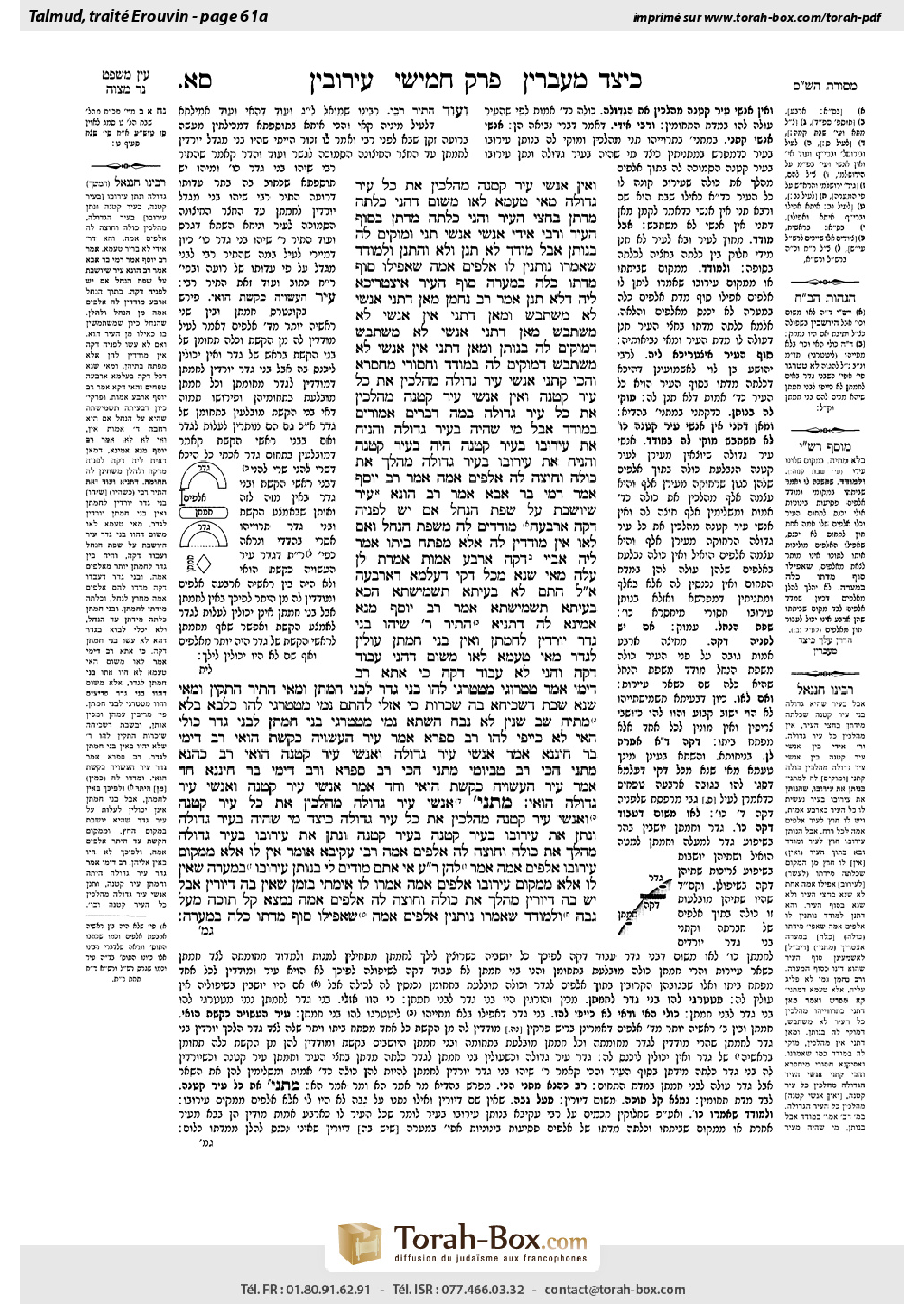
Eruvin 61a: Talmud study for Daf Yomi
Study the Talmud for Daf Yomi with scanned pages, Hebrew text, English translations from Sefaria and AI-generated French translations.
Passage selection and English or AI-generated French translation are available where the scan has annotations. Daf Study is independent of Torah-Box and Sefaria.
Browse Eruvin · עירובין · All tractatesEruvin 61a text and translations
This page of Eruvin includes the Aramaic text, an English translation and an AI-generated French translation, alongside the scan above.
עירובין ס״א א · Aramaic and Hebrew text
וְאֵין אַנְשֵׁי עִיר קְטַנָּה מְהַלְּכִין אֶת כׇּל עִיר גְּדוֹלָה.
מַאי טַעְמָא — לָאו מִשּׁוּם דְּהָנֵי כָּלְתָה מִדָּתָן בַּחֲצִי הָעִיר, וְהָנֵי כָּלְתָה מִדָּתָן בְּסוֹף הָעִיר.
וְרַבִּי אִידִי, ״אַנְשֵׁי אַנְשֵׁי״ תָּנֵי, וּמוֹקֵים לָהּ בְּנוֹתֵן. אֲבָל מוֹדֵד לָא תְּנַן.
וְלָא?! וְהָתְנַן: וְלַמּוֹדֵד שֶׁאָמְרוּ נוֹתְנִין לוֹ אַלְפַּיִם אַמָּה, שֶׁאֲפִילּוּ סוֹף מִדָּתוֹ כָּלֶה בִּמְעָרָה!
סוֹף הָעִיר אִיצְטְרִיכָא לֵיהּ, דְּלָא תְּנַן.
אָמַר רַב נַחְמָן: מַאן דְּתָנֵי ״אַנְשֵׁי״ לָא מִשְׁתַּבַּשׁ, וּמַאן דְּתָנֵי ״אֵין אַנְשֵׁי״ לָא מִשְׁתַּבַּשׁ.
מַאן דְּתָנֵי ״אַנְשֵׁי״ לָא מִשְׁתַּבַּשׁ — דְּמוֹקֵים לַהּ בְּנוֹתֵן. וּמַאן דְּתָנֵי ״אֵין אַנְשֵׁי״ לָא מִשְׁתַּבַּשׁ — דְּמוֹקֵים לַהּ בְּמוֹדֵד.
וְחַסּוֹרֵי מְחַסְּרָא, וְהָכִי קָתָנֵי: אַנְשֵׁי עִיר גְּדוֹלָה מְהַלְּכִין אֶת כׇּל עִיר קְטַנָּה, וְאֵין אַנְשֵׁי עִיר קְטַנָּה מְהַלְּכִין אֶת כׇּל עִיר גְּדוֹלָה. בַּמֶּה דְּבָרִים אֲמוּרִים, בְּמוֹדֵד. אֲבָל מִי שֶׁהָיָה בְּעִיר גְּדוֹלָה וְהִנִּיחַ אֶת עֵירוּבוֹ בְּעִיר קְטַנָּה, הָיָה בְּעִיר קְטַנָּה וְהִנִּיחַ אֶת עֵירוּבוֹ בְּעִיר גְּדוֹלָה — מְהַלֵּךְ אֶת כּוּלָּהּ וְחוּצָה לָהּ אַלְפַּיִם אַמָּה.
אָמַר רַב יוֹסֵף אָמַר רָמֵי בַּר אַבָּא אָמַר רַב הוּנָא: עִיר שֶׁיּוֹשֶׁבֶת עַל שְׂפַת הַנַּחַל, אִם יֵשׁ לְפָנֶיהָ דַּקָּה אַרְבָּעָה — מוֹדְדִים לָהּ מִשְּׂפַת הַנַּחַל. וְאִם לָאו — אֵין מוֹדְדִין לָהּ אֶלָּא מִפֶּתַח בֵּיתוֹ.
אֲמַר לֵיהּ אַבָּיֵי: דַּקָּה אַרְבַּע אַמּוֹת אֲמַרְתְּ לַן עֲלַהּ. מַאי שְׁנָא מִכׇּל דַּקֵּי דְעָלְמָא דְּאַרְבְּעָה?
אֲמַר לֵיהּ: הָתָם, לָא בְּעִיתָא תַּשְׁמִישְׁתָּא. הָכָא, בְּעִיתָא תַּשְׁמִישְׁתָּא.
אָמַר רַב יוֹסֵף: מְנָא אָמֵינָא לַהּ? דְּתַנְיָא: הִתִּיר רַבִּי שֶׁיְּהוּ בְּנֵי גָדֵר יוֹרְדִין לְחַמָּתָן, וְאֵין בְּנֵי חַמָּתָן עוֹלִין לְגָדֵר. מַאי טַעְמָא, לָאו מִשּׁוּם דְּהָנֵי עֲבוּד דַּקָּה, וְהָנֵי לָא עֲבוּד דַּקָּה?!
כִּי אֲתָא רַב דִּימִי אָמַר: טַטְרוֹגֵי מְטַטְרְגִי לְהוּ בְּנֵי גָדֵר לִבְנֵי חַמָּתָן, וּמַאי ״הִתִּיר״ — הִתְקִין.
וּמַאי שְׁנָא שַׁבָּת, דִּשְׁכִיחָא בָּהּ שִׁכְרוּת.
כִּי אָזְלִי לְהָתָם, נָמֵי מְטַטְרְגִי לְהוּ? כַּלְבָּא בְּלָא מָתֵיהּ, שַׁב שְׁנִין לָא נָבַח.
הַשְׁתָּא נָמֵי מְטַטְרְגִי בְּנֵי חַמָּתָן לִבְנֵי גָדֵר! כּוּלֵּי הַאי לָא כָּיְיפִי לְהוּ.
רַב סָפְרָא אָמַר: עִיר הָעֲשׂוּיָה כְּקֶשֶׁת הֲוַאי.
רַב דִּימִי בַּר חִינָּנָא אָמַר: אַנְשֵׁי עִיר גְּדוֹלָה וְאַנְשֵׁי עִיר קְטַנָּה הֲוַאי.
רַב כָּהֲנָא מַתְנֵי הָכִי. רַב טַבְיוֹמֵי מַתְנֵי הָכִי: רַב סָפְרָא וְרַב דִּימִי בַּר חִינָּנָא, חַד אָמַר: עִיר הָעֲשׂוּיָה כְּקֶשֶׁת הֲוַאי, וְחַד אָמַר: אַנְשֵׁי עִיר קְטַנָּה וְאַנְשֵׁי עִיר גְּדוֹלָה הֲוַאי.
מַתְנִי׳ אַנְשֵׁי עִיר גְּדוֹלָה מְהַלְּכִין אֶת כׇּל עִיר קְטַנָּה, וְאַנְשֵׁי עִיר קְטַנָּה מְהַלְּכִין אֶת כׇּל עִיר גְּדוֹלָה. כֵּיצַד? מִי שֶׁהָיָה בְּעִיר גְּדוֹלָה וְנָתַן אֶת עֵירוּבוֹ בְּעִיר קְטַנָּה, בְּעִיר קְטַנָּה וְנָתַן אֶת עֵירוּבוֹ בְּעִיר גְּדוֹלָה — מְהַלֵּךְ אֶת כּוּלָּהּ, וְחוּצָה לָהּ אַלְפַּיִם אַמָּה.
רַבִּי עֲקִיבָא אוֹמֵר: אֵין לוֹ אֶלָּא מִמְּקוֹם עֵירוּבוֹ אַלְפַּיִם אַמָּה. אָמַר לָהֶן רַבִּי עֲקִיבָא: אִי אַתֶּם מוֹדִים לִי בְּנוֹתֵן עֵירוּבוֹ בִּמְעָרָה, שֶׁאֵין לוֹ אֶלָּא מִמְּקוֹם עֵירוּבוֹ אַלְפַּיִם אַמָּה?
אָמְרוּ לוֹ: אֵימָתַי — בִּזְמַן שֶׁאֵין בָּהּ דָּיוֹרִין, אֲבָל יֵשׁ בָּהּ דָּיוֹרִין — מְהַלֵּךְ אֶת כּוּלָּהּ וְחוּצָה לָהּ אַלְפַּיִם אַמָּה. נִמְצָא, קַל תּוֹכָהּ מֵעַל גַּבָּהּ.
וְלַמּוֹדֵד שֶׁאָמְרוּ נוֹתְנִין אַלְפַּיִם אַמָּה — שֶׁאֲפִילּוּ סוֹף מִדָּתוֹ כָּלֶה בִּמְעָרָה.
Eruvin 61a · English translation
And the residents of a small city may not walk through an entire large city.
What is the reason for this difference? Is it not because these, the residents of the small city, their measure of two thousand cubits terminated in the middle of the large city, and therefore they may walk only to the end of their two thousand cubits; and these, the residents of the large city, their measure of two thousand cubits terminated at the far end of the small city, allowing them to walk through the entire city as though it were four cubits and complete the two thousand cubit measure of their Shabbat limit on the other side of the city?
And Rabbi Idi, who said that Rabbi Yehoshua ben Levi’s statement has no source, may hold that the mishna teaches the two cases with the same formulation. Just as it states: The residents of a large city may walk through an entire small city, it similarly states: The residents of a small city may walk through an entire large city. His version of the mishna did not state that the residents of a small city may not walk through an entire large city. And he establishes the mishna as referring to one who placed his eiruv inside the other city. Consequently, that city becomes his Shabbat residence, and he may walk anywhere in that city and an additional two thousand cubits beyond it. But we did not learn anything about one who was measuring two thousand cubits from his Shabbat residence outside the city, in which case it makes a difference whether the entire city is within his two thousand cubits or whether only part of it is within this limit.
The Gemara asks: And did we not learn in the mishna about one who was measuring? Didn’t we learn in the mishna: And as for one who is measuring his Shabbat limit, with regard to whom the Sages said that one gives him two thousand cubits, that applies even if the end of his measurement terminates in the middle of a cave? Although a cave has the status of a private domain, he may enter only the part of the cave that is within his two thousand cubits. This case is directly parallel to the case of one whose two thousand cubits end in the middle of a city.
The Gemara answers: Although there is a source for the case of one whose limit ends in the middle of a city, it was nevertheless necessary for Rabbi Yehoshua ben Levi to teach the case where one’s measure ends at the far end of the city, in which case the entire city is regarded as four cubits and the rest of the Shabbat limit is completed on the other side of the city, as we did not learn anything about such a case.
With regard to the mishna cited above, Rav Naḥman said: One who teaches the following in the second clause: The residents of a small city may walk through an entire large city, does not err in his rendering of the mishna. And one who teaches: The residents of a small city may not walk through an entire large city, also does not err. Both renderings are plausible.
Rav Naḥman explains: One who teaches: The residents of a small city may walk through an entire large city, does not err, as he establishes the mishna as referring to one who places his eiruv inside the other city. And one who teaches: The residents of a small city may not walk through an entire large city also does not err, as he establishes the mishna as referring to one who measures his Shabbat limit and arrives at the city from the outside.
And the mishna is incomplete and it teaches the following: The residents of a large city may walk through an entire small city, but the residents of a small city may not walk through an entire large city. In what case is this statement said? It was said with regard to one who was measuring his two thousand cubits from his Shabbat residence. But one who was in the large city and placed his eiruv in the small city, and similarly one who was in the small city and placed his eiruv in the large city, he may walk through the entire city in which he placed his eiruv and beyond it two thousand cubits.
Rav Yosef said that Rami bar Abba said that Rav Huna said: With regard to a city located on the edge of a ravine, if there is a barrier four cubits high in front of it, one measures its Shabbat limit from the edge of the ravine, as it is considered the border of the city. And if there is not a barrier four cubits high in front of it, the Shabbat limit is measured from the entrance of each person’s house, as the city is not considered a permanent settlement.
Abaye said to him: You told us with regard to this case that a barrier four cubits high is required. What is different about this case that it requires a barrier that is higher than all other barriers, which must reach a height of only four handbreadths?
He said to him: There, use of the place is not frightening; here, use of the place is frightening. Generally, partitions serve a symbolic function, and therefore it is sufficient for the partition to be four handbreadths high. In this case, however, it is frightening to stand along the edge of the ravine without a protective barrier, and therefore a barrier four cubits high must be constructed for the safety of the residents.
Rav Yosef said: From where do I derive to say this halakha? As it was taught in a baraita: Rabbi Yehuda HaNasi permitted the residents of Geder, situated at the top of a slope, to descend on Shabbat to Ḥamtan, situated at the bottom of the slope, but the residents of Ḥamtan may not ascend to Geder. What is the reason? Is it not because these, the inhabitants of Geder, constructed a barrier at the lower edge of their city, and these, the members of Ḥamtan, did not construct a barrier at the upper edge of their city? Consequently, the residents of Geder measured their Shabbat limit from their barrier, and Ḥamtan was included in their two thousand cubits. The residents of Ḥamtan had to measure their Shabbat limits from their homes, and therefore Geder was not within their two thousand cubit limit.
The Gemara relates that when Rav Dimi came from Eretz Yisrael to Babylonia, he said: This ruling was issued not due to their respective Shabbat limits, but rather because the residents of Geder would assault [metatreg] the residents of Ḥamtan. And what does it mean that Rabbi Yehuda HaNasi permitted the residents of Geder to descend to Ḥamtan, but not vice versa? He instituted this. In other words, this was not a halakhic ruling, but rather an ordinance instituted to protect the public welfare and prevent fighting.
The Gemara asks: What is different about Shabbat that Rabbi Yehuda HaNasi instituted this ordinance only for Shabbat and not for the rest of the week? The Gemara answers: Drunkenness is common on Shabbat, when people eat to their heart’s content. Therefore, there is a greater chance of violent behavior.
The Gemara asks: When the residents of Geder go to Ḥamtan, they will assault the residents there; of what use, then, is this ordinance? The Gemara answers, citing a popular saying: A dog that is not in its place will not bark for seven years. On its own turf, a dog barks readily, but it becomes scared in unfamiliar surroundings and remains silent. Similarly, the people of Geder are not nearly as bold when they visit Ḥamtan as they are in their own town.
The Gemara asks: If so, we should be concerned about the reverse scenario, that now too, the residents of Ḥamtan, in their home territory, will take revenge and assault the residents of Geder. The Gemara answers: The people of Geder would not be submissive to such an extent. While visiting Ḥamtan, they would not initiate fights, but they would certainly fight back if they were attacked. Consequently, the people of Ḥamtan would not dare initiate hostilities with them. Therefore, there is no concern about the safety of either group.
Rav Safra said: Geder was a city shaped like a bow, whose two ends were separated by less than four thousand cubits. The empty space of the bow was viewed as though it were filled with houses, and its Shabbat limit was measured from the imaginary bowstring stretched between the two ends of the bow. Consequently, Ḥamtan was included in its Shabbat limit, and the residents of Geder were permitted to go there on Shabbat. With regard to the inhabitants of Ḥamtan, however, that same area between the ends of Geder was viewed as empty space, and therefore the houses of Geder along the arc of the bow were beyond their Shabbat limit.
Rav Dimi bar Ḥinana said: The people of Geder were residents of a large city, and the people of Ḥamtan were residents of a small city. Consequently, the residents of the large city, Geder, could walk through all of Ḥamtan, the small city; but the residents of Ḥamtan could walk only through part of Geder, as explained previously.
Rav Kahana taught it that way, as stated previously; whereas Rav Tavyomi taught it more concisely, in this way: Rav Safra and Rav Dimi bar Ḥinana disagreed about the matter. One of them said: Geder was a city shaped like a bow; and one of them said: The people of Ḥamtan were residents of a small city and the people of Geder were residents of a large city.
MISHNA: The residents of a large city may walk through an entire small city, and the residents of a small city may walk through an entire large city, even if part of it is located more than two thousand cubits from their city. How so? One who was in a large city and placed his eiruv in a small city, or one who was in a small city and placed his eiruv in a large city, may walk through the entire city in which he placed his eiruv and another two thousand cubits beyond it, as the entire city is considered as though it were only four cubits.
Rabbi Akiva says: He has only two thousand cubits from the place of his eiruv, as the actual area of the city is included in the calculation. Rabbi Akiva said to the Rabbis: Do you not concede to me that one who places his eiruv in a cave has only two thousand cubits from the place of his eiruv, and that consequently the entire cave is not considered as merely four cubits?
The Rabbis said to him: When does this apply? When the cave has no residents. But if it has residents, it is considered as though it were only four cubits, and one may walk through all of it and another two thousand cubits beyond it. Consequently, the halakha with regard to an eiruv placed inside a cave is sometimes more lenient than the halakha governing an eiruv placed in the area above the cave. If one places his eiruv inside a cave that has residents, he has two thousand cubits beyond the cave; if he places it above the cave, where there are no residents, he has only two thousand cubits from the place of his eiruv.
And as for one who is measuring his Shabbat limit, with regard to whom the Sages said that one gives him two thousand cubits, that measurement applies even if the end of his measurement terminates in the middle of a cave. He may not walk further into the cave, even if the cave is inhabited.
Eruvin 61a · Traduction française (IA)
Et les habitants d'une petite ville ne peuvent pas marcher à travers une grande ville entière.
Quelle est la raison de cette différence? N'est-ce pas parce que ceux, les habitants de la petite ville, leur mesure de deux mille coudées s'arrêtait au milieu de la grande ville, et donc ils ne peuvent marcher que jusqu'à la fin de leurs deux mille coudées; et ceux, les habitants de la grande ville, leur mesure de deux mille coudées s'arrêtait à l'extrémité de la petite ville, leur permettant de marcher à travers toute la ville comme si elle était de quatre coudées et d'achever la mesure de leurs limites sabbatiques de deux mille coudées de l'autre côté de la ville?
Et Rabbi Idi, qui affirmait que la déclaration de Rabbi Yéhoshua ben Levi n'avait pas de source, peut soutenir que la mitsna enseigne les deux cas avec la même formulation. Tout comme il est dit : Les habitants d'une grande ville peuvent marcher à travers une petite ville entière, il est également dit : Les habitants d'une petite ville peuvent marcher à travers une grande ville entière. Sa version de la mitsna n'a pas indiqué que les habitants d'une petite ville ne peuvent pas marcher à travers une grande ville entière. Et il établit la mitsna comme se référant à celui qui a placé son eiruv à l'intérieur de la ville. Ainsi, cette ville devient son lieu de résidence sabbatique, et il peut marcher n'importe où dans cette ville et deux mille coudées supplémentaires au-delà. Mais nous n'avons pas appris quoi que ce soit à propos de celui qui mesurait deux mille coudées à partir de son lieu de résidence sabbatique en dehors de la ville, dans ce cas, il fait une différence si toute la ville est dans ses deux mille coudées ou si seulement une partie est dans ce limites.
La Guemara demande : N'avons-nous pas appris dans la Michna à propos de celui qui mesurait ? N'avons-nous pas appris dans la Michna : Et concernant celui qui mesure sa limite sabbatique, à propos duquel les Sages ont dit que l'on lui donne deux mille coudées, cela s'applique même si la fin de sa mesure s'arrête au milieu d'une grotte ? Bien qu'une grotte ait le statut d'un domaine privé, il ne peut entrer que dans la partie de la grotte qui est dans ses deux mille coudées. Ce cas est directement parallèle au cas de celui dont les deux mille coudées s'arrêtent au milieu d'une ville.
La Guemara répond : Bien qu'il y ait une source pour le cas de celui dont la limite s'arrête au milieu d'une ville, il a tout de même été nécessaire que Rabbi Yéhoshua ben Levi enseigne le cas où la mesure de deux mille coudées s'arrête à l'extrémité de la ville, dans ce cas la ville entière est considérée comme quatre coudées et la partie restante de la limite sabbatique est achevée de l'autre côté de la ville, comme nous n'avons pas appris quoi que ce soit à ce sujet.
Concernant la Michna citée ci-dessus, Rav Naḥman a dit : Celui qui enseigne ce qui suit dans la deuxième clause : Les habitants d'une petite ville peuvent marcher à travers une grande ville entière, ne s'erreur pas dans sa formulation de la Michna. Et celui qui enseigne : Les habitants d'une petite ville ne peuvent pas marcher à travers une grande ville entière, ne s'erreur pas non plus. Les deux formulations sont plausibles.
Rav Naḥman explique : Celui qui enseigne : Les habitants d'une petite ville peuvent marcher à travers une grande ville entière, ne s'erreur pas, car il établit la mitsna comme se référant à celui qui place son eiruv à l'intérieur de la ville. Et celui qui enseigne : Les habitants d'une petite ville ne peuvent pas marcher à travers une grande ville entière ne s'erreur pas non plus, car il établit la mitsna comme se référant à celui qui mesure sa limite sabbatique et arrive à la ville depuis l'extérieur.
Et la mitsna est incomplète et elle enseigne ce qui suit : Les habitants d'une grande ville peuvent marcher à travers une petite ville entière, mais les habitants d'une petite ville ne peuvent pas marcher à travers une grande ville entière. Dans quel cas cette déclaration est-elle dite ? Elle a été dite concernant celui qui mesurait ses deux mille coudées à partir de son lieu de résidence sabbatique. Mais celui qui était dans la grande ville et a placé son eiruv dans la petite ville, et de même celui qui était dans la petite ville et a placé son eiruv dans la grande ville, peut marcher à travers toute la ville où il a placé son eiruv et au-delà de deux mille coudées.
Rav Yosef a dit que Rami bar Abba a dit que Rav Huna a dit : Concernant une ville située à l'extrémité d'un ravin, si il y a un obstacle de quatre coudées de haut devant elle, on mesure sa limite sabbatique à partir de l'extrémité du ravin, car elle est considérée comme la frontière de la ville. Et si il n'y a pas d'obstacle de quatre coudées de haut devant elle, la limite sabbatique est mesurée à partir de l'entrée de chaque maison, car la ville n'est pas considérée comme un établissement permanent.
Abaye dit à lui : Vous nous avez dit à propos de ce cas qu'un obstacle de quatre coudées de haut est requis. Quelle est la différence dans ce cas qui exige un obstacle plus haut que tous les autres obstacles, qui doivent atteindre une hauteur de seulement quatre paumes ?
Il lui a répondu : Là, l'utilisation de la place n'est pas effrayante ; ici, l'utilisation de la place est effrayante. Généralement, les partitions servent une fonction symbolique, et donc il suffit que la partition soit de quatre paumes de haut. Dans ce cas, cependant, il est effrayant de se tenir à l'extrémité du ravin sans une barrière protectrice, et donc une barrière de quatre coudées de haut doit être construite pour la sécurité des habitants.
Rav Yosef a dit : D'où dérive-t-on pour dire cette halakha ? Comme il a été enseigné dans une baraïta : Rabbi Yéhuda HaNasi a permis aux habitants de Geder, situés au sommet d'une pente, de descendre le sabbat à Ḥamtan, situé en bas de la pente, mais les habitants de Ḥamtan ne peuvent pas monter à Geder. Quelle est la raison ? N'est-ce pas parce que ceux, les habitants de Geder, ont construit un obstacle à l'extrémité inférieure de leur ville, et ceux, les membres de Ḥamtan, n'ont pas construit un obstacle à l'extrémité supérieure de leur ville ? Ainsi, les habitants de Geder mesuraient leur limite sabbatique à partir de leur obstacle, et Ḥamtan était inclus dans leurs deux mille coudées. Les habitants de Ḥamtan devaient mesurer leurs limites sabbatiques à partir de leurs maisons, et donc Geder n'était pas dans leurs deux mille coudées.
La Guemara rapporte que lorsque Rav Dimi est venu de la Terre d'Israël en Babylone, il a dit : Cette décision n'a pas été rendue en raison des limites de Shabbat respectives, mais plutôt parce que les habitants de Geder attaquaient les habitants de Ḥamtan. Et que signifie le fait que Rabbi Yehuda HaNasi a permis aux habitants de Geder de descendre à Ḥamtan, mais pas l'inverse ? Il a institué cela. En d'autres termes, cela n'était pas une décision halakhique, mais plutôt un ordonnance institué pour la protection du bien commun et pour prévenir les combats.
La Guemara demande : Qu'est-ce qui diffère au sujet de Shabbat qui a conduit Rabbi Yehuda HaNasi à instituer cet ordonnance uniquement pour Shabbat et non pour les autres jours de la semaine ? La Guemara répond : L'alcool est courant le samedi, lorsque les gens mangent à leur guise. Par conséquent, il y a plus de chances de comportement violent.
La Guemara demande : Lorsque les habitants de Geder vont à Ḥamtan, ils attaquent les habitants là-bas ; à quoi bon alors cet ordonnance ? La Guemara répond, en citant une maxime populaire : Un chien qui n'est pas dans son territoire ne grohle pas pendant sept ans. Sur son propre territoire, un chien grohle facilement, mais il devient effrayé dans un environnement inconnu et reste silencieux. De même, les habitants de Geder ne sont pas aussi audacieux lorsqu'ils visitent Ḥamtan qu'ils le sont dans leur propre ville.
La Guemara demande : Si c'est ainsi, nous devrions nous inquiéter du cas inverse, à savoir que maintenant aussi, les habitants de Ḥamtan, sur leur territoire, prendront leur revanche et attaqueront les habitants de Geder. La Guemara répond : Les habitants de Geder ne sont pas aussi soumis à ce point. Alors qu'ils visitent Ḥamtan, ils ne déclencheront pas de combats, mais ils se défendront certainement s'ils sont attaqués. Par conséquent, les habitants de Ḥamtan n'oseraient pas initier des hostilités avec eux. Ainsi, il n'y a pas de préoccupation concernant la sécurité de l'un ou de l'autre groupe.
Rav Safra a dit : Geder était une ville en forme d'arc, dont les deux extrémités étaient séparées par moins de quatre mille coudées. L'espace vide de l'arc était considéré comme si c'était rempli de maisons, et sa limite de Shabbat était mesurée à partir de la corde imaginaire de l'arc tendue entre les deux extrémités. Par conséquent, Ḥamtan était inclus dans sa limite de Shabbat, et les habitants de Geder étaient autorisés à y aller le samedi. En ce qui concerne les habitants de Ḥamtan, cependant, la même zone entre les extrémités de Geder était considérée comme un espace vide, et par conséquent les maisons de Geder le long de l'arc de l'arc étaient au-delà de leur limite de Shabbat.
Rav Dimi bar Ḥinana a dit : Les habitants de Geder étaient des résidents d'une grande ville, et les habitants de Ḥamtan étaient des résidents d'une petite ville. Par conséquent, les résidents de la grande ville, Geder, pouvaient marcher à travers toute la petite ville, Ḥamtan ; mais les résidents de Ḥamtan pouvaient marcher seulement à travers une partie de Geder, comme expliqué précédemment.
Rav Kahana l'a enseigné ainsi, comme mentionné précédemment ; en revanche, Rav Tavyomi l'a enseigné de manière plus concise, ainsi : Rav Safra et Rav Dimi bar Ḥinana étaient en désaccord sur la question. L'un d'eux a dit : Geder était une ville en forme d'arc ; et l'autre a dit : Les habitants de Ḥamtan étaient des résidents d'une petite ville et les habitants de Geder étaient des résidents d'une grande ville.
MICHNA : Les habitants d'une grande ville peuvent marcher à travers toute une petite ville, et les habitants d'une petite ville peuvent marcher à travers toute une grande ville, même si une partie est située à plus de deux mille coudées de leur ville. Comment cela se passe-t-il ? Celui qui était dans une grande ville et a placé son eiruv dans une petite ville, ou celui qui était dans une petite ville et a placé son eiruv dans une grande ville, peut marcher à travers toute la ville où il a placé son eiruv et deux mille coudées supplémentaires, car toute la ville est considérée comme si elle n'avait que quatre coudées.
Rabbi Akiva dit : Il n'a que deux mille coudées depuis le lieu de son eiruv, car la véritable superficie de la ville est incluse dans le calcul. Rabbi Akiva a dit aux Rabbins : Ne reconnaissez-vous pas me permettre que celui qui place son eiruv dans une grotte n'a que deux mille coudées depuis le lieu de son eiruv, et que par conséquent toute la grotte n'est pas considérée comme seulement quatre coudées ?
Les Rabbins lui dirent : Dans quel cas cela s'applique-t-il ? Lorsque la grotte n'a pas de résidents. Mais si elle en a, elle est considérée comme si elle n'avait que quatre coudées, et l'on peut marcher à travers toute la grotte et deux mille coudées supplémentaires au-delà. Par conséquent, la halakha concernant un eiruv placé à l'intérieur d'une grotte peut parfois être plus clémente que la halakha concernant un eiruv placé au-dessus de la grotte. Si l'on place son eiruv à l'intérieur d'une grotte qui a des résidents, il a deux mille coudées au-delà de la grotte ; si l'on le place au-dessus de la grotte, où il n'y a pas de résidents, il a seulement deux mille coudées depuis le lieu de son eiruv.
Et concernant celui qui mesure sa limite de Shabbat, à l'égard duquel les Sages ont dit qu'on lui donne deux mille coudées, cette mesure s'applique même si la fin de sa mesure se termine au milieu d'une grotte. Il ne peut pas marcher davantage dans la grotte, même si la grotte est habitée.
Traduction française générée par IA à partir de l’édition anglaise de Sefaria. Vérifie toujours un passage avec le texte source.
Text from Sefaria: William Davidson Edition - Vocalized Aramaic (CC BY NC); William Davidson Edition - English (CC BY NC).