Eruvin 61b: Talmud study for Daf Yomi
Study the Talmud for Daf Yomi with scanned pages, Hebrew text, English translations from Sefaria and AI-generated French translations.
Passage selection and English or AI-generated French translation are available where the scan has annotations. Daf Study is independent of Torah-Box and Sefaria.
Browse Eruvin · עירובין · All tractatesEruvin 61b text and translations
This page of Eruvin includes the Aramaic text, an English translation and an AI-generated French translation, alongside the scan above.
עירובין ס״א ב · Aramaic and Hebrew text
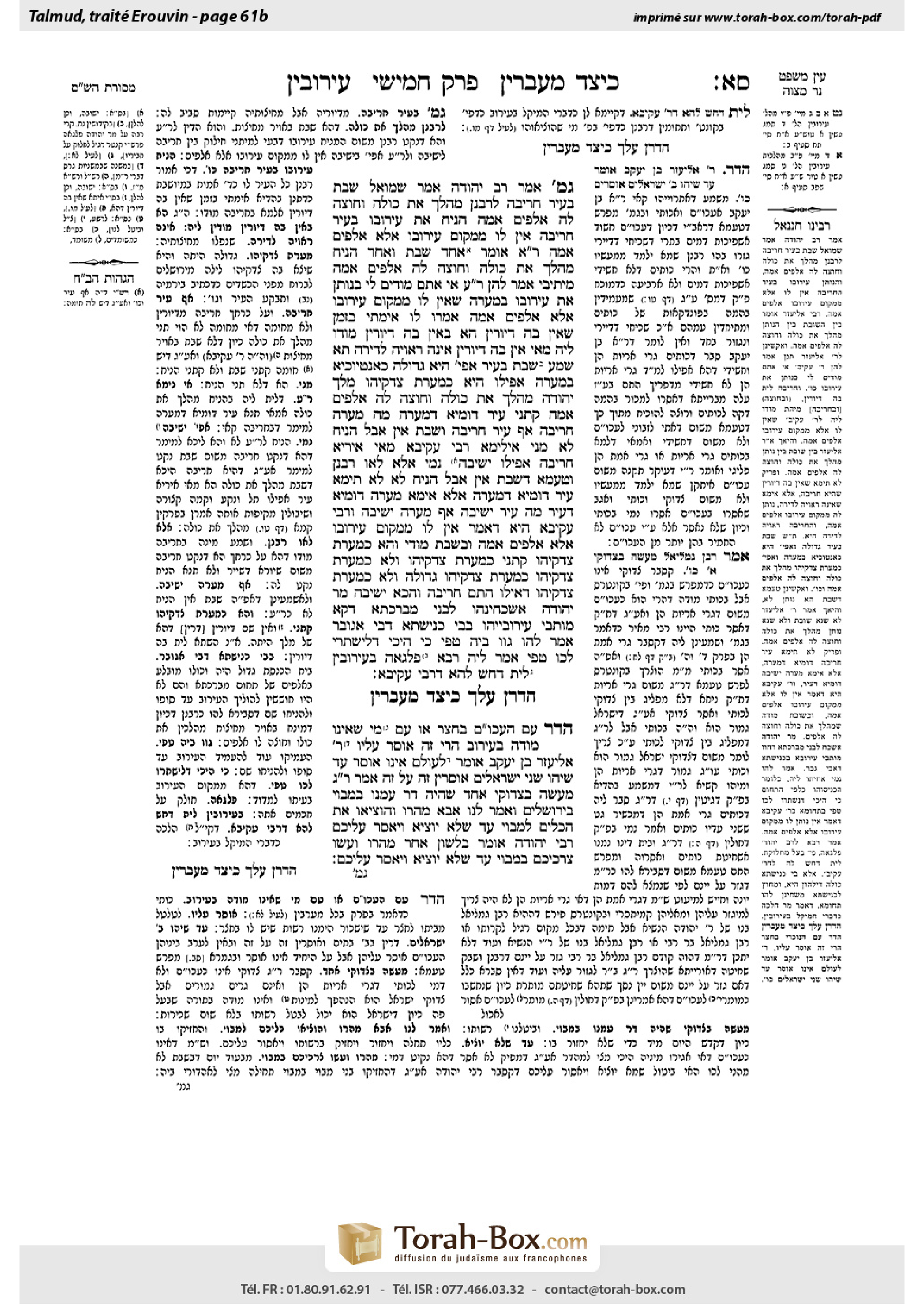
גְּמָ׳ אָמַר רַב יְהוּדָה אָמַר שְׁמוּאֵל: שָׁבַת בְּעִיר חֲרֵיבָה, לְרַבָּנַן מְהַלֵּךְ אֶת כּוּלָּהּ וְחוּצָה לָהּ אַלְפַּיִם אַמָּה. הִנִּיחַ אֶת עֵירוּבוֹ בְּעִיר חֲרֵיבָה — אֵין לוֹ מִמְּקוֹם עֵירוּבוֹ אֶלָּא אַלְפַּיִם אַמָּה. רַבִּי אֶלְעָזָר אוֹמֵר: אֶחָד שָׁבַת וְאֶחָד הִנִּיחַ — מְהַלֵּךְ אֶת כּוּלָּהּ וְחוּצָה לָהּ אַלְפַּיִם אַמָּה.
מֵיתִיבִי, אָמַר לָהֶן רַבִּי עֲקִיבָא: אִי אַתֶּם מוֹדִים לִי בְּנוֹתֵן אֶת עֵירוּבוֹ בִּמְעָרָה, שֶׁאֵין לוֹ מִמְּקוֹם עֵירוּבוֹ אֶלָּא אַלְפַּיִם אַמָּה? אָמְרוּ לוֹ: אֵימָתַי, בִּזְמַן שֶׁאֵין בָּהּ דָּיוֹרִין. הָא בְּאֵין בָּהּ דָּיוֹרִין מוֹדוּ לֵיהּ?!
מַאי ״אֵין בָּהּ דָּיוֹרִין״ — אֵינָהּ רְאוּיָה לְדִירָה.
תָּא שְׁמַע: שָׁבַת בְּעִיר, אֲפִילּוּ הִיא גְּדוֹלָה כְּאַנְטִיּוֹכְיָא, בִּמְעָרָה, אֲפִילּוּ הִיא כִּמְעָרַת צִדְקִיָּהוּ מֶלֶךְ יְהוּדָה — מְהַלֵּךְ אֶת כּוּלָּהּ וְחוּצָה לָהּ אַלְפַּיִם אַמָּה. קָתָנֵי עִיר דּוּמְיָא דִמְעָרָה, מָה מְעָרָה חֲרֵיבָה, אַף עִיר חֲרֵיבָה. וְשָׁבַת אִין, אֲבָל הִנִּיחַ לָא.
מַנִּי, אִילֵימָא רַבִּי עֲקִיבָא, מַאי אִירְיָא חֲרֵיבָה? אֲפִילּוּ יְשִׁיבָה נָמֵי! אֶלָּא לָאו רַבָּנַן, וְטַעְמָא דְּשָׁבַת אִין, אֲבָל הִנִּיחַ — לָא!
לָא תֵּימָא עִיר דּוּמְיָא דִמְעָרָה, אֶלָּא אֵימָא מְעָרָה דּוּמְיָא דְעִיר. מָה עִיר יְשִׁיבָה, אַף מְעָרָה יְשִׁיבָה. וְרַבִּי עֲקִיבָא הִיא, דְּאָמַר: אֵין לוֹ מִמְּקוֹם עֵירוּבוֹ אֶלָּא אַלְפַּיִם אַמָּה, וּבְשָׁבַת מוֹדֵי.
וְהָא כִּמְעָרַת צִדְקִיָּהוּ קָתָנֵי! כִּמְעָרַת צִדְקִיָּהוּ, וְלֹא כִּמְעָרַת צִדְקִיָּהוּ. כִּמְעָרַת צִדְקִיָּהוּ — גְּדוֹלָה. וְלֹא כִּמְעָרַת צִדְקִיָּהוּ — דְּאִילּוּ הָתָם חֲרֵיבָה, וְהָכָא יְשִׁיבָה.
מָר יְהוּדָה אַשְׁכְּחִינְהוּ לִבְנֵי מְבָרַכְתָּא דְּקָא מוֹתְבִי עֵירוּבַיְיהוּ בְּבֵי כְּנִישְׁתָּא דְּבֵי אַגּוֹבָר, אֲמַר לְהוּ: גַּוּוֹ בֵּיהּ טְפֵי, כִּי הֵיכִי דְּלִישְׁתְּרֵי לְכוּ טְפֵי.
אֲמַר לֵיהּ רָבָא: פָּלְגָאָה, בְּעֵירוּבִין לֵית דְּחַשׁ לְהָא דְּרַבִּי עֲקִיבָא.
הַדְרָן עֲלָךְ כֵּיצַד מְעַבְּרִין
מַתְנִי׳ הַדָּר עִם הַנׇּכְרִי בֶּחָצֵר, אוֹ עִם מִי שֶׁאֵינוֹ מוֹדֶה בָּעֵירוּב — הֲרֵי זֶה אוֹסֵר עָלָיו.
רַבִּי אֱלִיעֶזֶר בֶּן יַעֲקֹב אוֹמֵר: לְעוֹלָם אֵינוֹ אוֹסֵר עַד שֶׁיְּהוּ שְׁנֵי יִשְׂרְאֵלִים אוֹסְרִין זֶה עַל זֶה.
אָמַר רַבָּן גַּמְלִיאֵל: מַעֲשֶׂה בְּצַדּוּקִי אֶחָד שֶׁהָיָה דָּר עִמָּנוּ בְּמָבוֹי בִּירוּשָׁלַיִם, וְאָמַר לָנוּ אַבָּא: מַהֲרוּ וְהוֹצִיאוּ אֶת הַכֵּלִים לַמָּבוֹי, עַד שֶׁלֹּא יוֹצִיא וְיֶאֱסֹר עֲלֵיכֶם.
רַבִּי יְהוּדָה אוֹמֵר: בְּלָשׁוֹן אַחֵר — מַהֲרוּ וַעֲשׂוּ צׇרְכֵיכֶם בַּמָּבוֹי, עַד שֶׁלֹּא יוֹצִיא וְיֶאֱסֹר עֲלֵיכֶם.
Eruvin 61b · English translation
GEMARA: Rav Yehuda said that Shmuel said: If one established his Shabbat residence in a desolate city whose walls are still standing, according to the Rabbis he may walk through all of it as though it were four cubits, and he may walk an additional two thousand cubits beyond it. If, however, he merely placed his eiruv in a desolate city, he has only two thousand cubits from the place of his eiruv. The Rabbis distinguish between one who establishes his Shabbat residence by actually being present in that location at the onset of Shabbat and one who does so by placing his eiruv there before Shabbat. Rabbi Elazar says: Whether he established his Shabbat residence through his physical presence or he merely placed his eiruv there, he may walk through all of it and another two thousand cubits beyond it.
The Gemara raises an objection based upon the mishna. Rabbi Akiva said to the Rabbis: Do you not concede to me that one who places his eiruv in a cave has only two thousand cubits from the place of his eiruv? They said to him: When does this apply? When the cave has no residents. Consequently, when it has no residents the Rabbis concede to Rabbi Akiva that one has only two thousand cubits from the place of his eiruv. This contradicts Rabbi Elazar’s assertion that, according to the Rabbis, even if one places his eiruv in the abandoned city, he may walk through all of it and another two thousand cubits beyond it.
The Gemara responds: What is the meaning of the qualification that it has no residents? It means that the place is not fit for residence. If, however, the city is suitable for habitation, it is considered like four cubits even if it is currently uninhabited.
Come and hear another difficulty from the following baraita: If one established his Shabbat residence through his physical presence in a city, even if it is as large as Antioch, or in a cave, even if it is particularly large, like the Cave of Zedekiah, king of Judah, he may walk through all of it and another two thousand cubits beyond it. The baraita teaches the case of a city that is similar to that of a cave: Just as a cave is presumably desolate, i.e., uninhabited, so too the city must be one that is desolate. And only in the case where he established his Shabbat residence through his physical presence would yes, this halakha apply; but if he merely placed his eiruv there, no, he may not measure his two thousand cubits from the edge of the city.
The Gemara continues clarifying the baraita: In accordance with whose opinion is this baraita? If you say it is in accordance with the opinion of Rabbi Akiva, why did the baraita specifically teach the case of a desolate city? Even if it was inhabited, the same halakha should also apply, as Rabbi Akiva holds that even if one placed his eiruv in an inhabited city, he has only two thousand cubits from the place of his eiruv. Rather, is it not in accordance with the opinion of the Rabbis? And nonetheless, the reason is that one established his Shabbat residence through his physical presence. In such a case, yes, one may walk through the entire city and another two thousand cubits beyond it. But if one merely placed his eiruv there, he would not be permitted to walk more than two thousand cubits from his eiruv, which would contradict the opinion of Rabbi Elazar.
The Gemara rejects this argument and argues that the initial inference was incorrect. Do not say that the baraita is referring to a city that is similar to a cave. Rather, say that it is referring to a cave that is similar to a city: Just as the city is presumably inhabited, so too the cave must be one that is inhabited. The baraita is then in accordance with the opinion of Rabbi Akiva, who said that if one merely places his eiruv in the cave, he has only two thousand cubits from the place of his eiruv. However, if one established his Shabbat residence there through his physical presence, even Rabbi Akiva concedes that the entire cave is considered as though it were four cubits, and he may walk two thousand cubits beyond the cave.
The Gemara asks: Doesn’t the baraita teach that this halakha applies even to a cave like the Cave of Zedekiah, which was uninhabited? The Gemara answers: The baraita is referring to a cave that is like the Cave of Zedekiah in one respect and not like the Cave of Zedekiah in other respects. It is like the Cave of Zedekiah in that the cave is as large as that one. And it is not exactly like the Cave of Zedekiah, as there, with regard to Zedekiah’s cave, it was desolate, and here the baraita is referring to a cave that is inhabited.
The Gemara relates that Mar Yehuda once found the residents of Mavrakhta placing their eiruvin in the synagogue of Beit Agovar. He said to them: Place your eiruv farther into the synagogue, so that more will be permitted to you, as the Shabbat limit is measured from the spot where the eiruv is deposited. Mar Yehuda holds that even when an eiruv is placed in an inhabited city, the two thousand cubits are measured from the location of the eiruv rather than from the edge of the city.
Rava said to him: Argumentative one! With regard to the halakhot of eiruv, nobody is concerned about this opinion of Rabbi Akiva, as the halakha is in accordance with the opinion of the Rabbis. Consequently, no matter where one places his eiruv in a city, the entire city is considered as though it were four cubits, and he is permitted to walk two thousand cubits beyond the edge of the city.
MISHNA: One who resides with a gentile in the same courtyard, or one who lives in the same courtyard with one who does not accept the principle of eiruv, even though he is not a gentile, such as a Samaritan [Kuti], this person renders it prohibited for him to carry from his own house into the courtyard or from the courtyard into his house, unless he rents this person’s rights in the courtyard, as will be explained below.
Rabbi Eliezer ben Ya’akov says: Actually, the gentile does not render it prohibited for one to carry, unless there are two Jews living in the same courtyard who themselves would prohibit one another from carrying if there were no eiruv. In such a case, the presence of the gentile renders the eiruv ineffective. However, if only one Jew lives there, the gentile does not render it prohibited for him to carry in the courtyard.
Rabban Gamliel said: There was an incident involving a certain Sadducee who lived with us in the same alleyway in Jerusalem, who renounced his rights to the alleyway before Shabbat. And Father said to us: Hurry and take out your utensils to the alleyway to establish possession of it, before he changes his mind and takes out his own utensils so as to reclaim his rights, in which case he would render it prohibited for you to use the entire alleyway.
Rabbi Yehuda says: Rabban Gamliel’s father spoke to them with a different formulation, saying: Hurry and do whatever you must do in the alleyway prior to Shabbat, before he takes out his utensils and renders it prohibited for you to use the alleyway. In other words, you may not bring out utensils to the alleyway at all on Shabbat, as the institution of an eiruv cannot be used in the neighborhood of a Sadducee. This is because, even if he renounced his rights to the alleyway, he can always retract and reclaim them.
Eruvin 61b · Traduction française (IA)
GUEMARA : Rav Yehuda a dit que Shmuel a dit : Si l'on a établi sa résidence sabbatique dans une ville déserte dont les murs sont encore debout, selon les Rabbins, il peut marcher à travers tout cela comme s'il s'agissait de quatre coudées, et il peut marcher en outre deux mille coudées au-delà. Cependant, si l'on a simplement placé son eiruv dans une ville déserte, on n'a que deux mille coudées à partir du lieu de l'eiruv. Les Rabbins distinguent entre celui qui établit sa résidence sabbatique en étant physiquement présent dans ce lieu au début du sabbat et celui qui le fait en plaçant son eiruv là avant le sabbat. Rabbi Elazar dit : Qu'importe qu'il ait établi sa résidence sabbatique par sa présence physique ou qu'il ait simplement placé son eiruv là, il peut marcher à travers tout cela et en outre deux mille coudées au-delà.
La Guemara soulève un objet fondé sur la mitsva. Rabbi Akiva a dit aux Rabbins : Ne reconnaissez-vous pas me concéder que celui qui place son eiruv dans une grotte n'a que deux mille coudées à partir du lieu de l'eiruv ? Ils lui ont répondu : Dans quel cas cela s'applique-t-il ? Lorsque la grotte n'a pas de résidents. Ainsi, lorsque celle-ci n'a pas de résidents, les Rabbins reconnaissent à Rabbi Akiva que l'on a seulement deux mille coudées à partir du lieu de l'eiruv. Cela contredit l'affirmation de Rabbi Elazar selon laquelle, selon les Rabbins, même si l'on place son eiruv dans une ville déserte, l'on peut marcher à travers tout cela et en outre deux mille coudées au-delà.
La Guemara répond : Qu'entend-on par la qualification qu'elle n'a pas de résidents ? Cela signifie que le lieu n'est pas adapté à la résidence. Cependant, si la ville est adaptée à l'habitation, elle est considérée comme quatre coudées même si elle est actuellement inhabitable.
Venez écouter une autre difficulté tirée de la suivante baraïta : Si l'on a établi sa résidence sabbatique par sa présence physique dans une ville, même si celle-ci est aussi grande qu'Antioche, ou dans une grotte, même si celle-ci est particulièrement grande, comme la grotte de Zédequias, roi de Juda, l'on peut marcher à travers tout cela et en outre deux mille coudées au-delà. La baraïta enseigne le cas d'une ville semblable à celui d'une grotte : Tout comme une grotte est supposée être déserte, c'est-à-dire inhabitable, de même la ville doit être une ville déserte. Et seulement dans le cas où l'on a établi sa résidence sabbatique par sa présence physique s'applique cette halakha ; mais si l'on a simplement placé son eiruv là, non, l'on ne peut pas mesurer ses deux mille coudées à partir de la limite de la ville.
La Guemara continue à clarifier la baraïta : Selon l'opinion de qui est-ce que cette baraïta ? Si vous dites qu'elle est selon l'opinion de Rabbi Akiva, pourquoi la baraïta a-t-elle spécifiquement enseigné le cas d'une ville déserte ? Même si elle était habitée, la même halakha devrait s'appliquer également, car Rabbi Akiva considère que même si l'on a placé son eiruv dans une ville habitée, l'on a seulement deux mille coudées à partir du lieu de l'eiruv. Cependant, si ce n'est pas selon l'opinion des Rabbins, et pourtant, la raison est que l'on a établi sa résidence sabbatique par sa présence physique. Dans ce cas, oui, l'on peut marcher à travers toute la ville et en outre deux mille coudées au-delà. Mais si l'on a simplement placé son eiruv là, l'on ne serait pas autorisé à marcher plus de deux mille coudées à partir de l'eiruv, ce qui contredirait l'opinion de Rabbi Elazar.
La Guemara rejette cet argument et affirme que l'inférence initiale était incorrecte. Ne dites pas que la baraïta fait référence à une ville semblable à une grotte. Dites plutôt qu'elle fait référence à une grotte semblable à une ville : Tout comme la ville est supposée être habitée, de même la grotte doit être une grotte habitée. La baraïta est alors selon l'opinion de Rabbi Akiva, qui a dit que si l'on a simplement placé son eiruv dans la grotte, l'on a seulement deux mille coudées à partir du lieu de l'eiruv. Cependant, si l'on a établi sa résidence sabbatique là par sa présence physique, même Rabbi Akiva reconnaît que toute la grotte est considérée comme si elle était de quatre coudées, et l'on peut marcher deux mille coudées au-delà de la grotte.
La Guemara pose la question : N'enseigne-t-elle pas la baraïta que cette halakha s'applique même à une grotte comme celle de Zédequias, qui était inhabitable ? La Guemara répond : La baraïta fait référence à une grotte qui est semblable à celle de Zédequias en un point et pas en d'autres. Elle est semblable à celle de Zédequias en ce qu'elle est aussi grande que celle-ci. Elle n'est pas exactement semblable à celle de Zédequias, car là, concernant la grotte de Zédequias, elle était déserte, et ici la baraïta fait référence à une grotte habitée.
La Guemara rapporte que Mar Yehuda a un jour trouvé les habitants de Mavrakhta qui plaçaient leur eiruv dans la synagogue de Beit Agovar. Il a dit à ceux-ci : Placez votre eiruv plus loin dans la synagogue, afin que davantage vous soit permis, car la limite du sabbat est mesurée à partir du lieu où l'eiruv est déposé. Mar Yehuda considère que même lorsque l'eiruv est placé dans une ville habitée, les deux mille coudées sont mesurées à partir du lieu de l'eiruv plutôt que de la limite de la ville.
Rava dit à lui : Argumentateur ! Concernant les halakht de l'eiruv, personne ne s'occupe de cette opinion de Rabbi Akiva, car la halakha suit l'opinion des Rabbins. Ainsi, peu importe où l'on place son eiruv dans une ville, toute la ville est considérée comme si elle était de quatre coudées, et l'on est autorisé à marcher deux mille coudées au-delà de la limite de la ville.
MICHNA : Celui qui vit avec un non-Juif dans le même cour, ou celui qui vit dans le même cour avec celui qui ne reconnaît pas le principe de l'eiruv, même s'il n'est pas un non-Juif, comme un Samaritain [Kuti], cette personne rend il interdit pour lui de porter de sa maison dans le cour ou du cour dans sa maison, à moins qu'il ne loue les droits de ce cour, comme cela sera expliqué plus loin.
Rabbi Eliezer ben Ya’akov dit : En réalité, le Gentil ne rend pas interdit de porter, sauf s’il y a deux Juifs vivant dans le même cour, qui eux-mêmes interdiraient l’un à l’autre de porter s’il n’y avait pas d’eiruv. Dans ce cas, la présence du Gentil rend l’eiruv inefficace. Cependant, si seul un Juif y vit, le Gentil ne rend pas interdit à lui de porter dans le cour.
Rabban Gamliel dit : Il y avait un incident concernant un certain Sadducéen qui vivait avec nous dans le même passage à Jérusalem, qui avait renoncé à ses droits sur le passage avant la Samedi. Et le Père nous a dit : Hâtez-vous de sortir vos ustensiles dans le passage pour y établir votre possession, avant qu’il ne change d’avis et ne sorte lui-même ses ustensiles afin de reprendre ses droits, dans le cas où il rendrait interdit pour vous d’utiliser l’intégralité du passage.
Rabbi Yehuda dit : Rabban Gamliel disait à ses fils avec une formulation différente : Hâtez-vous de faire ce que vous devez faire dans le passage avant la Samedi, avant qu’il ne sorte ses ustensiles et ne rendît interdit pour vous d’utiliser le passage. En d’autres termes, vous ne pouvez pas sortir d’ustensiles dans le passage du tout le Samedi, car l’institution de l’eiruv ne peut être utilisée dans le quartier d’un Sadducéen. Cela est dû au fait que, même s’il a renoncé à ses droits sur le passage, il peut toujours revenir et les reprendre.
Traduction française générée par IA à partir de l’édition anglaise de Sefaria. Vérifie toujours un passage avec le texte source.
Text from Sefaria: William Davidson Edition - Vocalized Aramaic (CC BY NC); William Davidson Edition - English (CC BY NC).