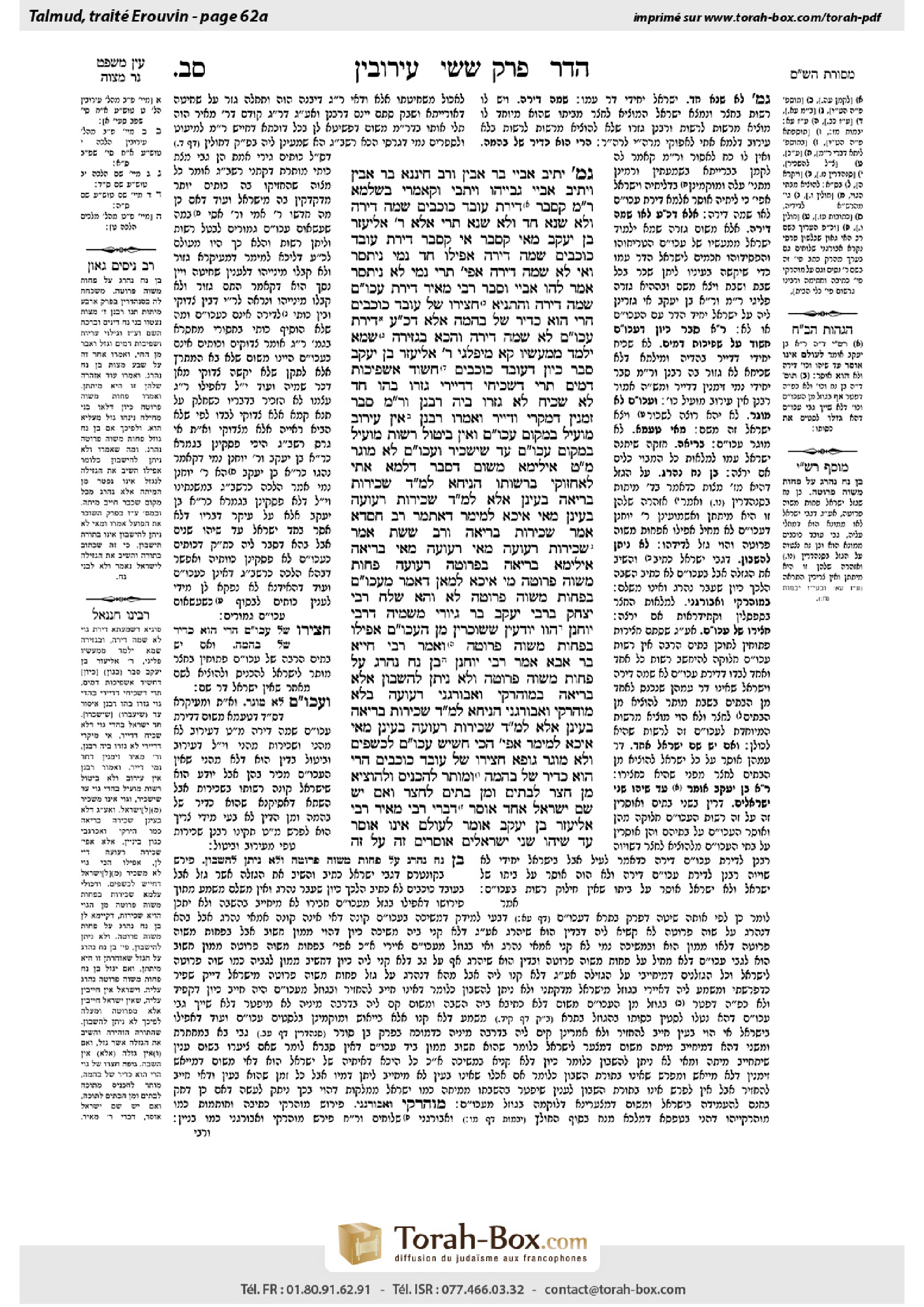
Eruvin 62a: Talmud study for Daf Yomi
Study the Talmud for Daf Yomi with scanned pages, Hebrew text, English translations from Sefaria and AI-generated French translations.
Passage selection and English or AI-generated French translation are available where the scan has annotations. Daf Study is independent of Torah-Box and Sefaria.
Browse Eruvin · עירובין · All tractatesEruvin 62a text and translations
This page of Eruvin includes the Aramaic text, an English translation and an AI-generated French translation, alongside the scan above.
עירובין ס״ב א · Aramaic and Hebrew text
גְּמָ׳ יָתֵיב אַבָּיֵי בַּר אָבִין וְרַב חִינָּנָא בַּר אָבִין, וְיָתֵיב אַבָּיֵי גַּבַּיְיהוּ, וְיָתְבִי וְקָאָמְרִי: בִּשְׁלָמָא רַבִּי מֵאִיר קָסָבַר דִּירַת גּוֹי שְׁמָהּ דִּירָה, וְלָא שְׁנָא חַד וְלָא שְׁנָא תְּרֵי.
אֶלָּא רַבִּי אֱלִיעֶזֶר בֶּן יַעֲקֹב מַאי קָסָבַר? אִי קָסָבַר דִּירַת גּוֹי שְׁמָהּ דִּירָה — אֲפִילּוּ חַד נָמֵי נִיתְּסַר! וְאִי לָא שְׁמָהּ דִּירָה — אֲפִילּוּ תְּרֵי נָמֵי לָא נִיתְּסַר!
אֲמַר לְהוּ אַבָּיֵי: וְסָבַר רַבִּי מֵאִיר דִּירַת גּוֹי שְׁמָהּ דִּירָה? וְהָתַנְיָא: חֲצֵירוֹ שֶׁל נׇכְרִי — הֲרֵי הוּא כְּדִיר שֶׁל בְּהֵמָה.
אֶלָּא: דְּכוּלֵּי עָלְמָא דִּירַת גּוֹי לֹא שְׁמָהּ דִּירָה, וְהָכָא בִּגְזֵירָה שֶׁמָּא יִלְמַד מִמַּעֲשָׂיו קָא מִיפַּלְגִי.
רַבִּי אֱלִיעֶזֶר בֶּן יַעֲקֹב סָבַר: כֵּיוָן דְּגוֹי חָשׁוּד אַשְּׁפִיכוּת דָּמִים, תְּרֵי דִּשְׁכִיחִי דְּדָיְירִי — גְּזַרוּ בְּהוּ, חַד לָא שְׁכִיחַ — לָא גְּזַרוּ בֵּיהּ רַבָּנַן.
וְרַבִּי מֵאִיר סָבַר: זִמְנִין דְּמִקְּרֵי וְדָיֵיר. וַאֲמַרוּ רַבָּנַן: אֵין עֵירוּב מוֹעִיל בִּמְקוֹם גּוֹי, וְאֵין בִּיטּוּל רְשׁוּת מוֹעִיל בִּמְקוֹם גּוֹי, עַד שֶׁיַּשְׂכִּיר. וְגוֹי לָא מוֹגַר.
מַאי טַעְמָא? אִילֵּימָא מִשּׁוּם דְּסָבַר: דִּלְמָא אָתֵי לְאַחְזוֹקֵי בִּרְשׁוּתוֹ, הָנִיחָא לְמַאן דְּאָמַר: שְׂכִירוּת בְּרִיאָה בָּעִינַן.
אֶלָּא לְמַאן דְּאָמַר: שְׂכִירוּת רְעוּעָה בָּעִינַן, מַאי אִיכָּא לְמֵימַר? דְּאִתְּמַר, רַב חִסְדָּא אָמַר: שְׂכִירוּת בְּרִיאָה. וְרַב שֵׁשֶׁת אָמַר: שְׂכִירוּת רְעוּעָה.
מַאי רְעוּעָה, מַאי בְּרִיאָה? אִילֵּימָא: בְּרִיאָה — בִּפְרוּטָה, רְעוּעָה — פָּחוֹת מִשָּׁוֶה פְּרוּטָה. מִי אִיכָּא לְמַאן דְּאָמַר מִגּוֹי בְּפָחוֹת מִשָּׁוֶה פְּרוּטָה לָא? וְהָא שָׁלַח רַבִּי יִצְחָק בְּרַבִּי יַעֲקֹב בַּר גִּיּוֹרֵי מִשְּׁמֵיהּ דְּרַבִּי יוֹחָנָן: הֲווֹ יוֹדְעִין שֶׁשּׂוֹכְרִין מִן הַגּוֹי אֲפִילּוּ בְּפָחוֹת מִשָּׁוֶה פְּרוּטָה.
וְאָמַר רַבִּי חִיָּיא בַּר אַבָּא אָמַר רַבִּי יוֹחָנָן: בֶּן נֹחַ נֶהֱרָג עַל פָּחוֹת מִשָּׁוֶה פְּרוּטָה, וְלֹא נִיתָּן לְהִשָּׁבוֹן.
אֶלָּא: בְּרִיאָה — בְּמוּהְרְקֵי וָאבוּרְגָנֵי, רְעוּעָה — בְּלָא מוּהְרְקֵי וָאבוּרְגָנֵי. הָנִיחָא לְמַאן דְּאָמַר: שְׂכִירוּת בְּרִיאָה בָּעִינַן.
אֶלָּא לְמַאן דְּאָמַר: שְׂכִירוּת רְעוּעָה בָּעִינַן, מַאי אִיכָּא לְמֵימַר? אֲפִילּוּ הָכִי חָשֵׁישׁ גּוֹי לִכְשָׁפִים, וְלָא מוֹגַר.
גּוּפָא: חֲצֵירוֹ שֶׁל גּוֹי הֲרֵי הוּא כְּדִיר שֶׁל בְּהֵמָה, וּמוּתָּר לְהַכְנִיס וּלְהוֹצִיא מִן חָצֵר לַבָּתִּים וּמִן בָּתִּים לֶחָצֵר.
וְאִם יֵשׁ שָׁם יִשְׂרָאֵל אֶחָד — אוֹסֵר, דִּבְרֵי רַבִּי מֵאִיר.
רַבִּי אֱלִיעֶזֶר בֶּן יַעֲקֹב אוֹמֵר: לְעוֹלָם אֵינוֹ אוֹסֵר עַד שֶׁיְּהוּ שְׁנֵי יִשְׂרְאֵלִים אוֹסְרִים זֶה עַל זֶה.
Eruvin 62a · English translation
GEMARA: Abaye bar Avin and Rav Ḥinana bar Avin were sitting, and Abaye was sitting beside them, and they sat and said: Granted, the opinion of Rabbi Meir, the author of the unattributed mishna, is clear, as he holds that the residence of a gentile is considered a significant residence. In other words, the gentile living in the courtyard is considered a resident who has a share in the courtyard. Since he cannot join in an eiruv with the Jew, he renders it prohibited for the Jew to carry from his house to the courtyard or from the courtyard to his house. Consequently, the case of one Jew living in the courtyard is no different from the case of two Jews living there. In both cases, the gentile renders it prohibited for carrying.
But Rabbi Eliezer ben Ya’akov, what does he hold? If you say he holds that the residence of a gentile is considered a significant residence, he should prohibit carrying even when there is only one Jew living in the courtyard. And if it is not considered a significant residence, he should not prohibit carrying even when there are two Jews living there.
Abaye said to them: Your basic premise is based on a faulty assumption. Does Rabbi Meir actually hold that the residence of a gentile is considered a significant residence? Wasn’t it taught in the Tosefta: The courtyard of a gentile is like the pen of an animal, i.e., just as an animal pen does not render it prohibited to carry in a courtyard, so too, the gentile’s residence in itself does not impose restrictions on a Jew.
Rather, this explanation must be rejected, and the dispute in the mishna should be understood differently: Everyone agrees that the residence of gentile is not considered a significant residence, and here they disagree about a decree that was issued lest the Jew learn from the gentile’s ways. The disagreement is with regard to whether this decree is applicable only when there are two Jews living in the courtyard, or even when there is only one Jew living there.
The disagreement should be understood as follows: Rabbi Eliezer ben Ya’akov holds that since a gentile is suspected of bloodshed, it is unusual for a single Jew to share a courtyard with a gentile. However, it is not unusual for two or more Jews to do so, as they will protect each other. Therefore, in the case of two Jews, who commonly live together with a gentile in the same courtyard, the Sages issued a decree to the effect that the gentile renders it prohibited for them to carry. This would cause great inconvenience to Jews living with gentiles and would thereby motivate the Jews to distance themselves from gentiles. In this manner, the Sages sought to prevent the Jews from learning from the gentiles’ ways. However, in the case of one Jew, for whom it is not common to live together with a gentile in the same courtyard, the Sages did not issue a decree that the gentile renders it prohibited for him to carry, as the Sages do not issue decrees for uncommon situations.
On the other hand, Rabbi Meir holds that sometimes it happens that a single Jew lives together with a gentile in the same courtyard, and hence it is appropriate to issue the decree in such a case as well. Therefore, the Sages said: An eiruv is not effective in a place where a gentile is living, nor is the renunciation of rights to a courtyard in favor of the other residents effective in a place where a gentile is living. Therefore, carrying is prohibited in a courtyard in which a gentile resides, unless the gentile rents out his property to one of the Jews for the purpose of an eiruv regardless of the number of Jews living there. And as a gentile would not be willing to rent out his property for this purpose, the living conditions will become too strained, prompting the Jew to move.
The Gemara poses a question: What is the reason that a gentile will not rent out his property for the purpose of an eiruv? If you say it is because the gentile thinks that perhaps they will later come to take possession of his property based on this rental, this works out well according to the one who said that we require a full-fledged rental, i.e., that rental for the purpose of an eiruv must be proper and valid according to all the halakhot of renting.
However, according to the one who said that we require only a flawed, symbolic rental, i.e., all that is needed is a token gesture that has the appearance of renting, what is there to say? The gentile would understand that it is not a real rental, and therefore he would not be wary of renting out his residence. As it was stated that the amora’im disputed this issue as follows: Rav Ḥisda said that we require a full-fledged rental, and Rav Sheshet said: A flawed, symbolic rental is sufficient.
Having mentioned this dispute, the Gemara now clarifies its particulars: What is a flawed rental, and what is a full-fledged one? If you say that a full-fledged rental refers to a case where one gives another person a peruta as rent, whereas in a flawed rental he provides him with less than the value of a peruta, this poses a difficulty. Is there anyone who said that renting from a gentile for less than the value of a peruta is not valid? Didn’t Rabbi Yitzḥak, son of Rabbi Ya’akov bar Giyorei, send in the name of Rabbi Yoḥanan: You should know that one may rent from a gentile even for less than the value of a peruta?
And Rabbi Ḥiyya bar Abba said that Rabbi Yoḥanan said: A Noahide, i.e., a gentile who stole is executed for his crime, according to the laws applying to Noahides, even if he stole less than the value of a peruta. A Noahide is particular about his property and unwilling to waive his rights to it, even if it is of minimal value; therefore, the prohibition against stealing applies to items of any value whatsoever. And in the case of Noahides, the stolen item is not returnable, as the possibility of rectification by returning a stolen object was granted only to Jews. The principle that less than the value of a peruta is not considered money applies to Jews alone. With regard to gentiles, it has monetary value, and therefore one may rent from a gentile with this amount.
Rather, the distinction between a full-fledged rental and a flawed rental should be explained as follows: A full-fledged rental refers to one that is confirmed by legal documents [moharkei] and guaranteed by officials [aburganei]; and a flawed rental means one that is not confirmed by legal documents and guaranteed by officials, an agreement that is unenforceable in court. Based on this explanation, the Gemara reiterates what was stated earlier with regard to the gentile’s concern about renting: This works out well according to the one who said that we require a full-fledged rental, as it is clear why the gentile would refuse to rent out his property.
But according to the one who said that we require only a flawed rental, what is there to say in this regard? Why shouldn’t the gentile want to rent out his residence? The Gemara answers: Even so, the gentile is concerned about witchcraft, i.e., that the procedure is used to cast a spell on him, and therefore he does not rent out his residence.
The Gemara examines the ruling in the Tosefta cited in the previous discussion. Returning to the matter itself: The courtyard of a gentile is like the pen of an animal, and it is permitted to carry in and carry out from the courtyard to the houses and from the houses to the courtyard, as the halakhot of eiruvin do not apply to the residences of gentiles.
But if there is one Jew living there in the same courtyard as the gentile, the gentile renders it prohibited for the Jew to carry from his house to the courtyard or vice versa. The Jew may carry there only if he rents the gentile’s property for the duration of Shabbat. This is the statement of Rabbi Meir.
Rabbi Eliezer ben Ya’akov says: Actually, the gentile does not render it prohibited for the Jew to carry unless there are two Jews living in the same courtyard who themselves would prohibit one another from carrying if there were no eiruv, and the presence of the gentile renders the eiruv ineffective.
Eruvin 62a · Traduction française (IA)
GUEMARA : Abaye bar Avin et Rav Ḥinana bar Avin étaient assis, et Abaye était assis à côté d'eux, et ils s'assirent et dirent : L'opinion de Rabbi Meir, l'auteur de la mitsna sans auteur, est claire, car il considère que la résidence d'un non-Juif est une résidence importante. En d'autres termes, le non-Juif vivant dans la cour est considéré comme un résident qui a une part dans la cour. Puisqu'il ne peut pas participer à un eiruv avec le Juif, il rend l'acte de porter interdit pour le Juif, que ce soit de sa maison vers la cour ou de la cour vers sa maison. Ainsi, le cas d'un Juif vivant dans la cour n'est pas différent du cas de deux Juifs vivant là. Dans les deux cas, le non-Juif rend l'acte de porter interdit.
Mais Rabbi Eliezer ben Ya’akov, qu’en est-il de son opinion ? Si vous dites qu’il considère que la résidence d’un non-Juif est une résidence importante, il devrait interdire le port même s’il y a un seul Juif dans la cour. Et si ce n’est pas considéré comme une résidence importante, il ne devrait pas interdire le port même s’il y a deux Juifs dans la cour.
Abaye dit à eux : Votre fondement est basé sur une hypothèse erronée. Rabbi Meir considère-t-il vraiment que la résidence d’un non-Juif est une résidence importante ? N’a-t-il pas été enseigné dans la Tosefta : La cour d’un non-Juif est comme l’enclos d’un animal, c’est-à-dire, tout comme un enclos d’animal ne rend pas l’acte de porter interdit dans la cour, de même la résidence du non-Juif elle-même ne pose pas de restriction pour un Juif.
Plutôt, cette explication doit être rejetée, et le débat dans la Michna doit être compris différemment : Tout le monde convient que la résidence d’un non-Juif n’est pas considérée comme une résidence importante, et ici ils débattent d’un décret émis afin que le Juif ne s’inspire pas des manières des non-Juifs. Le débat porte sur le fait que ce décret s’applique uniquement lorsque deux Juifs habitent dans la cour, ou même lorsque seul un Juif y habite.
Le débat doit être compris ainsi : Rabbi Eliezer ben Ya’akov considère que puisqu’un non-Juif est soupçonné de meurtre, il est inhabituel qu’un seul Juif partage une cour avec un non-Juif. Cependant, il n’est pas inhabituel que deux ou plusieurs Juifs le fassent, car ils se protègent mutuellement. Ainsi, dans le cas de deux Juifs, qui habitent communément avec un non-Juif dans la même cour, les Sages ont émis un décret selon lequel le non-Juif rend l’acte de porter interdit pour eux. Cela causerait une grande gêne aux Juifs vivant avec des non-Juifs et les encouragerait à s’éloigner des non-Juifs. Ainsi, les Sages cherchaient à empêcher les Juifs d’apprendre les manières des non-Juifs. Cependant, dans le cas d’un seul Juif, pour qui il n’est pas commun de vivre avec un non-Juif dans la même cour, les Sages n’ont pas émis un décret selon lequel le non-Juif rend l’acte de porter interdit, car les Sages n’émettent pas de décrets pour les situations inhabituelles.
Du côté opposé, le Rabbi Meïr considère que parfois il arrive qu’un seul Juif vive avec un non-Juif dans la même cour, et donc il est approprié d’émettre ce décret dans ce cas-là aussi. Ainsi, les Sages dirent : Un eiruv n’est pas efficace dans un lieu où un non-Juif habite, ni la renonciation aux droits de la cour en faveur des autres habitants n’est efficace dans un lieu où un non-Juif habite. Ainsi, le port est interdit dans une cour où un non-Juif habite, sauf si le non-Juif loue son bien à l’un des Juifs à l’effet d’un eiruv, indépendamment du nombre de Juifs y habitant. Et comme un non-Juif ne serait pas disposé à louer son bien à cet effet, les conditions de vie deviendraient trop difficiles, poussant le Juif à s’en aller.
La Guemara pose une question : Quel est le motif pour lequel un non-Juif ne louera-t-il pas son bien à l’effet d’un eiruv ? Si vous dites que c’est parce qu’il pense qu’ils pourraient plus tard prendre possession de son bien en vertu de cette location, cela s’applique bien à celui qui dit que nous exigeons une location complète, c’est-à-dire que la location à l’effet d’un eiruv doit être propre et valide selon toutes les halakhot de la location.
Cependant, selon celui qui dit que nous exigeons seulement une location fausse, symbolique, c’est-à-dire que tout ce qui est nécessaire est un geste symbolique, qu’est-ce que cela signifie ? Le non-Juif comprendrait qu’il ne s’agit pas d’une location réelle, et donc il ne serait pas méfiant à l’idée de louer son résidence. Comme il a été dit que les amora’im disputaient cette question ainsi : Rav Ḥisda dit que nous exigeons une location complète, et Rav Sheshet dit : Une location fausse, symbolique suffit.
Ayant mentionné cette dispute, la Guemara clarifie maintenant ses détails : Qu’est-ce qu’une location défectueuse et qu’est-ce qu’une location complète ? Si vous dites qu’une location complète fait référence à un cas où l’on donne à un autre une peruta comme loyer, tandis qu’une location défectueuse consiste à lui donner moins que la valeur d’une peruta, cela pose un problème. Y a-t-il quelqu’un qui ait dit qu’une location d’un non-Juif pour moins que la valeur d’une peruta n’est pas valide ? N’a-t-il pas été dit par Rabbi Yitzḥak, fils de Rabbi Ya’akov bar Giyorei, en nom de Rabbi Yoḥanan : Vous devez savoir qu’on peut louer d’un non-Juif même pour moins que la valeur d’une peruta ?
Et Rabbi Ḥiyya bar Abba dit que Rabbi Yoḥanan dit : Un Noéh, c’est-à-dire un non-Juif qui a volé est exécuté pour son crime selon les lois applicables aux Noéhs, même s’il a volé moins que la valeur d’une peruta. Un Noéh est particulier à son bien et refuse de renoncer à ses droits, même s’il s’agit d’une valeur minimale ; donc, la prohibition contre le vol s’applique à des objets de toute valeur. Et dans le cas des Noéhs, l’objet volé n’est pas récupérable, car la possibilité de réparation par la restitution d’un objet volé a été donnée uniquement aux Juifs. Le principe selon lequel moins que la valeur d’une peruta n’est pas considéré comme de l’argent s’applique uniquement aux Juifs. En ce qui concerne les non-Juifs, cela a une valeur monétaire, et donc on peut louer d’un non-Juif avec cette somme.
Plutôt, la distinction entre un bail complet et un bail déficient doit être expliquée comme suit : Un bail complet désigne un bail confirmé par des documents légaux [moharkei] et garanti par des autorités [aburganei] ; et un bail déficient désigne un bail qui n'est pas confirmé par des documents légaux et garanti par des autorités, un accord non exécutable devant un tribunal. Selon cette explication, le Guemara réitère ce qui a été dit précédemment concernant l'inquiétude du non-Jeu à propos du bail : Cela s'explique bien selon celui qui affirme que nous exigeons un bail complet, car il est clair pourquoi le non-Jeu refuserait de louer sa propriété.
Mais selon celui qui affirme que nous exigeons uniquement un bail déficient, que dire à ce sujet ? Pourquoi le non-Jeu ne voudrait-il pas louer sa résidence ? La Guemara répond : Même ainsi, le non-Jeu est inquiet de la sorcellerie, c'est-à-dire que la procédure est utilisée pour lancer un sort contre lui, et par conséquent il ne loue pas sa résidence.
Le Guemara examine le jugement mentionné dans la Tosefta citée dans la discussion précédente. Revenons à la question elle-même : Le jardin d'un non-Jeu est comme la cour d'un animal, et il est permis de porter à l'intérieur et à l'extérieur du jardin vers les maisons et des maisons vers le jardin, car les halakhot d'eiruvin ne s'appliquent pas aux résidences des non-Juifs.
Mais si un Juif habite là dans le même cour de jardin que le non-Jeu, le non-Jeu rend interdit au Juif de porter de sa maison vers la cour ou inversement. Le Juif peut porter là seulement s'il loue la propriété du non-Jeu pour la durée du Shabbat. C'est la déclaration de Rabbi Meir.
Rabbi Eliezer ben Ya’akov dit : En réalité, le non-Jeu ne rend pas interdit au Juif de porter, sauf s'il y a deux Juifs habitant dans la même cour qui, eux-mêmes, rendraient interdit l'un à l'autre de porter s'il n'y avait pas d'eiruv, et la présence du non-Jeu rend l'eiruv inefficace.
Traduction française générée par IA à partir de l’édition anglaise de Sefaria. Vérifie toujours un passage avec le texte source.
Text from Sefaria: William Davidson Edition - Vocalized Aramaic (CC BY NC); William Davidson Edition - English (CC BY NC).