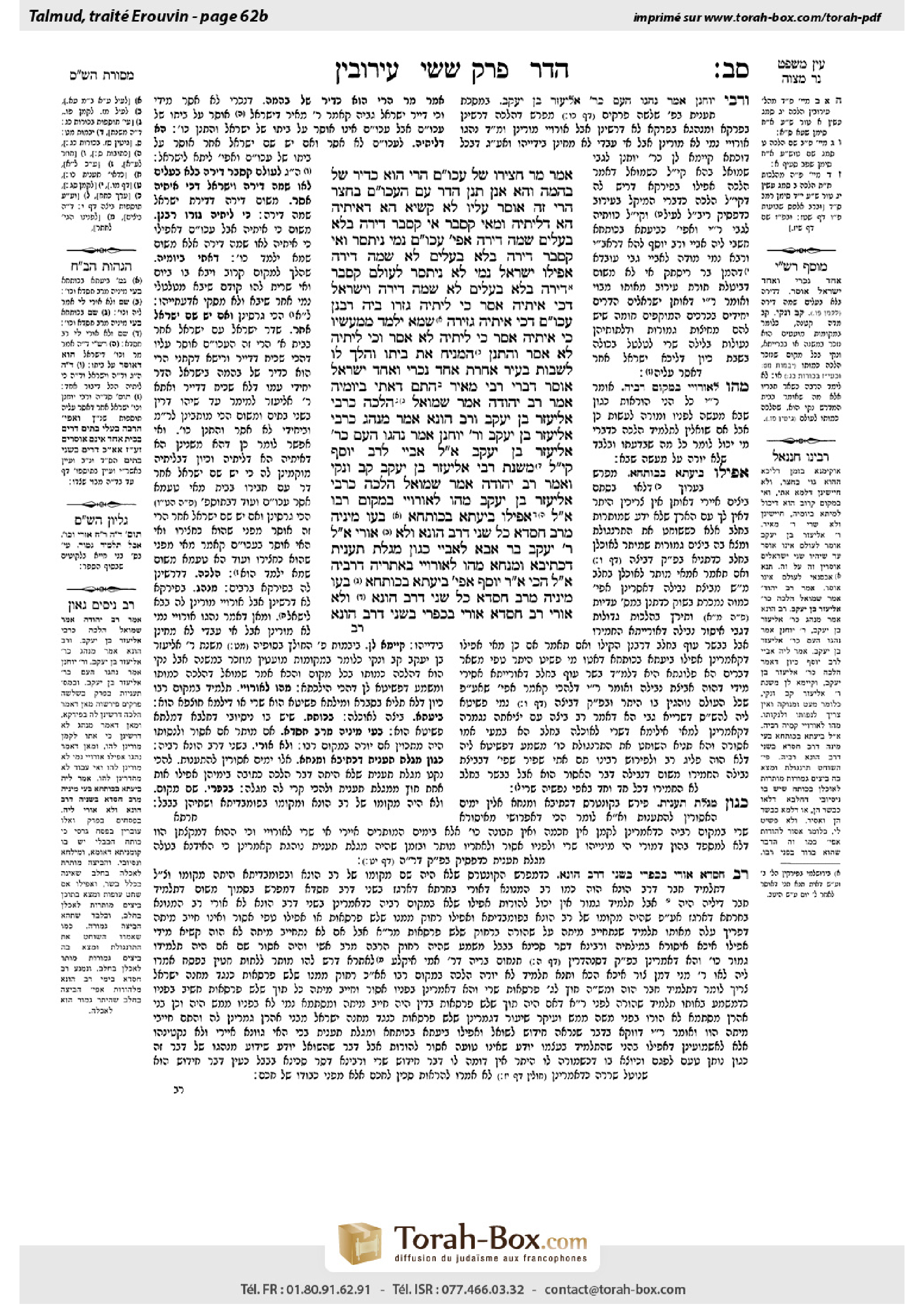
Eruvin 62b: Talmud study for Daf Yomi
Study the Talmud for Daf Yomi with scanned pages, Hebrew text, English translations from Sefaria and AI-generated French translations.
Passage selection and English or AI-generated French translation are available where the scan has annotations. Daf Study is independent of Torah-Box and Sefaria.
Browse Eruvin · עירובין · All tractatesEruvin 62b text and translations
This page of Eruvin includes the Aramaic text, an English translation and an AI-generated French translation, alongside the scan above.
עירובין ס״ב ב · Aramaic and Hebrew text
אָמַר מָר: חֲצֵירוֹ שֶׁל גּוֹי הֲרֵי הוּא כְּדִיר שֶׁל בְּהֵמָה. וְהָא אֲנַן תְּנַן: הַדָּר עִם הַנׇּכְרִי בֶּחָצֵר הֲרֵי זֶה אוֹסֵר עָלָיו!
לָא קַשְׁיָא: הָא — דְּאִיתֵיהּ. הָא — דְּלֵיתֵיהּ.
וּמַאי קָסָבַר? אִי קָסָבַר דִּירָה בְּלֹא בְּעָלִים שְׁמָהּ דִּירָה — אֲפִילּוּ גּוֹי נָמֵי נִיתְּסַר. וְאִי קָסָבַר דִּירָה בְּלֹא בְּעָלִים לֹא שְׁמָהּ דִּירָה — אֲפִילּוּ יִשְׂרָאֵל נָמֵי לָא נִיתְּסַר!
לְעוֹלָם קָסָבַר דִּירָה בְּלֹא בְּעָלִים — לֹא שְׁמָהּ דִּירָה. וְיִשְׂרָאֵל, דְּכִי אִיתֵיהּ אָסַר, כִּי לֵיתֵיהּ — גְּזַרוּ בֵּיהּ רַבָּנַן.
גּוֹי, דְּכִי אִיתֵיהּ — גְּזֵירָה שֶׁמָּא יִלְמַד מִמַּעֲשָׂיו. כִּי אִיתֵיהּ — אָסַר, כִּי לֵיתֵיהּ — לָא אָסַר.
וְכִי לֵיתֵיהּ, לָא אָסַר? וְהָתְנַן: הַמַּנִּיחַ אֶת בֵּיתוֹ וְהָלַךְ לוֹ לִשְׁבּוֹת בְּעִיר אַחֶרֶת, אֶחָד נׇכְרִי וְאֶחָד יִשְׂרָאֵל אוֹסֵר, דִּבְרֵי רַבִּי מֵאִיר.
הָתָם דְּאָתֵי בְּיוֹמֵיהּ.
אָמַר רַב יְהוּדָה אָמַר שְׁמוּאֵל: הֲלָכָה כְּרַבִּי אֱלִיעֶזֶר בֶּן יַעֲקֹב. וְרַב הוּנָא אָמַר: מִנְהָג כְּרַבִּי אֱלִיעֶזֶר בֶּן יַעֲקֹב. וְרַבִּי יוֹחָנָן אָמַר: נָהֲגוּ הָעָם כְּרַבִּי אֱלִיעֶזֶר בֶּן יַעֲקֹב.
אֲמַר לֵיהּ אַבָּיֵי לְרַב יוֹסֵף: קַיְימָא לַן מִשְׁנַת רַבִּי אֱלִיעֶזֶר בֶּן יַעֲקֹב קַב וְנָקִי, וְאָמַר רַב יְהוּדָה אָמַר שְׁמוּאֵל: הֲלָכָה כְּרַבִּי אֱלִיעֶזֶר בֶּן יַעֲקֹב.
מַהוּ לְאוֹרוֹיֵי בִּמְקוֹם רַבּוֹ?
אֲמַר לֵיהּ: אֲפִילּוּ בֵּיעֲתָא בְּכוּתָּחָא בְּעוֹ מִינֵּיהּ מֵרַב חִסְדָּא כׇּל שְׁנֵי דְּרַב הוּנָא, וְלָא אוֹרִי.
אֲמַר לֵיהּ רַבִּי יַעֲקֹב בַּר אַבָּא לְאַבָּיֵי: כְּגוֹן מְגִלַּת תַּעֲנִית דִּכְתִיבָא וּמַנְּחָא. מַהוּ לְאוֹרוֹיֵי בְּאַתְרֵיהּ דְּרַבֵּיהּ? אֲמַר לֵיהּ, הָכִי אָמַר רַב יוֹסֵף: אֲפִילּוּ בֵּיעֲתָא בְּכוּתָּחָא בְּעוֹ מִינֵּיהּ מֵרַב חִסְדָּא כׇּל שְׁנֵי דְּרַב הוּנָא, וְלָא אוֹרִי.
רַב חִסְדָּא אוֹרִי בְּכַפְרִי בִּשְׁנֵי דְּרַב הוּנָא.
Eruvin 62b · English translation
The Gemara proceeds to analyze the Tosefta: The Master said above: The courtyard of a gentile is like the pen of an animal, which implies that the residence of a gentile is not considered a significant residence. But didn’t we learn otherwise in the mishna: One who resides with a gentile in the same courtyard this person prohibits him from carrying? This implies that a gentile’s residence is in fact of significance.
The Gemara answers: That is not difficult. This halakha in the mishna is referring to a situation where the gentile is present, and therefore carrying is prohibited, whereas that halakha in the Tosefta refers to a situation where he is not present, and therefore carrying is permitted.
The Gemara poses a question: What does Rabbi Meir hold? If he holds that a residence without its owners is still considered a residence, and it is prohibited to carry in the courtyard even when the owner is away, then even a gentile in absentia should likewise render it prohibited for carrying. And if he holds that a residence without its owners is not considered a residence, then even a Jew who is away should also not render it prohibited for carrying.
The Gemara answers: Actually, he holds that a residence without its owners is not considered a residence, but nevertheless, he draws a distinction between a Jew and a gentile. In the case of a Jew, who renders it prohibited to carry for those who dwell in the same courtyard when he is present in his residence, the Sages decreed with regard to him that even when he is not present, his residence renders it prohibited for them to carry as though he were present.
However, with regard to a gentile, who even when he is present does not fundamentally render it prohibited to carry, but only due to a rabbinic decree that was issued lest the Jew learn from the gentile’s ways, no further decree was necessary. Thus, when he is present, the gentile renders it prohibited to carry; but when he is not present, he does not render it prohibited to carry.
The Gemara asks: And when the gentile is not present, does he really not render it prohibited for carrying? Didn’t we learn elsewhere in a mishna: With regard to one who left his house without establishing an eiruv and went to spend Shabbat in a different town, whether he was a gentile or a Jew, he renders it prohibited for the other residents of his courtyard to carry objects from their houses to the courtyard and vice versa. This is the statement of Rabbi Meir. This indicates that according to Rabbi Meir, a gentile renders it prohibited to carry in the courtyard even if he is not present.
The Gemara answers: There, it is referring to a situation where the person who left his house without establishing an eiruv intends to return on that same day, on Shabbat. Since upon his return he will render it prohibited for others to carry in the courtyard, the decree is applied even before he returns home. However, if he left his house intending to return after the conclusion of Shabbat, he does not render it prohibited to carry, in absentia.
Rav Yehuda said that Shmuel said: The halakha in this dispute is in accordance with the opinion of Rabbi Eliezer ben Ya’akov. And Rav Huna said: This is not an established halakha to be issued publicly; rather, the custom is in accordance with the opinion of Rabbi Eliezer ben Ya’akov, i.e., a Sage would rule according to his opinion for those who come to ask. And Rabbi Yoḥanan said: The people are accustomed to conduct themselves in accordance with the opinion of Rabbi Eliezer ben Ya’akov. Accordingly, a Sage would not issue such a ruling even to those who inquire, but if someone acts leniently in accordance with his opinion, he would not object.
Abaye said to Rav Yosef, his teacher: We maintain that the teaching of Rabbi Eliezer ben Ya’akov measures a kav, but is clean, meaning that it is small in quantity but clear and complete, and that the halakha is in accordance with his opinion in all instances. Moreover, with regard to our issue, Rav Yehuda said that Shmuel said: The halakha is in accordance with the opinion of Rabbi Eliezer ben Ya’akov, and therefore there is no doubt about the matter.
However, what is the halakha with regard to whether a disciple may issue a ruling according to the opinion of Rabbi Eliezer ben Ya’akov in his teacher’s place of jurisdiction, i.e., in a place where he is the recognized authority? Although it is usually prohibited to do so, perhaps such an evident and well-known principle such as this does not fall into the category of rulings that a disciple may not issue in his teacher’s territory.
Rav Yosef said to Abaye: Even when Rav Ḥisda was asked about the permissibility of cooking an egg in kutaḥ, a dairy dish, throughout the years of Rav Huna’s life, he refused to issue a ruling. Rav Ḥisda was a disciple of Rav Huna, and a disciple may not issue a ruling in his teacher’s place of jurisdiction about even the simplest of matters.
Rabbi Ya’akov bar Abba said to Abaye: With regard to matters such as those detailed in Megillat Ta’anit, which is written and laid on the shelf for all to access and offers a list of the days on which fasting is prohibited, what is the halakha concerning whether or not a disciple may rule about these matters in his teacher’s place of jurisdiction? Abaye said to him: Rav Yosef said as follows: Even when Rav Ḥisda was asked about the permissibility of cooking an egg in kutaḥ throughout the years of Rav Huna’s life, he refused to issue a ruling.
The Gemara relates that Rav Ḥisda nonetheless issued halakhic rulings in the town of Kafri during the years of Rav Huna’s life, as he was not actually in his teacher’s place.
Eruvin 62b · Traduction française (IA)
Le Guemara poursuit son analyse de la Tosefta : Le Maître a dit plus haut : Le jardin d’un non-Juif est comme la cour d’un animal, ce qui implique que la résidence d’un non-Juif n’est pas considérée comme une résidence importante. Mais n’avons-nous pas appris autrement dans la mitsva : Celui qui vit avec un non-Juif dans le même jardin, cette personne interdit à l’autre de porter ? Cela implique que la résidence d’un non-Juif est en effet importante.
Le Guemara répond : Ce n’est pas difficile. Cette halakha dans la mitsva fait référence à un cas où le non-Juif est présent, et donc le port est interdit, tandis que cette halakha dans la Tosefta fait référence à un cas où il n’est pas présent, et donc le port est permis.
Le Guemara pose une question : Quelle est l’opinion de Rabbi Meïr ? Si il considère que la résidence sans ses propriétaires est encore considérée comme une résidence, et qu’il est interdit de porter dans la cour même lorsque le propriétaire est absent, alors même un non-Juif absent devrait rendre le port interdit. Et si il considère que la résidence sans ses propriétaires n’est pas considérée comme une résidence, alors même un Juif absent ne devrait pas rendre le port interdit.
Le Guemara répond : En réalité, il considère que la résidence sans ses propriétaires n’est pas considérée comme une résidence, mais il fait une distinction entre un Juif et un non-Juif. Dans le cas d’un Juif, qui rend le port interdit pour ceux qui habitent dans la même cour lorsqu’il est présent dans sa résidence, les Sages ont décrété qu’avec lui absent, sa résidence rend le port interdit comme s’il était présent.
Cependant, concernant un non-Juif, qui même s’il est présent ne rend pas fondamentalement le port interdit, mais seulement en vertu d’un décret rabbinique afin que le Juif ne s’inspire pas de ses mœurs, aucun décret supplémentaire n’était nécessaire. Ainsi, lorsqu’il est présent, le non-Juif rend le port interdit, mais lorsqu’il n’est pas présent, il ne le rend pas interdit.
Le Guemara pose une question : Et lorsqu’un non-Juif n’est pas présent, ne rend-il pas vraiment le port interdit ? N’avons-nous pas appris ailleurs dans une mitsva : Concernant celui qui a quitté sa maison sans établir un eiruv et est allé passer le Shabbat dans une autre ville, qu’il soit un non-Juif ou un Juif, il rend le port interdit pour les autres habitants de sa cour pour porter des objets de leur maison vers la cour et vice versa. C’est l’affirmation de Rabbi Meïr. Cela indique que selon Rabbi Meïr, un non-Juif rend le port interdit dans la cour même s’il n’est pas présent.
Le Guemara répond : Là, il s’agit d’un cas où la personne qui a quitté sa maison sans établir un eiruv a l’intention de revenir le même jour, le Shabbat. Puisque lors de son retour il rendra le port interdit pour les autres, le décret est appliqué même avant qu’il ne revienne chez lui. Cependant, si elle a quitté sa maison avec l’intention de revenir après la fin du Shabbat, elle ne rend pas le port interdit en son absence.
Rav Yéhouda a dit que Shmuel a dit : La halakha dans ce débat est selon l’opinion de Rabbi Eliezer ben Ya’akov. Et Rav Huna a dit : Ce n’est pas une halakha établie à publier ; plutôt, la coutume est selon l’opinion de Rabbi Eliezer ben Ya’akov, c’est-à-dire qu’un Sage rendrait selon son opinion pour ceux qui viennent demander. Et Rabbi Yoḥanan a dit : Le peuple est habitué à agir selon l’opinion de Rabbi Eliezer ben Ya’akov. Ainsi, un Sage ne donnerait pas un tel avis même à ceux qui interrogent, mais s’il agissait avec une leniencé selon son opinion, il ne s’opposerait pas.
Abaye a dit à Rav Yosef, son maître : Nous maintenons que l’enseignement de Rabbi Eliezer ben Ya’akov mesure un kav, mais est propre, c’est-à-dire qu’il est petit en quantité mais clair et complet, et que la halakha est selon son opinion dans tous les cas. De plus, concernant notre question, Rav Yéhouda a dit que Shmuel a dit : La halakha est selon l’opinion de Rabbi Eliezer ben Ya’akov, et donc il n’y a pas de doute à ce sujet.
Cependant, quelle est la halakha concernant le fait qu'un disciple puisse émettre un avis selon l'opinion de Rabbi Eliezer ben Ya'akov dans le lieu de juridiction de son maître, c'est-à-dire dans un lieu où il est le maître reconnu ? Bien que ce soit généralement interdit de le faire, peut-être un principe aussi évident et bien connu que celui-ci ne tombe pas dans la catégorie des décisions que un disciple ne peut émettre dans le territoire de son maître.
Rav Yosef a dit à Abaye : Même lorsque Rav Ḥisda a été interrogé sur la permissibilité de cuire un œuf dans un plat laitier, un kutaḥ, pendant les années de la vie de Rav Huna, il a refusé d'émettre un avis. Rav Ḥisda était un disciple de Rav Huna, et un disciple ne peut pas émettre un avis dans le territoire de son maître même sur les choses les plus simples.
Rabbi Ya’akov bar Abba a dit à Abaye : Concernant des questions telles que celles détaillées dans la Megillat Ta’anit, qui est écrite et placée sur l’étagère pour que tout le monde puisse y accéder et offre une liste des jours où le jeûne est interdit, quelle est la halakha concernant le fait qu'un disciple puisse émettre un avis sur ces questions dans le territoire de son maître ? Abaye a dit à lui : Rav Yosef a dit comme suit : Même lorsque Rav Ḥisda a été interrogé sur la permissibilité de cuire un œuf dans un plat laitier pendant les années de la vie de Rav Huna, il a refusé d’émettre un avis.
Le Guemara relate que Rav Ḥisda a toutefois rendu des décisions halakhiques dans la ville de Kafri pendant les années de la vie de Rav Huna, car il n’était pas effectivement dans le lieu de son maître.
Traduction française générée par IA à partir de l’édition anglaise de Sefaria. Vérifie toujours un passage avec le texte source.
Text from Sefaria: William Davidson Edition - Vocalized Aramaic (CC BY NC); William Davidson Edition - English (CC BY NC).