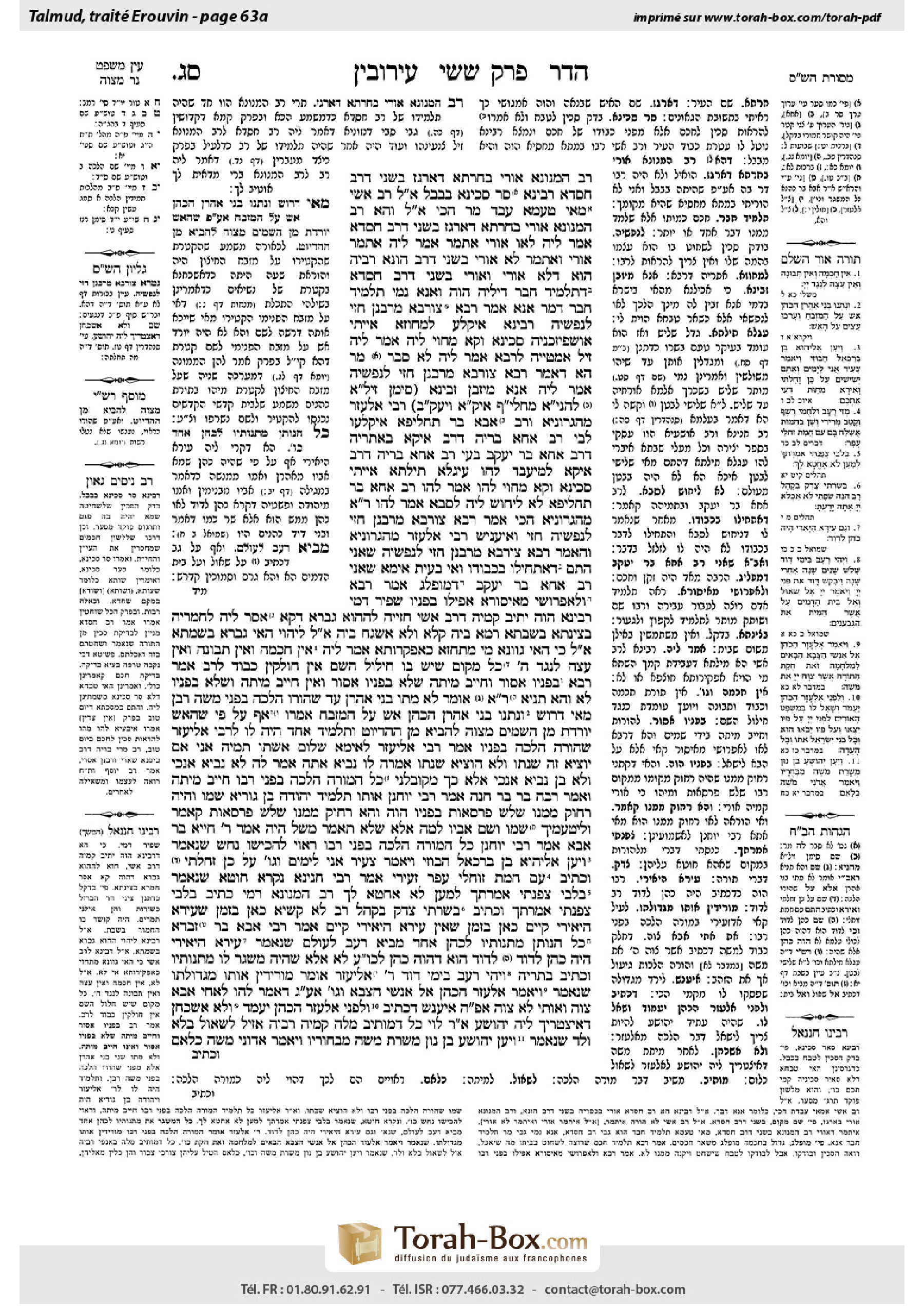
Eruvin 63a: Talmud study for Daf Yomi
Study the Talmud for Daf Yomi with scanned pages, Hebrew text, English translations from Sefaria and AI-generated French translations.
Passage selection and English or AI-generated French translation are available where the scan has annotations. Daf Study is independent of Torah-Box and Sefaria.
Browse Eruvin · עירובין · All tractatesEruvin 63a text and translations
This page of Eruvin includes the Aramaic text, an English translation and an AI-generated French translation, alongside the scan above.
עירובין ס״ג א · Aramaic and Hebrew text
רַב הַמְנוּנָא אוֹרִי בְּחַרְתָּא דְאַרְגֵּז בִּשְׁנֵי דְּרַב חִסְדָּא.
רָבִינָא סָר סַכִּינָא בְּבָבֶל. אֲמַר לֵיהּ רַב אָשֵׁי: מַאי טַעְמָא עֲבַד מָר הָכִי?
אֲמַר לֵיהּ: וְהָא רַב הַמְנוּנָא אוֹרִי בְּחַרְתָּא דְאַרְגֵּז בִּשְׁנֵי דְּרַב חִסְדָּא! אֲמַר לֵיהּ: ״לָאו אוֹרִי״ אִתְּמַר.
אֲמַר לֵיהּ: אִתְּמַר ״אוֹרִי״, וְאִתְּמַר ״לָא אוֹרִי״, בִּשְׁנֵי דְּרַב הוּנָא רַבֵּיהּ הוּא דְּלָא אוֹרִי, וְאוֹרִי בִּשְׁנֵי דְּרַב חִסְדָּא, דְּתַלְמִיד חָבֵר דִּילֵיהּ הֲוָה. וַאֲנָא נָמֵי תַּלְמִיד חָבֵר דְּמָר אֲנָא.
אָמַר רָבָא: צוּרְבָּא מֵרַבָּנַן חָזֵי לְנַפְשֵׁיהּ. רָבִינָא אִיקְּלַע לְמָחוֹזָא, אַיְיתִי אוּשְׁפִּיזְכָנֵיהּ סַכִּינָא וְקָא מַחְוֵי לֵיהּ. אֲמַר לֵיהּ: זִיל אַמְטְיֵיהּ לְרָבָא.
אֲמַר לֵיהּ: לָא סָבַר מָר הָא דְּאָמַר רָבָא צוּרְבָּא מֵרַבָּנַן חָזֵי לְנַפְשֵׁיהּ. אֲמַר לֵיהּ: אֲנָא מִיזְבָּן זָבֵינָא.
(סִימָן: זִילָא לְהַנְיָא, מַחְלִיף, אִיקָא, וְיַעֲקֹב).
רַבִּי אֶלְעָזָר מֵהַגְרוֹנְיָא וְרַב אַבָּא בַּר תַּחְלִיפָא אִיקְּלַעוּ לְבֵי רַב אַחָא בְּרֵיהּ דְּרַב אִיקָא, בְּאַתְרֵיהּ דְּרַב אַחָא בַּר יַעֲקֹב. בָּעֵי רַב אַחָא בְּרֵיהּ דְּרַב אִיקָא לְמִיעְבַּד לְהוּ עִיגְלָא תִּילְתָּא, אַיְיתִי סַכִּינָא וְקָא מַחְוֵי לְהוּ.
אֲמַר לְהוּ רַב אַחָא בַּר תַּחְלִיפָא: לָא לֵיחוּשׁ לֵיהּ לְסָבָא? אֲמַר לְהוּ רַבִּי אֶלְעָזָר מֵהַגְרוֹנְיָא: הָכִי אָמַר רָבָא, צוּרְבָּא מֵרַבָּנַן חָזֵי לְנַפְשֵׁיהּ. חֲזִי, וְאִיעֲנִישׁ רַבִּי אֶלְעָזָר מֵהַגְרוֹנְיָא.
וְהָאָמַר רָבָא: צוּרְבָּא מֵרַבָּנַן חָזֵי לְנַפְשֵׁיהּ! שָׁאנֵי הָתָם דְּאַתְחִילוּ בִּכְבוֹדוֹ.
וְאִי בָּעֵית אֵימָא: שָׁאנֵי רַב אַחָא בַּר יַעֲקֹב דְּמוּפְלָג.
אָמַר רָבָא: וּלְאַפְרוֹשֵׁי מֵאִיסּוּרָא — אֲפִילּוּ בְּפָנָיו שַׁפִּיר דָּמֵי. רָבִינָא הֲוָה יָתֵיב קַמֵּיהּ דְּרַב אָשֵׁי, חַזְיֵיהּ לְהָהוּא גַּבְרָא דְּקָא אָסַר לֵיהּ לְחַמְרֵיהּ בְּצִינְתָא בְּשַׁבְּתָא. רְמָא בֵּיהּ קָלָא, וְלָא אַשְׁגַּח בֵּיהּ. אֲמַר לֵיהּ: לֶיהֱוֵי הַאי גַּבְרָא בְּשַׁמְתָּא.
אֲמַר לֵיהּ: כִּי הַאי גַּוְונָא, מִי מִתְחֲזֵא כְּאַפְקֵרוּתָא? אֲמַר לֵיהּ: ״אֵין חׇכְמָה וְאֵין תְּבוּנָה וְאֵין עֵצָה לְנֶגֶד ה׳״, כׇּל מָקוֹם שֶׁיֵּשׁ בּוֹ חִילּוּל הַשֵּׁם — אֵין חוֹלְקִין כָּבוֹד לָרַב.
אָמַר רָבָא: בְּפָנָיו — אָסוּר, וְחַיָּיב מִיתָה. שֶׁלֹּא בְּפָנָיו — אָסוּר, וְאֵין חַיָּיב מִיתָה.
וְשֶׁלֹּא בְּפָנָיו לָא? וְהָא תַּנְיָא: רַבִּי אֱלִיעֶזֶר אוֹמֵר: לֹא מֵתוּ בְּנֵי אַהֲרֹן עַד שֶׁהוֹרוּ הֲלָכָה בִּפְנֵי מֹשֶׁה רַבָּן. מַאי דְּרוּשׁ: ״וְנָתְנוּ בְּנֵי אַהֲרֹן הַכֹּהֵן אֵשׁ עַל הַמִּזְבֵּחַ״, אָמְרוּ: אַף עַל פִּי שֶׁהָאֵשׁ יוֹרֶדֶת מִן הַשָּׁמַיִם, מִצְוָה לְהָבִיא מִן הַהֶדְיוֹט.
וְתַלְמִיד אֶחָד הָיָה לוֹ לְרַבִּי אֱלִיעֶזֶר, שֶׁהוֹרָה הֲלָכָה בְּפָנָיו. אָמַר רַבִּי אֱלִיעֶזֶר לְאִימָּא שָׁלוֹם אִשְׁתּוֹ: תָּמֵיהַּ אֲנִי אִם יוֹצִיא זֶה שְׁנָתוֹ. וְלֹא הוֹצִיא שְׁנָתוֹ.
אָמְרָה לוֹ: נָבִיא אַתָּה? אָמַר לָהּ: לֹא נָבִיא אָנֹכִי וְלֹא בֶּן נָבִיא אָנֹכִי, אֶלָּא כָּךְ מְקּוּבְּלַנִי: כׇּל הַמּוֹרֶה הֲלָכָה בִּפְנֵי רַבּוֹ חַיָּיב מִיתָה.
וְאָמַר רַבָּה בַּר בַּר חָנָה אָמַר רַבִּי יוֹחָנָן: אוֹתוֹ תַּלְמִיד יְהוּדָה בֶּן גּוּרְיָא שְׁמוֹ, וְהָיָה רָחוֹק מִמֶּנּוּ שָׁלֹשׁ פַּרְסָאוֹת?!
בְּפָנָיו הֲוָה. וְהָא רָחוֹק מִמֶּנּוּ שָׁלֹשׁ פַּרְסָאוֹת קָאָמַר! וְלִיטַעְמָיךְ: שְׁמוֹ וְשֵׁם אָבִיו לָמָּה? אֶלָּא שֶׁלֹּא תֹּאמַר מָשָׁל הָיָה.
אָמַר רַבִּי חִיָּיא בַּר אַבָּא אָמַר רַבִּי יוֹחָנָן: כׇּל הַמּוֹרֶה הֲלָכָה בִּפְנֵי רַבּוֹ, רָאוּי לְהַכִּישׁוֹ נָחָשׁ, שֶׁנֶּאֱמַר: ״וַיַּעַן אֱלִיהוּא בֶן בַּרַכְאֵל הַבּוּזִי וַיֹּאמַר צָעִיר אֲנִי לְיָמִים וְגוֹ׳ עַל כֵּן זָחַלְתִּי״. וּכְתִיב: ״עִם חֲמַת זוֹחֲלֵי עָפָר״.
זְעֵירִי אָמַר רַבִּי חֲנִינָא: נִקְרָא חוֹטֵא, שֶׁנֶּאֱמַר: ״בְּלִבִּי צָפַנְתִּי אִמְרָתֶךָ לְמַעַן לֹא אֶחֱטָא לָךְ״.
רַב הַמְנוּנָא רָמֵי: כְּתִיב ״בְּלִבִּי צָפַנְתִּי אִמְרָתֶךָ״, וּכְתִיב ״בִּשַּׂרְתִּי צֶדֶק בְּקָהָל רַב״! לָא קַשְׁיָא: כָּאן — בִּזְמַן שֶׁעִירָא הַיָּאִירִי קַיָּים, כָּאן — בִּזְמַן שֶׁאֵין עִירָא הַיָּאִירִי קַיָּים.
אָמַר רַבִּי אַבָּא בַּר זַבְדָּא: כׇּל הַנּוֹתֵן מַתְּנוֹתָיו לְכֹהֵן אֶחָד, מֵבִיא רָעָב לְעוֹלָם, שֶׁנֶּאֱמַר ״עִירָא הַיָּאִירִי הָיָה כֹהֵן לְדָוִד״. לְדָוִד הוּא דַּהֲוָה כֹּהֵן, לְכוּלֵּי עָלְמָא לָא?! אֶלָּא שֶׁהָיָה מְשַׁגֵּר לוֹ מַתְּנוֹתָיו, וּכְתִיב בָּתְרֵיהּ: ״וַיְהִי רָעָב בִּימֵי דָוִד״.
רַבִּי אֱלִיעֶזֶר אוֹמֵר: מוֹרִידִין אוֹתוֹ מִגְּדוּלָּתוֹ, שֶׁנֶּאֱמַר: ״וַיֹּאמֶר אֶלְעָזָר הַכֹּהֵן אֶל אַנְשֵׁי הַצָּבָא וְגוֹ׳״. אַף עַל גַּב דַּאֲמַר לְהוּ: לַאֲחִי אַבָּא צִוָּה, וְאוֹתִי לֹא צִוָּה — אֲפִילּוּ הָכִי, אִיעֲנַשׁ.
דִּכְתִיב: ״וְלִפְנֵי אֶלְעָזָר הַכֹּהֵן יַעֲמֹד״, וְלָא אַשְׁכְּחַן דְּאִיצְטְרִיךְ לֵיהּ יְהוֹשֻׁעַ.
אָמַר רַבִּי לֵוִי: כׇּל דְּמוֹתֵיב מִלָּה קַמֵּיהּ רַבֵּיהּ — אָזֵיל לִשְׁאוֹל בְּלֹא וָלָד, שֶׁנֶּאֱמַר: ״וַיַּעַן יְהוֹשֻׁעַ בִּן נוּן מְשָׁרֵת מֹשֶׁה מִבְּחוּרָיו וַיֹּאמַר אֲדוֹנִי מֹשֶׁה כְּלָאֵם״.
Eruvin 63a · English translation
Rav Hamnuna issued halakhic rulings in the town of Ḥarta De’argez during the years of Rav Ḥisda’s life, even though Rav Ḥisda was his teacher.
The Gemara relates that Ravina once examined a slaughterer’s knife in Babylonia to check if it was fit for slaughtering, during the lifetime of his teacher, Rav Ashi, who also lived in Babylonia. Rav Ashi said to him: What is the reason that the Master acted in this manner? Isn’t it prohibited for a disciple to issue rulings while his teacher is still alive?
Ravina said to him: Didn’t Rav Hamnuna issue halakhic rulings in Ḥarta De’argez during the years of Rav Ḥisda’s life, as they were not in the same town, even though they were both located in Babylonia? Since I do not live in the same town as you, it stands to reason that I would be permitted to issue rulings as well. Rav Ashi said to Ravina: It was actually stated that Rav Hamnuna did not issue halakhic rulings during Rav Ḥisda’s lifetime, and that is the correct tradition.
Ravina said to Rav Ashi: In fact, it was stated that Rav Hamnuna issued rulings, and it was also stated that he did not issue rulings, and both traditions are correct. During the years of the life of Rav Huna, Rav Hamnuna’s principal teacher, Rav Hamnuna did not issue rulings at all, but he did issue rulings during the years of Rav Ḥisda’s life, for Rav Hamnuna was Rav Ḥisda’s disciple-colleague. And since I, too, am the Master’s disciple and colleague, I should also be permitted to examine a slaughterer’s knife when I am not in the same town.
Rava said: A Torah scholar may examine a knife for himself and use it for slaughtering, without having to show it to the local Sage. The Gemara relates that Ravina happened to come to Meḥoza, the home town of Rava. His host brought out a knife for slaughtering and showed it to him. He said to him: Go, bring it to Rava, the town Sage, for examination.
The host said to him: Doesn’t the Master hold in accordance with that which Rava said: A Torah scholar may examine a slaughtering knife for himself? In this case I am using the knife to slaughter on your behalf. Ravina said to him: Since I am only buying the meat from you, it is not considered as though I am slaughtering for myself. Rava’s principle does not apply to such a case.
The Gemara cites a mnemonic for the names of the Sages mentioned in the following discussion: Zila Lehanya: Rabbi Elazar from Hagronya; Maḥlif: Rav Abba bar Taḥalifa; Ika: Rav Aḥa bar Ika; and Ya’akov: Rav Aḥa bar Ya’akov.
The Gemara now relates that Rabbi Elazar from Hagronya and Rav Abba bar Taḥalifa happened to come to the house of Rav Aḥa, son of Rav Ika, in the place of jurisdiction of Rav Aḥa bar Ya’akov. Rav Aḥa, son of Rav Ika, wanted to prepare for them a third-born calf, whose meat was considered a delicacy. He brought out a slaughtering knife and showed it to them.
Rav Aḥa bar Taḥalifa said to them: Should we not be concerned with the respect of the Elder, Rav Aḥa bar Ya’akov, and present the knife to him for inspection, as this is his town? Rabbi Elazar from Hagronya said to them: That is unnecessary, since Rava said as follows: A Torah scholar may examine a knife for himself. Rabbi Elazar from Hagronya then inspected the knife, but he was later punished at the hand of Heaven for disregarding the honor of the senior rabbi.
The Gemara expresses surprise: What was Rabbi Elazar from Hagronya’s mistake? Didn’t Rava say: A Torah scholar may examine a slaughtering knife for himself? The Gemara answers: It was different there, as they had already begun to discuss the issue of the honor of Rav Aḥa bar Ya’akov. Had the name of Rav Aḥa bar Ya’akov never arisen, they would have been permitted to examine the knife themselves. Once his name had been mentioned, however, they should have approached him with the knife. Their failure to do so is considered a display of disrespect.
And if you wish, say instead: Rav Aḥa bar Ya’akov is different, as he was illustrious in age and wisdom, and thus deserved more honor than a regular Sage.
Rava said: Even though it is ordinarily prohibited for a disciple to issue a halakhic ruling in his teacher’s place, if he does so in order to separate another person from a prohibition he is committing, even in his teacher’s presence it seems well, i.e., it is permitted. The Gemara relates that Ravina was once sitting before Rav Ashi when he saw a certain man tying his donkey to a palm tree on Shabbat, in violation of the decree of the Sages against utilizing trees on Shabbat. He raised his voice to him in protest, but the man paid him no attention. Ravina then said to Rav Ashi: Let this man be in excommunication for transgressing the words of the Sages and ignoring a scholar’s rebuke.
Afterward, Ravina said to Rav Ashi: Behavior such as this, the way I acted in your presence just now, does it appear like irreverent behavior? Rav Ashi said to him: With regard to this it is stated: “There is no wisdom or understanding or council against the Lord” (Proverbs 21:30). The Sages expounded this verse as follows: Wherever a desecration of God’s name is involved, no respect is paid even to a teacher, i.e., in such a situation one should disregard the respect due to his teacher’s wisdom and understanding and object to the inappropriate behavior.
Rava said: With regard to one who issues a halakhic ruling in his teacher’s location without the intention of preventing someone from violating a prohibition, the following distinction applies: In the teacher’s actual presence, the disciple is prohibited to issue such a ruling, and if he does so, he is liable to receive the death penalty at the hand of Heaven. However, when he is not in his actual presence, the disciple is still prohibited to issue the ruling, but he is not liable to receive the death penalty.
The Gemara asks: Is the disciple not liable to receive the death penalty if he issues his ruling not in the teacher’s presence? But wasn’t it taught otherwise in a baraita: Rabbi Eliezer says: The sons of Aaron died only because they issued a halakhic ruling before Moses, their teacher? What did they expound in support of their conclusion that they must bring fire inside as opposed to waiting for fire to come down from the heavens? It is stated in the Torah: “And the sons of Aaron the priest shall put fire on the altar, and lay the wood in order on the fire” (Leviticus 1:7), which led them to say: Although fire descends from Heaven, it is nonetheless a mitzva to bring ordinary fire. Although they derived this from the verses, they were punished for ruling in the presence of their teacher.
It was further related that Rabbi Eliezer had a certain disciple who issued a halakhic ruling in his presence. Rabbi Eliezer said to his wife, Imma Shalom: I will be surprised if this one completes his year, i.e., if he lives until the end of the year. And so it was, he did not complete his year.
His wife said to him: Are you a prophet? He said to her: I am not a prophet, nor the son of a prophet, but I have received the following tradition: Anyone who issues a halakhic ruling in his teacher’s presence is liable to receive the death penalty.
And Rabba bar bar Ḥana said that Rabbi Yoḥanan said: That disciple was named Yehuda ben Gurya, and he was three parasangs away from Rabbi Eliezer. Apparently, one is liable for the death penalty even if he did not issue his ruling in his teacher’s presence.
The Gemara answers: In fact, the incident took place in the actual presence of the teacher, which is why the disciple was punished. The distance mentioned refers to the distance between the student’s usual place and the teacher. The Gemara expresses surprise: But didn’t Rabba bar bar Ḥana say that he was three parasangs away from his teacher? That implies that this was his distance from his teacher at the time of the ruling. The Gemara answers: And, according to your reasoning, that the details of the story must relate to the time of the ruling, why mention his name and his father’s name? Rather, the details were given so that you should not say it was a parable. That is also the reason why he provided the details concerning the student’s usual place. This does not contradict the fact that Yehuda ben Gurya issued his ruling in the actual presence of his teacher.
The Gemara continues to discuss the same topic. Rabbi Ḥiyya bar Abba said that Rabbi Yoḥanan said: Whoever issues a halakhic ruling in his teacher’s presence is deserving of being bitten by a snake, as it is stated: “And Elihu, son of Barachel the Buzite answered and said, I am young, and you are very old; therefore I held back [zaḥalti] and I was afraid, and did not declare my opinion to you” (Job 32:6), and it is written: “With the venom of the crawling things of [zoḥalei] the dust” (Deuteronomy 32:24), which refers to snakes. Elihu’s statement is understood as follows: I must apologize for speaking in my teacher’s presence, for one who does so is liable to be punished with the bite of a snake.
Ze’eiri said that Rabbi Ḥanina said: Whoever issues a halakhic ruling in his teacher’s presence is called a sinner, as it is stated: “Your word have I hidden in my heart, that I might not sin against You” (Psalms 119:11). In what case would speaking one’s word entail a sin? In a case where one rules on a matter of halakha in the presence of his teacher.
Rav Hamnuna raised a contradiction between the verse previously mentioned and another verse: It is written: “Your word have I hidden in my heart,” implying that David did not want to reveal the words of Torah, whereas in a second verse it is written: “I have preached righteousness in the great congregation” (Psalms 40:10). He answered: This is not difficult. Here, in the verse in which David remained silent, it is referring to the period when Ira HaYa’iri, David’s teacher, was alive; there, in the verse where he publicized his words, it is referring to the period when Ira HaYa’iri was no longer alive.
Having mentioned Ira HaYa’iri, the Gemara now cites a related teaching. Rabbi Abba bar Zavda said: Whoever gives all his priestly gifts to one priest has acted improperly and brings famine into the world as punishment. As it is stated: “And also Ira HaYa’iri was a priest for David” (II Samuel 20:26), which invites the question: Was he a priest for David alone, and not for anyone else? Rather, it means that David would send all his priestly gifts to him alone, i.e., he was the only priest to enjoy David’s gifts. And it is written afterward: “And there was a famine in the days of David, three years, year after year” (II Samuel 21:1).
Rabbi Eliezer says: Anyone who rules in his teacher’s presence is lowered from his position of greatness, as it is stated: “And Elazar the priest said to the men of war who went to battle: This is the statute of the Torah which the Lord commanded Moses” (Numbers 31:21). Although Elazar said to the soldiers: God commanded this statute to my father’s brother, while to me He did not command it, even so he was punished for speaking in this manner in the presence of his teacher, Moses.
What was his punishment? As it is written that God had told Moses with regard to Joshua: “And he shall stand before Elazar the priest, who shall inquire for him by the judgment of the Urim before the Lord: at his word shall they go out, and at his word they shall come in, both he, and all the children of Israel with him, even all the congregation” (Numbers 27:21). Elazar was originally awarded a place of great honor. But we do not find in the Bible that Joshua ever had need of him. It is never stated that Joshua made use of the Urim through Elazar, which shows that Elazar never achieved the greatness promised him.
With regard to this same issue, Rabbi Levi said: Whoever answers a word in the presence of his teacher will go down to the netherworld childless, as it is stated: “And Joshua bin Nun, the minister of Moses from his youth, answered and said: My lord Moses, shut them in” (Numbers 11:28). Since he spoke to his teacher out of turn, he was punished by remaining childless.
Eruvin 63a · Traduction française (IA)
Rav Hamnuna a rendu des décisions halakhiques dans la ville de Ḥarta De’argez pendant la vie de Rav Ḥisda, même si Rav Ḥisda était son maître.
La Guemara rapporte que Ravina a un jour examiné un couteau de boucher à Babylone pour vérifier s'il était propre à la boucherie, pendant la vie de son maître, Rav Ashi, qui habitait également à Babylone. Rav Ashi lui a dit : Quel est le motif pour lequel le Maître a agi ainsi ? N'est-il pas interdit à un disciple de rendre des décisions pendant que son maître est encore vivant ?
Ravina a répondu à Rav Ashi : N'a-t-il pas été dit que Rav Hamnuna rendait des décisions halakhiques à Ḥarta De’argez pendant la vie de Rav Ḥisda, puisqu'ils ne résidaient pas dans la même ville, même s'ils étaient tous deux à Babylone ? Puisque je ne vis pas dans la même ville que vous, il est logique que je sois autorisé à rendre des décisions également. Rav Ashi a répondu à Ravina : En réalité, il a été dit que Rav Hamnuna n'avait pas rendu de décisions halakhiques pendant la vie de Rav Ḥisda, et c'est la tradition correcte.
Ravina a dit à Rav Ashi : En effet, il a été dit que Rav Hamnuna rendait des décisions, et il a également été dit qu'il ne les rendait pas, et les deux traditions sont correctes. Pendant la vie de Rav Huna, le maître principal de Rav Hamnuna, Rav Hamnuna n'a jamais rendu de décisions, mais il en a rendu durant la vie de Rav Ḥisda, car Rav Hamnuna était son disciple-collegue. Et puisque je suis également le disciple-collegue du Maître, je devrais être autorisé à examiner un couteau de boucher lorsque je ne suis pas dans la même ville.
Rava a dit : Un savant de la Torah peut examiner un couteau lui-même et l'utiliser pour la boucherie, sans avoir à le montrer au sage local. La Guemara rapporte que Ravina est venu à Meḥoza, la ville natale de Rava. Son hôte a sorti un couteau de boucher et l'a montré à Ravina. Il lui a dit : Allez, amenez-le à Rava, le sage de la ville, pour l'examiner.
L'hôte a dit à Ravina : N'est-ce pas que le Maître suit ce que Rava a dit : Un savant de la Torah peut examiner lui-même un couteau de boucher ? Dans ce cas, je utilise le couteau pour la boucherie à votre place. Ravina a répondu à l'hôte : Puisque je n'achète que la viande de vous, cela ne constitue pas comme si je boucherais pour moi-même. Le principe de Rava ne s'applique pas à ce cas.
La Guemara cite un acronyme pour les noms des Sages mentionnés dans la discussion suivante : Zila Lehanya : Rabbi Elazar de Hagronya ; Maḥlif : Rav Abba bar Taḥalifa ; Ika : Rav Aḥa bar Ika ; et Ya’akov : Rav Aḥa bar Ya’akov.
La Guemara rapporte maintenant que Rabbi Elazar de Hagronya et Rav Abba bar Taḥalifa sont arrivés à la maison de Rav Aḥa, fils de Rav Ika, dans le territoire de juridiction de Rav Aḥa bar Ya’akov. Rav Aḥa, fils de Rav Ika, voulait préparer pour eux un veau troisième, dont la viande était considérée comme un délice. Il a sorti un couteau de boucher et l'a montré à eux.
Rav Aḥa bar Taḥalifa a dit à eux : Devons-nous avoir peur de l'honneur du rabbin senior, Rav Aḥa bar Ya’akov, et présenter le couteau à lui pour l'examen, car c'est sa ville ? Rabbi Elazar de Hagronya a dit à eux : Cela n'est pas nécessaire, puisque Rava a dit comme suit : Un savant de la Torah peut examiner un couteau lui-même. Rabbi Elazar de Hagronya a ensuite examiné le couteau, mais il a été puni par le Ciel pour avoir négligé l'honneur du rabbin senior.
La Guemara exprime une surprise : Quelle était l'erreur de Rabbi Elazar de Hagronya ? N’a-t-il pas dit Rava : Un savant de la Torah peut examiner un couteau de boucher lui-même ? La Guemara répond : C’était différent là-bas, car ils avaient déjà commencé à discuter de l’honneur de Rav Aḥa bar Ya’akov. Si le nom de Rav Aḥa bar Ya’akov n’avait jamais été mentionné, ils auraient été autorisés à examiner le couteau eux-mêmes. Une fois que son nom avait été mentionné, cependant, ils devaient s’adresser à lui avec le couteau. Leur manque de respect est considéré comme une manifestation de mépris.
Et si vous le souhaitez, dites plutôt : Rav Aḥa bar Ya’akov est différent, car il était illustre en âge et en sagesse, et méritait donc plus d’honneur qu’un rabbin ordinaire.
Rava a dit : Même si c’est normalement interdit à un disciple de rendre une décision halakhique dans le lieu de son maître, s’il le fait afin de séparer une autre personne d’une transgression qu’elle commet, même en présence de son maître, cela semble bien, c’est-à-dire qu’il est permis. La Guemara rapporte que Ravina était un jour assis devant Rav Ashi lorsqu’il a vu un certain homme attacher son âne à un palmier le sabbat, en violation de la déclaration des Sages contre l’utilisation des arbres le sabbat. Il a élevé la voix pour protester, mais l’homme n’a pas pris en compte son avertissement. Ravina a ensuite dit à Rav Ashi : Que cet homme soit mis sous excommunication pour avoir transgressé les paroles des Sages et avoir ignoré la réprimande d’un savant.
Après cela, Ravina dit à Rav Ashi : Un tel comportement, celui que j'ai eu en votre présence tout à l'heure, semble-t-il un comportement irrévérent ? Rav Ashi répond à Ravina : Il est dit : « Il n'y a pas de sagesse ni de compréhension ni de conseil contre l'Éternel » (Proverbes 21:30). Les Sages ont expliqué cette verset comme suit : Partout où il y a une profanation du nom d'Éternel, aucun respect n'est rendu même à un maître, c'est-à-dire que dans de tels cas, on doit négliger le respect dû à la sagesse et à la compréhension de son maître et s'opposer au comportement inapproprié.
Rava dit : En ce qui concerne celui qui rend une décision halakhique dans le lieu de son maître sans l'intention de prévenir quelqu'un de transgresser une interdiction, la distinction suivante s'applique : En présence du maître, le disciple est interdit de rendre une telle décision, et s'il le fait, il est puni par la mort au Ciel. Cependant, lorsqu'il n'est pas en présence du maître, le disciple est toujours interdit de rendre la décision, mais il n'est pas puni par la mort.
Le Guemara pose la question : Un disciple n’est-il pas condamné à mort s’il rend un jugement en dehors de la présence de son maître ? Mais n’a-t-il pas été enseigné autrement dans une baraïta : Rabbi Eliezer dit : Les fils d’Aaron sont morts uniquement parce qu’ils ont rendu un jugement halakhique devant Moïse, leur maître ? Qu’ont-ils expliqué pour soutenir leur conclusion selon laquelle ils devaient apporter du feu à l’intérieur plutôt que d’attendre que le feu descende du ciel ? Il est dit dans la Torah : « Et les fils d’Aaron le prêtre mettront du feu sur l’autel, et placeront le bois dans l’ordre sur le feu » (Lévitique 1:7), ce qui les a conduits à dire : Bien que le feu descende du ciel, il s’agit tout de même d’une mitsva d’apporter du feu ordinaire. Bien qu’ils aient tiré cela des versets, ils ont été punis pour avoir rendu un jugement devant leur maître.
Il fut rapporté également que Rabbi Eliezer avait un disciple qui rendit un jugement halakhique devant lui. Rabbi Eliezer dit à sa femme, Imma Shalom : Je serai étonné s'il termine son année, c'est-à-dire s'il vit jusqu'à la fin de l'année. Et ainsi fut-il, il n'acheva pas son année.
Sa femme lui dit : Es-tu un prophète ? Il lui répondit : Je ne suis pas un prophète, ni le fils d'un prophète, mais j'ai reçu la tradition suivante : Quiconque rend un jugement halakhique devant son maître est puni de la mort.
Et Rabba bar bar Ḥana dit que Rabbi Yoḥanan dit : Ce disciple s’appelait Yehuda ben Gurya, et il était trois parasangs éloigné de Rabbi Eliezer. Apparemment, on est puni de la mort même si l’on n’a pas rendu son jugement devant son maître.
Le Guemara répond : En réalité, l’incident s’est produit devant la présence du maître, ce qui est la raison pour laquelle le disciple a été puni. La distance mentionnée fait référence à la distance entre le lieu habituel du disciple et son maître. Le Guemara exprime une surprise : Mais n’a-t-il pas dit Rabba bar bar Ḥana qu’il était trois parasangs éloigné de son maître ? Cela implique que c’était la distance à ce moment-là. Le Guemara répond : Et, selon votre raisonnement, que les détails de l’histoire doivent se rapporter au moment du jugement, pourquoi mentionner son nom et celui de son père ? Plutôt, les détails ont été donnés afin que vous ne pensiez pas que c’était une parabole. C’est aussi la raison pour laquelle il a donné les détails concernant le lieu habituel du disciple. Cela ne contredit pas le fait que Yehuda ben Gurya ait rendu son jugement devant son maître.
Le Guemara continue à discuter du même sujet. Rabbi Ḥiyya bar Abba dit que Rabbi Yoḥanan dit : Quiconque rend un jugement halakhique devant son maître mérite d’être mordu par un serpent, car il est dit : « Et Elihu, fils de Barachel le Buzite répondit et dit, Je suis jeune, et vous êtes très âgé ; donc j’ai reculé [zaḥalti] et j’ai eu peur, et n’ai pas déclaré mon opinion à vous » (Job 32:6), et il est écrit : « Avec la venime des reptiles de [zoḥalei] la poussière » (Deutéronome 32:24), ce qui fait référence aux serpents. La déclaration d’Elihu est comprise comme suit : Je dois m’excuser pour avoir parlé devant mon maître, car celui qui le fait est puni de la morsure d’un serpent.
Ze’eiri dit que Rabbi Ḥanina dit : Quiconque rend un jugement halakhique en présence de son maître est appelé un pécheur, car il est dit : « Vos paroles j’ai cachées dans mon cœur, afin que je ne péche pas contre vous » (Psaumes 119:11). Dans quel cas parlerait-on de péché ? Dans le cas où l’on rend un jugement sur une question de halakha en présence de son maître.
Rav Hamnuna a soulevé un problème entre le verset mentionné précédemment et un autre verset : Il est écrit : « Vos paroles j’ai cachées dans mon cœur », ce qui implique que David ne voulait pas révéler les paroles de la Torah, tandis qu’un autre verset dit : « J’ai prêché la justice dans la grande assemblée » (Psaumes 40:10). Il répondit : Ce n’est pas difficile. Ici, dans le verset où David restait silencieux, il fait référence à la période où Ira HaYa’iri, son maître, était vivant ; là, dans le verset où il publiait ses paroles, il fait référence à la période où Ira HaYa’iri n’était plus vivant.
Ayant mentionné Ira HaYa’iri, le Guemara cite maintenant une enseignement lié. Rabbi Abba bar Zavda dit : Quiconque donne tous ses dons sacrés à un seul prêtre agit de manière incorrecte et provoque la famine dans le monde en punition. Car il est dit : « Et aussi Ira HaYa’iri fut un prêtre pour David » (II Rois 20:26), ce qui pose la question : Était-il un prêtre uniquement pour David, et non pour personne d’autre ? Plutôt, cela signifie que David envoyait tous ses dons sacrés à lui seul, c’est-à-dire qu’il était le seul prêtre à bénéficier des dons de David. Et il est écrit ensuite : « Et il y eut une famine aux jours de David, trois ans, année après année » (II Rois 21:1).
Rabbi Eliezer dit : Quiconque exerce un jugement devant son maître est abaissé de sa position de grandeur, car il est dit : « Et Elazar le prêtre dit aux hommes de guerre qui allaient en guerre : C’est la loi de la Torah que l’Eternel a commandé à Moïse » (Nombres 31:21). Bien que Elazar ait dit aux soldats : Dieu a commandé cette loi à mon oncle, tandis qu’à moi Il ne l’a pas commandée, il a tout de même été puni pour avoir parlé ainsi devant son maître, Moïse.
Quelle fut sa punition ? Il est écrit que Dieu avait dit à Moïse concernant Josué : « Et il se tiendra devant Elazar le prêtre, qui interrogera pour lui par le jugement des Urim devant l’Eternel : à son mot ils sortiront, et à son mot ils entreront, lui et toute la génération d’Israël avec lui, toute la congrégation » (Nombres 27:21). Elazar était initialement récompensé d’une place de grand honneur. Mais on ne trouve pas dans la Bible que Josué ait jamais eu besoin de lui. Il n’est jamais mentionné que Josué ait utilisé les Urim par Elazar, ce qui montre que Elazar n’a jamais atteint la grandeur promise.
Concernant cette même question, le Rabbi Lévi dit : Celui qui répond à une parole en présence de son maître descendra dans l'au-delà sans enfants, car il est dit : « Et Josué fils de Nun, ministre de Moïse depuis son enfance, répondit et dit : Mon Seigneur Moïse, fermez-les » (Nombres 11:28). Puisqu'il a parlé à son maître hors de propos, il a été puni en restant stérile.
Traduction française générée par IA à partir de l’édition anglaise de Sefaria. Vérifie toujours un passage avec le texte source.
Text from Sefaria: William Davidson Edition - Vocalized Aramaic (CC BY NC); William Davidson Edition - English (CC BY NC).