Eruvin 63b: Talmud study for Daf Yomi
Study the Talmud for Daf Yomi with scanned pages, Hebrew text, English translations from Sefaria and AI-generated French translations.
Passage selection and English or AI-generated French translation are available where the scan has annotations. Daf Study is independent of Torah-Box and Sefaria.
Browse Eruvin · עירובין · All tractatesEruvin 63b text and translations
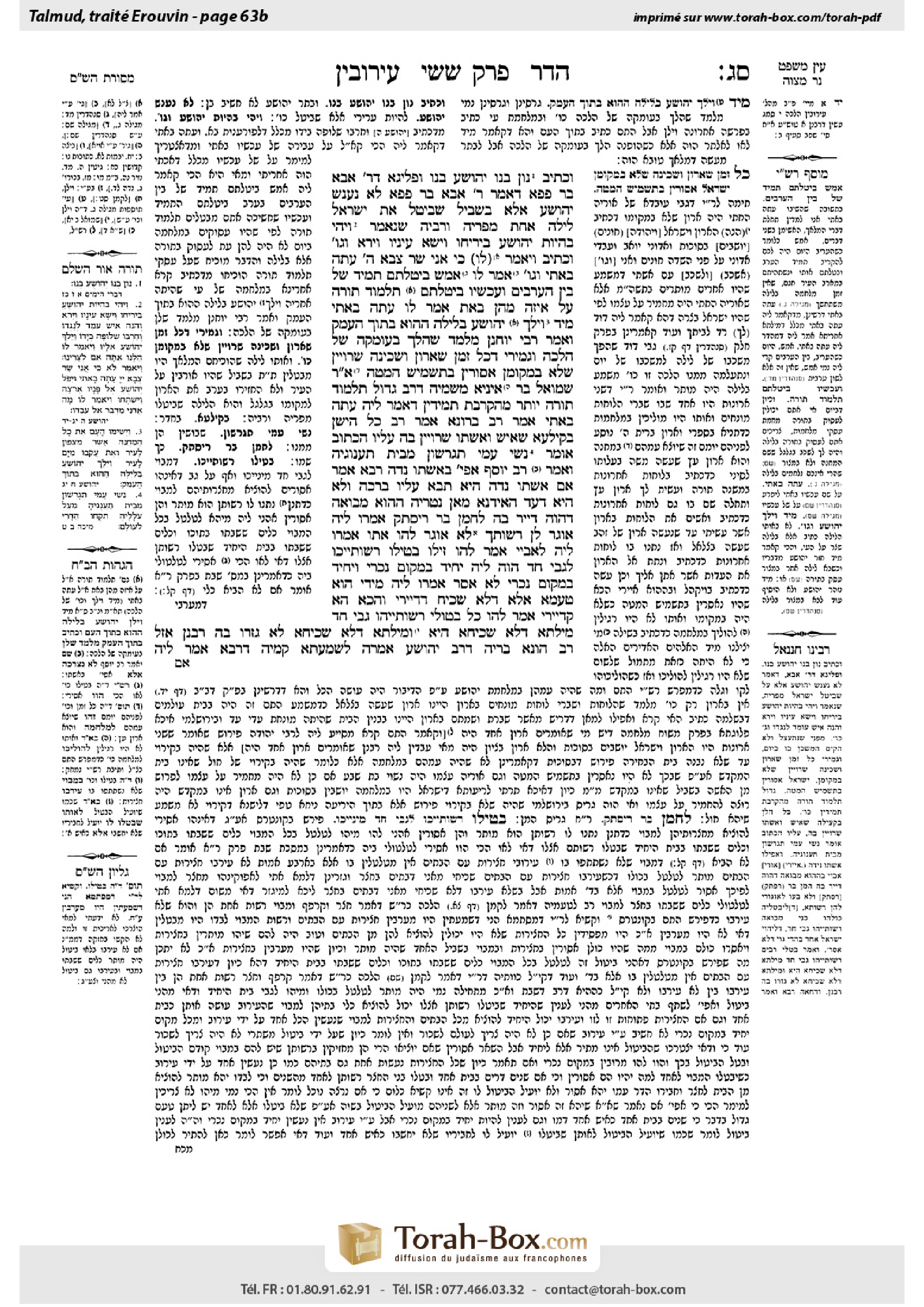
This page of Eruvin includes the Aramaic text, an English translation and an AI-generated French translation, alongside the scan above.
עירובין ס״ג ב · Aramaic and Hebrew text
וּכְתִיב: ״נוֹן בְּנוֹ יְהוֹשֻׁעַ בְּנוֹ״.
וּפְלִיגָא דְּרַבִּי אַבָּא בַּר פָּפָּא, דְּאָמַר רַבִּי אַבָּא בַּר פָּפָּא: לֹא נֶעֱנַשׁ יְהוֹשֻׁעַ אֶלָּא בִּשְׁבִיל שֶׁבִּיטֵּל אֶת יִשְׂרָאֵל לַיְלָה אַחַת מִפְּרִיָּה וּרְבִיָּה.
שֶׁנֶּאֱמַר: ״וַיְהִי בִּהְיוֹת יְהוֹשֻׁעַ בִּירִיחוֹ וַיִּשָּׂא עֵינָיו וַיַּרְא וְגוֹ׳״, וּכְתִיב: ״וַיֹּאמֶר (לוֹ) כִּי אֲנִי שַׂר צְבָא ה׳ עַתָּה בָאתִי וְגוֹ׳״.
אָמַר לוֹ: אֶמֶשׁ בִּיטַּלְתֶּם תָּמִיד שֶׁל בֵּין הָעַרְבַּיִם, וְעַכְשָׁיו בִּיטַּלְתֶּם תַּלְמוּד תּוֹרָה. עַל אֵיזֶה מֵהֶן בָּאתָ? אָמַר לוֹ: ״עַתָּה בָּאתִי״.
מִיָּד: ״וַיֵּלֶךְ יְהוֹשֻׁעַ בַּלַּיְלָה הַהוּא בְּתוֹךְ הָעֵמֶק״, וְאָמַר רַבִּי יוֹחָנָן: מְלַמֵּד שֶׁהָלַךְ בְּעוֹמְקָהּ שֶׁל הֲלָכָה.
וּגְמִירִי דְּכׇל זְמַן שֶׁאָרוֹן וּשְׁכִינָה שְׁרוּיִין שֶׁלֹּא בִּמְקוֹמָן אֲסוּרִין בְּתַשְׁמִישׁ הַמִּטָּה.
אָמַר רַבִּי שְׁמוּאֵל בַּר אִינְיָא מִשְּׁמֵיהּ דְּרַב: גָּדוֹל תַּלְמוּד תּוֹרָה יוֹתֵר מֵהַקְרָבַת תְּמִידִין, דַּאֲמַר לֵיהּ: ״עַתָּה בָּאתִי״.
אָמַר רַב בְּרוֹנָא אָמַר רַב: כׇּל הַיָּשֵׁן בְּקִילְעָא שֶׁאִישׁ וְאִשְׁתּוֹ שְׁרוּיִין בָּהּ, — עָלָיו הַכָּתוּב אוֹמֵר: ״נְשֵׁי עַמִּי תְּגָרְשׁוּן מִבֵּית תַּעֲנוּגֶיהָ״.
וְאָמַר רַב יוֹסֵף: אֲפִילּוּ בְּאִשְׁתּוֹ נִדָּה.
רָבָא אָמַר: אִם אִשְׁתּוֹ נִדָּה הִיא — תָּבֹא עָלָיו בְּרָכָה. וְלָא הִיא, דְּעַד הָאִידָּנָא מַאן נַטְרֵיהּ?
הָהוּא מְבוֹאָה דַּהֲוָה דָּיַיר בָּהּ לַחְמָן בַּר רִיסְתַּק. אֲמַרוּ לֵיהּ: אוֹגַר לַן רְשׁוּתָךְ, לָא אוֹגַר לְהוּ.
אֲתוֹ אֲמַרוּ לֵיהּ לְאַבָּיֵי. אֲמַר לְהוּ: זִילוּ בַּטִּילוּ רְשׁוּתַיְיכוּ לְגַבֵּי חַד, הָוֵה לֵיהּ יָחִיד בִּמְקוֹם גּוֹי, וְיָחִיד בִּמְקוֹם גּוֹי לָא אָסַר.
אֲמַרוּ לֵיהּ: מִידֵּי הוּא טַעְמָא אֶלָּא דְּלָא שְׁכִיחַ דְּדָיְירִי, וְהָכָא הָא קָדָיְירִי!
אֲמַר לְהוּ: כׇּל בַּטּוֹלֵי רְשׁוּתַיְיהוּ גַּבֵּי חַד, מִילְּתָא דְלָא שְׁכִיחָא הִיא, וּמִילְּתָא דְלָא שְׁכִיחָא, לָא גְּזַרוּ בַּהּ רַבָּנַן.
אֲזַל רַב הוּנָא בְּרֵיהּ דְּרַב יְהוֹשֻׁעַ אַמְרַהּ לִשְׁמַעְתָּא קַמֵּיהּ דְּרָבָא, אֲמַר לֵיהּ:
Eruvin 63b · English translation
And it is written at the end of the list of the descendants of Ephraim: “Non his son, Joshua his son” (i Chronicles 7:27), which implies that Joshua himself had no children.
And this tradition differs from the following statement of Rabbi Abba bar Pappa, for Rabbi Abba bar Pappa said: Joshua was punished to remain childless only because he had prevented the Jewish people from fulfilling the commandment of being fruitful and multiplying for one night. Therefore, he was punished measure-for-measure by not having children himself.
As it is stated: “And it came to pass when Joshua was by Jericho that he lifted up his eyes and looked, and, behold, a man stood over against him with his sword drawn in his hand” (Joshua 5:13), and it is written further: “And he said: No, but I am captain of the host of the Lord, I am now come” (Joshua 5:14). The man, an angel, came to demand something of Joshua and to rebuke him.
The angel said to him: Last night, due to your preparations for war, you neglected the daily evening offering, and now, tonight, you are neglecting Torah study. Joshua asked him: For which of these sins have you come specially to reprove me? He said to him: “I am now come,” i.e., the fact that I did not come last night, but waited until now, shows that the sin of neglecting Torah study is the more severe one.
Joshua immediately acted to rectify the matter by deciding that he must devote more time to learning Torah, as it is stated: “And Joshua walked that night in the midst of the valley [ha’emek]” (Joshua 8:13). And Rabbi Yoḥanan said: This teaches that he walked all night in the depth [be’omeka] of halakha, thereby atoning for his previous neglect of Torah study.
And they learned as a tradition that any time that the Ark and the Divine Presence are not resting in their proper places, the entire Jewish people are prohibited from engaging in marital relations. Owing to the nation’s preoccupation with war, the Ark was not restored to its rightful place in the Tabernacle. Since Joshua did not attend to this state of affairs, he was responsible for the people’s neglect of the commandment to be fruitful and multiply, for which he was punished by remaining childless.
The Gemara now cites a further teaching in this regard: Rabbi Shmuel bar Inya said in the name of Rav: Torah study is greater than the offering of daily sacrifices, as the angel said to Joshua: “I am now come,” i.e., on account of the second sin, demonstrating that neglect of Torah study is a more serious offense than neglect of the daily offerings.
With regard to the neglect of the commandment of procreation, Rav Beruna said that Rav said: Whoever sleeps in a chamber in which a husband and wife are resting, thus thwarting their intimacy, the verse says about him: “The women of my people you cast out from their pleasant houses” (Micah 2:9), and his punishment is detailed in that chapter.
And Rav Yosef said: This applies not only to a woman who is ritually pure and permitted to her husband, but even in the case of a man whose wife is menstruating, for even then, although she is prohibited to him, they are more comfortable being alone together.
Rava said: If his wife is menstruating, may a blessing come upon the person sleeping in the room, for he protects the couple from the possibility of sin. The Gemara rejects this: But that is not so, i.e., this argument is invalid, for who protected the husband until now? In other words, there is no need for concern in this case, and hence one must refrain from behavior that causes distress to the couple.
The Gemara returns to the issue of renting out domains for the purpose of an eiruv. The Gemara relates that there was a certain alleyway in which the gentile, Laḥman bar Ristak, lived. His Jewish neighbors said to him: Rent us your domain, i.e., your right to use the alleyway, so that it will not render it prohibited for us to carry. He would not rent it to them, and therefore they could not carry in the alleyway on Shabbat.
The Jewish neighbors came and spoke to Abaye, asking him how they might proceed. He said to them: Go, all of you, and renounce your domains, i.e., your rights to use the alleyway, in favor of one person, who will be permitted to carry in it. In this manner it is a case of one individual living in the same place as a gentile. And the halakha has already been established that in the case of one individual living in the same place as a gentile, the gentile does not render it prohibited for him to carry. Consequently, one person at least will be able to make use of the alleyway.
They said to him: But isn’t the reason that no restrictions are imposed when one person lives together with a gentile in the same courtyard only that it is not common for people to live with a gentile in that fashion? But here, many people are in fact living in the same alleyway as the gentile. In this more common situation, the Sages did impose restrictions.
Abaye said to them: Any renunciation of the domains of many people in favor of a single individual is an uncommon occurrence. The principle is that in the case of an uncommon occurrence, the Sages did not issue a decree as a preventive measure. In pressing circumstances such as these, one may rely on this allowance.
Rav Huna, son of Rav Yehoshua, went and reported this halakha before Rava, who said to him:
Eruvin 63b · Traduction française (IA)
Et il est écrit à la fin de la liste des descendants d'Ephraïm : « Non son fils, Josué son fils » (1 Rois 7:27), ce qui implique que Josué lui-même n'avait pas d'enfants.
Et cette tradition diffère de la déclaration suivante du Rabbi Abba bar Pappa, car Rabbi Abba bar Pappa a dit : Josué a été puni pour rester stérile uniquement parce qu'il avait empêché le peuple juif de remplir la Mitsva d'être fécond et de multiplier pour une nuit. Ainsi, il a été puni mesure pour mesure en ne ayant pas d'enfants lui-même.
Comme il est dit : « Et il advint que Josué était à Jéricho, qu'il leva les yeux et regarda, et voici un homme debout en face de lui avec son épée tirée de sa main » (Josué 5:13), et il est écrit plus loin : « Et il dit : Non, mais je suis chef de l'armée du Seigneur, je suis maintenant venu » (Josué 5:14). L'homme, un ange, est venu exiger quelque chose de Josué et le réprimander.
L'ange lui dit : La nuit dernière, en raison de vos préparatifs pour la guerre, vous avez négligé l'offrande du soir quotidienne, et maintenant, cette nuit, vous négligez l'étude de la Torah. Josué lui demanda : Pour quel de ces péchés avez-vous venu spécialement me réprimander ? Il lui dit : « Je suis maintenant venu », c'est-à-dire que le fait que je ne suis pas venu la nuit dernière, mais que j'ai attendu jusqu'à maintenant, montre que le péché de négliger l'étude de la Torah est le plus grave.
Josué agit immédiatement pour corriger la situation en décidant qu'il devait consacrer plus de temps à l'étude de la Torah, comme il est dit : « Et Josué marcha cette nuit dans le milieu du vallon [ha’emek] » (Josué 8:13). Et Rabbi Yoḥanan a dit : Cela enseigne qu'il marcha toute la nuit dans la profondeur [be’omeka] de la halakha, ce qui l'a expié pour son précédent négligence de l'étude de la Torah.
Et ils apprirent comme une tradition que toute fois que l'Arche et la Présence divine ne sont pas en repos à leur lieu propre, tout le peuple juif est interdit d'engager des relations conjugales. En raison de la préoccupation du peuple avec la guerre, l'Arche n'était pas restaurée à son lieu propre dans le Tabernacle. Puisque Josué n'a pas pris en charge cette situation, il était responsable de la négligence du peuple du commandement d'être fécond et de multiplier, pour lequel il a été puni en restant stérile.
La Guemara cite maintenant une autre barayta à ce sujet : Rabbi Shmuel bar Inya a dit en nom de Rav : L'étude de la Torah est plus grande que l'offrande des sacrifices quotidiens, comme l'ange a dit à Josué : « Je suis maintenant venu », c'est-à-dire en raison du second péché, démontrant que la négligence de l'étude de la Torah est un péché plus grave que la négligence des offrandes quotidiennes.
Concernant la négligence du commandement de la procréation, Rav Beruna a dit que Rav a dit : Celui qui dort dans une chambre où un mari et une femme reposent, empêchant ainsi leur intimité, la Torah dit à son sujet : « Les femmes de mon peuple, vous avez expulsées de leurs belles demeures » (Micha 2:9), et sa punition est détaillée dans ce chapitre.
Et Rav Yosef a dit : Cela s'applique non seulement à une femme pure et permise à son mari, mais même dans le cas d'un homme dont la femme est en cours de menstruation, car même alors, bien qu'elle lui soit interdite, ils sont plus à l'aise d'être ensemble.
Rava a dit : Si sa femme est en cours de menstruation, peut-on bénir la personne dormant dans la pièce, car il protège le couple de la possibilité de pécher. La Guemara rejette cela : Mais cela n'est pas ainsi, c'est-à-dire cet argument est invalide, car qui a protégé le mari jusqu'à maintenant ? En d'autres termes, il n'y a pas besoin de s'inquiéter de cela, et donc on doit se refréner de comportement qui cause une détresse au couple.
La Guemara retourne à la question de la location de domaines à l'effet d'un eiruv. La Guemara rapporte qu'il y avait un certain passage où le gentil, Laḥman bar Ristak, habitait. Ses voisins juifs lui dirent : Louez-nous votre domaine, c'est-à-dire votre droit d'utiliser le passage, afin qu'il ne rende pas interdit pour nous de porter. Il ne loua pas à eux, et donc ils ne pouvaient pas porter dans le passage le sabbat.
Les voisins juifs vinrent et parlèrent à Abaye, demandant comment ils pouvaient agir. Il leur dit : Allez, tous ensemble, et renoncez à vos domaines, c'est-à-dire à vos droits d'utiliser le passage, en faveur d'une seule personne, qui sera autorisé à porter dedans. Ainsi, il s'agit d'un cas d'une seule personne vivant avec un gentil. Et la halakha a déjà été établie que dans le cas d'une seule personne vivant avec un gentil, le gentil ne rend pas interdit pour lui de porter. Ainsi, au moins une personne pourra utiliser le passage.
Ils lui dirent : Mais n'est-ce pas la raison pour laquelle des restrictions ne sont pas imposées lorsque une seule personne vit avec un gentil dans le même cour, uniquement parce que c'est peu commun que les gens vivent avec un gentil ainsi ? Mais ici, beaucoup de personnes vivent en effet dans le même passage que le gentil. Dans cette situation plus courante, les Sages ont imposé des restrictions.
Abaye dit à eux : Tout renoncement des domaines de beaucoup de personnes en faveur d'une seule personne est une occurrence peu commune. Le principe est que dans le cas d'une occurrence peu commune, les Sages n'ont pas émis un décret préventif. Dans des circonstances pressantes telles que celles-ci, on peut se fier à cette autorisation.
Rav Huna, fils de Rav Yehoshua, alla rapporter cette halakha à Rava, qui lui dit :
Traduction française générée par IA à partir de l’édition anglaise de Sefaria. Vérifie toujours un passage avec le texte source.
Text from Sefaria: William Davidson Edition - Vocalized Aramaic (CC BY NC); William Davidson Edition - English (CC BY NC).