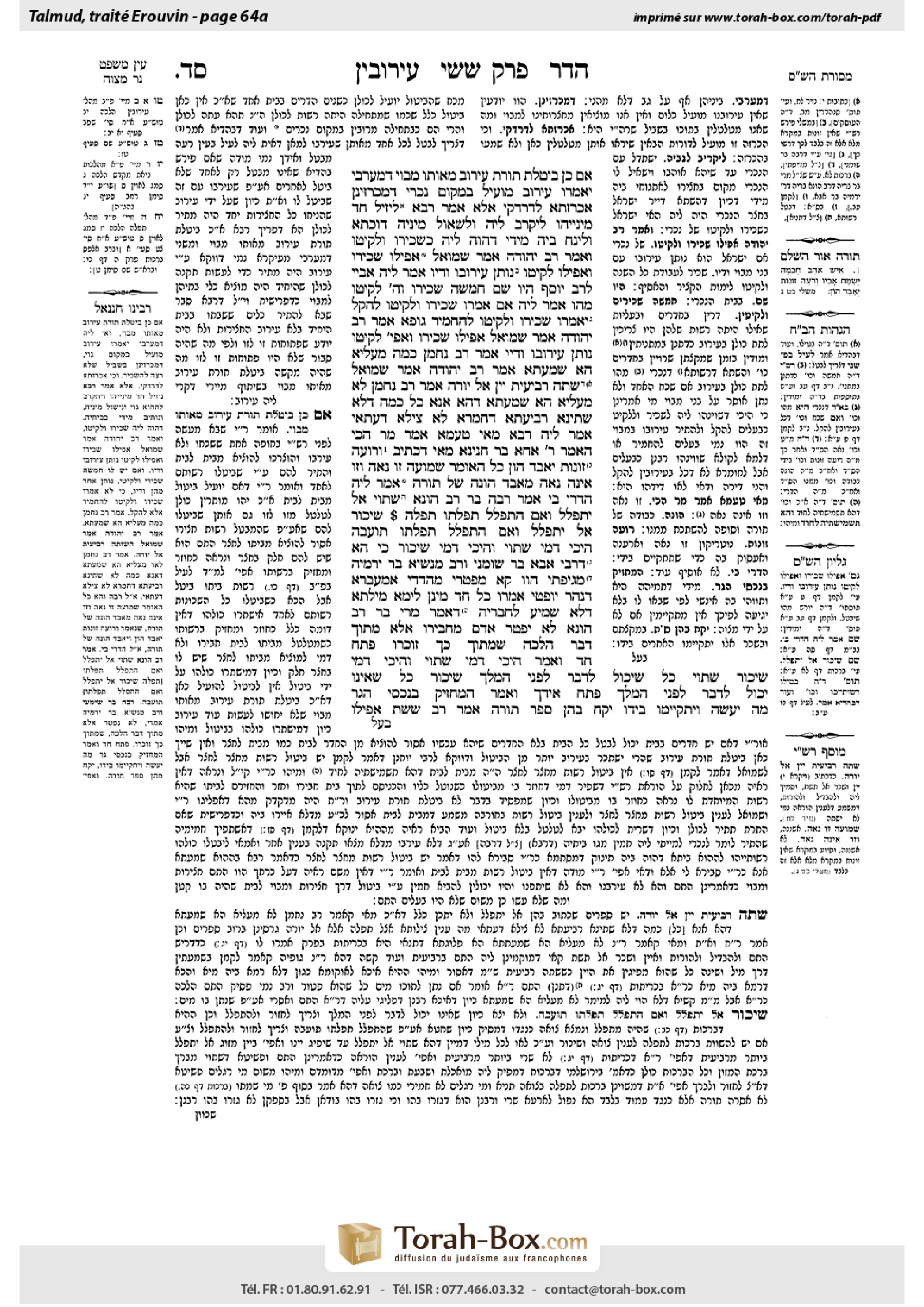
Eruvin 64a: Talmud study for Daf Yomi
Study the Talmud for Daf Yomi with scanned pages, Hebrew text, English translations from Sefaria and AI-generated French translations.
Passage selection and English or AI-generated French translation are available where the scan has annotations. Daf Study is independent of Torah-Box and Sefaria.
Browse Eruvin · עירובין · All tractatesEruvin 64a text and translations
This page of Eruvin includes the Aramaic text, an English translation and an AI-generated French translation, alongside the scan above.
עירובין ס״ד א · Aramaic and Hebrew text
אִם כֵּן, בִּיטַּלְתָּ תּוֹרַת עֵירוּב מֵאוֹתוֹ מָבוֹי!
דִּמְעָרְבִי. יֹאמְרוּ עֵירוּב מוֹעִיל בִּמְקוֹם גּוֹי?! דְּמַכְרְזִינַן.
אַכְרָזְתָּא לְדַרְדְּקֵי?!
אֶלָּא אָמַר רָבָא: לֵיזִיל חַד מִינַּיְיהוּ, לִיקְרַב לֵיהּ, וְלִשְׁאוֹל מִינֵּיהּ דּוּכְתָּא וְלַינַּח בֵּיהּ מִידֵּי, דְּהָוֵה לֵיהּ כִּשְׂכִירוֹ וּלְקִיטוֹ, וְאָמַר רַב יְהוּדָה אָמַר שְׁמוּאֵל: אֲפִילּוּ שְׂכִירוֹ וַאֲפִילּוּ לְקִיטוֹ — נוֹתֵן עֵירוּבוֹ וְדַיּוֹ.
אֲמַר לֵיהּ אַבָּיֵי לְרַב יוֹסֵף: הָיוּ שָׁם חֲמִשָּׁה שְׂכִירוֹ וַחֲמִשָּׁה לְקִיטוֹ מַהוּ? אֲמַר לֵיהּ: אִם אָמְרוּ שְׂכִירוֹ וּלְקִיטוֹ לְהָקֵל, יֹאמְרוּ שְׂכִירוֹ וּלְקִיטוֹ לְהַחֲמִיר?
גּוּפָא, אָמַר רַב יְהוּדָה אָמַר שְׁמוּאֵל: אֲפִילּוּ שְׂכִירוֹ וַאֲפִילּוּ לְקִיטוֹ, נוֹתֵן עֵירוּבוֹ וְדַיּוֹ. אָמַר רַב נַחְמָן: כַּמָּה מְעַלְּיָא הָא שְׁמַעְתָּא.
אָמַר רַב יְהוּדָה אָמַר שְׁמוּאֵל: שָׁתָה רְבִיעִית יַיִן — אַל יוֹרֶה. אָמַר רַב נַחְמָן: לָא מְעַלְּיָא הָא שְׁמַעְתָּא, דְּהָא אֲנָא כֹּל כַּמָּה דְּלָא שָׁתֵינָא רְבִיעֵתָא דְּחַמְרָא — לָא צִילָא דַּעְתַּאי.
אֲמַר לֵיהּ רָבָא: מַאי טַעְמָא אָמַר מָר הָכִי? הָאָמַר רַבִּי אַחָא בַּר חֲנִינָא: מַאי דִּכְתִיב ״וְרוֹעֶה זוֹנוֹת יְאַבֶּד הוֹן״ — כׇּל הָאוֹמֵר שְׁמוּעָה זוֹ נָאָה, וְזוֹ אֵינָהּ נָאָה — מְאַבֵּד הוֹנָה שֶׁל תּוֹרָה! אֲמַר לֵיהּ: הֲדַרִי בִּי.
אָמַר רַבָּה בַּר רַב הוּנָא: שָׁתוּי אַל יִתְפַּלֵּל, וְאִם הִתְפַּלֵּל — תְּפִלָּתוֹ תְּפִלָּה. שִׁיכּוֹר אַל יִתְפַּלֵּל, וְאִם הִתְפַּלֵּל — תְּפִלָּתוֹ תּוֹעֵבָה.
הֵיכִי דָּמֵי שָׁתוּי, וְהֵיכִי דָּמֵי שִׁיכּוֹר? כִּי הָא דְּרַבִּי אַבָּא בַּר שׁוּמְנִי וְרַב מְנַשְּׁיָא בַּר יִרְמְיָה מִגִּיפְתִּי הֲווֹ קָא מִפַּטְרִי מֵהֲדָדֵי אַמַּעְבָּרָא דִּנְהַר יוֹפְטִי. אֲמַרוּ: כׇּל חַד מִינַּן לֵימָא מִילְּתָא דְּלָא שְׁמִיעַ לְחַבְרֵיהּ, דְּאָמַר מָרִי בַּר רַב הוּנָא: לָא יִפָּטֵר אָדָם מֵחֲבֵירוֹ אֶלָּא מִתּוֹךְ דְּבַר הֲלָכָה, שֶׁמִּתּוֹךְ כָּךְ זוֹכְרוֹ.
פְּתַח חַד וַאֲמַר: הֵיכִי דָּמֵי שָׁתוּי, וְהֵיכִי דָּמֵי שִׁיכּוֹר? שָׁתוּי — כֹּל שֶׁיָּכוֹל לְדַבֵּר לִפְנֵי הַמֶּלֶךְ. שִׁיכּוֹר — כֹּל שֶׁאֵינוֹ יָכוֹל לְדַבֵּר לִפְנֵי הַמֶּלֶךְ.
פְּתַח אִידַּךְ וַאֲמַר: הַמַּחֲזִיק בְּנִכְסֵי הַגֵּר, מַה יַּעֲשֶׂה וְיִתְקַיְּימוּ בְּיָדוֹ? יִקַּח בָּהֶן סֵפֶר תּוֹרָה. אָמַר רַב שֵׁשֶׁת: אֲפִילּוּ
Eruvin 64a · English translation
If so, you have abolished the halakhic category of eiruv from that alleyway. Since from a halakhic perspective it is considered as though only one person lives in that alleyway, there is no need for an eiruv. Consequently, when the residents carry in it without an eiruv, observers will mistakenly think that it is permitted to carry in an alleyway even without an eiruv.
Rav Huna, son of Rav Yehoshua, replied: It is required that they establish an eiruv anyway, as a reminder of the laws of eiruvin, even though it serves no halakhic purpose. Rava retorted that this in turn results in a different problem: Observers will then say that an eiruv is effective even in the place of a gentile, even if he does not rent out his domain, which is against the halakha. He replied: We make an announcement to the effect that they are not carrying because of the eiruv, and that it only serves as a reminder.
Rava rejected this option as well: Can we make an announcement for the children? Even if it is assured that all adults present will hear the announcement, how will the children, who do not hear or understand the announcement, know the halakha later in life? Recalling that their fathers established an eiruv in this alleyway, they will think that an eiruv is effective even in the place of a gentile. Therefore, one cannot rely on Abaye’s solution.
Rather, Rava said that the gentile’s Jewish neighbors should proceed as follows: Let one of them go and become friendly with the gentile, and ask him for permission to make use of a place in his domain, and set something down there, thus becoming like the gentile’s hired laborer or harvester. And Rav Yehuda said that Shmuel said: Not only can the gentile himself rent out his domain for the purpose of an eiruv, but even his hired laborer, and even his harvester, if he is a Jew, may rent out the space and contribute to the eiruv on his behalf, and this is enough.
Abaye said to Rav Yosef: If there were five hired laborers or five harvesters there, what is the halakha? Does the presence of more than one of these, if they are all Jews, entail a stringency, such that they are all required to join in the eiruv or that they are all required to rent out his domain? Rav Yosef said to him: If the Sages said that the gentile’s hired laborer or harvester stands in his place as a leniency, would they say that his hired laborer or harvester stands in his place as a stringency? This law was stated only as a leniency with regard to the laws of renting for the purpose of an eiruv, not in order to introduce more stringencies.
The Gemara proceeds to examine the ruling cited in the course of the previous discussion. Returning to the matter itself, Rav Yehuda said that Shmuel said: Even the gentile’s hired laborer, and even his harvester, may contribute to the eiruv in his stead, and this is enough. Rav Naḥman said: How excellent is this halakha. Even Rav Naḥman agreed with this statement, and viewed it as correct and substantiated.
However, Rav Naḥman did not give his approval to all of Rav Yehuda’s rulings, as Rav Yehuda said that Shmuel said: If one drank a quarter-log of wine, he may not issue a halakhic ruling, as the wine is liable to confuse his thinking. With regard to this second statement, Rav Naḥman said: This halakha is not excellent, as concerning myself, as long as I have not drunk a quarter-log of wine, my mind is not clear. It is only after drinking wine that I can issue appropriate rulings.
Rava said to Rav Naḥman: What is the reason that the Master said this, making a statement that praises one halakha and disparages another? Didn’t Rabbi Aḥa bar Ḥanina say: What is the meaning of that which is written: “But he who keeps company with prostitutes [zonot] wastes his fortune” (Proverbs 29:3)? It alludes to the following: Anyone who says: This teaching is pleasant [zo na’a] but this is not pleasant, loses the fortune of Torah. It is not in keeping with the honor of Torah to make such evaluations. Rav Naḥman said to him: I retract, and I will no longer make such comments concerning words of Torah.
On the topic of drinking wine, Rabba bar Rav Huna said: One who has drunk wine must not pray, but if he nonetheless prayed, his prayer is a prayer, i.e., he has fulfilled his obligation. On the other hand, one who is intoxicated with wine must not pray, and if he prayed, his prayer is an abomination.
The Gemara poses a question: What are the circumstances in which a person is considered one who has drunk wine; and what are the circumstances in which a person is considered one who is intoxicated with wine? The Gemara answers that one can learn this from the following event: As Rabbi Abba bar Shumni and Rav Menashya bar Yirmeya from Gifti were taking leave of each other at the ford of the Yofti River, they said: Let each one of us say something that his fellow scholar has not yet heard, for Mari bar Rav Huna said: A person must take leave of his fellow only in the midst of a discussion of a matter of halakha, as due to this he will remember him.
One of them opened the discussion and said: What are the circumstances where a person is considered one who has drunk wine, and what are the circumstances where a person is considered one who is intoxicated with wine? One who has drunk wine refers to anyone who has drunk wine but whose mind remains clear enough that he is able to talk in the presence of a king. One who is intoxicated refers to anyone who is so disoriented by the wine he has drunk that he is not able to talk in the presence of a king.
The other one then opened a different discussion and said: With regard to one who took possession of a convert’s property, what should he do so that it remains in his hands? The property of a convert who died without children is regarded as ownerless, and is acquired by the first person to perform a valid act of acquisition upon it. Since in this case the one who took possession of the property did not acquire it through his own labor, his ownership is tenuous, and he is liable to lose it unless he uses it for the purpose of a mitzva. One in this situation should buy a Torah scroll with part of the revenue, and by the merit of this act, he will retain the rest. Rav Sheshet said: Even
Eruvin 64a · Traduction française (IA)
Si c'est le cas, vous avez annulé la catégorie halakhique d'eiruv pour cette allée. En effet, du point de vue halakhique, elle est considérée comme si seule une personne habitait dans cette allée, et donc il n'y a pas besoin d'eiruv. Par conséquent, lorsque les habitants portent des objets sans eiruv, les observateurs pourront penser à tort que porter des objets dans une allée est permis même sans eiruv.
Rav Huna, fils de Rav Yehoshua, répondit : Il est nécessaire qu'ils établissent un eiruv de toute façon, comme un rappel des lois des eiruvin, même si cela n'a pas de valeur halakhique. Rava rétorqua que cela entraîne un autre problème : les observateurs diront alors que l'eiruv est efficace même dans la résidence d'un non-Juif, même s'il ne loue pas son domaine, ce qui contredit la halakha. Il répondit : Nous faisons une annonce selon laquelle ils ne portent pas les objets à cause de l'eiruv, et que cela sert uniquement à rappeler la loi.
Rava rejeta cette option également : peut-on faire une annonce aux enfants ? Même si on est sûr que tous les adultes présents entendront l'annonce, comment les enfants, qui n'entendent pas ou ne comprennent pas l'annonce, sauront la halakha plus tard dans la vie ? En se souvenant que leurs pères ont établi un eiruv dans cette allée, ils penseront que l'eiruv est efficace même dans la résidence d'un non-Juif. Par conséquent, on ne peut pas compter sur la solution d'Abaye.
Rava dit plutôt que les voisins juifs du non-Juif devraient agir ainsi : l'un d'eux devrait aller s'entendre avec le non-Juif, lui demander la permission d'utiliser un lieu de son domaine, et y poser quelque chose, devenant ainsi un ouvrier ou un récolteur employé du non-Juif. Et Rav Yehuda dit que Shmuel a dit : Non seulement le non-Juif lui-même peut louer son domaine à cet effet, mais même son ouvrier ou son récolteur, et même s'il est juif, peut louer l'espace et contribuer à l'eiruv à sa place, et cela suffit.
Abaye dit à Rav Yosef : Si il y avait cinq ouvriers ou cinq récolteurs là-bas, quelle est la halakha ? La présence de plus d'une personne de ce genre, si elles sont toutes juives, entraîne-t-elle une stricte application, de sorte qu'elles doivent toutes participer à l'eiruv ou louer le domaine ? Rav Yosef répondit à lui : Si les Sages disent que l'ouvrier ou le récolteur du non-Juif est considéré comme lui-même pour une leniency, diraient-ils qu'il est considéré comme lui-même pour une stringence ? Cette loi a été énoncée uniquement comme une leniency concernant les lois de location pour l'eiruv, pas pour introduire davantage de stringences.
La Guemara poursuit en examinant la décision citée lors de la discussion précédente. Revenant à la question elle-même, Rav Yehuda dit que Shmuel a dit : Même l'ouvrier ou le récolteur du non-Juif peut contribuer à l'eiruv à sa place, et cela suffit. Rav Naḥman dit : Quel est la beauté de cette halakha. Rav Naḥman a également approuvé cette déclaration, et la considérait comme correcte et fondée.
Cependant, Rav Naḥman n'a pas donné son approbation à toutes les décisions de Rav Yehuda, car Rav Yehuda a dit que Shmuel a dit : Si l'on a bu un quart de log de vin, on ne peut pas émettre un avis halakhique, car le vin peut troubler sa pensée. Concernant cette deuxième déclaration, Rav Naḥman a dit : Cette halakha n'est pas excellente, car concernant moi-même, tant que je n'ai pas bu un quart de log de vin, mon esprit n'est pas clair. C'est seulement après avoir bu du vin que je peux émettre des décisions appropriées.
Rava dit à Rav Naḥman : Quel est le motif que le Maître a dit cela, en faisant une déclaration qui loue une halakha et dénigre une autre ? N'a-t-il pas dit Rabbi Aḥa bar Ḥanina : Quelle est la signification de ce qui est écrit : « Mais celui qui fréquente les prostituées [zonot] gaspille son argent » (Proverbes 29:3) ? Cela désigne le suivant : Quiconque dit : Cet enseignement est agréable [zo na’a] mais celui-ci ne l'est pas, perd l'argent de la Torah. Il n'est pas conforme à l'honneur de la Torah de faire de tels jugements. Rav Naḥman dit à lui : Je retire, et je ne ferai plus de tels commentaires concernant les paroles de Torah.
Sur le sujet de la consommation de vin, Rabba bar Rav Huna dit : Celui qui a bu du vin ne doit pas prier, mais si il prie tout de même, sa prière est une prière, c'est-à-dire qu'il a accompli son obligation. En revanche, celui qui est ivre à cause du vin ne doit pas prier, et si il prie, sa prière est une abomination.
La Guemara pose une question : Quelles sont les circonstances dans lesquelles une personne est considérée comme ayant bu du vin, et quels sont ceux dans lesquels elle est considérée comme ivre ? La Guemara répond qu'on peut apprendre cela à partir de l'histoire suivante : Rabbi Abba bar Shumni et Rav Menashya bar Yirmeya de Gifti prenaient congé l'un de l'autre au gué du fleuve Yofti, et ils dirent : Que chacun d'entre nous dise quelque chose que son collègue savant n'a pas encore entendu, car Mari bar Rav Huna a dit : Une personne doit prendre congé de son collègue seulement au milieu d'une discussion sur une question de halakha, car cela lui permettra de le retenir en mémoire.
L'un d'eux ouvrit la discussion et dit : Quelles sont les circonstances dans lesquelles une personne est considérée comme ayant bu du vin, et quels sont ceux dans lesquels elle est considérée comme ivre ? Celui qui a bu du vin désigne toute personne qui a bu du vin mais dont l'esprit reste suffisamment clair pour pouvoir parler en présence d'un roi. Celui qui est ivre désigne toute personne qui est si désorienté par le vin qu'il ne peut pas parler en présence d'un roi.
L'autre a alors ouvert une discussion différente et a dit : En ce qui concerne celui qui a pris possession des biens d'un converti, que devrait-il faire pour que ceux-ci restent en son possession ? Les biens d'un converti décédé sans enfants sont considérés comme sans propriétaire, et sont acquis par la première personne qui y a accompli un acte valide d'acquisition. Dans ce cas, celui qui a pris possession des biens n'a pas acquis ceux-ci par son propre travail, donc son droit de propriété est précaire, et il est tenu responsable de les perdre à moins qu'il ne les utilise à l'effet d'une mitsva. Celui qui se trouve dans cette situation devrait acheter un rouleau de Torah avec une partie des revenus, et grâce au mérite de cet acte, il conservera le reste. Rav Sheshet a dit : Même
Traduction française générée par IA à partir de l’édition anglaise de Sefaria. Vérifie toujours un passage avec le texte source.
Text from Sefaria: William Davidson Edition - Vocalized Aramaic (CC BY NC); William Davidson Edition - English (CC BY NC).