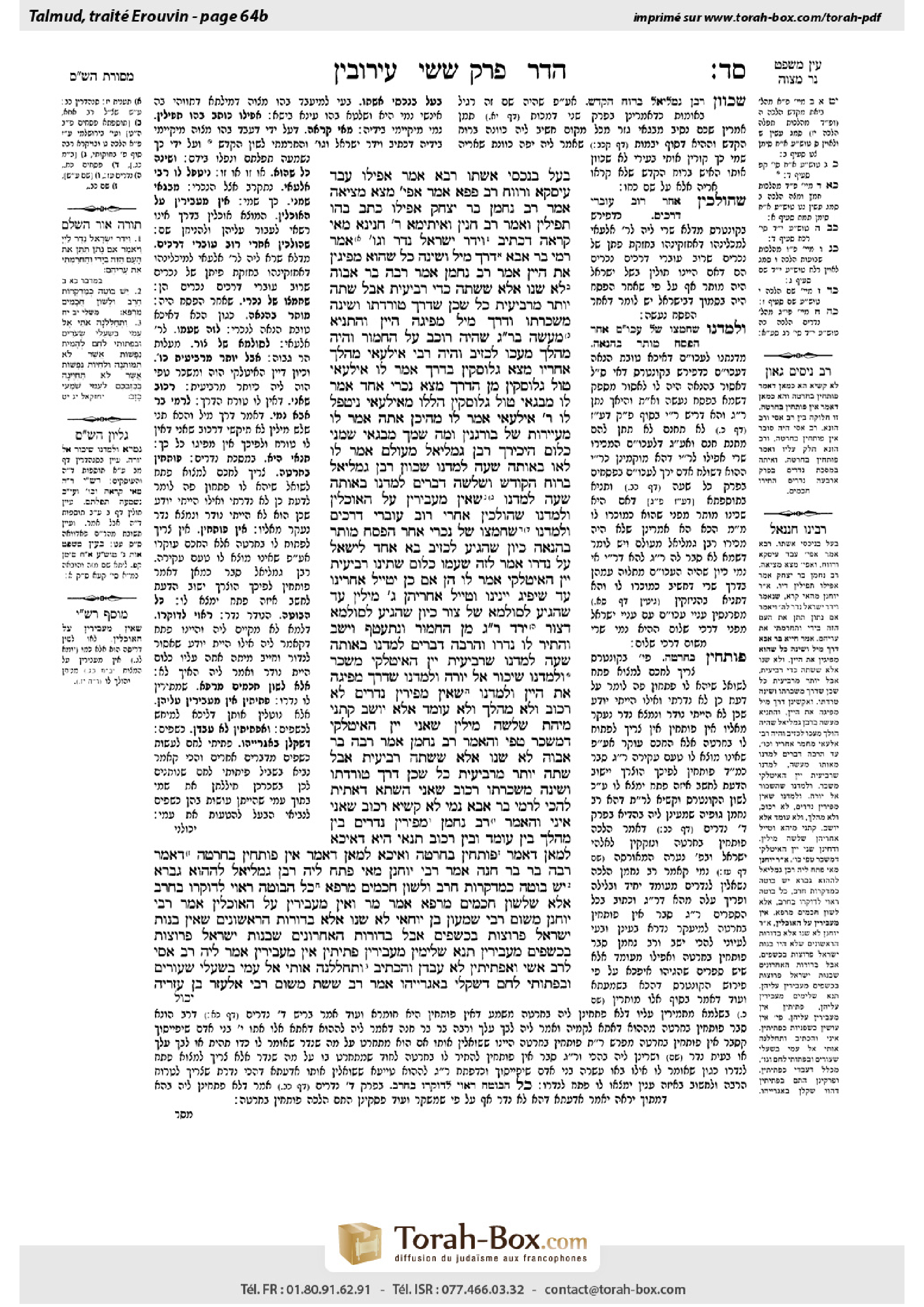
Eruvin 64b: Talmud study for Daf Yomi
Study the Talmud for Daf Yomi with scanned pages, Hebrew text, English translations from Sefaria and AI-generated French translations.
Passage selection and English or AI-generated French translation are available where the scan has annotations. Daf Study is independent of Torah-Box and Sefaria.
Browse Eruvin · עירובין · All tractatesEruvin 64b text and translations
This page of Eruvin includes the Aramaic text, an English translation and an AI-generated French translation, alongside the scan above.
עירובין ס״ד ב · Aramaic and Hebrew text
בַּעַל בְּנִכְסֵי אִשְׁתּוֹ.
רָבָא אָמַר: אֲפִילּוּ עֲבַד עִיסְקָא וּרְוַוח. רַב פָּפָּא אָמַר: אֲפִילּוּ מָצָא מְצִיאָה. אָמַר רַב נַחְמָן בַּר יִצְחָק: אֲפִילּוּ כְּתַב בְּהוּ תְּפִילִּין.
וְאָמַר רַב חָנִין, וְאִיתֵּימָא רַבִּי חֲנִינָא: מַאי קְרָאָה, דִּכְתִיב: ״וַיִּדַּר יִשְׂרָאֵל נֶדֶר וְגוֹ׳״.
אָמַר רָמֵי בַּר אַבָּא: דֶּרֶךְ מִיל, וְשֵׁינָה כׇּל שֶׁהוּא — מְפִיגִין אֶת הַיַּיִן. אָמַר רַב נַחְמָן אָמַר רַבָּה בַּר אֲבוּהּ: לֹא שָׁנוּ אֶלָּא שֶׁשָּׁתָה כְּדֵי רְבִיעִית, אֲבָל שָׁתָה יוֹתֵר מֵרְבִיעִית — כׇּל שֶׁכֵּן שֶׁדֶּרֶךְ טוֹרַדְתּוֹ וְשֵׁינָה מְשַׁכַּרְתּוֹ.
וְדֶרֶךְ מִיל מְפִיגָה הַיַּיִן?! וְהָתַנְיָא: מַעֲשֶׂה בְּרַבָּן גַּמְלִיאֵל שֶׁהָיָה רוֹכֵב עַל הַחֲמוֹר וְהָיָה מְהַלֵּךְ מֵעַכּוֹ לִכְזִיב, וְהָיָה רַבִּי אִילְעַאי מְהַלֵּךְ אַחֲרָיו. מָצָא גְּלוּסְקִין בַּדֶּרֶךְ, אָמַר לוֹ: אִילְעַאי, טוֹל גְּלוּסְקִין מִן הַדֶּרֶךְ. מָצָא גּוֹי אֶחָד, אָמַר לוֹ: מַבְגַּאי, טוֹל גְּלוּסְקִין הַלָּלוּ מֵאִילְעַאי.
נִיטַּפֵּל לוֹ רַבִּי אִילְעַאי, אָמַר לוֹ: מֵהֵיכָן אַתָּה? אָמַר לוֹ: מֵעֲיָירוֹת שֶׁל בּוּרְגָּנִין. וּמָה שִׁמְךָ? מַבְגַּאי שְׁמֵנִי. כְּלוּם הִיכִּירְךָ רַבָּן גַּמְלִיאֵל מֵעוֹלָם? אָמַר לוֹ: לָאו.
בְּאוֹתָהּ שָׁעָה לָמַדְנוּ שֶׁכִּוֵּון רַבָּן גַּמְלִיאֵל בְּרוּחַ הַקּוֹדֶשׁ. וּשְׁלֹשָׁה דְּבָרִים לָמַדְנוּ בְּאוֹתָהּ שָׁעָה: לָמַדְנוּ שֶׁאֵין מַעֲבִירִין עַל הָאוֹכָלִין.
וְלָמַדְנוּ שֶׁהוֹלְכִין אַחֲרֵי רוֹב עוֹבְרֵי דְּרָכִים. וְלָמַדְנוּ שֶׁחֲמֵצוֹ שֶׁל גּוֹי אַחַר הַפֶּסַח מוּתָּר בַּהֲנָאָה.
כֵּיוָן שֶׁהִגִּיעַ לִכְזִיב, בָּא אֶחָד לִישָּׁאֵל עַל נִדְרוֹ. אָמַר לָזֶה שֶׁעִמּוֹ: כְּלוּם שָׁתִינוּ רְבִיעִית יַיִן הָאִיטַלְקִי? אָמַר לוֹ: הֵן. אִם כֵּן, יְטַיֵּיל אַחֲרֵינוּ עַד שֶׁיָּפִיג יֵינֵינוּ.
וְטִיֵּיל אַחֲרֵיהֶן שְׁלֹשָׁה מִילִין, עַד שֶׁהִגִּיעַ לְסוּלָּמָא שֶׁל צוּר. כֵּיוָן שֶׁהִגִּיעַ לְסוּלָּמָא דְצוֹר, יָרַד רַבָּן גַּמְלִיאֵל מִן הַחֲמוֹר, וְנִתְעַטֵּף, וְיָשַׁב, וְהִתִּיר לוֹ נִדְרוֹ.
וְהַרְבֵּה דְּבָרִים לָמַדְנוּ בְּאוֹתָהּ שָׁעָה. לָמַדְנוּ שֶׁרְבִיעִית יַיִן הָאִיטַלְקִי מְשַׁכֵּר, וְלָמַדְנוּ שִׁיכּוֹר אַל יוֹרֶה, וְלָמַדְנוּ שֶׁדֶּרֶךְ מְפִיגָה אֶת הַיַּיִן, וְלָמַדְנוּ שֶׁאֵין מְפִירִין נְדָרִים לֹא רָכוּב וְלֹא מְהַלֵּךְ וְלֹא עוֹמֵד, אֶלָּא יוֹשֵׁב.
קָתָנֵי מִיהַת שְׁלֹשָׁה מִילִין! שָׁאנֵי יַיִן הָאִיטַלְקִי דִּמְשַׁכַּר טְפֵי.
וְהָאָמַר רַב נַחְמָן אָמַר רַבָּה בַּר אֲבוּהּ: לֹא שָׁנוּ אֶלָּא שֶׁשָּׁתָה רְבִיעִית, אֲבָל שָׁתָה יוֹתֵר מֵרְבִיעִית, כׇּל שֶׁכֵּן דֶּרֶךְ טוֹרַדְתּוֹ וְשֵׁינָה מְשַׁכַּרְתּוֹ!
רָכוּב שָׁאנֵי. הַשְׁתָּא דְּאָתֵית לְהָכִי, לְרָמִי בַּר אַבָּא נָמֵי לָא קַשְׁיָא: רָכוּב שָׁאנֵי.
אִינִי?! וְהָאָמַר רַב נַחְמָן: מְפִירִין נְדָרִים בֵּין מְהַלֵּךְ בֵּין עוֹמֵד וּבֵין רָכוּב!
תַּנָּאֵי הִיא. דְּאִיכָּא לְמַאן דְּאָמַר: פּוֹתְחִין בַּחֲרָטָה.
וְאִיכָּא לְמַאן דְּאָמַר: אֵין פּוֹתְחִין בַּחֲרָטָה.
דְּאָמַר רַבָּה בַּר בַּר חָנָה אָמַר רַבִּי יוֹחָנָן: מַאי פָּתַח לֵיהּ רַבָּן גַּמְלִיאֵל לְהָהוּא גַּבְרָא: ״יֵשׁ בּוֹטֶה כְּמַדְקְרוֹת חָרֶב וּלְשׁוֹן חֲכָמִים מַרְפֵּא״ — כֹּל הַבּוֹטֶה רָאוּי לְדוֹקְרוֹ בְּחֶרֶב, אֶלָּא שֶׁלְּשׁוֹן חֲכָמִים מַרְפֵּא.
אָמַר מָר: וְאֵין מַעֲבִירִין עַל הָאוֹכָלִין. אָמַר רַבִּי יוֹחָנָן מִשּׁוּם רַבִּי שִׁמְעוֹן בֶּן יוֹחַאי: לֹא שָׁנוּ אֶלָּא בְּדוֹרוֹת הָרִאשׁוֹנִים, שֶׁאֵין בְּנוֹת יִשְׂרָאֵל פְּרוּצוֹת בִּכְשָׁפִים. אֲבָל בְּדוֹרוֹת הָאַחֲרוֹנִים, שֶׁבְּנוֹת יִשְׂרָאֵל פְּרוּצוֹת בִּכְשָׁפִים — מַעֲבִירִין.
תָּנָא: שְׁלֵימִין מַעֲבִירִין, פְּתִיתִין אֵין מַעֲבִירִין. אֲמַר לֵיהּ רַב אַסִּי לְרַב אָשֵׁי: וְאַפְּתִיתִין לָא עָבְדָן? וְהָכְתִיב: ״וַתְּחַלֶּלְנָה אוֹתִי אֶל עַמִּי בְּשַׁעֲלֵי שְׂעוֹרִים וּבִפְתוֹתֵי לֶחֶם״! דְּשָׁקְלִי בְּאַגְרַיְיהוּ.
אָמַר רַב שֵׁשֶׁת מִשּׁוּם רַבִּי אֶלְעָזָר בֶּן עֲזַרְיָה:
Eruvin 64b · English translation
a husband who acquired rights to his wife’s property that she had brought into the marriage as her dowry should use part of the profits for the acquisition of a Torah scroll.
Rava said: Even if he entered into a business venture and made a large profit, he should act in a similar manner. Rav Pappa said: Even if he found a lost article, he should do the same. Rav Naḥman bar Yitzḥak said: He need not use the money to commission the writing of a Torah scroll, as even if he wrote a set of phylacteries with it, this, too, is a mitzva whose merit will enable him to retain the rest of the money.
Rav Ḥanin said, and some say it was Rabbi Ḥanina who said: What is the verse that alludes to this? As it is written: “And Israel vowed a vow to the Lord and said: If You will indeed deliver this people into my hand, then I will consecrate their cities” (Numbers 21:2), which shows that one who wishes to succeed should sanctify a portion of his earnings for Heaven.
The Gemara now cites additional teachings relating to the drinking of wine. Rami bar Abba said: Walking a path of a mil, and similarly, sleeping even a minimal amount, will dispel the effect of wine that one has drunk. Rav Naḥman said that Rabba bar Avuh said: They only taught this with regard to one who has drunk a quarter-log of wine, but with regard to one who has drunk more than a quarter-log, this advice is not useful. In that case, walking a path of such a distance will preoccupy and exhaust him all the more, and a small amount of sleep will further intoxicate him.
The Gemara poses a question: Does walking a path of only a mil dispel the effects of wine? Wasn’t it taught in a baraita: There was an incident involving Rabban Gamliel, who was riding a donkey and traveling from Akko to Keziv, and his student Rabbi Elai was walking behind him. Rabban Gamliel found some fine loaves of bread on the road, and he said to his student: Elai, take the loaves from the road. Further along the way, Rabban Gamliel encountered a certain gentile and said to him: Mavgai, take these loaves from Elai.
Elai joined the gentile and said to him: Where are you from? He said to him: From the nearby towns of guardsmen. He asked: And what is your name? The gentile replied: My name is Mavgai. He then inquired: Has Rabban Gamliel ever met you before, seeing as he knows your name? He said to him: No.
The Gemara interrupts the story in order to comment: At that time we learned that Rabban Gamliel divined the gentile’s name by way of divine inspiration that rested upon him. And at that time we also learned three matters of halakha from Rabban Gamliel’s behavior: We learned that one may not pass by food, i.e., if a person sees food lying on the ground, he must stop and pick it up.
We also learned that we follow the majority of travelers. Since the area was populated mostly by gentiles, Rabban Gamliel assumed that the loaf belonged to a gentile, and was consequently prohibited to be eaten by a Jew. Therefore, he ordered that it be given to a gentile. And we further learned that with regard to leavened bread belonging to a gentile, it is permitted to benefit from this food after Passover. The incident recounted above occurred not long after the festival of Passover. By giving the loaf to the gentile instead of burning it in accordance with the halakhot of leavened bread that remains after Passover, Rabban Gamliel gained a certain benefit from it in the form of the gentile’s gratitude. This benefit is regarded as having monetary value.
The Gemara resumes the narrative: When Rabban Gamliel arrived in Keziv, a person came before him to request that he dissolve his vow. Rabban Gamliel said to the one who was with him, i.e., Rabbi Elai: Did we drink a quarter-log of Italian wine earlier? He said to him: Yes. Rabban Gamliel replied: If so, let him journey after us until the effect of our wine is dispelled, after which we may consider his issue.
And that person journeyed after them for three mil, until Rabban Gamliel arrived at the Ladder of Tyre. When he arrived at the Ladder of Tyre, Rabban Gamliel alighted from his donkey and wrapped himself in his shawl in the customary manner of a judge, who wraps himself in a shawl in order to sit in awe at the time of judgment, and he sat and dissolved his vow.
The Gemara continues: At that time we learned many matters of halakha from Rabban Gamliel’s conduct. We learned that a quarter-log of Italian wine intoxicates, and we learned that one who is intoxicated may not issue a halakhic ruling, and we learned that walking on a path dispels the effect of wine, and lastly we learned that one may not annul vows when he is either mounted on an animal, or walking, or even standing, but only when he is sitting.
In any event, the baraita is teaching that Rabban Gamliel found it necessary to walk three mil in order to become sober after drinking wine. The Gemara resolves the contradiction. Italian wine is different in that it is more intoxicating, therefore more extended activity is required in order to dispel its effects.
The Gemara poses a question: But didn’t Rav Naḥman say that Rabba bar Avuh said: They taught this only with regard to one who has drunk a quarter-log of wine, but with regard to one who has drunk more than a quarter-log, walking that distance will preoccupy and exhaust him all the more, and a small amount of sleep will further intoxicate him? If Italian wine is more intoxicating than other wine, shouldn’t a quarter-log be considered like a larger quantity of other wine?
The Gemara answers: Being mounted on an animal is different from walking; since he is not on foot it is not such a tiring activity. Accordingly, riding three mil will not exhaust him; rather, it will dispel the effect of the wine. The Gemara adds: Now that you have arrived at this conclusion, according to Rami bar Abba, who says that walking one mil is sufficient, it is also not difficult, as he too can say that riding is different from walking. Since one is not on foot, the effects of the wine are not dispelled as quickly. Therefore, three mil is necessary.
The Gemara poses a question with regard to one of the details of the story: Is that so, that Rabban Gamliel was required to alight from his donkey in order to annul the vow? But didn’t Rav Naḥman say: One may annul vows walking, standing, or mounted? Why, then, did Rabban Gamliel dismount his donkey?
The Gemara answers: This is a dispute between tanna’im, as there is an authority who says that one may open the possibility for dissolution of a vow by means of regret alone. In other words, there is no need to search for a special reason in order to dissolve a person’s vow; it is enough to ascertain that he regrets making it. This can be done easily, even while walking, standing, or riding.
And there is another authority who says that one may not open the possibility for dissolution of a vow by means of regret alone. Rather, one must find an opening, i.e., a particular reason to dissolve the vow in question, which requires a thorough analysis of the circumstances of the vow. This task must be performed free of distractions, which means one must be seated (Tosafot).
As Rabba bar bar Ḥana said that Rabbi Yoḥanan said: With what did Rabban Gamliel open the possibility for dissolving his vow for that man, i.e., what opening did he find for him? Rabban Gamliel cited the verse: “There is one who utters like the piercings of a sword; but the tongue of the wise is health” (Proverbs 12:18) and explained it as follows: Whoever utters a vow deserves to be pierced by a sword, as he might fail to fulfill it. Therefore, one should not vow at all. Had you known that whoever vows is liable to be executed, would you have vowed? Rather, it is the tongue of the wise that heals, as when a Sage dissolves a vow, he dissolves it retroactively, and it is as though one had never taken the vow.
The Gemara continues with its analysis of the baraita. The Master said previously: One of the halakhot learned from the incident involving Rabban Gamliel was that one may not pass by food; rather, one must treat the food with respect and pick it up. Rabbi Yoḥanan said in the name of Rabbi Shimon bar Yoḥai: They taught this ruling only in the early generations, when Jewish women were not accustomed to using witchcraft. However, in the later generations, when Jewish women are accustomed to using witchcraft, one may pass by food, as a spell might have been cast on the bread, and one must not put himself in unnecessary danger.
A Sage taught: If the loaves are whole, one may pass them by, as they might have been placed there for the purposes of witchcraft; however, if they are in pieces, one may not pass them by, because bread in pieces is not used for witchcraft. Rav Asi said to Rav Ashi: Do they not perform magic with pieces of bread? Isn’t it written in the verse that deals with witchcraft: “And you have profaned Me among My people for handfuls of barley and for pieces of bread” (Ezekiel 13:19)? The Gemara answers: The verse does not mean that they used pieces of bread in their witchcraft, but rather that they took such pieces as their wages.
Rav Sheshet said in the name of Rabbi Elazar ben Azarya:
Eruvin 64b · Traduction française (IA)
Un mari qui a acquis des droits sur les biens de sa femme, que celle-ci avait apportés en mariage comme dot, doit utiliser une partie des profits pour l'achat d'un livre de la Torah.
Rava a dit : Même s'il entreprend une affaire commerciale et réalise un bénéfice important, il doit agir de la même manière. Rav Pappa a dit : Même s'il trouve un objet perdu, il doit faire de même. Rav Naḥman bar Yitzḥak a dit : Il n'a pas besoin d'utiliser cet argent pour commander l'écriture d'un livre de la Torah, car même s'il écrit des phylactères avec, cela constitue également une mitsva dont la mérite lui permettra de conserver le reste de l'argent.
Rav Ḥanin a dit, et certains disent que c'était Rabbi Ḥanina qui a dit : Quel est le verset qui évoque cela ? Il est écrit : « Et Israël fit un vœu à l'Éternel et dit : Si Tu livres effectivement ce peuple entre mes mains, alors je consacrerai leurs villes » (Nombres 21:2), ce qui montre que celui qui veut réussir doit sanctifier une part de ses revenus pour le Ciel.
La Guemara cite maintenant d'autres enseignements relatifs à la consommation de vin. Rami bar Abba a dit : Marcher sur un chemin d'un mil, et de même, dormir même une quantité minimale, élimine l'effet du vin que l'on a bu. Rav Naḥman a dit que Rabba bar Avuh a dit : Ils ont enseigné cela uniquement concernant celui qui a bu un quart de log de vin, mais concernant celui qui a bu plus d'un quart de log, cet avis n'est pas utile. Dans ce cas, marcher sur une telle distance fatiguerait davantage et un petit somme éveillerait davantage l'ivresse.
La Guemara pose une question : Marcher sur un chemin d'un mil élimine-t-il les effets du vin ? N'avait-on pas appris dans une baraïta : Il y avait un incident concernant Rabban Gamliel, qui montait un âne et voyageait d'Akko à Keziv, et son élève Rabbi Elai marchait derrière lui. Rabban Gamliel trouva des belles baguettes de pain sur le chemin, et il dit à son élève : Elai, prends les baguettes du chemin. Plus loin sur la route, Rabban Gamliel rencontra un certain non-Juif et dit à celui-ci : Mavgai, prends ces baguettes d'Elai.
Elai s'associa au non-Juif et lui demanda : D'où viens-tu ? Il répondit : Des villes proches des gardes. Il demanda : Et quel est ton nom ? Le non-Juif répondit : Mon nom est Mavgai. Il demanda alors : Rabban Gamliel a-t-il jamais rencontré toi avant, vu qu'il connaît ton nom ? Il répondit : Non.
La Guemara interrompt l'histoire pour commenter : À cette époque, nous avons appris que Rabban Gamliel percevait le nom du non-Juif par l'inspiration divine qui reposait sur lui. Et à cette époque, nous avons également appris trois points de halakha à partir du comportement de Rabban Gamliel : Nous avons appris qu'on ne doit pas passer à côté de nourriture, c'est-à-dire si une personne voit de la nourriture sur le sol, il doit s'arrêter et la ramasser.
Nous avons également appris que nous suivons la majorité des voyageurs. Puisque la région était peuplée principalement de non-Juifs, Rabban Gamliel a supposé que la baguette appartenait à un non-Juif et était donc interdite à un Juif. Il a donc ordonné qu'elle soit donnée à un non-Juif. Nous avons également appris que concernant le pain levé appartenant à un non-Juif, il est permis d'en tirer profit après la Pâque. L'incident raconté ci-dessus s'est produit peu après la fête de Pâque. En donnant la baguette au non-Juif au lieu de la brûler selon les halakhot du pain levé restant après la Pâque, Rabban Gamliel a obtenu un certain bénéfice sous la forme de la gratitude du non-Juif. Ce bénéfice est considéré comme ayant une valeur monétaire.
La Guemara reprend l'histoire : Lorsque Rabban Gamliel arriva à Keziv, une personne vint le supplier de résilier son vœu. Rabban Gamliel dit à celui qui était avec lui, c'est-à-dire à Rabbi Elai : Avons-nous bu un quart de log de vin italien plus tôt ? Il répondit : Oui. Rabban Gamliel répondit : Si c'est le cas, laisse-le nous suivre jusqu'à ce que l'effet de notre vin s'efface, après quoi nous pouvons considérer son affaire.
Et cette personne marcha après eux pendant trois mil, jusqu'à ce que Rabban Gamliel arrive à l'Échelle de Tyr. Lorsqu'il arriva à l'Échelle de Tyr, Rabban Gamliel descendit de son âne et s'enveloppa dans son manteau selon la coutume d'un juge, qui s'enveloppe dans un manteau afin de s'asseoir avec respect lors des jugements, et il s'assit et annula son vœu.
La Guemara continue : À cette époque, nous avons appris beaucoup de points de halakha à partir du comportement de Rabban Gamliel. Nous avons appris qu'un quart de log de vin italien ivresse, et nous avons appris qu'une personne ivre ne peut pas rendre un jugement halakhique, et nous avons appris que marcher sur un chemin élimine l'effet du vin, et enfin nous avons appris qu'on ne peut pas annuler un vœu quand on est monté sur un animal, ou marchant, ou même debout, mais seulement quand on est assis.
En tout cas, la baraïta enseigne que Rabban Gamliel avait besoin de marcher trois mil afin de se désaltérer après avoir bu du vin. La Guemara résout la contradiction. Le vin italien est différent dans la mesure où il est plus ivre, donc une activité plus prolongée est nécessaire pour éliminer ses effets.
La Guemara pose une question : Mais n’a-t-on pas dit, par Rav Naḥman, que Rabba bar Avuh a dit : Ils ont enseigné cela uniquement concernant celui qui a bu un quart de log de vin, mais concernant celui qui a bu plus d’un quart de log, marcher sur cette distance fatiguerait davantage et un petit somme éveillerait davantage l’ivresse ? Si le vin italien est plus ivre que d’autres vins, ne devrait-on pas considérer un quart de log comme équivalent à une quantité plus grande d’autres vins ?
Le Guemara répond : Se trouver monté sur un animal est différent de marcher ; puisque l'on n'est pas à pied, cela n'est pas une activité aussi fatigante. Ainsi, faire trois mil à cheval ne fatiguerait pas ; plutôt, cela éliminerait l'effet du vin. Le Guemara ajoute : Maintenant que vous avez conclu cela, selon Rami bar Abba, qui dit que marcher un mil suffit, cela n'est pas difficile non plus, car il pourrait aussi dire que monter est différent de marcher. Puisque l'on n'est pas à pied, l'effet du vin n'est pas éliminé aussi rapidement. Ainsi, trois mil sont nécessaires.
Le Guemara pose une question concernant l'un des détails de l'histoire : Est-ce que c'est ainsi, que Rabban Gamliel devait descendre de son âne afin d'annuler la promesse ? Mais n'a-t-il pas dit Rav Naḥman : On peut annuler des promesses en marchant, en restant debout ou monté ? Pourquoi, alors, Rabban Gamliel a-t-il descendu son âne ?
Le Guemara répond : C'est un débat entre les tannaïm, car il y a un maître qui dit qu'on peut ouvrir la possibilité d'annulation d'une promesse par le seul regret. En d'autres termes, il n'est pas nécessaire de chercher une raison particulière pour annuler une promesse d'une personne ; il suffit de constater qu'il regrette d'avoir fait cette promesse. Cela peut être fait facilement, même en marchant, en restant debout ou en montant à cheval.
Et il y a un autre maître qui dit qu'on ne peut pas ouvrir la possibilité d'annulation d'une promesse par le seul regret. Plutôt, on doit trouver une ouverture, c'est-à-dire une raison particulière pour annuler la promesse en question, ce qui nécessite une analyse approfondie des circonstances de la promesse. Cette tâche doit être accomplie sans distractions, ce qui signifie qu'on doit être assis (selon Tosafot).
Comme Rabba bar bar Ḥana a dit que Rabbi Yoḥanan a dit : Avec quoi Rabban Gamliel a-t-il ouvert la possibilité d'annuler sa promesse pour cet homme, c'est-à-dire quelle ouverture a-t-il trouvé pour lui ? Rabban Gamliel a cité la parole : « Il y a celui qui parle comme les entailles d'une épée ; mais la langue du sage est la santé » (Proverbes 12:18) et l'a expliquée ainsi : Celui qui fait une promesse mérite d'être transpercé par une épée, car il pourrait ne pas la remplir. Ainsi, on ne devrait pas faire de promesse du tout. Si vous aviez su que celui qui promet est puni, auriez-vous fait une promesse ? Plutôt, c'est la langue du sage qui guérit, car quand un sage annule une promesse, il l'annule rétroactivement, et cela est comme si l'on n'avait jamais fait la promesse.
Le Guemara continue son analyse de la baraïta. Le Maître a dit précédemment : L'une des halakhot apprise de l'incident impliquant Rabban Gamliel est que l'on ne doit pas passer à côté de la nourriture ; plutôt, on doit traiter la nourriture avec respect et la ramasser. Rabbi Yoḥanan a dit au nom de Rabbi Shimon bar Yoḥai : Ils ont enseigné cette décision seulement dans les générations précédentes, lorsque les femmes juives n'étaient pas habituées à l'usage de la sorcellerie. Cependant, dans les générations ultérieures, lorsque les femmes juives sont habituées à l'usage de la sorcellerie, on peut passer à côté de la nourriture, car un sort pourrait avoir été jeté sur le pain, et on ne doit pas se mettre en danger inutile.
Un sage a enseigné : Si les pains sont entiers, on peut les laisser passer, car ils pourraient avoir été placés là à des fins de sorcellerie ; cependant, si ils sont en morceaux, on ne doit pas les laisser passer, car le pain en morceaux n'est pas utilisé pour la sorcellerie. Rav Asi a dit à Rav Ashi : N'utilisent-ils pas la sorcellerie avec des morceaux de pain ? N'est-il pas écrit dans la parole concernant la sorcellerie : « Et vous avez profané Moi parmi Mon peuple pour des poignées de blé et pour des morceaux de pain » (Ezéchiel 13:19) ? Le Guemara répond : La parole ne signifie pas qu'ils utilisaient des morceaux de pain dans leur sorcellerie, mais plutôt qu'ils prenaient de tels morceaux comme rémunération.
Rav Sheshet a dit au nom de Rabbi Elazar ben Azarya :
Traduction française générée par IA à partir de l’édition anglaise de Sefaria. Vérifie toujours un passage avec le texte source.
Text from Sefaria: William Davidson Edition - Vocalized Aramaic (CC BY NC); William Davidson Edition - English (CC BY NC).