Eruvin 65a: Talmud study for Daf Yomi
Study the Talmud for Daf Yomi with scanned pages, Hebrew text, English translations from Sefaria and AI-generated French translations.
Passage selection and English or AI-generated French translation are available where the scan has annotations. Daf Study is independent of Torah-Box and Sefaria.
Browse Eruvin · עירובין · All tractatesEruvin 65a text and translations
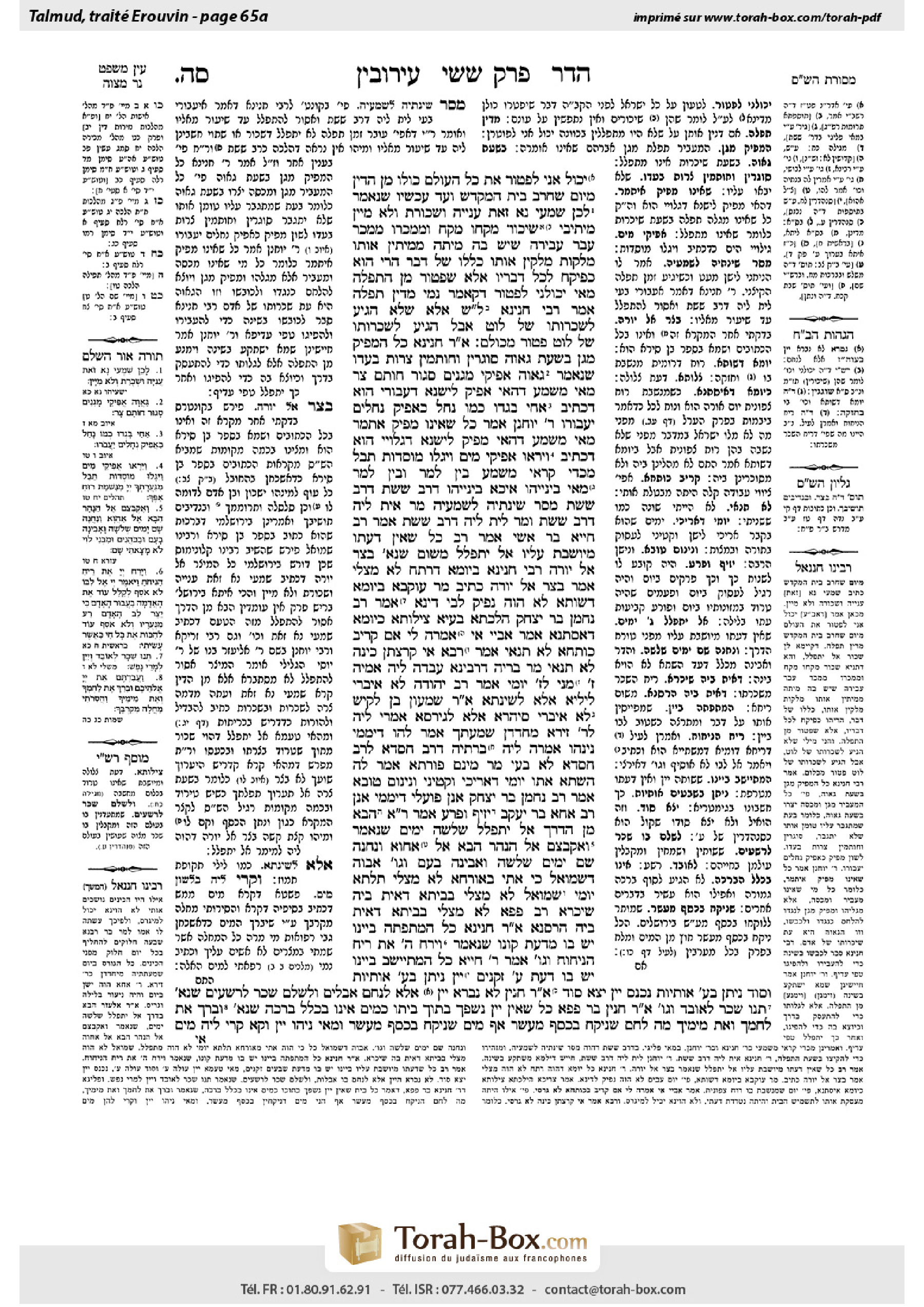
This page of Eruvin includes the Aramaic text, an English translation and an AI-generated French translation, alongside the scan above.
עירובין ס״ה א · Aramaic and Hebrew text
יָכוֹל אֲנִי לִפְטוֹר אֶת כָּל הָעוֹלָם כּוּלּוֹ מִן הַדִּין מִיּוֹם שֶׁחָרַב בֵּית הַמִּקְדָּשׁ וְעַד עַכְשָׁיו, שֶׁנֶּאֱמַר: ״לָכֵן שִׁמְעִי נָא זֹאת עֲנִיָּיהּ וּשְׁכוּרַת וְלֹא מִיָּיִן״.
מֵיתִיבִי: שִׁיכּוֹר מִקָּחוֹ מִקָּח, וּמִמְכָּרוֹ מִמְכָּר. עָבַר עֲבֵירָה שֶׁיֵּשׁ בָּהּ מִיתָה — מְמִיתִין אוֹתוֹ, מַלְקוֹת — מַלְקִין אוֹתוֹ. כְּלָלוֹ שֶׁל דָּבָר: הֲרֵי הוּא כְּפִיקֵּחַ לְכׇל דְּבָרָיו, אֶלָּא שֶׁפָּטוּר מִן הַתְּפִלָּה.
מַאי ״יָכוֹלְנִי לִפְטוֹר״ דְּקָאָמַר נָמֵי — מִדִּין תְּפִלָּה.
אָמַר רַבִּי חֲנִינָא: לֹא שָׁנוּ אֶלָּא שֶׁלֹּא הִגִּיעַ לְשִׁכְרוּתוֹ שֶׁל לוֹט, אֲבָל הִגִּיעַ לְשִׁכְרוּתוֹ שֶׁל לוֹט — פָּטוּר מִכּוּלָּם.
אָמַר רַבִּי חֲנִינָא: כׇּל הַמֵּפִיק מָגֵן בִּשְׁעַת גַּאֲוָה, סוֹגְרִין וְחוֹתְמִין צָרוֹת בַּעֲדוֹ, שֶׁנֶּאֱמַר: ״גַּאֲוָה אֲפִיקֵי מָגִנִּים סָגוּר חוֹתָם צָר״.
מַאי מַשְׁמַע דְּהַאי ״אָפִיק״ לִישָּׁנָא דְעַבּוֹרֵי הוּא? דִּכְתִיב: ״אַחַי בָּגְדוּ כְמוֹ נָחַל כַּאֲפִיק נְחָלִים יַעֲבוֹרוּ״.
רַבִּי יוֹחָנָן אָמַר: ״כֹּל שֶׁאֵינוֹ מֵפִיק״ אִתְּמַר.
מַאי מַשְׁמַע דְּהַאי ״מֵפִיק״ לִישָּׁנָא דְגַלּוֹיֵי הוּא? דִּכְתִיב: ״וַיֵּרָאוּ אֲפִיקֵי מַיִם וַיִּגָּלוּ מוֹסְדוֹת תֵּבֵל״.
מִכְּדֵי, קְרָאֵי מַשְׁמַע בֵּין לְמָר וּבֵין לְמָר, מַאי בֵּינַיְיהוּ? אִיכָּא בֵּינַיְיהוּ דְּרַב שֵׁשֶׁת. דְּרַב שֵׁשֶׁת מָסַר שִׁינְתֵּיהּ לְשַׁמָּעֵיהּ. מָר אִית לֵיהּ דְּרַב שֵׁשֶׁת, וּמָר לֵית לֵיהּ דְּרַב שֵׁשֶׁת.
אָמַר רַב חִיָּיא בַּר אָשֵׁי אָמַר רַב: כֹּל שֶׁאֵין דַּעְתּוֹ מְיוּשֶּׁבֶת עָלָיו אַל יִתְפַּלֵּל, מִשּׁוּם שֶׁנֶּאֱמַר: ״בְּצָר אַל יוֹרֶה״. רַבִּי חֲנִינָא בְּיוֹמָא דְּרָתַח לָא מְצַלֵּי, אָמַר: ״בְּצָר אַל יוֹרֶה״ כְּתִיב. מָר עוּקְבָא בְּיוֹמָא דְשׁוּתָא לָא הֲוָה נָפֵיק לְבֵי דִינָא.
אָמַר רַב נַחְמָן בַּר יִצְחָק: הִלְכְתָא בָּעֲיָא צִילּוּתָא כְּיוֹמָא דְאִסְתָּנָא. אָמַר אַבָּיֵי: אִי אָמְרָה לִי אֵם קָרֵיב כּוּתָּחָא — לָא תְּנַאי.
אָמַר רָבָא: אִי קְרַצְתַּן כִּינָּה לָא תְּנַאי. מָר בְּרֵיהּ דְּרָבִינָא עֲבַדָה לֵיהּ אִמֵּיהּ שִׁבְעָה מָנֵי לְשִׁבְעָה יוֹמֵי.
אָמַר רַב יְהוּדָה: לָא אִיבְּרִי לֵילְיָא אֶלָּא לְשִׁינְתָּא. אָמַר רַבִּי שִׁמְעוֹן בֶּן לָקִישׁ: לָא אִיבְּרִי סֵיהֲרָא אֶלָּא לְגִירְסָא. אָמְרִי לֵיהּ לְרַבִּי זֵירָא: מְחַדְּדָן שְׁמַעְתָּךְ. אֲמַר לְהוּ: דִּימָמֵי נִינְהוּ.
אֲמַרָה לֵיהּ בַּרְתֵּיהּ דְּרַב חִסְדָּא לְרַב חִסְדָּא: לָא בָּעֵי מָר מֵינַם פּוּרְתָּא? אֲמַר לַהּ: הַשְׁתָּא אָתוּ יוֹמֵי דַּאֲרִיכֵי וְקַטִּינֵי, וְנֵינוּם טוּבָא.
אָמַר רַב נַחְמָן בַּר יִצְחָק: אֲנַן פּוֹעֲלֵי דִּימָמֵי אֲנַן. רַב אַחָא בַּר יַעֲקֹב יָזֵיף וּפָרַע.
אָמַר רַבִּי אֶלְעָזָר: הַבָּא מִן הַדֶּרֶךְ, אַל יִתְפַּלֵּל שְׁלֹשָׁה יָמִים, שֶׁנֶּאֱמַר: ״וָאֶקְבְּצֵם אֶל הַנָּהָר הַבָּא אֶל אַחֲוָא וַנַּחֲנֶה שָׁם יָמִים שְׁלֹשָׁה וָאָבִינָה בָּעָם וְגוֹ׳״.
אֲבוּהּ דִּשְׁמוּאֵל, כִּי אָתֵי בְּאוֹרְחָא, לָא מְצַלֵּי תְּלָתָא יוֹמֵי. שְׁמוּאֵל לָא מְצַלֵּי בְּבֵיתָא דְּאִית בֵּיהּ שִׁיכְרָא. רַב פָּפָּא לָא מְצַלֵּי בְּבֵיתָא דְּאִית בֵּיהּ הַרְסָנָא.
אָמַר רַבִּי חֲנִינָא: כׇּל הַמִּתְפַּתֶּה בְּיֵינוֹ — יֵשׁ בּוֹ מִדַּעַת קוֹנוֹ, שֶׁנֶּאֱמַר: ״וַיָּרַח ה׳ אֶת רֵיחַ הַנִּיחוֹחַ וְגוֹ׳״.
אָמַר רַבִּי חִיָּיא: כׇּל הַמִּתְיַישֵּׁב בְּיֵינוֹ — יֵשׁ בּוֹ דַּעַת שִׁבְעִים זְקֵנִים. ״יַיִן״ נִיתַּן בְּשִׁבְעִים אוֹתִיּוֹת, וְ״סוֹד״ נִיתַּן בְּשִׁבְעִים אוֹתִיּוֹת. נִכְנַס יַיִן — יָצָא סוֹד.
אָמַר רַבִּי חָנִין: לֹא נִבְרָא יַיִן אֶלָּא לְנַחֵם אֲבֵלִים וּלְשַׁלֵּם שָׂכָר לָרְשָׁעִים, שֶׁנֶּאֱמַר: ״תְּנוּ שֵׁכָר לְאוֹבֵד וְגוֹ׳״.
אָמַר רַבִּי חָנִין בַּר פָּפָּא: כׇּל שֶׁאֵין יַיִן נִשְׁפָּךְ בְּתוֹךְ בֵּיתוֹ כַּמַּיִם — אֵינוֹ בִּכְלַל בְּרָכָה, שֶׁנֶּאֱמַר: ״וּבֵרַךְ אֶת לַחְמְךָ וְאֶת מֵימֶיךָ״. מָה לֶחֶם שֶׁנִּיקָּח בְּכֶסֶף מַעֲשֵׂר — אַף מַיִם שֶׁנִּיקָּח בְּכֶסֶף מַעֲשֵׂר, וּמַאי נִיהוּ — יַיִן, וְקָא קָרֵי לֵיהּ מַיִם.
Eruvin 65a · English translation
I can make an argument that exempts the entire world from judgment, from the day that the Temple was destroyed until now. As it is stated: “Therefore, hear now this, you afflicted and drunken, but not from wine” (Isaiah 51:21), which teaches that in the wake of the destruction of the Temple, all Jews are considered intoxicated and are not responsible for any sins they commit.
The Gemara raises an objection to this argument from the following baraita: With regard to one who is intoxicated, his acquisition is a binding acquisition; that is, he cannot retract the transaction when he is sober, and similarly, his sale is a binding sale. Moreover, if he committed a transgression for which he is liable to receive the death penalty, he is executed; and if the offense is punishable by lashes, he is flogged. The principle is that he is like a sober person in all matters, except that he is exempt from prayer. Therefore, even if the people of Israel are considered drunk, they are nonetheless responsible for their actions.
The Gemara answers that even Rabbi Elazar ben Azarya did not mean that they should be exempt from liability for all their sins. Rather, what is the meaning of his statement: I can exempt? He, too, meant that he could exempt them from the judgment of prayer, i.e., Jews cannot be held liable for praying without the proper intentions.
Rabbi Ḥanina said: They taught that an intoxicated person is responsible for all his actions only in a case where he did not reach the state of intoxication of Lot; however, if he reached the state of intoxication of Lot, so that he is altogether unaware of his actions, he is exempt from all liability.
Rabbi Ḥanina said: Whoever passes a shield over himself at a time of arrogance, i.e., whoever suppresses his evil inclination as though it were covered with a shield when he is arrogant, e.g., when he is intoxicated or the like (Rabbeinu Ḥananel), troubles will be closed and sealed from him, as it is stated: “The channels of [afikei] his scales are his pride, closed together as with a tight [tzar] seal” (Job 41:7). The verse is interpreted homiletically: When at a time of arrogance a person passes a shield [mapik] over his evil inclination, his troubles [tzarot] will be closed and sealed before him.
The Gemara poses a question: From where may it be inferred that the meaning of this word afik is a formulation denoting passing [aborei]? The Gemara answers: As it is written: “My brothers have dealt deceitfully like a wadi, like the channel [afik] of brooks that pass by [ya’avoru]” (Job 6:15). This implies that the term afik is synonymous with the verb ya’avoru, which refers to something that travels and passes by.
Rabbi Yoḥanan said: This is not the correct interpretation; rather, it was stated that whoever does not cover, but draws out [mapik] a shield at a time of arrogance, troubles will be closed and sealed from him. In other words, a person must draw his weapons and shield in order to fight his evil inclination when it tries to overpower him (Rabbeinu Ḥananel).
The Gemara poses a question: From where may it be inferred that this word mapik is a formulation denoting revealing? The Gemara answers: As it is written: “The channels of [afikei] waters were seen, and the foundations of the world were laid bare” (Psalms 18:16).
The Gemara asks: Now, since the verses may be interpreted both in accordance with the opinion of this Master and in accordance with the opinion of the other Master, what is the practical difference between them? The Gemara answers: The practical difference between them is with regard to the following practice of Rav Sheshet, as Rav Sheshet gave the responsibility for monitoring his sleep to his attendant, instructing the attendant to wake him when the time for prayer arrived. One Sage, Rabbi Ḥanina, is of the opinion that the practice of Rav Sheshet is correct, as Rabbi Ḥanina maintains that if one is in great need of sleep, it is better to nap for a while and then wake up with renewed vigor. And one Sage, Rabbi Yoḥanan, is not of the opinion that the practice of Rav Sheshet is correct. He holds that a person must marshal his strength and pray, rather than succumb to the need for sleep.
Rav Ḥiyya bar Ashi said that Rav said: Anyone whose mind is unsettled should not pray, as it is stated: When distressed, one should not issue decisions. The Gemara relates that Rabbi Ḥanina, on a day that he was angry, would not pray, as he said that it is written: When distressed, one should not issue decisions. The Gemara similarly relates that Mar Ukva, on a day of a south wind, would not venture out to the court, for this hot and harsh wind would disturb his usual clarity of mind.
Rav Naḥman bar Yitzḥak said: The study of halakha requires clarity, as on a day when a north wind blows and clears the skies. Abaye said similarly that if my stepmother says to me: Bring me a dish of kutaḥ, I can no longer study Torah in my usual fashion, as even a simple task such as this troubles me and distracts me from my Torah study.
Similarly, Rava said: If I am bitten by a louse, I can no longer learn in my usual manner. The Gemara relates that the mother of Mar, son of Ravina, would prepare seven garments for him for the seven days of the week, so that he would not be bitten by the lice found in old clothes (Rabbeinu Ḥananel).
Rav Yehuda said: Night was created only for sleep. Rabbi Shimon ben Lakish said: The moon was created only for Torah study by its light. When people said to Rabbi Zeira: Your teachings are exceedingly sharp, he said to them: They were formulated during the daytime hours. This teaches that Torah study during the day is most beneficial to clarity of the mind.
Rav Ḥisda’s daughter said to her father, Rav Ḥisda, who would spend his nights in study: Doesn’t the Master wish to sleep a little? He said to her: Days that are long in quantity but short in the opportunity to study Torah and perform mitzvot will soon arrive, and we will sleep a lot. After I die, there will be more than enough time for sleep.
Rav Naḥman bar Yitzḥak said: We, Torah scholars, are day workers, as our study is performed primarily during the day. The Gemara relates that Rav Aḥa bar Ya’akov would borrow and repay, i.e., if for some reason he neglected to study during the day, he would use the night hours to compensate for the missed time.
Rabbi Elazar said: One who returns home from a journey should not pray for three days while recovering from the hardship of being on the road, as it is stated: “And I gathered them together at the river that runs to Aḥava, and we encamped there for three days, and I inspected the people” (Ezra 8:15), after which it is stated: “Then I proclaimed a fast there, at the river of Aḥava, that we might afflict ourselves before our God, to seek of Him a safe journey for us” (Ezra 8:21), which teaches that they rested three days before praying.
The Gemara relates that Shmuel’s father, when he would return home from his journey, would not pray for three days, as he would have to rest from his journey. Shmuel himself would not pray in a house that contained an alcoholic beverage, as the scent of the alcohol would disturb his concentration during prayer. Similarly, Rav Pappa would not pray in a house that contained small fried fish, due to their smell.
Rabbi Ḥanina said: Whoever is appeased by his wine, i.e., whoever becomes more relaxed after drinking, has in him an element of the mind-set of his Creator, who acted in a similar fashion, as it is stated: “And the Lord smelled the sweet savor, and the Lord said in His heart, I will not again curse the ground any more for man’s sake” (Genesis 8:21). As it were, God acted more favorably toward His creatures after He was appeased with the smell of the burnt offerings. Smell can be as potent as drinking or eating itself.
Rabbi Ḥiyya said: Anyone who remains settled of mind after drinking wine, and does not become intoxicated, has an element of the mind-set of seventy Elders. The allusion is: Wine [yayin spelled yod, yod, nun] was given in seventy letters, as the numerological value of the letters comprising the word is seventy, as yod equals ten and nun equals fifty. Similarly, the word secret [sod spelled samekh, vav, dalet] was given in seventy letters, as samekh equals sixty, vav equals six, and dalet equals four. Typically, when wine entered the body, a secret emerged. Whoever does not reveal secrets when he drinks is clearly blessed with a firm mind, like that of seventy Elders.
Rabbi Ḥanin said: Wine was created only in order to comfort mourners in their distress, and to reward the wicked in this world so they will have no reward left in the World-to-Come, as it is stated: “Give strong drink to him that is ready to perish, and wine to the bitter of soul. Let him drink, and forget his poverty, and remember his misery no more” (Proverbs 31:6). “Him that is ready to perish” refers to the wicked, who will perish from the world, while “the bitter of soul” denotes mourners.
Rabbi Ḥanin bar Pappa said: Anyone in whose house wine does not flow like water is not yet included in the Torah’s blessing, as it is stated: “And He shall bless your bread and your water” (Exodus 23:25). The water mentioned in this verse actually refers to wine, as learned in the following manner: Just as bread is something that may be purchased with second-tithe money, i.e., one is permitted to buy bread with money used to redeem second-tithe, so too the word water in the verse is referring to a liquid that may be purchased with second-tithe money. And what is that? It is wine, as one may buy wine with second-tithe money, but one may not buy water; and nevertheless, the verse calls it “water.”
Eruvin 65a · Traduction française (IA)
Je puis établir un argument qui exempterait toute la monde de jugement, depuis le jour où le Temple a été détruit jusqu'à présent. Car il est dit : « Par conséquent, écoute maintenant cela, toi l'opprimé et l'ivrogne, mais pas à cause du vin » (Isaïe 51:21), ce qui enseigne que, après la destruction du Temple, tous les Juifs sont considérés comme ivres et ne sont pas responsables des péchés qu'ils commettent.
La Guemara soulève une objection contre cet argument à partir de la suivante baraïta : Concernant celui qui est ivre, son achat est un achat contraignant ; c'est-à-dire qu'il ne peut pas révoquer la transaction lorsqu'il est sobre, et de même, sa vente est une vente contraignante. De plus, si l'on a commis un péché pour lequel l'on est condamné à la peine de mort, on est exécuté ; et si l'offense est punie par des fessures, on est battu. Le principe est qu'il est comme un homme sobre en toutes choses, sauf qu'il est exempt de prière. Ainsi, même si le peuple d'Israël est considéré comme ivre, ils sont néanmoins responsables de leurs actions.
La Guemara répond que même Rabbi Eléazar ben Azaria n'a pas voulu dire qu'ils devraient être exemptés de responsabilité pour tous leurs péchés. Plutôt, quelle est la signification de son affirmation : Je puis exempter ? Il, lui aussi, voulait dire qu'il pouvait les exempter du jugement de la prière, c'est-à-dire que les Juifs ne peuvent pas être tenus responsables de prier sans les intentions appropriées.
Rabbi Ḥanina a dit : Ils ont enseigné que l'ivrogne est responsable de toutes ses actions uniquement dans le cas où il n'a pas atteint l'état d'ivresse de Lot ; cependant, s'il a atteint l'état d'ivresse de Lot, de sorte qu'il est totalement inconscient de ses actions, il est exempt de toute responsabilité.
Rabbi Ḥanina a dit : Celui qui passe un bouclier sur lui lors d'une période d'arrogance, c'est-à-dire celui qui étouffe son penchant mauvais comme s'il était couvert par un bouclier lorsqu'il est arrogant, par exemple lorsqu'il est ivre ou du genre (Rabbeinu Ḥananel), les malheurs seront fermés et scellés pour lui, car il est dit : « Les canaux de [afikei] ses balances sont son orgueil, fermés comme un [tzar] sceau serré » (Job 41:7). La verset est interprété de manière allégorique : Lors d'une période d'arrogance, quand une personne passe un bouclier [mapik] sur son penchant mauvais, ses malheurs [tzarot] seront fermés et scellés devant lui.
La Guemara pose une question : D'où peut-on déduire que le mot afik signifie une formulation désignant le passage [aborei] ? La Guemara répond : Comme il est écrit : « Mes frères ont agi de manière trompeuse comme un wadi, comme le canal [afik] des ruisseaux qui passent par [ya'avoru] » (Job 6:15). Cela implique que le terme afik est synonyme du verbe ya'avoru, qui désigne quelque chose qui voyage et passe par.
Rabbi Yoḥanan a dit : Cela n'est pas l'interprétation correcte ; plutôt, il a été dit que celui qui ne couvre pas, mais tire un bouclier [mapik] lors d'une période d'arrogance, les malheurs seront fermés et scellés pour lui. En d'autres termes, une personne doit tirer ses armes et son bouclier afin de combattre son penchant mauvais lorsqu'il tente de l'emporter (Rabbeinu Ḥananel).
La Guemara pose une question : D'où peut-on déduire que ce mot mapik est une formulation désignant la révélation ? La Guemara répond : Comme il est écrit : « Les canaux de [afikei] eaux ont été vus, et les fondations du monde ont été révélées » (Psaumes 18:16).
La Guemara pose une question : Maintenant, puisque les versets peuvent être interprétés à la fois selon l'opinion de ce Maître et selon l'opinion de l'autre Maître, quelle est la différence pratique entre eux ? La Guemara répond : La différence pratique entre eux concerne la pratique de Rav Sheshet, car Rav Sheshet a confié la surveillance de son sommeil à son serviteur, en instruisant le serviteur à le réveiller lors de l'heure de la prière. Un Sage, Rabbi Ḥanina, est d'avis que la pratique de Rav Sheshet est correcte, car Rabbi Ḥanina maintient que si l'on a grand besoin de sommeil, il est préférable de s'endormir un moment et de se réveiller avec un nouvel élan. Et un autre Sage, Rabbi Yoḥanan, n'est pas d'avis que la pratique de Rav Sheshet soit correcte. Il considère que l'individu doit mobiliser ses forces et prier, plutôt que de céder à la nécessité de dormir.
Rav Ḥiyya bar Ashi a dit que Rav a dit : Celui dont l'esprit est troublé ne doit pas prier, car il est dit : Lorsqu'on est en détresse, on ne doit pas prendre des décisions. La Guemara rapporte que Rabbi Ḥanina, un jour où il était en colère, ne priait pas, car il disait que cela est écrit : Lorsqu'on est en détresse, on ne doit pas prendre des décisions. La Guemara rapporte également que Mar Ukva, un jour de vent du sud, ne sortait pas du tribunal, car ce vent chaud et pénible perturbait sa clarté habituelle d'esprit.
Rav Naḥman bar Yitzḥak a dit : L'étude de la halakha exige la clarté, comme un jour où un vent du nord souffle et nettoie le ciel. Abaye a dit de même que si ma belle-mère me dit : Apporte-moi un plat de kutaḥ, je ne peux plus étudier la Torah comme d'habitude, car même une tâche simple comme celle-ci me trouble et me distrait de mon étude de la Torah.
De même, Rava a dit : Si je suis mordu par un pou, je ne peux plus apprendre comme d'habitude. La Guemara rapporte que la mère de Mar, fils de Ravina, préparait sept vêtements pour lui pour les sept jours de la semaine, afin qu'il ne soit pas mordu par les poux trouvés dans les vêtements anciens (Rabbeinu Ḥananel).
Rav Yehuda a dit : La nuit a été créée uniquement pour le sommeil. Rabbi Shimon ben Lakish a dit : La lune a été créée uniquement pour l'étude de la Torah grâce à sa lumière. Lorsque les gens dirent à Rabbi Zeira : Tes enseignements sont extrêmement acérés, il leur dit : Ils ont été formulés pendant les heures du jour. Cela enseigne que l'étude de la Torah pendant la journée est la plus bénéfique pour la clarté de l'esprit.
La fille de Rav Ḥisda dit à son père, Rav Ḥisda, qui passait ses nuits à étudier : Ne désire-t-il pas le Maître de dormir un peu ? Il lui répondit : Bientôt viendront des jours qui sont longs en quantité mais courts en termes d'opportunité d'étudier la Torah et d'accomplir des mitsvot, et nous dormirons beaucoup. Après mon décès, il y aura plus qu'assez de temps pour dormir.
Rav Naḥman bar Yitzḥak dit : Nous, les savants de la Torah, sommes des travailleurs de jour, car notre étude est principalement faite pendant la journée. La Guemara rapporte que Rav Aḥa bar Ya’akov empruntait et remboursait, c'est-à-dire, si pour une raison quelconque il négligeait d'étudier pendant la journée, il utilisait les heures de la nuit pour compenser le temps perdu.
Rabbi Elazar dit : Celui qui rentre chez lui après un voyage ne devrait pas prier pendant trois jours pendant sa récupération de la fatigue du voyage, car il est dit : « Et je rassemblai les gens au fleuve qui coule vers Aḥava, et nous campâmes là trois jours, et je fis l'inspection du peuple » (Ezra 8:15), après quoi il est dit : « Puis je proclamai un jeûne là, au fleuve d'Aḥava, afin que nous nous affligions devant notre Dieu, afin de demander à Lui un voyage sûr pour nous » (Ezra 8:21), ce qui enseigne qu'ils reposèrent trois jours avant de prier.
La Guemara rapporte que le père de Shmuel, lorsqu'il rentrait chez lui après un voyage, ne priait pas pendant trois jours, car il devait reposer de son voyage. Shmuel lui-même ne priait pas dans une maison contenant un breuvage alcoolisé, car l'odeur de l'alcool perturbait sa concentration pendant la prière. De même, Rav Pappa ne priait pas dans une maison contenant des petits poissons frits, en raison de leur odeur.
Rabbi Ḥanina dit : Celui qui est apaisé par son vin, c'est-à-dire celui qui devient plus détendu après avoir bu, possède en lui un élément du mode de pensée de son Créateur, qui agissait de la même manière, car il est dit : « Et l'Éternel sentit l'odeur du suave, et l'Éternel dit en son cœur : Je ne bénirai plus la terre pour l'homme » (Genèse 8:21). En d'autres termes, Dieu agit plus favorablement envers Ses créatures après qu'Il avait été apaisé par l'odeur des offrandes brûlées. L'odeur peut être aussi puissante que boire ou manger lui-même.
Rabbi Ḥiyya dit : Quiconque reste calme d'esprit après avoir bu du vin, sans devenir ivre, possède un élément du mode de pensée des soixante-dix Anciens. L'allusion est : Le vin [yayin, écrit yod, yod, nun] fut donné en soixante-dix lettres, car la valeur numérique des lettres composant le mot est soixante-dix, car yod égale dix et nun égale cinquante. De même, le mot secret [sod, écrit samekh, vav, dalet] fut donné en soixante-dix lettres, car samekh égale soixante, vav égale six, et dalet égale quatre. Généralement, lorsque le vin pénétrait dans le corps, un secret émergeait. Celui qui ne révèle pas de secrets lorsqu'il boit est clairement béni d'un esprit ferme, comme celui des soixante-dix Anciens.
Rabbi Ḥanin dit : Le vin fut créé uniquement afin de consoler les veufs dans leur détresse, et pour récompenser les méchants dans ce monde afin qu'ils n'aient plus de récompense dans le Monde à Venir, car il est dit : « Donne un breuvage fort à celui qui est prêt à périr, et du vin à celui dont l'âme est amère. Fais-le boire, et qu'il oublie sa pauvreté, et qu'il ne souvienne plus de sa misère » (Proverbes 31:6). « Celui qui est prêt à périr » désigne les méchants, qui périront du monde, tandis que « celui dont l'âme est amère » désigne les veufs.
Rabbi Ḥanin bar Pappa dit : Quiconque n'a pas de vin qui coule dans sa maison comme de l'eau n'est pas encore inclus dans la bénédiction de la Torah, car il est dit : « Et Il bénira ton pain et ton eau » (Exode 23:25). L'eau mentionné dans cette verset fait référence en réalité au vin, comme appris ainsi : Tout comme le pain est quelque chose que l'on peut acheter avec l'argent de la deuxième dîme, c'est-à-dire qu'on est autorisé à acheter du pain avec l'argent utilisé pour racheter la deuxième dîme, de même le mot eau dans le verset fait référence à un liquide que l'on peut acheter avec l'argent de la deuxième dîme. Et quel est ce liquide ? C'est le vin, car on peut acheter du vin avec l'argent de la deuxième dîme, mais on ne peut pas acheter de l'eau ; et pourtant, le verset l'appelle « eau ».
Traduction française générée par IA à partir de l’édition anglaise de Sefaria. Vérifie toujours un passage avec le texte source.
Text from Sefaria: William Davidson Edition - Vocalized Aramaic (CC BY NC); William Davidson Edition - English (CC BY NC).