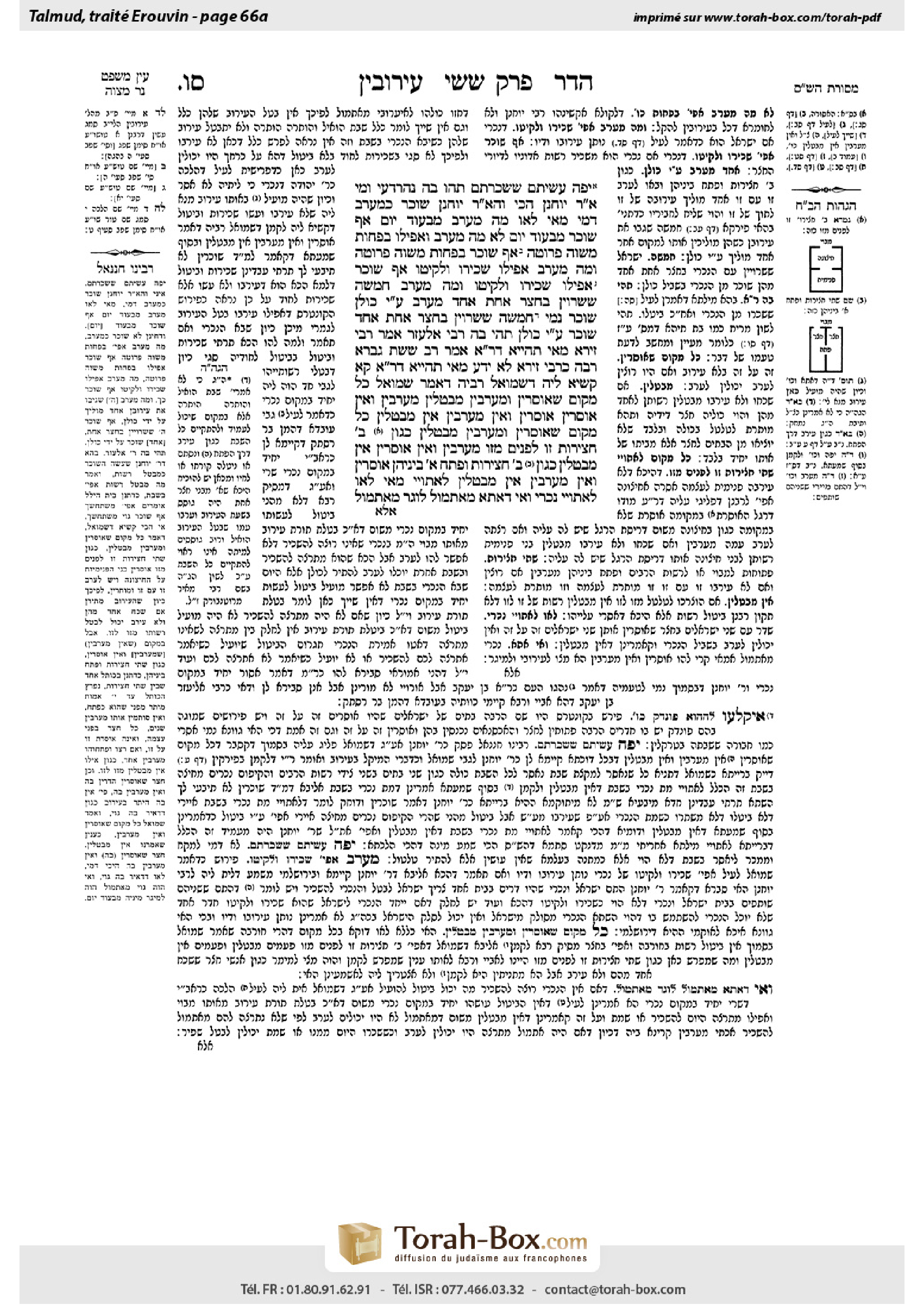
Eruvin 66a: Talmud study for Daf Yomi
Study the Talmud for Daf Yomi with scanned pages, Hebrew text, English translations from Sefaria and AI-generated French translations.
Passage selection and English or AI-generated French translation are available where the scan has annotations. Daf Study is independent of Torah-Box and Sefaria.
Browse Eruvin · עירובין · All tractatesEruvin 66a text and translations
This page of Eruvin includes the Aramaic text, an English translation and an AI-generated French translation, alongside the scan above.
עירובין ס״ו א · Aramaic and Hebrew text
יָפֶה עֲשִׂיתֶם שֶׁשְּׂכַרְתֶּם. תָּהוּ בָּהּ נְהַרְדָּעֵי: וּמִי אָמַר רַבִּי יוֹחָנָן הָכִי? וְהָאָמַר רַבִּי יוֹחָנָן: שׂוֹכֵר כִּמְעָרֵב דָּמֵי. מַאי לָאו: מָה מְעָרֵב מִבְּעוֹד יוֹם, אַף שׂוֹכֵר מִבְּעוֹד יוֹם!
לָא, מָה מְעָרֵב וַאֲפִילּוּ בְּפָחוֹת מִשָּׁוֶה פְּרוּטָה, אַף שׂוֹכֵר בְּפָחוֹת מִשָּׁוֶה פְּרוּטָה. וּמָה מְעָרֵב אֲפִילּוּ שְׂכִירוֹ וּלְקִיטוֹ, אַף שׂוֹכֵר אֲפִילּוּ שְׂכִירוֹ וּלְקִיטוֹ.
וּמָה מְעָרֵב חֲמִשָּׁה שֶׁשְּׁרוּיִן בְּחָצֵר אַחַת — אֶחָד מְעָרֵב עַל יְדֵי כּוּלָּן, שׂוֹכֵר נָמֵי, חֲמִשָּׁה שֶׁשְּׁרוּיִן בְּחָצֵר אַחַת — אֶחָד שׂוֹכֵר עַל יְדֵי כּוּלָּן.
תָּהֵי בַּהּ רַבִּי אֶלְעָזָר. אָמַר רַבִּי זֵירָא: מַאי תִּהְיָיא דְּרַבִּי אֶלְעָזָר? אָמַר רַב שֵׁשֶׁת: גַּבְרָא רַבָּה כְּרַבִּי זֵירָא לָא יָדַע מַאי תִּהְיָיא דְּרַבִּי אֶלְעָזָר? קָא קַשְׁיָא לֵיהּ דִּשְׁמוּאֵל רַבֵּיהּ.
דְּאָמַר שְׁמוּאֵל: כׇּל מָקוֹם שֶׁאוֹסְרִין וּמְעָרְבִין — מְבַטְּלִין. מְעָרְבִין וְאֵין אוֹסְרִין, אוֹסְרִין וְאֵין מְעָרְבִין — אֵין מְבַטְּלִין.
כׇּל מָקוֹם שֶׁאוֹסְרִין וּמְעָרְבִין — מְבַטְּלִין, כְּגוֹן שְׁתֵּי חֲצֵירוֹת זוֹ לִפְנִים מִזּוֹ.
מְעָרְבִין וְאֵין אוֹסְרִין — אֵין מְבַטְּלִין, כְּגוֹן שְׁתֵּי חֲצֵירוֹת וּפֶתַח אֶחָד בֵּינֵיהֶן.
אוֹסְרִין וְאֵין מְעָרְבִין — אֵין מְבַטְּלִין. לְאֵתוֹיֵי מַאי, לָאו לְאֵתוֹיֵי גּוֹי?
וְאִי דַּאֲתָא מֵאֶתְמוֹל — לוֹגַר מֵאֶתְמוֹל!
Eruvin 66a · English translation
You acted well when you rented. The Sages of Neharde’a wondered at this teaching: Did Rabbi Yoḥanan actually say this? Didn’t Rabbi Yoḥanan say just the opposite: Renting from a gentile is like establishing an eiruv? What, is he not to be understood as imposing a stringency: Just as one who establishes an eiruv may do so only while it is still day, so too, one who rents a gentile’s property must do so while it is still day?
The Gemara rejects this argument: No, his statement was intended as a leniency: Just as one who establishes an eiruv may do so even with less than the value of a peruta, so too, one who rents a gentile’s property may rent it for less than the value of a peruta. And just as the one who establishes an eiruv need not be the owner himself, but even his hired laborer or harvester may do so, so too, one who rents a gentile’s property need not rent from the landlord himself, but may rent even from his hired laborer or harvester who are acting on his behalf.
And similarly, just as with regard to one who establishes an eiruv, the halakha is that if five people live in the same courtyard, one of them may establish an eiruv with the residents of a different courtyard on behalf of them all, so too, with regard to one who rents a gentile’s property; if five people live in the same courtyard together with a gentile, one of them may rent the gentile’s property on behalf of them all.
Rabbi Elazar wondered at Rabbi Yoḥanan’s ruling that the Sages had acted well when they rented the gentile’s property on Shabbat and then they renounced their rights to that one, so that at least it would be permitted to use the courtyard. Rabbi Zeira said: What was the reason for Rabbi Elazar’s wonder? Rav Sheshet said: Can it be that such a great person as Rabbi Zeira did not know what was the source of Rabbi Elazar’s wonder? He had difficulty with a statement of his teacher, Shmuel.
As Shmuel said: With regard to any place where the residents render it prohibited for each other to carry but where they may establish a joint eiruv if they so desire, in order to permit carrying, each may renounce his property rights for the other if they failed to establish an eiruv before Shabbat. However, in a place where the residents may establish an eiruv together but they do not render it prohibited for each other for carrying, or where they render it prohibited for each other for carrying but they may not establish an eiruv together, in such situations they may not renounce their property rights for each other.
The Gemara clarifies the above teaching: With regard to any place where the residents render it prohibited for each other to carry but where they may establish an eiruv, they may renounce their rights for each other, such as in the case of two courtyards, one within the other. The residents of the two courtyards render each other prohibited to carry between the courtyards, but they may establish a joint eiruv in order to permit carrying. In such a case, the residents may renounce their property rights for each other if they failed to establish an eiruv before Shabbat.
In a place where the residents may establish an eiruv together but they do not render each other prohibited to carry, they may not renounce their property rights for each other, in a case where two courtyards both opening to an alleyway that have a single opening between them. Even though the two courtyards may establish a joint eiruv and be considered a single courtyard, they do not render it prohibited for each other to carry if they did not do so, because neither needs to make use of the other. Consequently, there is no option of renouncing rights in favor of the other courtyard.
In a place where they render each other prohibited from carrying but they may not establish an eiruv together, what does this come to include? In reference to which case did Shmuel make this statement? Wasn’t it meant to include a gentile who shares a courtyard with two Jews? The Jewish residents of the courtyard render each other prohibited from carrying in such a case, but they may not establish an eiruv due to the presence of the gentile.
The Gemara further analyzes the case: Now, if it is referring to a situation where the gentile arrived on the previous day, i.e., before Shabbat, let him rent the property from the gentile on the previous day. Before Shabbat, both options were available: They could have either established an eiruv or one Jew could have renounced his rights in favor of the other. Therefore, it would not have been considered a situation in which they render each other prohibited to carry but cannot establish an eiruv.
Eruvin 66a · Traduction française (IA)
Vous avez bien fait de louer. Les Sages de Neharde’a se sont étonnés de cette enseignement : Rabbi Yoḥanan a-t-il vraiment dit cela ? N’a-t-il pas dit tout le contraire : Louer d’un non-Juif est comme établir un eiruv ? Qu’est-ce que cela signifie, qu’il ne faut pas le comprendre comme une stricte exigence : Comme celui qui établit un eiruv peut le faire même s’il n’a que moins que la valeur d’un peruta, de même celui qui loue la propriété d’un non-Juif peut le faire même s’il n’a que moins que la valeur d’un peruta.
La Guemara rejette cet argument : Non, sa déclaration était faite dans un sens de leniencité : Comme celui qui établit un eiruv peut le faire même s’il n’a que moins que la valeur d’un peruta, de même celui qui loue la propriété d’un non-Juif peut le faire même s’il n’a que moins que la valeur d’un peruta. Et comme celui qui établit un eiruv n’a pas besoin d’être lui-même le propriétaire, mais même son ouvrier ou son moissonneur peut le faire, de même celui qui loue la propriété d’un non-Juif n’a pas besoin de louer directement du propriétaire, mais peut le faire même auprès de son ouvrier ou de son moissonneur qui agissent à sa place.
Et de même, comme concernant celui qui établit un eiruv, la halakha est que si cinq personnes habitent dans le même cour, l’une d’entre elles peut établir un eiruv avec les habitants d’un autre cour pour tous, de même concernant celui qui loue la propriété d’un non-Juif ; si cinq personnes habitent dans le même cour avec un non-Juif, l’une d’entre elles peut louer la propriété du non-Juif à la place de tous.
Rabbi Elazar s’est étonné de la décision de Rabbi Yoḥanan selon laquelle les Sages avaient bien fait de louer la propriété du non-Juif le sabbat, puis de renoncer à leurs droits concernant celui-ci, afin qu’au moins l’utilisation du cour soit permise. Rabbi Zeira a dit : Quelle était la raison de l’étonnement de Rabbi Elazar ? Rav Sheshet a dit : Peut-on penser que quelqu’un de si grand calibre que Rabbi Zeira ne savait pas la source de l’étonnement de Rabbi Elazar ? Il avait du mal avec une déclaration de son maître, Shmuel.
Comme Shmuel a dit : Concernant tout lieu où les habitants rendent interdit à l’autre de porter mais où ils peuvent établir un eiruv commun s’ils le souhaitent, afin de permettre le port, chacun peut renoncer à ses droits en faveur de l’autre si ils n’ont pas établi un eiruv avant le sabbat. Cependant, dans un lieu où les habitants peuvent établir un eiruv commun mais où ils ne rendent pas interdit à l’autre de porter, ou où ils rendent interdit à l’autre de porter mais où ils ne peuvent pas établir un eiruv commun, dans ces cas ils ne peuvent pas renoncer à leurs droits en faveur de l’autre.
La Guemara clarifie l’enseignement ci-dessus : Concernant tout lieu où les habitants rendent interdit à l’autre de porter mais où ils peuvent établir un eiruv, ils peuvent renoncer à leurs droits en faveur de l’autre, comme dans le cas de deux cours, l’un à l’intérieur de l’autre. Les habitants des deux cours rendent interdit à l’autre de porter entre les cours, mais ils peuvent établir un eiruv commun afin de permettre le port. Dans ce cas, les habitants peuvent renoncer à leurs droits en faveur de l’autre si ils n’ont pas établi un eiruv avant le sabbat.
Dans un lieu où les habitants peuvent établir un eiruv commun mais où ils ne rendent pas interdit à l’autre de porter, ils ne peuvent pas renoncer à leurs droits en faveur de l’autre, dans le cas de deux cours qui s’ouvrent tous deux sur un passage et qui ont une seule ouverture entre eux. Même si les deux cours peuvent établir un eiruv commun et être considérés comme un seul cour, ils ne rendent pas interdit à l’autre de porter s’ils n’ont pas fait cela, car aucun n’a besoin de l’autre. Par conséquent, il n’y a pas d’option de renoncer à ses droits en faveur de l’autre cour.
Dans un lieu où ils rendent interdit à l’autre de porter mais où ils ne peuvent pas établir un eiruv commun, de quoi cela s’agit-il ? À quel cas Shmuel faisait-il référence ? N’était-ce pas censé inclure un non-Juif qui partage un cour avec deux Juifs ? Les habitants juifs du cour rendent interdit à l’autre de porter dans ce cas, mais ils ne peuvent pas établir un eiruv en raison de la présence du non-Juif.
La Guemara analyse davantage ce cas : Maintenant, si cela fait référence à un cas où le non-Juif est arrivé la veille, c’est-à-dire avant le sabbat, laissez-le louer la propriété du non-Juif la veille. Avant le sabbat, les deux options étaient disponibles : ils pouvaient soit établir un eiruv, soit un Juif pouvait renoncer à ses droits en faveur de l’autre. Par conséquent, cela ne serait pas considéré comme un cas où ils rendent interdit à l’autre de porter mais où ils ne peuvent pas établir un eiruv.
Traduction française générée par IA à partir de l’édition anglaise de Sefaria. Vérifie toujours un passage avec le texte source.
Text from Sefaria: William Davidson Edition - Vocalized Aramaic (CC BY NC); William Davidson Edition - English (CC BY NC).