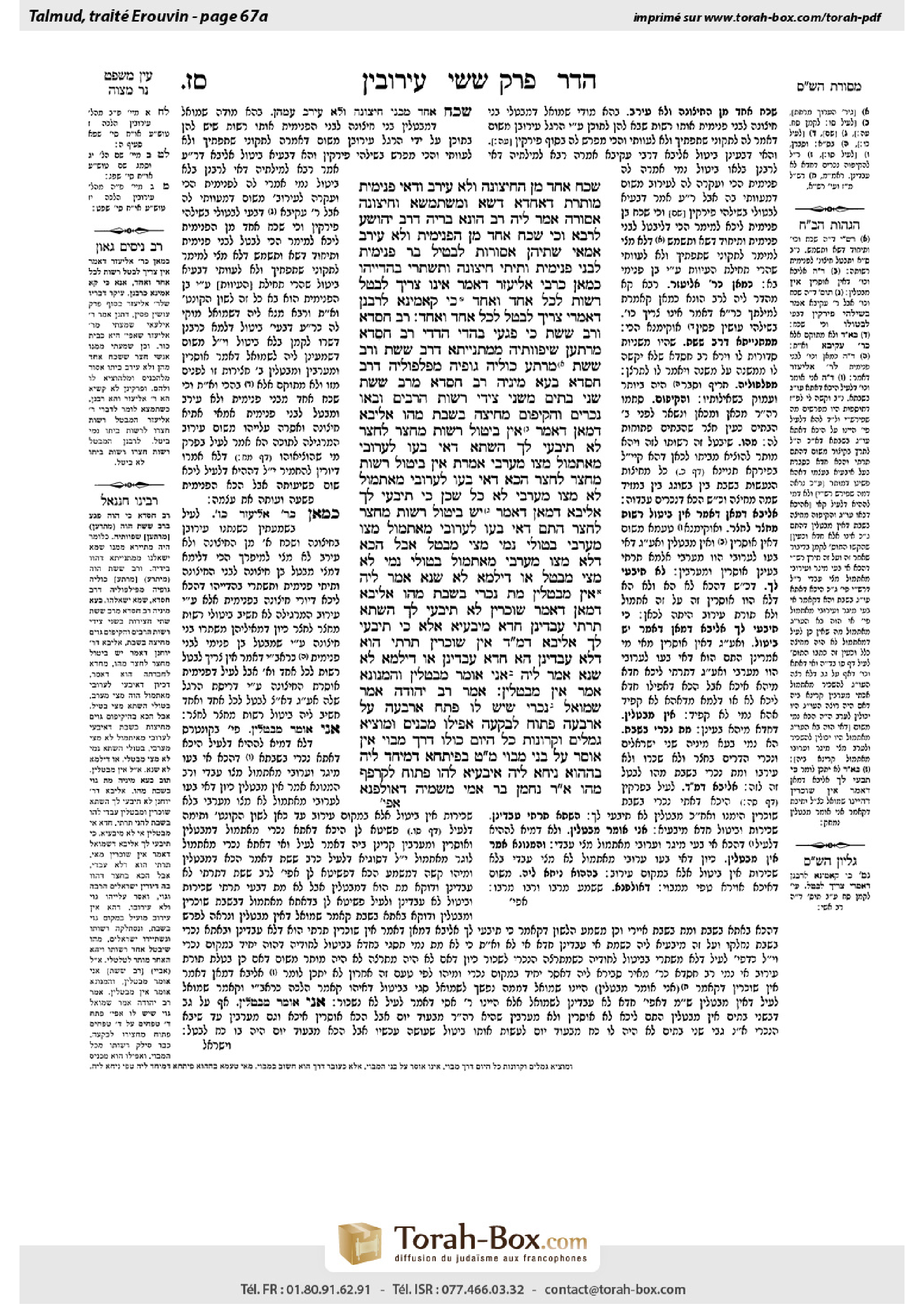
Eruvin 67a: Talmud study for Daf Yomi
Study the Talmud for Daf Yomi with scanned pages, Hebrew text, English translations from Sefaria and AI-generated French translations.
Passage selection and English or AI-generated French translation are available where the scan has annotations. Daf Study is independent of Torah-Box and Sefaria.
Browse Eruvin · עירובין · All tractatesEruvin 67a text and translations
This page of Eruvin includes the Aramaic text, an English translation and an AI-generated French translation, alongside the scan above.
עירובין ס״ז א · Aramaic and Hebrew text
שָׁכַח אֶחָד מִן הַחִיצוֹנָה וְלֹא עֵירַב — וַדַּאי פְּנִימִית מוּתֶּרֶת, דְּאָחֲדָא דַּשָּׁא, וּמִשְׁתַּמְּשָׁא, וְחִיצוֹנָה אֲסוּרָה.
אֲמַר לֵיהּ רַב הוּנָא בְּרֵיהּ דְּרַב יְהוֹשֻׁעַ לְרָבָא: וְכִי שָׁכַח אֶחָד מִן הַפְּנִימִית וְלֹא עֵירַב אַמַּאי שְׁתֵּיהֶן אֲסוּרוֹת, לְבַטֵּיל בַּר פְּנִימִית לִבְנֵי פְּנִימִית, וְתֵיתֵי חִיצוֹנָה וְתִשְׁתְּרֵי בַּהֲדַיְיהוּ!
כְּמַאן — כְּרַבִּי אֱלִיעֶזֶר, דְּאָמַר: אֵינוֹ צָרִיךְ לְבַטֵּל רְשׁוּת לְכׇל אֶחָד וְאֶחָד? כִּי קָאָמֵינָא לְרַבָּנַן, דְּאָמְרִי: צָרִיךְ לְבַטֵּל לְכׇל אֶחָד וְאֶחָד!
רַב חִסְדָּא וְרַב שֵׁשֶׁת כִּי פָּגְעִי בַּהֲדֵי הֲדָדֵי — רַב חִסְדָּא מִרַתְעָן שִׂיפְווֹתֵיהּ מִמַּתְנְיָיתָא דְּרַב שֵׁשֶׁת, וְרַב שֵׁשֶׁת מִרְתַע כּוּלֵּיהּ גּוּפֵיהּ מִפִּלְפּוּלֵיהּ דְּרַב חִסְדָּא.
בְּעָא מִינֵּיהּ רַב חִסְדָּא מֵרַב שֵׁשֶׁת: שְׁנֵי בָתִּים מִשְּׁנֵי צִידֵּי רְשׁוּת הָרַבִּים וּבָאוּ גּוֹיִם וְהִקִּיפוּם מְחִיצָה בְּשַׁבָּת, מַהוּ?
אַלִּיבָּא דְּמַאן דְּאָמַר אֵין בִּיטּוּל רְשׁוּת מֵחָצֵר לְחָצֵר, לָא תִּיבְּעֵי לָךְ. הַשְׁתָּא דְּאִי בָּעוּ לְעָרוֹבֵי מֵאֶתְמוֹל מָצוּ מְעָרְבִי — אָמְרַתְּ ״אֵין בִּיטּוּל רְשׁוּת מֵחָצֵר לְחָצֵר״, הָכָא דְּאִי בָּעוּ לְעָרוֹבֵי מֵאֶתְמוֹל לָא מָצוּ מְעָרְבִי — לֹא כׇּל שֶׁכֵּן?!
כִּי תִּיבְּעֵי לָךְ אַלִּיבָּא דְּמַאן דְּאָמַר ״יֵשׁ בִּיטּוּל רְשׁוּת מֵחָצֵר לְחָצֵר״. הָתָם, דְּאִי בָּעוּ לְעָרוֹבֵי מֵאֶתְמוֹל מָצוּ מְעָרְבִי — בַּטּוֹלֵי נָמֵי מָצֵי מְבַטֵּל — אֲבָל הָכָא, דְּלָא מָצוּ מְעָרְבִי מֵאֶתְמוֹל — בַּטּוֹלֵי נָמֵי לָא מָצֵי מְבַטֵּל.
אוֹ דִילְמָא לָא שְׁנָא. אֲמַר לֵיהּ: אֵין מְבַטְּלִין.
מֵת גּוֹי בְּשַׁבָּת מַהוּ?
אַלִּיבָּא דְּמַאן דְּאָמַר שׂוֹכְרִין — לָא תִּיבְּעֵי לָךְ: הַשְׁתָּא תַּרְתֵּי עָבְדִינַן, חֲדָא מִיבַּעְיָא!
אֶלָּא כִּי תִּיבְּעֵי לָךְ אַלִּיבָּא דְּמַאן דְּאָמַר אֵין שׂוֹכְרִין. תַּרְתֵּי הוּא דְּלָא עָבְדִינַן, הָא חֲדָא — עָבְדִינַן, אוֹ דִילְמָא לָא שְׁנָא. אֲמַר לֵיהּ: אֲנִי אוֹמֵר מְבַטְּלִין, וְהַמְנוּנָא אָמַר אֵין מְבַטְּלִין.
אָמַר רַב יְהוּדָה אָמַר שְׁמוּאֵל: גּוֹי שֶׁיֵּשׁ לוֹ פֶּתַח אַרְבָּעָה עַל אַרְבָּעָה פָּתוּחַ לְבִקְעָה, אֲפִילּוּ מַכְנִיס וּמוֹצִיא גְּמַלִּים וּקְרוֹנוֹת כׇּל הַיּוֹם כּוּלּוֹ דֶּרֶךְ מָבוֹי, אֵין אוֹסֵר עַל בְּנֵי מָבוֹי.
מַאי טַעְמָא? בְּפִיתְחָא דִּמְיַחַד לֵיהּ, בְּהָהוּא נִיחָא לֵיהּ.
אִיבַּעְיָא לְהוּ: פָּתוּחַ לְקַרְפֵּף, מַהוּ? אָמַר רַב נַחְמָן בַּר אַמֵּי מִשְּׁמֵיהּ דְּאוּלְפָנָא:
Eruvin 67a · English translation
But if a resident of the outer courtyard forgot and did not establish an eiruv, it is certainly permitted to carry in the inner courtyard, as its residents can close the door between the two courtyards, thereby preventing the residents of the outer courtyard from entering, and they can then use their courtyard on their own. However, it is still prohibited to carry in the outer courtyard.
Rav Huna, son of Rav Yehoshua, said to Rava: And if a resident of the inner courtyard forgot and did not establish an eiruv, why is it prohibited to carry in both courtyards? Let the resident of the inner courtyard who forgot to establish an eiruv renounce his rights in favor of the other residents of the inner courtyard, and then let the residents of the outer courtyard, who had established an eiruv with the inner one, come and be permitted to carry together with them.
Rava replied: In accordance with whose opinion do you make this suggestion? It is in accordance with the opinion of Rabbi Eliezer, who said: It is not necessary to renounce one’s rights in favor of each and every resident. Rather, it is enough for a person to renounce his rights in favor of a single person, as once he no longer has any rights in the courtyard, he can no longer render it prohibited to carry there. According to this approach, a resident of the inner courtyard may indeed renounce his rights in favor of the other residents of his courtyard. The outer courtyard would then be rendered permitted together with the inner courtyard. However, when I spoke, it was in accordance with the opinion of the Rabbis, who say: It is necessary to renounce one’s rights in favor of each and every resident. Therefore, in order to render the outer courtyard permitted, it would be necessary for the person who forgot to establish the eiruv to renounce his rights in favor of the residents of the outer courtyard as well. However, he may not do so, as one may not renounce rights from one courtyard to another. Therefore, the outer courtyard may not be rendered permitted in this manner.
The Gemara relates that when Rav Ḥisda and Rav Sheshet would meet each other, Rav Ḥisda’s lips would tremble from the teachings of Rav Sheshet. Rav Sheshet’s fluency and expertise were such that Rav Ḥisda would be filled with awe in his presence. For his part, Rav Sheshet’s entire body would shake from Rav Ḥisda’s sharpness, i.e., from his brilliant, analytical mind.
Rav Ḥisda raised a dilemma before Rav Sheshet: If there were two unconnected houses on two sides of a public domain, and gentiles came and enclosed them in a partition on Shabbat, what is the halakha? By erecting the fence, the gentiles nullified the public domain between the two houses, turning it into a private domain. Consequently, carrying from one house to the other is permitted by Torah law. The question is: Is it possible to render it permitted to carry even by rabbinic law? Can one resident renounce his rights to the area between the houses and thereby allow the other to carry there?
The Gemara clarifies the question: In accordance with the opinion of the one who said that there is no renouncing of rights from one courtyard to another, you have no dilemma, as carrying is certainly prohibited. Now, if in a case where had they wanted to establish an eiruv yesterday they could have established an eiruv, e.g., in a case of two adjacent courtyards with an entranceway between them, you say that there is no renouncing of rights from one courtyard to another, then here, in a case of two houses situated on opposite sides of a public domain, where had they wanted to establish an eiruv yesterday they could not have established an eiruv, because of the public domain between the houses, all the more so is it not clear that there is no renouncing of rights?
Where you have a dilemma is in accordance with the opinion of the one who said that there is renouncing of rights from one courtyard to another, and the two sides of the question are as follows: Perhaps there, where had they wanted to establish an eiruv yesterday they could have established an eiruv then, they can also renounce rights now. But here, where they could not have established an eiruv yesterday even had they wanted to, one may not renounce rights now either.
Or perhaps there is no difference between the two cases. Since renunciation of rights is possible under the current circumstances, yesterday’s situation is not taken into account. Rav Sheshet said to Rav Ḥisda: In such a case, one may not renounce his rights.
Rav Ḥisda posed a similar question: If two Jews and a gentile shared a courtyard, and no steps had been taken prior to Shabbat to render it permitted to carry in the courtyard, and the gentile died on Shabbat, what is the halakha? Since the gentile died, he no longer imposes restrictions on carrying in the courtyard. May one Jew now renounce his rights in favor of the other and thereby render it permitted for him to carry in the courtyard?
The Gemara clarifies the question: In accordance with the opinion of the one who said that one may rent from a gentile who arrives on Shabbat, you have no dilemma. Now that we may perform two actions, both rent and renounce rights, as the Jewish neighbors may rent from the gentile and subsequently each could renounce his rights in favor of the other, is it necessary to state that we may perform one action? Each Jew may certainly renounce his rights in favor of the other.
Rather, there is a dilemma in accordance with the opinion of the one who said that they may not rent from the gentile in such a case. The two sides of the question are as follows: Perhaps it is two actions that we may not perform, rent and renounce; however, one action alone we may perform; or perhaps there is no difference between one action and two. Rav Sheshet said to Rav Ḥisda: I say that in such a case one may renounce his rights, while Rav Hamnuna said that one may not renounce his rights.
Rav Yehuda said that Shmuel said: With regard to a gentile who lives in a courtyard that opens into an alleyway in which many Jews reside, and he has another entrance on the other side of the courtyard, even one that is only four by four handbreadths in size, that opens into a valley, then in such a case, even if all day long he brings camels and wagons in and out of his courtyard by way of the alleyway, so that it is evident that he uses the alleyway, he nonetheless does not render it prohibited for the residents of the alleyway to carry. He is not considered a resident of the alleyway alongside them, as the entrance from the field is viewed as the true entrance to his courtyard.
What is the reason that his small entrance from the field is considered his main entrance? Because the entrance that is exclusively his is preferable to him. Despite its small size, the gentile views the entrance from the field as his main entrance, while he uses the one that opens into the alleyway only when it is convenient.
Based on this assumption, a dilemma was raised before the Sages: If the gentile’s courtyard opens into an alleyway in which Jews reside, and it also has an entrance that opens into an enclosure rather than into a valley, what is the halakha? Which entrance is considered his primary entrance? Rav Naḥman bar Ami said, citing a tradition [mishmei de’ulpana] he received from his teachers:
Eruvin 67a · Traduction française (IA)
Mais si un résident du courtil extérieur a oublié et n'a pas établi un eiruv, il est certainement permis de porter dans le courtil intérieur, car ses résidents peuvent fermer la porte entre les deux courtils, empêchant ainsi les résidents du courtil extérieur d'entrer, et ils peuvent alors utiliser leur courtil librement. Cependant, il est encore interdit de porter dans le courtil extérieur.
Rav Huna, fils de Rav Yehoshua, dit à Rava : Et si un résident du courtil intérieur a oublié et n'a pas établi un eiruv, pourquoi est-il interdit de porter dans les deux courtils ? Que le résident du courtil intérieur qui a oublié d'établir un eiruv renonce à ses droits au profit des autres résidents du courtil intérieur, et ensuite que les résidents du courtil extérieur, qui avaient établi un eiruv avec celui-ci, viennent et soient autorisés à porter ensemble avec eux.
Rava répondit : Selon quel avis faites-vous cette suggestion ? C'est selon l'avis de Rabbi Eliezer, qui dit : Il n'est pas nécessaire de renoncer à ses droits au profit de chaque résident. Il suffit qu'une personne renonce à ses droits au profit d'une seule personne, car une fois qu'il n'a plus de droits dans le courtil, il ne peut plus rendre le port interdit. Selon cette approche, un résident du courtil intérieur peut effectivement renoncer à ses droits au profit des autres résidents de son courtil. Le courtil extérieur serait alors rendu permis ensemble avec le courtil intérieur. Cependant, lorsque j'ai parlé, c'était selon l'avis des Rabbins, qui disent : Il est nécessaire de renoncer à ses droits au profit de chaque résident. Ainsi, afin de rendre le courtil extérieur permis, il faudrait que la personne qui a oublié d'établir l'eiruv renonce à ses droits au profit des résidents du courtil extérieur également. Cependant, il ne peut pas le faire, car on ne peut pas renoncer à des droits d'un courtil à un autre. Ainsi, le courtil extérieur ne peut pas être rendu permis de cette manière.
La Guemara rapporte que lorsque Rav Ḥisda et Rav Sheshet se rencontraient, les lèvres de Rav Ḥisda tremblaient à cause des enseignements de Rav Sheshet. La fluence et l'expertise de Rav Sheshet étaient telles que Rav Ḥisda éprouvait de la crainte en sa présence. Quant à Rav Sheshet, tout son corps tremblait en présence de Rav Ḥisda, c'est-à-dire à cause de son esprit vif et analytique.
Rav Ḥisda posa un dilemme devant Rav Sheshet : Si deux maisons non connectées se trouvaient des deux côtés d'un domaine public, et que des non-Juifs vinrent et construisirent un mur entre elles le sabbat, quelle est la halakha ? En élevant le mur, les non-Juifs ont annulé le domaine public entre les deux maisons, le transformant en un domaine privé. Ainsi, porter d'une maison à l'autre est permis selon la loi divine. La question est : Est-il possible de rendre le port permis également selon la loi rabbinique ? Un résident peut-il renoncer à ses droits sur la zone entre les maisons et permettre ainsi à l'autre de porter là ?
La Guemara clarifie la question : Selon l'avis de celui qui dit qu'il n'est pas possible de renoncer à des droits d'un courtil à un autre, vous n'avez pas de dilemme, car le port est certainement interdit. Maintenant, si dans un cas où ils auraient pu établir un eiruv hier, ils l'ont pu, par exemple, dans le cas de deux courtils adjacents avec une entrée entre eux, vous dites qu'il n'y a pas de renonciation de droits d'un courtil à un autre, alors ici, dans le cas de deux maisons situées des deux côtés d'un domaine public, où ils n'auraient pu établir un eiruv hier même s'ils l'avaient voulu, à plus forte raison n'est-il pas clair qu'il n'y a pas de renonciation de droits ?
Le dilemme est selon l'avis de celui qui dit qu'il y a renonciation de droits d'un courtil à un autre, et les deux côtés de la question sont les suivants : Peut-être là, où ils auraient pu établir un eiruv hier, ils peuvent aussi renoncer à leurs droits maintenant. Mais ici, où ils n'auraient pu établir un eiruv hier même s'ils l'avaient voulu, on ne peut pas renoncer à ses droits maintenant non plus.
Ou peut-être il n'y a pas de différence entre les deux cas. Puisque la renonciation de droits est possible dans les circonstances actuelles, la situation d'hier n'est pas prise en compte. Rav Sheshet dit à Rav Ḥisda : Dans un tel cas, on ne peut pas renoncer à ses droits.
Rav Ḥisda posa une question similaire : Si deux Juifs et un non-Juif partageaient un courtil, et qu'aucune mesure n'avait été prise avant le sabbat pour rendre le port permis dans le courtil, et que le non-Juif est mort le sabbat, quelle est la halakha ? Puisque le non-Juif est mort, il n'impose plus de restrictions au port dans le courtil. Un Juif peut-il maintenant renoncer à ses droits au profit de l'autre et permettre ainsi au second de porter dans le courtil ?
La Guemara clarifie la question : Selon l'avis de celui qui dit qu'on peut louer d'un non-Juif qui arrive le sabbat, vous n'avez pas de dilemme. Maintenant que nous pouvons effectuer deux actions, à savoir louer et renoncer à nos droits, comme les voisins juifs peuvent louer du non-Juif et ensuite chacun pourrait renoncer à ses droits au profit de l'autre, est-il nécessaire de dire que nous pouvons effectuer une action ? Chaque Juif peut certainement renoncer à ses droits au profit de l'autre.
Plutôt, il y a un dilemme selon l'avis de celui qui dit qu'on ne peut pas louer du non-Juif dans ce cas. Les deux côtés de la question sont les suivants : Peut-être il s'agit de deux actions que nous ne pouvons pas effectuer, à savoir louer et renoncer à nos droits ; cependant, une seule action nous est permise ; ou peut-être il n'y a pas de différence entre une action et deux. Rav Sheshet dit à Rav Ḥisda : Je dis que dans ce cas, on peut renoncer à ses droits, tandis que Rav Hamnuna dit que l'on ne peut pas renoncer à ses droits.
Rav Yehuda a dit que Shmuel a dit : En ce qui concerne un non-Juif qui habite dans une cour qui s'ouvre sur un passage où habitent beaucoup de Juifs, et qui a une autre entrée de l'autre côté de la cour, même une entrée de quatre par quatre tefachim, qui s'ouvre sur une vallée, dans ce cas, même si toute la journée il fait entrer des chameaux et des chariots dans sa cour par le passage, de sorte qu'il est évident qu'il utilise le passage, il ne rend pas ce passage interdit aux habitants du passage pour porter des objets. Il n'est pas considéré comme un habitant du passage aux côtés d'eux, car l'entrée depuis le champ est considérée comme l'entrée principale de sa cour.
Quelle est la raison pour laquelle son entrée petite depuis le champ est considérée comme son entrée principale ? Parce que l'entrée qui est exclusivement la sienne lui préfère. Malgré sa petite taille, le non-Juif considère l'entrée depuis le champ comme son entrée principale, tandis qu'il utilise celle qui s'ouvre sur le passage uniquement lorsqu'il est pratique.
Sur la base de cette hypothèse, un dilemme a été soulevé devant les Sages : Si la cour du non-Juif s'ouvre sur un passage où habitent des Juifs, et qu'elle a également une entrée qui s'ouvre sur un enclos plutôt que sur une vallée, quelle est la halakha ? Quelle est l'entrée considérée comme l'entrée principale ? Rav Naḥman bar Ami a dit, en citant une tradition [mishmei de’ulpana] qu'il a reçue de ses maîtres :
Traduction française générée par IA à partir de l’édition anglaise de Sefaria. Vérifie toujours un passage avec le texte source.
Text from Sefaria: William Davidson Edition - Vocalized Aramaic (CC BY NC); William Davidson Edition - English (CC BY NC).