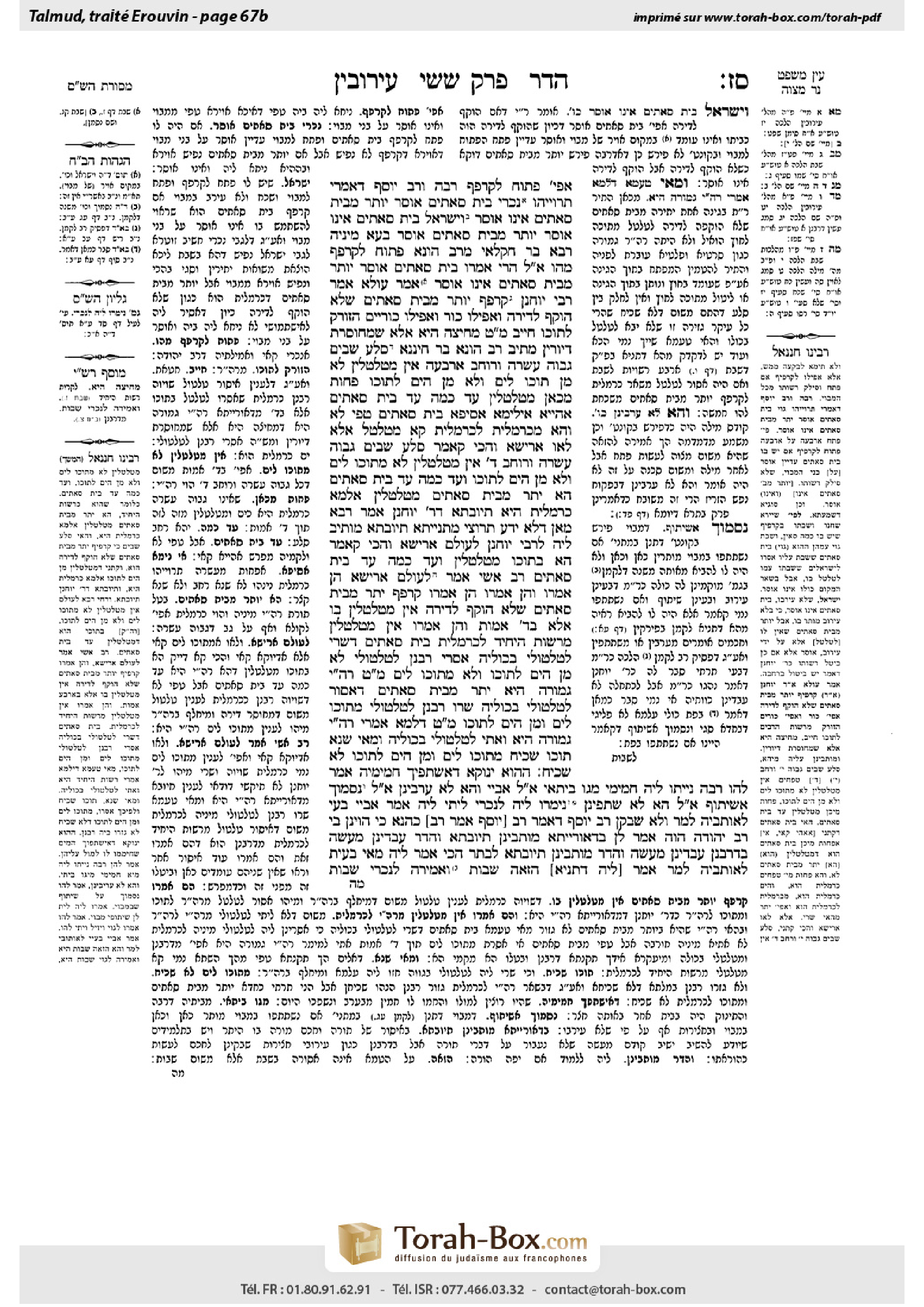
Eruvin 67b: Talmud study for Daf Yomi
Study the Talmud for Daf Yomi with scanned pages, Hebrew text, English translations from Sefaria and AI-generated French translations.
Passage selection and English or AI-generated French translation are available where the scan has annotations. Daf Study is independent of Torah-Box and Sefaria.
Browse Eruvin · עירובין · All tractatesEruvin 67b text and translations
This page of Eruvin includes the Aramaic text, an English translation and an AI-generated French translation, alongside the scan above.
עירובין ס״ז ב · Aramaic and Hebrew text
אֲפִילּוּ פָּתוּחַ לְקַרְפֵּף.
רַבָּה וְרַב יוֹסֵף דְּאָמְרִי תַּרְוַיְיהוּ: גּוֹי בֵּית סָאתַיִם — אוֹסֵר, יוֹתֵר מִבֵּית סָאתַיִם — אֵינוֹ אוֹסֵר.
וְיִשְׂרָאֵל בֵּית סָאתַיִם — אֵינוֹ אוֹסֵר.
יוֹתֵר מִבֵּית סָאתַיִם — אוֹסֵר.
בְּעָא מִינֵּיהּ רָבָא בַּר חַקְלַאי מֵרַב הוּנָא: פָּתוּחַ לְקַרְפֵּף מַהוּ? אֲמַר לֵיהּ: הֲרֵי אָמְרוּ בֵּית סָאתַיִם — אוֹסֵר, יוֹתֵר מִבֵּית סָאתַיִם — אֵינוֹ אוֹסֵר.
אָמַר עוּלָּא אָמַר רַבִּי יוֹחָנָן: קַרְפֵּף יוֹתֵר מִבֵּית סָאתַיִם שֶׁלֹּא הוּקַּף לְדִירָה, וַאֲפִילּוּ כּוֹר וַאֲפִילּוּ כּוֹרַיִים — הַזּוֹרֵק לְתוֹכוֹ חַיָּיב. מַאי טַעְמָא, מְחִיצָה הִיא, אֶלָּא שֶׁמְחוּסֶּרֶת דָּיוֹרִין.
מֵתִיב רַב הוּנָא בַּר חִינָּנָא: סֶלַע שֶׁבַּיָּם גָּבוֹהַּ עֲשָׂרָה וְרוֹחַב אַרְבָּעָה — אֵין מְטַלְטְלִין לֹא מִן תּוֹכוֹ לַיָּם וְלֹא מִן הַיָּם לְתוֹכוֹ. פָּחוֹת מִכָּאן — מְטַלְטְלִין. עַד כַּמָּה — עַד בֵּית סָאתַיִם.
אַהֵיָיא? אִילֵּימָא אַסֵּיפָא — בֵּית סָאתַיִם, טְפֵי לָא? וְהָא מִכַּרְמְלִית לְכַרְמְלִית קָא מְטַלְטֵל.
אֶלָּא לָאו אַרֵישָׁא, וְהָכִי קָאָמַר: סֶלַע שֶׁבַּיָּם גָּבוֹהַּ עֲשָׂרָה וְרוֹחַב אַרְבָּעָה — אֵין מְטַלְטְלִין לֹא מִתּוֹכוֹ לַיָּם וְלֹא מִן הַיָּם לְתוֹכוֹ. וְעַד כַּמָּה — עַד בֵּית סָאתַיִם, הָא יָתֵר מִבֵּית סָאתַיִם — מְטַלְטְלִין. אַלְמָא כַּרְמְלִית הִיא, תְּיוּבְתָּא דְּרַבִּי יוֹחָנָן!
אָמַר רָבָא: מַאן דְּלָא יָדַע תָּרוֹצֵי מַתְנְיָיתָא — תְּיוּבְתָּא מוֹתֵיב לֵיהּ לְרַבִּי יוֹחָנָן. לְעוֹלָם אַרֵישָׁא, וְהָכִי קָאָמַר: הָא בְּתוֹכוֹ — מְטַלְטְלִין. וְעַד כַּמָּה — עַד בֵּית סָאתַיִם.
רַב אָשֵׁי אָמַר: לְעוֹלָם אַרֵישָׁא, הֵן אָמְרוּ וְהֵן אָמְרוּ.
הֵן אָמְרוּ: קַרְפֵּף יָתֵר מִבֵּית סָאתַיִם שֶׁלֹּא הוּקַּף לְדִירָה — אֵין מְטַלְטְלִין בּוֹ אֶלָּא בְּאַרְבַּע אַמּוֹת. וְהֵן אָמְרוּ: אֵין מְטַלְטְלִין מֵרְשׁוּת הַיָּחִיד לְכַרְמְלִית.
בֵּית סָאתַיִם דְּשָׁרֵי לְטַלְטוֹלֵי בְּכוּלֵּיהּ, אָסְרִי רַבָּנַן לְטַלְטוֹלֵי לֹא מִן הַיָּם לְתוֹכוֹ וְלֹא מִתּוֹכוֹ לַיָּם. מַאי טַעְמָא, רְשׁוּת הַיָּחִיד גְּמוּרָה הִיא.
יָתֵר מִבֵּית סָאתַיִם, דְּאָסוּר לְטַלְטוֹלֵי בְּכוּלֵּיהּ, שָׁרוּ רַבָּנַן לְטַלְטוֹלֵי מִתּוֹכוֹ לַיָּם וּמִן הַיָּם לְתוֹכוֹ. מַאי טַעְמָא? דִּלְמָא אָמְרִי: רְשׁוּת הַיָּחִיד גְּמוּרָה הִיא, וְאָתֵי לְטַלְטוֹלֵי בְּכוּלֵּיהּ.
וּמַאי שְׁנָא? תּוֹכוֹ שְׁכִיחַ. מִתּוֹכוֹ לַיָּם וּמִן הַיָּם לְתוֹכוֹ — לָא שְׁכִיחַ.
הָהוּא יָנוֹקָא דְּאִשְׁתְּפִיךְ חַמִּימֵיהּ. אֲמַר לְהוּ רַבָּה: נַיְיתוֹ לֵיהּ חַמִּימֵי מִגּוֹ בֵּיתַאי. אֲמַר לֵיהּ אַבָּיֵי: וְהָא לָא עָרְבִינַן.
אֲמַר לֵיהּ: נִסְמוֹךְ אַשִּׁיתּוּף. אֲמַר לֵיהּ: הָא לָא שַׁתְּפִינַן. נֵימְרוּ לֵיהּ לְגוֹי לַיְתֵי לֵיהּ.
אָמַר אַבָּיֵי: בְּעַי לְאוֹתֹבֵיהּ לְמָר, וְלָא שַׁבְקַן רַב יוֹסֵף, דְּאָמַר רַב [יוֹסֵף אָמַר רַב] כָּהֲנָא: כִּי הֲוֵינַן בֵּי רַב יְהוּדָה, הֲוָה אֲמַר לַן: בִּדְאוֹרָיְיתָא — מוֹתְבִינַן תְּיוּבְתָּא וַהֲדַר עָבְדִינַן מַעֲשֶׂה, בִּדְרַבָּנַן — עָבְדִינַן מַעֲשֶׂה וַהֲדַר מוֹתְבִינַן תְּיוּבְתָּא.
לְבָתַר הָכִי אֲמַר לֵיהּ: מַאי בָּעֵית לְאוֹתֹבֵיהּ לְמָר? אֲמַר [לֵיהּ: דְּתַנְיָא]: הַזָּאָה שְׁבוּת, וַאֲמִירָה לְגוֹי שְׁבוּת.
Eruvin 67b · English translation
Even if it opens into an enclosure, this is considered its main entrance, rather than the one that opens into the alleyway.
It is Rabba and Rav Yosef who both say: The halakha in such a case depends on the identity of the owner of the courtyard. With regard to a courtyard owned by a gentile, if the enclosure behind his courtyard is the size of two beit se’a or less, he renders it prohibited for the Jewish residents of the alleyway to carry. An enclosure of this size is not large enough for all the gentile’s needs, and therefore his main entrance is the one that opens into the alleyway. However, if the enclosure is greater than the size of two beit se’a, he does not render it prohibited for the residents of the alleyway to carry, as such an enclosure is sufficient for all his needs.
On the other hand, with regard to a courtyard owned by a Jew, if the enclosure is the size of two beit se’a or less, he does not render it prohibited for the other residents of the alleyway to carry, even if he did not join in an eiruv with them. Because he has the option of carrying in such an enclosure on Shabbat, he would not carry in the alleyway, as it is more convenient for him to carry in a place that belongs exclusively to him.
However, if the enclosure is greater than the size of two beit se’a, in which case it is prohibited to carry there, the Jew would carry only by way of the alleyway. Therefore, he renders it prohibited for his fellow residents of the alleyway to carry unless he establishes an eiruv with them.
With regard to this issue, Rava bar Ḥaklai raised a dilemma before Rav Huna: If the gentile’s courtyard opens into an alleyway, and it also has an entrance that opens into an enclosure, what is the halakha? He said to him: They have already said that if the enclosure is the size of two beit se’a or less, the gentile renders it prohibited for the Jewish residents of the alleyway to carry; however, if it is more than two beit se’a, he does not render it prohibited for them to carry.
Ulla said that Rabbi Yoḥanan said: With regard to an enclosure greater than the size of two beit se’a that was not originally surrounded by a fence for the purpose of residence, even if it is as large as a field that produces a crop of one kor, and even two kor, one who inadvertently throws an object into it from the public domain is liable to bring a sin-offering, like one who throws into a private domain. What is the reason for this? It is because the partition of an enclosure is a valid partition. Consequently, the enclosure is considered a private domain by Torah law, except that it is lacking residents, and therefore the Sages did not permit one to carry inside it as in a proper private domain.
Rav Huna bar Ḥinnana raised an objection from the following baraita: With regard to a rock protruding from the sea that is ten handbreadths high and four handbreadths wide, one may not carry from it to the sea or from the sea to it on Shabbat. The rock has the status of a private domain, while the sea is a karmelit, and it is prohibited to carry from a private domain into a karmelit or vice versa on Shabbat. If the rock is smaller than this, either in height or width, so that it is no longer considered a private domain, one may carry to or from it. How large may the rock be? It may be up to the size of two beit se’a.
The Gemara attempts to clarify the meaning of this baraita: To which part of the baraita is the clause: Up to the size of two beit se’a, referring? If you say it is referring to the latter clause, can it be that with regard to a rock that is less than ten handbreadths high, the halakha is that carrying is permitted if the rock is up to the size of two beit se’a, but no more than that? Wouldn’t he be carrying from one karmelit to another, which is certainly permitted?
Rather, is it not referring to the first clause of the baraita, and this is what it is saying: With regard to a rock protruding from the sea that is ten handbreadths high and four handbreadths wide, one may not carry from it to the sea or from the sea to it, as it has the status of a private domain. And how large may it be for this prohibition to apply? Up to the size of two beit se’a. But if the rock is greater than the size of two beit se’a, one may carry. Apparently, it is a karmelit in all respects, and not just as a stringency. This appears to be a conclusive refutation of the opinion of Rabbi Yoḥanan.
Rava said: Only one who does not know how to explain mishnayot raises such refutations against Rabbi Yoḥanan, one of the greatest Sages of his generation. Rather, the baraita is to be understood as follows: Actually, the final words of the baraita refer to the first clause, and this is what it is saying: With regard to a rock protruding from the sea that is ten handbreadths high and four handbreadths wide, one may not carry from it to the sea or from the sea to it, but within it, on the rock itself, one may carry, as it is considered a private domain. And how large may the rock be and remain permitted? Up to two beit se’a.
Rav Ashi said that the baraita may be explained differently, yet still in a manner that does not refute the words of Rabbi Yoḥanan: Actually, the final words of the baraita refer to the first clause, as stated by Rav Huna bar Ḥanina. However, one may not infer from them a principle with regard to enclosures, as they said that the halakha is stringent in one case, and they said that the halakha should be lenient in a different case, i.e., the same Sages who were stringent in one case were lenient in another.
How so? They said that in the case of an enclosure greater than the size of two beit se’a that was not originally enclosed with a fence for the purpose of residence, one may carry only a distance of four cubits, as it has the status of a karmelit in this regard. And they also said that one may not carry from a private domain to a karmelit. Both of these halakhot are decrees of the Sages.
Therefore, the Sages developed the following principles: With regard to a rock that is no larger than two beit se’a, so that it is permitted to carry on all of it, the Sages prohibited carrying from the sea to it and from it to the sea. What is the reason for this? It is that the rock is a full-fledged private domain, and they did not permit one to carry from a private domain to a karmelit or vice versa.
However, if it is larger than the size of two beit se’a, so that it is prohibited to carry on all of it by rabbinic decree, the Sages permitted carrying from the sea to it and from it to the sea. What is the reason for this? It is because the Sages were concerned that perhaps people would say that it is a proper private domain, and they would come to carry on all of it. Were the Sages to prohibit carrying from the rock to the sea, people would think that it is a full-fledged private domain, and they would carry on it. Since all these decrees are rabbinic in nature, the Sages permitted carrying from a private domain to a karmelit in this case in order to prevent people from violating a different rabbinic decree, which prohibits carrying in an enclosure that is greater than the size of two beit se’a. However, no general conclusion may be inferred from this that an enclosure larger than two beit se’a is not a private domain by Torah law.
The Gemara asks: And what is the difference between the decrees that caused the Sages to choose to uphold the one decree and not the other? The Gemara answers: The difference is that carrying within the rock is common, whereas carrying from it to the sea and from the sea to it is not common. The Sages permitted carrying in the less likely scenario in order to reinforce the decree against carrying within the rock, the more common situation.
The Gemara now relates that there was once a certain baby whose warm water, which had been prepared for his Shabbat circumcision, spilled. Rabba said to them: Let them bring warm water for him from my house. Abaye said to him: But we did not establish an eiruv in the courtyard, so it is prohibited to carry the water.
Rabba said to him: Let us rely on the merging of alleyways, which may serve in place of a joining of courtyards in pressing circumstances such as these. Abaye said to him: But we did not establish a merging of alleyways either. Rabba replied: If so, let them instruct a gentile to bring the warm water for him, even though it is generally prohibited to instruct a gentile to perform labor for a Jew that involves a desecration of Shabbat.
Abaye said: I wanted to raise an objection against the Master, Rabba, but Rav Yosef would not let me do so, as Rav Yosef said that Rav Kahana said: When we were in Rav Yehuda’s house, he would say to us when we were presented with a halakhic difficulty: With regard to a Torah law, we first raise objections and then we perform an act, i.e., if someone has an objection to a proposed action, we must first clarify the matter and only then may we proceed. However, with regard to rabbinic laws, we first perform an act and then we raise objections.
Afterward, when they had brought the water, Rav Yosef said to Abaye: What objection did you wish to raise against the Master, Rabba? He said to him: As it was taught in a baraita: Sprinkling the water of purification on an impure person on Shabbat is not prohibited by Torah law; rather, it is only a rabbinic decree to enhance the character of Shabbat as a day of rest. And telling a gentile to perform a Shabbat labor on behalf of a Jew is likewise only a rabbinic decree.
Eruvin 67b · Traduction française (IA)
Même s'il s'ouvre sur un enclos, cela est considéré comme son entrée principale, plutôt que celle qui s'ouvre sur la cour.
Rabba et Rav Yosef disent tous les deux : La halakha dans un tel cas dépend de l'identité du propriétaire de la cour. En ce qui concerne une cour appartenant à un non-Juif, si l'enclos derrière sa cour est de la taille de deux beit se'a ou moins, il rend cette cour interdite au transport par les habitants juifs de la cour. Un enclos de cette taille n'est pas suffisant pour toutes les besoins du non-Juif, et par conséquent son entrée principale est celle qui s'ouvre sur la cour. Cependant, si l'enclos est plus grand que la taille de deux beit se'a, il ne rend pas cette cour interdite au transport par les habitants de la cour, car un tel enclos est suffisant pour tous ses besoins.
En revanche, en ce qui concerne une cour appartenant à un Juif, si l'enclos est de la taille de deux beit se'a ou moins, il ne rend pas cette cour interdite au transport par les autres habitants de la cour, même s'il n'a pas participé à un eiruv avec eux. En effet, il a la possibilité de transporter dans cet enclos le sabbat, et il ne transportera pas dans la cour, car c'est plus pratique pour lui de transporter dans un lieu qui lui appartient exclusivement.
Cependant, si l'enclos est plus grand que la taille de deux beit se'a, dans ce cas, il est interdit de transporter là-bas, le Juif transportera uniquement par la cour. Par conséquent, il rend cette cour interdite au transport par ses concitoyens de la cour à moins qu'il ne constitue un eiruv avec eux.
En ce qui concerne cette question, Rava bar Ḥaklai a soulevé un dilemme devant Rav Huna : Si la cour du non-Juif s'ouvre sur une cour et qu'elle a également une entrée qui s'ouvre sur un enclos, quelle est la halakha ? Il a dit à lui : Ils ont déjà dit que si l'enclos est de la taille de deux beit se'a ou moins, le non-Juif rend cette cour interdite au transport par les habitants juifs de la cour ; cependant, si elle est plus grande que deux beit se'a, il ne rend pas cette cour interdite au transport par eux.
Ulla a dit que Rabbi Yoḥanan a dit : En ce qui concerne un enclos plus grand que la taille de deux beit se'a qui n'était pas initialement entouré d'un mur pour l'habitation, même s'il est aussi grand qu'un champ produisant une récolte d'un kor, et même deux kor, celui qui jette accidentellement un objet dans cet enclos depuis le domaine public est tenu de présenter un sacrifice expiatoire, comme celui qui jette dans un domaine privé. Quelle est la raison de cela ? C'est parce que le mur d'un enclos est une partition valide. Par conséquent, l'enclos est considéré comme un domaine privé selon la Torah, sauf qu'il n'y a pas de résidents, et par conséquent les Sages n'ont pas permis de transporter à l'intérieur comme dans un domaine privé complet.
Rav Huna bar Ḥinnana souleva un objet contre la baraïta suivante : En ce qui concerne une roche émergeant de la mer, de dix tefachim de haut et de quatre tefachim de large, on ne peut pas transporter de là vers la mer ou de la mer vers là le sabbat. La roche a le statut d'un domaine privé, tandis que la mer est un karmelit, et il est interdit de transporter d'un domaine privé vers un karmelit ou vice versa le sabbat. Si la roche est plus petite que cela, soit en hauteur soit en largeur, de sorte qu'elle n'est plus considérée comme un domaine privé, on peut transporter vers ou depuis elle. De quelle taille peut être la roche ? Elle peut être jusqu'à la taille de deux beit se’a.
La Guemara tente de clarifier le sens de cette baraïta : À quelle partie de la baraïta fait référence la clause : Jusqu'à la taille de deux beit se’a ? Si vous dites qu'elle fait référence à la clause suivante, peut-être que concernant une roche plus petite que dix tefachim de haut, la halakha est que le transport est permis si la roche est jusqu'à la taille de deux beit se’a, mais pas plus ? Ne serait-ce pas un transport d'un karmelit à un autre, ce qui est certainement permis ?
Plutôt, n'est-ce pas fait référence à la première clause de la baraïta, et c'est ce que cela dit : En ce qui concerne une roche émergeant de la mer, de dix tefachim de haut et de quatre tefachim de large, on ne peut pas transporter de là vers la mer ou de la mer vers là, car elle a le statut d'un domaine privé. Et de quelle taille peut-elle être pour que cette interdiction s'applique ? Jusqu'à la taille de deux beit se’a. Mais si la roche est plus grande que la taille de deux beit se’a, on peut transporter. Apparemment, c'est un karmelit en tous points, et non seulement comme une stricte interdiction. Cela semble être une refutation concluante de l'opinion de Rabbi Yoḥanan.
Rava a dit : Seul celui qui ne sait pas expliquer les mishnayot soulève de tels objections contre Rabbi Yoḥanan, l'un des plus grands Sages de son époque. Plutôt, la baraïta doit être comprise comme suit : En réalité, les derniers mots de la baraïta font référence à la première clause, et c'est ce qu'elle dit : En ce qui concerne une roche émergeant de la mer, de dix tefachim de haut et de quatre tefachim de large, on ne peut pas transporter de là vers la mer ou de la mer vers là, mais à l'intérieur, sur la roche elle-même, on peut transporter, car elle est considérée comme un domaine privé. Et de quelle taille peut être la roche et rester permis ? Jusqu'à deux beit se'a.
Rav Ashi a dit que la baraïta peut être interprétée différemment, tout en restant dans un sens qui ne contredit pas les paroles de Rabbi Yoḥanan : En réalité, les derniers mots de la baraïta font référence à la première clause, comme l'a dit Rav Huna bar Ḥanina. Cependant, on ne peut pas en déduire un principe concernant les enclos, car ils ont dit que la halakha est stricte dans un cas, et qu'elle devrait être clémente dans un autre cas, c'est-à-dire les mêmes Sages qui étaient stricte dans un cas étaient clémente dans un autre.
Comment cela ? Ils ont dit que dans le cas d'un enclos plus grand que la taille de deux beit se'a qui n'était pas initialement entouré d'un mur pour l'habitation, on peut transporter seulement une distance de quatre coudées, car il a le statut d'un karmelit à cet égard. Et ils ont aussi dit qu'on ne peut pas transporter d'un domaine privé vers un karmelit. Ces deux halakhot sont des décrets des Sages.
Par conséquent, les Sages ont établi les principes suivants : Concernant une roche dont la taille ne dépasse pas deux beit se’a, de sorte qu'il est permis de porter sur toute sa surface, les Sages ont interdit de porter du rivage vers la roche et de la roche vers le rivage. Pourquoi cela ? Parce que la roche constitue un domaine privé complet, et ils n'ont pas permis de porter d'un domaine privé vers un karmelit ou inversement.
Cependant, si la roche est plus grande que deux beit se’a, de sorte qu'il est interdit de porter sur toute sa surface par décret rabbinique, les Sages ont permis de porter du rivage vers la roche et de la roche vers le rivage. Pourquoi cela ? Parce que les Sages craignaient que les gens puissent penser que la roche est un domaine privé complet, et ils viendraient à porter sur toute sa surface. Si les Sages avaient interdit de porter de la roche vers le rivage, les gens auraient pensé qu'il s'agissait d'un domaine privé complet, et ils auraient porté sur toute sa surface. Puisque tous ces décrets sont de nature rabbinique, les Sages ont permis de porter d'un domaine privé vers un karmelit dans ce cas afin d'éviter que les gens ne transgressent un autre décret rabbinique, qui interdit de porter dans un enclos dont la taille dépasse celle de deux beit se’a. Cependant, aucune conclusion générale ne peut être tirée de cela, car un enclos plus grand que deux beit se’a n'est pas nécessairement un domaine privé selon la Loi divine.
La Guemara pose la question : Et quelle est la différence entre les décrets qui ont conduit les Sages à choisir de maintenir l'un et non l'autre ? La Guemara répond : La différence réside dans le fait que porter à l'intérieur de la roche est courant, tandis que porter de la roche vers le rivage et inversement ne l'est pas. Les Sages ont permis de porter dans le scénario moins probable afin de renforcer le décret interdisant de porter à l'intérieur de la roche, le cas plus courant.
La Guemara rapporte ensuite qu'il y avait un jour un bébé dont l'eau tiède, préparée pour sa circoncision du Sabbat, s'était renversée. Rabba dit à ceux-ci : Apportez de l'eau tiède pour lui à partir de ma maison. Abaye dit à lui : Mais nous n'avons pas établi un eiruv dans la cour, donc il est interdit de porter l'eau.
Rabba dit à lui : Faisons confiance à la fusion des ruelles, qui peut servir à la place d'une union de cours dans des circonstances telles que celle-ci. Abaye dit à lui : Mais nous n'avons pas établi non plus une fusion de ruelles. Rabba répondit : Si c'est ainsi, faites-leur demander à un non-Juif de porter l'eau tiède pour lui, même si c'est généralement interdit d'ordonner à un non-Juif d'accomplir un travail du Sabbat pour un Juif.
Abaye dit : J'avais l'intention de présenter une objection contre le Maître, Rabba, mais Rav Yosef ne m'a pas permis de le faire, car Rav Yosef a dit que Rav Kahana avait dit : Quand nous étions chez Rav Yehuda, il disait à nous quand nous étions confrontés à une difficulté halakhique : Concernant une loi divine, nous levons d'abord des objections et ensuite nous accomplissons une action, c'est-à-dire si quelqu'un a une objection contre une action proposée, nous devons d'abord clarifier la question et seulement ensuite pouvons-nous agir. Cependant, concernant les lois rabbiniques, nous accomplissons d'abord une action et ensuite nous levons des objections.
Plus tard, après qu'ils eurent apporté l'eau, Rav Yosef dit à Abaye : Quelle objection vouliez-vous opposer au Maître, Rabba ? Il répondit : Comme il a été enseigné dans une baraïta : Sprinkler l'eau de purification sur une personne impure le Sabbat n'est pas interdit par la Loi divine ; plutôt, c'est seulement un décret rabbinique afin d'améliorer la qualité du Sabbat comme jour de repos. Et ordonner à un non-Juif d'accomplir un travail du Sabbat à la place d'un Juif est également seulement un décret rabbinique.
Traduction française générée par IA à partir de l’édition anglaise de Sefaria. Vérifie toujours un passage avec le texte source.
Text from Sefaria: William Davidson Edition - Vocalized Aramaic (CC BY NC); William Davidson Edition - English (CC BY NC).