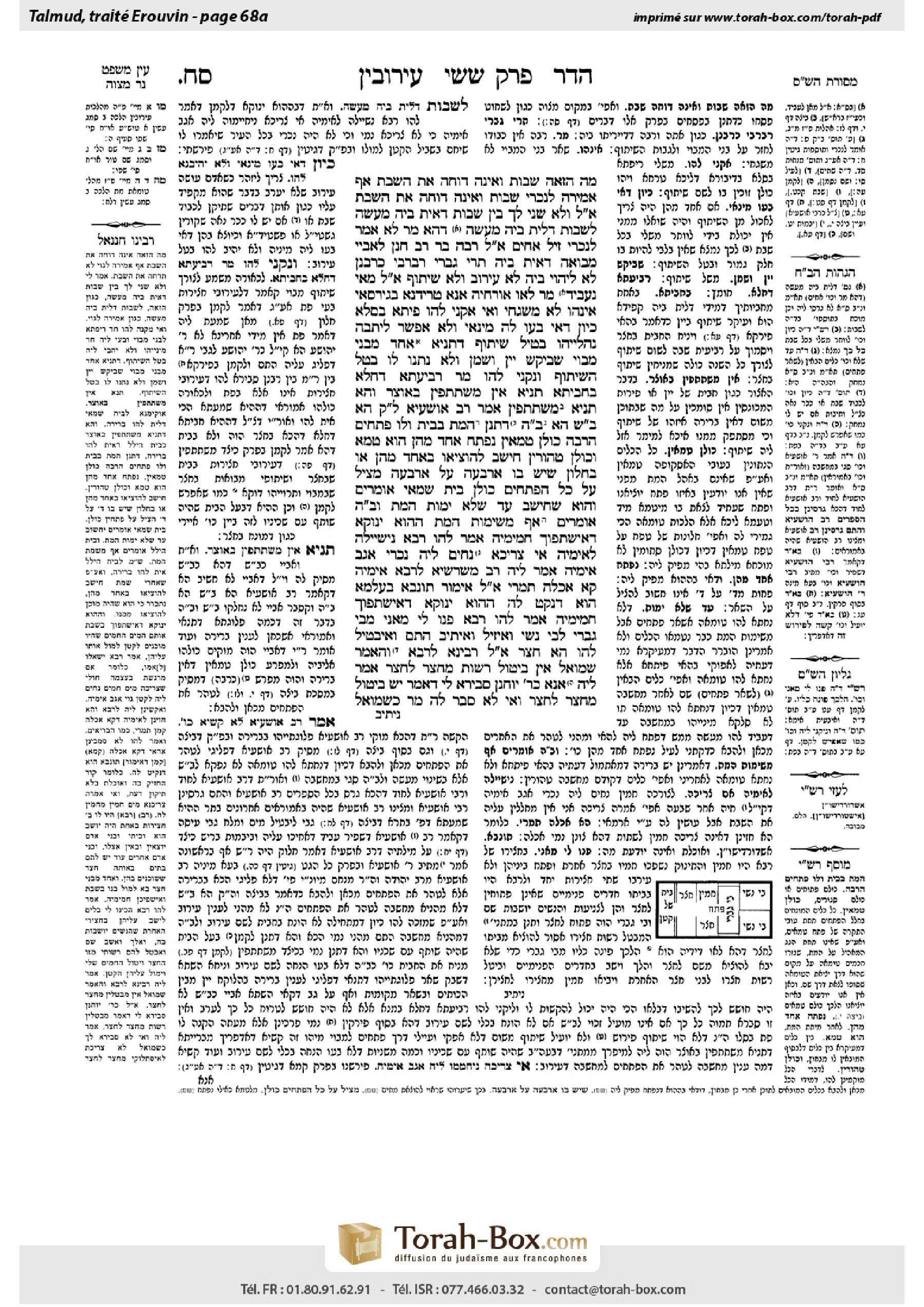
Eruvin 68a: Talmud study for Daf Yomi
Study the Talmud for Daf Yomi with scanned pages, Hebrew text, English translations from Sefaria and AI-generated French translations.
Passage selection and English or AI-generated French translation are available where the scan has annotations. Daf Study is independent of Torah-Box and Sefaria.
Browse Eruvin · עירובין · All tractatesEruvin 68a text and translations
This page of Eruvin includes the Aramaic text, an English translation and an AI-generated French translation, alongside the scan above.
עירובין ס״ח א · Aramaic and Hebrew text
מָה הַזָּאָה שְׁבוּת, וְאֵינָהּ דּוֹחָה אֶת הַשַּׁבָּת. אַף אֲמִירָה לְגוֹי שְׁבוּת, וְאֵינָהּ דּוֹחָה אֶת הַשַּׁבָּת.
אֲמַר לֵיהּ: וְלָא שָׁנֵי לָךְ בֵּין שְׁבוּת דְּאִית בֵּיהּ מַעֲשֶׂה לִשְׁבוּת דְּלֵית בֵּיהּ מַעֲשֶׂה? דְּהָא מָר לָא אֲמַר לְגוֹי: זִיל אַחֵים.
אֲמַר לֵיהּ רַבָּה בַּר רַב חָנָן לְאַבָּיֵי: מְבוֹאָה דְּאִית בֵּיהּ תְּרֵי גַּבְרֵי רַבְרְבֵי כְּרַבָּנַן, לָא לֶיהֱוֵי בֵּיהּ לָא עֵירוּב וְלֹא שִׁיתּוּף?! אֲמַר לֵיהּ: מַאי נַעֲבֵיד? מָר, לָאו אוֹרְחֵיהּ. אֲנָא, טְרִידְנָא בְּגִירְסַאי. אִינְהוּ, לָא מַשְׁגְּחִי.
וְאִי אַקְנִי לְהוּ פִּיתָּא בְּסַלָּא — כֵּיוָן דְּאִי בָּעוּ לַהּ מִינַּאי וְלָא אֶפְשָׁר לִיתְּבַהּ נִהֲלַיְיהוּ, בָּטֵיל שִׁיתּוּף.
דְּתַנְיָא: אֶחָד מִבְּנֵי מָבוֹי שֶׁבִּיקֵּשׁ יַיִן וָשֶׁמֶן, וְלֹא נָתְנוּ לוֹ — בָּטֵל הַשִּׁתּוּף.
וְנַקְנֵי לְהוּ מָר רְבִיעֲתָא דְחַלָּא בְּחָבִיתָא. תַּנְיָא, אֵין מִשְׁתַּתְּפִין בָּאוֹצָר.
וְהָא תַּנְיָא מִשְׁתַּתְּפִין! אָמַר רַב אוֹשַׁעְיָא: לָא קַשְׁיָא, הָא — בֵּית שַׁמַּאי, הָא — בֵּית הִלֵּל.
דִּתְנַן: הַמֵּת בַּבַּיִת, וְלוֹ פְּתָחִים הַרְבֵּה — כּוּלָּן טְמֵאִין.
נִפְתַּח אֶחָד מֵהֶן — הוּא טָמֵא, וְכוּלָּן טְהוֹרִין. חִישֵּׁב לְהוֹצִיאוֹ בְּאֶחָד מֵהֶן, אוֹ בַּחַלּוֹן שֶׁיֵּשׁ בּוֹ אַרְבָּעָה עַל אַרְבָּעָה — מַצִּיל עַל כׇּל הַפְּתָחִים כּוּלָּן.
בֵּית שַׁמַּאי אוֹמְרִים: וְהוּא שֶׁחִישֵּׁב עַד שֶׁלֹּא יָמוּת הַמֵּת. וּבֵית הִלֵּל אוֹמְרִים: אַף מִשֶּׁיָּמוּת הַמֵּת.
הָהוּא יָנוֹקָא דְּאִישְׁתְּפוּךְ חַמִּימֵיהּ, אֲמַר לְהוּ רָבָא: נִישַׁיְּילַהּ לְאִימֵּיהּ אִי צְרִיכָא — נַחֵים לֵיהּ גּוֹי אַגַּב אִימֵּיהּ.
אֲמַר לֵיהּ רַב מְשַׁרְשְׁיָא לְרָבָא: אִימֵּיהּ קָא אָכְלָה תַּמְרֵי. אֲמַר לֵיהּ: אֵימוֹר, תּוּנְבָּא בְּעָלְמָא הוּא דְּנָקֵט לַהּ.
הָהוּא יָנוֹקָא דְּאִישְׁתְּפוּךְ חַמִּימֵיהּ, אֲמַר לְהוּ רָבָא: פַּנּוּ לִי מָאנֵי מִבֵּי גַבְרֵי לְבֵי נְשֵׁי, וְאֵיזִיל וְאִיתֵּיב הָתָם וְאֶיבַטֵּיל לְהוּ הָא חָצֵר.
אֲמַר לֵיהּ רָבִינָא לְרָבָא, וְהָאָמַר שְׁמוּאֵל: אֵין בִּיטּוּל רְשׁוּת מֵחָצֵר לְחָצֵר?! אֲמַר לֵיהּ: אֲנָא כְּרַבִּי יוֹחָנָן סְבִירָא לִי, דְּאָמַר: יֵשׁ בִּיטּוּל מֵחָצֵר לְחָצֵר.
וְאִי לָא סָבַר לַהּ מָר כִּשְׁמוּאֵל
Eruvin 68a · English translation
Just as sprinkling the water of purification is prohibited by rabbinic decree and does not override Shabbat, even for the purpose of a mitzva, so too, telling a gentile to perform a prohibited labor Shabbat is prohibited by rabbinic decree and does not override Shabbat. How, then, could Rabba suggest that they instruct a gentile and thus transgress a rabbinic decree?
Rav Yosef said to him: But do you not differentiate between a rabbinic decree that involves an action and a rabbinic decree that does not involve an action? As the Master, Rabba, did not say to the gentile: Go and heat water on Shabbat, but only told him to transfer something from one domain to another, which does not involve an action and is therefore less severe.
Upon hearing of this incident and the ensuing discussion, Rabba bar Rav Ḥanan said to Abaye: In an alleyway that contains two such great people as the Sages Rabba and Abaye, is it possible that there could be neither an eiruv nor a merging of alleyways? Abaye said to him: What should we do? As for the Master, Rabba, it is not his manner to go and collect for the eiruv from all the residents of the alleyway. As for myself, I am busy with my studies and do not have time to take care of this issue. And they, the other residents of the alleyway, do not attend to such matters.
And if I were to transfer to the residents of the alleyway a share of the bread in my basket, so as to allow them to join a merging of alleyways, since if they would want to take it from me it would be impossible for me to give it to them because I am poor and need the small amount of bread that I can afford for myself, the merging of alleyways would therefore be invalid.
As it was taught in a baraita: If one of the residents of an alleyway requested wine or oil from the merging of alleyways, and they did not give him any, the merging of alleyways is invalid. This is because it has become evident that he is not considered a true partner in it.
Rabba bar Rav Ḥanin further asked: But let the Master transfer to them a quarter-log of vinegar in one of his barrels; certainly even Abaye could afford to provide such a small amount of vinegar for the rest of the residents. Abaye replied: It was taught in a baraita: One may not use food in a storeroom for a merging of alleyways, as it is not clear which specific portion of the food is being set aside for that purpose. The same halakha would apply to an unspecified quarter-log of vinegar in a barrel.
Rabba bar Rav Ḥanin raised a difficulty. Wasn’t it taught in a different baraita: One may use stored food for a merging of alleyways? Rav Oshaya said: This is not difficult. This source, the baraita that states that one may not use stored food for a merging of alleyways, is in accordance with the opinion of Beit Shammai. And that source, the baraita that states that it is permitted to do so, is in accordance with the opinion of Beit Hillel. Beit Shammai and Beit Hillel disagree about whether or not to apply the principle of retroactive clarification.
As we learned in a mishna: If a corpse is in a house, and the house has many entrances, they are all ritually impure. It is currently unknown through which entrance the corpse will be removed from the house, and any of the entrances might be used for this purpose. Therefore, they all contract impurity imparted by a corpse in a tent as though the corpse had already passed through each of them.
However, if only one of them was open, that particular entrance is ritually impure, as the corpse will certainly be removed through it, while all of the others are ritually pure. If one decided from the outset to remove the corpse through one of the entrances, or through a window that is four by four handbreadths in size, it saves all of the other entrances from contracting impurity.
Beit Shammai say: This applies only if he had decided on an entrance before the person died, so that the entrance through which his body would be removed was already determined at the time of death. But Beit Hillel say: This applies even if he decided the matter only after the person had died, as the principle of retroactive selection is invoked and the entrance through which the deceased will be removed has been retroactively established. The same dispute applies to a merging of alleyways with an unspecified portion of stored food, and it revolves around whether it can be retroactively established that a specific portion had been set aside for the merging of alleyways.
The Gemara relates another story about a certain baby whose warm water, which had been prepared for his Shabbat circumcision, spilled. Rava said to those who had brought the matter to his attention: Let us ask the baby’s mother. If the warm water is necessary for her health, let a gentile heat water for the baby indirectly, through his mother. In other words, the water may be heated for the mother, as a woman after childbirth is regarded as being in a life-threatening situation.
Rav Mesharshiya said to Rava: The baby’s mother is healthy enough that she is eating dates. Certainly her condition is not precarious enough to necessitate the heating of water. Rava said to him: It is possible to say that it was merely a ravenous hunger that had seized her, and she is unaware of what she is eating, but in fact she is still dangerously ill.
The Gemara relates yet another similar incident: There was once a certain baby whose warm water, which had been prepared for his Shabbat circumcision, spilled. Rava, who had water in his courtyard but had not established a joint eiruv with the adjacent courtyard where the baby was located, said to those who asked him about the matter: Clear away my belongings from the men’s chamber, which opens directly into my courtyard, to the inner women’s chamber, which does not. Rava was concerned that he would come to carry his belongings into the courtyard, which would be prohibited once he had renounced his rights to it. And I will go and sit there, in the women’s chamber, and I will renounce my rights to this courtyard in favor of the residents of the baby’s courtyard, so that they will be able to transfer the warm water from one courtyard to the other.
Ravina said to Rava: Didn’t Shmuel say: There is no renunciation of rights from one courtyard to another. How, then, can you renounce your rights to your courtyard in this manner? Rava said to him: I hold in accordance with the opinion of Rabbi Yoḥanan, who said: There is renouncing of rights from one courtyard to another.
Ravina then asked Rava: But if the Master does not hold in accordance with the opinion of Shmuel,
Eruvin 68a · Traduction française (IA)
Comme l'aspersion de l'eau de purification est interdite par un décret rabbinique et ne peut pas prévaloir sur le sabbat, même pour l'accomplissement d'une mitsva, de même, il est interdit par un décret rabbinique de demander à un non-Juif d'accomplir un travail interdit le sabbat, et ce ne peut pas prévaloir sur le sabbat. Comment donc Rabba pourrait-il suggérer qu'ils instruisent un non-Juif et ainsi transgresser un décret rabbinique ?
Rav Yosef dit à lui : Mais ne distinguez-vous pas entre un décret rabbinique qui implique une action et un décret rabbinique qui ne l'implique pas ? Comme le Maître, Rabba, n'a pas dit au non-Juif : Va et fais bouillir de l'eau le sabbat, mais seulement lui a dit de transférer quelque chose d'un domaine à un autre, ce qui ne comporte pas d'action et est donc moins grave.
Après avoir entendu ce fait et la discussion qui en a suivi, Rabba bar Rav Ḥanan dit à Abaye : Dans un passage étroit qui contient deux tels grands hommes que les Sages Rabba et Abaye, est-il possible que ni un eiruv ni un mélange de passages ne puissent exister ? Abaye dit à lui : Que devons-nous faire ? En ce qui concerne le Maître, Rabba, ce n'est pas sa manière de se rendre à l'origine de l'eiruv auprès de tous les habitants du passage. En ce qui me concerne, je suis occupé par mes études et n'ai pas le temps de m'occuper de cette question. Et les autres habitants du passage, ils n'ont pas l'habitude de s'occuper de tels sujets.
Et si je transférais à ceux qui habitent le passage une part du pain de mon panier, afin qu'ils puissent participer à un mélange de passages, puisque s'ils voulaient le prendre de moi, il serait impossible pour moi de le leur donner, car je suis pauvre et j'ai besoin de ce petit morceau de pain que je peux m'offrir, le mélange de passages serait donc invalide.
Comme il a été enseigné dans une baraïta : Si un des habitants d'un passage demandait du vin ou de l'huile à partir du mélange de passages, et qu'ils ne lui en donnaient aucun, le mélange de passages est invalide. Cela est dû au fait qu'il est devenu évident qu'il n'est pas considéré comme un partenaire véritable dans ce mélange.
Rabba bar Rav Ḥanin a encore posé une difficulté : Mais que le Maître transfère à eux un quart de log de vinaigre dans l'une de ses tonneaux ; certainement même Abaye pourrait s'offrir de fournir une telle petite quantité de vinaigre aux autres habitants. Abaye a répondu : Il a été enseigné dans une baraïta : On ne peut pas utiliser des aliments en stock pour un mélange de passages, car il n'est pas clair quelle portion spécifique de ces aliments est mise de côté à cet effet. La même halakha s'appliquerait à un quart de log de vinaigre indéterminé dans un tonneau.
Rabba bar Rav Ḥanin a soulevé une difficulté. N'était-il pas enseigné dans une autre baraïta : On peut utiliser des aliments en stock pour un mélange de passages ? Rav Oshaya a dit : Ce n'est pas difficile. Cette source, la baraïta qui dit qu'on ne peut pas utiliser des aliments en stock pour un mélange de passages, est selon l'opinion de Beit Shammai. Et cette source, la baraïta qui dit qu'on peut le faire, est selon l'opinion de Beit Hillel. Beit Shammai et Beit Hillel s'opposent sur la question de savoir si l'on doit appliquer le principe de clarification rétrospective.
Comme nous avons appris dans une mitsva : Si un cadavre est dans une maison, et que la maison a plusieurs entrées, toutes sont impures. Il est actuellement inconnu par quelle entrée le cadavre sera retiré de la maison, et toute entrée pourrait être utilisée à cet effet. Par conséquent, toutes contractent l'impureté transmise par un cadavre dans une tente comme si le cadavre avait déjà traversé chacune d'entre elles.
Cependant, si seule une d'entre elles était ouverte, cette entrée est impure, car le cadavre sera certainement retiré par elle, tandis que toutes les autres sont pures. Si l'on avait décidé dès le départ de retirer le cadavre par une entrée, ou par une fenêtre de quatre par quatre tefachim, cela sauve toutes les autres entrées de contracter l'impureté.
Beit Shammai disent : Cela s'applique uniquement si l'on avait décidé d'une entrée avant que la personne ne meure, de sorte que l'entrée par laquelle son corps serait retiré était déjà déterminée au moment de sa mort. Mais Beit Hillel disent : Cela s'applique même si l'on a décidé de la question après que la personne eut mouru, car le principe de sélection rétrospective est invoqué et l'entrée par laquelle le défunt sera retiré a été établie rétrospectivement. La même dispute s'applique à un mélange de passages avec une portion indéterminée d'aliments en stock, et elle tourne autour de la question de savoir si l'on peut établir rétrospectivement que une portion spécifique avait été mise de côté pour le mélange de passages.
La Guemara rapporte une autre histoire concernant un certain bébé dont l'eau tiède, préparée pour sa circoncision du sabbat, s'était renversée. Rava dit à ceux qui avaient apporté la question à son attention : Faisons appel à la mère du bébé. Si l'eau tiède est nécessaire à sa santé, faites chauffer de l'eau pour le bébé indirectement, à travers sa mère. En d'autres termes, l'eau peut être chauffée pour la mère, car une femme après l'accouchement est considérée comme étant dans une situation de danger de vie.
Rav Mesharshiya dit à Rava : La mère du bébé est assez en bonne santé pour manger des dattes. Certainement, son état n'est pas suffisamment précaire pour nécessiter le chauffage de l'eau. Rava dit à lui : Il est possible de dire qu'il s'agissait simplement d'une faim impérieuse qui l'avait saisie, et qu'elle ne savait pas ce qu'elle mangeait, mais en réalité elle est encore gravement malade.
La Guemara rapporte encore un autre incident similaire : Il y avait une fois un bébé dont l'eau tiède, préparée pour sa circoncision du sabbat, avait été renversée. Rava, qui avait de l'eau dans son cour de maison mais n'avait pas établi un eiruv commun avec le cour de maison adjacent où se trouvait le bébé, répondit à ceux qui lui posaient la question : Éloignez mes affaires de la pièce des hommes, qui donne directement sur mon cour de maison, vers la pièce des femmes intérieure, qui ne le fait pas. Rava avait peur qu'il vienne à porter ses affaires dans le cour de maison, ce qui serait interdit une fois qu'il aurait renoncé à ses droits sur celui-ci. Et je vais aller m'installer là, dans la pièce des femmes, et je renoncerai à mes droits sur ce cour de maison en faveur des habitants du cour de maison du bébé, afin qu'ils puissent transférer l'eau tiède d'un cour de maison à l'autre.
Ravina dit à Rava : N'as-tu pas entendu Shmuel dire : Il n'y a pas de renonciation de droits d'un cour de maison à un autre. Comment, alors, peux-tu renoncer à tes droits sur ton cour de maison ainsi ? Rava répondit à lui : Je suis en accord avec l'opinion de Rabbi Yoḥanan, qui a dit : Il y a une renonciation de droits d'un cour de maison à un autre.
Ravina demanda alors à Rava : Mais si le Maître ne suit pas l'opinion de Shmuel,
Traduction française générée par IA à partir de l’édition anglaise de Sefaria. Vérifie toujours un passage avec le texte source.
Text from Sefaria: William Davidson Edition - Vocalized Aramaic (CC BY NC); William Davidson Edition - English (CC BY NC).