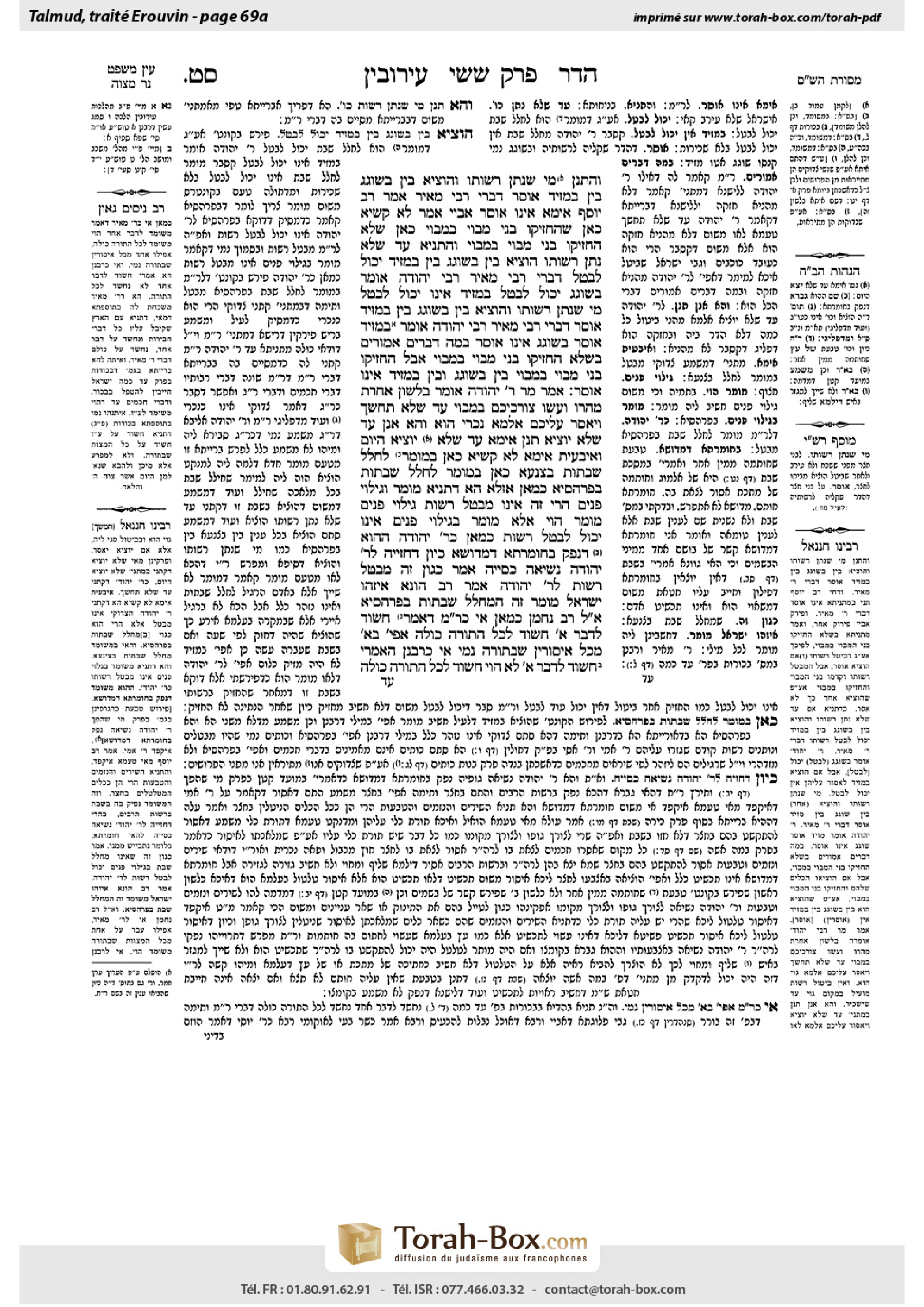
Eruvin 69a: Talmud study for Daf Yomi
Study the Talmud for Daf Yomi with scanned pages, Hebrew text, English translations from Sefaria and AI-generated French translations.
Passage selection and English or AI-generated French translation are available where the scan has annotations. Daf Study is independent of Torah-Box and Sefaria.
Browse Eruvin · עירובין · All tractatesEruvin 69a text and translations
This page of Eruvin includes the Aramaic text, an English translation and an AI-generated French translation, alongside the scan above.
עירובין ס״ט א · Aramaic and Hebrew text
וְהָתְנַן מִי שֶׁנָּתַן רְשׁוּתוֹ וְהוֹצִיא, בֵּין בְּשׁוֹגֵג בֵּין בְּמֵזִיד — אוֹסֵר, דִּבְרֵי רַבִּי מֵאִיר.
אָמַר רַב יוֹסֵף: אֵימָא ״אֵינוֹ אוֹסֵר״. אַבָּיֵי אָמַר, לָא קַשְׁיָא: כָּאן — שֶׁהֶחֱזִיקוּ בְּנֵי מָבוֹי בַּמָּבוֹי, כָּאן — שֶׁלֹּא הֶחְזִיקוּ בְּנֵי מָבוֹי בַּמָּבוֹי.
וְהָתַנְיָא: עַד שֶׁלֹּא נָתַן רְשׁוּתוֹ, הוֹצִיא בֵּין בְּשׁוֹגֵג בֵּין בְּמֵזִיד — יָכוֹל לְבַטֵּל, דִּבְרֵי רַבִּי מֵאִיר. רַבִּי יְהוּדָה אוֹמֵר: בְּשׁוֹגֵג יָכוֹל לְבַטֵּל, בְּמֵזִיד אֵינוֹ יָכוֹל לְבַטֵּל.
מִי שֶׁנָּתַן רְשׁוּתוֹ וְהוֹצִיא, בֵּין בְּשׁוֹגֵג בֵּין בְּמֵזִיד — אוֹסֵר, דִּבְרֵי רַבִּי מֵאִיר. רַבִּי יְהוּדָה אוֹמֵר: בְּמֵזִיד אוֹסֵר, בְּשׁוֹגֵג אֵינוֹ אוֹסֵר. בַּמֶּה דְּבָרִים אֲמוּרִים — בְּשֶׁלֹּא הֶחְזִיקוּ בְּנֵי מָבוֹי בַּמָּבוֹי, אֲבָל הֶחְזִיקוּ בְּנֵי מָבוֹי בַּמָּבוֹי, בֵּין בְּשׁוֹגֵג וּבֵין בְּמֵזִיד — אֵינוֹ אוֹסֵר.
אָמַר מָר: רַבִּי יְהוּדָה אוֹמֵר בְּלָשׁוֹן אַחֶרֶת: מַהֲרוּ וַעֲשׂוּ צוֹרְכֵיכֶם בַּמָּבוֹי עַד שֶׁלֹּא תֶּחְשַׁךְ וְיֶאֱסֹר עֲלֵיכֶם. אַלְמָא גּוֹי הוּא. וְהָא אֲנַן ״עַד שֶׁלֹּא יוֹצִיא״ תְּנַן!
אֵימָא ״עַד שֶׁלֹּא יוֹצִיא הַיּוֹם״. וְאִיבָּעֵית אֵימָא, לָא קַשְׁיָא: כָּאן — בְּמוּמָר לְחַלֵּל שַׁבָּתוֹת בְּצִנְעָא, כָּאן — בְּמוּמָר לְחַלֵּל שַׁבָּתוֹת בְּפַרְהֶסְיָא.
כְּמַאן אָזְלָא הָא דְּתַנְיָא: מוּמָר וְגִילּוּי פָּנִים הֲרֵי זֶה אֵינוֹ מְבַטֵּל רְשׁוּת. גִּילּוּי פָּנִים — מוּמָר הָוֵי?
אֶלָּא: מוּמָר בְּגִילּוּי פָּנִים — אֵינוֹ יָכוֹל לְבַטֵּל רְשׁוּת, כְּמַאן כְּרַבִּי יְהוּדָה.
הָהוּא דִּנְפַק בְּחוּמַרְתָּא דִמְדוּשָׁא. כֵּיוָן דְּחַזְיֵיהּ לְרַבִּי יְהוּדָה נְשִׂיאָה, כַּסְּיַיהּ. אָמַר: כְּגוֹן זֶה מְבַטֵּל רְשׁוּת לְרַבִּי יְהוּדָה.
אָמַר רַב הוּנָא: אֵיזֶהוּ יִשְׂרָאֵל מוּמָר — זֶה הַמְחַלֵּל שַׁבָּתוֹת בְּפַרְהֶסְיָא. אֲמַר לֵיהּ רַב נַחְמָן: כְּמַאן? אִי כְּרַבִּי מֵאִיר דְּאָמַר: חָשׁוּד לְדָבָר אֶחָד, — חָשׁוּד לְכׇל הַתּוֹרָה כּוּלָּהּ, אֲפִילּוּ בְּאֶחָד מִכׇּל אִיסּוּרִין שֶׁבַּתּוֹרָה נָמֵי.
אִי כְּרַבָּנַן, הָאָמְרִי: חָשׁוּד לְדָבָר אֶחָד לָא הָוֵי חָשׁוּד לְכׇל הַתּוֹרָה כּוּלָּהּ,
Eruvin 69a · English translation
But didn’t we learn elsewhere in the mishna: If one gave away his rights in his courtyard to the other residents of the courtyard, renouncing them after having forgotten to establish an eiruv with them the previous day, and then he carried something out from his house into the courtyard, whether unwittingly or intentionally, he again renders it prohibited for all the residents of the courtyard to carry; this is the statement of Rabbi Meir. This indicates that according to Rabbi Meir, even if the resident carried something into the courtyard on Shabbat itself, he cancels his renunciation, contrary to Rabbi Meir’s own statement in the mishna with regard to a Sadducee.
Rav Yosef said: Say that Rabbi Meir’s statement should read instead: He does not render it prohibited. Abaye said: It is not difficult, as the contradiction between the two teachings of Rabbi Meir can be resolved as follows: Here, where the Sadducee cannot cancel his renunciation, it refers to a case where the residents of the alleyway had already taken possession of the alleyway before he brought out his vessels; whereas here, where the Jew cancels his renunciation, it refers to a case where the residents of the alleyway had not taken possession of the alleyway prior to his act of carrying.
And similarly, it was taught in a baraita: With regard to one who failed to join in an eiruv with the other residents of his alleyway, if he carried something from his house into the alleyway before he gave away, i.e., renounced, his rights in the alleyway, whether unwittingly or intentionally, he can still renounce his rights; this is the statement of Rabbi Meir. Rabbi Yehuda says: If he unwittingly carried from his house into the alleyway, he can still renounce his rights, but if he did so intentionally, he cannot renounce them, for one who publicly transgresses the words of the Sages and intentionally desecrates Shabbat has the status of a gentile.
However, if one already gave away, i.e., renounced, his rights in the alleyway, and then he carried something from his house into the alleyway, whether unwittingly or intentionally, he renders prohibited all the residents’ use of the alleyway, for his action cancels his renunciation; these are the words of Rabbi Meir. Rabbi Yehuda says: If he did it intentionally, he renders carrying prohibited; but if he carried inadvertently, he does not render carrying prohibited. In what case is this statement said? In a case where the residents of the alleyway had not already taken possession of the alleyway. But if the residents of the alleyway had already taken possession of the alleyway before he carried something into the alleyway, all agree that whether he did it unwittingly or intentionally, he does not render prohibited their use of the alleyway.
The Master said above in the baraita: Rabbi Yehuda says: Rabban Gamliel spoke to them with a different formulation, saying: Hurry, and do whatever you must do in the alleyway prior to Shabbat, before night falls, and he will render prohibited your use of the alleyway. It is apparent from this statement that a Sadducee is considered a gentile, whose renunciation of his rights in an alleyway is ineffective. But didn’t we learn in the mishna that according to Rabbi Yehuda, he said: Hurry, and do whatever you have to do before he takes out [yotzi] his vessels and renders prohibited your use of the alleyway, which implies that until then they may in fact use the alleyway; that is, his renunciation is effective?
The Gemara answers: Say that the mishna should read as follows: Hurry, and do whatever you have to do before the day goes out [yotzi hayom], i.e., before the end of Friday. And if you wish, say: It is not difficult. Here, where the mishna implies that a Sadducee may renounce his rights in an alleyway, it refers to an apostate of the kind who desecrates Shabbat in private; here, where the baraita implies that a Sadducee may not renounce his rights in an alleyway, it refers to an apostate who desecrates Shabbat in public [befarhesya]. Such a person is likened to a gentile in all regards, and therefore he may not renounce his rights in the alleyway.
The Gemara comments: In accordance with which tanna is the ruling that was taught in the following baraita: An apostate or a brazen-faced person may not renounce his rights in favor of his neighbors. Before discussing the halakha itself, the Gemara wonders at the phrase brazen-faced person. It would appear to mean an impudent person who acts against the Torah in a brazen manner, but is not such a one an apostate? Why then are the two listed separately?
Rather, read the baraita as follows: A brazen-faced apostate, i.e., one who publicly displays his deviation from Torah, may not renounce his rights in favor of his neighbors. In accordance with whose opinion was this stated? It is in accordance with the opinion of Rabbi Yehuda.
The Gemara now relates that a certain person went out with a coral ring into the public domain, and it is prohibited to do so on Shabbat. When he saw Rabbi Yehuda Nesia approaching, he quickly covered it. Although he was desecrating the Shabbat, he did not want the Sage to see it. Rabbi Yehuda Nesia said: A person such as this, who is careful not to desecrate Shabbat in public, may renounce his rights in his courtyard according to the opinion of Rabbi Yehuda.
In connection with the preceding discussion with regard to one who does not conform to Torah law, Rav Huna said: Who is an apostate Jew? This is one who desecrates Shabbat in public. Rav Naḥman said to him: In accordance with whose opinion did you say this? If he said this in accordance with the opinion of Rabbi Meir, who said: One who is suspected of transgressing one matter, i.e., someone who is known to have committed one transgression, is suspected of transgressing the entire Torah, he should be considered an apostate even if he transgresses one of all the other prohibitions of the Torah as well, and not necessarily one as severe as Shabbat desecration.
If he said this in accordance with the opinion of the Rabbis, it is difficult. Didn’t they say: One who is suspected of transgressing one matter is not suspected of transgressing the entire Torah,
Eruvin 69a · Traduction française (IA)
Mais n’avons-nous pas appris ailleurs dans la Michna : Si l’on a donné ses droits dans son cour de jardin aux autres habitants de la cour, en renonçant à ces droits après avoir oublié d’établir un eiruv avec eux la veille, et qu’il transporte quelque chose de sa maison dans la cour, volontairement ou non, il rend à nouveau interdit à tous les habitants de la cour de transporter ; c’est la déclaration du Rabbi Meïr. Cela montre que selon le Rabbi Meïr, même si l’habitant transporte quelque chose dans la cour le samedi lui-même, il annule son renoncement, contrairement à la déclaration du Rabbi Meïr dans la Michna concernant un Sadducéen.
Rav Yosef a dit : Dites que la déclaration du Rabbi Meïr devrait plutôt être : Il ne rend pas interdit. Abaye a dit : Ce n’est pas difficile, car la contradiction entre les deux enseignements du Rabbi Meïr peut être résolue ainsi : Ici, où le Sadducéen ne peut pas annuler son renoncement, il s’agit d’un cas où les habitants de la rue avaient déjà pris possession de la rue avant qu’il ne sorte ses objets ; tandis que là, où le Juif annule son renoncement, il s’agit d’un cas où les habitants de la rue n’avaient pas encore pris possession de la rue avant son acte de transport.
Et de même, il a été enseigné dans une baraïta : Concernant celui qui n’a pas participé à un eiruv avec les autres habitants de sa rue, si il transporte quelque chose de sa maison dans la rue avant d’avoir renoncé à ses droits dans la rue, volontairement ou non, il peut encore renoncer à ses droits ; c’est la déclaration du Rabbi Meïr. Le Rabbi Yéhuda dit : Si il a transporté volontairement de sa maison dans la rue, il peut encore renoncer à ses droits, mais si il l’a fait intentionnellement, il ne peut pas renoncer à ses droits, car celui qui transgresse publiquement les paroles des Sages et déshonore intentionnellement le sabbat est considéré comme un non-Juif.
Cependant, si l'on a déjà renoncé à ses droits dans la rue, et qu'il transporte quelque chose de sa maison dans la rue, volontairement ou non, il rend interdit l'utilisation de la rue par tous les habitants ; son action annule son renoncement ; ces sont les paroles du Rabbi Meïr. Le Rabbi Yéhuda dit : Si il l'a fait intentionnellement, il rend le transport interdit ; mais si il l'a fait accidentellement, il ne rend pas le transport interdit. Dans quel cas cette déclaration est-elle dite ? Dans un cas où les habitants de la rue n'avaient pas encore pris possession de la rue. Mais si les habitants de la rue avaient déjà pris possession de la rue avant qu'il ne transporte quelque chose dans la rue, tous s'accordent sur le fait que, qu'il l'ait fait accidentellement ou intentionnellement, il ne rend pas interdit leur utilisation de la rue.
Le Maître a dit plus haut dans la baraïta : Le Rabbi Yéhuda dit : Rabban Gamliel leur a parlé avec une formulation différente, disant : Hâtez-vous, et faites ce que vous devez faire dans la rue avant le sabbat, avant que la nuit ne tombe, et il rendra interdit votre utilisation de la rue. Il est évident de cette déclaration que le Sadducéen est considéré comme un non-Juif, dont le renoncement aux droits dans une rue est inefficace. Mais n'avons-nous pas appris dans la mishna que selon le Rabbi Yéhuda, il a dit : Hâtez-vous, et faites ce que vous avez à faire avant qu'il ne sorte [yotzi] ses objets et ne rendra interdit votre utilisation de la rue, ce qui implique que jusqu'à ce moment ils peuvent en effet utiliser la rue ; c'est-à-dire son renoncement est efficace ?
La Guemara répond : Dites que la Michna devrait être ainsi : Hâtez-vous, et faites ce que vous avez à faire avant que la journée ne s’achève [yotzi hayom], c’est-à-dire avant la fin du vendredi. Et si vous le souhaitez, dites : Ce n’est pas difficile. Ici, où la Michna implique que le Sadducéen peut renoncer à ses droits dans une rue, il s’agit d’un apostat qui déshonore le sabbat en privé ; ici, où la baraïta implique que le Sadducéen ne peut pas renoncer à ses droits dans une rue, il s’agit d’un apostat qui déshonore le sabbat en public [befarhesya]. Une telle personne est comparée à un non-Juif en tous points, et par conséquent il ne peut pas renoncer à ses droits dans la rue.
La Guemara commente : Selon quel tanna est la décision enseignée dans la baraïta suivante : Un apostat ou une personne impudique ne peut pas renoncer à ses droits en faveur de ses voisins. Avant d’aborder la halakha elle-même, la Guemara s’interroge sur la phrase « personne impudique ». Il semble que cela signifie une personne impudente qui agit contre la Torah de manière audacieuse, mais n’est-ce pas un apostat ? Pourquoi alors sont-ils mentionnés séparément ?
Plutôt, lisez la baraïta ainsi : Un apostat impudique, c’est-à-dire celui qui affiche publiquement son écart par rapport à la Torah, ne peut pas renoncer à ses droits en faveur de ses voisins. Selon quel opinion a-t-elle été déclarée ? C’est selon l’opinion du Rabbi Yéhuda.
La Guemara rapporte maintenant qu’un homme est sorti avec un anneau de corail dans le domaine public, et c’est interdit de le faire le samedi. Lorsqu’il a vu Rabbi Yéhuda Nesia approcher, il a rapidement caché l’anneau. Bien qu’il ait enfreint le sabbat, il ne voulait pas que le Sage le voie. Rabbi Yéhuda Nesia a dit : Une personne telle que celle-ci, qui prend soin de ne pas enfreindre le sabbat en public, peut renoncer à ses droits dans sa cour selon l’opinion du Rabbi Yéhuda.
En lien avec la discussion précédente concernant celui qui ne suit pas la loi de la Torah, Rav Huna a dit : Qui est un Juif apostat ? C’est celui qui enfreint le sabbat en public. Rav Naḥman a dit à lui : Selon quel opinion avez-vous dit cela ? Si il a dit cela selon l’opinion du Rabbi Meïr, qui disait : Celui qui est soupçonné d’avoir transgressé une seule chose, c’est-à-dire une personne connue pour avoir commis une seule transgression, est soupçonné d’avoir transgressé toute la Torah, il devrait être considéré comme un apostat même s’il transgresse une autre des prohibitions de la Torah, et non nécessairement une aussi grave que l’enfreinte du sabbat.
Si l'on a dit cela conformément à l'opinion des Sages, c'est difficile. N'ont-ils pas dit : Celui qui est soupçonné d'avoir transgressé une seule chose n'est pas soupçonné d'avoir transgressé toute la Torah,
Traduction française générée par IA à partir de l’édition anglaise de Sefaria. Vérifie toujours un passage avec le texte source.
Text from Sefaria: William Davidson Edition - Vocalized Aramaic (CC BY NC); William Davidson Edition - English (CC BY NC).