Eruvin 69b: Talmud study for Daf Yomi
Study the Talmud for Daf Yomi with scanned pages, Hebrew text, English translations from Sefaria and AI-generated French translations.
Passage selection and English or AI-generated French translation are available where the scan has annotations. Daf Study is independent of Torah-Box and Sefaria.
Browse Eruvin · עירובין · All tractatesEruvin 69b text and translations
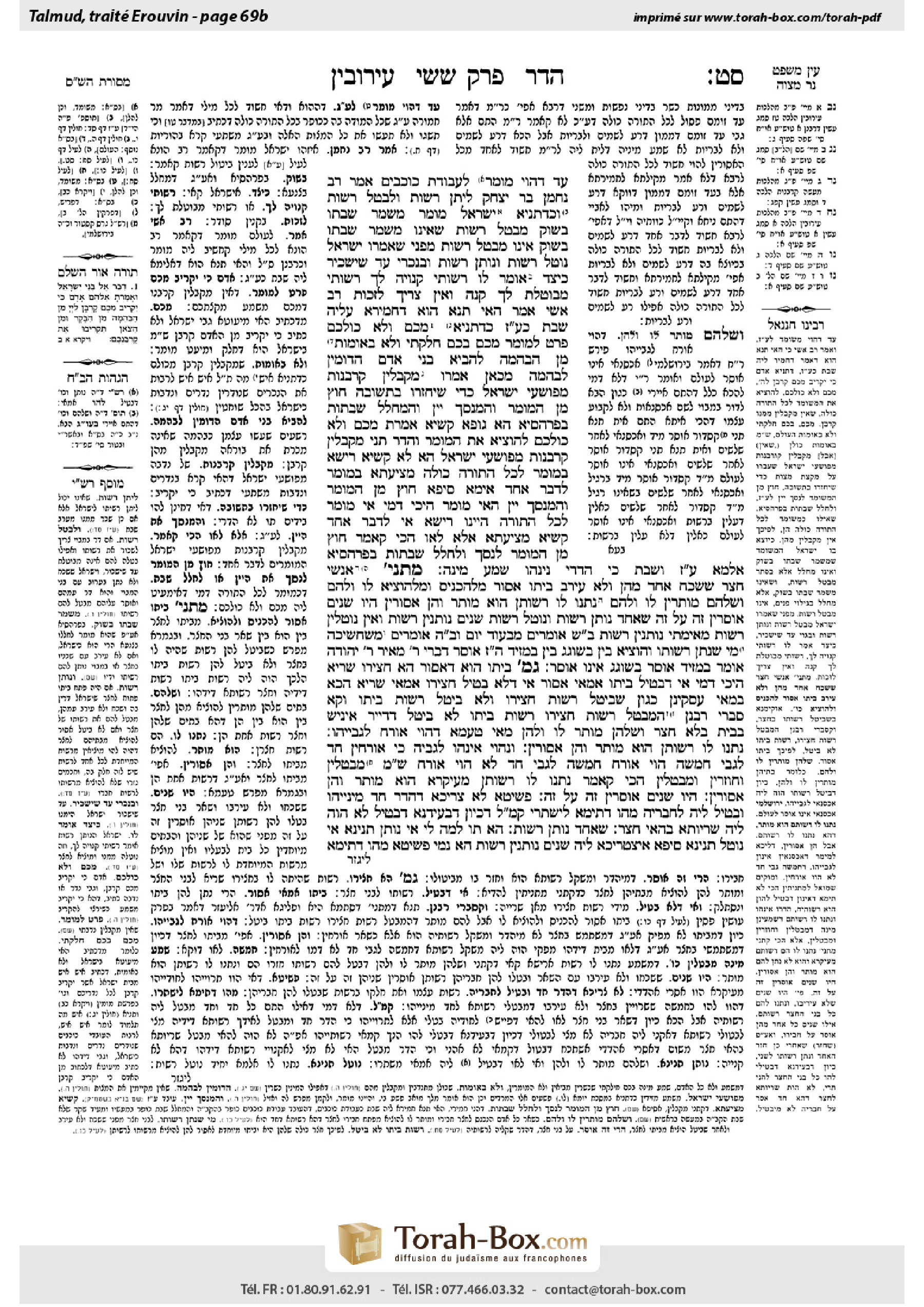
This page of Eruvin includes the Aramaic text, an English translation and an AI-generated French translation, alongside the scan above.
עירובין ס״ט ב · Aramaic and Hebrew text
עַד דְּהָוֵי מוּמָר לַעֲבוֹדָה זָרָה.
אָמַר רַב נַחְמָן בַּר יִצְחָק: לִיתֵּן רְשׁוּת וּלְבַטֵּל רְשׁוּת. וְכִדְתַנְיָא: יִשְׂרָאֵל מוּמָר, מְשַׁמֵּר שַׁבַּתּוֹ בַּשּׁוּק — מְבַטֵּל רְשׁוּת, שֶׁאֵינוֹ מְשַׁמֵּר שַׁבַּתּוֹ בַּשּׁוּק — אֵינוֹ מְבַטֵּל רְשׁוּת.
מִפְּנֵי שֶׁאָמְרוּ: יִשְׂרָאֵל נוֹטֵל רְשׁוּת וְנוֹתֵן רְשׁוּת. וּבְגוֹי, עַד שֶׁיַּשְׂכִּיר. כֵּיצַד? אוֹמֵר לוֹ: רְשׁוּתִי קְנוּיָה לָךְ, רְשׁוּתִי מְבוּטֶּלֶת לָךְ — קָנָה, וְאֵין צָרִיךְ לִזְכּוֹת.
רַב אָשֵׁי אָמַר: הַאי תַּנָּא הוּא דַּחֲמִירָא עֲלֵיהּ שַׁבָּת כַּעֲבוֹדָה זָרָה.
כִּדְתַנְיָא: ״מִכֶּם״ — וְלֹא כּוּלְּכֶם, פְּרָט לַמּוּמָר. ״מִכֶּם״ — בָּכֶם חִלַּקְתִּי, וְלֹא בָּאוּמּוֹת.
״מִן הַבְּהֵמָה״ — לְהָבִיא בְּנֵי אָדָם הַדּוֹמִין לִבְהֵמָה. מִכָּאן אָמְרוּ: מְקַבְּלִין קׇרְבָּנוֹת מִפּוֹשְׁעֵי יִשְׂרָאֵל, כְּדֵי שֶׁיַּחְזְרוּ בִּתְשׁוּבָה. חוּץ מִן הַמּוּמָר, וְהַמְנַסֵּךְ יַיִן, וְהַמְחַלֵּל שַׁבָּתוֹת בְּפַרְהֶסְיָא.
הָא גוּפָא קַשְׁיָא: אָמְרַתְּ ״מִכֶּם״ וְלֹא כּוּלְּכֶם, לְהוֹצִיא אֶת הַמּוּמָר. וַהֲדַר תָּנֵי: מְקַבְּלִין קׇרְבָּנוֹת מִפּוֹשְׁעֵי יִשְׂרָאֵל! הָא לָא קַשְׁיָא: רֵישָׁא — בְּמוּמָר לְכׇל הַתּוֹרָה כּוּלָּהּ, מְצִיעֲתָא — בְּמוּמָר לְדָבָר אֶחָד.
אֵימָא סֵיפָא: חוּץ מִן הַמּוּמָר וְהַמְנַסֵּךְ יַיִן. הַאי מוּמָר, הֵיכִי דָמֵי? אִי מוּמָר לְכׇל הַתּוֹרָה — הַיְינוּ רֵישָׁא. אִי לְדָבָר אֶחָד, קַשְׁיָא מְצִיעֲתָא.
אֶלָּא לָאו הָכִי קָאָמַר: חוּץ מִן הַמּוּמָר לְנַסֵּךְ וּלְחַלֵּל שַׁבָּתוֹת בְּפַרְהֶסְיָא. אַלְמָא עֲבוֹדָה זָרָה וְשַׁבָּת כִּי הֲדָדֵי נִינְהוּ. שְׁמַע מִינַּהּ.
מַתְנִי׳ אַנְשֵׁי חָצֵר שֶׁשָּׁכַח אֶחָד מֵהֶן וְלֹא עֵירַב — בֵּיתוֹ אָסוּר מִלְּהַכְנִיס וּמִלְּהוֹצִיא לוֹ וְלָהֶם, וְשֶׁלָּהֶם מוּתָּרִין לוֹ וְלָהֶם. נָתְנוּ לוֹ רְשׁוּתָן — הוּא מוּתָּר, וְהֵן אֲסוּרִין.
הָיוּ שְׁנַיִם — אוֹסְרִין זֶה עַל זֶה. שֶׁאֶחָד נוֹתֵן רְשׁוּת וְנוֹטֵל רְשׁוּת, שְׁנַיִם נוֹתְנִין רְשׁוּת וְאֵין נוֹטְלִין רְשׁוּת.
מֵאֵימָתַי נוֹתְנִין רְשׁוּת? בֵּית שַׁמַּאי אוֹמְרִים: מִבְּעוֹד יוֹם. בֵּית הִלֵּל אוֹמְרִים: מִשֶּׁחָשֵׁיכָה. מִי שֶׁנָּתַן רְשׁוּתוֹ וְהוֹצִיא, בֵּין בְּשׁוֹגֵג בֵּין בְּמֵזִיד — הֲרֵי זֶה אוֹסֵר, דִּבְרֵי רַבִּי מֵאִיר. רַבִּי יְהוּדָה אוֹמֵר: בְּמֵזִיד אוֹסֵר, בְּשׁוֹגֵג אֵינוֹ אוֹסֵר.
גְּמָ׳ בֵּיתוֹ הוּא דְּאָסוּר, הָא חֲצֵירוֹ שַׁרְיָא.
הֵיכִי דָמֵי? אִי דְּבַטֵּיל, בֵּיתוֹ אַמַּאי אָסוּר. אִי דְּלָא בַּטֵּיל, חֲצֵירוֹ אַמַּאי שַׁרְיָא? הָכָא בְּמַאי עָסְקִינַן, כְּגוֹן שֶׁבִּיטֵּל רְשׁוּת חֲצֵירוֹ, וְלֹא בִּיטֵּל רְשׁוּת בֵּיתוֹ. וְקָא סָבְרִי רַבָּנַן: הַמְבַטֵּל רְשׁוּת חֲצֵירוֹ — רְשׁוּת בֵּיתוֹ לֹא בִּיטֵּל, דְּדָיַיר אִינִישׁ בְּבַיִת בְּלָא חָצֵר.
וְשֶׁלָּהֶן מוּתָּר לוֹ וְלָהֶן, מַאי טַעְמָא? דְּהָוֵי אוֹרֵחַ לְגַבַּיְיהוּ.
נָתְנוּ לוֹ רְשׁוּתָן, הוּא מוּתָּר וְהֵן אֲסוּרִין. וְנֶהֱוֵי אִינְהוּ לְגַבֵּיהּ כִּי אוֹרְחִין! חַד לְגַבֵּי חֲמִשָּׁה — הָוֵי אוֹרֵחַ, חֲמִשָּׁה לְגַבֵּי חַד — לָא הָוֵי אוֹרֵחַ.
שְׁמַע מִינַּהּ, מְבַטְּלִין וְחוֹזְרִין וּמְבַטְּלִין.
הָכִי קָאָמַר: נָתְנוּ לוֹ רְשׁוּתָן מֵעִיקָּרָא — הוּא מוּתָּר וְהֵן אֲסוּרִין.
הָיוּ שְׁנַיִם אוֹסְרִין זֶה עַל זֶה. פְּשִׁיטָא? לָא צְרִיכָא, דַּהֲדַר חַד מִינַּיְיהוּ וּבַטֵּיל לֵיהּ לְחַבְרֵיהּ. מַהוּ דְּתֵימָא לִישְׁתְּרֵי, קָא מַשְׁמַע לַן דְּכֵיוָן דִּבְעִידָּנָא דְּבַטֵּיל לָא הֲוָה לֵיהּ שַׁרְיוּתָא בְּהַאי חָצֵר.
שֶׁאֶחָד נוֹתֵן רְשׁוּת. הָא תּוּ לְמָה לִי? אִי נוֹתֵן — תְּנֵינָא, אִי נוֹטֵל — תְּנֵינָא?
סֵיפָא אִיצְטְרִיכָא לֵיהּ: שְׁנַיִם נוֹתְנִין רְשׁוּת. הָא נָמֵי פְּשִׁיטָא! מַהוּ דְּתֵימָא
Eruvin 69b · English translation
unless he is an apostate with regard to idolatry. As long as he has not worshipped idols, his transgression of a single prohibition does not put him under suspicion of transgressing the rest of the Torah.
Rav Naḥman bar Yitzḥak said: Rav Huna was not attempting to offer a broad definition of an apostate, but was rather referring to the specific issue of giving away rights or renouncing rights in a domain with regard to the halakhot of eiruvin. And as it was taught in the following Tosefta: An apostate Jew, if he observes his Shabbat in the marketplace, i.e., in public, he may renounce his rights in a domain like a regular Jew, but if he does not observe his Shabbat in the marketplace, he may not renounce his rights in a domain, as he is no longer considered a Jew in this regard.
This distinction is significant due to the fact that the Sages said: A Jew may receive rights and give away rights in a domain through a mere statement of renunciation, but with regard to a gentile it is not so, as he may not transfer his rights to others or renounce them in a domain unless he actually rents it out. How so? A Jew may say to his fellow: May my rights in this domain be acquired by you, or May my rights in this domain be renounced to you, and his fellow thereby acquires those rights, and it is not necessary that he take possession of it through a formal mode of acquisition.
Rav Ashi said: Rav Huna’s statement that a Jew who desecrates Shabbat in public is an apostate is indeed a general statement, as he is no longer considered a Jew in any sense. In accordance with the opinion of which tanna did he make that statement? It is in accordance with the opinion of this tanna, for whom Shabbat is as severe as idolatry, and therefore one who desecrates Shabbat is treated like an idol worshipper.
As it was taught in a baraita with regard to the verse: “Speak to the children of Israel and say to them: When any man of you brings an offering to the Lord, you shall bring your offering of the cattle, of the herd, or of the flock” (Leviticus 1:2). The baraita expounds: “Of you,” i.e., some of you, but not all of you may bring an offering – to the exclusion of an apostate. “Of you” additionally serves to emphasize that among you, the children of Israel, I distinguish between those who observe the Torah and are fit to bring an offering, and those who are not fit, but not among the nations, i.e., in regard to the other nations, even those who do not fulfill the precepts binding upon them may offer their sacrifices.
“Of the cattle” is expounded as follows: To include people who are similar to animals in their disdain for the proper behavior of man, i.e., that the wicked too may offer sacrifices. From here the Sages stated: We accept voluntary sacrifices from Jewish transgressors, in order to enable them to repent, apart from the apostate, one who pours wine libations as part of idol worship, and one who desecrates Shabbat in public, from whom we do not accept sacrifices without their complete repentance.
The Gemara expresses surprise: This baraita itself is difficult, i.e., it contains an internal contradiction: You first said: “Of you,” but not all of you, to the exclusion of an apostate; and then you taught: We accept sacrifices from Jewish transgressors. The Gemara answers: This is not difficult, as it can be explained as follows: The first clause refers to an apostate with regard to the entire Torah, whose sacrifices are not accepted, whereas the middle clause speaks of an apostate with regard to one matter alone, whose sacrifices are indeed accepted.
The Gemara raises a difficulty: If so, say an explanation of the last clause of the mishna: Apart from the apostate and one who pours wine libations to idolatry, and one who desecrates Shabbat in public. This apostate, what are the circumstances indicating his status? If it refers to an apostate with regard to the entire Torah, this is the same as the first clause. And if it refers to an apostate with regard to only one thing, the middle clause of the baraita is difficult, for it states that we accept sacrifices from such an apostate.
Rather, is it not true that this is what it is saying: Apart from the apostate with regard to pouring wine libations to idolatry and desecrating Shabbat in public? Although they transgress only one matter, this transgression is so serious that they are considered apostates with regard to the entire Torah. It is apparent from here that idolatry and Shabbat are equivalent, which indicates that there is a tanna who considers public Shabbat desecration as severe a transgression as idolatry. The Gemara concludes: Indeed, learn from this that it is so.
MISHNA: If one of the residents of a courtyard forgot and did not participate in an eiruv with the other residents before Shabbat, and on Shabbat he renounced his rights in the courtyard to the other residents, his house is prohibited both to him, who forgot to establish an eiruv, and to them, the other residents, to bring in objects from the courtyard to his house or to take them out from his house into the courtyard. But their houses are permitted both to him and to them, for taking objects out into the courtyard and for bringing them in. If they gave away their rights in the courtyard to him, i.e., if they renounced their rights in his favor, he is permitted to carry from his house into the courtyard, but they are prohibited from doing so.
If two residents of the courtyard forgot to establish an eiruv, and the others renounced their rights in the courtyard in their favor, they prohibit one another. In this scenario, the courtyard would belong to both of them, but each individual house remains the domain of its owner. It would therefore be prohibited for each of these residents to carry into the courtyard. For one resident may give away and receive rights in a domain, whereas two residents may only give away rights in a domain, but they may not receive rights in a domain. Since they did not establish an eiruv, it is unreasonable for the other residents of the courtyard to give away their rights in the domain, as the two who are prohibited because they did not participate in the eiruv render it prohibited for each other to carry.
The mishna poses a general question: When may one give away rights in a domain? Beit Shammai say: While it is still day, i.e., before the onset of Shabbat; and Beit Hillel say: Even after nightfall, when it is already Shabbat. The mishna cites another dispute: If one gave away his rights in his courtyard to the other residents of the courtyard, renouncing them after having forgotten to establish an eiruv with them the previous day, and then he carried something out from his house into the courtyard – whether unwittingly, forgetting that he had renounced his rights, or intentionally, he renders carrying prohibited for all the residents of the courtyard, for his action cancels his renunciation; this is the statement of Rabbi Meir. Rabbi Yehuda says: If he acted intentionally, he renders carrying prohibited; but if he acted unwittingly, he does not render carrying prohibited.
GEMARA: The Gemara first analyzes the language of the mishna. It states: It is prohibited to bring in objects from the courtyard to his house and to take them out from his house into the courtyard. It can be inferred from this that it is carrying to and from his house that is prohibited, but carrying to and from his share of the courtyard is permitted to the other residents of the courtyard.
The Gemara asks: What are the circumstances where this ruling applies? If the resident who forgot to establish an eiruv renounced his rights, why is his house rendered prohibited? And if he did not renounce his rights, why is his courtyard permitted? The Gemara explains: With what are we dealing here? We are dealing with a special case, where he renounced his rights in his courtyard to the others but did not renounce his rights in his house to them. And the Rabbis hold that one who renounces his rights in his courtyard has not renounced his rights in his house, as it is common for people to reside in a house without a courtyard.
The Gemara proceeds in its analysis of the mishna: It states that carrying in and out of their houses is permitted for him and for them. The Gemara poses a question: What is the reason that their houses are permitted to him? The Gemara answers: For he is regarded like a guest of theirs, i.e., he is subordinate to them and may carry wherever they may do so.
We learned in the mishna: If the other residents gave away their rights in the courtyard to him, he is permitted to carry from his house into the courtyard, but they are prohibited from doing so. The Gemara asks: But let them, the ones who renounced their rights in the courtyard, be regarded as guests of his, which would enable them to carry as well. The Gemara answers: One vis-à-vis five is considered a guest, whereas five or more vis-à-vis one are not ordinarily viewed as guests.
The Gemara attempts to draw another inference from the wording of the mishna: Shall we not learn from this, from the order of events in the mishna, that one may renounce his rights in favor of another when he needs it, and then the latter may renounce his rights in favor of the former when he needs it? For the mishna first describes a case in which the one who forgot to establish an eiruv renounces his rights in favor of the others, at which stage they may use the courtyard, and then afterward recounts that the other residents renounce their rights in favor of the one who forgot to establish an eiruv, leaving it permitted for him and prohibited for them.
The Gemara answers: No proof can be brought from here, for this is what the mishna is saying: If they gave away their rights in the courtyard to him at the outset, it is permitted for him and it is prohibited for them. In other words, this is not a continuation of the previous clause, but a separate case.
We learned in the mishna: If two residents of a courtyard forgot to establish an eiruv, and the others renounced their rights in the courtyard in their favor, they render one another prohibited from carrying. The Gemara raises a difficulty: Isn’t this obvious? What novel teaching is stated here? The Gemara answers: No, this ruling is necessary in a case where the others renounced their rights in the courtyard in favor of the pair, and one of them then renounced his rights in favor of the other. Lest you say let it now be permitted for him to carry, the mishna teaches us that since at the time of his renunciation it was not permitted for him to carry in that courtyard, he may not renounce his rights either. Therefore, his renunciation is ineffective, and they are both prohibited from carrying.
The mishna explains: For one resident may give away and receive rights in a domain. The Gemara poses a question: Why do I need this further explanation? This ruling can be deduced from the previous cases: If the mishna wishes to teach the halakha with regard to giving away rights, we already learned that one person may give away his rights in a domain, and if it wishes to teach the halakha with regard to receiving rights, we already learned it as well, so why the repetition?
The Gemara answers: He needed it due to the ruling in the latter clause, which includes the novel teaching that two residents may give away rights in a domain. The Gemara again wonders: But this halakha as well, that even multiple residents may give away their rights in a domain, is obvious. The Gemara answers: This was stated lest you say:
Eruvin 69b · Traduction française (IA)
sauf s'il est un apostat concernant l'idolâtrie. Aussi longtemps qu'il n'a pas adoré d'idole, sa transgression d'une seule interdiction ne le met pas sous le soupçon de transgresser le reste de la Torah.
Rav Naḥman bar Yitzḥak a dit : Rav Huna ne cherchait pas à donner une définition générale d'un apostat, mais faisait référence à la question spécifique de la cession ou de la renonciation des droits dans un domaine concernant les halakhot d'eiruvin. Et comme il a été enseigné dans la Tosefta suivante : Un Juif apostat, s'il observe son Shabbat dans le marché, c'est-à-dire en public, il peut renoncer à ses droits dans un domaine comme un Juif ordinaire, mais s'il ne respecte pas son Shabbat dans le marché, il ne peut pas renoncer à ses droits dans un domaine, car il n'est plus considéré comme un Juif à cet égard.
Cette distinction est importante car les Sages ont dit : Un Juif peut recevoir des droits et les céder dans un domaine par une simple déclaration de renonciation, mais concernant un non-Juif, ce n'est pas le cas, car il ne peut pas transférer ses droits à autrui ou les renoncer dans un domaine à moins qu'il ne les loue. Comment cela se passe-t-il ? Un Juif peut dire à son camarade : Que mes droits dans ce domaine soient acquis par toi, ou Que mes droits dans ce domaine soient renoncés à toi, et son camarade acquiert ainsi ces droits, et il n'est pas nécessaire qu'il prenne possession de celui-ci par un mode formel d'acquisition.
Rav Ashi a dit : L'affirmation de Rav Huna selon laquelle un Juif qui profane le Shabbat en public est un apostat est effectivement une déclaration générale, car il n'est plus considéré comme un Juif en aucun sens. Selon l'opinion de quel tanna a-t-il fait cette déclaration ? C'est selon l'opinion de ce tanna, pour qui le Shabbat est aussi grave que l'idolâtrie, et donc celui qui profane le Shabbat est traité comme un adorateur d'idole.
Il a été enseigné dans une baraïta concernant la parole : « Parle aux enfants d'Israël et dis-leur : Quand un homme d'entre vous apporte un holocauste à l'Éternel, tu apporteras ton holocauste de bétail, de troupeau ou de troupeau » (Lévitique 1:2). La baraïta explique : « D'entre vous », c'est-à-dire certains d'entre vous, mais pas tous, peuvent apporter un holocauste – en excluant l'apostat. « D'entre vous » sert aussi à souligner que parmi vous, les enfants d'Israël, je distingue ceux qui observent la Torah et sont dignes d'apporter un holocauste, et ceux qui ne le sont pas, mais pas parmi les nations, c'est-à-dire concernant les autres nations, même celles qui ne remplissent pas les préceptes qui leur sont imposés, peuvent apporter leurs sacrifices.
« Du bétail » est expliqué comme suit : Pour inclure les gens qui sont semblables aux animaux dans leur mépris pour le comportement approprié de l'homme, c'est-à-dire que les méchants eux-mêmes peuvent apporter des sacrifices. D'où les Sages ont dit : Nous acceptons les sacrifices volontaires des transgresseurs juifs, afin de leur permettre de se repentir, à l'exception de l'apostat, celui qui verse des libations de vin en tant qu'adoration d'idole, et celui qui profane le Shabbat en public, auprès de qui nous ne acceptons pas les sacrifices sans leur repentir complet.
La Guemara exprime une surprise : cette baraïta elle-même est difficile, c'est-à-dire qu'elle contient une contradiction interne : vous avez d'abord dit : « D'entre vous », mais pas tous, en excluant l'apostat ; et ensuite vous avez enseigné : nous acceptons les sacrifices des transgresseurs juifs. La Guemara répond : cela n'est pas difficile, car cela peut être expliqué comme suit : la première clause fait référence à un apostat concernant toute la Torah, dont les sacrifices ne sont pas acceptés, tandis que la clause intermédiaire parle d'un apostat concernant une seule chose seulement, dont les sacrifices sont effectivement acceptés.
La Guemara soulève une difficulté : si c'est ainsi, dites une explication de la dernière clause de la Michna : à l'exception de l'apostat et de celui qui verse des libations de vin à l'idolâtrie et de celui qui profane le Shabbat en public. Cet apostat, quels sont les circonstances indiquant son statut ? Si cela fait référence à un apostat concernant toute la Torah, cela est le même que la première clause. Et si cela fait référence à un apostat concernant une seule chose seulement, la clause intermédiaire de la baraïta est difficile, car elle dit que nous acceptons les sacrifices de tel apostat.
Plutôt, n'est-ce pas vrai que cela dit : à l'exception de l'apostat concernant le versement de libations de vin à l'idolâtrie et la profanation du Shabbat en public ? Bien qu'ils transgressent seulement une seule chose, cette transgression est si grave qu'ils sont considérés comme des apostats concernant toute la Torah. Il est évident d'ici que l'idolâtrie et le Shabbat sont équivalents, ce qui indique qu'il y a un tanna qui considère la profanation du Shabbat en public comme une transgression aussi grave que l'idolâtrie. La Guemara conclut : effectivement, apprenez-en cela.
MICHNA : Si l'un des habitants d'un cour de jardin a oublié et n'a pas participé à un eiruv avec les autres habitants avant le Shabbat, et s'il renonce à ses droits dans le cour de jardin aux autres habitants le Shabbat, sa maison est interdite à lui, celui qui a oublié d'établir un eiruv, et aux autres, les autres habitants, pour apporter des objets du cour de jardin vers sa maison ou pour en retirer de sa maison vers le cour de jardin. Mais leurs maisons sont permises à lui et aux autres, pour en retirer des objets vers le cour de jardin et pour en apporter des objets dedans. Si ils ont cédé leurs droits dans le cour de jardin à lui, c'est-à-dire s'ils ont renoncé à leurs droits en faveur de lui, il est permis à lui de porter des objets de sa maison vers le cour de jardin, mais les autres sont interdits de le faire.
Si deux habitants du cour de la ville ont oublié d'établir un eiruv, et que les autres ont renoncé à leurs droits dans le cour en faveur de ces deux, ils s'interdisent mutuellement. Dans ce cas, le cour appartiendrait aux deux, mais chaque maison individuelle reste le domaine de son propriétaire. Il en résulterait donc que chaque résident ne pourrait pas porter quelque chose dans le cour. En effet, un résident peut donner et recevoir des droits dans un domaine, tandis que deux résidents peuvent seulement donner des droits dans un domaine, mais ne peuvent pas recevoir des droits dans un domaine. Puisque ces deux n'ont pas établi un eiruv, il est incohérent que les autres résidents du cour donnent leurs droits dans le domaine, car les deux qui sont interdits à cause de leur non-participation à l'eiruv rendent mutuellement l'usage du cour interdit.
La mitsva pose une question générale : Dans quel cas peut-on donner des droits dans un domaine ? Beit Shammai disent : Tant qu'il fait jour, c'est-à-dire avant l'entrée du sabbat ; et Beit Hillel disent : Même après le coucher du soleil, quand il est déjà sabbat. La mitsva cite un autre débat : Si l'on a donné ses droits dans son cour aux autres résidents du cour, et qu'il les a renonçés après avoir oublié d'établir un eiruv avec eux la veille, et qu'il a ensuite transporté quelque chose de sa maison dans le cour – qu'il l'ait fait sans conscience de ce qu'il avait renoncé à ses droits, ou intentionnellement – il rend l'usage du cour interdit à tous les résidents du cour, car son action annule sa renonciation ; c'est l'opinion de Rabbi Meir. Rabbi Yehuda dit : Si l'action a été intentionnelle, il rend l'usage du cour interdit ; mais si l'action a été involontaire, il ne rend pas l'usage du cour interdit.
GUEMARA : La Guemara commence par analyser la formulation de la mitsna. Elle dit : Il est interdit de ramener des objets du cour dans sa maison et de les enlever de sa maison dans le cour. On peut en déduire que c'est l'usage de la maison qui est interdit, mais l'usage de sa part du cour est permis aux autres résidents du cour.
La Guemara pose une question : Dans quelles circonstances cette décision s'applique-t-elle ? Si le résident qui a oublié d'établir un eiruv a renoncé à ses droits, pourquoi sa maison est-elle interdite ? Et si il n'a pas renoncé à ses droits, pourquoi son cour est-il permis ? La Guemara explique : De quoi sommes-nous en train de parler ? Nous parlons d'un cas particulier, où il a renoncé à ses droits dans son cour aux autres mais n'a pas renoncé à ses droits dans sa maison. Et les Rabbins considèrent que celui qui renonce à ses droits dans son cour n'a pas renoncé à ses droits dans sa maison, car il est courant que les gens habitent une maison sans cour.
La Guemara poursuit son analyse de la mitsna : Elle dit que l'usage d'aller et venir dans leurs maisons est permis pour lui et pour eux. La Guemara pose une question : Quel est le motif qui permet à leurs maisons d'être permises pour lui ? La Guemara répond : Parce qu'il est considéré comme un invité des leurs, c'est-à-dire qu'il est soumis à eux et peut porter partout où ils peuvent porter.
Nous avons appris dans la Michna : Si les autres résidents ont donné leurs droits dans le courtyard à lui, il est permis à lui de porter de sa maison dans le courtyard, mais ils sont interdits de le faire. La Guemara pose la question : Mais laissent-les, ceux qui ont renoncé à leurs droits dans le courtyard, être considérés comme des invités de la sienne, ce qui permettrait à eux de porter aussi. La Guemara répond : Un vis-à-vis cinq est considéré comme un invité, tandis que cinq ou plus vis-à-vis un ne sont pas normalement vus comme des invités.
La Guemara tente de tirer une autre conséquence de la formulation de la Michna : Ne devons-nous pas apprendre de cela, de l'ordre des événements dans la Michna, que l'on peut renoncer à ses droits en faveur d'un autre lorsqu'on en a besoin, et ensuite que l'autre puisse renoncer à ses droits en faveur du premier lorsqu'il en a besoin ? Car la Michna décrit d'abord un cas où celui qui a oublié d'établir un eiruv renonce à ses droits en faveur des autres, à ce stade ils peuvent utiliser le courtyard, et ensuite raconte que les autres résidents renoncent à leurs droits en faveur de celui qui a oublié d'établir un eiruv, laissant ainsi l'usage permis pour lui et interdit pour eux.
La Guemara répond : On ne peut pas tirer de preuve de cela, car c'est ce que la Michna dit : Si ils ont donné leurs droits dans le courtyard à lui dès le début, il est permis pour lui et interdit pour eux. En d'autres termes, cela n'est pas une continuation du précédent point, mais un cas séparé.
Nous avons appris dans la Michna : Si deux résidents d'un cour ont oublié d'établir un eiruv, et que les autres ont renoncé à leurs droits dans le cour en leur faveur, ils s'interdisent mutuellement l'usage. La Guemara soulève une difficulté : N'est-ce pas évident ? Quel enseignement nouveau est-il dit ici ? La Guemara répond : Non, cette décision est nécessaire dans un cas où les autres ont renoncé à leurs droits dans le cour en faveur du couple, et que l'un d'eux a ensuite renoncé à ses droits en faveur de l'autre. De peur que vous disiez qu'il est maintenant permis à lui d'employer, la Michna nous apprend que puisque lors de sa renonciation il n'était pas permis à lui d'employer ce cour, il ne peut pas renoncer à ses droits non plus. Ainsi, sa renonciation est inefficace, et ils sont tous deux interdits à l'usage.
La Michna explique : Un résident peut donner et recevoir des droits dans un domaine. La Guemara pose une question : Pourquoi avons-nous besoin d'une telle explication supplémentaire ? Cette décision peut être déduite des cas précédents : Si la Michna veut enseigner la halakha concernant la donation de droits, nous avons déjà appris que l'un peut donner ses droits dans un domaine, et si elle veut enseigner la halakha concernant la réception de droits, nous l'avons aussi apprise, donc pourquoi la répétition ?
Le Guemara répond : Il en avait besoin en raison de la décision contenue dans la clause suivante, qui inclut l'enseignement nouveau selon lequel deux résidents peuvent céder des droits sur un domaine. Le Guemara se demande à nouveau : Mais cette halakha également, selon laquelle même plusieurs résidents peuvent céder leurs droits sur un domaine, est évidente. Le Guemara répond : Cela a été dit afin que vous ne disiez pas :
Traduction française générée par IA à partir de l’édition anglaise de Sefaria. Vérifie toujours un passage avec le texte source.
Text from Sefaria: William Davidson Edition - Vocalized Aramaic (CC BY NC); William Davidson Edition - English (CC BY NC).