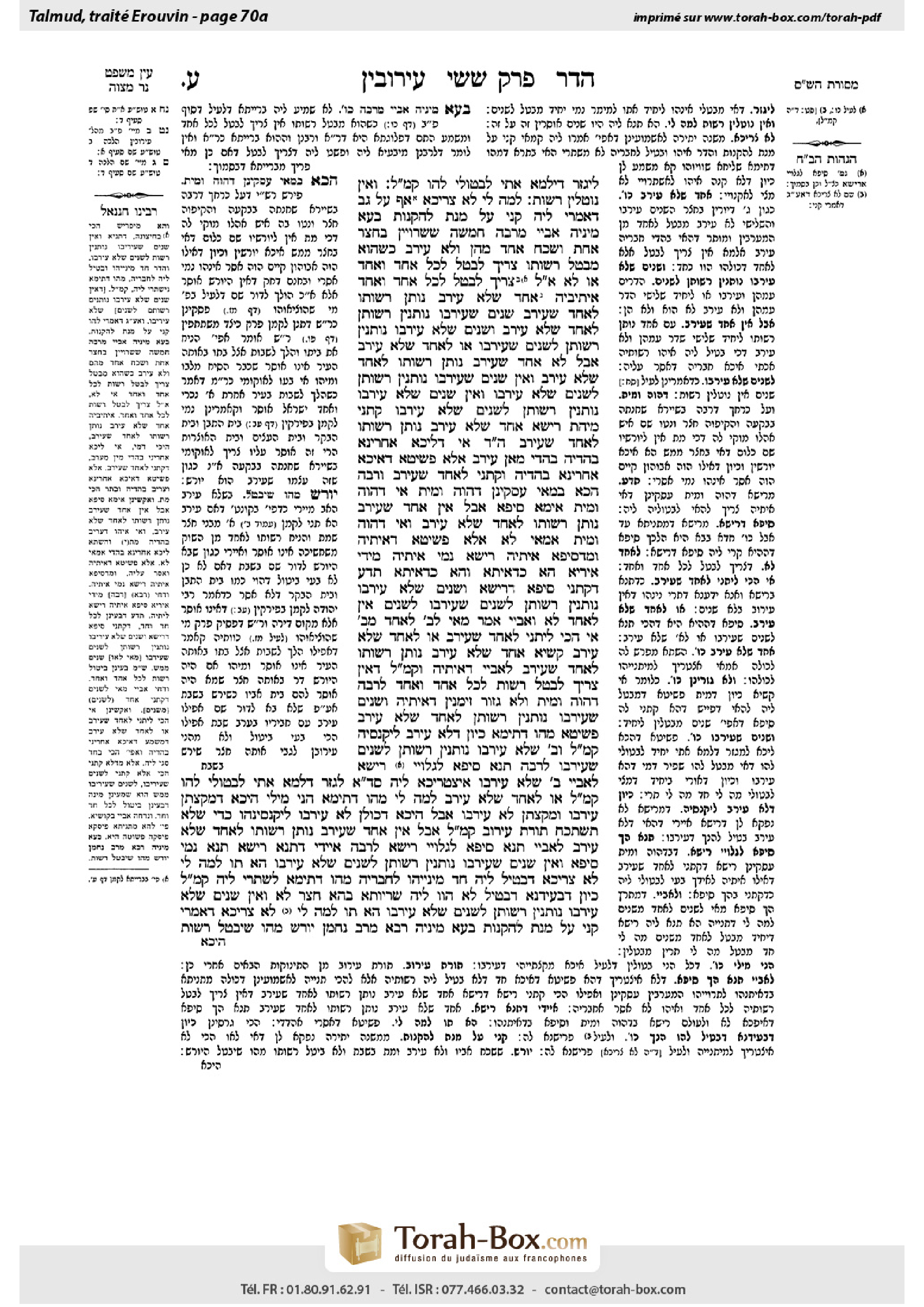
Eruvin 70a: Talmud study for Daf Yomi
Study the Talmud for Daf Yomi with scanned pages, Hebrew text, English translations from Sefaria and AI-generated French translations.
Passage selection and English or AI-generated French translation are available where the scan has annotations. Daf Study is independent of Torah-Box and Sefaria.
Browse Eruvin · עירובין · All tractatesEruvin 70a text and translations
This page of Eruvin includes the Aramaic text, an English translation and an AI-generated French translation, alongside the scan above.
עירובין ע׳ א · Aramaic and Hebrew text
לִיגְזַר דִּילְמָא אָתֵי לְבַטּוֹלֵי לְהוּ. קָא מַשְׁמַע לַן.
וְאֵין נוֹטְלִין רְשׁוּת. לְמָה לִי? לָא צְרִיכָא, אַף עַל גַּב דְּאָמְרִי לֵיהּ: קְנִי עַל מְנָת לְהַקְנוֹת.
בְּעָא מִינֵּיהּ אַבָּיֵי מֵרַבָּה: חֲמִשָּׁה שֶׁשְּׁרוּיִין בְּחָצֵר אַחַת, וְשָׁכַח אֶחָד מֵהֶן וְלֹא עֵירַב, כְּשֶׁהוּא מְבַטֵּל רְשׁוּתוֹ צָרִיךְ לְבַטֵּל לְכׇל אֶחָד וְאֶחָד אוֹ לָא? אֲמַר לֵיהּ: צָרִיךְ לְבַטֵּל לְכׇל אֶחָד וְאֶחָד.
אֵיתִיבֵיהּ: אֶחָד שֶׁלֹּא עֵירַב נוֹתֵן רְשׁוּתוֹ לְאֶחָד שֶׁעֵירַב, שְׁנַיִם שֶׁעֵירְבוּ נוֹתְנִין רְשׁוּתָן לְאֶחָד שֶׁלֹּא עֵירַב, וּשְׁנַיִם שֶׁלֹּא עֵירְבוּ נוֹתְנִין רְשׁוּתָן לִשְׁנַיִם שֶׁעֵירְבוּ, אוֹ לְאֶחָד שֶׁלֹּא עֵירַב.
אֲבָל לֹא אֶחָד שֶׁעֵירַב נוֹתֵן רְשׁוּתוֹ לְאֶחָד שֶׁלֹּא עֵירַב, וְאֵין שְׁנַיִם שֶׁעֵירְבוּ נוֹתְנִין רְשׁוּתָן לִשְׁנַיִם שֶׁלֹּא עֵירְבוּ, וְאֵין שְׁנַיִם שֶׁלֹּא עֵירְבוּ נוֹתְנִין רְשׁוּתָן לִשְׁנַיִם שֶׁלֹּא עֵירְבוּ.
קָתָנֵי מִיהַת רֵישָׁא: אֶחָד שֶׁלֹּא עֵירַב — נוֹתֵן רְשׁוּתוֹ לְאֶחָד שֶׁעֵירַב. הֵיכִי דָמֵי? אִי דְּלֵיכָּא אַחֲרִינָא בַּהֲדֵיהּ, בַּהֲדֵי מַאן עֵירַב?
אֶלָּא פְּשִׁיטָא — דְּאִיכָּא אַחֲרִינָא בַּהֲדֵיהּ, וְקָתָנֵי: לְאֶחָד שֶׁעֵירַב!
וְרַבָּה: הָכָא בְּמַאי עָסְקִינַן, דַּהֲוָה וּמִית.
אִי דַּהֲוָה וּמִית — אֵימָא סֵיפָא, אֲבָל אֵין אֶחָד שֶׁעֵירַב נוֹתֵן רְשׁוּתוֹ לְאֶחָד שֶׁלֹּא עֵירַב. וְאִי דַּהֲוָה וּמִית, אַמַּאי לָא!
אֶלָּא פְּשִׁיטָא דְּאִיתֵיהּ. וּמִדְּסֵיפָא אִיתֵיהּ, רֵישָׁא נָמֵי אִיתֵיהּ.
מִידֵּי אִירְיָא? הָא כִּדְאִיתָא, וְהָא כִּדְאִיתָא.
תֵּדַע, דְּקָתָנֵי סֵיפָא דְּרֵישָׁא: וּשְׁנַיִם שֶׁלֹּא עֵירְבוּ, נוֹתְנִין רְשׁוּתָן לִשְׁנַיִם שֶׁעֵירְבוּ. לִשְׁנַיִם אִין! לְאֶחָד לָא.
וְאַבָּיֵי אָמַר: מַאי ״לִשְׁנַיִם״ — לְאֶחָד מִשְּׁנַיִם. אִי הָכִי לִיתְנֵי: לְאֶחָד שֶׁעֵירַב אוֹ לְאֶחָד שֶׁלֹּא עֵירַב. קַשְׁיָא.
אֶחָד שֶׁלֹּא עֵירַב נוֹתֵן רְשׁוּתוֹ לְאֶחָד שֶׁעֵירַב. לְאַבָּיֵי דְּאִיתֵיהּ, וְקָא מַשְׁמַע לַן: דְּאֵין צָרִיךְ לְבַטֵּל רְשׁוּת לְכׇל אֶחָד וְאֶחָד. לְרַבָּה דַּהֲוָה וּמִית, וְלָא גְּזוּר זִימְנִין דְּאִיתֵיהּ.
וּשְׁנַיִם שֶׁעֵירְבוּ נוֹתְנִין רְשׁוּתָן לְאֶחָד שֶׁלֹּא עֵירַב. פְּשִׁיטָא? מַהוּ דְּתֵימָא כֵּיוָן דְּלָא עֵירַב — לִיקְנְסֵיהּ, קָא מַשְׁמַע לַן.
וּשְׁנַיִם שֶׁלֹּא עֵירְבוּ נוֹתְנִין רְשׁוּתָן לִשְׁנַיִם שֶׁעֵירְבוּ. לְרַבָּה — תְּנָא סֵיפָא לְגַלּוֹיֵי רֵישָׁא, לְאַבָּיֵי — שְׁנַיִם שֶׁלֹּא עֵירְבוּ אִיצְטְרִיכָא לֵיהּ, סָלְקָא דַּעְתָּךְ אָמֵינָא: לִגְזַר דִּלְמָא אָתֵי לְבַטּוֹלֵי לְהוּ. קָא מַשְׁמַע לַן.
אוֹ לְאֶחָד שֶׁלֹּא עֵירַב. לְמָה לִי? מַהוּ דְּתֵימָא: הָנֵי מִילֵּי — הֵיכָא דְּמִקְצָתָן עֵירְבוּ וּמִקְצָתָן לֹא עֵירְבוּ. אֲבָל הֵיכָא דְּכוּלָּן לֹא עֵירְבוּ — לִיקְנְסִינְהוּ, כְּדֵי שֶׁלֹּא תִּשְׁתַּכַּח תּוֹרַת עֵירוּב, קָא מַשְׁמַע לַן.
אֲבָל אֵין אֶחָד שֶׁעֵירַב נוֹתֵן רְשׁוּתוֹ לְאֶחָד שֶׁלֹּא עֵירַב. לְאַבָּיֵי — תְּנָא סֵיפָא לְגַלּוֹיֵי רֵישָׁא, לְרַבָּה — אַיְּידֵי דִּתְנָא רֵישָׁא תְּנָא נָמֵי סֵיפָא.
וְאֵין שְׁנַיִם שֶׁעֵירְבוּ נוֹתְנִין רְשׁוּתָן לִשְׁנַיִם שֶׁלֹּא עֵירְבוּ. הָא תּוּ לְמָה לִי? לָא צְרִיכָא, דְּבַטֵּיל לֵיהּ חַד מִינַּיְיהוּ לְחַבְרֵיהּ. מַהוּ דְּתֵימָא: לִשְׁתְּרֵי לֵיהּ, קָא מַשְׁמַע לַן: כֵּיוָן דִּבְעִידָּנָא דְּבַטֵּיל לָא הֲווֹ לֵיהּ שַׁרְיוּתָא בְּהָא חָצֵר — לָא.
וְאֵין שְׁנַיִם שֶׁלֹּא עֵירְבוּ נוֹתְנִין רְשׁוּתָן לִשְׁנַיִם שֶׁלֹּא עֵירְבוּ. הָא תּוּ לְמָה לִי? לָא צְרִיכָא, דְּאָמְרִי: קְנִי עַל מְנָת לְהִקָּנוֹת.
בְּעָא מִינֵּיהּ רָבָא מֵרַב נַחְמָן: יוֹרֵשׁ מַהוּ שֶׁיְּבַטֵּל רְשׁוּת.
Eruvin 70a · English translation
Let us issue a decree that two residents may not give away their rights in a domain, lest people come to renounce their rights in favor of two residents as well. People might assume that just as two may give away their rights to one, so too may one give away his rights to two. The mishna therefore teaches us that we do not issue such a decree.
We learned in the mishna: But two may not receive rights in a domain. The Gemara poses a question: Why do I need to say this? Isn’t it superfluous? The Gemara answers: No, it is necessary to teach that rights may not be acquired even if the other residents of the courtyard say to one of the two who did not establish an eiruv: Acquire our rights in the courtyard on condition that you transfer them in turn to your friend, the other one who did not establish an eiruv. The mishna teaches that he does not become their agent and cannot transfer the rights to the other person, as he himself cannot receive such rights under these circumstances.
Abaye raised a dilemma before Rabba: If five people live in the same courtyard, and one of them forgot to join in an eiruv, when he renounces his rights in the courtyard, must he renounce them in favor of each and every one of the others or not? Rabba said to him: He must renounce his rights in favor of each and every one.
Abaye raised an objection from the following baraita: One resident of a courtyard who did not establish an eiruv may renounce his rights in the courtyard in favor of one who did establish an eiruv. Two courtyard residents who established an eiruv may also renounce their rights in the courtyard in favor of one who did not establish an eiruv. And similarly, two courtyard residents who did not establish an eiruv may renounce their rights in the courtyard in favor of two residents who did establish an eiruv or in favor of one resident who did not establish an eiruv.
But one courtyard resident who did establish an eiruv may not renounce his rights in the courtyard in favor of one resident who did not establish an eiruv, nor may two residents who established an eiruv renounce their rights in the courtyard in favor of two other residents who did not establish an eiruv, nor may two residents who did not establish an eiruv renounce their rights in the courtyard in favor of two residents who did not establish an eiruv.
In any event the first clause is teaching: One resident of a courtyard who did not establish an eiruv may renounce his rights in the courtyard in favor of one who did establish an eiruv. What are the circumstances surrounding this case? If there is no other resident with him, i.e., if there were only two people living in the courtyard, with whom did he, the other resident, establish an eiruv? He could not have established an eiruv on his own.
Rather, it is obvious that there is another resident with him, apart from the one who failed to establish an eiruv, and yet it states: He may renounce his rights in the courtyard in favor of one who did establish an eiruv, which implies that it is enough for him to renounce his rights in favor of one of the residents. He does not have to renounce his rights in favor of all of them.
The Gemara now asks: And how does Rabba understand this teaching? The Gemara answers: Rabba can say as follows: With what are we dealing here? This is a special case, where there was another person in the courtyard with whom he established the eiruv, but that person died in the meantime, leaving only one who established an eiruv, to whom the one who did not establish an eiruv may renounce his rights.
The Gemara raises a difficulty: If it indeed refers to a case where there was another person, but he died, say an explanation for the latter clause of the baraita: But one courtyard resident who did establish an eiruv may not renounce his rights in favor of one who did not establish an eiruv. Now if it refers to a case where there was at first another person but he died, why may the one courtyard resident not renounce his rights in the courtyard? Now there is only one other person present in the courtyard.
Rather, it is obvious that there is another person present, with whom the eiruv was established. And since the latter clause of the baraita deals with a case where there is another person present, the first clause of the baraita must also be dealing with a case where there is another person present.
The Gemara rejects this proof: Is this necessarily the designation in both cases? Must the two clauses necessarily be dealing with the same case? This case as it is, and this case as it is, i.e., each clause deals with a unique set of circumstances, which need not accord with each other.
The Gemara adds: Know that this baraita does not only deal with one state of affairs, for the last part of the first clause teaches: And two courtyard residents who did not establish an eiruv may renounce their rights in the courtyard in favor of two residents who did establish an eiruv. It can be inferred from this that in favor of two residents, yes, they may renounce their rights, but in favor of one, no, they may not. This clearly indicates that they must renounce their rights in the courtyard in favor of both of them.
And Abaye can say: What is the meaning of in favor of two? In favor of one of the two, for this is as effective as renouncing their rights in favor of both of them. The Gemara raises a difficulty: If so, let it teach that the two courtyard residents who did not establish an eiruv may renounce their rights in the courtyard in favor of one resident who established an eiruv or in favor of one resident who did not establish an eiruv, from which one would understand that there are two present, for otherwise there could be no eiruv. The Gemara concludes: This is indeed difficult according to Abaye’s opinion, although it does not completely refute his opinion.
The Gemara now explains the need for each clause of the baraita. The baraita opens: One resident of a courtyard who did not establish an eiruv may renounce his rights in favor of one who did establish an eiruv. According to Abaye, this refers to a case where there is another person present, and it teaches us that he need not renounce his rights in the courtyard in favor of each and every one of the others. According to Rabba, this refers to a case where there was another person in the courtyard, with whom he established the eiruv, but that person died in the meantime, and the novel teaching is that the Sages did not issue a decree due to the concern that sometimes that other person is still present.
The baraita continues: Two courtyard residents who established an eiruv may renounce their rights in the courtyard in favor of one who did not establish an eiruv. The Gemara poses a question: Isn’t this obvious? What new halakha is being taught here? The Gemara answers: Lest you say that since he did not establish an eiruv, we should penalize him by insisting that he renounce his rights in their favor and not the reverse, therefore the baraita teaches us that it is permitted even for the ones who established an eiruv to renounce their rights in his favor.
It was further taught in the baraita: And similarly, two courtyard residents who did not establish an eiruv may renounce their rights in the courtyard in favor of two residents who established an eiruv. According to Rabba, the baraita taught the latter clause to shed light on the first clause. As the latter clause teaches that one must renounce rights to every resident in the courtyard, the first clause must refer to the case where the additional resident passed away, for otherwise, he would not be able to renounce his rights to only one of the residents of the courtyard. According to Abaye, it was necessary for the mishna to teach the halakha in the case of two who did not establish an eiruv. For it could enter your mind to say that we should issue a decree determining that the two residents who did not establish an eiruv may not renounce their rights in favor of the two residents who established an eiruv, lest the two who established an eiruv come to renounce their rights in favor of the two who did not. The baraita, therefore, teaches us that we do not issue such a decree.
The baraita continues: Or they may renounce their rights in favor of one who did not establish an eiruv. The Gemara poses a question: Why do I need this addition? The Gemara explains: Lest you say that these permissive rulings with regard to renunciation apply only in a case where some of the residents established an eiruv and some of them did not establish an eiruv. But in a case where none of the residents established an eiruv, we should penalize them by not allowing renunciation, so that the halakhic category of eiruv should not be forgotten by those who come after them. The baraita, therefore, teaches us that we are not concerned about this.
We further learned in the baraita: But one courtyard resident who did establish an eiruv may not renounce his rights in the courtyard in favor of one who did not establish an eiruv. According to Abaye, the baraita taught the latter clause to shed light on the first clause, for Abaye proves from here that a person may renounce his rights to one of the two courtyard residents, and need not renounce his rights to both of them. According to Rabba, since the baraita taught the first clause in a certain style, it also taught the latter clause in that same style, but no halakhic conclusion can be garnered from here.
The baraita further states: Nor may two residents who established an eiruv renounce their rights in the courtyard in favor of two other residents who did not establish an eiruv. The Gemara raises a difficulty: Why do I need this further matter? Isn’t this statement superfluous? The Gemara answers: No, it is necessary for the case where one of the two who did not establish an eiruv subsequently renounced his rights in favor of his fellow resident. Lest you say that it should now be permitted to carry, as there is only one person left who has any rights in the courtyard and failed to establish an eiruv, therefore it teaches us that since at the time of his renunciation he was not permitted in that courtyard, he may not renounce his rights in it, and therefore carrying is prohibited for both.
The baraita concludes: Nor may two residents who did not establish an eiruv renounce their rights in the courtyard in favor of two residents who did not establish an eiruv. The Gemara poses the question: Why do I need this additional matter? Isn’t it superfluous? The Gemara answers: No, it is necessary for the case where the other courtyard residents said to one of the first two who did not establish an eiruv: Acquire our rights in the courtyard on condition that you transfer them in turn to your friend, the other one who did not establish an eiruv. They attempted to appoint one of them as an agent to transfer the collective rights to the other. The baraita teaches us that this method is ineffective.
Rava raised a dilemma before Rav Naḥman: With regard to an heir, what is the halakha regarding whether he may renounce rights in a courtyard? If a person who had forgotten to establish an eiruv died on Shabbat, may his heir renounce his rights in his stead?
Eruvin 70a · Traduction française (IA)
Émettons un décret selon lequel deux résidents ne peuvent pas céder leurs droits sur un domaine, afin que les gens ne viennent pas à renoncer leurs droits en faveur de deux résidents également. Les gens pourraient penser que tout comme deux peuvent céder leurs droits à un seul, ainsi un seul peut céder ses droits à deux. La mitsva nous apprend donc que nous ne décrétions pas un tel décret.
Nous avons appris dans la mitsva : Mais deux ne peuvent pas recevoir des droits sur un domaine. La Guemara pose une question : Pourquoi dois-je dire cela ? N'est-ce pas superflu ? La Guemara répond : Non, il est nécessaire d'apprendre que les droits ne peuvent pas être acquis même si les autres résidents du courtil disent à l'un des deux qui n'a pas établi un eiruv : Acquiers nos droits sur le courtil à la condition que tu les transfères à ton ami, l'autre qui n'a pas établi un eiruv. La mitsva apprend que celui-ci ne devient pas leur agent et ne peut pas transférer les droits à l'autre personne, car lui-même ne peut pas acquérir de tels droits dans ces circonstances.
Abaye a posé un dilemme devant Rabba : Si cinq personnes habitent dans le même courtil, et l'une d'entre elles a oublié de participer à un eiruv, lorsqu'il renonce à ses droits dans le courtil, doit-il renoncer à ses droits en faveur de chacun des autres ou non ? Rabba a dit à lui : Il doit renoncer à ses droits en faveur de chacun des autres.
Abaye souleva un objet contre la baraïta suivante : Un résident d'un courtil qui n'avait pas établi un eiruv peut renoncer à ses droits dans le courtil en faveur d'un résident qui avait établi un eiruv. Deux résidents d'un courtil qui avaient établi un eiruv peuvent également renoncer à leurs droits dans le courtil en faveur d'un résident qui n'avait pas établi un eiruv. De même, deux résidents d'un courtil qui n'avaient pas établi un eiruv peuvent renoncer à leurs droits dans le courtil en faveur de deux résidents qui avaient établi un eiruv ou en faveur d'un résident qui n'avait pas établi un eiruv.
Mais un résident d'un courtil qui avait établi un eiruv ne peut pas renoncer à ses droits dans le courtil en faveur d'un résident qui n'avait pas établi un eiruv, ni deux résidents qui avaient établi un eiruv ne peuvent renoncer à leurs droits dans le courtil en faveur de deux autres résidents qui n'avaient pas établi un eiruv, ni deux résidents qui n'avaient pas établi un eiruv ne peuvent renoncer à leurs droits dans le courtil en faveur de deux résidents qui n'avaient pas établi un eiruv.
En tout cas, la première clause enseigne : Un résident d'un courtil qui n'avait pas établi un eiruv peut renoncer à ses droits dans le courtil en faveur d'un résident qui avait établi un eiruv. Quelles sont les circonstances de ce cas ? S'il n'y a pas d'autre résident avec lui, c'est-à-dire s'il n'y avait que deux personnes dans le courtil, avec qui l'autre résident a-t-il établi un eiruv ? Il ne pouvait pas l'établir seul.
Plutôt, il est évident qu'il y a un autre résident avec lui, en dehors de celui qui n'a pas réussi à établir un eiruv, et pourtant il est dit : Il peut renoncer à ses droits dans le courtil en faveur d'un qui a établi un eiruv, ce qui implique qu'il suffit qu'il renonce à ses droits en faveur d'un des résidents. Il n'a pas besoin de renoncer à ses droits en faveur de tous ceux-ci.
La Guemara pose maintenant une question : Et comment Rabba comprend-il cette enseignement ? La Guemara répond : Rabba peut dire comme suit : Avec quoi sommes-nous en train de nous occuper ici ? C'est un cas particulier, où il y avait une autre personne dans le courtil avec qui il a établi l'eiruv, mais cette personne est décédée en temps voulu, laissant seulement un qui a établi l'eiruv, à qui le résident qui n'a pas établi l'eiruv peut renoncer à ses droits.
La Guemara soulève une difficulté : Si cela fait référence effectivement à un cas où il y avait une autre personne, mais celle-ci est décédée, expliquez la dernière clause de la baraïta : Mais un résident d'un courtil qui a établi un eiruv ne peut pas renoncer à ses droits en faveur d'un qui n'a pas établi un eiruv. Maintenant, si cela fait référence à un cas où il y avait d'abord une autre personne mais celle-ci est décédée, pourquoi le résident d'un courtil ne peut-il pas renoncer à ses droits dans le courtil ? Maintenant, il n'y a plus qu'un autre résident présent dans le courtil.
Plutôt, il est évident qu'il y a une autre personne présente, avec qui l'eiruv a été établi. Et puisque la dernière clause de la baraïta traite d'un cas où une autre personne est présente, la première clause de la baraïta doit également traiter d'un cas où une autre personne est présente.
La Guemara rejette cette preuve : Est-ce que cette situation est nécessairement la même dans les deux cas ? Les deux clauses doivent-elles nécessairement traiter du même cas ? Cette situation telle qu'elle est, et cette situation telle qu'elle est, c'est-à-dire chaque clause traite d'un ensemble de circonstances unique, qui n'a pas besoin de correspondre aux autres.
La Guemara ajoute : Sachez que cette baraïta ne traite pas seulement d'une situation particulière, car la dernière partie de la première clause enseigne : Et deux résidents d'un courtil qui n'ont pas établi un eiruv peuvent renoncer à leurs droits dans le courtil en faveur de deux résidents qui ont établi un eiruv. On peut en déduire que, en faveur de deux résidents, oui, ils peuvent renoncer à leurs droits, mais en faveur d'un seul, non, ils ne peuvent pas. Cela montre clairement qu'ils doivent renoncer à leurs droits dans le courtil en faveur des deux.
Et Abaye peut dire : Quelle est la signification de « en faveur de deux » ? En faveur d'un des deux, car cela est aussi efficace que renoncer à leurs droits en faveur des deux. La Guemara soulève une difficulté : Si c'est ainsi, pourquoi ne pas enseigner que les deux résidents du courtil qui n'ont pas établi un eiruv peuvent renoncer à leurs droits dans le courtil en faveur d'un résident qui a établi un eiruv ou en faveur d'un résident qui n'a pas établi un eiruv, d'où l'on pourrait comprendre qu'il y a deux personnes présentes, car autrement il n'y aurait pas d'eiruv. La Guemara conclut : Cela est effectivement difficile selon l'opinion d'Abaye, bien qu'il ne la réfute pas entièrement.
La Guemara explique maintenant la nécessité de chaque clause de la baraïta. La baraïta commence par : Un résident d'un cour de jardin qui n'a pas établi un eiruv peut renoncer à ses droits en faveur d'un autre qui a établi un eiruv. Selon Abaye, cela se réfère à un cas où une autre personne est présente, et cela nous apprend que l'on n'a pas besoin de renoncer à ses droits en faveur de chacun des autres. Selon Rabba, cela se réfère à un cas où une autre personne était présente dans le cour de jardin, avec qui il avait établi l'eiruv, mais que cette personne est décédée depuis, et la nouvelle enseignement est que les Sages n'ont pas émis un décret en raison de la crainte que parfois cette autre personne soit encore présente.
La baraïta continue : Deux résidents d'un cour de jardin qui ont établi un eiruv peuvent renoncer à leurs droits dans le cour de jardin en faveur d'un autre qui n'a pas établi un eiruv. La Guemara pose une question : N'est-ce pas évident ? Quelle nouvelle halakha est ici enseignée ? La Guemara répond : Pour éviter que vous ne disiez que puisque l'autre n'a pas établi un eiruv, nous devons le pénaliser en exigeant qu'il renonce à ses droits en leur faveur et non l'inverse, donc la baraïta nous apprend que même ceux qui ont établi un eiruv peuvent renoncer à leurs droits en faveur de celui qui n'a pas établi un eiruv.
Il fut également enseigné dans la baraïta : De même, deux résidents d'un cour de jardin qui n'ont pas établi un eiruv peuvent renoncer à leurs droits dans le cour de jardin en faveur de deux résidents qui ont établi un eiruv. Selon Rabba, la baraïta a enseigné cette dernière clause pour éclairer la première clause. Comme la dernière clause enseigne qu'il faut renoncer à ses droits en faveur de chaque résident du cour de jardin, la première clause doit se référer au cas où le résident supplémentaire est décédé, sinon il ne pourrait pas renoncer à ses droits qu'en faveur d'un seul des résidents du cour de jardin. Selon Abaye, il était nécessaire que la Michna enseigne cette halakha dans le cas de deux résidents qui n'ont pas établi un eiruv. Car il pourrait entrer en vous l'idée que nous devons émettre un décret déterminant que les deux résidents qui n'ont pas établi un eiruv ne peuvent pas renoncer à leurs droits en faveur des deux résidents qui ont établi un eiruv, de peur que les deux qui ont établi un eiruv viennent renoncer à leurs droits en faveur des deux qui n'ont pas établi un eiruv. La baraïta nous apprend donc que nous ne décrétions pas cela.
La baraïta continue : Ou ils peuvent renoncer à leurs droits en faveur d'un résident qui n'a pas établi un eiruv. La Guemara pose une question : Pourquoi ai-je besoin de cette addition ? La Guemara explique : Pour éviter que vous ne disiez que ces règles permises concernant le renoncement s'appliquent uniquement dans un cas où certains des résidents ont établi un eiruv et d'autres n'ont pas établi un eiruv. Mais dans un cas où aucun des résidents n'a établi un eiruv, nous devrions les pénaliser en ne permettant pas le renoncement, afin que la catégorie halakhique de l'eiruv ne soit pas oubliée par ceux qui viennent après. La baraïta nous apprend donc que nous ne sommes pas préoccupés par cela.
Nous avons également appris dans la baraïta : Mais un résident d'un cour de jardin qui a établi un eiruv ne peut pas renoncer à ses droits dans le cour de jardin en faveur d'un résident qui n'a pas établi un eiruv. Selon Abaye, la baraïta a enseigné cette dernière clause pour éclairer la première clause, car Abaye en tire la preuve que l'on peut renoncer à ses droits en faveur d'un des deux résidents du cour de jardin, et qu'il n'est pas nécessaire de renoncer à ses droits en faveur des deux. Selon Rabba, puisque la baraïta a enseigné la première clause dans un certain style, elle a aussi enseigné la dernière clause dans ce même style, mais aucune conclusion halakhique ne peut être tirée d'ici.
La baraïta affirme également : Ni deux résidents qui ont établi un eiruv ne peuvent renoncer à leurs droits dans le cour de jardin en faveur de deux autres résidents qui n'ont pas établi un eiruv. La Guemara soulève une difficulté : Pourquoi ai-je besoin de cette autre matière ? N'est-ce pas superflu ? La Guemara répond : Non, il est nécessaire pour le cas où l'un des deux qui n'ont pas établi un eiruv renonce ultérieurement à ses droits en faveur de son collègue résident. Pour éviter que vous ne disiez qu'il devrait maintenant être permis de transporter, car il ne reste qu'une seule personne ayant des droits dans le cour de jardin et qui n'a pas établi un eiruv, donc la baraïta nous apprend que puisque lors de son renoncement il n'était pas autorisé dans ce cour de jardin, il ne peut pas renoncer à ses droits envers lui, et donc le transport est interdit pour les deux.
La baraïta conclut : Ni deux résidents qui n'ont pas établi un eiruv ne peuvent renoncer à leurs droits dans le cour de jardin en faveur de deux résidents qui n'ont pas établi un eiruv. La Guemara pose la question : Pourquoi ai-je besoin de cette matière supplémentaire ? N'est-ce pas superflu ? La Guemara répond : Non, il est nécessaire pour le cas où les autres résidents du cour de jardin dirent à l'un des deux premiers qui n'ont pas établi un eiruv : Acquière nos droits dans le cour de jardin à la condition que tu les transfères à ton ami, l'autre qui n'a pas établi un eiruv. Ils ont tenté d'assigner l'un d'eux comme agent pour transférer les droits collectifs à l'autre. La baraïta nous apprend que cette méthode est inefficace.
Rava posa un dilemme devant Rav Naḥman : En ce qui concerne un héritier, quelle est la halakha concernant la possibilité qu'il renonce à des droits dans un cour de jardin ? Si une personne qui avait oublié d'établir un eiruv est décédée le sabbat, peut son héritier renoncer à ses droits à sa place ?
Traduction française générée par IA à partir de l’édition anglaise de Sefaria. Vérifie toujours un passage avec le texte source.
Text from Sefaria: William Davidson Edition - Vocalized Aramaic (CC BY NC); William Davidson Edition - English (CC BY NC).