Eruvin 6b: Talmud study for Daf Yomi
Study the Talmud for Daf Yomi with scanned pages, Hebrew text, English translations from Sefaria and AI-generated French translations.
Passage selection and English or AI-generated French translation are available where the scan has annotations. Daf Study is independent of Torah-Box and Sefaria.
Browse Eruvin · עירובין · All tractatesEruvin 6b text and translations
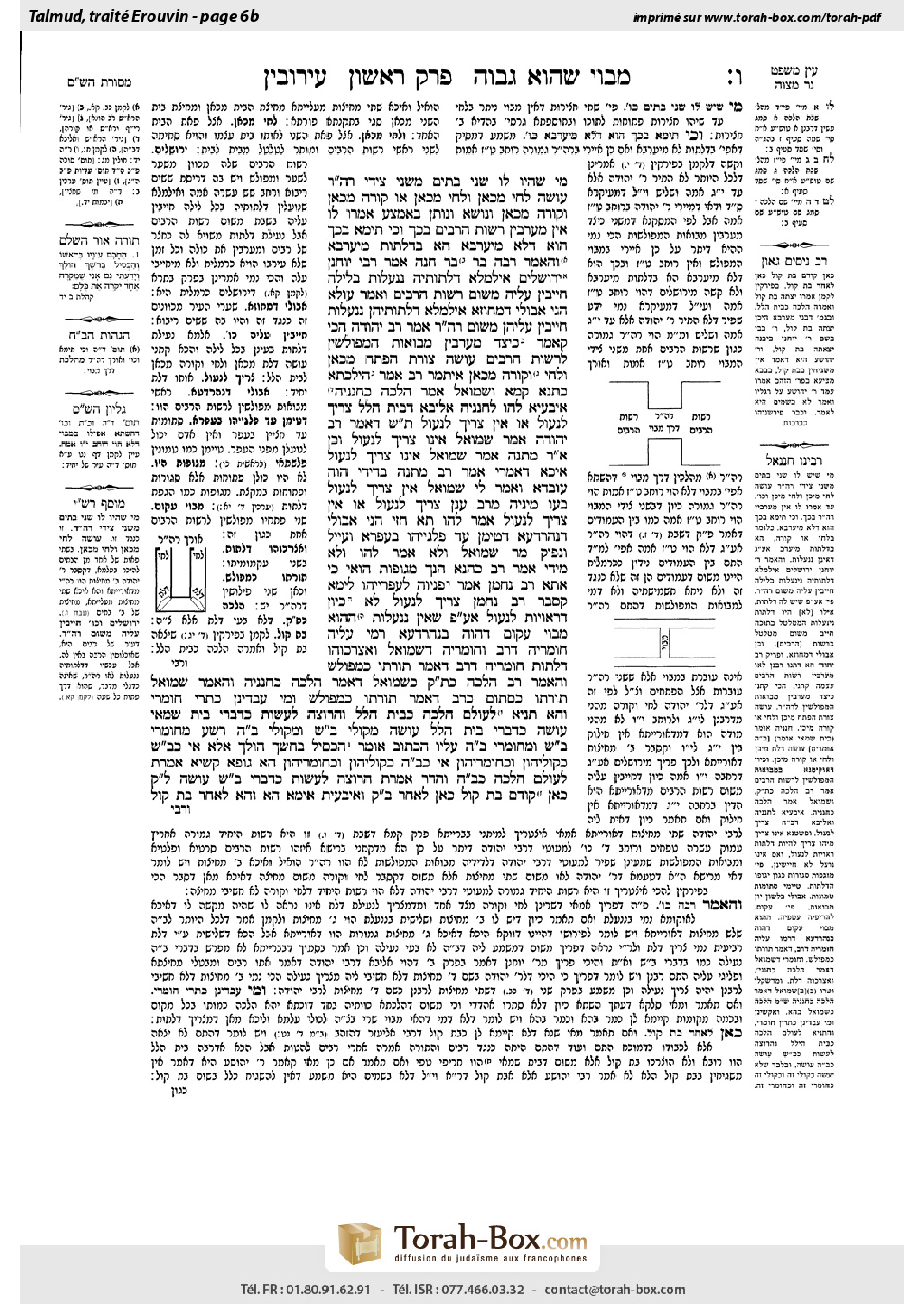
This page of Eruvin includes the Aramaic text, an English translation and an AI-generated French translation, alongside the scan above.
עירובין ו׳ ב · Aramaic and Hebrew text
מִי שֶׁהָיוּ לוֹ שְׁנֵי בָתִּים מִשְּׁנֵי צִידֵּי רְשׁוּת הָרַבִּים, עוֹשֶׂה לֶחִי מִכָּאן וְלֶחִי מִכָּאן, אוֹ קוֹרָה מִכָּאן וְקוֹרָה מִכָּאן, וְנוֹשֵׂא וְנוֹתֵן בָּאֶמְצַע. אָמְרוּ לוֹ: אֵין מְעָרְבִין רְשׁוּת הָרַבִּים בְּכָךְ.
וְכִי תֵּימָא בְּכָךְ הוּא דְּלָא מִיעָרְבָא, הָא בִּדְלָתוֹת מִיעָרְבָא, וְהָאָמַר רַבָּה בַּר בַּר חָנָה אָמַר רַבִּי יוֹחָנָן: יְרוּשָׁלַיִם, אִילְמָלֵא דַּלְתוֹתֶיהָ נִנְעָלוֹת בַּלַּיְלָה — חַיָּיבִין עָלֶיהָ מִשּׁוּם רְשׁוּת הָרַבִּים!
וְאָמַר עוּלָּא: הָנֵי אֲבוּלֵּי דְמָחוֹזָא אִילְמָלֵא דַּלְתוֹתֵיהֶן נִנְעָלוֹת — חַיָּיבִין עֲלֵיהֶן מִשּׁוּם רְשׁוּת הָרַבִּים.
אָמַר רַב יְהוּדָה, הָכִי קָאָמַר: כֵּיצַד מְעָרְבִין מְבוֹאוֹת הַמְפוּלָּשִׁין לִרְשׁוּת הָרַבִּים, עוֹשֶׂה צוּרַת הַפֶּתַח מִכָּאן וְלֶחִי וְקוֹרָה מִכָּאן.
אִיתְּמַר. רַב אָמַר: הִילְכְתָא כְּתַנָּא קַמָּא. וּשְׁמוּאֵל אָמַר: הֲלָכָה כַּחֲנַנְיָה.
אִיבַּעְיָא לְהוּ: לַחֲנַנְיָה אַלִּיבָּא דְּבֵית הִלֵּל צָרִיךְ לִנְעוֹל, אוֹ אֵין צָרִיךְ לִנְעוֹל? תָּא שְׁמַע, דְּאָמַר רַב יְהוּדָה אָמַר שְׁמוּאֵל: אֵינוֹ צָרִיךְ לִנְעוֹל. וְכֵן אָמַר רַב מַתְנָה אָמַר שְׁמוּאֵל: אֵינוֹ צָרִיךְ לִנְעוֹל. אִיכָּא דְאָמְרִי אָמַר רַב מַתְנָה: בְּדִידִי הֲוָה עוֹבָדָא, וְאָמַר לִי שְׁמוּאֵל: אֵין צָרִיךְ לִנְעוֹל.
בְּעוֹ מִינֵּיהּ מֵרַב עָנָן: צָרִיךְ לִנְעוֹל אוֹ אֵין צָרִיךְ לִנְעוֹל? אֲמַר לְהוּ: תָּא חֲזִי הָנֵי אֲבוּלֵּי דִּנְהַרְדָּעָא דְּטִימָן עַד פַּלְגַיְיהוּ בְּעַפְרָא, וְעָיֵיל וְנָפֵיק מָר שְׁמוּאֵל, וְלָא אֲמַר לְהוּ וְלָא מִידֵּי.
אָמַר רַב כָּהֲנָא: הָנָךְ מְגוּפוֹת הֲוַאי.
כִּי אֲתָא רַב נַחְמָן אָמַר: פַּנְּיוּהּ לְעַפְרַיְיהוּ. לֵימָא קָסָבַר רַב נַחְמָן: צָרִיךְ לִנְעוֹל? לָא, כֵּיוָן דִּרְאוּיוֹת לִנְעוֹל, אַף עַל פִּי שֶׁאֵין נִנְעָלוֹת.
הָהוּא מָבוֹי עָקוֹם דַּהֲוָה בִּנְהַרְדְּעָא, רְמֵי עֲלֵיהּ חוּמְרֵיהּ דְּרַב וְחוּמְרֵיהּ דִּשְׁמוּאֵל, וְאַצְרְכוּהוּ דְּלָתוֹת. חוּמְרֵיהּ דְּרַב — דְּאָמַר: תּוֹרָתוֹ כִּמְפוּלָּשׁ. וְהָאָמַר רַב הֲלָכָה כְּתַנָּא קַמָּא?!
כִּשְׁמוּאֵל — דְּאָמַר: הֲלָכָה כַּחֲנַנְיָה. וְהָאָמַר שְׁמוּאֵל תּוֹרָתוֹ כְּסָתוּם! כְּרַב דְּאָמַר תּוֹרָתוֹ כִּמְפוּלָּשׁ.
וּמִי עָבְדִינַן כִּתְרֵי חוּמְרֵי? וְהָא תַּנְיָא: לְעוֹלָם הֲלָכָה כְּבֵית הִלֵּל, וְהָרוֹצֶה לַעֲשׂוֹת כְּדִבְרֵי בֵּית שַׁמַּאי עוֹשֶׂה, כְּדִבְרֵי בֵּית הִלֵּל עוֹשֶׂה. מִקּוּלֵּי בֵּית שַׁמַּאי וּמִקּוּלֵּי בֵּית הִלֵּל — רָשָׁע. מֵחוּמְרֵי בֵּית שַׁמַּאי וּמֵחוּמְרֵי בֵּית הִלֵּל — עָלָיו הַכָּתוּב אוֹמֵר: ״הַכְּסִיל בְּחֹשֶׁךְ הוֹלֵךְ״. אֶלָּא, אִי כְּבֵית שַׁמַּאי כְּקוּלֵּיהוֹן וּכְחוּמְרֵיהוֹן, אִי כְּבֵית הִלֵּל כְּקוּלֵּיהוֹן וּכְחוּמְרֵיהוֹן.
הָא גוּפָא קַשְׁיָא. אָמְרַתְּ: לְעוֹלָם הֲלָכָה כְּבֵית הִלֵּל, וַהֲדַר אָמְרַתְּ: הָרוֹצֶה לַעֲשׂוֹת כְּדִבְרֵי בֵּית שַׁמַּאי עוֹשֶׂה?!
לָא קַשְׁיָא: כָּאן — קוֹדֶם בַּת קוֹל. כָּאן — לְאַחַר בַּת קוֹל.
וְאִיבָּעֵית אֵימָא: הָא וְהָא — לְאַחַר בַּת קוֹל,
Eruvin 6b · English translation
One who has two houses opposite each other on the two sides of the public domain, and he wishes to carry from one house to the other on Shabbat via the public domain, he may place a side post from here, on one side of one of the houses, and an additional side post from here, on the other side. Alternatively, he may place a cross beam from here, from one end of one house, and an additional cross beam from here, from the other side of the house, and then he may carry objects and place them in the area between them, for in this manner he turns the middle area into a private domain. The Rabbis said to him: One cannot render a public domain fit for carrying by means of an eiruv in this manner. Apparently, there is no way to establish an absolute public domain fit for carrying by means of an eiruv.
The Gemara questions its previous conclusion: And if you say that it is only in this manner, by way of a side post or a cross beam, that a public domain cannot be rendered fit for carrying, but by means of doors it can be rendered fit for carrying. But this is not true, as didn’t Rabba bar bar Ḥana say that Rabbi Yoḥanan said: With regard to Jerusalem, were it not for the fact that its doors are locked at night, one would be liable for carrying in it on Shabbat, because its thoroughfares are regarded as a public domain? This shows that the presence of a door is not sufficient to render it permitted to carry in a public domain; rather, the door must actually be locked.
And similarly, Ulla stated: With regard to the city entrances [abbulei] of Meḥoza, which meet the criteria for a public domain, were it not for the fact that their doors are locked, one would be liable for carrying in them, because they are regarded as a public domain. Apparently, without the actual locking of doors it is impossible to establish a public domain fit for carrying by means of the symbolic partitions of a side post or a cross beam. If so, how can the Sages in the baraita argue about how to establish a public domain fit for carrying?
Rather, Rav Yehuda said: The wording of the baraita must be emended so that this is what it says: How does one render alleyways that are not themselves public domains but are open on two opposite sides into the public domain fit for carrying by means of an eiruv? He constructs an opening in the form of a doorway from here, on one side of the alleyway, and a side post or a cross beam from here, on the other side.
It was stated that the amora’im differed on how the halakha is to be decided with regard to this issue. Rav said: The halakha is in accordance with the opinion of the anonymous first tanna of the baraita, and it is sufficient to have the form of a doorway on one side and a side post or cross beam on the other side in order to render it permitted to carry in an alleyway that is open on two opposite sides to the public domain. And Shmuel says: The halakha is in accordance with the opinion of Ḥananya, following the position of Beit Hillel, who also require a door on one side.
A dilemma was raised before the Sages concerning the position of Beit Hillel: According to Ḥananya, in accordance with the opinion of Beit Hillel, must this door be locked or need it not be locked? Come and hear a proof from that which Rav Yehuda said that Shmuel said, who, as mentioned earlier, rules in accordance with Beit Hillel: The door need not be locked. And similarly, Rav Mattana said that Shmuel said: The door need not be locked. Some say that Rav Mattana said: A case involving this very issue happened to me, and Shmuel said to me: The door need not be locked.
They raised a dilemma before Rav Anan with regard to this issue: Need the door be locked or need it not be locked? He said to them: Come and see these city entrances of Neharde’a that open on two opposite sides into the public domain, the gateways of which were filled up halfway with earth, so that the doors themselves could not possibly be locked. Mar Shmuel regularly goes in and out through them, but has never said anything to the people of Neharde’a about them. This shows that it is not necessary for the doors to be locked.
Rav Kahana rejected this proof and said: Those doors in Neharde’a were partially blocked, and therefore there was no need to lock them, but in general, the door of an alleyway that opens on both sides into the public domain must be locked.
The Gemara relates that when Rav Naḥman came to Neharde’a, he said: Clear away the earth, so that the doors can be locked. The Gemara attempts to understand Rav Naḥman’s instruction: Let us say that Rav Naḥman holds that the door of an alleyway that is open on two opposite sides must be locked. The Gemara explains: No, this is not proof. In order for carrying to be permitted in such an alleyway, it is enough that the doors be fit to be locked, even if they are not actually locked.
The Gemara describes a certain crooked, L-shaped alleyway that was in Neharde’a, upon which they imposed the stringency of Rav and the stringency of Shmuel, and required it to have doors. The Gemara attempts to understand this ruling: The stringency of Rav, namely, that which he said, that an L-shaped alleyway is regarded like an alleyway that is open on two opposite sides. But this is difficult, for didn’t Rav say that the law follows the anonymous first tanna of the baraita, who says that even an open alleyway itself does not require doors, and that an opening in the form of a doorway suffices?
The Gemara answers: They required doors in accordance with the opinion of Shmuel, who said that the halakha is in accordance with the opinion of Ḥananya. But this too is difficult, for if the doors were required in accordance with Shmuel’s opinion, didn’t Shmuel say that an L-shaped alleyway is regarded like an alleyway that is closed on one side, which does not need any doors at all? The Gemara explains: The doors were required in accordance with the opinion of Rav, who said that an L-shaped alleyway is regarded like an alleyway that is open on two opposite sides. Therefore, they adopted the stringencies of both Rav and Shmuel: Rav’s stringency that an L-shaped alleyway is deemed an open alleyway, and Shmuel’s stringency that an open alleyway requires a door.
The Gemara poses a question: But do we adopt the respective stringencies of two authorities who disagree on a series of issues? Wasn’t it taught in a baraita: The halakha is always in accordance with the opinion of Beit Hillel, but one who wishes to act in accordance with the opinion of Beit Shammai may do so, and one who wishes to act in accordance with the opinion of Beit Hillel may do so. If he wishes to adopt both the leniencies of Beit Shammai and also the leniencies of Beit Hillel, he is a wicked person. And if he wishes to adopt both the stringencies of Beit Shammai and also the stringencies of Beit Hillel, with regard to him the verse states: “The fool walks in darkness” (Ecclesiastes 2:14). Rather, he should act either in accordance with Beit Shammai, following both their leniencies and their stringencies, or in accordance with Beit Hillel, following both their leniencies and their stringencies.
The Gemara first raises a problem concerning the wording of the baraita: The baraita is itself difficult to understand, because it contains an internal contradiction between its clauses: You first said that the halakha is always in accordance with the opinion of Beit Hillel, and then you reversed that and said that one who wishes to act in accordance with the view of Beit Shammai may do so.
The Gemara answers: This is not difficult. Here, the baraita’s statement that a person may act as he wishes was made before the Divine Voice emerged and announced that the halakha is always in accordance with Beit Hillel; and here, the statement that the halakha is always in accordance with Beit Hillel was made after the Divine Voice issued this ruling.
And if you wish, say a different answer: Both this statement and that statement were made after the Divine Voice announced that the halakha is in accordance with Beit Hillel,
Eruvin 6b · Traduction française (IA)
Celui qui possède deux maisons face à face, l'une de chaque côté du domaine public, et qui souhaite transporter quelque chose d'une maison à l'autre le sabbat en passant par le domaine public, peut placer un poteau latéral ici, sur un côté d'une des maisons, et un autre poteau latéral ici, sur l'autre côté. Alternativement, il peut placer une poutre transversale ici, à l'extrémité d'une des maisons, et une autre poutre transversale ici, de l'autre côté de la maison, puis il peut transporter des objets et les placer dans la zone entre eux, car ainsi il transforme la zone centrale en un domaine privé. Les Sages dirent à lui : On ne peut pas rendre un domaine public apte au transport par le biais d'un eiruv de cette manière. Apparemment, il n'y a pas de moyen de rendre un domaine public absolu apte au transport par l'intermédiaire d'un eiruv.
Le Guemara questionne sa conclusion précédente : Et si vous dites que c'est uniquement de cette manière, par le biais d'un poteau latéral ou d'une poutre transversale, que le domaine public ne peut être rendu apte au transport, mais par le biais de portes, il peut être rendu apte au transport. Mais cela n'est pas vrai, car n'a-t-il pas dit Rabba bar bar Ḥana que Rabbi Yoḥanan a dit : En ce qui concerne Jérusalem, si ses portes n'étaient pas verrouillées la nuit, on serait puni pour transporter dedans le sabbat, car ses rues sont considérées comme un domaine public ? Cela montre que la présence d'une porte n'est pas suffisante pour rendre un domaine public apte au transport ; la porte doit être verrouillée en réalité.
Et de même, Ulla a dit : En ce qui concerne les entrées de la ville [abbulei] de Meḥoza, qui remplissent les critères d'un domaine public, si ce n'était pas pour le fait qu'elles sont verrouillées, on serait puni pour transporter dedans, car elles sont considérées comme un domaine public. Apparemment, sans le verrouillage réel des portes, il est impossible de rendre un domaine public apte au transport par le biais des parois symboliques d'un poteau latéral ou d'une poutre transversale. Si c'est ainsi, comment les Sages dans la baraïta peuvent-ils discuter de la manière de rendre un domaine public apte au transport ?
Plutôt, Rav Yehuda a dit : Le texte de la baraïta doit être corrigé afin qu'il dise ceci : Comment rendre apte au transport un passage qui n'est pas lui-même un domaine public mais qui est ouvert sur deux côtés opposés par le biais d'un eiruv ? Il construit une ouverture en forme de porte ici, sur un côté du passage, et un poteau latéral ou une poutre transversale ici, sur l'autre côté.
Il a été dit que les amora’im différaient sur la manière dont la halakha doit être décidée concernant cette question. Rav a dit : La halakha suit l'opinion du tanna anonyme premier de la baraïta, et il suffit d'avoir la forme d'une porte sur un côté et un poteau latéral ou une poutre transversale sur l'autre côté pour rendre apte au transport un passage ouvert sur deux côtés opposés. Et Shmuel dit : La halakha suit l'opinion de Ḥananya, qui suit la position de Beit Hillel, qui exige également une porte sur un côté.
Un dilemme a été soulevé devant les Sages concernant la position de Beit Hillel : Selon Ḥananya, conformément à l'opinion de Beit Hillel, cette porte doit-elle être verrouillée ou pas ? Venez écouter une preuve à partir de ce que Rav Yehuda a dit que Shmuel a dit, qui, comme mentionné précédemment, suit l'opinion de Beit Hillel : La porte n'a pas besoin d'être verrouillée. Et de même, Rav Mattana a dit que Shmuel a dit : La porte n'a pas besoin d'être verrouillée. Certains disent que Rav Mattana a dit : Une situation concernant cette même question m'a été rapportée, et Shmuel m'a dit : La porte n'a pas besoin d'être verrouillée.
Ils ont soulevé un dilemme devant Rav Anan concernant cette question : La porte doit-elle être verrouillée ou pas ? Il a dit à eux : Venez voir ces entrées de ville de Neharde’a qui s'ouvrent sur deux côtés opposés dans le domaine public, dont les portes étaient partiellement bouchées par de la terre, de sorte que les portes elles-mêmes ne pouvaient pas être verrouillées. Mar Shmuel entre et sort régulièrement par elles, mais n'a jamais dit quoi que ce soit aux habitants de Neharde’a à leur sujet. Cela montre que le verrouillage des portes n'est pas nécessaire.
Rav Kahana a rejeté cette preuve et a dit : Ces portes à Neharde’a étaient partiellement bouchées, et donc il n'était pas nécessaire de les verrouiller, mais en général, la porte d'un passage qui s'ouvre sur les deux côtés dans le domaine public doit être verrouillée.
Le Guemara rapporte que lorsque Rav Naḥman est venu à Neharde’a, il a dit : Enlevez la terre, afin que les portes puissent être verrouillées. Le Guemara tente de comprendre l'instruction de Rav Naḥman : Disons que Rav Naḥman considère que la porte d'un passage qui s'ouvre sur deux côtés opposés doit être verrouillée. Le Guemara explique : Non, cela n'est pas une preuve. Afin que le transport soit permis dans un tel passage, il suffit que les portes soient aptes à être verrouillées, même si elles ne sont pas effectivement verrouillées.
Le Guemara décrit un certain passage en L, en forme de coin, qui était à Neharde’a, sur lequel ils ont imposé la stricteur de Rav et de Shmuel, et exigé qu'il ait des portes. Le Guemara tente de comprendre cette décision : La stricteur de Rav, à savoir ce qu'il a dit, que le passage en L est considéré comme un passage qui s'ouvre sur deux côtés opposés. Mais cela est difficile, car n'a-t-il pas dit Rav que la loi suit l'opinion du tanna anonyme premier de la baraïta, qui dit que même un passage ouvert ne nécessite pas de portes, et que l'ouverture en forme de porte suffit ?
La Guemara répond : Ils exigeaient des portes conformément à l'opinion de Shmuel, qui affirmait que la halakha suit l'opinion de Ḥananya. Mais cela aussi est difficile, car si les portes étaient exigées conformément à l'opinion de Shmuel, n'a-t-il pas dit qu'un passage en L est considéré comme un passage fermé d'un côté, qui n'a pas besoin de portes du tout ? La Guemara explique : les portes étaient exigées conformément à l'opinion de Rav, qui affirmait qu'un passage en L est considéré comme un passage ouvert sur deux côtés opposés. Ainsi, ils adoptèrent les stringences de Rav et de Shmuel : la stringence de Rav selon laquelle un passage en L est considéré comme un passage ouvert, et la stringence de Shmuel selon laquelle un passage ouvert nécessite une porte.
La Guemara pose une question : mais adoptons-nous les stringences respectives de deux autorités qui s'opposent sur une série de questions ? N'a-t-il pas été enseigné dans une baraïta : la halakha est toujours en conformité avec l'opinion de Beit Hillel, mais celui qui veut agir selon l'opinion de Beit Shammai peut le faire, et celui qui veut agir selon l'opinion de Beit Hillel peut le faire. Et s'il veut adopter à la fois les leniencies de Beit Shammai et les leniencies de Beit Hillel, il est un mauvais homme. Et s'il veut adopter à la fois les stringences de Beit Shammai et les stringences de Beit Hillel, concernant lui la Sainte Écriture dit : « L'homme insensé marche dans l'obscurité » (Ecclésiaste 2:14). En réalité, il devrait agir soit selon Beit Shammai, en suivant à la fois leurs leniencies et leurs stringences, soit selon Beit Hillel, en suivant à la fois leurs leniencies et leurs stringences.
La Guemara soulève d'abord un problème concernant la formulation de la baraïta : la baraïta elle-même est difficile à comprendre, car elle contient une contradiction interne entre ses clauses : vous dites d'abord que la halakha est toujours en conformité avec l'opinion de Beit Hillel, puis vous inversez cela en disant que celui qui veut agir selon l'opinion de Beit Shammai peut le faire.
La Guemara répond : cela n'est pas difficile. Ici, l'affirmation de la baraïta selon laquelle une personne peut agir comme elle l'entend a été faite avant que la Voix Divine ne se lève et n'annonce que la halakha est toujours en conformité avec Beit Hillel ; et ici, l'affirmation selon laquelle la halakha est toujours en conformité avec Beit Hillel a été faite après que la Voix Divine ait rendu ce jugement.
Et si vous le souhaitez, dites une autre réponse : ces deux affirmations ont été faites après que la Voix Divine ait annoncé que la halakha est en conformité avec Beit Hillel,
Traduction française générée par IA à partir de l’édition anglaise de Sefaria. Vérifie toujours un passage avec le texte source.
Text from Sefaria: William Davidson Edition - Vocalized Aramaic (CC BY NC); William Davidson Edition - English (CC BY NC).