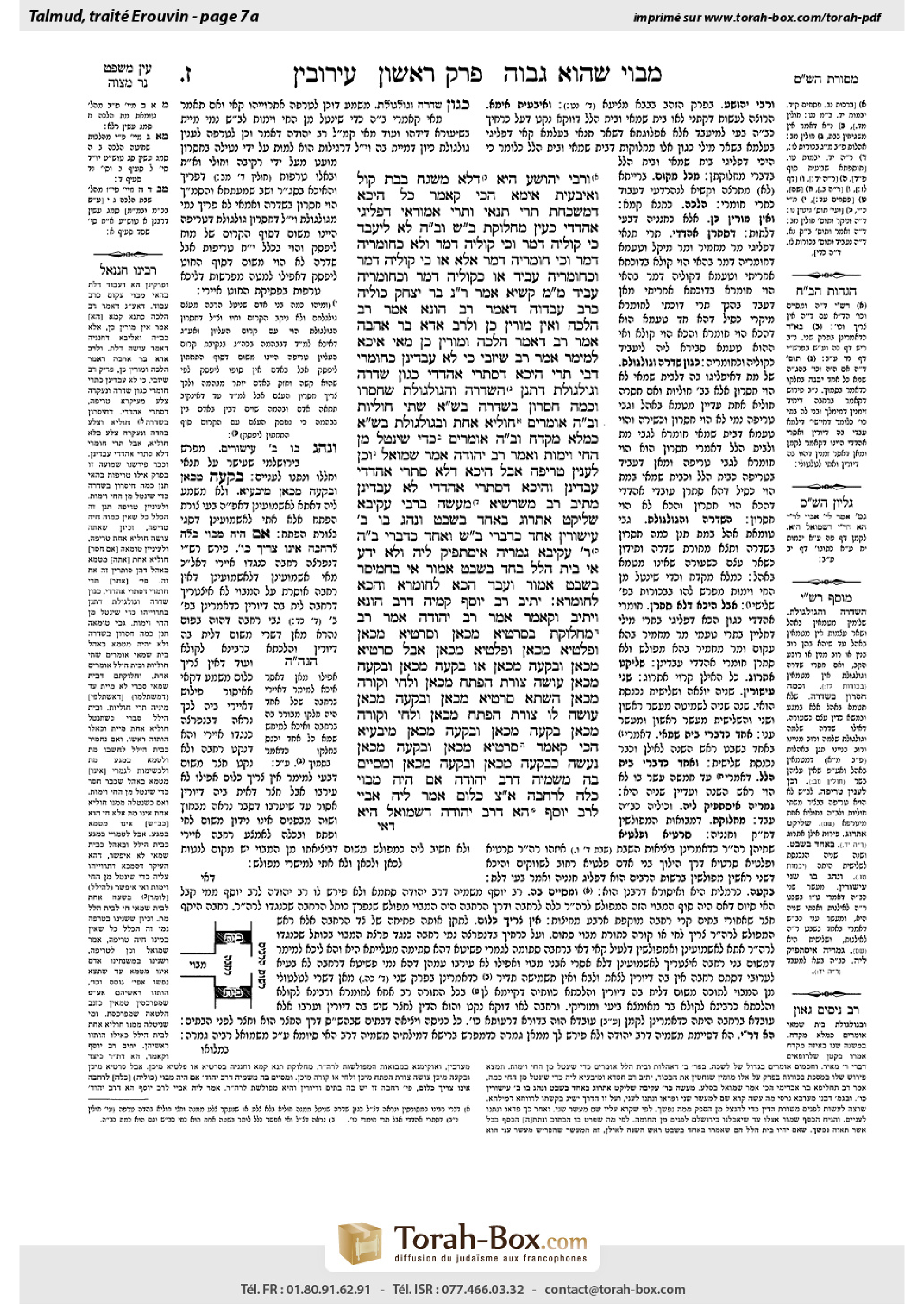
Eruvin 7a: Talmud study for Daf Yomi
Study the Talmud for Daf Yomi with scanned pages, Hebrew text, English translations from Sefaria and AI-generated French translations.
Passage selection and English or AI-generated French translation are available where the scan has annotations. Daf Study is independent of Torah-Box and Sefaria.
Browse Eruvin · עירובין · All tractatesEruvin 7a text and translations
This page of Eruvin includes the Aramaic text, an English translation and an AI-generated French translation, alongside the scan above.
עירובין ז׳ א · Aramaic and Hebrew text
וְרַבִּי יְהוֹשֻׁעַ הִיא דְּלָא מַשְׁגַּח בְּבַת קוֹל.
וְאִיבָּעֵית אֵימָא, הָכִי קָאָמַר: כׇּל הֵיכָא דְּמַשְׁכַּחַתְּ תְּרֵי תַּנָּאֵי וּתְרֵי אָמוֹרָאֵי דִּפְלִיגִי אַהֲדָדֵי כְּעֵין מַחֲלוֹקֶת בֵּית שַׁמַּאי וּבֵית הִלֵּל — לָא לֶיעְבַּד כִּי קוּלֵּיהּ דְּמָר וְכִי קוּלֵּיהּ דְּמָר, וְלָא כְּחוּמְרֵיהּ דְּמָר וְכִי חוּמְרֵיהּ דְּמָר. אֶלָּא, אוֹ כִּי קוּלֵּיהּ דְּמָר וּכְחוּמְרֵיהּ עָבֵיד, אוֹ כְּקוּלֵּיהּ דְּמָר וּכְחוּמְרֵיהּ עָבֵיד.
מִכׇּל מָקוֹם קַשְׁיָא!
אָמַר רַב נַחְמָן בַּר יִצְחָק: כּוּלֵּיהּ כְּרַב עַבְדוּהּ. דְּאָמַר רַב הוּנָא אָמַר רַב: הֲלָכָה וְאֵין מוֹרִין כֵּן.
וּלְרַב אַדָּא בַּר אַהֲבָה אָמַר רַב, דְּאָמַר: הֲלָכָה וּמוֹרִין כֵּן, מַאי אִיכָּא לְמֵימַר?
אָמַר רַב שֵׁיזְבִי: כִּי לָא עָבְדִינַן כְּחוּמְרֵי דְּבֵי תְרֵי — הֵיכָא דְּסָתְרִי אַהֲדָדֵי.
כְּגוֹן שִׁדְרָה וְגוּלְגּוֹלֶת. דִּתְנַן: הַשִּׁדְרָה וְהַגּוּלְגּוֹלֶת שֶׁחָסְרוּ — וְכַמָּה חֶסְרוֹן? בַּשִּׁדְרָה, בֵּית שַׁמַּאי אוֹמְרִים: שְׁתֵּי חוּלְיוֹת, וּבֵית הִלֵּל אוֹמְרִים: חוּלְיָא אַחַת. וּבַגּוּלְגּוֹלֶת, בֵּית שַׁמַּאי אוֹמְרִים: כִּמְלֹא מַקְדֵּחַ, וּבֵית הִלֵּל אוֹמְרִים: כְּדֵי שֶׁיִּנָּטֵל מִן הַחַי וְיָמוּת.
וְאָמַר רַב יְהוּדָה אָמַר שְׁמוּאֵל: וְכֵן לְעִנְיַן טְרֵיפָה.
אֲבָל הֵיכָא דְּלָא סָתְרִי אַהֲדָדֵי עָבְדִינַן.
וְהֵיכָא דְּסָתְרִי אַהֲדָדֵי לָא עָבְדִינַן?! מֵתִיב רַב מְשַׁרְשְׁיָא: מַעֲשֶׂה בְּרַבִּי עֲקִיבָא שֶׁלִּיקֵּט אֶתְרוֹג בְּאֶחָד בִּשְׁבָט, וְנָהַג בּוֹ שְׁנֵי עִישּׂוּרִין: אֶחָד כְּדִבְרֵי בֵּית שַׁמַּאי, וְאֶחָד כְּדִבְרֵי בֵּית הִלֵּל?!
רַבִּי עֲקִיבָא גְּמָרֵיהּ אִיסְתַּפֵּיק לֵיהּ, וְלָא יְדַע אִי בֵּית הִלֵּל בְּחַד בִּשְׁבָט אֲמוּר, אִי בַּחֲמֵיסַר בִּשְׁבָט אֲמוּר, וַעֲבַד הָכָא לְחוּמְרָא וְהָכָא לְחוּמְרָא.
יָתֵיב רַב יוֹסֵף קַמֵּיהּ דְּרַב הוּנָא, וְיָתֵיב וְקָאָמַר, אָמַר רַב יְהוּדָה אָמַר רַב: מַחֲלוֹקֶת בִּסְרַטְיָא מִכָּאן וּסְרַטְיָא מִכָּאן, וּפְלַטְיָא מִכָּאן וּפְלַטְיָא מִכָּאן.
אֲבָל סְרַטְיָא מִכָּאן וּבִקְעָה מִכָּאן, אוֹ בִּקְעָה מִכָּאן וּבִקְעָה מִכָּאן — עוֹשֶׂה צוּרַת הַפֶּתַח מִכָּאן וְלֶחִי וְקוֹרָה מִכָּאן.
הַשְׁתָּא סְרַטְיָא מִכָּאן וּבִקְעָה מִכָּאן, עוֹשֶׂה לוֹ צוּרַת הַפֶּתַח מִכָּאן וְלֶחִי וְקוֹרָה מִכָּאן — בִּקְעָה מִכָּאן וּבִקְעָה מִכָּאן מִיבַּעְיָא?!
הָכִי קָאָמַר: סְרַטְיָא מִכָּאן וּבִקְעָה מִכָּאן — נַעֲשֶׂה כְּבִקְעָה מִכָּאן וּבִקְעָה מִכָּאן.
וּמְסַיֵּים בַּהּ מִשְּׁמֵיהּ דְּרַב יְהוּדָה: אִם הָיָה מָבוֹי כָּלֶה לִרְחָבָה, אֵין צָרִיךְ כְּלוּם.
אֲמַר לֵיהּ אַבָּיֵי לְרַב יוֹסֵף: הָא דְּרַב יְהוּדָה דִּשְׁמוּאֵל הִיא.
Eruvin 7a · English translation
and the latter statement is in accordance with the opinion of Rabbi Yehoshua, who does not pay attention to a Divine Voice that attempts to intervene in matters of halakha, for according to him, the dispute between Beit Shammai and Beit Hillel has not yet been decided.
The Gemara suggests yet another resolution: And if you wish, say instead that this is what the baraita is saying: Wherever you find two tanna’im or two amora’im who disagree with each other in the manner of the disputes between Beit Shammai and Beit Hillel, one should not act either in accordance with the leniency of the one Master and in accordance with the leniency of the other Master, nor should one act in accordance with the stringency of the one Master and in accordance with the stringency of the other Master. Rather, one should act either in accordance with both the leniencies and the stringencies of the one Master, or in accordance with both the leniencies and the stringencies of the other Master.
All of this is suggested to explain the wording of the baraita. In any case, it is difficult to explain the law with regard to the alleyway in Neharde’a, concerning which they simultaneously adopted the stringencies of both Rav and Shmuel.
Rav Naḥman bar Yitzḥak said: In fact, they acted entirely in accordance with the opinion of Rav, and the reason that they required doors and did not rely on the opening in the form of a doorway alone is due to that which Rav Huna said that Rav said: This is the halakha; however, a public ruling is not issued to that effect ab initio. Although Rav maintains that an opening in the form of a doorway is sufficient in an open alleyway, a public ruling is not issued to that effect; rather, the ruling is stringent, in accordance with Ḥananya’s position, and requires doors.
The Gemara asks: And according to the statement of Rav Adda bar Ahava that Rav said, as Rav Adda bar Ahava said that Rav said with regard to the same issue: This is the halakha and a public ruling is issued to that effect, what can be said? Why did the residents of Neharde’a adopt the stringencies of the two authorities?
Rav Sheizvi said: The principle of dictating when we do not act in accordance with the stringencies of two authorities applies only in a case where the two stringencies contradict one another. In these types of cases, following both stringencies would result in an internal contradiction.
The Gemara illustrates this principle with an example from the laws governing the spine and skull. As we learned in a mishna: The spine and the skull of a corpse that are incomplete do not impart ritual impurity via a tent as a corpse would; rather, they impart impurity only through contact or if they are carried as individual bones. This basic law was unanimously accepted, but the details were the subject of dispute: How much is considered a deficiency in the spine for this purpose? Beit Shammai say: If it is missing two vertebrae, and Beit Hillel say: Even if it is missing only one vertebra. And similarly, they argued over the deficiency in the skull: Beit Shammai say: It must be missing piece the size of a drill hole, and Beit Hillel say: It must be missing an amount that, when removed from a living person, would cause him to die, which is a larger amount.
And Rav Yehuda said that Shmuel said: Beit Shammai and Beit Hillel argued likewise with respect to a tereifa, a kosher animal suffering from a wound or illness that will cause it to die within twelve months, and which is prohibited to be eaten even after the required ritual slaughter. Beit Shammai say that an animal is regarded as a tereifa if it is missing two vertebrae, while Beit Hillel hold that it is a tereifa if it lacks even one. In such a situation, a person must not be stringent with regard to the halakhot of tereifa in accordance with the view of Beit Hillel, and at the same time be stringent with regard to the halakhot of ritual impurity of a corpse in accordance with the view of Beit Shammai, for the two disputes relate to the same issue, and one must not act in accordance with two contradictory opinions.
Rav Sheizvi continues: However, in a case where the two stringencies do not contradict one another, we may indeed act in accordance with the stringencies of two authorities. Therefore, the stringencies adopted in the case of the alleyway in Neharde’a were legitimate, for the two stringencies related to two separate issues: Rav’s stringency was that an L-shaped alleyway is regarded like an open alleyway, and Shmuel’s stringency was that an open alleyway requires a door.
The Gemara challenges Rav Sheizvi’s assertion: Is it true that we do not act in accordance with the stringencies of two authorities in a case where the two stringencies contradict one another? Rav Mesharshiya raised an objection from a baraita: There was an incident involving Rabbi Akiva, who gathered the fruit of a citron tree on the first of the month of Shevat and applied the laws of two tithes to it. After teruma and the first tithe have been separated, an additional tithe is separated from what is left. During the first, second, fourth, and fifth years of the Sabbatical cycle, second tithe is set aside to be taken to Jerusalem and eaten there by its owner, while during the third and sixth years, poor man’s tithe is set aside to be distributed to the needy. When tithing the fruit picked on the first of Shevat, Rabbi Akiva set aside both additional tithes, second tithe and poor man’s tithe: He set aside one in accordance with the statement of Beit Shammai, who say that the new year for trees begins on the first of Shevat, and as that day belongs to the new year, a tithe must be set aside in accordance with the law of that year; and he set aside one in accordance with the statement of Beit Hillel, that the new year for trees is the fifteenth of Shevat, and any fruit picked prior to that date must be tithed in accordance with the law of the previous year. Apparently, Rabbi Akiva adopted for himself two contradictory stringencies.
The Gemara answers: Rabbi Akiva did not act in this way in order to be stringent in accordance with both opinions, but because he was in doubt with regard to his tradition and did not know whether Beit Hillel said the New Year for trees falls on the first of Shevat or on the fifteenth of Shevat, and therefore he acted stringently here and stringently there.
The Gemara resumes its discussion of alleyways that are open on two opposite sides. Rav Yosef sat before Rav Huna, and he sat and said: Rav Yehuda said that Rav said: The dispute between the anonymous first tanna of the baraita and Ḥananya refers to a case where there is a main street [seratya] from here, on one side of the alleyway, and a main street from here, on the other side. Alternatively, it refers to a case where there is a plaza [pelatya] from here, on one side of the alleyway, and a plaza from here, on the other side.
But if there is a main street from here, on one side, and a valley from here, on the other side, a valley being a karmelit, which is neither a public domain nor a private domain, in which carrying is prohibited on Shabbat by rabbinic decree, or if there is a valley from here, on one side, and a valley from here, on the other side, one constructs an opening in the form of a doorway from here, on one side of the alleyway, and places a side post or a cross beam from here, on the other side. One is thereby permitted to carry in the alleyway even according to the opinion of Ḥananya.
The Gemara raises a question about this ruling: Now, if you say that where there is a main street from here, on one side of the alleyway, and a valley from here, on the other side, it is sufficient to construct an opening in the form of a doorway from here, on one side, and a side post or a cross beam from here, on the other side, was it necessary to state that these are sufficient if there is a valley from here, on one side of the alleyway, and a valley from here, on the other side?
The Gemara answers: This is what he intended to say: If there is a main street from here, on one side, and a valley from here, on the other side, it is considered as if there were a valley from here, on one side, and a valley from here, on the other side.
The Gemara continues: And when Rav Yosef reported this ruling, he concluded with a statement in the name of Rav Yehuda himself, without attributing it to one of Rav Yehuda’s teachers: If the alleyway terminated in a backyard, i.e., a closed-off area behind a group of houses, then even if there is a breach in the wall between the yard and the public domain beyond it, nothing is needed on this side of the alleyway, as it is considered closed.
Abaye said to Rav Yosef: This ruling of Rav Yehuda is a ruling of his teacher Shmuel, and not of his other teacher, Rav.
Eruvin 7a · Traduction française (IA)
et la déclaration suivante est conforme à l'opinion du Rabbi Yéhoshua, qui ne prête pas attention à une Voix Divine qui tente d'intervenir dans les affaires de halakha, car selon lui, le débat entre Beit Shammaï et Beit Hillel n'a pas encore été tranché.
La Guemara suggère une autre résolution : Et si vous le souhaitez, dites plutôt que c'est ce que dit la baraïta : Lorsque vous trouvez deux tannaïm ou deux amoraïm qui s'opposent l'un à l'autre dans le style des débats entre Beit Shammaï et Beit Hillel, on ne doit pas agir ni selon la leniété de l'un des maîtres ni selon la leniété de l'autre, ni selon la stricteur de l'un ni selon la stricteur de l'autre. On doit plutôt agir soit selon les leniétés et les stricteurs de l'un des maîtres, soit selon les leniétés et les stricteurs de l'autre.
Tout cela est suggéré pour expliquer le texte de la baraïta. En tout cas, il est difficile d'expliquer la loi concernant l'allée de Nehardea, à propos de laquelle ils ont simultanément adopté les stricteurs de Rav et de Shmuel.
Rav Naḥman bar Yitzḥak a dit : En réalité, ils ont agi entièrement selon l'opinion de Rav, et la raison pour laquelle ils exigeaient des portes et ne s'appuyaient pas uniquement sur l'ouverture en forme de porte est due à ce que Rav Huna a rapporté que Rav avait dit : C'est la halakha ; cependant, un arrêt public n'est pas rendu à cet effet dès le début. Bien que Rav maintienne que l'ouverture en forme de porte est suffisante dans une allée ouverte, un arrêt public n'est pas rendu à cet effet ; on agit plutôt de manière stricte, selon la position d'Hananya, et exige des portes.
La Guemara pose la question : Et selon la déclaration de Rav Adda bar Ahava que Rav a faite, comme Rav Adda bar Ahava a dit que Rav a dit concernant la même question : C'est la halakha et un arrêt public est rendu à cet effet, que peut-on dire ? Pourquoi les habitants de Nehardea ont-ils adopté les stricteurs des deux autorités ?
Rav Sheizvi a dit : Le principe de dictée s'applique uniquement dans le cas où les deux stricteurs s'opposent l'un à l'autre. Dans ces cas, suivre les deux stricteurs entraînerait une contradiction interne.
La Guemara illustre ce principe avec un exemple tiré des lois concernant la colonne vertébrale et la tête. Comme nous l'avons appris dans une mitsna : La colonne vertébrale et la tête d'un cadavre incomplet ne transmettent pas l'impureté rituelle via une tente comme un cadavre ; ils transmettent l'impureté uniquement par contact ou si on les transporte comme des os individuels. Cette loi de base a été unanime, mais les détails étaient l'objet de débats : Quelle quantité est considérée comme un défaut dans la colonne vertébrale à cet effet ? Beit Shammaï disent : Si elle manque deux vertèbres, et Beit Hillel disent : Même si elle manque une seule vertèbre. Et de même, ils ont débattu du défaut dans la tête : Beit Shammaï disent : Elle doit manquer une pièce de la taille d'un trou de perceuse, et Beit Hillel disent : Elle doit manquer une quantité qui, enlevée à un vivant, le ferait mourir, ce qui est une quantité plus grande.
Et Rav Yéhuda a dit que Shmuel a dit : Beit Shammaï et Beit Hillel ont débattu de la même manière concernant un tereifa, un animal kasher souffrant d'une plaie ou d'une maladie qui le fera mourir en douze mois, et qui est interdit de manger même après la cérémonie de sacrifice rituel. Beit Shammaï disent qu'un animal est considéré comme un tereifa s'il manque deux vertèbres, tandis que Beit Hillel disent qu'il est un tereifa s'il manque même une seule. Dans un tel cas, une personne ne doit pas être stricte concernant les halakhot du tereifa selon l'opinion de Beit Hillel, et en même temps être stricte concernant les halakhot de l'impureté rituelle du cadavre selon l'opinion de Beit Shammaï, car les deux débats concernent la même question, et on ne doit pas agir selon deux opinions contradictoires.
Rav Sheizvi continue : Cependant, dans un cas où les deux stricteurs ne s'opposent pas l'un à l'autre, nous pouvons effectivement agir selon les stricteurs des deux autorités. Ainsi, les stricteurs adoptés dans le cas de l'allée de Nehardea étaient légitimes, car les deux stricteurs concernaient deux questions distinctes : la stricteur de Rav était que le coude d'une allée est considéré comme une allée ouverte, et la stricteur de Shmuel était que l'allée ouverte exige une porte.
La Guemara conteste l'affirmation de Rav Sheizvi : Est-ce vrai que nous ne suivons pas les stricteurs de deux autorités dans un cas où les deux stricteurs s'opposent l'un à l'autre ? Rav Mesharshiya a soulevé une objection à partir d'une baraïta : Il y avait un incident concernant Rabbi Akiva, qui a récolté les fruits d'un citron le premier du mois de Shevat et a appliqué les lois de deux dîmes à ce fruit. Après que la terouma et la première dîme aient été séparées, une autre dîme a été séparée du reste. Pendant la première, la deuxième, la quatrième et la cinquième années du cycle sabbatique, la dîme secondaire a été mise de côté pour être emportée à Jérusalem et mangée par son propriétaire, tandis que pendant la troisième et la sixième années, la dîme du pauvre a été mise de côté pour être distribuée aux nécessiteux. Lors de la dîme du fruit récolté le premier de Shevat, Rabbi Akiva a mis de côté les deux dîmes supplémentaires, la dîme secondaire et la dîme du pauvre : il a mis de côté une selon l'opinion de Beit Shammaï, qui disent que l'année nouvelle des arbres commence le premier de Shevat, et comme ce jour appartient à l'année nouvelle, une dîme doit être mise de côté selon la loi de cette année ; et il a mis de côté une selon l'opinion de Beit Hillel, qui disent que l'année nouvelle des arbres est le quinzième de Shevat, et tout fruit récolté avant cette date doit être dîmé selon la loi de l'année précédente. Apparemment, Rabbi Akiva a adopté pour lui-même deux stricteurs contradictoires.
La Guemara répond : Rabbi Akiva n’a pas agi ainsi pour être strict en conformité avec les deux opinions, mais parce qu’il était en doute quant à sa tradition et ne savait pas si Beit Hillel disait que le Nouvel An des arbres tombe le premier de Shevat ou le quinzième de Shevat, et donc il a agi strictement ici et strictement là.
La Guemara reprend la discussion sur les cours qui sont ouvertes sur deux côtés opposés. Rav Yosef était assis devant Rav Huna, et il a dit : Rav Yehuda a dit que Rav a dit : Le débat entre le premier tanna anonyme de la baraïta et Ḥananya concerne un cas où il y a une rue principale d’ici, d’un côté de la cour, et une rue principale d’ici, de l’autre côté. Alternativement, il concerne un cas où il y a une place d’ici, d’un côté de la cour, et une place d’ici, de l’autre côté.
Mais si il y a une rue principale d’ici, d’un côté, et une vallée d’ici, de l’autre côté, une vallée étant un karmelit, qui n’est ni un domaine public ni un domaine privé, où le transport est interdit le sabbat par décision rabbinique, ou si il y a une vallée d’ici, d’un côté, et une vallée d’ici, de l’autre côté, on construit une ouverture en forme de porte d’ici, d’un côté de la cour, et on place un poteau latéral ou une traverse d’ici, de l’autre côté. On est ainsi autorisé à transporter dans la cour même selon l’opinion de Ḥananya.
La Guemara soulève une question concernant cette décision : Maintenant, si vous dites que là où il y a une rue principale d’ici, d’un côté de la cour, et une vallée d’ici, de l’autre côté, il suffit de construire une ouverture en forme de porte d’ici, d’un côté, et un poteau latéral ou une traverse d’ici, de l’autre côté, était-il nécessaire de dire que cela suffit si il y a une vallée d’ici, d’un côté de la cour, et une vallée d’ici, de l’autre côté ?
La Guemara répond : C’est ce qu’il voulait dire : Si il y a une rue principale d’ici, d’un côté, et une vallée d’ici, de l’autre côté, cela est considéré comme s’il y avait une vallée d’ici, d’un côté, et une vallée d’ici, de l’autre côté.
La Guemara continue : Et lorsque Rav Yosef rapportait cette décision, il concluait avec une déclaration en nom de Rav Yehuda lui-même, sans l’attribuer à l’un des maîtres de Rav Yehuda : Si la cour se terminait dans un jardin, c’est-à-dire une zone fermée derrière un groupe de maisons, alors même s’il y a une ouverture dans le mur entre le jardin et le domaine public au-delà, rien n’est nécessaire de ce côté de la cour, car elle est considérée comme fermée.
Abaye dit à Rav Yosef : Cette décision de Rav Yehuda est une décision de son maître Shmuel, et non de son autre maître, Rav.
Traduction française générée par IA à partir de l’édition anglaise de Sefaria. Vérifie toujours un passage avec le texte source.
Text from Sefaria: William Davidson Edition - Vocalized Aramaic (CC BY NC); William Davidson Edition - English (CC BY NC).