Eruvin 70b: Talmud study for Daf Yomi
Study the Talmud for Daf Yomi with scanned pages, Hebrew text, English translations from Sefaria and AI-generated French translations.
Passage selection and English or AI-generated French translation are available where the scan has annotations. Daf Study is independent of Torah-Box and Sefaria.
Browse Eruvin · עירובין · All tractatesEruvin 70b text and translations
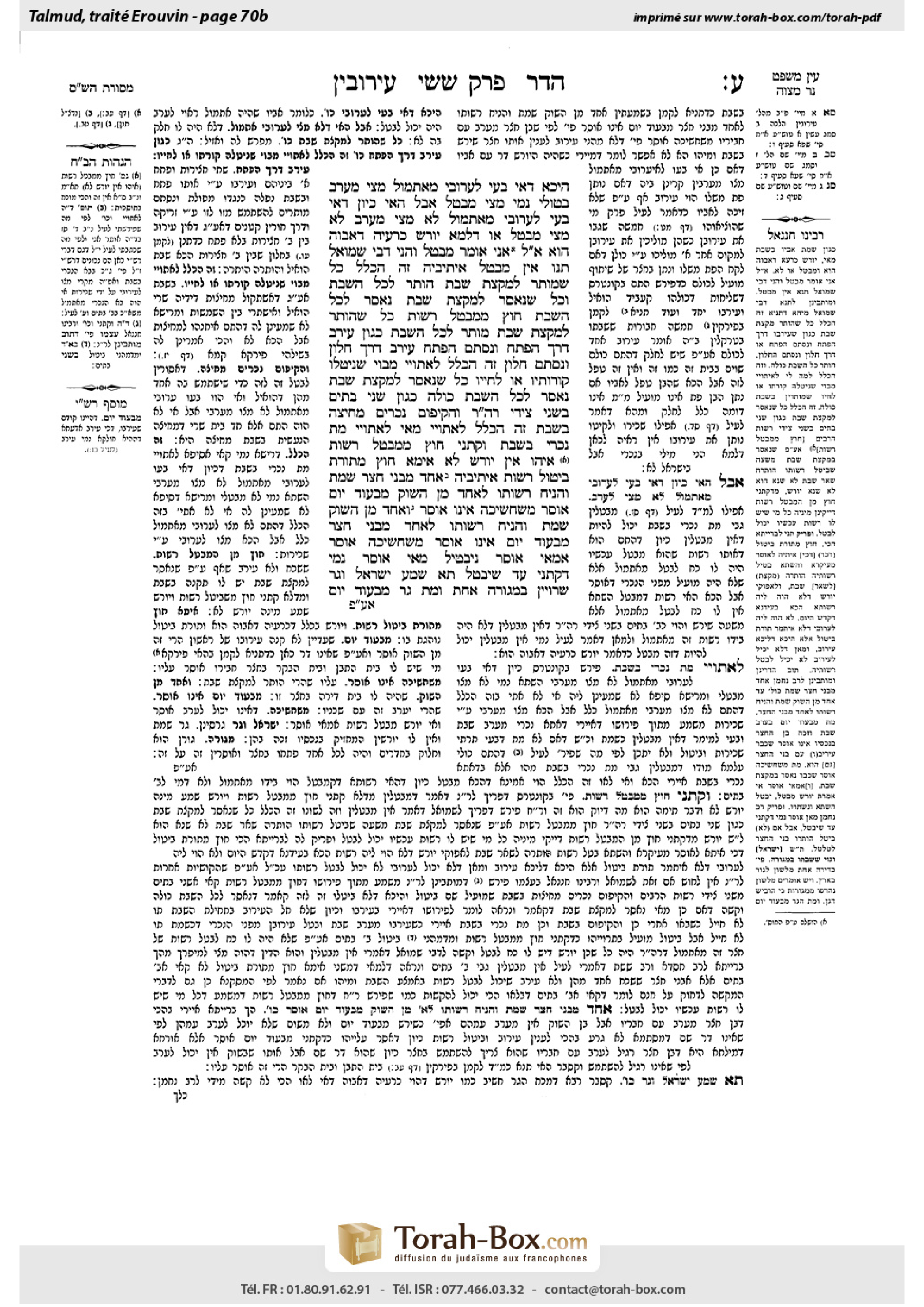
This page of Eruvin includes the Aramaic text, an English translation and an AI-generated French translation, alongside the scan above.
עירובין ע׳ ב · Aramaic and Hebrew text
הֵיכָא דְּאִי בָּעֵי לְעָרוֹבֵי מֵאֶתְמוֹל מָצֵי מְעָרֵב — בַּטּוֹלֵי נָמֵי מָצֵי מְבַטֵּל, אֲבָל הַאי כֵּיוָן דְּאִי בָּעֵי לְעָרוֹבֵי מֵאֶתְמוֹל — לָא מָצֵי מְעָרֵב, לָא מָצֵי מְבַטֵּל.
אוֹ דִּלְמָא: יוֹרֵשׁ כַּרְעֵיהּ דַּאֲבוּהּ הוּא?
אֲמַר לֵיהּ: אֲנִי אוֹמֵר מְבַטֵּל, וְהָנֵי דְּבֵי שְׁמוּאֵל תָּנוּ אֵין מְבַטֵּל. אֵיתִיבֵיהּ: זֶה הַכְּלָל, כׇּל שֶׁמּוּתָּר לְמִקְצָת שַׁבָּת — הוּתַּר לְכׇל הַשַּׁבָּת, וְכׇל שֶׁנֶּאְסַר לְמִקְצָת שַׁבָּת — נֶאְסַר לְכׇל הַשַּׁבָּת חוּץ מִמְּבַטֵּל רְשׁוּת.
כׇּל שֶׁהוּתַּר לְמִקְּצָת שַׁבָּת, מוּתָּר לְכׇל הַשַּׁבָּת — כְּגוֹן עֵירַב דֶּרֶךְ הַפֶּתַח, וְנִסְתַּם הַפֶּתַח. עֵירַב דֶּרֶךְ חַלּוֹן, וְנִסְתַּם חַלּוֹן.
זֶה הַכְּלָל — לְאֵתוֹיֵי מָבוֹי שֶׁנִּיטְּלוּ קוֹרוֹתָיו אוֹ לְחָיָיו.
כׇּל שֶׁנֶּאְסַר לְמִקְצָת שַׁבָּת, נֶאְסַר לְכׇל הַשַּׁבָּת כּוּלָּהּ — כְּגוֹן שְׁנֵי בָתִּים בִּשְׁנֵי צִידֵּי רְשׁוּת הָרַבִּים, וְהִקִּיפוּם גּוֹיִם מְחִיצָה בְּשַׁבָּת.
זֶה הַכְּלָל לְאֵתוֹיֵי מַאי? לְאֵתוֹיֵי מֵת גּוֹי בְּשַׁבָּת.
וְקָתָנֵי: חוּץ מִמְּבַטֵּל רְשׁוּת. אִיהוּ — אִין, יוֹרֵשׁ — לָא.
אֵימָא: חוּץ מִתּוֹרַת בִּיטּוּל רְשׁוּת.
אֵיתִיבֵיהּ: אֶחָד מִבְּנֵי חָצֵר שֶׁמֵּת, וְהִנִּיחַ רְשׁוּתוֹ לְאֶחָד מִן הַשּׁוּק, מִבְּעוֹד יוֹם — אוֹסֵר, מִשֶּׁחָשֵׁיכָה — אֵינוֹ אוֹסֵר.
וְאֶחָד מִן הַשּׁוּק שֶׁמֵּת וְהִנִּיחַ רְשׁוּתוֹ לְאֶחָד מִבְּנֵי חָצֵר, מִבְּעוֹד יוֹם — אֵינוֹ אוֹסֵר, מִשֶּׁחָשֵׁיכָה — אוֹסֵר.
אַמַּאי אוֹסֵר? נִיבַטֵּיל! מַאי ״אוֹסֵר״ נָמֵי דְּקָתָנֵי — עַד שֶׁיְּבַטֵּל.
תָּא שְׁמַע: יִשְׂרָאֵל וְגֵר שְׁרוּיִין בִּמְגוּרָה אַחַת, וּמֵת גֵּר מִבְּעוֹד יוֹם,
Eruvin 70b · English translation
The Gemara explains the two sides of the question: On the one hand, perhaps only in a case where, if the person wanted to establish an eiruv on the previous day he could have established an eiruv, he can also renounce his rights on Shabbat. But this heir, since, if he wanted to establish an eiruv the previous day he could not have established an eiruv, as he was not then a resident of the courtyard, therefore, today he cannot renounce his rights either.
Or perhaps an heir is like his father’s foot, i.e., he is considered an extension of his father and substitutes for him in all regards, which means that just as his father could have renounced his rights, so can he.
Rav Naḥman said to him: I myself say that an heir can indeed renounce rights in a courtyard, while those scholars of the school of Shmuel taught: He cannot renounce rights in a courtyard. Rava raised an objection to Rav Naḥman from the following baraita: This is the principle: Anything that is permitted for part of Shabbat is permitted for all of Shabbat, and anything that is prohibited for part of Shabbat is prohibited for all of Shabbat, apart from one who renounces his rights in a courtyard, for renunciation can provide an allowance halfway through Shabbat.
The Gemara now explains each element of the baraita: Anything that is permitted for part of Shabbat is permitted for all of Shabbat. For example, if an eiruv was established between two adjacent courtyards that are connected via an opening between them, and that opening was closed up on Shabbat, the eiruv is valid. Alternately, if an eiruv was established between the two courtyards that are connected via a window opening from one to the other, and that window was closed up on Shabbat, the eiruv is valid. As carrying from one courtyard to another was permitted at the beginning of Shabbat, it is permitted throughout Shabbat.
The Gemara comments: The words this is the principle come to include the case of an alleyway whose cross beams or side posts were removed on Shabbat, teaching that one may nonetheless use the alleyway, as it had been permitted at the outset of Shabbat.
The Gemara continues its explanation of the baraita: Anything that is prohibited for part of Shabbat is prohibited for all of Shabbat. For example, if there were two houses on two sides of a public domain, which gentiles enclosed with a wall on Shabbat, the enclosed area remains prohibited. Even though a partition of this kind is considered a proper one with regard to Shabbat domains, it is prohibited to carry objects from either house into the enclosed area, even if the owner of the first house renounces his rights in the area in favor of the owner of the second house, as they could not have established an eiruv between them before Shabbat.
The Gemara asks: What do the words this is the principle come to include in this part of the baraita? The Gemara answers: It comes to include the case of a gentile resident of the courtyard who died on Shabbat without having rented out his domain to a Jew for the purpose of an eiruv. In this case, the Jewish neighbors are prohibited from carrying in the courtyard. Because it was prohibited to establish an eiruv the previous day, carrying in the courtyard continues to be prohibited on Shabbat, even though the gentile is now deceased.
And the baraita teaches: Apart from one who renounces his rights in a courtyard, which teaches that a person may renounce his rights in a courtyard even on Shabbat, despite the fact that the courtyard was prohibited prior to his renunciation. The Gemara infers: He himself, i.e., the original owner, yes, he may renounce his rights even on Shabbat, but with regard to his heir, no, he may not renounce his rights on Shabbat, which contradicts Rav Naḥman’s opinion.
Rav Naḥman replied: Say that the baraita must be understood as follows: Apart from anyone who falls into the halakhic category of one who renounces his rights in a domain. In other words, the baraita is not referring to a particular person who renounces his rights, but rather to the category of renunciation in general, which includes an heir.
Rava raised a further objection to the opinion of Rav Naḥman from a different baraita: If a resident of a courtyard died and left his domain, the use of his house, to one from the marketplace, i.e., a non-resident of the courtyard, the following distinction applies: If he died while it was still day, i.e., before Shabbat, the one from the marketplace renders carrying prohibited, for it is assumed that he received his portion before the onset of Shabbat and should have joined in an eiruv with the others. Since he failed to establish an eiruv with the other residents of the courtyard, he renders carrying prohibited in the entire courtyard. If, however, he died after nightfall, he does not render carrying prohibited, for so long as it was permitted to carry for part of Shabbat it remains permitted for the entirety of Shabbat.
And alternatively, if one from the marketplace who owned a residence in the courtyard but did not dwell there died and left his domain to a resident of the courtyard who does live there and usually joins in an eiruv with his neighbors, the following distinction applies: If the person from the marketplace died while it was still day, i.e., before Shabbat, the courtyard resident does not render carrying prohibited, as when he establishes his eiruv it includes his new residence as well. If, however, the person from the marketplace died after nightfall without having established an eiruv, the deceased renders carrying prohibited. As this residence was prohibited at the beginning of Shabbat, it can no longer be permitted on that Shabbat.
Rava’s question is based on the first case discussed in the baraita: According to Rav Naḥman, why does the heir render carrying prohibited in this case? Let him renounce his rights in the courtyard to the other residents, as Rav Naḥman maintains that an heir may renounce rights. Rav Naḥman replied: What is the meaning of the word prohibits that the baraita teaches here? It means he renders carrying prohibited until he renounces his rights, i.e., although there is no way of rectifying the situation by means of an eiruv, it can be corrected by way of renunciation.
Come and hear a different proof challenging Rav Naḥman’s opinion, from the following baraita: If a Jew and a convert were living in a single residency comprised of several rooms, and the convert died childless while it was still day, such a convert has no heirs, and therefore the first to take possession of his property acquires it.
Eruvin 70b · Traduction française (IA)
La Guemara explique les deux côtés de la question : d'une part, peut-être seulement dans le cas où, si la personne voulait établir un eiruv la veille, elle aurait pu l'établir, elle peut aussi renoncer à ses droits le sabbat. Mais cet héritier, puisque, s'il voulait établir un eiruv la veille, il ne pouvait pas l'établir, car il n'était pas alors un habitant du courtil, donc aujourd'hui il ne peut pas non plus renoncer à ses droits.
Ou peut-être l'héritier est comme le pied de son père, c'est-à-dire qu'il est considéré comme une extension de son père et remplace celui-ci en toutes choses, ce qui signifie que tout comme son père pouvait renoncer à ses droits, lui aussi peut le faire.
Rav Naḥman dit à lui : Je dis moi-même que l'héritier peut effectivement renoncer à ses droits dans un courtil, tandis que ceux des savants de la maison de Shmuel enseignent : Il ne peut pas renoncer à ses droits dans un courtil. Rava oppose un objet à Rav Naḥman tiré de la suivante baraïta : C'est le principe : Tout ce qui est permis pour une partie du sabbat est permis pour tout le sabbat, et tout ce qui est interdit pour une partie du sabbat est interdit pour tout le sabbat, à l'exception de celui qui renonce à ses droits dans un courtil, car la renonciation peut permettre une exception au milieu du sabbat.
La Guemara explique maintenant chaque élément de la baraïta : Tout ce qui est permis pour une partie du sabbat est permis pour tout le sabbat. Par exemple, si un eiruv a été établi entre deux courtils adjacents connectés par une ouverture entre eux, et que cette ouverture a été fermée le sabbat, l'eiruv est valide. Alternativement, si un eiruv a été établi entre les deux courtils connectés par une fenêtre ouvrant d'un à l'autre, et que cette fenêtre a été fermée le sabbat, l'eiruv est valide. Comme le transport d'un courtil à l'autre était permis au début du sabbat, il est permis tout au long du sabbat.
La Guemara commente : Les mots « c'est le principe » viennent inclure le cas d'un passage dont les poutres transversales ou les poteaux latéraux ont été retirés le sabbat, enseignant qu'on peut toutefois utiliser ce passage, car il avait été permis au début du sabbat.
La Guemara continue son explication de la baraïta : Tout ce qui est interdit pour une partie du sabbat est interdit pour tout le sabbat. Par exemple, si deux maisons étaient situées des deux côtés d'un domaine public, que les non-Juifs avaient entouré d'un mur le sabbat, la zone entourée reste interdite. Même si un tel mur est considéré comme une partition appropriée concernant les domaines du sabbat, il est interdit de porter des objets d'une maison à l'autre dans cette zone, même si l'propriétaire de la première maison renonce à ses droits en faveur de l'propriétaire de la deuxième maison, car ils n'ont pas pu établir un eiruv entre eux avant le sabbat.
La Guemara pose la question : Quel est le cas inclus par les mots « c'est le principe » dans cette partie de la baraïta ? La Guemara répond : Il vient inclure le cas d'un non-Juif résidant dans le courtil qui est mort le sabbat sans avoir loué son domaine à un Juif à l'effet d'un eiruv. Dans ce cas, les voisins juifs sont interdits de porter dans le courtil. Car il était interdit d'établir un eiruv la veille, le port dans le courtil reste interdit le sabbat, même si le non-Juif est maintenant décédé.
Et la baraïta enseigne : À l'exception de celui qui renonce à ses droits dans un courtil, ce qui enseigne qu'une personne peut renoncer à ses droits dans un courtil même le sabbat, malgré le fait que le courtil était interdit avant sa renonciation. La Guemara déduit : Lui-même, c'est-à-dire l'original propriétaire, oui, il peut renoncer à ses droits même le sabbat, mais concernant son héritier, non, il ne peut pas renoncer à ses droits le sabbat, ce qui contredit l'opinion de Rav Naḥman.
Rav Naḥman répondit : Dites que la baraïta doit être comprise ainsi : À l'exception de toute personne tombant dans la catégorie halakhique de celui qui renonce à ses droits dans un domaine. En d'autres termes, la baraïta ne fait pas référence à une personne particulière qui renonce à ses droits, mais plutôt à la catégorie de la renonciation en général, qui inclut l'héritier.
Rava opposa une objection supplémentaire à l'opinion de Rav Naḥman tirée d'une autre baraïta : Si un résident d'un courtil meurt et laisse son domaine, l'utilisation de sa maison à un homme du marché, c'est-à-dire un non-résident du courtil, fait l'objet de la distinction suivante : S'il meurt pendant la journée, c'est-à-dire avant le sabbat, l'homme du marché rend le port interdit, car on suppose qu'il a reçu sa part avant le début du sabbat et aurait dû rejoindre un eiruv avec les autres. Comme il n'a pas établi un eiruv avec les autres résidents du courtil, il rend le port interdit dans l'ensemble du courtil. Si, cependant, il meurt après le crépuscule, il ne rend pas le port interdit, car tant que le port était permis pour une partie du sabbat, il reste permis pour l'ensemble du sabbat.
Et alternativement, si un homme du marché qui possédait une résidence dans le courtil mais ne y habitait pas meurt et laisse son domaine à un résident du courtil qui y habite et qui s'associe habituellement à un eiruv avec ses voisins, la distinction suivante s'applique : Si l'homme du marché meurt pendant la journée, c'est-à-dire avant le sabbat, le résident du courtil ne rend pas le port interdit, car quand il établit son eiruv, il inclut sa nouvelle résidence. Si, cependant, l'homme du marché meurt après le crépuscule sans avoir établi un eiruv, le défunt rend le port interdit. Comme cette résidence était interdite au début du sabbat, elle ne peut plus être permise ce sabbat.
La question de Rava s'appuie sur le premier cas discuté dans la baraïta : Selon Rav Naḥman, pourquoi l'héritier rend-il le portage interdit dans ce cas ? Que l'héritiier renonce à ses droits dans la cour aux autres résidents, car Rav Naḥman maintient que l'héritier peut renoncer à ses droits. Rav Naḥman répondit : Quelle est la signification du mot "interdit" que la baraïta enseigne ici ? Cela signifie qu'il rend le portage interdit jusqu'à ce qu'il renonce à ses droits, c'est-à-dire, bien qu'il n'y ait aucun moyen de corriger la situation par l'intermédiaire d'un eiruv, elle peut être corrigée par la renonciation.
Viens écouter une autre preuve qui contredit l'opinion de Rav Naḥman, tirée de la baraïta suivante : Si un Juif et un converti vivaient dans une résidence unique composée de plusieurs chambres, et que le converti meurt sans enfants alors qu'il est encore jour, ce converti n'ayant pas d'héritiers, le premier à prendre possession de ses biens l'acquiert.
Traduction française générée par IA à partir de l’édition anglaise de Sefaria. Vérifie toujours un passage avec le texte source.
Text from Sefaria: William Davidson Edition - Vocalized Aramaic (CC BY NC); William Davidson Edition - English (CC BY NC).