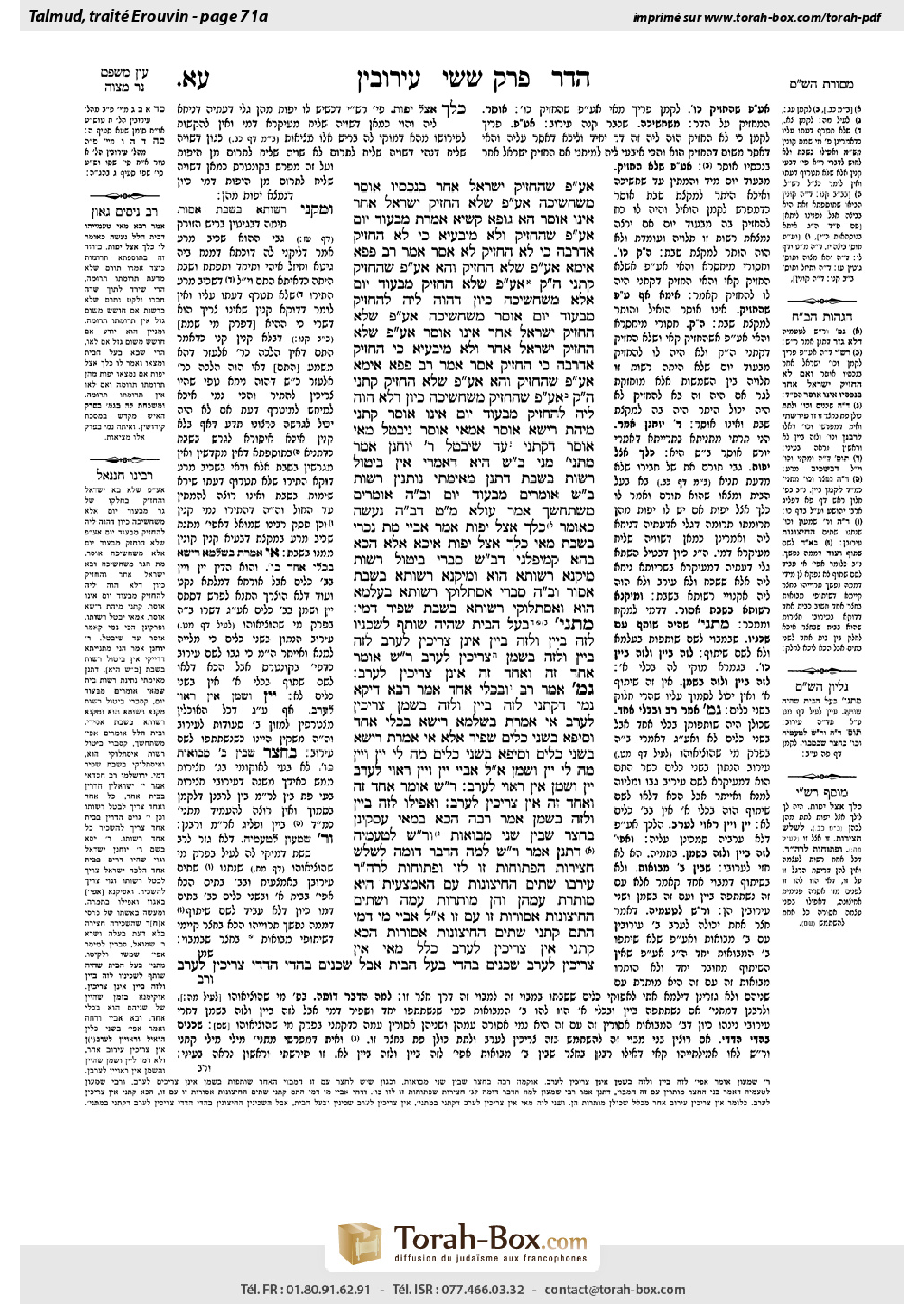
Eruvin 71a: Talmud study for Daf Yomi
Study the Talmud for Daf Yomi with scanned pages, Hebrew text, English translations from Sefaria and AI-generated French translations.
Passage selection and English or AI-generated French translation are available where the scan has annotations. Daf Study is independent of Torah-Box and Sefaria.
Browse Eruvin · עירובין · All tractatesEruvin 71a text and translations
This page of Eruvin includes the Aramaic text, an English translation and an AI-generated French translation, alongside the scan above.
עירובין ע״א א · Aramaic and Hebrew text
אַף עַל פִּי שֶׁהֶחֱזִיק יִשְׂרָאֵל אַחֵר בִּנְכָסָיו — אוֹסֵר. מִשֶּׁחָשֵׁיכָה, אַף עַל פִּי שֶׁלֹּא הֶחְזִיק יִשְׂרָאֵל אַחֵר — אֵינוֹ אוֹסֵר.
הָא גוּפָא קַשְׁיָא, אָמְרַתְּ: מִבְּעוֹד יוֹם — אַף עַל פִּי שֶׁהֶחְזִיק, וְלָא מִיבַּעְיָא כִּי לֹא הֶחְזִיק. אַדְּרַבָּה, כִּי לֹא הֶחְזִיק לָא אָסַר!
אָמַר רַב פָּפָּא: אֵימָא: אַף עַל פִּי שֶׁלֹּא הֶחְזִיק. וְהָא ״אַף עַל פִּי שֶׁהֶחְזִיק״ קָתָנֵי?
הָכִי קָאָמַר: אַף עַל פִּי שֶׁלֹּא הֶחְזִיק מִבְּעוֹד יוֹם אֶלָּא מִשֶּׁחָשֵׁיכָה, כֵּיוָן דַּהֲוָה לֵיהּ לְהַחְזִיק מִבְּעוֹד יוֹם — אוֹסֵר. מִשֶּׁחָשֵׁיכָה, אַף עַל פִּי שֶׁלֹּא הֶחְזִיק יִשְׂרָאֵל אַחֵר — אֵינוֹ אוֹסֵר.
״אַף עַל פִּי שֶׁלֹּא הֶחְזִיק יִשְׂרָאֵל אַחֵר״, וְלָא מִיבַּעְיָא כִּי הֶחְזִיק?! אַדְּרַבָּה, כִּי הֶחְזִיק אָסַר!
אָמַר רַב פָּפָּא, אֵימָא: ״אַף עַל פִּי שֶׁהֶחְזִיק״. וְהָא ״אַף עַל פִּי שֶׁלֹּא הֶחְזִיק״ קָתָנֵי! הָכִי קָאָמַר: אַף עַל פִּי שֶׁהֶחְזִיק מִשֶּׁחָשֵׁיכָה, כֵּיוָן דְּלָא הֲוָה לֵיהּ לְהַחְזִיק מִבְּעוֹד יוֹם — אֵינוֹ אוֹסֵר.
קָתָנֵי מִיהַת רֵישָׁא אוֹסֵר, אַמַּאי אוֹסֵר? נִיבַטֵּל!
מַאי ״אוֹסֵר״ דְּקָתָנֵי — עַד שֶׁיְּבַטֵּל.
רַבִּי יוֹחָנָן אָמַר: מַתְנִיתִין, מַנִּי? — בֵּית שַׁמַּאי הִיא, דְּאָמְרִי: אֵין בִּיטּוּל רְשׁוּת בְּשַׁבָּת. דִּתְנַן: מֵאֵימָתַי נוֹתְנִין רְשׁוּת? בֵּית שַׁמַּאי אוֹמְרִים: מִבְּעוֹד יוֹם, וּבֵית הִלֵּל אוֹמְרִים: מִשֶּׁתֶּחְשַׁךְ.
אָמַר עוּלָּא: מַאי טַעְמָא דְּבֵית הִלֵּל, נַעֲשָׂה כְּאוֹמֵר ״כְּלָךְ אֵצֶל יָפוֹת״.
אָמַר אַבָּיֵי: מֵת גּוֹי בְּשַׁבָּת מַאי ״כְּלָךְ אֵצֶל יָפוֹת״ אִיכָּא?
אֶלָּא הָכָא בְּהָא קָמִיפַּלְגִי: בֵּית שַׁמַּאי סָבְרִי בִּיטּוּל רְשׁוּת מִיקְנֵא רְשׁוּתָא הוּא, וּמִיקְנֵא רְשׁוּתָא בְּשַׁבָּת — אָסוּר. וּבֵית הִלֵּל סָבְרִי אִסְתַּלּוֹקֵי רְשׁוּתָא בְּעָלְמָא הוּא, וְאִסְתַּלּוֹקֵי רְשׁוּתָא בְּשַׁבָּת — שַׁפִּיר דָּמֵי.
מַתְנִי׳ בַּעַל הַבַּיִת שֶׁהָיָה שׁוּתָּף לִשְׁכֵנָיו, לָזֶה בְּיַיִן וְלָזֶה בְּיַיִן — אֵינָן צְרִיכִין לְעָרֵב.
לָזֶה בְּיַיִן וְלָזֶה בְּשֶׁמֶן — צְרִיכִין לְעָרֵב. רַבִּי שִׁמְעוֹן אוֹמֵר: אֶחָד זֶה וְאֶחָד זֶה, אֵינָן צְרִיכִין לְעָרֵב.
גְּמָ׳ אָמַר רַב: וּבִכְלִי אֶחָד. אָמַר רָבָא, דַּיְקָא נָמֵי דְּקָתָנֵי: לָזֶה בְּיַיִן וְלָזֶה בְּשֶׁמֶן — צְרִיכִין לְעָרֵב. אִי אָמְרַתְּ בִּשְׁלָמָא: רֵישָׁא בִּכְלִי אֶחָד, וְסֵיפָא בִּשְׁנֵי כֵלִים — שַׁפִּיר. אֶלָּא אִי אָמְרַתְּ: רֵישָׁא בִּשְׁנֵי כֵלִים, וְסֵיפָא בִּשְׁנֵי כֵלִים — מָה לִי יַיִן וָיַיִן, מָה לִי יַיִן וָשֶׁמֶן?!
אֲמַר לֵיהּ אַבָּיֵי: יַיִן וָיַיִן רָאוּי לְעָרֵב. יַיִן וְשֶׁמֶן אֵין רָאוּי לְעָרֵב.
רַבִּי שִׁמְעוֹן אוֹמֵר, אֶחָד זֶה וְאֶחָד זֶה — אֵין צְרִיכִין לְעָרֵב. וַאֲפִילּוּ לָזֶה בְּיַיִן וְלָזֶה בְּשֶׁמֶן! אָמַר רַבָּה: הָכָא בְּמַאי עָסְקִינַן בְּחָצֵר שֶׁבֵּין שְׁנֵי מְבוֹאוֹת, וְרַבִּי שִׁמְעוֹן לְטַעְמֵיהּ —
דִּתְנַן, אָמַר רַבִּי שִׁמְעוֹן: לְמָה הַדָּבָר דּוֹמֶה, לְשָׁלֹשׁ חֲצֵירוֹת הַפְּתוּחוֹת זוֹ לָזוֹ וּפְתוּחוֹת לִרְשׁוּת הָרַבִּים. עֵירְבוּ שְׁתַּיִם הַחִיצוֹנוֹת עִם הָאֶמְצָעִית — הִיא מוּתֶּרֶת עִמָּהֶן, וְהֵן מוּתָּרוֹת עִמָּהּ, וּשְׁתַּיִם הַחִיצוֹנוֹת אֲסוּרוֹת זוֹ עִם זוֹ.
אֲמַר לֵיהּ אַבָּיֵי: מִי דָּמֵי? הָתָם קָתָנֵי: שְׁתַּיִם הַחִיצוֹנוֹת אֲסוּרוֹת, הָכָא קָתָנֵי: אֵין צְרִיכִין לְעָרֵב כְּלָל!
מַאי ״אֵין צְרִיכִין לְעָרֵב״ — שְׁכֵנִים בַּהֲדֵי בַּעַל הַבַּיִת, אֲבָל שְׁכֵנִים בַּהֲדֵי הֲדָדֵי — צְרִיכִין לְעָרֵב.
Eruvin 71a · English translation
In such a case, even though a different Jew took possession of the convert’s property, the one who acquires it renders carrying prohibited. If, however, he died after nightfall, even though a different Jew did not take possession of his property, it, i.e., carrying, is not prohibited, for carrying had already been permitted on that Shabbat.
The Gemara raises a difficulty: The baraita itself is difficult. You first said: If the convert died while it was still day, even though a different Jew took possession of his property, the latter renders carrying prohibited, which implies that it is not necessary to say so where another Jew did not take possession of the property, for in such a case it is certainly prohibited. But this is incorrect. On the contrary, in a case where a different person did not take possession of the property, it is certainly not prohibited, for in such a case the convert’s property is ownerless and there is nobody to render carrying in the courtyard prohibited.
Rav Pappa said: Say that the baraita should read as follows: Even though a different Jew did not take possession of it. The Gemara raises a difficulty: How can it be corrected in this manner? But doesn’t it teach: Even though he took possession of it?
The Gemara answers: This is what the baraita is saying: If the convert died while it was still day, then even though a different Jew did not take possession of the property while it was still day but only after nightfall, since he had the possibility of taking possession of it while it was still day, the person who acquires it renders carrying prohibited. If, however, the convert died after nightfall, even though a different Jew did not take possession of his property, it does not render it prohibited to carry.
The Gemara now considers the next clause of the baraita, which states: If the convert died after nightfall, even though a different Jew did not take possession of his property, carrying is not prohibited. This implies that it is not necessary to say so where another Jew did take possession of the property, for in such a case it is certainly not prohibited. But, on the contrary, where a different person takes possession of the property, he renders carrying prohibited.
Rav Pappa said: Say that the baraita should read as follows: Even though a different Jew took possession of it. The Gemara raises a difficulty: But didn’t the baraita teach: Even though he did not take possession of it? The Gemara explains: This is what the baraita is saying: If the convert died after nightfall, even though a different Jew took possession of his property after nightfall, since he did not have the possibility of taking possession of it while it was still day, he does not render carrying prohibited.
After explaining the baraita, the Gemara proceeds to clarify the issue at hand: In any event, the first clause is teaching that the person who acquires the convert’s property renders carrying prohibited; but why does he render carrying prohibited? Let him renounce his rights in the domain like an heir. The implication then is that he does not have the option of renunciation, in contrast to the opinion of Rav Naḥman.
Rav Naḥman replied: What is the meaning of the word prohibits that it teaches here? It means he renders carrying prohibited until he renounces his rights, but renunciation is effective.
Rabbi Yoḥanan said: Who is the tanna of the problematic baraitot that imply that an heir cannot renounce rights, and from which objections were brought against Rav Naḥman? It is Beit Shammai, who say that there is no renunciation of rights on Shabbat at all, even for the owner of the property. As we learned in the mishna: When may one give away rights in a domain? Beit Shammai say: While it is still day. And Beit Hillel say: Even after nightfall.
With regard to this dispute itself, Ulla said: What is the reason of Beit Hillel that one may renounce rights even after nightfall? This should be considered an act of acquisition, which is prohibited on Shabbat. He explains: It is comparable to one who says: Turn toward the high-quality ones. If a person sets aside teruma from another person’s produce without the latter’s knowledge, and when the owner finds out he says: Why did you set aside this produce? Turn toward the high-quality ones, i.e., you should have gone to find better produce to use as teruma, then the teruma that was separated is considered teruma, provided there was indeed quality produce in that place. The reason is that the owner has demonstrated his retroactive acquiescence to the other person’s setting aside of teruma. Therefore, the latter is considered his agent for this purpose. The same applies to our issue. If a person intended to permit both himself and others to carry in a courtyard by means of establishing an eiruv but forgot to do so, by renouncing his rights after nightfall, he retroactively makes plain his desire that his domain should be mingled with that of his neighbors. What he then does on Shabbat is not a complete action, but merely a demonstration of his intentions.
Abaye said: This explanation is unsatisfactory, as when a gentile dies on Shabbat, what connection is there to the concept: Turn toward the high-quality ones? When a gentile dies on Shabbat, his Jewish neighbors may renounce their rights in the courtyard to each other and thus render carrying in the courtyard permitted, even though such renunciation would have been ineffective prior to his passing. Consequently, it cannot be said that it works retroactively.
Rather, the Gemara rejects Ulla’s explanation and states that here they disagree over the following: Beit Shammai hold that renunciation of a domain is equivalent to acquisition of a domain, and acquisition of a domain is prohibited on Shabbat. And Beit Hillel hold that it is merely withdrawal from a domain, and withdrawal from a domain seems well on Shabbat, i.e., it is permitted. As such, there is no reason to prohibit renunciation as a form of acquisition, which is prohibited as a part of a decree against conducting commerce on Shabbat.
MISHNA: If a homeowner was in partnership with his neighbors, with this one in wine and with that one in wine, they need not establish an eiruv, for due to their authentic partnership they are considered to be one household, and no further partnership is required.
If, however, he was in partnership with this one in wine and with that one in oil, they must establish an eiruv. As they are not partners in the same item, they are not all considered one partnership. Rabbi Shimon says: In both this case and that case, i.e., even if he partners with his neighbors in different items, they need not establish an eiruv.
GEMARA: Rav said: The halakha that one who is in partnership in wine with both his neighbors need not establish an eiruv applies only if their wine is in one vessel. Rava said: The language of the mishna is also precise, as it teaches: If he was in partnership with this one in wine and with the other one in oil, they must establish an eiruv. Granted, if you say that the first clause of the mishna deals with one vessel, and the latter clause deals with two vessels, one of wine and one of oil, it is well. But, if you say that the first clause of the mishna speaks of two vessels, and the latter clause also speaks of two vessels, what difference is it to me if it is wine and wine or wine and oil? The halakha should be the same in both cases.
Abaye said to him: This is no proof, and the first clause can be referring to a case where the wine was in separate vessels as well. The difference is that wine and wine is suitable for mixing together, and therefore can be considered a single unit even if divided into two containers. Wine and oil, however, are not suitable for mixing.
We learned in the mishna: Rabbi Shimon says: In both this case, where they are partners in wine alone, and that case, where the partnerships are in wine and oil, they need not establish an eiruv. The Gemara poses a question: Did he say this even if the partnership is with this one in wine and with the other one in oil? But these are not suitable for mixing. Rabba said: With what are we dealing here? We are dealing with a courtyard positioned between two alleyways, and Rabbi Shimon follows his usual line of reasoning.
As we learned in a mishna: Rabbi Shimon said: To what is this matter comparable? It is comparable to the case of three courtyards that open into one another and also open into a public domain. If the two outer courtyards each established an eiruv with the middle one, it is permitted for residents of the middle one to carry with the two outer ones, and it is permitted for residents of the two outer ones to carry with the middle one. However, it is prohibited for the residents of the two outer courtyards to carry with each other, as they did not establish an eiruv with each other. This teaches that the residents of one courtyard can establish an eiruv with a courtyard on each side, and need not choose between them. Here too, the residents of the courtyard can participate in an eiruv with both alleyways, one by means of wine and the other by means of oil.
Abaye said to him: Are the cases really comparable? There it teaches: It is prohibited for the residents of the two outer courtyards to carry with each other, whereas here it teaches: They need not establish an eiruv, indicating that it is permitted for residents of all three domains to carry with each other.
The Gemara explains: What is the subject of the phrase they need not establish an eiruv? It refers to the neighbors together with the homeowner, i.e., the residents of the courtyards that open into each of the alleyways with the resident of the courtyard in the middle. But with regard to the neighbors with each other, i.e., if the residents of the two alleyways wish to be permitted to carry with each other, they must establish an eiruv and place it in the middle courtyard.
Eruvin 71a · Traduction française (IA)
Dans ce cas, même si un autre Juif a pris possession des biens du converti, celui qui les acquiert rend le port interdit. Cependant, si celui-ci est mort après le coucher du soleil, même si un autre Juif n'a pas pris possession de ses biens, le port n'est pas interdit, car le port avait déjà été autorisé ce samedi-là.
La Guemara soulève un problème : la baraïta elle-même est difficile. Vous avez d'abord dit : Si le converti est mort pendant la journée, même si un autre Juif a pris possession de ses biens, le dernier rend le port interdit, ce qui implique qu'il n'est pas nécessaire de le dire dans le cas où un autre Juif n'a pas pris possession des biens, car dans ce cas, il est certainement interdit. Mais cela est incorrect. Au contraire, dans le cas où une autre personne n'a pas pris possession des biens, il est certainement interdit, car dans ce cas, les biens du converti sont sans propriétaire et personne ne rend le port dans la cour interdit.
Rav Pappa dit : Dites que la baraïta devrait lire ainsi : Même si un autre Juif n'a pas pris possession d'elle. La Guemara soulève un problème : comment peut-on corriger ainsi ? Mais ne dit-il pas : Même s'il a pris possession d'elle ?
La Guemara répond : C'est ce que la baraïta dit : Si le converti est mort pendant la journée, alors même si un autre Juif n'a pas pris possession des biens pendant la journée mais seulement après le coucher du soleil, puisque celui-ci avait la possibilité de prendre possession des biens pendant la journée, la personne qui les acquiert rend le port interdit. Si, cependant, le converti est mort après le coucher du soleil, même si un autre Juif n'a pas pris possession de ses biens, cela ne rend pas le port interdit.
La Guemara considère maintenant la prochaine clause de la baraïta, qui stipule : Si le converti est mort après le coucher du soleil, même si un autre Juif n'a pas pris possession de ses biens, le port n'est pas interdit. Cela implique qu'il n'est pas nécessaire de le dire dans le cas où un autre Juif a pris possession des biens, car dans ce cas, il est certainement interdit. Mais, au contraire, dans le cas où une autre personne a pris possession des biens, elle rend le port interdit.
Rav Pappa dit : Dites que la baraïta devrait lire ainsi : Même si un autre Juif a pris possession d'elle. La Guemara soulève un problème : Mais ne dit-elle pas que la baraïta a enseigné : Même s'il n'a pas pris possession d'elle ? La Guemara explique : C'est ce que la baraïta dit : Si le converti est mort après le coucher du soleil, même si un autre Juif a pris possession de ses biens après le coucher du soleil, puisque celui-ci n'avait pas la possibilité de prendre possession des biens pendant la journée, il ne rend pas le port interdit.
Après avoir expliqué la baraïta, la Guemara passe à clarifier la question principale : En tout cas, la première clause enseigne que la personne qui acquiert les biens du converti rend le port interdit ; mais pourquoi rend-elle le port interdit ? Que la personne renonce à ses droits dans le domaine comme un héritier. L'implication est alors que cela ne lui est pas permis, contrairement à l'opinion de Rav Naḥman.
Rav Naḥman répondit : Quelle est la signification du mot interdit qu'elle enseigne ici ? Cela signifie qu'il rend le port interdit jusqu'à ce qu'il renonce à ses droits, mais le renoncement est efficace.
Rabbi Yoḥanan dit : Qui est le tanna des baraitot problématiques qui impliquent que l'héritier ne peut pas renoncer à ses droits, et à partir desquelles des objections ont été formulées contre Rav Naḥman ? C'est Beit Shammai, qui disent qu'il n'y a pas de renoncement des droits le sabbat du tout, même pour le propriétaire des biens. Comme nous l'avons appris dans la mishna : Quand peut-on donner des droits dans un domaine ? Beit Shammai disent : Tant qu'il fait encore jour. Et Beit Hillel disent : Même après le coucher du soleil.
Concernant ce débat lui-même, Ulla dit : Quel est le motif de Beit Hillel qui permet de renoncer à des droits même après le coucher du soleil ? Cela devrait être considéré comme une action d'acquisition, qui est interdite le sabbat. Il explique : C'est comparable à celui qui dit : Tournez vers les meilleurs. Si une personne désigne la terouma d'une production d'un autre sans la connaissance de ce dernier, et quand l'propriétaire découvre cela, il dit : Pourquoi avez-vous désigné cette production ? Tournez vers les meilleurs, c'est-à-dire que vous deviez aller chercher une meilleure production pour utiliser comme terouma, alors la terouma désignée est considérée comme terouma, à condition qu'il y ait effectivement une production de qualité dans cet endroit. La raison est que l'propriétaire a montré son accord rétrospectif à la désignation de la terouma par l'autre personne. Ainsi, l'autre est considéré comme son agent à cet effet. La même chose s'applique à notre problème. Si une personne avait l'intention de permettre à lui-même et aux autres de porter dans une cour en établissant un eiruv mais avait oublié de le faire, en renonçant à ses droits après le coucher du soleil, il rend rétrospectivement clair son désir que sa propriété soit mêlée à celle de ses voisins. Ce qu'il fait alors le sabbat n'est pas une action complète, mais simplement une démonstration de ses intentions.
Abaye dit : Cette explication est insatisfaisante, car quand un gentil meurt le sabbat, quelle est la connexion avec la notion : Tournez vers les meilleurs ? Quand un gentil meurt le sabbat, ses voisins juifs peuvent renoncer à leurs droits dans la cour les uns aux autres et ainsi rendre le port dans la cour autorisé, même si ce renoncement aurait été inefficace avant son décès. Ainsi, on ne peut pas dire qu'il agit rétrospectivement.
Au contraire, la Guemara rejette l'explication d'Ulla et affirme qu'ils s'opposent sur ce qui suit : Beit Shammai considèrent que le renoncement d'un domaine est équivalent à l'acquisition d'un domaine, et l'acquisition d'un domaine est interdite le sabbat. Et Beit Hillel considèrent qu'il s'agit simplement d'un retrait d'un domaine, et le retrait d'un domaine semble bien le sabbat, c'est-à-dire qu'il est autorisé. Ainsi, il n'y a pas de raison d'interdire le renoncement comme forme d'acquisition, car celui-ci est interdit en tant que partie d'un décret contre l'activité commerciale le sabbat.
MICHNA : Si un propriétaire de maison était en partenariat avec ses voisins, l'un en vin et l'autre en vin, ils n'ont pas besoin d'établir un eiruv, car, en raison de leur partenariat authentique, ils sont considérés comme une seule famille, et aucun autre partenariat n'est requis.
Cependant, si l'on était en partenariat avec l'un en vin et avec l'autre en huile, ils doivent établir un eiruv. Comme ils ne sont pas partenaires dans le même objet, ils ne sont pas tous considérés comme un seul partenariat. Rabbi Shimon dit : Dans les deux cas, c'est-à-dire même si l'on est en partenariat avec ses voisins dans des objets différents, ils n'ont pas besoin d'établir un eiruv.
GUEMARA : Rav dit : La halakha selon laquelle celui qui est en partenariat en vin avec ses deux voisins n'a pas besoin d'établir un eiruv s'applique uniquement si leur vin est dans un seul récipient. Rava dit : La formulation de la mishna est aussi précise, car elle enseigne : Si l'on était en partenariat avec l'un en vin et avec l'autre en huile, ils doivent établir un eiruv. Bien sûr, si vous dites que la première partie de la mishna traite d'un seul récipient, et la seconde partie traite de deux récipients, l'un en vin et l'autre en huile, c'est bien. Mais, si vous dites que la première partie de la mishna parle de deux récipients, et la seconde partie parle également de deux récipients, quelle différence cela fait-il pour moi si c'est du vin et du vin ou du vin et de l'huile ? La halakha devrait être la même dans les deux cas.
Abaye dit à lui : Cela n'est pas une preuve, et la première partie peut faire référence à un cas où le vin était dans des récipients séparés. La différence est que le vin et le vin sont adaptés à être mélangés ensemble, et donc peuvent être considérés comme une seule unité même si divisés en deux conteneurs. Le vin et l'huile, cependant, ne sont pas adaptés à être mélangés.
Nous avons appris dans la mishna : Rabbi Shimon dit : Dans ce cas-ci, où ils sont partenaires uniquement en vin, et dans ce cas-là, où les partenariats sont en vin et en huile, ils n'ont pas besoin d'établir un eiruv. La Guemara pose une question : A-t-il dit cela même si le partenariat est avec celui-ci en vin et avec l'autre en huile ? Mais ces deux sont incompatibles. Rabba dit : Avec quoi sommes-nous en train de traiter ? Nous traitons d'un courtyard situé entre deux cours, et Rabbi Shimon suit sa ligne de raisonnement habituelle.
Comme nous l'avons appris dans une mishna : Rabbi Shimon dit : À quoi cela est-il comparable ? C'est comparable au cas de trois courtyards qui s'ouvrent les uns sur les autres et s'ouvrent également sur un domaine public. Si les deux courtyards externes ont chacun établi un eiruv avec le milieu, il est permis aux résidents du milieu de porter avec les deux externes, et il est permis aux résidents des deux externes de porter avec le milieu. Cependant, il est interdit aux résidents des deux courtyards externes de porter les uns avec les autres, car ils n'ont pas établi un eiruv entre eux. Cela enseigne que les résidents d'un courtyard peuvent établir un eiruv avec un courtyard sur chaque côté, et n'ont pas besoin de choisir entre eux. Ici aussi, les résidents du courtyard peuvent participer à un eiruv avec les deux allées, l'un par le vin et l'autre par l'huile.
Abaye dit à lui : Les cas sont-ils vraiment comparables ? Il y a là-bas une interdiction : les résidents des deux courtyards externes ne doivent pas porter l'un avec l'autre, tandis que ici il est dit : ils n'ont pas besoin d'établir un eiruv, ce qui indique qu'il est permis aux résidents des trois domaines de porter l'un avec l'autre.
La Guemara explique : De quoi la phrase « ils n'ont pas besoin d'établir un eiruv » parle-t-elle ? Elle fait référence aux voisins ensemble avec le propriétaire, c'est-à-dire les résidents des courtyards qui s'ouvrent sur chaque allée avec le résident du courtyard du milieu. Mais concernant les voisins entre eux, c'est-à-dire si les résidents des deux allées souhaitent être autorisés à porter les uns avec les autres, ils doivent établir un eiruv et le placer dans le courtyard milieu.
Traduction française générée par IA à partir de l’édition anglaise de Sefaria. Vérifie toujours un passage avec le texte source.
Text from Sefaria: William Davidson Edition - Vocalized Aramaic (CC BY NC); William Davidson Edition - English (CC BY NC).