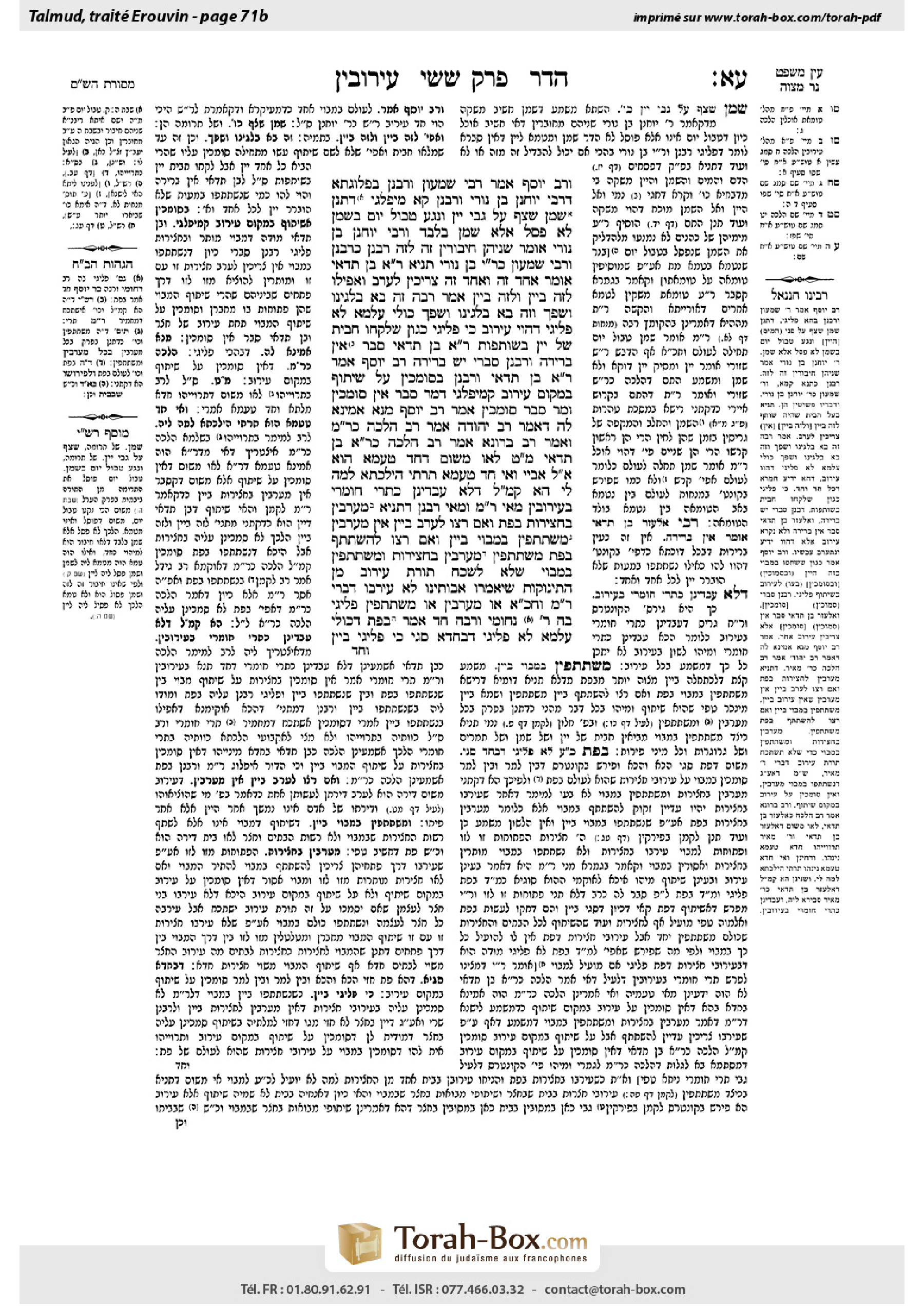
Eruvin 71b: Talmud study for Daf Yomi
Study the Talmud for Daf Yomi with scanned pages, Hebrew text, English translations from Sefaria and AI-generated French translations.
Passage selection and English or AI-generated French translation are available where the scan has annotations. Daf Study is independent of Torah-Box and Sefaria.
Browse Eruvin · עירובין · All tractatesEruvin 71b text and translations
This page of Eruvin includes the Aramaic text, an English translation and an AI-generated French translation, alongside the scan above.
עירובין ע״א ב · Aramaic and Hebrew text
וְרַב יוֹסֵף אָמַר: רַבִּי שִׁמְעוֹן וְרַבָּנַן בִּפְלוּגְתָּא דְּרַבִּי יוֹחָנָן בֶּן נוּרִי וְרַבָּנַן קָא מִיפַּלְגִי. דִּתְנַן: שֶׁמֶן שֶׁצָּף עַל גַּבֵּי יַיִן, וְנָגַע טְבוּל יוֹם בְּשֶׁמֶן — לֹא פָּסַל אֶלָּא שֶׁמֶן בִּלְבַד, וְרַבִּי יוֹחָנָן בֶּן נוּרִי אוֹמֵר: שְׁנֵיהֶן חִיבּוּרִין זֶה לָזֶה.
רַבָּנַן — כְּרַבָּנַן, וְרַבִּי שִׁמְעוֹן — כְּרַבִּי יוֹחָנָן בֶּן נוּרִי.
תַּנְיָא, רַבִּי אֱלִיעֶזֶר בֶּן תַּדַּאי אוֹמֵר: אֶחָד זֶה וְאֶחָד זֶה צְרִיכִין לְעָרֵב. וַאֲפִילּוּ לָזֶה בְּיַיִן וְלָזֶה בְּיַיִן?
אָמַר רַבָּה: זֶה בָּא בִּלְגִינוֹ וְשָׁפַךְ, וָזֶה בָּא בִּלְגִינוֹ וְשָׁפַךְ — כּוּלֵּי עָלְמָא לָא פְּלִיגִי דְּהָוֵי עֵירוּב.
כִּי פְּלִיגִי כְּגוֹן שֶׁלָּקְחוּ חָבִית שֶׁל יַיִן בְּשׁוּתָּפוּת, רַבִּי אֱלִיעֶזֶר בֶּן תַּדַּאי סָבַר: אֵין בְּרֵירָה, וְרַבָּנַן סָבְרִי: יֵשׁ בְּרֵירָה.
רַב יוֹסֵף אָמַר: רַבִּי אֱלִיעֶזֶר בֶּן תַּדַּאי וְרַבָּנַן בְּסוֹמְכִין עַל שִׁיתּוּף בִּמְקוֹם עֵירוּב קָמִיפַּלְגִי.
דְּמָר סָבַר: אֵין סוֹמְכִין, וּמָר סָבַר: סוֹמְכִין.
אָמַר רַב יוֹסֵף: מְנָא אָמֵינָא לַהּ, דְּאָמַר רַב יְהוּדָה אָמַר רַב: הֲלָכָה כְּרַבִּי מֵאִיר. וְאָמַר רַב בְּרוֹנָא אָמַר רַב: הֲלָכָה כְּרַבִּי אֱלִיעֶזֶר בֶּן תַּדַּאי. מַאי טַעְמָא, לָאו מִשּׁוּם דְּחַד טַעְמָא הוּא?
אֲמַר לֵיהּ אַבָּיֵי: וְאִי חַד טַעְמָא, תַּרְתֵּי הִילְכְתָא לְמָה לִי?! הָא קָא מַשְׁמַע לַן דְּלָא עָבְדִינַן כִּתְרֵי חוּמְרֵי בְּעֵירוּבִין.
מַאי רַבִּי מֵאִיר וּמַאי רַבָּנַן? דְּתַנְיָא: מְעָרְבִין בַּחֲצֵירוֹת בְּפַת, וְאִם רָצוּ לְעָרֵב בְּיַיִן — אֵין מְעָרְבִין. מִשְׁתַּתְּפִין בְּמָבוֹי בְּיַיִן, וְאִם רָצוּ לְהִשְׁתַּתֵּף בְּפַת — מִשְׁתַּתְּפִין.
מְעָרְבִין בַּחֲצֵירוֹת וּמִשְׁתַּתְּפִין בְּמָבוֹי שֶׁלֹּא לְשַׁכֵּחַ תּוֹרַת עֵירוּב מִן הַתִּינוֹקוֹת, שֶׁיֹּאמְרוּ: אֲבוֹתֵינוּ לֹא עֵירְבוּ, דִּבְרֵי רַבִּי מֵאִיר. וַחֲכָמִים אוֹמְרִים: אוֹ מְעָרְבִין אוֹ מִשְׁתַּתְּפִין.
פְּלִיגִי בַּהּ רַבִּי נְחוּמִי וְרַבָּה, חַד אָמַר: בְּפַת דְּכוּלֵּי עָלְמָא לָא פְּלִיגִי דְּבַחֲדָא סַגִּי, כִּי פְּלִיגִי בְּיַיִן.
Eruvin 71b · English translation
And Rav Yosef said: In fact we are dealing here with a single alleyway, and Rabbi Shimon and the Rabbis disagree about the same point of dispute between Rabbi Yoḥanan ben Nuri and the Rabbis. As we learned in a mishna: If teruma oil was floating on the surface of wine, and one who immersed during the day, touched the oil, he disqualified only the oil alone. However, he did not disqualify the wine, because it is considered separate from the oil. Only the oil is disqualified, and it does not render other items ritually impure. And Rabbi Yoḥanan ben Nuri says: They are both connected to each other and are considered as one, so the wine is also ritually impure.
The Gemara explains: The opinion of the Rabbis in our mishna is in accordance with the opinion of the Rabbis in the other mishna, who maintain that wine and oil are not connected and therefore cannot be used together in an eiruv, and the opinion of Rabbi Shimon is in accordance with the opinion of Rabbi Yoḥanan ben Nuri, who holds that wine and oil are connected, and may be used together in an eiruv.
It was taught in a baraita: Rabbi Eliezer ben Taddai says: In both this case, of wine and wine, and that case, of wine and oil, they must establish an eiruv. The Gemara expresses wonder: Did he say this even if the partnership is with this one in wine and also with the other one in wine? Why should these partnerships not be sufficient to consider the items merged?
Rabba said: If they partnered in the following manner, such that this one came with his wine-filled jug and poured its contents into a barrel, and the other one came with his jug and poured his wine into that same barrel, everyone agrees that it is a valid eiruv, even if they did not act specifically for that purpose.
Where they disagree is in the case where they bought a barrel of wine in partnership. Rabbi Eliezer ben Taddai holds: There is no principle of retroactive clarification, i.e., there is no halakhic assumption that the undetermined halakhic status of items can be retroactively clarified. Consequently, after the wine is consumed, it is not possible to clarify retroactively which portion of the wine belonged to each person. Therefore, they cannot each be said to own a particular part of the wine, which renders it unfit for an eiruv. But the Rabbis hold that there is retroactive clarification, and therefore they may rely on this partnership to establish an eiruv.
Rav Yosef said that this dispute should be understood differently, as Rabbi Eliezer ben Taddai and the Rabbis disagree about whether one may rely on a merging of an alleyway instead of an eiruv, i.e., whether the merging of an alleyway to permit carrying in the alleyway, exempts the courtyards that open into the alleyway from having to establish an eiruv for the purpose of carrying from one courtyard to the other.
As one Sage, Rabbi Eliezer ben Taddai, holds that one may not rely on it in that case, as carrying in the courtyards requires specifically an eiruv, and the merging of alleyways is insufficient. And one Sage, i.e., the Rabbis, maintains that one may rely on and use the merging of alleyways to permit carrying between the courtyards as well.
Rav Yosef said: From where do I say this, that this is the subject of their dispute? As Rav Yehuda said that Rav said: The halakha is in accordance with the opinion of Rabbi Meir, which will be detailed later, that one may not rely on a merging of alleyways instead of an eiruv. And Rav Beruna said that Rav said: The halakha is in accordance with the opinion of Rabbi Eliezer ben Taddai, that in both cases they must establish an eiruv. What is the reason he ruled in this manner? Is it not because the rationale for both rulings is one and the same?
Abaye said to him: But if it is one reason, why do I need two rulings? On the contrary, it would be enough to rule in one case, from which we could infer the other as well. Rav Yosef replied: There is nevertheless a reason for both rulings, as this comes to teach us that we do not act in accordance with two stringencies of one tanna in matters of eiruv. Had Rav ruled only in accordance with Rabbi Meir, we would have known only that the halakha is in accordance with his opinion with regard to one specific detail of the case. He therefore ruled in accordance with two Sages: Rabbi Eliezer ben Taddai with regard to a merging of alleyways with wine, and Rabbi Meir with regard to a merging of alleyways with bread. Each is stringent with regard to a different detail of the case.
Having mentioned Rabbi Meir, the Gemara now asks: What is the statement of Rabbi Meir, and what is the statement of the Rabbis? As it was taught in the following baraita: One may establish an eiruv with bread between courtyards that open to one another, but if one wanted to establish an eiruv with wine, one may not establish an eiruv in that manner. One may merge the courtyards that open into an alleyway with wine, and if one wanted to establish a merging of alleyways with bread, one may merge the courtyards of alleyways in this manner.
Why does one establish an eiruv between courtyards and also merge the courtyards that open into an alleyway? It is so as not to cause the halakhic category of eiruv to be forgotten by the children, as if a merging of alleyways alone were used, the children would later say: Our fathers never established an eiruv. Therefore, an eiruv is established for educational purposes; this is the statement of Rabbi Meir. And the Rabbis say: One may either establish an eiruv or merge alleyways.
Rabbi Naḥumi and Rabba disagreed about this issue. One of them said: In the case of bread, which may be used both for an eiruv and for a merging of alleyways, everyone agrees that one, either an eiruv or a merging of alleyways, is enough. When they disagree in the case of wine, which may be used only for a merging of alleyways but not for an eiruv, Rabbi Meir maintains that an eiruv is also necessary, while the Rabbis maintain that it is not required.
Eruvin 71b · Traduction française (IA)
Et Rav Yosef a dit : En effet, nous sommes ici en présence d'un seul passage étroit, et Rabbi Shimon et les Rabbins divergent sur le même point de débat entre Rabbi Yoḥanan ben Nuri et les Rabbins. Comme nous l'avons appris dans une mitsva : Si l'huile de terouma flottait à la surface du vin, et qu'une personne qui s'était immergé pendant la journée touchait l'huile, il disqualifiait uniquement l'huile seule. Cependant, il ne disqualifiait pas le vin, car il est considéré comme séparé de l'huile. Seule l'huile est disqualifiée, et elle ne rend pas d'autres objets impurs. Et Rabbi Yoḥanan ben Nuri dit : Ils sont tous deux connectés entre eux et sont considérés comme un seul, donc le vin est également rendu impur.
La Guemara explique : L'opinion des Rabbins dans notre mitsva est en conformité avec l'opinion des Rabbins dans l'autre mitsva, qui maintiennent que le vin et l'huile ne sont pas connectés et qu'ils ne peuvent donc être utilisés ensemble dans un eiruv, et l'opinion de Rabbi Shimon est en conformité avec l'opinion de Rabbi Yoḥanan ben Nuri, qui considère que le vin et l'huile sont connectés et peuvent être utilisés ensemble dans un eiruv.
Il fut enseigné dans une baraïta : Rabbi Eliezer ben Taddai dit : Dans ce cas-ci, de vin et de vin, et dans ce cas-là, de vin et d'huile, ils doivent établir un eiruv. La Guemara exprime une surprise : A-t-il dit cela même si le partenariat est avec celui-ci en vin et aussi avec l'autre en vin ? Pourquoi ces partenariats ne devraient-ils pas suffire à considérer les objets comme fusionnés ?
Rabba dit : Si deux personnes ont formé un partenariat de telle manière que l'une est venue avec son tonneau de vin et a versé son contenu dans un tonneau, et que l'autre est venue avec son tonneau et a versé son vin dans ce même tonneau, tout le monde convient que c'est un eiruv valide, même s'ils n'ont pas agi spécifiquement à cet effet.
C'est dans le cas où ils ont acheté un tonneau de vin en partenariat que Rabbi Eliezer ben Taddai maintient : Il n'y a pas de principe de clarification rétrospective, c'est-à-dire qu'il n'y a pas d'hypothèse halakhique selon laquelle le statut halakhique indéterminé des objets peut être clarifié rétrospectivement. Ainsi, après que le vin ait été consommé, il n'est pas possible de clarifier rétrospectivement quelle partie du vin appartenait à chacun. Par conséquent, ils ne peuvent pas être considérés comme possédant une part spécifique du vin, ce qui rendrait l'eiruv inadapté. Mais les Rabbins pensent qu'il y a une clarification rétrospective, et donc ils peuvent s'appuyer sur ce partenariat pour établir un eiruv.
Rav Yosef dit que ce débat devrait être compris différemment, comme Rabbi Eliezer ben Taddai et les Rabbins divergent sur le fait de savoir si l'on peut s'appuyer sur la fusion d'un passage étroit à la place d'un eiruv, c'est-à-dire si la fusion d'un passage étroit pour permettre le transport dans le passage étroit exemptait les courtyards qui s'ouvrent sur le passage étroit de devoir établir un eiruv pour le transport d'un courtyard à l'autre.
Comme un Sage, Rabbi Eliezer ben Taddai, affirme que l'on ne peut pas s'appuyer sur cela dans ce cas, car le transport dans les courtyards nécessite spécifiquement un eiruv, et la fusion des passages étroits est insuffisante. Et un Sage, c'est-à-dire les Rabbins, maintient que l'on peut s'appuyer sur et utiliser la fusion des passages étroits pour permettre le transport entre les courtyards également.
Rav Yosef dit : D'où dis-je cela, que c'est le sujet de leur débat ? Comme Rav Yehuda a dit que Rav a dit : La halakha suit l'opinion de Rabbi Meir, qui sera détaillée plus tard, que l'on ne peut pas s'appuyer sur la fusion des passages étroits à la place d'un eiruv. Et Rav Beruna a dit que Rav a dit : La halakha suit l'opinion de Rabbi Eliezer ben Taddai, que dans les deux cas ils doivent établir un eiruv. Quelle est la raison de ce jugement ? N'est-ce pas parce que la raison des deux décisions est la même ?
Abaye a dit à lui : Mais si c'est une seule raison, pourquoi ai-je besoin de deux décisions ? Au contraire, il suffirait de juger dans un cas, d'où nous pourrions déduire l'autre. Rav Yosef a répondu : Il y a néanmoins une raison pour les deux décisions, car cela nous apprend que nous ne suivons pas deux stricteurs d'un même tanna dans les affaires d'eiruv. Si Rav avait jugé uniquement selon Rabbi Meir, nous aurions su seulement que la halakha suit son opinion concernant un détail spécifique du cas. Il a donc jugé selon deux Sages : Rabbi Eliezer ben Taddai concernant la fusion des passages étroits avec du vin, et Rabbi Meir concernant la fusion des passages étroits avec du pain. Chacun est strict concernant un détail différent du cas.
Ayant mentionné Rabbi Meir, la Guemara pose maintenant la question : Quel est l'opinion de Rabbi Meir et quelle est l'opinion des Rabbins ? Comme il fut enseigné dans la baraïta suivante : On peut établir un eiruv avec du pain entre des courtyards qui s'ouvrent les uns sur les autres, mais si l'on veut établir un eiruv avec du vin, on ne peut pas établir un eiruv de cette manière. On peut fusionner les courtyards qui s'ouvrent sur un passage étroit avec du vin, et si l'on voulait établir une fusion de passages étroits avec du pain, on peut fusionner les courtyards des passages étroits de cette manière.
Pourquoi établit-on un eiruv entre des courtyards et aussi fusionne-t-on les courtyards qui s'ouvrent sur un passage étroit ? C'est afin de ne pas faire oublier à la génération future la catégorie halakhique de l'eiruv, car si seule la fusion des passages étroits était utilisée, les enfants diraient plus tard : Nos pères n'ont jamais établi un eiruv. Par conséquent, l'eiruv est établi à des fins éducatives ; c'est l'opinion de Rabbi Meir. Et les Rabbins disent : On peut soit établir un eiruv, soit fusionner les passages étroits.
Rabbi Naḥumi et Rabba divergèrent sur ce sujet. L'un d'eux dit : Dans le cas du pain, qui peut être utilisé à la fois pour un eiruv et pour une fusion de passages étroits, tout le monde convient que l'un ou l'autre, soit un eiruv ou une fusion de passages étroits, suffit. Lorsqu'ils divergent dans le cas du vin, qui peut être utilisé uniquement pour une fusion de passages étroits et non pour un eiruv, Rabbi Meir maintient que l'eiruv est également nécessaire, tandis que les Rabbins maintiennent qu'il n'est pas requis.
Traduction française générée par IA à partir de l’édition anglaise de Sefaria. Vérifie toujours un passage avec le texte source.
Text from Sefaria: William Davidson Edition - Vocalized Aramaic (CC BY NC); William Davidson Edition - English (CC BY NC).