Eruvin 72a: Talmud study for Daf Yomi
Study the Talmud for Daf Yomi with scanned pages, Hebrew text, English translations from Sefaria and AI-generated French translations.
Passage selection and English or AI-generated French translation are available where the scan has annotations. Daf Study is independent of Torah-Box and Sefaria.
Browse Eruvin · עירובין · All tractatesEruvin 72a text and translations
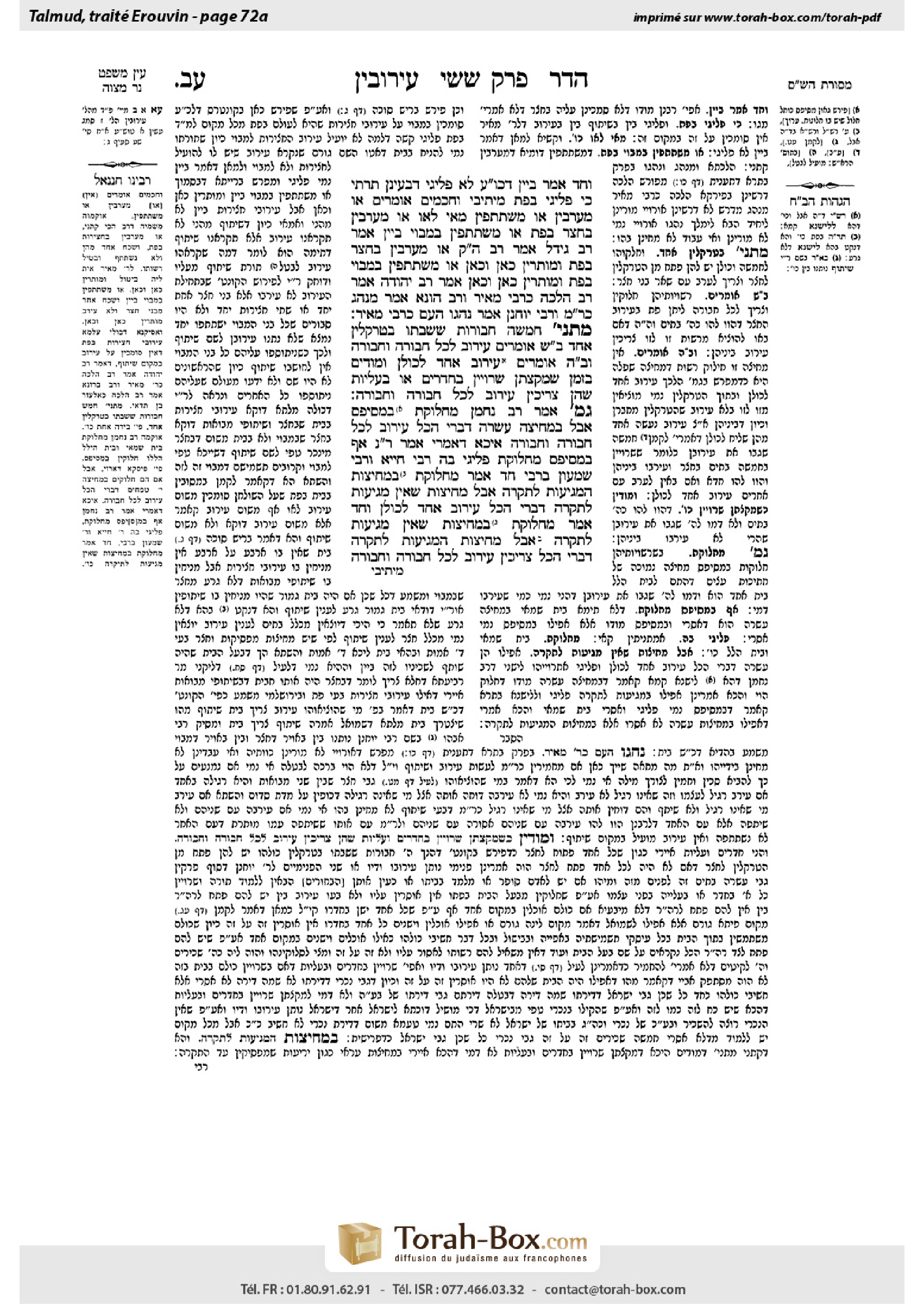
This page of Eruvin includes the Aramaic text, an English translation and an AI-generated French translation, alongside the scan above.
עירובין ע״ב א · Aramaic and Hebrew text
וְחַד אָמַר: בְּיַיִן דְּכוּלֵּי עָלְמָא לָא פְּלִיגִי דְּבָעֵינַן תַּרְתֵּי, כִּי פְּלִיגִי בְּפַת.
מֵיתִיבִי: וַחֲכָמִים אוֹמְרִים אוֹ מְעָרְבִין אוֹ מִשְׁתַּתְּפִין. מַאי לָאו: אוֹ מְעָרְבִין בְּחָצֵר בְּפַת, אוֹ מִשְׁתַּתְּפִין בְּמָבוֹי בְּיַיִן.
אָמַר רַב גִּידֵּל אָמַר רַב, הָכִי קָאָמַר: אוֹ מְעָרְבִין בְּחָצֵר בְּפַת — וּמוּתָּרִין כָּאן וְכָאן, אוֹ מִשְׁתַּתְּפִין בְּמָבוֹי בְּפַת — וּמוּתָּרִין כָּאן וְכָאן.
אָמַר רַב יְהוּדָה אָמַר רַב: הֲלָכָה כְּרַבִּי מֵאִיר. וְרַב הוּנָא אָמַר: מִנְהָג כְּרַבִּי מֵאִיר. וְרַבִּי יוֹחָנָן אָמַר: נָהֲגוּ הָעָם כְּרַבִּי מֵאִיר.
מַתְנִי׳ חֲמִשָּׁה חֲבוּרוֹת שֶׁשָּׁבְתוּ בִּטְרַקְלִין אֶחָד, בֵּית שַׁמַּאי אוֹמְרִים: עֵירוּב לְכׇל חֲבוּרָה וַחֲבוּרָה, וּבֵית הִלֵּל אוֹמְרִים: עֵירוּב אֶחָד לְכוּלָּן.
וּמוֹדִים בִּזְמַן שֶׁמִּקְצָתָן שְׁרוּיִין בַּחֲדָרִים אוֹ בַּעֲלִיּוֹת, שֶׁהֵן צְרִיכִין עֵירוּב לְכׇל חֲבוּרָה וַחֲבוּרָה.
גְּמָ׳ אָמַר רַב נַחְמָן: מַחְלוֹקֶת בִּמְסִיפָס, אֲבָל בִּמְחִיצָה עֲשָׂרָה — דִּבְרֵי הַכֹּל עֵירוּב לְכׇל חֲבוּרָה וַחֲבוּרָה. אִיכָּא דְּאָמְרִי, אָמַר רַב נַחְמָן: אַף בִּמְסִיפָס מַחְלוֹקֶת.
פְּלִיגִי בַּהּ רַבִּי חִיָּיא וְרַבִּי שִׁמְעוֹן בְּרַבִּי. חַד אָמַר: מַחְלוֹקֶת בִּמְחִיצוֹת הַמַּגִּיעוֹת לַתִּקְרָה, אֲבָל מְחִיצוֹת שֶׁאֵין מַגִּיעוֹת לַתִּקְרָה — דִּבְרֵי הַכֹּל עֵירוּב אֶחָד לְכוּלָּן. וְחַד אָמַר: מַחְלוֹקֶת בִּמְחִיצוֹת שֶׁאֵין מַגִּיעוֹת לַתִּקְרָה, אֲבָל מְחִיצוֹת הַמַּגִּיעוֹת לַתִּקְרָה — דִּבְרֵי הַכֹּל צְרִיכִין עֵירוּב לְכׇל חֲבוּרָה וַחֲבוּרָה.
Eruvin 72a · English translation
And one said: In the case of wine, everyone agrees that two are required, both a merging of alleyways and a joining of courtyards. When they disagree is in a case where an eiruv was established with bread: Rabbi Meir maintains that both a merging of alleyways and a joining of courtyards are required, whereas the Rabbis say that one is sufficient.
The Gemara raises an objection from the baraita itself. And the Rabbis say: One may either establish an eiruv or a merging of alleyways. What, does it not mean that one either establishes an eiruv in the courtyard with bread or a merging in the alleyway with wine, which indicates that they also disagreed in a case where a merging of alleyways was established with wine?
Rav Giddel said that Rav said that the Rabbis were saying as follows: One may either establish an eiruv in the courtyard with bread, and it would be rendered permitted to carry both here, in the courtyard, and there, in the alleyway, or one may establish a merging of alleyways in the alleyway with bread, and it would be rendered permitted to carry both here, in the courtyard, and there, in the alleyway.
Rav Yehuda said that Rav said: The halakha is in accordance with the opinion of Rabbi Meir. And Rav Huna said: No clear halakhic ruling was issued in his favor, but the custom is in accordance with the opinion of Rabbi Meir. Therefore, if someone asks, he should be instructed to act accordingly. And Rabbi Yoḥanan said: It is not even a custom established by the Sages. Rather, the people were accustomed to act in accordance with the opinion of Rabbi Meir, and we do not tell them they have acted inappropriately.
MISHNA: With regard to five groups of people who spent Shabbat in one hall [teraklin] that was subdivided by partitions into separate rooms, each of which had a separate entrance to a courtyard that was shared with other houses, Beit Shammai say: An eiruv is required for each and every group, i.e., each group must contribute separately to the eiruv of the courtyard, as each is considered a different house. And Beit Hillel say: One eiruv suffices for all of them, as the partitions do not render the different sections separate houses.
And Beit Hillel concede that when some of them occupy separate rooms or upper stories, they require a separate eiruv for each and every group, and the fact that they are in the same building does not render them one unified group.
GEMARA: Rav Naḥman said: The dispute applies only where they divided the hall with a partition of pegs [mesifas]. However, if they divided it with a sturdy partition ten handbreadths high, all agree that a separate contribution to the eiruv is required for each and every group, as this certainly divides the hall into separate living quarters. Some say a different version of the previous passage, according to which Rav Naḥman said as follows: Even where they merely divided the room with a partition of pegs, there is a dispute about whether this is considered a full-fledged partition.
The Gemara relates that Rabbi Ḥiyya and Rabbi Shimon, son of Rabbi Yehuda HaNasi, disagreed about this issue. One of them said: This dispute is with regard to partitions that reach the ceiling, but with regard to partitions that do not reach the ceiling, all agree that one eiruv suffices for all of them, as the partitions do not turn the compartments into separate houses. And one said: This dispute is with regard to partitions that do not reach the ceiling, but with regard to partitions that reach the ceiling, all agree that the compartments are considered separate living quarters, and they require a separate contribution to the eiruv for each and every group.
Eruvin 72a · Traduction française (IA)
Et un autre dit : En ce qui concerne le vin, tout le monde est d'accord sur le fait que deux sont nécessaires, à la fois un mélange de cours d'entrée et une jonction de courtyards. Ils divergent lorsqu'il s'agit d'un eiruv établi avec du pain : Rabbi Meir affirme que les deux, un mélange de cours d'entrée et une jonction de courtyards, sont nécessaires, tandis que les Sages disent qu'un seul suffit.
La Guemara évoque un contre-exemple tiré de la baraïta elle-même. Et les Sages disent : On peut soit établir un eiruv, soit un mélange de cours d'entrée. Qu'est-ce que cela ne signifie pas que l'on peut soit établir un eiruv dans le courtil avec du pain, soit un mélange dans le couloir avec du vin, ce qui indique qu'ils divergent aussi dans le cas où un mélange de cours d'entrée a été établi avec du vin ?
Rav Giddel dit que Rav dit que les Sages disaient ainsi : On peut soit établir un eiruv dans le courtil avec du pain, et cela permettrait de porter à la fois ici, dans le courtil, et là, dans le couloir, soit établir un mélange de cours d'entrée dans le couloir avec du pain, et cela permettrait de porter à la fois ici, dans le courtil, et là, dans le couloir.
Rav Yehuda dit que Rav dit : La halakha suit l'opinion de Rabbi Meir. Et Rav Huna dit : Il n'y a pas eu de décision halakhique en faveur de lui, mais la coutume suit l'opinion de Rabbi Meir. Par conséquent, si quelqu'un pose une question, il devrait être instruit d'agir ainsi. Et Rabbi Yoḥanan dit : Ce n'est même pas une coutume établie par les Sages. Plutôt, les gens étaient habitués à agir selon l'opinion de Rabbi Meir, et nous ne leur disons pas qu'ils agissent de manière inappropriée.
MICHNA : En ce qui concerne cinq groupes de personnes ayant passé le Shabbat dans une salle [teraklin] divisée en chambres par des cloisons, chacune ayant une entrée séparée vers un courtil partagé avec d'autres maisons, Beit Shammai disent : Un eiruv est nécessaire pour chaque groupe, c'est-à-dire chaque groupe doit contribuer séparément à l'eiruv du courtil, car chaque groupe est considéré comme une maison différente. Et Beit Hillel disent : Un seul eiruv suffit pour tous, car les cloisons ne rendent pas les sections distinctes des maisons.
Et Beit Hillel reconnaissent que lorsqu'ils occupent des chambres ou des étages séparés, ils nécessitent un eiruv séparé pour chaque groupe, et le fait qu'ils soient dans le même bâtiment ne rend pas qu'ils soient un groupe unifié.
GUEMARA : Rav Naḥman dit : Le débat s'applique uniquement lorsqu'ils ont divisé la salle avec une cloison de clous [mesifas]. Cependant, si ils ont divisé la salle avec une cloison solide de dix tefachim de haut, tous sont d'accord sur le fait qu'une contribution séparée à l'eiruv est nécessaire pour chaque groupe, car cela divise clairement la salle en des appartements distincts. Certains disent une version différente du passage précédent, selon laquelle Rav Naḥman a dit ainsi : Même lorsqu'ils ont simplement divisé la pièce avec une cloison de clous, il y a un débat sur le fait que cela soit considéré comme une cloison complète.
La Guemara rapporte que Rabbi Ḥiyya et Rabbi Shimon, fils de Rabbi Yehuda HaNasi, divergeaient sur ce sujet. L'un d'eux dit : Ce débat concerne les cloisons qui atteignent le plafond, mais concernant les cloisons qui n'atteignent pas le plafond, tous sont d'accord sur le fait qu'un seul eiruv suffit pour tous, car les cloisons ne transforment pas les compartiments en des maisons distinctes. Et l'autre dit : Ce débat concerne les cloisons qui n'atteignent pas le plafond, mais concernant les cloisons qui atteignent le plafond, tous sont d'accord sur le fait que les compartiments sont considérés comme des appartements distincts, et qu'ils nécessitent une contribution séparée à l'eiruv pour chaque groupe.
Traduction française générée par IA à partir de l’édition anglaise de Sefaria. Vérifie toujours un passage avec le texte source.
Text from Sefaria: William Davidson Edition - Vocalized Aramaic (CC BY NC); William Davidson Edition - English (CC BY NC).