Eruvin 72b: Talmud study for Daf Yomi
Study the Talmud for Daf Yomi with scanned pages, Hebrew text, English translations from Sefaria and AI-generated French translations.
Passage selection and English or AI-generated French translation are available where the scan has annotations. Daf Study is independent of Torah-Box and Sefaria.
Browse Eruvin · עירובין · All tractatesEruvin 72b text and translations
This page of Eruvin includes the Aramaic text, an English translation and an AI-generated French translation, alongside the scan above.
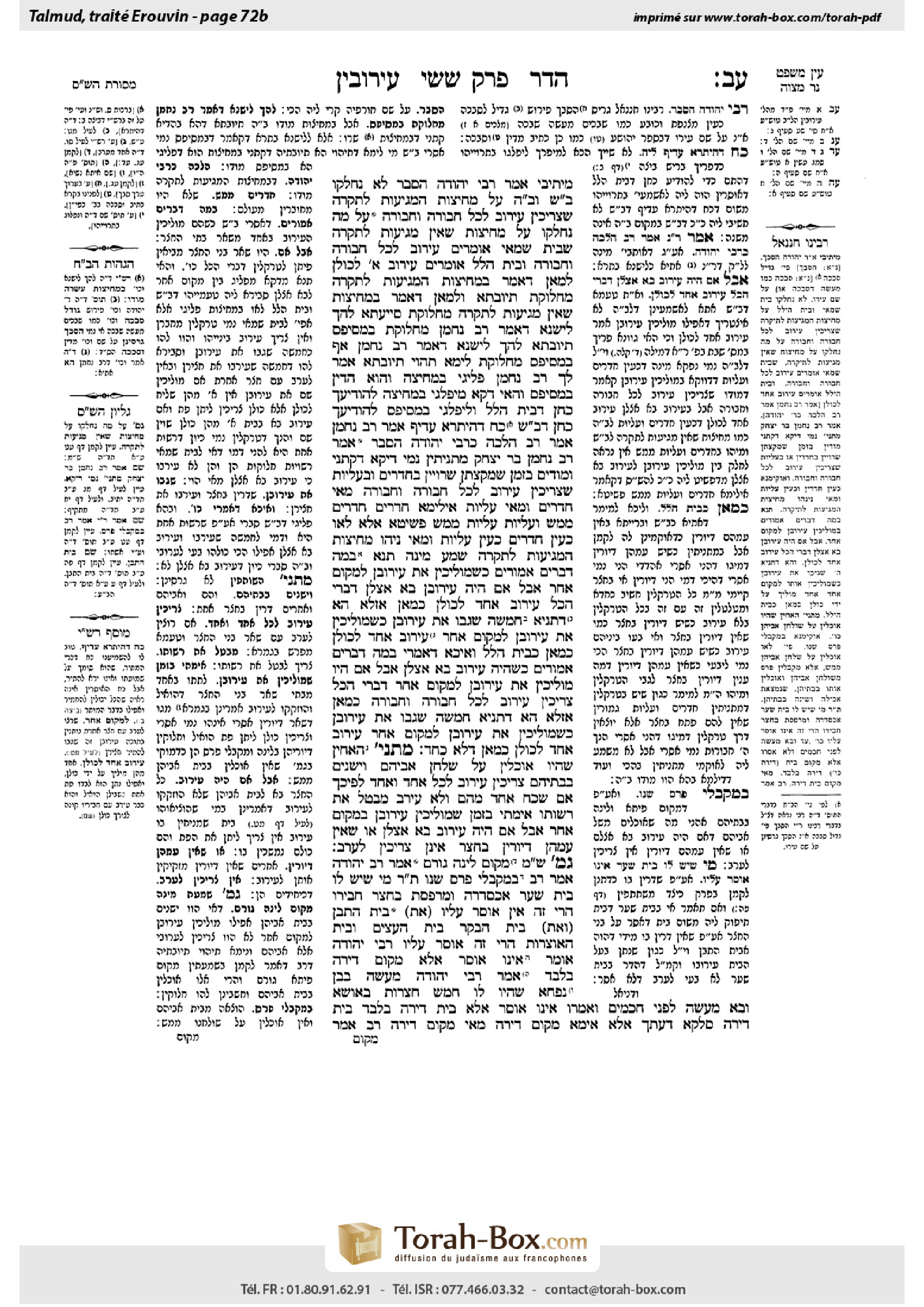
עירובין ע״ב ב · Aramaic and Hebrew text
מֵיתִיבִי, אָמַר רַבִּי יְהוּדָה הַסַּבָּר: לֹא נֶחְלְקוּ בֵּית שַׁמַּאי וּבֵית הִלֵּל עַל מְחִיצוֹת הַמַּגִּיעוֹת לַתִּקְרָה שֶׁצְּרִיכִין עֵירוּב לְכׇל חֲבוּרָה וַחֲבוּרָה. עַל מָה נֶחְלְקוּ — עַל מְחִיצוֹת שֶׁאֵין מַגִּיעוֹת לַתִּקְרָה, שֶׁבֵּית שַׁמַּאי אוֹמְרִים: עֵירוּב לְכׇל חֲבוּרָה וַחֲבוּרָה, וּבֵית הִלֵּל אוֹמְרִים: עֵירוּב אֶחָד לְכוּלָּן.
לְמַאן דְּאָמַר בִּמְחִיצוֹת הַמַּגִּיעוֹת לַתִּקְרָה מַחְלוֹקֶת — תְּיוּבְתָּא, וּלְמַאן דְּאָמַר בִּמְחִיצוֹת שֶׁאֵין מַגִּיעוֹת לַתִּקְרָה מַחְלוֹקֶת — סִיַּיעְתָּא. לְהַךְ לִישָּׁנָא דְּאָמַר רַב נַחְמָן: מַחְלוֹקֶת בִּמְסִיפָס — תְּיוּבְתָּא.
לְהַךְ לִישָּׁנָא דְּאָמַר רַב נַחְמָן: אַף בִּמְסִיפָס מַחְלוֹקֶת, לֵימָא תִּהְוֵי תְּיוּבְתָּא?
אָמַר לְךָ רַב נַחְמָן: פְּלִיגִי בִּמְחִיצָה, וְהוּא הַדִּין בִּמְסִיפָס. וְהַאי דְּקָא מִיפַּלְגִי בִּמְחִיצָה — לְהוֹדִיעֲךָ כֹּחָן דְּבֵית הִלֵּל.
וְלִיפְלְגִי בִּמְסִיפָס לְהוֹדִיעֲךָ כֹּחָן דְּבֵית שַׁמַּאי! כֹּחַ דְּהֶיתֵּרָא עָדִיף.
אָמַר רַב נַחְמָן אָמַר רַב: הֲלָכָה כְּרַבִּי יְהוּדָה הַסַּבָּר.
אָמַר רַב נַחְמָן בַּר יִצְחָק: מַתְנִיתִין נָמֵי דַּיְקָא, דְּקָתָנֵי: וּמוֹדִים בִּזְמַן שֶׁמִּקְצָתָן שְׁרוּיִין בַּחֲדָרִים וּבַעֲלִיּוֹת, שֶׁצְּרִיכִין עֵירוּב לְכׇל חֲבוּרָה וַחֲבוּרָה. מַאי חֲדָרִים, וּמַאי עֲלִיּוֹת? אִילֵּימָא חֲדָרִים — חֲדָרִים מַמָּשׁ, וַעֲלִיּוֹת — עֲלִיּוֹת מַמָּשׁ, פְּשִׁיטָא. אֶלָּא לָאו: כְּעֵין חֲדָרִים, כְּעֵין עֲלִיּוֹת. וּמַאי נִיהוּ — מְחִיצוֹת הַמַּגִּיעוֹת לַתִּקְרָה. שְׁמַע מִינַּהּ.
תָּנָא: בַּמֶּה דְּבָרִים אֲמוּרִים, כְּשֶׁמּוֹלִיכִין אֶת עֵירוּבָן לְמָקוֹם אַחֵר. אֲבָל אִם הָיָה עֵירוּבָן בָּא אֶצְלָן — דִּבְרֵי הַכֹּל עֵירוּב אֶחָד לְכוּלָּן.
כְּמַאן אָזְלָא הָא דְּתַנְיָא: חֲמִשָּׁה שֶׁגָּבוּ אֶת עֵירוּבָן, כְּשֶׁמּוֹלִיכִין אֶת עֵירוּבָן לְמָקוֹם אַחֵר — עֵירוּב אֶחָד לְכוּלָּן. כְּמַאן, כְּבֵית הִלֵּל.
וְאִיכָּא דְּאָמְרִי: בַּמֶּה דְּבָרִים אֲמוּרִים, כְּשֶׁהָיָה עֵירוּב בָּא אֶצְלָן. אֲבָל אִם הָיוּ מוֹלִיכִין אֶת עֵירוּבָן לְמָקוֹם אַחֵר — דִּבְרֵי הַכֹּל צְרִיכִין עֵירוּב לְכׇל חֲבוּרָה וַחֲבוּרָה.
כְּמַאן אָזְלָא הָא דְּתַנְיָא: חֲמִשָּׁה שֶׁגָּבוּ אֶת עֵירוּבָן, כְּשֶׁמּוֹלִיכִין אֶת עֵירוּבָן לְמָקוֹם אַחֵר — עֵירוּב אֶחָד לְכוּלָּן, כְּמַאן? דְּלָא כְּחַד.
מַתְנִי׳ הָאַחִין שֶׁהָיוּ אוֹכְלִין עַל שֻׁלְחָן אֲבִיהֶם וִישֵׁנִים בְּבָתֵּיהֶם — צְרִיכִין עֵירוּב לְכׇל אֶחָד וְאֶחָד. לְפִיכָךְ, אִם שָׁכַח אֶחָד מֵהֶם וְלֹא עֵירַב — מְבַטֵּל אֶת רְשׁוּתוֹ.
אֵימָתַי, בִּזְמַן שֶׁמּוֹלִיכִין עֵירוּבָן בִּמְקוֹם אַחֵר. אֲבָל אִם הָיָה עֵירוּב בָּא אֶצְלָן, אוֹ שֶׁאֵין עִמָּהֶן דָּיוֹרִין בֶּחָצֵר — אֵינָן צְרִיכִין לְעָרֵב.
גְּמָ׳ שְׁמַע מִינַּהּ מְקוֹם לִינָה גּוֹרֵם. אָמַר רַב יְהוּדָה אָמַר רַב: בִּמְקַבְּלֵי פְרָס שָׁנוּ.
תָּנוּ רַבָּנַן: מִי שֶׁיֵּשׁ לוֹ בֵּית שַׁעַר, אַכְסַדְרָה, וּמִרְפֶּסֶת בַּחֲצַר חֲבֵירוֹ — הֲרֵי זֶה אֵין אוֹסֵר עָלָיו. (אֶת) בֵּית הַתֶּבֶן (וְאֶת) בֵּית הַבָּקָר בֵּית הָעֵצִים וּבֵית הָאוֹצָרוֹת — הֲרֵי זֶה אוֹסֵר עָלָיו. רַבִּי יְהוּדָה אוֹמֵר: אֵינוֹ אוֹסֵר אֶלָּא מְקוֹם דִּירָה בִּלְבַד.
אָמַר רַבִּי יְהוּדָה: מַעֲשֶׂה בְּבֶן נַפָּחָא שֶׁהָיוּ לוֹ חָמֵשׁ חֲצֵרוֹת בְּאוּשָׁא, וּבָא מַעֲשֶׂה לִפְנֵי חֲכָמִים, וְאָמְרוּ: אֵינוֹ אוֹסֵר אֶלָּא בֵּית דִּירָה בִּלְבַד.
בֵּית דִּירָה סָלְקָא דַּעְתָּךְ? אֶלָּא אֵימָא: מְקוֹם דִּירָה.
מַאי מְקוֹם דִּירָה? רַב אָמַר:
Eruvin 72b · English translation
The Gemara raises an objection based on the following baraita: Rabbi Yehuda the Keen [hasabbar], who was known by this name due to his sharp mind, said: Beit Shammai and Beit Hillel did not disagree about partitions that reach the ceiling, as all agree that they require a separate contribution to the eiruv for each and every group. With regard to what did they disagree? With regard to partitions that do not reach the ceiling, as Beit Shammai say: A separate contribution to the eiruv is required for each and every group, and Beit Hillel say: One contribution to the eiruv suffices for all of them.
According to the one who said that it was with regard to partitions that reach the ceiling that there was a dispute, this baraita offers a conclusive refutation. And according to the one who said that it was with regard to partitions that do not reach the ceiling that there was a dispute, the baraita offers support. With regard to that version which holds that Rav Naḥman said: The dispute applies only where they divided the hall with a mesifas, this baraita is a conclusive refutation.
However, the following issue needs further clarification: With regard to that version which holds that Rav Naḥman said: The dispute applies even where the hall was divided with a mesifas, shall we say that Rabbi Yehuda the Keen’s statement is a conclusive refutation? That is to say, does it imply that all agree that in the case of a mesifas, one eiruv suffices for them all?
Rav Naḥman could have said to you: They explicitly disagreed about a partition, and the same is true of a partition of pegs. And the fact that they disagree with regard to a partition rather than a partition of pegs is to convey to you the far-reaching nature of the opinion of Beit Hillel. Even where the compartments are divided by full-fledged partitions, Beit Hillel remain of the opinion that one contribution to the eiruv suffices for all of them, as the partitions do not turn them into separate residences.
The Gemara asks: If they disagreed in both cases, let them disagree in the baraita about a mesifas, and thereby inform you of the strength of Beit Shammai. They are stringent and require a separate contribution to the eiruv for each and every group, even in the case of a mesifas. The Gemara answers: It is preferable for the tanna to teach us the strength of a permissive ruling. If a tanna can formulate a dispute in a manner that emphasizes the strength of the more lenient position, he will do so.
Rav Naḥman said that Rav said: The halakha is in accordance with the statement of Rabbi Yehuda the Keen, that all agree that where the partitions reach the ceiling, a separate contribution to the eiruv is required for each group, and that they disagree only about partitions that do not reach the ceiling.
Rav Naḥman bar Yitzḥak said: The mishna is also precise according to this view, as it teaches: And Beit Hillel concede that when some of them occupy separate rooms or upper stories, they require a separate eiruv for each and every group. What is the meaning of the word rooms, and what is the meaning of the term upper stories? If you say that the word rooms refers to actual rooms and the term upper stories refers to actual upper stories, i.e., they were separate from the beginning and are not subdivisions of a larger room, it is obvious, as this is the halakha governing the case of many people residing in the same courtyard. Rather, doesn’t it mean that they are similar to rooms and similar to upper stories? And what are these partitions? They are partitions that reach the ceiling; and even though they are not actual rooms or upper stories, they are considered like rooms and upper stories. The Gemara concludes: Indeed, learn from this that this is the case.
It was taught in a baraita: In what case is this statement, that Beit Shammai require a separate contribution to the eiruv from each group, said? It is in a case where the groups in the hall bring their eiruv elsewhere in the courtyard, i.e., to a different house. But if their eiruv was coming to them, i.e., if the other members of the courtyard brought their contributions and established the eiruv in that hall, all agree that one contribution to the eiruv suffices for all of them. The fact that the eiruv is placed in this house renders all of its residents members of a single unit.
The Gemara comments: In accordance with whose opinion is the ruling that was taught in the following baraita: With regard to five people who live in the same courtyard and collected their eiruv, when they take their eiruv elsewhere in the courtyard, one contribution to the eiruv suffices for all of them. In accordance with whose opinion is this ruling? In accordance with the opinion of Beit Hillel.
And some say a different version of the previous passage: In what case is this statement, that Beit Hillel require only one contribution for all the groups together, said? It is in a case where the eiruv was coming to them. But if the groups in the hall were bringing their eiruv elsewhere in the courtyard, all agree that a separate contribution to the eiruv is required for each and every one of them.
If so, in accordance with whose opinion is the ruling that was taught in the baraita: With regard to five people who live in the same courtyard and collected their eiruv, when they take their eiruv elsewhere in the courtyard, one contribution to the eiruv suffices for all of them. In accordance with whose opinion is this ruling? It is not in accordance with either one of them.
MISHNA: In the case of brothers who were eating at their father’s table and sleeping in their own houses in the same courtyard, a separate contribution to the eiruv is required for each and every one of them. Therefore, if one of them forgot and did not contribute to the eiruv, he must renounce his rights in the courtyard in order to render carrying in the courtyard permitted to the rest of the courtyard’s residents.
When do they state this halakha? They state it when they take their eiruv elsewhere in the courtyard, i.e., to the house of one of the other residents. But if the eiruv was coming to them, i.e., if it was placed in their father’s house, or if there are no other residents with the brothers and their father in the courtyard, they are not required to establish an eiruv, as they are considered like a single individual living in a courtyard.
GEMARA: The Gemara comments on the statement in the mishna that a separate contribution to the eiruv must be made by each of the brothers if they sleep in their own houses: Learn from it that one’s place of sleep determines the location of his residence. The Gemara rejects this conclusion. Rav Yehuda said that Rav said: They taught this mishna with regard to brothers who receive a portion from their father. The mishna is not referring to brothers who actually eat at their father’s table, but rather to brothers whose father supplies them with food that they eat in their own homes.
The Sages taught in a baraita: One who has a gatehouse, porch, or balcony in his friend’s courtyard does not render the owner of the courtyard prohibited from carrying there without an eiruv, as these locations are not considered residences. However, if he has a storeroom of straw, a cattle shed, a woodshed, or a storehouse in his friend’s courtyard, he renders it prohibited for his friend to carry there without an eiruv. Rabbi Yehuda says: Only a place of actual dwelling renders carrying prohibited, but a building that is not designated for residence does not render carrying without an eiruv prohibited for another resident of the courtyard.
Rabbi Yehuda said: There was an incident with ben Nappaḥa, who had houses in five courtyards in Usha, only one of which served as his own residence. And the case came before the Sages to decide whether an eiruv must be made for all of them, and they said: Only a house of residence renders carrying prohibited.
The Gemara expresses surprise at the wording of the baraita: Does it enter your mind that the correct reading is a house of residence? He has a house in each of the five courtyards. Rather, say: A place of residence, i.e., it is prohibited to carry in the place where he actually lives, but nowhere else.
The Gemara asks: What is considered one’s place of residence? Rav said:
Eruvin 72b · Traduction française (IA)
La Guemara évoque un objet d'objection basé sur la suivante baraïta : Rabbi Yehuda le Keen [hasabbar], connu par ce nom à cause de son esprit vif, disait : Beit Shammai et Beit Hillel n'avaient pas de désaccord concernant les cloisons qui atteignaient le plafond, car tous s'accordaient sur le fait qu'une contribution séparée à l'eiruv était nécessaire pour chaque groupe. À propos de quel point avaient-ils désaccord ? À propos des cloisons qui ne touchaient pas le plafond, car Beit Shammai disait : Une contribution séparée à l'eiruv est nécessaire pour chaque groupe, et Beit Hillel disait : Une seule contribution à l'eiruv suffit pour tous.
Selon celui qui affirmait que le désaccord était concernant les cloisons qui atteignaient le plafond, cette baraïta offre une refutation définitive. Et selon celui qui affirmait que le désaccord était concernant les cloisons qui ne touchaient pas le plafond, la baraïta offre un soutien. À propos de cette version qui affirme que Rav Naḥman a dit : Le désaccord s'applique uniquement dans le cas où la salle a été divisée par une mesifas, cette baraïta est une refutation définitive.
Cependant, la question suivante nécessite une clarification supplémentaire : À propos de cette version qui affirme que Rav Naḥman a dit : Le désaccord s'applique même lorsque la salle a été divisée par une mesifas, devons-nous dire que la déclaration de Rabbi Yehuda le Keen est une refutation définitive ? C'est-à-dire, cela implique-t-il que tous s'accordent sur le fait que dans le cas d'une mesifas, une seule contribution à l'eiruv suffit pour tous ?
Rav Naḥman aurait pu dire à l'égard de vous : Ils ont explicitement désaccordé sur une cloison, et c'est la même chose pour une cloison de clous. Et le fait qu'ils aient désaccordé sur une cloison plutôt qu'une cloison de clous est pour vous indiquer la portée de l'opinion de Beit Hillel. Même lorsque les compartiments sont divisés par des cloisons pleinement établies, Beit Hillel reste de l'avis que une contribution à l'eiruv suffit pour tous, car les cloisons ne les transforment pas en résidences distinctes.
La Guemara pose la question : Si ils avaient désaccordé dans les deux cas, qu'ils désaccordent dans la baraïta concernant une mesifas, et ainsi vous informent de la rigueur de l'opinion de Beit Shammai. Ils sont stricts et exigent une contribution séparée à l'eiruv pour chaque groupe, même dans le cas d'une mesifas. La Guemara répond : Il est préférable que le tanna nous enseigne la force d'un règlement permissif. Si un tanna peut formuler un désaccord de manière à souligner la force de la position plus clémente, il le fera.
Rav Naḥman a dit que Rav a dit : La halakha suit l'opinion de Rabbi Yehuda le Keen, que tous s'accordent sur le fait que, dans le cas de cloisons qui atteignent le plafond, une contribution séparée à l'eiruv est nécessaire pour chaque groupe, et qu'ils ne désaccordent que concernant les cloisons qui ne touchent pas le plafond.
Rav Naḥman bar Yitzḥak a dit : La Michna est aussi précise selon cette vue, car elle enseigne : Et Beit Hillel reconnaissent que lorsque certains d'entre eux occupent des chambres ou des étages supérieurs séparés, ils nécessitent une eiruv séparée pour chaque groupe. Quelle est la signification du mot « chambres » et quelle est la signification du terme « étages supérieurs » ? Si vous dites que le mot « chambres » fait référence à des chambres réelles et que le terme « étages supérieurs » fait référence à des étages réels, c'est-à-dire qu'ils étaient séparés dès le départ et ne sont pas des subdivisions d'une pièce plus grande, cela est évident, car c'est la halakha concernant le cas de plusieurs personnes résidant dans le même cour. En revanche, n'est-ce pas plutôt que cela signifie qu'ils sont semblables à des chambres et à des étages supérieurs ? Et quels sont ces cloisons ? Ce sont des cloisons qui atteignent le plafond ; et même s'ils ne sont pas des chambres réelles ou des étages supérieurs, ils sont considérés comme des chambres et des étages supérieurs. La Guemara conclut : En effet, apprenez-en que c'est ainsi.
Il a été enseigné dans une baraïta : Dans quel cas cette déclaration, que Beit Shammai exigent une eiruv séparée pour chaque groupe, est-elle dite ? C'est dans le cas où les groupes de la salle apportent leur eiruv ailleurs dans le cour, c'est-à-dire dans une autre maison. Mais si leur eiruv venait vers eux, c'est-à-dire si les autres membres du cour apportaient leurs contributions et établissaient l'eiruv dans cette salle, tous s'accordent sur le fait qu'une seule contribution à l'eiruv suffit pour tous. Le fait que l'eiruv soit placé dans cette maison rend tous ses habitants membres d'une seule unité.
La Guemara commente : Selon l'opinion de qui est le règlement enseigné dans la suivante baraïta : Concernant cinq personnes qui habitent dans le même cour et ont collecté leur eiruv, lorsqu'ils apportent leur eiruv ailleurs dans le cour, une seule contribution à l'eiruv suffit pour tous. Selon l'opinion de qui est ce règlement ? Selon l'opinion de Beit Hillel.
Et certains disent une version différente du passage précédent : Dans quel cas cette déclaration, que Beit Hillel exige une seule contribution pour tous les groupes ensemble, est-elle dite ? C'est dans le cas où l'eiruv venait vers eux. Mais si les groupes de la salle apportaient leur eiruv ailleurs dans le jardin, tous s'accordent sur le fait qu'une contribution séparée à l'eiruv est nécessaire pour chaque groupe.
Si c'est ainsi, selon l'opinion de qui est le règlement enseigné dans la baraïta : Concernant cinq personnes qui habitent dans le même jardin et ont collecté leur eiruv, lorsqu'ils apportent leur eiruv ailleurs dans le jardin, une seule contribution à l'eiruv suffit pour tous. Selon l'opinion de qui est ce règlement ? Ce n'est pas selon l'opinion de l'un d'eux.
MICHNA : Dans le cas de frères qui mangeaient à la table de leur père et dormaient dans leurs propres maisons dans le même jardin, une contribution séparée à l'eiruv est nécessaire pour chaque individu. Ainsi, si l'un d'eux a oublié et n'a pas contribué à l'eiruv, il doit renoncer à ses droits dans le jardin afin de permettre au reste des habitants du jardin de faire le transport dans le jardin.
Quand affirment-ils cette halakha ? Ils l'affirment lorsqu'ils prennent leur eiruv ailleurs dans la cour, c'est-à-dire chez l'un des autres habitants. Mais si l'eiruv venait vers eux, c'est-à-dire s'il était placé dans la maison de leur père, ou s'il n'y a pas d'autres habitants avec les frères et leur père dans la cour, ils n'ont pas besoin d'établir un eiruv, car ils sont considérés comme une seule personne vivant dans une cour.
GUEMARA : La Guemara commente la déclaration de la michna selon laquelle une contribution séparée à l'eiruv doit être faite par chaque frère s'ils dorment dans leurs propres maisons : Apprends-en que l'endroit où l'on dort détermine l'emplacement de son domicile. La Guemara rejette cette conclusion. Rav Yehuda a dit que Rav a dit : Ils ont enseigné cette michna concernant des frères qui reçoivent une part de leur père. La michna ne fait pas référence à des frères qui mangent effectivement à la table de leur père, mais plutôt à des frères dont le père leur fournit de la nourriture qu'ils mangent dans leurs propres maisons.
Les Sages ont enseigné dans une baraïta : Celui qui a une porte, une galerie ou un balcon dans la cour de son ami ne rend pas l'propriétaire de la cour interdit de porter là sans eiruv, car ces lieux ne sont pas considérés comme des résidences. Cependant, s'il a une remise de foin, une écurie, un tas de bois ou un entrepôt dans la cour de son ami, il rend cette cour interdite pour son ami de porter là sans eiruv. Rabbi Yehuda dit : Seul un lieu de résidence rend le port interdit, mais un bâtiment non destiné à la résidence ne rend pas le port sans eiruv interdit pour un autre habitant de la cour.
Rabbi Yehuda dit : Il y avait un cas concernant ben Nappaḥa, qui avait des maisons dans cinq courtyards à Usha, dont seul l'un était sa propre résidence. Et le cas est venu devant les Sages pour décider si un eiruv doit être fait pour tous ceux-ci, et ils ont dit : Seule une maison de résidence rend le port interdit.
La Guemara exprime de la surprise par le wording de la baraïta : Est-ce que cela entre dans votre esprit que la lecture correcte est une maison de résidence ? Il a une maison dans chacun des cinq courtyards. Plutôt, dis : Un lieu de résidence, c'est-à-dire il est interdit de porter là où il vit effectivement, mais nulle part ailleurs.
La Guemara pose la question : Qu'est-ce qui constitue le lieu de résidence d'une personne ? Rav a dit :
Traduction française générée par IA à partir de l’édition anglaise de Sefaria. Vérifie toujours un passage avec le texte source.
Text from Sefaria: William Davidson Edition - Vocalized Aramaic (CC BY NC); William Davidson Edition - English (CC BY NC).