Eruvin 73a: Talmud study for Daf Yomi
Study the Talmud for Daf Yomi with scanned pages, Hebrew text, English translations from Sefaria and AI-generated French translations.
Passage selection and English or AI-generated French translation are available where the scan has annotations. Daf Study is independent of Torah-Box and Sefaria.
Browse Eruvin · עירובין · All tractatesEruvin 73a text and translations
This page of Eruvin includes the Aramaic text, an English translation and an AI-generated French translation, alongside the scan above.
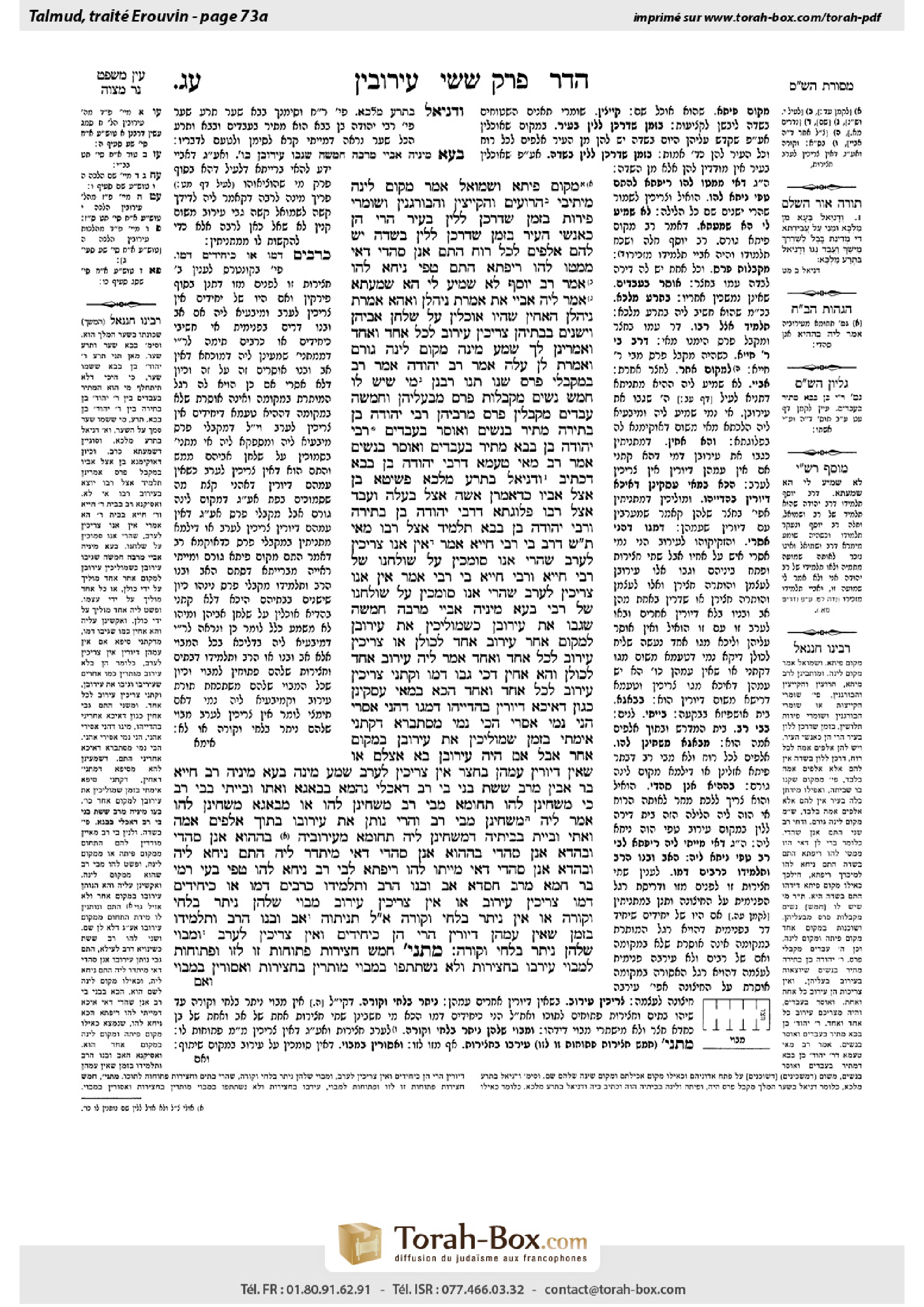
עירובין ע״ג א · Aramaic and Hebrew text
מְקוֹם פִּיתָּא, וּשְׁמוּאֵל אָמַר: מְקוֹם לִינָה.
מֵיתִיבִי: הָרוֹעִים, וְהַקַּיָּיצִין וְהַבּוּרְגָּנִין וְשׁוֹמְרֵי פֵירוֹת, בִּזְמַן שֶׁדַּרְכָּן לָלִין בָּעִיר — הֲרֵי הֵן כְּאַנְשֵׁי הָעִיר. בִּזְמַן שֶׁדַּרְכָּן לָלִין בַּשָּׂדֶה — יֵשׁ לָהֶם אַלְפַּיִם לְכׇל רוּחַ!
הָתָם אֲנַן סָהֲדִי דְּאִי מַמְטוּ לְהוּ רִיפְתָּא הָתָם, טְפֵי נִיחָא לְהוּ.
אָמַר רַב יוֹסֵף: לָא שְׁמִיעַ לִי הָא שְׁמַעְתָּא. אֲמַר לֵיהּ אַבָּיֵי: אַתְּ אֲמַרְתְּ נִיהֲלַן, וְאַהָא אֲמַרְתְּ נִיהֲלַן: הָאַחִין שֶׁהָיוּ אוֹכְלִין עַל שֻׁלְחַן אֲבִיהֶן, וִישֵׁנִים בְּבָתֵּיהֶן — צְרִיכִין עֵירוּב לְכׇל אֶחָד וְאֶחָד. וְאָמְרִינַן לָךְ: שְׁמַע מִינַּהּ מְקוֹם לִינָה גּוֹרֵם. וַאֲמַרְתְּ לַן עֲלַהּ, אָמַר רַב יְהוּדָה אָמַר רַב: בִּמְקַבְּלֵי פְרָס שָׁנוּ.
תָּנוּ רַבָּנַן: מִי שֶׁיֵּשׁ לוֹ חָמֵשׁ נָשִׁים מְקַבְּלוֹת פְּרָס מִבַּעֲלֵיהֶן, וַחֲמִשָּׁה עֲבָדִים מְקַבְּלִין פְּרָס מֵרַבֵּיהֶן — רַבִּי יְהוּדָה בֶּן בְּתִירָה מַתִּיר בַּנָּשִׁים, וְאוֹסֵר בָּעֲבָדִים.
רַבִּי יְהוּדָה בֶּן בָּבָא מַתִּיר בָּעֲבָדִים, וְאוֹסֵר בַּנָּשִׁים.
אָמַר רַב: מַאי טַעְמָא דְּרַבִּי יְהוּדָה בֶּן בָּבָא, דִּכְתִיב: ״וְדָנִיֵּאל בִּתְרַע מַלְכָּא״.
פְּשִׁיטָא, בֵּן אֵצֶל אָבִיו, כְּדַאֲמַרַן. אִשָּׁה אֵצֶל בַּעְלָהּ וְעֶבֶד אֵצֶל רַבּוֹ, פְּלוּגְתָּא דְּרַבִּי יְהוּדָה בֶּן בְּתִירָה וְרַבִּי יְהוּדָה בֶּן בָּבָא. תַּלְמִיד אֵצֶל רַבּוֹ, מַאי?
תָּא שְׁמַע, דְּרַב בֵּי רַבִּי חִיָּיא אָמַר: אֵין אָנוּ צְרִיכִין לְעָרֵב, שֶׁהֲרֵי אָנוּ סוֹמְכִין עַל שׁוּלְחָנוֹ שֶׁל רַבִּי חִיָּיא. וְרַבִּי חִיָּיא בֵּי רַבִּי אָמַר: אֵין אָנוּ צְרִיכִין לְעָרֵב, שֶׁהֲרֵי אָנוּ סוֹמְכִין עַל שׁוּלְחָנוֹ שֶׁל רַבִּי.
בְּעָא מִינֵּיהּ אַבָּיֵי מֵרַבָּה: חֲמִשָּׁה שֶׁגָּבוּ אֶת עֵירוּבָן, כְּשֶׁמּוֹלִיכִין אֶת עֵירוּבָן לְמָקוֹם אַחֵר, עֵירוּב אֶחָד לְכוּלָּן, אוֹ צְרִיכִין עֵירוּב לְכׇל אֶחָד וְאֶחָד? אֲמַר לֵיהּ: עֵירוּב אֶחָד לְכוּלָּן.
וְהָא אַחִין, דְּכִי גָּבוּ דָּמוּ, וְקָתָנֵי: צְרִיכִין עֵירוּב לְכׇל אֶחָד וְאֶחָד! הָכָא בְּמַאי עָסְקִינַן — כְּגוֹן דְּאִיכָּא דָּיוֹרִין בַּהֲדַיְיהוּ. דְּמִגּוֹ דְּהָנֵי אָסְרִי, הָנֵי נָמֵי אָסְרִי.
הָכִי נָמֵי מִסְתַּבְּרָא, דְּקָתָנֵי: אֵימָתַי? בִּזְמַן שֶׁמּוֹלִיכִין אֶת עֵירוּבָן בְּמָקוֹם אַחֵר, אֲבָל אִם הָיָה עֵירוּבָן בָּא אֶצְלָם, אוֹ שֶׁאֵין דָּיוֹרִין עִמָּהֶן בֶּחָצֵר — אֵין צְרִיכִין לְעָרֵב, שְׁמַע מִינַּהּ.
בְּעָא מִינֵּיהּ רַב חִיָּיא בַּר אָבִין מֵרַב שֵׁשֶׁת: בְּנֵי בֵי רַב, דְּאָכְלִי נַהֲמָא בְּבָאגָא, וְאָתוּ וּבָיְיתִי בְּבֵי רַב, כִּי מָשְׁחִינַן לְהוּ תְּחוּמָא, מִבֵּי רַב מָשְׁחִינַן לְהוּ אוֹ מִבָּאגָא מָשְׁחִינַן לְהוּ? אֲמַר לֵיהּ: מָשְׁחִינַן מִבֵּי רַב.
וַהֲרֵי נוֹתֵן אֶת עֵירוּבוֹ בְּתוֹךְ אַלְפַּיִם אַמָּה, וְאָתֵי וּבָיֵית בְּבֵיתֵיהּ, דְּמָשְׁחִינַן לֵיהּ תְּחוּמָא מֵעֵירוּבֵיהּ!
בְּהָהוּא — אֲנַן סָהֲדִי, וּבְהָדָא — אֲנַן סָהֲדִי. בְּהָהוּא אֲנַן סָהֲדִי — דְּאִי מִיתְּדַר לֵיהּ הָתָם נִיחָא לֵיהּ, וּבַהֲדָא אֲנַן סָהֲדִי — דְּאִי מַיְיתוּ לְהוּ רִיפְתָּא לְבֵי רַב, נִיחָא לְהוּ טְפֵי.
בָּעֵי רָמֵי בַּר חָמָא מֵרַב חִסְדָּא: אָב וּבְנוֹ, הָרַב וְתַלְמִידוֹ, כְּרַבִּים דָּמוּ אוֹ כִּיחִידִים דָּמוּ? צְרִיכִין עֵירוּב, אוֹ אֵין צְרִיכִין עֵירוּב? מָבוֹי שֶׁלָּהֶן נִיתָּר בְּלֶחִי וְקוֹרָה, אוֹ אֵין נִיתָּר בְּלֶחִי וְקוֹרָה?
אֲמַר לֵיהּ, תְּנֵיתוּהָ: אָב וּבְנוֹ, הָרַב וְתַלְמִידוֹ, בִּזְמַן שֶׁאֵין עִמָּהֶן דָּיוֹרִין הֲרֵי הֵן כִּיחִידִים, וְאֵין צְרִיכִין לְעָרֵב, וּמָבוֹי שֶׁלָּהֶן נִיתָּר בְּלֶחִי וְקוֹרָה.
מַתְנִי׳ חָמֵשׁ חֲצֵירוֹת פְּתוּחוֹת זוֹ לָזוֹ וּפְתוּחוֹת לְמָבוֹי, עֵירְבוּ בַּחֲצֵירוֹת וְלֹא נִשְׁתַּתְּפוּ בַּמָּבוֹי — מוּתָּרִין בַּחֲצֵירוֹת וַאֲסוּרִין בְּמָבוֹי.
Eruvin 73a · English translation
The place where he eats his bread, and Shmuel said: His place of sleep.
The Gemara raises an objection to Rav’s opinion from a baraita: With regard to shepherds; fig watchmen, who guard figs spread out in the field; guardsmen who sit in small guardhouses; and produce watchmen; when they customarily sleep in the city in addition to eating there, they are like the residents of the city with regard to their Shabbat limit, even though they were in the field when Shabbat began. However, when they customarily sleep in the field, even though they eat in the town, they have only two thousand cubits in each direction from the places where they sleep. This seems to contradict the opinion of Rav, who maintains that a person’s place of dwelling is determined by where he eats, not by where he sleeps.
The Gemara answers: There, in the case of the people in the field, we are witnesses, i.e., it is clearly evident, that if people would bring them bread there, to the place where they sleep, it would be more convenient for them. Fundamentally, however, a person’s dwelling place is determined by where he eats, rather than where he sleeps.
Rav Yosef said: I have not heard this halakha stated by Rav. An illness had caused Rav Yosef to forget his studies. His student, Abaye, said to him: You yourself said it to us, and it was with regard to this that you said it to us: With regard to brothers who were eating at their father’s table and sleeping in their own houses in the same courtyard, a separate contribution to the eiruv is required for each and every one of them. And we said to you: Can one learn from here that a person’s place of sleep determines the location of his Shabbat residence? And you said to us in this regard that Rav Yehuda said that Rav said: They taught this mishna with regard to brothers who receive a portion from their father and are therefore considered as though they eat at his table, whereas in actual fact they eat their meals in their own homes.
The Sages taught in a baraita: With regard to one who has five wives who receive a portion from their husband while each living in her own quarters in the courtyard, and five slaves who receive a portion from their master while living in their own lodgings in the courtyard, Rabbi Yehuda ben Beteira permits in the case of the wives, i.e., they do not each have to contribute separately to the eiruv, as they are all considered to be residing with their husband. And he prohibits in the case of the slaves, meaning that he holds that as they live in separate houses, each is considered as residing on his own.
Rabbi Yehuda ben Bava permits in the case of the slaves, as a slave necessarily follows his master, and he prohibits in the case of the wives, as each woman is significant in her own right, and is not totally dependent on her husband.
Rav said: What is the rationale for the opinion of Rabbi Yehuda ben Bava? As it is written: “But Daniel was in the gate of the king” (Daniel 2:49). The verse refers to Daniel’s function rather than to an actual location, indicating that wherever Daniel went, it was as though he was in the king’s gate. The same applies to any slave vis-à-vis his master.
The Gemara proceeds to clarify various aspects of this issue, starting with a summary of what has already been stated. The halakha is obvious in the case of a son with his father, as we stated it above the mishna. A wife with her husband and a slave with his master are subject to the dispute between Rabbi Yehuda ben Beteira and Rabbi Yehuda ben Bava. With regard to a student who lives with his master in the same courtyard and receives his sustenance from him, what is his status with regard to eiruv?
Come and hear a resolution to this question: As Rav, when he was in the school of Rabbi Ḥiyya, said: We do not need to establish an eiruv, as we are dependent upon the table of Rabbi Ḥiyya. And similarly, Rabbi Ḥiyya himself, when he was in the school of Rabbi Yehuda HaNasi, said: We do not need to establish an eiruv, as we are dependent upon the table of Rabbi Yehuda HaNasi.
Abaye raised a dilemma before Rabba: With regard to five people who live in the same courtyard and collected their eiruv, when they take their eiruv elsewhere in order to merge their courtyard with a different one, is one contribution to the eiruv sufficient for all of them, or do they need a separate contribution to the eiruv for each and every one of them? Rabba said to him: One contribution to the eiruv suffices for all of them.
Abaye asked: But in the case of brothers, who are comparable to people who collected their eiruv, the mishna nonetheless teaches: They require a separate eiruv for each and every one of them. Rabba responded: With what are we dealing here? We are dealing with a case where there are other residents, in addition to the father and his sons, living with them. In that case, since these additional residents render carrying in the same courtyard prohibited unless they join in an eiruv, those brothers also render it prohibited for one another to carry in the other courtyard unless each of them contributes to the eiruv.
The Gemara comments: So too, it is reasonable to understand, as the mishna teaches: When do they state this halakha? When they bring their eiruv elsewhere in the courtyard. But if their eiruv was coming to them, or if there are no other residents with them in the courtyard, they do not need to establish an eiruv, as they are considered like a single individual living in a courtyard. Learn from this that the preceding ruling refers to a situation where they shared the courtyard with other residents.
The Gemara addresses a similar issue with regard to a joining of Shabbat boundaries: Rav Ḥiyya bar Avin raised a dilemma before Rav Sheshet: With regard to students in their master’s house who eat their bread in their houses in the field [baga] and then come and sleep in their master’s house, when we measure their Shabbat limit for them, do we measure it for them from their master’s house, where they sleep, or do we measure it for them from the field, where they eat? He said to him: We measure it from their master’s house.
Rav Ḥiyya bar Avin asked: But in the case of one who deposits his eiruv, which establishes the location of his meal, within two thousand cubits, and then goes back and sleeps in his house, we measure his Shabbat limit from his eiruv. This implies that the determining factor is where he eats, rather than where he sleeps.
The Gemara answers: In that case we are witnesses, and in this case we are witnesses, i.e., in both cases the person’s intentions regarding his place of residence are clearly evident. In that case, where the person deposits his eiruv, we are witnesses that if he could reside there, at the site of his eiruv, it would be better for him, i.e., if he could spend the night there he would do so, since he wishes to continue from that place onward on the following day. And in this case of the students in their master’s house, we are witnesses that if people would bring them bread in their master’s house, enabling them to eat there, it would be better for them. Consequently, it is considered their place of residence.
Rami bar Ḥama raised a dilemma before Rav Ḥisda: With regard to a father and his son, or a master and his student, are they considered as many people or as individuals? The practical import of the question is as follows: If they lived together in a courtyard that was within another courtyard, are they considered as many people, who require an eiruv in order to render it permitted to carry in the outer courtyard, or do they not require an eiruv, as they are treated as an individual, who does not render carrying in the outer courtyard prohibited? Is their alleyway rendered permitted for carrying through a side post and a cross beam, like one that has multiple residents, or is it not rendered permitted for carrying through a side post and a cross beam?
Rav Ḥisda said to him: You have already learned this in the following baraita: With regard to a father and his son or a master and his student, when there are no other residents with them, they are considered like individuals, and they do not need to establish an eiruv, and their alleyway becomes permitted for carrying through a side post and a cross beam without a merging of alleyways.
MISHNA: If five courtyards open into one another and also open into an alleyway, the following distinctions apply: If the residents of the courtyard established an eiruv in the courtyards and did not merge the courtyards that open into the alleyway, they are permitted to carry in the courtyards and they are prohibited to carry in the alleyway. The eiruv they established cannot also serve as a merging of the courtyards that open into the alleyway.
Eruvin 73a · Traduction française (IA)
La place où il mange son pain, et Shmuel a dit : Son lieu de sommeil.
La Guemara soulève une objection contre l'opinion de Rav, à partir d'une baraïta : En ce qui concerne les bergers ; les gardiens de figues, qui gardent les figues étalées dans le champ ; les gardes qui s'assoient dans de petites cabanes de garde ; et les gardiens de production ; lorsqu'ils dorment habituellement en ville en plus de manger là, ils sont considérés comme les habitants de la ville en ce qui concerne leur limite de Shabbat, même s'ils étaient dans le champ lorsque le Shabbat a commencé. Cependant, lorsqu'ils dorment habituellement dans le champ, même s'ils mangent en ville, ils n'ont que deux mille coudées dans chaque direction à partir des lieux où ils dorment. Cela semble contredire l'opinion de Rav, qui maintient que le lieu de résidence d'une personne est déterminé par l'endroit où elle mange, et non par l'endroit où elle dort.
La Guemara répond : Là, dans le cas des personnes dans le champ, nous sommes témoins, c'est-à-dire cela est clairement évident, que si les gens apportaient du pain là, au lieu où ils dorment, cela serait plus pratique pour eux. Fondamentalement, cependant, le lieu de résidence d'une personne est déterminé par l'endroit où elle mange, plutôt que par l'endroit où elle dort.
Rav Yosef a dit : Je n'ai pas entendu cette halakha énoncée par Rav. Une maladie avait causé à Rav Yosef d'oublier ses études. Son élève, Abaye, lui a dit : Vous-même l'avez dit à nous, et c'était à ce sujet que vous l'avez dit à nous : En ce qui concerne des frères qui mangeaient à la table de leur père et dormaient dans leurs propres maisons dans le même cour, une contribution séparée à l'eiruv est nécessaire pour chacun d'eux. Et nous avons dit à vous : Peut-on apprendre de cela que le lieu de sommeil d'une personne détermine la localisation de son résidence du Shabbat ? Et vous avez dit à nous à ce sujet que Rav Yehuda a dit que Rav a dit : Ils ont enseigné cette mitsna en ce qui concerne des frères qui reçoivent une part de leur père et sont donc considérés comme s'ils mangeaient à sa table, alors que, en réalité, ils mangent leurs repas dans leurs propres maisons.
Les Sages ont enseigné dans une baraïta : En ce qui concerne celui qui a cinq épouses qui reçoivent une part de leur mari tout en vivant chacune dans leur propre quartier dans le cour, et cinq serviteurs qui reçoivent une part de leur maître tout en vivant dans leurs propres logements dans le cour, Rabbi Yehuda ben Beteira permet dans le cas des épouses, c'est-à-dire qu'ils n'ont pas besoin de contribuer séparément à l'eiruv, car ils sont tous considérés comme résidant avec leur mari. Et il interdit dans le cas des serviteurs, ce qui signifie qu'il considère qu'ils vivent dans des maisons séparées, chacun étant considéré comme résidant seul.
Rabbi Yehuda ben Bava permet dans le cas des serviteurs, car un serviteur suit nécessairement son maître, et il interdit dans le cas des épouses, car chaque femme est importante en elle-même et n'est pas totalement dépendante de son mari.
Rav a dit : Quelle est la raison de l'opinion de Rabbi Yehuda ben Bava ? Comme il est écrit : « Mais Daniel était à la porte du roi » (Daniel 2:49). La versette fait référence à la fonction de Daniel plutôt qu'à un lieu réel, indiquant que partout où Daniel allait, cela était comme s'il était à la porte du roi. La même chose s'applique à tout serviteur vis-à-vis de son maître.
La Guemara poursuit pour clarifier divers aspects de cette question, en commençant par un résumé de ce qui a déjà été dit. La halakha est évidente dans le cas d'un fils avec son père, comme nous l'avons dit ci-dessus la mitsna. Une femme avec son mari et un serviteur avec son maître sont soumis au débat entre Rabbi Yehuda ben Beteira et Rabbi Yehuda ben Bava. En ce qui concerne un élève qui vit avec son maître dans le même jardin et reçoit son alimentation de lui, quel est son statut en ce qui concerne l'eiruv ?
Venez écouter une résolution à cette question : Comme Rav, lorsqu'il était dans l'école de Rabbi Ḥiyya, a dit : Nous n'avons pas besoin d'établir un eiruv, car nous dépendons de la table de Rabbi Ḥiyya. De même, Rabbi Ḥiyya lui-même, lorsqu'il était dans l'école de Rabbi Yehuda HaNasi, a dit : Nous n'avons pas besoin d'établir un eiruv, car nous dépendons de la table de Rabbi Yehuda HaNasi.
Abaye posa un dilemme devant Rabba : En ce qui concerne cinq personnes qui habitent dans le même cour et qui ont collecté leur eiruv, lorsqu'ils emportent leur eiruv ailleurs afin de fusionner leur cour avec un autre, une contribution unique à l'eiruv suffit-elle pour tous, ou ont-ils besoin d'une contribution séparée à l'eiruv pour chacun d'eux ? Rabba répondit à Abaye : Une contribution unique à l'eiruv suffit pour tous.
Abaye demanda : Mais dans le cas des frères, qui sont comparables aux personnes ayant collecté leur eiruv, la mitsna enseigne toutefois : Ils nécessitent une eiruv séparée pour chacun d'eux. Rabba répondit : De quoi sommes-nous en train de parler ? Nous parlons d'un cas où il y a d'autres résidents, en plus du père et de ses fils, vivant avec eux. Dans ce cas, puisque ces résidents supplémentaires rendent le portage dans le même cour interdit à moins qu'ils ne participent à un eiruv, ces frères rendent également le portage interdit les uns pour les autres dans l'autre cour à moins que chacun d'eux ne contribue à l'eiruv.
La Guemara commente : De même, il est raisonnable de le comprendre, comme la mitsna enseigne : Quand est-ce qu'ils énoncent cette halakha ? Quand ils apportent leur eiruv ailleurs dans le cour. Mais si leur eiruv venait vers eux, ou s'il n'y a pas d'autres résidents avec eux dans le cour, ils n'ont pas besoin d'établir un eiruv, car ils sont considérés comme une seule personne vivant dans un cour. Apprenez-en que la décision précédente fait référence à un cas où ils partageaient le cour avec d'autres résidents.
La Guemara aborde une question similaire concernant la jonction des limites de Shabbat : Rav Ḥiyya bar Avin a soulevé un dilemme devant Rav Sheshet : En ce qui concerne les étudiants dans la maison de leur maître qui mangent leur pain dans leurs maisons du champ [baga] et ensuite viennent dormir dans la maison de leur maître, lorsque nous mesurons leur limite de Shabbat pour eux, mesurons-nous celle-ci à partir de la maison de leur maître, où ils dorment, ou mesurons-nous celle-ci à partir du champ, où ils mangent ? Il lui a répondu : Nous mesurons leur limite de Shabbat à partir de la maison de leur maître.
Rav Ḥiyya bar Avin a demandé : Mais dans le cas d'une personne qui dépose son eiruv, qui établit la localisation de son repas, à deux mille coudées, et ensuite retourne dormir dans sa maison, nous mesurons sa limite de Shabbat à partir de son eiruv. Cela implique que le facteur déterminant est l'endroit où il mange, et non l'endroit où il dort.
La Guemara répond : Dans ce cas nous sommes témoins, et dans ce cas nous sommes témoins, c'est-à-dire que dans les deux cas les intentions de la personne concernant son lieu de résidence sont clairement visibles. Dans ce cas, où la personne dépose son eiruv, nous sommes témoins que s'il pouvait résider là, au site de son eiruv, cela lui serait préférable, c'est-à-dire s'il pouvait y passer la nuit, il le ferait, car il souhaite continuer à partir de cet endroit le lendemain. Et dans ce cas des étudiants dans la maison de leur maître, nous sommes témoins que si les gens apportaient du pain dans la maison de leur maître, permettant à ces étudiants de manger là, cela leur serait préférable. Par conséquent, cela est considéré comme leur lieu de résidence.
Rami bar Ḥama posa un dilemme devant Rav Ḥisda : En ce qui concerne un père et son fils, ou un maître et son étudiant, sont-ils considérés comme plusieurs personnes ou comme des individus ? L'importance pratique de cette question est la suivante : Si ils vivaient ensemble dans un courtil qui était à l'intérieur d'un autre courtil, sont-ils considérés comme plusieurs personnes, nécessitant un eiruv afin de rendre permis de porter dans le courtil extérieur, ou ne nécessitent-ils pas d'eiruv, car ils sont traités comme un individu, qui ne rend pas le port dans le courtil extérieur interdit ? Le passage de leur courtil est-il rendu permis de porter par un poteau latéral et une traverse, comme celui d'une personne ayant plusieurs résidents, ou n'est-il pas rendu permis de porter par un poteau latéral et une traverse ?
Rav Ḥisda lui répondit : Vous avez déjà appris cela dans la baraïta suivante : En ce qui concerne un père et son fils ou un maître et son étudiant, lorsque n'y a pas d'autres résidents avec eux, ils sont considérés comme des individus, et ils n'ont pas besoin d'établir un eiruv, et leur passage de courtil devient permis de porter par un poteau latéral et une traverse sans fusion des courtils.
MICHNA : Si cinq courtils s'ouvrent les uns sur les autres et s'ouvrent également sur un passage, les distinctions suivantes s'appliquent : Si les résidents du courtil ont établi un eiruv dans les courtils et n'ont pas fusionné les courtils qui s'ouvrent sur le passage, ils sont autorisés à porter dans les courtils et interdits à porter dans le passage. L'eiruv qu'ils ont établi ne peut pas non plus servir de fusion des courtils qui s'ouvrent sur le passage.
Traduction française générée par IA à partir de l’édition anglaise de Sefaria. Vérifie toujours un passage avec le texte source.
Text from Sefaria: William Davidson Edition - Vocalized Aramaic (CC BY NC); William Davidson Edition - English (CC BY NC).