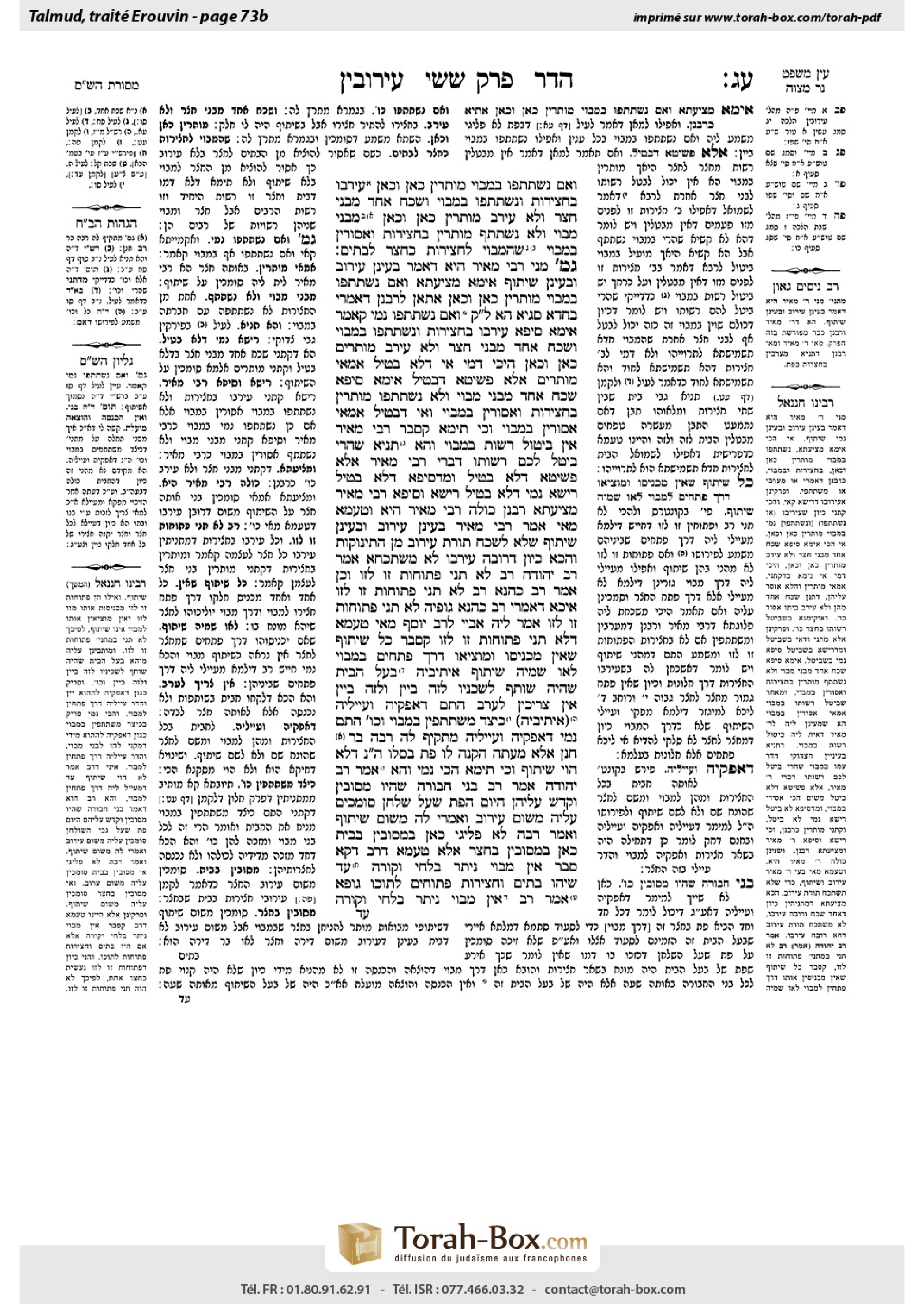
Eruvin 73b: Talmud study for Daf Yomi
Study the Talmud for Daf Yomi with scanned pages, Hebrew text, English translations from Sefaria and AI-generated French translations.
Passage selection and English or AI-generated French translation are available where the scan has annotations. Daf Study is independent of Torah-Box and Sefaria.
Browse Eruvin · עירובין · All tractatesEruvin 73b text and translations
This page of Eruvin includes the Aramaic text, an English translation and an AI-generated French translation, alongside the scan above.
עירובין ע״ג ב · Aramaic and Hebrew text
וְאִם נִשְׁתַּתְּפוּ בַּמָּבוֹי — מוּתָּרִין כָּאן וְכָאן.
עֵירְבוּ בַּחֲצֵירוֹת וְנִשְׁתַּתְּפוּ בַּמָּבוֹי, וְשָׁכַח אֶחָד מִבְּנֵי חָצֵר וְלֹא עֵירַב — מוּתָּרִין כָּאן וְכָאן.
מִבְּנֵי מָבוֹי וְלֹא נִשְׁתַּתֵּף — מוּתָּרִין בַּחֲצֵירוֹת וַאֲסוּרִין בַּמָּבוֹי, שֶׁהַמָּבוֹי לַחֲצֵירוֹת כֶּחָצֵר לַבָּתִּים.
גְּמָ׳ מַנִּי? רַבִּי מֵאִיר הִיא, דְּאָמַר: בָּעִינַן עֵירוּב וּבָעִינַן שִׁיתּוּף.
אֵימָא מְצִיעֲתָא: ״וְאִם נִשְׁתַּתְּפוּ בַּמָּבוֹי מוּתָּרִין כָּאן וְכָאן״, אֲתָאן לְרַבָּנַן דְּאָמְרִי בַּחֲדָא סַגִּיא!
הָא לָא קַשְׁיָא: וְאִם נִשְׁתַּתְּפוּ נָמֵי קָאָמַר.
אֵימָא סֵיפָא: עֵירְבוּ בַּחֲצֵירוֹת וְנִשְׁתַּתְּפוּ בַּמָּבוֹי, וְשָׁכַח אֶחָד מִבְּנֵי חָצֵר וְלֹא עֵירַב — מוּתָּרִים כָּאן וְכָאן. הֵיכִי דָמֵי? אִי דְּלָא בַּטֵּיל, אַמַּאי מוּתָּרִים? אֶלָּא פְּשִׁיטָא דְּבַטֵּיל. אֵימָא סֵיפָא: שָׁכַח אֶחָד מִבְּנֵי מָבוֹי וְלֹא נִשְׁתַּתְּפוּ — מוּתָּרִין בַּחֲצֵירוֹת וַאֲסוּרִין בַּמָּבוֹי, וְאִי דְּבַטֵּיל — אַמַּאי אֲסוּרִין בַּמָּבוֹי?
וְכִי תֵּימָא קָסָבַר רַבִּי מֵאִיר אֵין בִּיטּוּל רְשׁוּת בְּמָבוֹי. וְהָא תַּנְיָא: שֶׁהֲרֵי בִּיטֵּל לָכֶם רְשׁוּתוֹ, דִּבְרֵי רַבִּי מֵאִיר.
אֶלָּא פְּשִׁיטָא דְּלָא בַּטֵּיל. וּמִדְּסֵיפָא דְּלָא בַּטֵּיל — רֵישָׁא נָמֵי דְּלָא בַּטֵּיל. רֵישָׁא וְסֵיפָא רַבִּי מֵאִיר, מְצִיעֲתָא רַבָּנַן!
כּוּלַּהּ רַבִּי מֵאִיר הִיא, וְטַעְמָא מַאי אָמַר רַבִּי מֵאִיר בָּעִינַן עֵירוּב וּבָעִינַן שִׁיתּוּף? שֶׁלֹּא לְשַׁכֵּחַ תּוֹרַת עֵירוּב מִן הַתִּינוֹקוֹת, וְהָכָא, כֵּיוָן דְּרוּבַּהּ עֵירְבוּ — לָא מִשְׁתַּכְחָא.
אָמַר רַב יְהוּדָה: רַב לָא תָּנֵי ״פְּתוּחוֹת זוֹ לָזוֹ״. וְכֵן אָמַר רַב כָּהֲנָא: רַב לָא תָּנֵי ״פְּתוּחוֹת זוֹ לָזוֹ״. אִיכָּא דְּאָמְרִי, רַב כָּהֲנָא גּוּפֵיהּ לָא תָּנֵי ״פְּתוּחוֹת זוֹ לָזוֹ״.
אֲמַר לֵיהּ אַבָּיֵי לְרַב יוֹסֵף: מַאי טַעְמָא דְּלָא תָּנֵי פְּתוּחוֹת זוֹ לָזוֹ. קָסָבַר כׇּל שִׁיתּוּף שֶׁאֵין מַכְנִיסוֹ וּמוֹצִיאוֹ דֶּרֶךְ פְּתָחִים בַּמָּבוֹי — לָאו שְׁמֵיהּ שִׁיתּוּף.
אֵיתִיבֵיהּ: בַּעַל הַבַּיִת שֶׁהָיָה שׁוּתָּף לִשְׁכֵנָיו, לָזֶה בְּיַיִן וְלָזֶה בְּיַיִן, אֵין צְרִיכִין לְעָרֵב. הָתָם, דְּאַפְּקֵיהּ וְעַיְּילֵיהּ.
(אֵיתִיבֵיהּ:) כֵּיצַד מִשְׁתַּתְּפִין בַּמָּבוֹי וְכוּ׳. הָתָם נָמֵי: דְּאַפְּקֵיהּ וְעַיְּילֵיהּ.
מַתְקֵיף לַהּ רַבָּה בַּר חָנָן: אֶלָּא מֵעַתָּה, הִקְנָה לוֹ פַּת בְּסַלּוֹ הָכִי נָמֵי דְּלָא הָוֵי שִׁיתּוּף?! וְכִי תֵּימָא: הָכִי נָמֵי, וְהָא אָמַר רַב יְהוּדָה אָמַר רַב: בְּנֵי חֲבוּרָה שֶׁהָיוּ מְסוּבִּין וְקִדֵּשׁ עֲלֵיהֶן הַיּוֹם — הַפַּת שֶׁעַל שֻׁלְחָן סוֹמְכִים עָלֶיהָ מִשּׁוּם עֵירוּב, וְאָמְרִי לַהּ מִשּׁוּם שִׁיתּוּף.
וְאָמַר רַבָּה, לָא פְּלִיגִי: כָּאן בִּמְסוּבִּין בַּבַּיִת, כָּאן בַּמְסוּבִּין בֶּחָצֵר.
אֶלָּא טַעְמָא דְּרַב, דְּקָא סָבַר: אֵין מָבוֹי נִיתָּר בְּלֶחִי וְקוֹרָה עַד שֶׁיְּהוּ בָּתִּים וַחֲצֵירוֹת פְּתוּחִים לְתוֹכוֹ.
גּוּפָא, אָמַר רַב: אֵין מָבוֹי נִיתָּר בְּלֶחִי וְקוֹרָה
Eruvin 73b · English translation
And if they merged the courtyards of the alleyway, they are permitted to carry both here, in the alleyway, and there, in the courtyards.
If they established an eiruv in the courtyards and also merged the courtyards of the alleyway, and one of the residents of the courtyard forgot and did not contribute to the eiruv in his courtyard, but did participate in the merging of the courtyards in the alleyway, they are permitted both here and there, as the merging of courtyards in the alleyway serves as an effective eiruv for the courtyards as well.
However, if one of the residents of the alleyway forgot and did not participate in the merging of courtyards that open into the alleyway, they are permitted to carry in the courtyards and prohibited from carrying in the alleyway, as the principle is: An alleyway is to its courtyards as a courtyard is to its houses.
GEMARA: The Gemara asks: In accordance with whose opinion is this mishna? The Gemara answers: It is in accordance with the opinion of Rabbi Meir, who said: We require an eiruv and we also require a merging of the courtyards in an alleyway, and one is not sufficient without the other.
The Gemara asks: If so, say the middle clause of the mishna: And if they merged the courtyards in the alleyway, they are permitted to carry both here and there. We have arrived at the opinion of the Rabbis, who say that one is enough, and one does not need both an eiruv and a merging of alleyways.
The Gemara responds: That is not difficult, as the mishna stated as follows: And if they also merged the courtyards in the alleyway, they are permitted to carry in the courtyards and in the alleyway.
The Gemara asks: Say the latter clause of the mishna: If they established an eiruv in the courtyards and also merged the courtyards in the alleyway, and one of the residents of the courtyard forgot and did not contribute to the eiruv in his courtyard but did participate in the merging of the alleyway, they are permitted to carry both here and there. What are the circumstances? If the person who forgot did not renounce his rights to the courtyard in favor of the others, why are they permitted to carry? Rather, it is obvious that he did renounce those rights. But if so, say the last clause of the mishna: If one of the members of the alleyway forgot and did not participate in the merging of the alleyway, they are permitted to carry in the courtyards and prohibited from carrying in the alleyway. But if he renounced his rights, why are they prohibited from carrying in the alleyway?
And if you say that Rabbi Meir holds that renunciation of rights is not effective in an alleyway, that answer is insufficient. Wasn’t it taught in a baraita with regard to an alleyway: As he renounced his rights in your favor; this is the statement of Rabbi Meir? This indicates that Rabbi Meir accepts the principle of renunciation of rights in an alleyway.
Rather, it is obvious that the person who forgot to participate in the merging of alleyways did not renounce his rights. And from the fact that the last clause of the mishna is referring to a case where he did not renounce his rights, it can be inferred that the first clause is also referring to a case where he did not renounce his rights. This would indicate that if they carried out a merging of alleyways, it also serves as an eiruv, even when one of them forgot to contribute to the eiruv and also failed to renounce his rights in the courtyard. This is in accordance with the opinion of the Rabbis, which leads to the puzzling conclusion that the first and last clauses of the mishna are in accordance with the opinion of Rabbi Meir, while the middle clause is in accordance with the opinion of the Rabbis.
The Gemara answers: In fact, it is all in accordance with the opinion of Rabbi Meir. And what is the reason that Rabbi Meir said we require an eiruv and we also require a merging of alleyways? It was only so as not to cause the halakhic category of eiruv to be forgotten by the children. If people would only merge courtyards, the halakha of establishing an eiruv for a courtyard would gradually be forgotten. And here, where only one person forgot to contribute to the eiruv, since most of them established an eiruv for the courtyards, the halakha of an eiruv will not be forgotten. Therefore, there is room to be lenient after the fact and to permit carrying in both places.
Rav Yehuda said: Rav did not teach the mishna as stating that the five courtyards open into one another, but rather that each courtyard opens into the alleyway, and each established its own eiruv. And so too, Rav Kahana said: Rav did not teach the mishna as stating that the courtyards open into one another. Some say that Rav Kahana himself did not teach the mishna as stating that the courtyards open into one another.
Abaye said to Rav Yosef: What is the reason he did not teach the mishna as stating that the five courtyards open into one another? Rav Yosef replied: Because he holds that any merging of alleyways that is not brought in and taken out by way of the entrances that open into the alleyway, i.e., which is not brought from each courtyard into the alleyway and then taken from the alleyway into the courtyard where it will be deposited, is not considered a valid merging of the alleyway. If the food used for the merging of alleyways is transferred directly from one courtyard to another, it seems as though it is being used to establish an eiruv. It is therefore ineffective as a merging of alleyways. Here too, if the courtyards open into one another, the merging of alleyways is invalid, due to a concern that the residents of the courtyard will transfer the food directly from one courtyard to another.
He raised an objection to him based upon the following mishna: A homeowner who was a partner of his neighbors, with this one in wine and with that one in wine, they do not need to establish an eiruv. This indicates that it is not actually necessary to transfer the food used for the merging of alleyways from one place to another. For example, it is sufficient to have a jointly owned barrel of wine in one courtyard even if it did not pass through the alleyway. The Gemara rejects this proof and explains the mishna as follows: There, it is referring to a case where they took the wine out into the alleyway and subsequently brought it in to the courtyard where it was to be kept.
He raised another objection to him from a different mishna: How does one merge courtyards that open into alleyways? The mishna continues and says that it is sufficient for one person to acquire the food used for the merging on behalf of all the other residents of the alleyway. This indicates that the food does not need to pass through all the courtyards in the alleyway. The Gemara rejects this proof as well: There too, it is referring to a case where they first took the food out from each of the courtyards into the alleyway and from there brought it into the courtyard where it was to be deposited.
Rabba bar Ḥanan strongly objects to this: However, if that is so, if he transferred ownership of bread in his basket to another person, so too, it would not be considered a valid merging. And if you say that this is indeed so, didn’t Rav Yehuda say that Rav said: With regard to members of a group who were dining together on Shabbat eve, and the day became sanctified for them, i.e., Shabbat began while they were eating, they may rely upon the bread on the table as an eiruv for the courtyard, and some say, as a merging of the alleyway.
And Rabba said: The two versions do not disagree with each other regarding whether the bread counts as an eiruv or as a merging of the alleyway. Here, where they can use it as an eiruv, it is referring to a case where they were dining in a house, since food deposited inside a house can serve as an eiruv for the courtyard. There, it is referring to a case where they were dining in a courtyard, and therefore they may rely on the bread as a merging of the alleyway. This proves that even Rav agrees that it is not necessary to take the food used to merge an alleyway into the alleyway itself and then bring it back to the courtyard.
Rather, we must retract the previous explanation and say that the reason Rav did not teach the mishna as stating that the courtyards opened into one another is that he holds that an alleyway cannot be rendered permitted for carrying through a side post and a cross beam unless there are houses and courtyards opening into it. If, however, the courtyards open into one another, they are considered like a single courtyard, in which case they cannot be rendered permitted for carrying through a side post or a cross beam, and the merging of the alleyway is ineffective.
The Gemara now examines the matter itself cited in the previous discussion. Rav said: An alleyway cannot become permitted for carrying through a side post and a cross beam,
Eruvin 73b · Traduction française (IA)
Et si les cours des ruelles ont été fusionnées, ils sont autorisés à porter à la fois ici, dans la ruelle, et là, dans les cours.
Si un eiruv a été établi dans les cours et que les cours des ruelles ont également été fusionnées, et qu'un des habitants des cours a oublié de contribuer à l'eiruv dans sa cour mais a participé à la fusion des cours dans la ruelle, ils sont autorisés à porter à la fois ici et là, car la fusion des cours dans la ruelle sert d'eiruv efficace pour les cours également.
Cependant, si un des habitants de la ruelle a oublié et n'a pas participé à la fusion des cours qui s'ouvrent sur la ruelle, ils sont autorisés à porter dans les cours et interdits de porter dans la ruelle, car le principe est : Une ruelle est à ses cours comme une cour est à ses maisons.
GUEMARA : La Guemara pose la question : Selon l'opinion de qui est cette Michna ? La Guemara répond : C'est selon l'opinion de Rabbi Meir, qui a dit : Nous exigeons un eiruv et nous exigeons également la fusion des cours dans une ruelle, et l'un seul n'est pas suffisant sans l'autre.
La Guemara pose la question : Si c'est ainsi, disons la clause intermédiaire de la Michna : Et si les cours ont été fusionnées dans la ruelle, ils sont autorisés à porter à la fois ici et là. Nous sommes arrivés à l'opinion des Rabbins, qui disent qu'un seul est suffisant, et qu'on n'a pas besoin à la fois d'un eiruv et d'une fusion de ruelles.
La Guemara répond : Ce n'est pas difficile, car la Michna a dit comme suit : Et si les cours ont également été fusionnées dans la ruelle, ils sont autorisés à porter dans les cours et dans la ruelle.
La Guemara pose la question : Disons la dernière clause de la Michna : Si un eiruv a été établi dans les cours et que les cours ont également été fusionnées dans la ruelle, et qu'un des habitants des cours a oublié de contribuer à l'eiruv dans sa cour mais a participé à la fusion de la ruelle, ils sont autorisés à porter à la fois ici et là. Quelles sont les circonstances ? Si la personne qui a oublié n'a pas renoncé à ses droits sur la cour en faveur des autres, pourquoi sont-ils autorisés à porter ? Plutôt, il est évident qu'il a renoncé à ces droits. Mais si c'est ainsi, disons la dernière clause de la Michna : Si un des membres de la ruelle a oublié et n'a pas participé à la fusion de la ruelle, ils sont autorisés à porter dans les cours et interdits de porter dans la ruelle. Mais s'il a renoncé à ses droits, pourquoi sont-ils interdits de porter dans la ruelle ?
Et si vous dites que Rabbi Meir considère que le renoncement des droits n'est pas efficace dans une ruelle, cette réponse n'est pas suffisante. N'a-t-il pas été enseigné dans une baraïta concernant une ruelle : Comme il a renoncé à ses droits en votre faveur ; c'est la déclaration de Rabbi Meir ? Cela indique que Rabbi Meir accepte le principe du renoncement des droits dans une ruelle.
Plutôt, il est évident que la personne qui a oublié de participer à la fusion des ruelles n'a pas renoncé à ses droits. Et du fait que la dernière clause de la mitsna fait référence à un cas où il n'a pas renoncé à ses droits, on peut en déduire que la première clause fait également référence à un cas où il n'a pas renoncé à ses droits. Cela indique que si une fusion des ruelles a été réalisée, cela sert également d'eiruv, même lorsque l'un d'entre eux a oublié de contribuer à l'eiruv et n'a pas renoncé à ses droits dans la cour. Cela est selon l'opinion des Rabbins, ce qui mène à la conclusion troublante que les premières et dernières clauses de la mitsna sont selon l'opinion de Rabbi Meir, tandis que la clause intermédiaire est selon l'opinion des Rabbins.
La Guemara répond : En réalité, tout est selon l'opinion de Rabbi Meir. Et quelle est la raison pour laquelle Rabbi Meir a dit que nous exigeons un eiruv et nous exigeons également une fusion des ruelles ? C'était uniquement pour ne pas faire oublier la catégorie halakhique de l'eiruv par les enfants. Si les gens ne faisaient que fusionner les cours, la halakha de l'établissement d'un eiruv pour une cour serait progressivement oubliée. Et ici, où seul une personne a oublié de contribuer à l'eiruv, puisque la plupart ont établi un eiruv pour les cours, la halakha de l'eiruv ne sera pas oubliée. Il y a donc lieu de faire une concession après coup et d'autoriser le port à la fois dans les deux lieux.
Rav Yehuda a dit : Rav n'a pas enseigné la mitsna comme indiquant que les cinq cours s'ouvrent les unes sur les autres, mais plutôt que chaque cour s'ouvre sur la ruelle, et que chaque cour a établi son propre eiruv. Et de même, Rav Kahana a dit : Rav n'a pas enseigné la mitsna comme indiquant que les cours s'ouvrent les unes sur les autres. Certains disent que Rav Kahana lui-même n'a pas enseigné la mitsna comme indiquant que les cours s'ouvrent les unes sur les autres.
Abaye a dit à Rav Yosef : Quelle est la raison pour laquelle il n'a pas enseigné la mitsna comme indiquant que les cinq cours s'ouvrent les unes sur les autres ? Rav Yosef a répondu : Parce qu'il considère que toute fusion de ruelles qui n'est pas apportée et retirée par les entrées qui s'ouvrent sur la ruelle, c'est-à-dire qui n'est pas apportée de chaque cour dans la ruelle et ensuite retiré de la ruelle dans la cour où il sera déposé, n'est pas considérée comme une fusion valide de la ruelle. Si les aliments utilisés pour la fusion de la ruelle sont transférés directement d'une cour à une autre, cela semble comme si on les utilisait pour établir un eiruv. Il est donc inefficace comme fusion de ruelles. De même, si les cours s'ouvrent les unes sur les autres, la fusion de la ruelle est invalide, en raison de la crainte que les habitants de la cour transfèrent directement les aliments d'une cour à une autre.
Il lui opposa un contre-argument fondé sur la suivante mitsva : Un propriétaire qui était partenaire avec ses voisins, avec l'un dans le vin et avec l'autre dans le vin, ils n'ont pas besoin d'établir un eiruv. Cela indique que ce n'est pas réellement nécessaire de transférer les aliments utilisés pour la fusion des cours depuis un lieu vers un autre. Par exemple, il suffit d'avoir une barrique de vin partagée dans une cour même si elle n'a pas traversé le passage. La Guemara rejette cette preuve et explique la mitsva comme suit : Là, il s'agit d'un cas où ils ont sorti le vin dans le passage et ensuite l'ont ramené dans la cour où il devait être conservé.
Il lui opposa un autre contre-argument tiré d'une autre mitsva : Comment fusionner des cours qui s'ouvrent sur des passages ? La mitsva continue et dit qu'il suffit qu'une seule personne acquière les aliments utilisés pour la fusion au bénéfice de tous les autres habitants du passage. Cela indique que les aliments n'ont pas besoin de passer par toutes les cours du passage. La Guemara rejette cette preuve également : Là aussi, il s'agit d'un cas où ils ont d'abord sorti les aliments de chaque cour dans le passage et d'ensuite les avoir ramenés dans la cour où ils devaient être déposés.
Rabba bar Ḥanan s'oppose fermement à cela : Cependant, si c'est ainsi, si l'on transfère la propriété du pain dans son panier à une autre personne, cela ne serait pas considéré comme une fusion valide. Et si vous dites que c'est effectivement ainsi, n'a-t-on pas dit que Rav Yehuda a dit que Rav a dit : En ce qui concerne les membres d'un groupe qui dînaient ensemble le soir du Shabbat, et que le jour est devenu sanctifié pour eux, c'est-à-dire que le Shabbat a commencé pendant qu'ils mangeaient, ils peuvent compter sur le pain sur la table comme eiruv pour la cour, et certains disent, comme une fusion du passage.
Et Rabba dit : Les deux versions ne s'opposent pas l'une à l'autre concernant le fait que le pain compte comme un eiruv ou comme une fusion du passage. Ici, où ils peuvent l'utiliser comme un eiruv, il s'agit d'un cas où ils dînaient dans une maison, puisque les aliments déposés à l'intérieur d'une maison peuvent servir d'eiruv pour la cour. Là, il s'agit d'un cas où ils dînaient dans une cour, et par conséquent ils peuvent compter sur le pain comme une fusion du passage. Cela prouve que même Rav accepte que ce n'est pas nécessaire de prendre les aliments utilisés pour fusionner un passage dans le passage lui-même et de les ramener ensuite dans la cour.
Au contraire, nous devons reconsidérer l'explication précédente et dire que la raison pour laquelle Rav n'a pas enseigné la mitsna en disant que les cours s'ouvrent les unes sur les autres est qu'il considère qu'un passage ne peut pas devenir permis pour le transport par un poteau latéral et une traverse à moins qu'il y ait des maisons et des cours qui s'ouvrent dessus. Cependant, si les cours s'ouvrent les unes sur les autres, elles sont considérées comme une seule cour, dans ce cas, elles ne peuvent pas devenir permises pour le transport par un poteau latéral ou une traverse, et la fusion du passage est inefficace.
La Guemara examine maintenant la question elle-même citée dans la discussion précédente. Rav dit : Un passage ne peut pas devenir permis pour le transport par un poteau latéral et une traverse,
Traduction française générée par IA à partir de l’édition anglaise de Sefaria. Vérifie toujours un passage avec le texte source.
Text from Sefaria: William Davidson Edition - Vocalized Aramaic (CC BY NC); William Davidson Edition - English (CC BY NC).