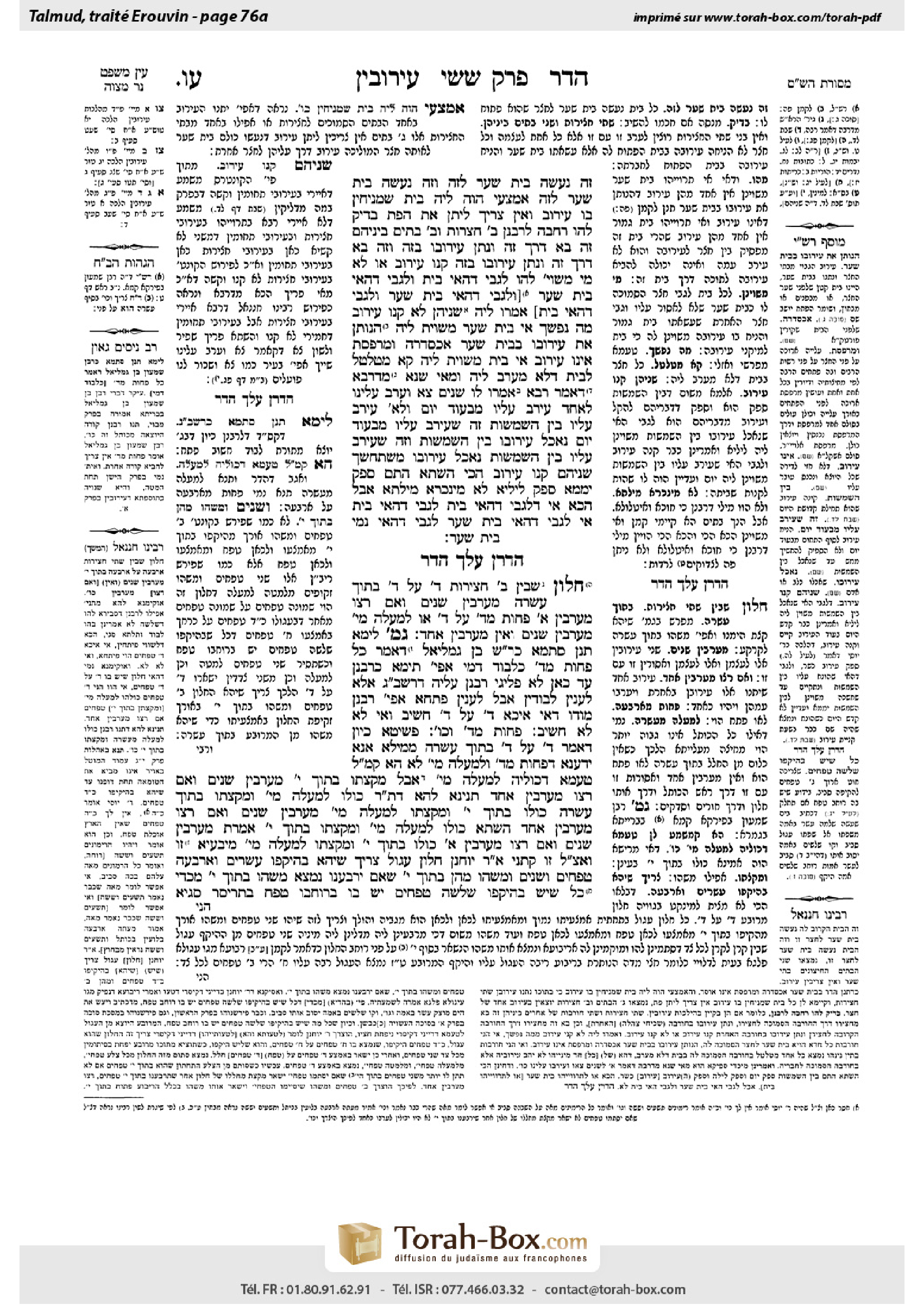
Eruvin 76a: Talmud study for Daf Yomi
Study the Talmud for Daf Yomi with scanned pages, Hebrew text, English translations from Sefaria and AI-generated French translations.
Passage selection and English or AI-generated French translation are available where the scan has annotations. Daf Study is independent of Torah-Box and Sefaria.
Browse Eruvin · עירובין · All tractatesEruvin 76a text and translations
This page of Eruvin includes the Aramaic text, an English translation and an AI-generated French translation, alongside the scan above.
עירובין ע״ו א · Aramaic and Hebrew text
זֶה נַעֲשֶׂה בֵּית שַׁעַר לָזֶה, וְזֶה נַעֲשֶׂה בֵּית שַׁעַר לָזֶה. אֶמְצָעִי הָוֵה לֵיהּ בַּיִת שֶׁמַּנִּיחִין בּוֹ עֵירוּב, וְאֵין צָרִיךְ לִיתֵּן אֶת הַפַּת.
בָּדֵיק לְהוּ רַחֲבָה לְרַבָּנַן: שְׁתֵּי חֲצֵרוֹת וּשְׁנֵי בָתִּים בֵּינֵיהֶם, זֶה בָּא דֶּרֶךְ זֶה וְנָתַן עֵירוּבוֹ בָּזֶה, וָזֶה בָּא דֶּרֶךְ זֶה וְנָתַן עֵירוּבוֹ בָּזֶה, קָנוּ עֵירוּב אוֹ לָא? מִי מְשַׁוֵּית לְהוּ לְגַבֵּי דְּהַאי בַּיִת, וּלְגַבֵּי דְּהַאי בֵּית שַׁעַר [וּלְגַבֵּי דְּהַאי בֵּית שַׁעַר, וּלְגַבֵּי דְּהַאי בַּיִת]?
אֲמַרוּ לֵיהּ: שְׁנֵיהֶן לֹא קָנוּ עֵירוּב, מָה נַפְשָׁךְ: אִי בֵּית שַׁעַר מְשַׁוֵּית לֵיהּ, הַנּוֹתֵן אֶת עֵירוּבוֹ בְּבֵית שַׁעַר אַכְסַדְרָה וּמִרְפֶּסֶת — אֵינוֹ עֵירוּב. אִי בַּיִת מְשַׁוֵּית לֵיהּ — קָא מְטַלְטֵל לְבַיִת דְּלָא מְעָרֵב לֵיהּ.
וּמַאי שְׁנָא מִדְּרָבָא? דְּאָמַר רָבָא: אָמְרוּ לוֹ שְׁנַיִם צֵא וְעָרֵב עָלֵינוּ. לְאֶחָד עֵירַב עָלָיו מִבְּעוֹד יוֹם, וּלְאֶחָד עֵירַב עָלָיו בֵּין הַשְּׁמָשׁוֹת. זֶה שֶׁעֵירַב עָלָיו מִבְּעוֹד יוֹם נֶאֱכַל עֵירוּבוֹ בֵּין הַשְּׁמָשׁוֹת, וְזֶה שֶׁעֵירַב עָלָיו בֵּין הַשְּׁמָשׁוֹת נֶאֱכַל עֵירוּבוֹ מִשֶּׁתֶּחְשַׁךְ — שְׁנֵיהֶם קָנוּ עֵירוּב!
הָכִי הַשְׁתָּא?! הָתָם סָפֵק יְמָמָא סָפֵק לֵילְיָא לָא מִינַּכְרָא מִילְּתָא, אֲבָל הָכָא, אִי דִּלְגַבֵּי דְּהַאי בַּיִת, לְגַבֵּי דְּהַאי בַּיִת. אִי לְגַבֵּי דְּהַאי בֵּית שַׁעַר, לְגַבֵּי דְּהַאי נָמֵי בֵּית שַׁעַר.
הַדְרָן עֲלָךְ הַדָּר
מַתְנִי׳ חַלּוֹן שֶׁבֵּין שְׁתֵּי חֲצֵירוֹת אַרְבָּעָה עַל אַרְבָּעָה, בְּתוֹךְ עֲשָׂרָה — מְעָרְבִין שְׁנַיִם. וְאִם רָצוּ — מְעָרְבִין אֶחָד.
פָּחוֹת מֵאַרְבָּעָה עַל אַרְבָּעָה אוֹ לְמַעְלָה מֵעֲשָׂרָה מְעָרְבִין שְׁנַיִם, וְאֵין מְעָרְבִין אֶחָד.
גְּמָ׳ לֵימָא תְּנַן סְתָמָא כְּרַבָּן שִׁמְעוֹן בֶּן גַּמְלִיאֵל, דְּאָמַר: כׇּל פָּחוֹת מֵאַרְבָּעָה כְּלָבוּד דָּמֵי.
אֲפִילּוּ תֵּימָא כְּרַבָּנַן, עַד כָּאן לָא פְּלִיגִי רַבָּנַן עֲלֵיהּ דְּרַבָּן שִׁמְעוֹן בֶּן גַּמְלִיאֵל אֶלָּא לְעִנְיַן לְבוּדִין, אֲבָל לְעִנְיַן פִּתְחָא אֲפִילּוּ רַבָּנַן מוֹדוּ דְּאִי אִיכָּא אַרְבָּעָה עַל אַרְבָּעָה — חֲשִׁיב, וְאִי לָא — לָא חֲשִׁיב.
פָּחוֹת מֵאַרְבָּעָה וְכוּ׳. פְּשִׁיטָא, כֵּיוָן דְּאָמַר אַרְבָּעָה עַל אַרְבָּעָה בְּתוֹךְ עֲשָׂרָה — מִמֵּילָא אֲנָא יָדַעְנָא דְּפָחוֹת מֵאַרְבָּעָה וּלְמַעְלָה מֵעֲשָׂרָה לָא!
הָא קָא מַשְׁמַע לַן טַעְמָא דְּכוּלֵּיהּ לְמַעְלָה מֵעֲשָׂרָה, אֲבָל מִקְצָתוֹ בְּתוֹךְ עֲשָׂרָה — מְעָרְבִין שְׁנַיִם, וְאִם רָצוּ — מְעָרְבִין אֶחָד.
תְּנֵינָא לְהָא דְּתָנוּ רַבָּנַן: כּוּלּוֹ לְמַעְלָה מֵעֲשָׂרָה וּמִקְצָתוֹ בְּתוֹךְ עֲשָׂרָה, כּוּלּוֹ בְּתוֹךְ עֲשָׂרָה וּמִקְצָתוֹ לְמַעְלָה מֵעֲשָׂרָה — מְעָרְבִין שְׁנַיִם, וְאִם רָצוּ — מְעָרְבִין אֶחָד.
הַשְׁתָּא כּוּלּוֹ לְמַעְלָה מֵעֲשָׂרָה וּמִקְצָתוֹ בְּתוֹךְ עֲשָׂרָה אָמְרַתְּ ״מְעָרְבִין שְׁנַיִם וְאִם רָצוּ מְעָרְבִין אֶחָד״, כּוּלּוֹ בְּתוֹךְ עֲשָׂרָה וּמִקְצָתוֹ לְמַעְלָה מֵעֲשָׂרָה מִיבַּעְיָא?
״זוֹ וְאֵין צָרִיךְ לוֹמַר זוֹ״ קָתָנֵי.
אָמַר רַבִּי יוֹחָנָן: חַלּוֹן עָגוֹל צָרִיךְ שֶׁיְּהֵא בְּהֶיקֵּפוֹ עֶשְׂרִים וְאַרְבָּעָה טְפָחִים, וּשְׁנַיִם וּמַשֶּׁהוּ מֵהֶן בְּתוֹךְ עֲשָׂרָה, שֶׁאִם יְרַבְּעֶנּוּ, נִמְצָא מַשֶּׁהוּ בְּתוֹךְ עֲשָׂרָה.
מִכְּדִי, כֹּל שֶׁיֵּשׁ בְּהֶיקֵּפוֹ שְׁלֹשָׁה טְפָחִים — יֵשׁ בּוֹ בְּרוֹחְבּוֹ טֶפַח, בִּתְרֵיסַר סַגִּיא.
Eruvin 76a · English translation
this outer house becomes a gatehouse to this courtyard, and that outer house becomes a gatehouse to that courtyard, and therefore the residents of the outer houses need not contribute to the eiruv. The middle house between them is the house in which the eiruv is placed, and therefore its residents need not contribute bread for the eiruv.
The Sage Raḥava tested the other Sages: If there were two courtyards and two houses between them, and a resident of this courtyard came through this house that opens to his courtyard and placed his eiruv in that house farther from his courtyard, and a resident of this other courtyard came through this house that opens to his courtyard and placed his eiruv in that house that opens to the other courtyard, did they acquire the eiruv or not, i.e., are the two eiruvin valid? Do you render it a house with regard to this courtyard, whose eiruv was placed there, and a gatehouse with regard to that one who passed through it in order to place his eiruv in the other house? And similarly, do you render the other house a gatehouse with regard to this one and a house with regard to that one?
The Sages said to Raḥava: Neither of them has acquired his eiruv. Whichever way you look at it, it is difficult: If you consider either house a gatehouse, the halakha with regard to one who places his eiruv in a gatehouse, a porch, or a balcony, is that it is not a valid eiruv. And if you consider either one a house, he would be carrying into a house for which he is not establishing an eiruv. Since the assumption that benefits one of them harms the other, and there is no way to establish firmly the status of these houses, the residents of both courtyards fail to acquire their eiruv.
Raḥava asked: What makes this case different from the ruling of Rava? As Rava said: In the case of two people who said to one person: Go and establish an eiruv of Shabbat limits for each of us, and he established an eiruv for one of them while it was still day, and he established an eiruv for the other one during twilight, and the eiruv of the one for whom he established an eiruv while it was still day was eaten during twilight, and the eiruv of the one for whom he established an eiruv during twilight was eaten after nightfall, both of them have acquired their eiruv. Twilight is of doubtful status as to whether it is considered day or night. If it is night, any eiruv established at that time is invalid, and if it is day, any eiruv eaten at that time is invalid. Rava nonetheless ruled leniently, despite the fact that two contradictory assumptions are involved, in keeping with the principle that in cases of doubt relating to an eiruv, the halakha is lenient. Consequently, with regard to the one whose eiruv was eaten during twilight, it is considered as though it was already night, and therefore his eiruv had already taken effect while it was still day before it was eaten. Conversely, with regard to the one whose eiruv was established during twilight, that period of time is viewed as day, and therefore his eiruv is valid as well.
The Sages respond: How can these cases be compared? There, where there is uncertainty whether it is day and uncertainty whether it is night, the matter is not noticeable, as no one sees exactly when each eiruv was established. But here, where the houses are clearly distinguishable, if with regard to this one, who placed his eiruv there, it is a house, then with regard to that one, who passed through it, it should also be regarded as a house. And if, with regard to this one, who passed through it, it is a gatehouse, then with regard to that one, who placed his eiruv there, it should also be considered a gatehouse. Therefore, neither of them acquires his eiruv.
MISHNA: If there is a window in a wall that separates between two courtyards, and the window measures four by four handbreadths and is within ten handbreadths of the ground, the inhabitants of the courtyards establish two eiruvin, one for each courtyard. And if they desire, they may establish one eiruv, thereby merging the two courtyards, as they may be considered as one due to the window.
However, if the window measures less than four by four handbreadths, or if it is above ten handbreadths from the ground, it is no longer considered a valid opening, and the two courtyards cannot be considered a single courtyard. Therefore, the residents establish two eiruvin, but they may not establish one eiruv.
GEMARA: With regard to the mishna’s determination that the size of the window must be four by four handbreadths, the Gemara asks: Let us say that we learned an unattributed mishna in accordance with the previously cited opinion of Rabban Shimon ben Gamliel, who said: Any gap less than four handbreadths is considered lavud, i.e., two objects are considered connected if the space between them is less than four handbreadths. That would explain why the window must be four handbreadths in size, as otherwise it would be considered as though it were sealed, based on the principle of lavud.
The Gemara rejects this suggestion: Even if you say that the mishna is in accordance with the opinion of the Rabbis that only gaps of less than three handbreadths are included in the principle of lavud, the Rabbis disagreed with Rabban Shimon ben Gamliel only with regard to the halakhot of lavud, i.e., what is considered connected. But with regard to an opening, even the Rabbis agree that if there is an opening of four by four handbreadths, it is significant, and if not, it is not significant.
It was taught in the mishna: If the window is less than four by four handbreadths, or above ten handbreadths from the ground, the residents of each courtyard must establish a separate eiruv. The Gemara objects: This is obvious. Since the mishna stated in the previous clause that if the window is four by four handbreadths and within ten handbreadths from the ground, they establish one eiruv, from this halakha itself I know that if the window is less than four by four handbreadths or above ten handbreadths, they may not establish one eiruv. Why was it necessary to teach this in the mishna?
The Gemara answers: It teaches us this matter: The reason is specifically that the entire window is above ten handbreadths; however, if part of it is within ten handbreadths of the ground, they establish two eiruvin, and if they desire, they may establish one eiruv.
The Gemara comments: According to this explanation, we already learned in the mishna that which the Sages taught in a baraita: If nearly all of the window is above ten handbreadths and only a small part of it is within ten handbreadths, or if nearly all of it is within ten handbreadths and only a small part of it is above ten handbreadths, they establish two eiruvin, and if they desire, they may establish one eiruv.
The essential meaning of this baraita is clear, but the Gemara raises a question with regard to its formulation: Now, if nearly all of it is above ten handbreadths and only a small part of it is within ten handbreadths, you said that they establish two eiruvin, and if they desire, they may establish one eiruv, i.e., the window has the status of an opening and therefore the two courtyards may establish a joint eiruv, then is it necessary to state the halakha governing the case where almost all of it is within ten and only a small part of it is above ten?
The Gemara answers that indeed, this baraita teaches employing the style: This, and it is unnecessary to say that, moving from the more difficult and novel case to the easier, more straightforward one.
Rabbi Yoḥanan said: A circular window must have a circumference of twenty-four handbreadths, with two and a bit of them within ten handbreadths of the ground, so that when he squares the window, i.e., if he forms the shape of a square inside it, it measures four by four handbreadths, and a bit of it is then within ten handbreadths of the ground.
The Gemara poses a question with regard to this calculation: Now, since there is a general principle that any circle with a circumference of three handbreadths is one handbreadth in diameter, then according to this formula, a window with a circumference of twelve handbreadths, meaning that it has a diameter of four handbreadths, should be sufficient to create a window of four by four.
Eruvin 76a · Traduction française (IA)
Cette maison extérieure devient une porte pour ce courtil, et cette maison extérieure devient une porte pour l'autre courtil, et donc les habitants des maisons extérieures n'ont pas besoin de contribuer à l'eiruv. La maison du milieu, entre elles, est la maison dans laquelle l'eiruv est placé, et donc ses habitants n'ont pas besoin de contribuer du pain pour l'eiruv.
Le Sage Raḥava a testé les autres Sages : Si deux courtils et deux maisons entre eux, et un habitant de ce courtil entre par cette maison qui s'ouvre sur son courtil et place son eiruv dans cette maison plus éloignée de son courtil, et un habitant de l'autre courtil entre par cette maison qui s'ouvre sur son courtil et place son eiruv dans cette maison qui s'ouvre sur l'autre courtil, ont-ils acquis l'eiruv ou non, c'est-à-dire sont-ils les deux eiruvin valides ? Est-ce que vous considérez cette maison comme une maison concernant ce courtil, dont l'eiruv a été placé là, et une porte concernant celui qui est passé par là pour placer son eiruv dans l'autre maison ? Et de même, est-ce que vous considérez l'autre maison comme une porte concernant ce courtil et une maison concernant celui-ci ?
Les Sages dirent à Raḥava : Aucun d'eux n'a acquis son eiruv. Quel que soit le point de vue, c'est difficile : Si vous considérez l'une de ces maisons comme une porte, la halakha concernant celui qui place son eiruv dans une porte, un porche ou un balcon est que cela n'est pas un eiruv valide. Et si vous considérez l'une d'entre elles comme une maison, il serait en train de porter dans une maison pour laquelle il n'a pas établi d'eiruv. Puisque l'hypothèse qui profite à l'un nuit à l'autre, et qu'il n'y a pas de moyen de fixer clairement le statut de ces maisons, les habitants des deux courtils échouent à acquérir leur eiruv.
Raḥava demanda : Qu'est-ce qui rend ce cas différent de la décision de Rava ? Comme Rava a dit : Dans le cas de deux personnes qui ont dit à une personne : Allez établir un eiruv des limites du Shabbat pour chacun de nous, et il a établi un eiruv pour l'un d'eux pendant qu'il faisait encore jour, et un eiruv pour l'autre pendant le crépuscule, et l'eiruv de celui pour qui il l'a établi pendant qu'il faisait encore jour a été mangé pendant le crépuscule, et l'eiruv de celui pour qui il l'a établi pendant le crépuscule a été mangé après la nuit, les deux ont acquis leur eiruv. Le crépuscule est d'un statut incertain quant à ce qu'il est considéré comme jour ou nuit. Si c'est la nuit, tout eiruv établi à ce moment-là est invalide, et si c'est le jour, tout eiruv mangé à ce moment-là est invalide. Rava a toutefois rendu une décision favorable, malgré le fait que deux hypothèses contradictoires sont impliquées, conformément au principe que dans les cas de doute concernant un eiruv, la halakha est favorable. Ainsi, concernant celui dont l'eiruv a été mangé pendant le crépuscule, on le considère comme s'il était déjà la nuit, et donc son eiruv avait déjà pris effet pendant qu'il faisait encore jour avant qu'il ne soit mangé. À l'inverse, concernant celui dont l'eiruv a été établi pendant le crépuscule, cette période est vue comme le jour, et donc son eiruv est valide également.
Les Sages répondent : Comment peuvent ces cas être comparés ? Là-bas, où il y a une incertitude quant à savoir si c'est jour ou si c'est nuit, la question n'est pas discernable, car personne ne voit exactement quand chaque eiruv a été établi. Mais ici, où les maisons sont clairement distinguables, si, concernant celui qui a placé son eiruv là, c'est une maison, alors concernant celui qui est passé par là, il devrait aussi être considéré comme une maison. Et si, concernant celui qui est passé par là, c'est une porte, alors concernant celui qui a placé son eiruv là, il devrait aussi être considéré comme une porte. Ainsi, aucun d'eux n'acquiert son eiruv.
MICHNA : Si une fenêtre existe dans un mur qui sépare deux courtyards, et que la fenêtre mesure quatre par quatre tefachim et est à moins de dix tefachim du sol, les habitants des courtyards établissent deux eiruvin, l'un pour chaque courtil. Et si ils le souhaitent, ils peuvent établir un eiruv, en considérant les deux courtyards comme un seul en raison de la fenêtre.
Cependant, si la fenêtre mesure moins de quatre par quatre tefachim, ou si elle est au-dessus de dix tefachim du sol, elle n'est plus considérée comme une ouverture valide, et les deux courtyards ne peuvent pas être considérés comme un seul courtil. Ainsi, les habitants établissent deux eiruvin, mais ils ne peuvent pas établir un eiruv.
GUEMARA : Concernant la détermination de la Michna que la taille de la fenêtre doit être quatre par quatre tefachim, la Guemara pose la question : Disons que nous avons appris une Michna non attribuée conformément à l'opinion précédemment citée de Rabban Shimon ben Gamliel, qui a dit : Tout espace inférieur à quatre tefachim est considéré comme lavud, c'est-à-dire que deux objets sont considérés comme connectés si l'espace entre eux est inférieur à quatre tefachim. Cela expliquerait pourquoi la fenêtre doit mesurer quatre tefachim, car autrement elle serait considérée comme s'il était scellé, selon le principe de lavud.
La Guemara rejette cette suggestion : Même si vous dites que la Michna est en conformité avec l'opinion des Rabbins qui considèrent que seul un espace inférieur à trois tefachim est inclus dans le principe de lavud, les Rabbins n'ont pas désaccordé avec Rabban Shimon ben Gamliel concernant les halakhot de lavud, c'est-à-dire ce qui est considéré comme connecté. Mais concernant une ouverture, même les Rabbins s'accordent sur le fait que si une ouverture de quatre par quatre tefachim existe, elle est significative, et si non, elle ne l'est pas.
Il a été enseigné dans la Michna : Si la fenêtre est inférieure à quatre par quatre tefachim, ou supérieure à dix tefachim du sol, les habitants de chaque courtil doivent établir un eiruv séparé. La Guemara s'oppose à cela : C'est évident. Puisque la Michna a dit dans la clause précédente que si la fenêtre est de quatre par quatre tefachim et à moins de dix tefachim du sol, ils établissent un eiruv, de cette halakha même je sais que si la fenêtre est inférieure à quatre par quatre tefachim ou supérieure à dix tefachim, ils ne peuvent pas établir un eiruv. Pourquoi était-il nécessaire d'enseigner cela dans la Michna ?
La Guemara répond : Elle nous apprend cette question : la raison est spécifiquement que toute la fenêtre est au-dessus de dix tefachim ; cependant, si une partie d'elle est à moins de dix tefachim du sol, ils établissent deux eiruvin, et s'ils le souhaitent, ils peuvent établir un seul eiruv.
La Guemara commente : Selon cette explication, nous avons déjà appris dans la mitsna ce que les Sages ont enseigné dans une baraïta : Si presque toute la fenêtre est au-dessus de dix tefachim et seulement une petite partie est à moins de dix tefachim du sol, ou si presque toute la fenêtre est à moins de dix tefachim du sol et seulement une petite partie est au-dessus de dix tefachim, ils établissent deux eiruvin, et s'ils le souhaitent, ils peuvent établir un seul eiruv.
Le sens essentiel de cette baraïta est clair, mais la Guemara soulève une question concernant sa formulation : Maintenant, si presque toute la fenêtre est au-dessus de dix tefachim et seulement une petite partie est à moins de dix tefachim du sol, vous dites qu'ils établissent deux eiruvin, et s'ils le souhaitent, ils peuvent établir un seul eiruv, c'est-à-dire que la fenêtre a le statut d'une ouverture et donc les deux courtyards peuvent établir un eiruv commun, alors est-il nécessaire de mentionner la halakha concernant le cas où presque toute la fenêtre est à moins de dix tefachim du sol et seulement une petite partie est au-dessus de dix tefachim ?
La Guemara répond que, en effet, cette baraïta enseigne en utilisant le style : Cela, et il n'est pas nécessaire de dire que, passant du cas plus difficile et plus nouveau au cas plus simple et plus évident.
Rabbi Yoḥanan a dit : Une fenêtre circulaire doit avoir un périmètre de vingt-quatre tefachim, avec deux et un peu plus de tefachim à moins de dix tefachim du sol, de sorte que lorsqu'on la transforme en carré, c'est-à-dire si on forme la forme d'un carré à l'intérieur, elle mesure quatre par quatre tefachim, et une partie d'elle est alors à moins de dix tefachim du sol.
La Guemara pose une question concernant ce calcul : Maintenant, puisque tout cercle dont le périmètre est de trois tefachim a un diamètre de un tefachim, alors selon cette formule, une fenêtre dont le périmètre est de douze tefachim, c'est-à-dire qui a un diamètre de quatre tefachim, devrait suffire pour créer une fenêtre de quatre par quatre.
Traduction française générée par IA à partir de l’édition anglaise de Sefaria. Vérifie toujours un passage avec le texte source.
Text from Sefaria: William Davidson Edition - Vocalized Aramaic (CC BY NC); William Davidson Edition - English (CC BY NC).