Eruvin 76b: Talmud study for Daf Yomi
Study the Talmud for Daf Yomi with scanned pages, Hebrew text, English translations from Sefaria and AI-generated French translations.
Passage selection and English or AI-generated French translation are available where the scan has annotations. Daf Study is independent of Torah-Box and Sefaria.
Browse Eruvin · עירובין · All tractatesEruvin 76b text and translations
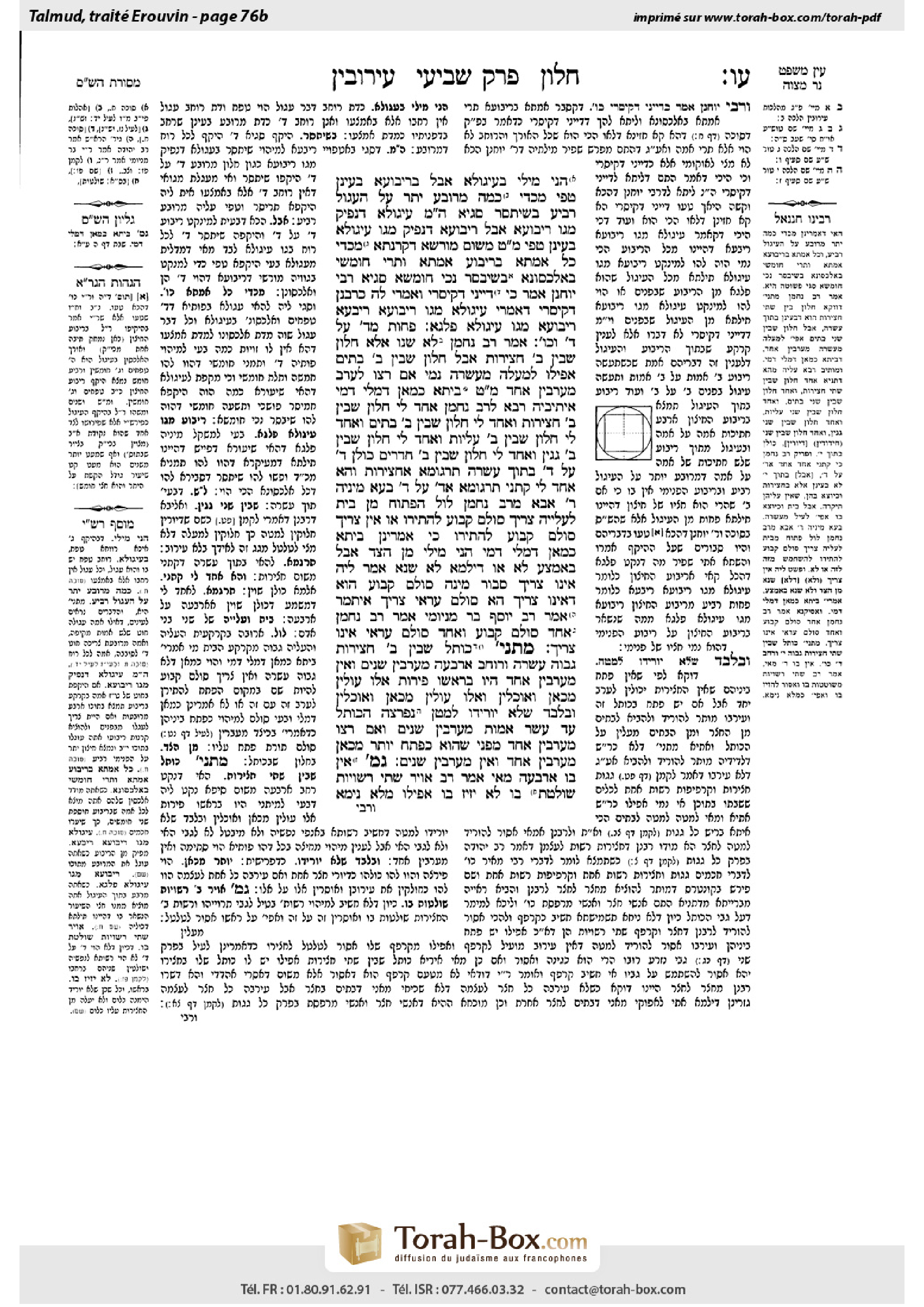
This page of Eruvin includes the Aramaic text, an English translation and an AI-generated French translation, alongside the scan above.
עירובין ע״ו ב · Aramaic and Hebrew text
הָנֵי מִילֵּי בְּעִיגּוּלָא, אֲבָל בְּרִיבּוּעָא בָּעִינַן טְפֵי.
מִכְּדֵי, כַּמָּה מְרוּבָּע יָתֵר עַל הֶעָגוֹל — רְבִיעַ, בְּשִׁיתְסַר סַגִּיא!
הָנֵי מִילֵּי עִיגּוּלָא דְּנָפֵיק מִגּוֹ רִיבּוּעָא. אֲבָל רִיבּוּעָא דְּנָפֵיק מִגּוֹ עִיגּוּלָא, בָּעִינַן טְפֵי. מַאי טַעְמָא? מִשּׁוּם מוּרְשָׁא דְקַרְנָתָא.
מִכְּדֵי, כׇּל אַמְּתָא בְּרִיבּוּעַ — אַמְּתָא וּתְרֵי חוּמְּשֵׁי בַּאֲלַכְסוֹנָא, בְּשֵׁיבְסַר נְכֵי חוּמְשָׁא סַגִּיא.
רַבִּי יוֹחָנָן אָמַר כִּי דַּיָּינֵי דְקֵיסָרִי, וְאָמְרִי לַהּ כְּרַבָּנַן דְקֵיסָרִי, דְּאָמְרִי: עִיגּוּלָא מִגּוֹ רִיבּוּעָא — רִיבְעָא, רִיבּוּעָא מִגּוֹ עִיגּוּלָא — פַּלְגָא.
פָּחוֹת מֵאַרְבָּעָה עַל אַרְבָּעָה וְכוּ׳. אָמַר רַב נַחְמָן: לֹא שָׁנוּ אֶלָּא חַלּוֹן שֶׁבֵּין שְׁתֵּי חֲצֵירוֹת, אֲבָל חַלּוֹן שֶׁבֵּין שְׁנֵי בָתִּים אֲפִילּוּ לְמַעְלָה מֵעֲשָׂרָה נָמֵי, אִם רָצוּ לְעָרֵב — מְעָרְבִין אֶחָד. מַאי טַעְמָא? בֵּיתָא כְּמַאן דִּמְלֵי דָּמֵי.
אֵיתִיבֵיהּ רָבָא לְרַב נַחְמָן: אֶחָד לִי חַלּוֹן שֶׁבֵּין שְׁתֵּי חֲצֵירוֹת, וְאֶחָד לִי חַלּוֹן שֶׁבֵּין שְׁנֵי בָתִּים, וְאֶחָד לִי חַלּוֹן שֶׁבֵּין שְׁתֵּי עֲלִיּוֹת, וְאֶחָד לִי חַלּוֹן שֶׁבֵּין שְׁנֵי גַגִּין, וְאֶחָד לִי חַלּוֹן שֶׁבֵּין שְׁנֵי חֲדָרִים — כּוּלָּן אַרְבָּעָה עַל אַרְבָּעָה בְּתוֹךְ עֲשָׂרָה!
תַּרְגּוּמָא אַחֲצֵירוֹת. וְהָא ״אֶחָד לִי״ קָתָנֵי! תַּרְגּוּמָא אַאַרְבָּעָה עַל אַרְבָּעָה.
בְּעָא מִינֵּיהּ רַבִּי אַבָּא מֵרַב נַחְמָן: לוּל הַפָּתוּחַ מִן בַּיִת לַעֲלִיָּיה, צָרִיךְ סוּלָּם קָבוּעַ לְהַתִּירוֹ אוֹ אֵין צָרִיךְ סוּלָּם קָבוּעַ לְהַתִּירוֹ?
כִּי אָמְרִינַן בֵּיתָא כְּמַאן דִּמְלֵי דָּמֵי — הָנֵי מִילֵּי מִן הַצַּד, אֲבָל בָּאֶמְצַע — לָא, אוֹ דִילְמָא לָא שְׁנָא?
אֲמַר לֵיהּ: אֵינוֹ צָרִיךְ. סְבוּר מִינָּה: סוּלָּם קָבוּעַ הוּא דְּאֵינוֹ צָרִיךְ, הָא סוּלָּם עֲרַאי — צָרִיךְ. אִיתְּמַר, אָמַר רַב יוֹסֵף בַּר מִנְיוֹמֵי אָמַר רַב נַחְמָן: אֶחָד סוּלָּם קָבוּעַ וְאֶחָד סוּלָּם עֲרַאי — אֵינוֹ צָרִיךְ.
מַתְנִי׳ כּוֹתֶל שֶׁבֵּין שְׁתֵּי חֲצֵירוֹת, גָּבוֹהַּ עֲשָׂרָה וְרוֹחַב אַרְבָּעָה — מְעָרְבִין שְׁנַיִם, וְאֵין מְעָרְבִין אֶחָד.
הָיוּ בְּרֹאשׁוֹ פֵּירוֹת — אֵלּוּ עוֹלִין מִכָּאן וְאוֹכְלִין, וְאֵלּוּ עוֹלִין מִכָּאן וְאוֹכְלִין, וּבִלְבַד שֶׁלֹּא יוֹרִידוּ לְמַטָּן.
נִפְרְצָה הַכּוֹתֶל, עַד עֶשֶׂר אַמּוֹת — מְעָרְבִין שְׁנַיִם, וְאִם רָצוּ מְעָרְבִין אֶחָד, מִפְּנֵי שֶׁהוּא כְּפֶתַח. יוֹתֵר מִכָּאן — מְעָרְבִין אֶחָד וְאֵין מְעָרְבִין שְׁנַיִם.
גְּמָ׳ אֵין בּוֹ אַרְבָּעָה מַאי? אָמַר רַב: אֲוִיר שְׁתֵּי רְשׁוּיוֹת שׁוֹלֶטֶת בּוֹ, לֹא יָזִיז בּוֹ אֲפִילּוּ מְלֹא נִימָא.
Eruvin 76b · English translation
This measurement applies only to a circle and the ratio between its circumference and diameter, but with regard to a square that must fit entirely within that circle, we require a circle with a larger circumference. In order for a square of four by four handbreadths to be entirely contained within a circle, the circumference of the circle must measure more than twelve handbreadths
The Gemara asks: Now, how much larger is a square than a circle? It is larger by one quarter. If so, a circle with a circumference of sixteen handbreadths at most should suffice.
The Gemara answers: This statement that a square is larger than a circle by a quarter applies only to a circle circumscribed by a square, but with regard to a square circumscribed by a circle, we require more, and the difference between the square and the circle is greater. What is the reason for this? It is due to the projection of the corners of the square, as the distance from the center of the square to its corners is greater than the distance from the center to its sides.
The Gemara further objects: Since every cubit in the side of a square is a cubit and two-fifths in the diagonal, a square of four by four handbreadths has a diagonal of five and three-fifths handbreadths. And since the diameter of a circle equals the diagonal of the square that it encompasses, the circle circumscribing a square of four by four handbreadths has a diameter of five and three-fifths handbreadths. If that measure is multiplied by three to arrive at the circumference of that circle, the result is that a circle with a circumference of seventeen handbreadths minus a fifth is sufficient to circumscribe a square of four by four handbreadths. Why, then, does Rabbi Yoḥanan say that a circular window must have a circumference of twenty-four handbreadths?
The Gemara answers: Rabbi Yoḥanan spoke in accordance with the opinion of the judges of Caesarea, and some say in accordance with the opinion of the Sages of Caesarea, who say: A circle that is circumscribed within a square is smaller than it by one quarter; with regard to a square that is circumscribed within a circle, the difference between them is equal to half the square. According to this explanation, Rabbi Yoḥanan calculated as follows: Since a square of four by four handbreadths has a perimeter of sixteen handbreadths, the circumference of the circle that encompasses it must be fifty percent larger, or twenty-four handbreadths.
It was taught in the mishna: If a window is less than four by four handbreadths, or if it is above ten handbreadths from the ground, the residents of the two courtyards may not establish one joint eiruv but must instead establish two independent ones. Rav Naḥman said: They taught this halakha of a window within ten handbreadths of the ground only with regard to a window between two courtyards. But with regard to a window between two houses, even if it is above ten handbreadths as well, if they wish to establish an eiruv, they establish one eiruv. What is the reason for this halakha? It is that a house is considered as though it were filled, and therefore there is no difference between below and above ten handbreadths with regard to a window in a house.
Rava raised an objection to the opinion of Rav Naḥman from that which was taught in a baraita: A window between two courtyards, and a window between two houses, and a window between two attics, and a window between two roofs, and a window between two rooms are all one and the same to me; they all must be four by four handbreadths and within ten handbreadths from the ground. This directly contradicts Rav Naḥman’s opinion.
The Gemara answers: Explain that this halakha of ten handbreadths mentioned in the baraita is referring only to courtyards. The Gemara objects: Doesn’t the baraita teach: Are all one and the same to me, indicating that they are all equal in this regard? Rather, explain that they are all equal in that the window must be the size of four by four handbreadths, but not that all must be within ten handbreadths of the ground.
Rabbi Abba raised a dilemma before Rav Naḥman: With regard to an aperture that opens from the ceiling of a house occupied by one person to an attic occupied by another, must a permanent ladder be positioned in the opening to render carrying from one level to the other permitted by turning the two into a single residence? Or, is a permanent ladder not necessary to render it permitted?
The Gemara clarifies the two sides of the question: When we say that a house is considered as though it were filled, does this apply only to a window positioned on the side, but not to a window in the middle? In that case, the opening would not be viewed as near the full part of the house, and a permanent ladder would be required. Or perhaps there is no difference, and since the house is considered filled, no ladder is necessary.
Rav Naḥman said to him: It is not necessary. The Sages understood from this response that he meant that a permanent ladder is not required, but a temporary ladder is required. However, it is stated in this regard: Rav Yosef bar Manyumi said that Rav Naḥman said: Neither a permanent ladder nor a temporary ladder is required, as the fact that the opening is located within the house is sufficient to render it permitted to carry from the house to the attic.
MISHNA: If a wall between two courtyards is ten handbreadths high and four handbreadths wide, the residents of the courtyard establish two eiruvin, a separate one for each courtyard, but they may not establish one eiruv.
If there was produce on top of the wall, these residents of one courtyard may ascend from this side and eat from it, and those residents of the other courtyard may ascend from that side and eat from it, provided that they do not lower the produce down from on top of the wall to one of the courtyards.
If the wall was breached, the following distinction applies: If the breach was up to ten cubits wide, they establish two eiruvin, and if they desire, they may establish one eiruv, as it is similar to an entrance, like any opening less than ten cubits wide. If the breach was more than this, they establish one eiruv, and they may not establish two, as a breach of this size nullifies the partition and joins the two courtyards into a single domain.
GEMARA: The Gemara asks: If this wall is not four handbreadths in width, what is the halakha? Rav said: In this case, the air of two domains controls it. Since the wall is not broad enough to be regarded a domain of its own, the top of the wall is seen as belonging to both courtyards and is then prohibited to both of them. Accordingly, one may not move anything on top of the wall, even as much as a hair’s breadth.
Eruvin 76b · Traduction française (IA)
Cette mesure s'applique uniquement à un cercle et au rapport entre son périmètre et son diamètre, mais concernant un carré qui doit être entièrement contenu dans ce cercle, nous exigeons un cercle dont le périmètre est plus grand. Afin qu'un carré de quatre par quatre tefachim soit entièrement contenu dans un cercle, le périmètre de ce cercle doit mesurer plus de douze tefachim.
La Guemara pose la question : Maintenant, de combien un carré est-il plus grand qu'un cercle ? Il est plus grand d'un quart. Si c'est le cas, un cercle dont le périmètre mesure seize tefachim au plus devrait suffire.
La Guemara répond : Cette affirmation selon laquelle un carré est plus grand qu'un cercle d'un quart s'applique uniquement à un cercle circonscrit à un carré, mais concernant un carré circonscrit à un cercle, nous exigeons davantage, et la différence entre le carré et le cercle est plus grande. Quelle est la raison de cela ? C'est dû à la projection des angles du carré, car la distance du centre du carré à ses angles est supérieure à la distance du centre à ses côtés.
La Guemara soulève une autre objection : Puisque chaque coudée du côté d'un carré est une coudée et deux cinquièmes dans la diagonale, un carré de quatre par quatre tefachim a une diagonale de cinq et trois cinquièmes tefachim. Et puisque le diamètre d'un cercle est égal à la diagonale du carré qu'il contient, le cercle circonscrit à un carré de quatre par quatre tefachim a un diamètre de cinq et trois cinquièmes tefachim. Si ce diamètre est multiplié par trois pour obtenir le périmètre de ce cercle, le résultat est que un cercle dont le périmètre mesure dix-sept tefachim moins un cinquième suffit à circonscire un carré de quatre par quatre tefachim. Pourquoi, alors, Rabbi Yoḥanan dit-il qu'une fenêtre circulaire doit avoir un périmètre de vingt-quatre tefachim ?
La Guemara répond : Rabbi Yoḥanan a parlé selon l'opinion des juges de Caesarea, et certains disent selon l'opinion des Sages de Caesarea, qui disent : Un cercle circonscrit à un carré est plus petit que ce dernier d'un quart ; concernant un carré circonscrit à un cercle, la différence entre eux est égale à la moitié du carré. Selon cette explication, Rabbi Yoḥanan a calculé ainsi : Puisque un carré de quatre par quatre tefachim a un périmètre de seize tefachim, le périmètre du cercle qui le contient doit être cinquante pour cent plus grand, soit vingt-quatre tefachim.
Il a été enseigné dans la Michna : Si une fenêtre est inférieure à quatre par quatre tefachim, ou si elle est située à plus de dix tefachim du sol, les habitants des deux courtyards ne peuvent pas établir un seul eiruv, mais doivent plutôt établir deux eiruvin indépendants. Rav Naḥman a dit : Ils ont enseigné cette halakha concernant une fenêtre à dix tefachim du sol uniquement concernant une fenêtre entre deux courtyards. Mais concernant une fenêtre entre deux maisons, même si elle est située à plus de dix tefachim du sol, si ils souhaitent établir un eiruv, ils établissent un seul eiruv. Quelle est la raison de cette halakha ? C'est que la maison est considérée comme remplie, et par conséquent, il n'y a pas de différence entre en dessous et au-dessus de dix tefachim concernant une fenêtre dans une maison.
Rava a soulevé une objection contre l'opinion de Rav Naḥman à partir de ce qui a été enseigné dans une baraïta : Une fenêtre entre deux courtyards, et une fenêtre entre deux maisons, et une fenêtre entre deux greniers, et une fenêtre entre deux toits, et une fenêtre entre deux pièces sont toutes identiques pour moi ; elles doivent toutes mesurer quatre par quatre tefachim et être situées à dix tefachim du sol. Cela contredit directement l'opinion de Rav Naḥman.
La Guemara répond : Expliquez que cette halakha des dix tefachim mentionnée dans la baraïta se réfère uniquement aux courtyards. La Guemara soulève une objection : N'est-ce pas que la baraïta enseigne : Toutes sont identiques pour moi, indiquant qu'elles sont toutes égales en ce sens ? Plutôt, expliquez qu'elles sont toutes égales en ce sens que la fenêtre doit mesurer quatre par quatre tefachim, mais pas que toutes doivent être situées à dix tefachim du sol.
Rabbi Abba posa un dilemme devant Rav Naḥman : Concernant une ouverture qui s'ouvre du plafond d'une maison occupée par une personne à un grenier occupé par une autre, doit-on placer une échelle permanente dans l'ouverture afin de rendre permis de transporter de l'un à l'autre ? Ou, est-ce que l'échelle permanente n'est pas nécessaire pour rendre cela permis ?
La Guemara clarifie les deux côtés de la question : Lorsque nous disons qu'une maison est considérée comme remplie, cela s'applique-t-il uniquement à une fenêtre située sur le côté, mais pas à une fenêtre au milieu ? Dans ce cas, l'ouverture ne serait pas vue comme proche de la partie pleine de la maison, et une échelle permanente serait nécessaire. Ou peut-être qu'il n'y a pas de différence, et puisque la maison est considérée comme remplie, aucune échelle n'est nécessaire.
Rav Naḥman a dit à lui : Ce n'est pas nécessaire. Les Sages ont compris de cette réponse qu'il voulait dire que l'échelle permanente n'est pas nécessaire, mais l'échelle temporaire l'est. Cependant, il est dit à ce sujet : Rav Yosef bar Manyumi a dit que Rav Naḥman a dit : Ni l'échelle permanente ni l'échelle temporaire n'ont besoin d'être placées, car le fait que l'ouverture soit située dans la maison suffit à rendre permis de transporter de la maison au grenier.
MICHNA : Si un mur entre deux courtyards est haut de dix tefachim et large de quatre tefachim, les habitants des courtyards établissent deux eiruvin, un séparé pour chaque courtyard, mais ils ne peuvent pas établir un seul eiruv.
Si des produits sont situés sur le mur, les habitants d'un courtyard peuvent monter de ce côté et manger de ceux-ci, et ceux du autre courtyard peuvent monter de l'autre côté et manger de ceux-ci, à condition qu'ils ne descendent pas les produits du mur vers l'un des courtyards.
Si le mur était percé, la distinction suivante s'applique : Si la brèche était d'une largeur de dix coudées, ils établissent deux eiruvin, et s'ils le souhaitent, ils peuvent établir un seul eiruv, car cela ressemble à une entrée, comme tout ouverture de moins de dix coudées de largeur. Si la brèche était plus grande que cela, ils établissent un seul eiruv, et ils ne peuvent pas établir deux, car une brèche de cette taille annule la séparation et unit les deux courtyards en un seul domaine.
GUEMARA : La Guemara pose la question : Si ce mur n'est pas d'une largeur de quatre tefachim, quelle est la halakha ? Rav dit : Dans ce cas, l'air des deux domaines le contrôle. Puisque le mur n'est pas suffisamment large pour être considéré comme un domaine à part, le sommet du mur est vu comme appartenant aux deux courtyards et est donc interdit aux deux. Ainsi, on ne peut pas déplacer quoi que ce soit sur le sommet du mur, même d'une épaisseur de cheveu.
Traduction française générée par IA à partir de l’édition anglaise de Sefaria. Vérifie toujours un passage avec le texte source.
Text from Sefaria: William Davidson Edition - Vocalized Aramaic (CC BY NC); William Davidson Edition - English (CC BY NC).