Eruvin 77a: Talmud study for Daf Yomi
Study the Talmud for Daf Yomi with scanned pages, Hebrew text, English translations from Sefaria and AI-generated French translations.
Passage selection and English or AI-generated French translation are available where the scan has annotations. Daf Study is independent of Torah-Box and Sefaria.
Browse Eruvin · עירובין · All tractatesEruvin 77a text and translations
This page of Eruvin includes the Aramaic text, an English translation and an AI-generated French translation, alongside the scan above.
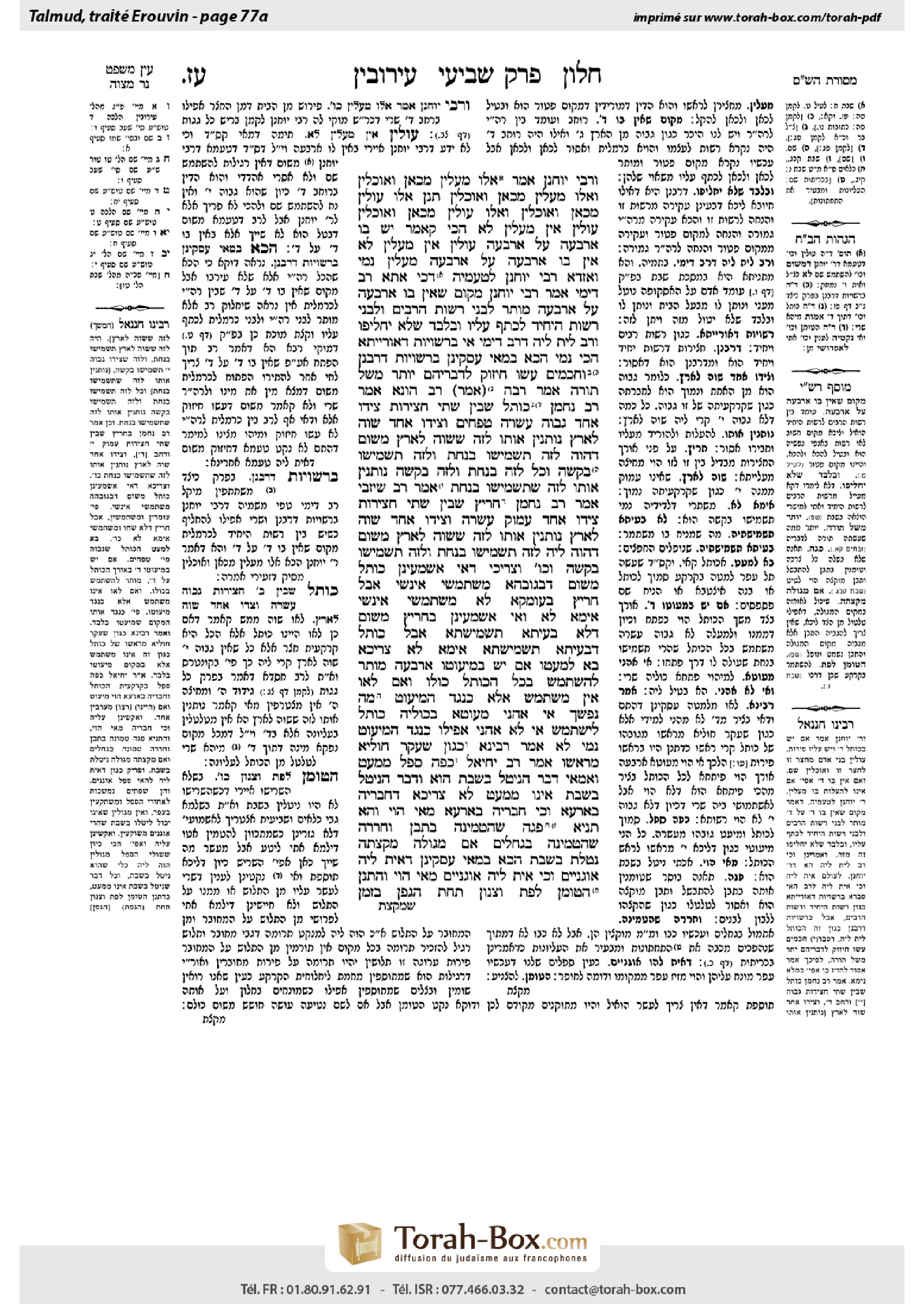
עירובין ע״ז א · Aramaic and Hebrew text
וְרַבִּי יוֹחָנָן אָמַר: אֵלּוּ מַעֲלִין מִכָּאן וְאוֹכְלִין, וְאֵלּוּ מַעֲלִין מִכָּאן וְאוֹכְלִין.
תְּנַן: אֵלּוּ עוֹלִין מִכָּאן וְאוֹכְלִין, וְאֵלּוּ עוֹלִין מִכָּאן וְאוֹכְלִין. עוֹלִין — אִין, מַעֲלִין — לָא.
הָכִי קָאָמַר: יֵשׁ בּוֹ אַרְבָּעָה עַל אַרְבָּעָה, עוֹלִין — אִין, מַעֲלִין — לָא. אֵין בּוֹ אַרְבָּעָה עַל אַרְבָּעָה — מַעֲלִין נָמֵי.
וְאַזְדָּא רַבִּי יוֹחָנָן לְטַעְמֵיהּ, דְּכִי אֲתָא רַב דִּימִי אָמַר רַבִּי יוֹחָנָן: מָקוֹם שֶׁאֵין בּוֹ אַרְבָּעָה עַל אַרְבָּעָה — מוּתָּר לִבְנֵי רְשׁוּת הָרַבִּים וְלִבְנֵי רְשׁוּת הַיָּחִיד לְכַתֵּף עָלָיו, וּבִלְבַד שֶׁלֹּא יַחֲלִיפוּ.
וְרַב לֵית לֵיהּ דְּרַב דִּימִי? אִי בִּרְשׁוּיוֹת דְּאוֹרָיְיתָא — הָכִי נָמֵי.
הָכָא בְּמַאי עָסְקִינַן — בִּרְשׁוּיוֹת דְּרַבָּנַן. וַחֲכָמִים עָשׂוּ חִיזּוּק לְדִבְרֵיהֶם יוֹתֵר מִשֶּׁל תּוֹרָה.
אָמַר רַבָּה (אָמַר) רַב הוּנָא אָמַר רַב נַחְמָן: כּוֹתֶל שֶׁבֵּין שְׁתֵּי חֲצֵירוֹת, צִידּוֹ אֶחָד גָּבוֹהַּ עֲשָׂרָה טְפָחִים וְצִידּוֹ אֶחָד שָׁוֶה לָאָרֶץ — נוֹתְנִין אוֹתוֹ לָזֶה שֶׁשָּׁוֶה לָאָרֶץ.
מִשּׁוּם דְּהָוֵה לָזֶה תַּשְׁמִישׁוֹ בְּנַחַת וְלָזֶה תַּשְׁמִישׁוֹ בְּקָשֶׁה. וְכׇל לָזֶה בְּנַחַת וְלָזֶה בְּקָשֶׁה — נוֹתְנִין אוֹתוֹ לָזֶה שֶׁתַּשְׁמִישׁוֹ בְּנַחַת.
אָמַר רַב שֵׁיזְבִי אָמַר רַב נַחְמָן: חָרִיץ שֶׁבֵּין שְׁתֵּי חֲצֵירוֹת, צִידּוֹ אֶחָד עָמוֹק עֲשָׂרָה וְצִידּוֹ אֶחָד שָׁוֶה לָאָרֶץ — נוֹתְנִין אוֹתוֹ לָזֶה שֶׁשָּׁוֶה לָאָרֶץ, מִשּׁוּם דְּהָוֵה לֵיהּ לָזֶה תַּשְׁמִישׁוֹ בְּנַחַת וְלָזֶה תַּשְׁמִישׁוֹ בְּקָשֶׁה וְכוּ׳.
וּצְרִיכִי. דְּאִי אַשְׁמְעִינַן כּוֹתֶל, מִשּׁוּם דִּבְגוּבְהָא מִשְׁתַּמְּשִׁי אִינָשֵׁי. אֲבָל חָרִיץ, בְּעוּמְקָא לָא מִשְׁתַּמְּשִׁי אִינָשֵׁי — אֵימָא לָא.
וְאִי אַשְׁמְעִינַן בְּחָרִיץ, מִשּׁוּם דְּלָא בְּעִיתָא תַּשְׁמִישְׁתָּא. אֲבָל כּוֹתֶל דִּבְעִיתָא תַּשְׁמִישְׁתָּא — אֵימָא לָא, צְרִיכָא.
בָּא לְמַעֲטוֹ, אִם יֵשׁ בְּמִיעוּטוֹ אַרְבָּעָה — מוּתָּר לְהִשְׁתַּמֵּשׁ בְּכׇל הַכּוֹתֶל כּוּלּוֹ. וְאִם לָאו — אֵין מִשְׁתַּמֵּשׁ אֶלָּא כְּנֶגֶד הַמִּיעוּט.
מָה נַפְשָׁךְ? אִי אַהֲנִי מִעוּטָא — בְּכוּלֵּיהּ כּוֹתֶל לִישְׁתַּמֵּשׁ. אִי לָא אַהֲנִי — אֲפִילּוּ כְּנֶגֶד הַמִּיעוּט נָמֵי לָא. אָמַר רָבִינָא: כְּגוֹן שֶׁעָקַר חוּלְיָא מֵרֹאשׁוֹ.
אָמַר רַב יְחִיאֵל: כָּפָה סֵפֶל — מְמַעֵט.
וְאַמַּאי? דָּבָר הַנִּיטָּל בְּשַׁבָּת הוּא, וְדָבָר הַנִּיטָּל בְּשַׁבָּת אֵינוֹ מְמַעֵט. לָא צְרִיכָא, דְּחַבְּרֵיהּ בְּאַרְעָא.
וְכִי חַבְּרֵיהּ בְּאַרְעָא, מַאי הָוֵי? וְהָא תַּנְיָא: פַּגָּה שֶׁהִטְמִינָהּ בְּתֶבֶן, וַחֲרָרָה שֶׁהִטְמִינָהּ בְּגֶחָלִים, אִם מְגוּלָּה מִקְצָתָהּ — נִטֶּלֶת בְּשַׁבָּת.
הָכָא בְּמַאי עָסְקִינַן, דְּאִית לֵיהּ אוֹגְנַיִים.
וְכִי אִית לֵיהּ אוֹגְנַיִים, מַאי הָוֵי? וְהָתְנַן: הַטּוֹמֵן לֶפֶת וּצְנוֹן תַּחַת הַגֶּפֶן, בִּזְמַן
Eruvin 77a · English translation
And Rabbi Yoḥanan said: These residents of one courtyard may raise food from their courtyard to the top of the wall and eat it there, and they may lower the food from the wall to the courtyard; and those residents of the other courtyard may raise food from their courtyard and eat it there, and they may lower the food from the wall to the courtyard. This is because the wall is considered nonexistent, and its domain is viewed as part of the two courtyards.
We learned in the mishna: If there was produce on top of the wall, these residents of one courtyard may ascend from this side and eat from it, and those residents of the other courtyard may ascend from that side and eat from it. The Gemara infers from this: To ascend, yes, it is permitted, but to raise food from the courtyard to the top of the wall, no, it is not permitted. This presents a challenge to Rabbi Yoḥanan’s opinion.
The Gemara answers that this is what the mishna is saying: If the top of the wall between the two courtyards is four by four handbreadths, then to ascend, yes, it is permitted. However, to raise food, no, it is prohibited, because in that case the top of the wall is considered a domain in its own right. But if it is not four by four handbreadths, it is an exempt domain, and therefore they may raise their food onto the wall as well.
And Rabbi Yoḥanan followed his line of reasoning in this regard, as when Rav Dimi came from Eretz Yisrael to Babylonia, he said that Rabbi Yoḥanan said: With regard to a place that does not have an area of four by four handbreadths and is situated between a public and a private domain, it is permissible for both the people in the public domain and for the people in the private domain to adjust the burden on their shoulders upon it, provided they do not exchange objects between them from one domain to the other domain. This demonstrates that in the case of an exempt domain, Rabbi Yoḥanan was not concerned that one might carry from one domain to another, and permitted members of both domains to use it.
The Gemara asks: And does Rav, who prohibits carrying in that case even as much as a hair’s breadth, not accept the opinion of Rav Dimi in this matter? The Gemara answers: If this referred to an exempt domain situated between two domains by Torah law, i.e., between a public and a private domain, so too, Rav would agree that the members of both domains may adjust their burdens there.
However, with what are we dealing here, in the case of the wall? We are dealing with domains by rabbinic law, and the Sages reinforced their statements even more than those of the Torah. Due to their severity, Torah laws are generally observed. Therefore, there is no need to impose decrees and enactments in order to preserve them. The same is not true of rabbinic decrees; if people ignore the preventive measures, they might come to violate the entire enactment.
Rabba said that Rav Huna said that Rav Naḥman said: With regard to a wall that is between two courtyards, and one side facing one courtyard is ten handbreadths high, and the other side is level with the ground of the second courtyard, i.e., the second courtyard is built on a higher plane, so that the wall is less than ten handbreadths above its floor, in this case the Sages grant the use of the top of the wall on Shabbat only to the courtyard in which the wall is level with the ground.
The reason is because the use of the wall is convenient for one side, i.e., the higher courtyard, but difficult for the other side. The wall can be used more conveniently by the residents of the higher courtyard. And the principle is that in any case with regard to Shabbat where an action is convenient for one party and difficult for another, the Sages grant it to the one for whom its use is convenient.
Similarly, Rav Sheizvi said that Rav Naḥman said: In the case of a ditch between two courtyards, one side of which is ten handbreadths deep, and the other side of which is level with the ground of the second courtyard, i.e., is less than ten handbreadths below it, the Sages grant the use of the ditch to the courtyard in which the ditch is level with the ground. This is because it is a case in which the use of the ditch is convenient for one side, where it is close to level with the ground, and difficult for the other, where the ditch is ten handbreadths deep, and whenever use of an item is convenient for one party and inconvenient for another, it is granted to the one for whom it is convenient.
The Gemara comments: And it was necessary to cite both of these cases, as it would not have been possible to learn one from the other, since, had Rav Naḥman taught us only the case with regard to a wall, one could have said that the halakha applies only in that case, because people use an elevated surface. Even for the residents of the lower courtyard, it is relatively easy to use this wall. However, with regard to a ditch, people do not use a deep surface, as it is troublesome to bend down and place an item in a ditch. In that case, one might say that it may not be used by the residents of either courtyard.
And likewise, had he taught us only the case with regard to a ditch, one could have said that the halakha applies only in that case, because its use does not cause worry, as anything placed in the ditch is protected. However, with regard to a wall, the use of which causes worry that the objects placed there are liable to fall, one might say that it may not be used by the residents of either courtyard. Therefore, it was necessary to state both of these rulings.
With regard to a wall between two courtyards, the Gemara states: If one comes to diminish the height of the wall by placing a stone next to it, or by building a platform in order to permit its use or to utilize it as a passageway to another courtyard, the following distinction applies: If the diminished section is at least four handbreadths wide, it is permitted to use the entire wall. This area has the status of an entrance and the two courtyards are considered one, which renders the entire wall permitted. However, if the diminished section is not at least four handbreadths wide, one may use only the area of the wall opposite the diminished section, but no more.
The Gemara challenges this ruling: Whichever way you look at it, this ruling is difficult. If the diminishing was effective, although it extends less than four handbreadths, let him use the entire wall; and if the diminishing was not effective, even the area corresponding to the diminished section should also not be permitted for use, as this section is insignificant. Ravina said: Here, it refers to a case where one removed a segment of stone from the top of the wall. Since the wall is actually less than ten handbreadths high along that section, it is fit for use as is an opening in the wall.
Rav Yeḥiel said: If one overturned a basin and placed it next to a wall, such that the wall is no longer ten handbreadths high, it effectively diminishes the height of the wall.
The Gemara asks: And why should this be so? Isn’t this basin an item that may be moved on Shabbat, i.e., something that one is permitted to handle? And the principle is that an item that may be moved on Shabbat does not diminish a wall. Since it can be removed at any moment on Shabbat, such an object cannot be viewed as a permanent part of the wall. The Gemara answers: No, it is necessary; this basin can be considered a permanent part of the wall in a case where he attached the basin to the ground by covering it with soil. The basin may then not be moved on Shabbat due to the prohibition of handling soil.
The Gemara challenges this explanation: And if one attached the basin to the ground, what of it? Wasn’t it taught in a baraita: With regard to an unripe fig that one buried in straw intended for kindling, so that it would ripen, or a cake that one buried in coals before Shabbat, and the coals were extinguished, if part of either one is visible, it may be moved on Shabbat. This is not prohibited, although as a result one will move the straw or the coals, which are set aside.
The Gemara explains: With what are we dealing here? We are dealing with a case where the top of the basin has a rim that is fully buried in the ground, so that removing the basin will dislodge the earth under which it is buried in a manner similar to digging, which is prohibited on Shabbat.
The Gemara further challenges this explanation: And if the basin has a rim, what of it? Didn’t we learn in a mishna: With regard to one who buries a turnip or a radish in the ground beneath a vine for safekeeping, when
Eruvin 77a · Traduction française (IA)
Et le maître Rabbi Yoḥanan a dit : Ces résidents d'un même courtil peuvent transporter des aliments de leur courtil jusqu'en haut du mur et manger là, et peuvent aussi descendre les aliments du mur jusqu'au courtil ; et ceux des autres courtils peuvent transporter des aliments de leur courtil et manger là, et peuvent aussi descendre les aliments du mur jusqu'au courtil. Cela est ainsi parce que le mur est considéré comme inexistant, et son domaine est vu comme faisant partie des deux courtils.
Nous avons appris dans la mitsna : Si des produits étaient sur le sommet du mur, ces résidents d'un même courtil peuvent monter de ce côté et manger de là, et ceux des autres courtils peuvent monter de l'autre côté et manger de là. La Guemara en déduit : Monter, oui, c'est permis, mais transporter des aliments du courtil jusqu'en haut du mur, non, c'est interdit. Cela présente un défi à l'opinion de Rabbi Yoḥanan.
La Guemara répond que c'est ce que la mitsna dit : Si la partie supérieure du mur entre les deux courtils est de quatre par quatre tefachim, alors monter, oui, c'est permis. Cependant, transporter des aliments, non, c'est interdit, car dans ce cas la partie supérieure du mur est considérée comme un domaine à part. Mais si elle n'est pas de quatre par quatre tefachim, c'est un domaine exempt, et par conséquent ils peuvent transporter leurs aliments sur le mur.
Et Rabbi Yoḥanan a suivi cette ligne de raisonnement, comme lorsque Rav Dimi est venu de la Terre d'Israël en Babylone, il a dit que Rabbi Yoḥanan a dit : En ce qui concerne un lieu qui n'a pas une surface de quatre par quatre tefachim et qui est situé entre un domaine public et un domaine privé, il est permis aux gens du domaine public et aux gens du domaine privé d'ajuster leur fardeau sur lui, à condition qu'ils ne transmettent pas d'objets d'un domaine à l'autre. Cela montre que, dans le cas d'un domaine exempt, Rabbi Yoḥanan ne s'inquiétait pas que l'on transporte d'un domaine à l'autre, et permettait à tous les membres des deux domaines d'en utiliser.
La Guemara demande : Et Rav, qui interdit le transport même d'une longueur de cheveu dans ce cas, ne ne pas accepter l'opinion de Rav Dimi en ce domaine ? La Guemara répond : Si cela concernait un domaine exempt situé entre deux domaines selon la Loi divine, c'est-à-dire entre un domaine public et un domaine privé, Rav aurait aussi accepté que les membres des deux domaines puissent y ajuster leur fardeau.
Cependant, avec quoi sommes-nous en train de nous occuper ici, dans le cas du mur ? Nous sommes en train de nous occuper de domaines selon la Loi rabbinique, et les Sages ont renforcé leurs déclarations même davantage que celles de la Torah. En raison de leur sévérité, les lois de la Torah sont généralement observées. Par conséquent, il n'y a pas besoin d'imposer des décréts et des édicules pour les préserver. Ce n'est pas le cas des décrets rabbiniques ; si les gens négligent les mesures préventives, ils pourraient finir par enfreindre l'ensemble de l'édit.
Rabba a dit que Rav Huna a dit que Rav Naḥman a dit : En ce qui concerne un mur entre deux courtils, et un côté fait face à un courtil à dix tefachim de haut, et l'autre côté est au niveau du sol du second courtil, c'est-à-dire que le second courtil est construit sur un plan plus élevé, de sorte que le mur est inférieur de dix tefachim à son sol, dans ce cas les Sages accordent l'utilisation du sommet du mur le sabbat uniquement au courtil dans lequel le mur est au niveau du sol.
La raison est que l'utilisation du mur est pratique pour un côté, c'est-à-dire le courtil supérieur, mais difficile pour l'autre côté. Le mur peut être utilisé plus facilement par les résidents du courtil supérieur. Et le principe est que, dans tout cas concernant le sabbat où une action est pratique pour une partie et difficile pour une autre, les Sages l'accordent à celui pour qui son utilisation est pratique.
De même, Rav Sheizvi a dit que Rav Naḥman a dit : En ce qui concerne un fossé entre deux courtils, un côté duquel est de dix tefachim de profondeur, et l'autre côté duquel est au niveau du sol du second courtil, c'est-à-dire inférieur de dix tefachim, les Sages accordent l'utilisation du fossé au courtil dans lequel le fossé est au niveau du sol. Cela est ainsi parce que c'est un cas où l'utilisation du fossé est pratique pour un côté, où il est proche du niveau du sol, et difficile pour l'autre, où le fossé est de dix tefachim de profondeur, et chaque fois que l'utilisation d'un objet est pratique pour une partie et inconfortable pour une autre, elle est accordée à celui pour qui elle est pratique.
La Guemara commente : Il était nécessaire de citer ces deux cas, car il n'aurait pas été possible d'apprendre l'un de l'autre. Car, si Rav Naḥman avait enseigné seulement le cas du mur, on aurait pu dire que la halakha s'applique uniquement à ce cas, car les gens utilisent une surface élevée. Même pour les résidents du courtil inférieur, il est relativement facile d'utiliser ce mur. Cependant, en ce qui concerne un fossé, les gens n'utilisent pas une surface profonde, car c'est pénible de se baisser et de placer un objet dans un fossé. Dans ce cas, on pourrait dire qu'il ne peut pas être utilisé par les résidents des deux courtils.
De même, si on avait enseigné seulement le cas du fossé, on aurait pu dire que la halakha s'applique uniquement à ce cas, car son utilisation ne cause pas d'inquiétude, car tout ce qui est placé dans le fossé est protégé. Cependant, en ce qui concerne un mur, l'utilisation duquel cause une inquiétude que les objets placés là puissent tomber, on pourrait dire qu'il ne peut pas être utilisé par les résidents des deux courtils. Par conséquent, il était nécessaire d'énoncer ces deux décisions.
Concernant un mur entre deux courtyards, la Guemara indique : Si l'on vient diminuer la hauteur du mur en plaçant une pierre à côté ou en construisant une plateforme afin de permettre son utilisation ou de l'utiliser comme passage vers un autre courtyard, la distinction suivante s'applique : Si la section diminuée est d'au moins quatre tefachim de large, on peut utiliser l'ensemble du mur. Cette zone a le statut d'une entrée et les deux courtyards sont considérés comme un seul, ce qui rend l'ensemble du mur permis. Cependant, si la section diminuée n'est pas d'au moins quatre tefachim de large, on peut utiliser uniquement la partie du mur opposée à la section diminuée, mais pas davantage.
La Guemara remet en question cette décision : Quel que soit le point de vue, cette décision est difficile. Si la diminution a eu effet, même si elle est inférieure à quatre tefachim, qu'on utilise l'ensemble du mur ; et si la diminution n'a pas eu effet, même la section correspondante ne devrait pas être permise, car cette section est insignifiante. Ravina a dit : Ici, il s'agit d'un cas où l'on a retiré un segment de pierre du haut du mur. Puisque le mur est effectivement inférieur à dix tefachim de haut sur cette section, il est considéré comme une ouverture dans le mur.
Rav Yéhiel a dit : Si l'on renverse un bassin et l'on le place à côté d'un mur, de sorte que le mur n'est plus dix tefachim de haut, cela diminue effectivement la hauteur du mur.
Le Guemara pose la question : Et pourquoi devrait-ce être ainsi ? N'est-ce pas un objet que l'on peut déplacer le shabbat, c'est-à-dire quelque chose que l'on est autorisé à manipuler ? Et le principe est que les objets que l'on peut déplacer le shabbat ne diminuent pas un mur. Puisque l'on peut les retirer à tout moment le shabbat, tels objets ne peuvent pas être considérés comme faisant partie du mur. Le Guemara répond : Non, il est nécessaire ; ce bassin peut être considéré comme faisant partie du mur dans le cas où l'on a fixé le bassin au sol en le recouvrant de terre. Le bassin peut alors ne pas être déplacé le shabbat en raison de l'interdiction de manipuler la terre.
Le Guemara remet en question cette explication : Et si l'on a fixé le bassin au sol, qu'y a-t-il de particulier ? N'a-t-on pas appris dans une baraïta : Concernant une figue non mûre que l'on a enterrée dans des pailles destinées à l'allumage, afin qu'elle mûrisse, ou un gâteau que l'on a enterré dans des cendres avant le shabbat, et les cendres sont éteintes, si une partie de l'un ou l'autre est visible, on peut le déplacer le shabbat. Cela n'est pas interdit, bien que cela entraîne que l'on déplace les pailles ou les cendres, qui sont mis de côté.
Le Guemara explique : De quoi sommes-nous en train de parler ? Nous parlons d'un cas où le bord du bassin est entièrement enterré dans le sol, de sorte que l'enlèvement du bassin délogera la terre sous lequel il est enterré de manière similaire à l'excavation, qui est interdite le shabbat.
Le Guemara remet en question cette explication encore davantage : Et si le bassin a un bord, qu'y a-t-il de particulier ? N'avons-nous pas appris dans une mitsna : Concernant celui qui enterré une navette ou un radis dans le sol sous une vigne pour la garder en sécurité, lors
Traduction française générée par IA à partir de l’édition anglaise de Sefaria. Vérifie toujours un passage avec le texte source.
Text from Sefaria: William Davidson Edition - Vocalized Aramaic (CC BY NC); William Davidson Edition - English (CC BY NC).