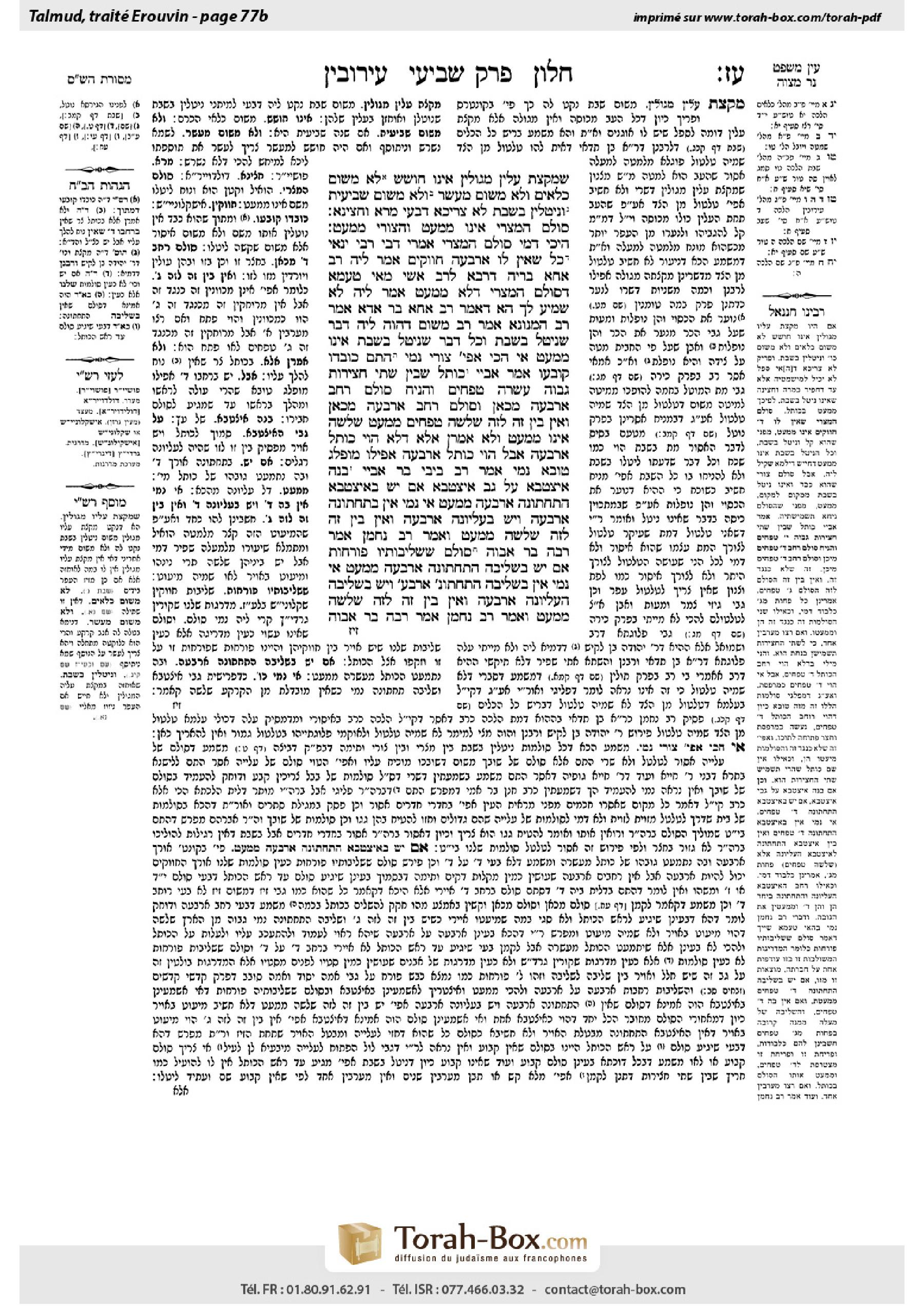
Eruvin 77b: Talmud study for Daf Yomi
Study the Talmud for Daf Yomi with scanned pages, Hebrew text, English translations from Sefaria and AI-generated French translations.
Passage selection and English or AI-generated French translation are available where the scan has annotations. Daf Study is independent of Torah-Box and Sefaria.
Browse Eruvin · עירובין · All tractatesEruvin 77b text and translations
This page of Eruvin includes the Aramaic text, an English translation and an AI-generated French translation, alongside the scan above.
עירובין ע״ז ב · Aramaic and Hebrew text
שֶׁמִּקְצָת עָלִין מְגוּלִּין אֵינוֹ חוֹשֵׁשׁ לֹא מִשּׁוּם כִּלְאַיִם, וְלֹא מִשּׁוּם מַעֲשֵׂר, וְלֹא מִשּׁוּם שְׁבִיעִית, וְנִיטָּלִין בַּשַּׁבָּת!
לָא צְרִיכָא, דְּבָעֵי מָרָא וַחֲצִינָא.
סוּלָּם הַמִּצְרִי אֵינוֹ מְמַעֵט וְהַצּוֹרִי מְמַעֵט. הֵיכִי דָּמֵי סוּלָּם הַמִּצְרִי? אָמְרִי דְּבֵי רַבִּי יַנַּאי: כֹּל שֶׁאֵין לוֹ אַרְבָּעָה חֲווֹקִים.
אֲמַר לֵיהּ רַב אַחָא בְּרֵיהּ דְּרָבָא לְרַב אָשֵׁי: מַאי טַעְמָא דְּסוּלָּם הַמִּצְרִי דְּלָא מְמַעֵט? אֲמַר לֵיהּ: לָא שְׁמִיעַ לָךְ הָא דְּאָמַר רַב אַחָא בַּר אַדָּא אָמַר רַב הַמְנוּנָא אָמַר רַב: מִשּׁוּם דְּהָוֵה לֵיהּ דָּבָר שֶׁנִּיטָּל בְּשַׁבָּת, וְכׇל דָּבָר שֶׁנִּיטָּל בְּשַׁבָּת — אֵינוֹ מְמַעֵט.
אִי הָכִי, אֲפִילּוּ צוֹרִי נָמֵי! הָתָם כּוֹבְדוֹ קוֹבְעוֹ.
אָמַר אַבָּיֵי: כּוֹתֶל שֶׁבֵּין שְׁתֵּי חֲצֵירוֹת גָּבוֹהַּ עֲשָׂרָה טְפָחִים, וְהִנִּיחַ סוּלָּם רָחָב אַרְבָּעָה מִכָּאן וְסוּלַּם רָחָב אַרְבָּעָה מִכָּאן, וְאֵין בֵּין זֶה לָזֶה שְׁלֹשָׁה טְפָחִים — מְמַעֵט. שְׁלֹשָׁה — אֵינוֹ מְמַעֵט.
וְלָא אֲמַרַן אֶלָּא דְּלָא הָוֵי כּוֹתֶל אַרְבָּעָה, אֲבָל הָוֵי כּוֹתֶל אַרְבָּעָה — אֲפִילּוּ מוּפְלָג טוּבָא, נָמֵי.
אָמַר רַב בִּיבִי בַּר אַבָּיֵי: בָּנָה אִיצְטְבָא עַל גַּב אִיצְטְבָא, אִם יֵשׁ בָּאִיצְטְבָא הַתַּחְתּוֹנָה אַרְבָּעָה — מְמַעֵט. אִי נָמֵי אֵין בַּתַּחְתּוֹנָה אַרְבָּעָה, וְיֵשׁ בָּעֶלְיוֹנָה אַרְבָּעָה, וְאֵין בֵּין זֶה לָזֶה שְׁלֹשָׁה — מְמַעֵט.
וְאָמַר רַב נַחְמָן אָמַר רַבָּה בַּר אֲבוּהּ: סוּלָּם שֶׁשְּׁלִיבוֹתָיו פּוֹרְחוֹת, אִם יֵשׁ בַּשְּׁלִיבָה הַתַּחְתּוֹנָה אַרְבָּעָה — מְמַעֵט. אִי נָמֵי אֵין בַּשְּׁלִיבָה הַתַּחְתּוֹנָה אַרְבָּעָה וְיֵשׁ בַּשְּׁלִיבָה הָעֶלְיוֹנָה אַרְבָּעָה, וְאֵין בֵּין זֶה לָזֶה שְׁלֹשָׁה — מְמַעֵט.
וְאָמַר רַב נַחְמָן אָמַר רַבָּה בַּר אֲבוּהּ:
Eruvin 77b · English translation
some of the leaves of the turnip or radish are showing, he need not be concerned due to diverse kinds, i.e., that he violated the prohibition of planting food crops in a vineyard, as he did not intend to commit an act of planting; nor due to tithes, i.e., there is no concern lest the turnip or radish grew further, in which case he would be obligated to tithe it; nor due to the prohibition against working the land during the Sabbatical Year, and similarly, he need not be concerned that they grew further and that the additional growth is prohibited as produce that grew during the Sabbatical Year. And therefore, the turnip or radish may be taken from the ground on Shabbat. Even if most of the turnip or radish is underground, it is permitted to pull it from the ground on Shabbat. If so, in the case described in the mishna here, even if the basin buried in the ground has a rim, it should nevertheless be permitted to move it.
The Gemara answers: No, Rabbi Yeḥiel’s ruling is necessary in a case where the basin was so firmly attached to the ground that one would need a hoe [mara] or a spade to remove it, as this action would certainly involve digging, which is prohibited on Shabbat. Therefore, since the basin cannot be removed on Shabbat, it is considered fixed in its place and effectively diminishes the height of the wall.
It was taught in a baraita: An Egyptian ladder, which is small, does not diminish the height of a wall, whereas a larger, Tyrian ladder effectively diminishes its height. The Gemara asks: What are the circumstances of an Egyptian ladder; i.e., what characterizes it? The scholars of the school of Rabbi Yannai said: Any ladder that does not have four rungs.
Rav Aḥa, son of Rava, said to Rav Ashi: What is the reason that an Egyptian ladder does not diminish the height of a wall? He said to him: Did you not hear that which Rav Aḥa bar Adda said that Rav Hamnuna said that Rav said: It is because it is an object that may be moved on Shabbat, i.e., it is not set-aside [muktze], and the principle is that any object that may be moved on Shabbat does not diminish the height of a wall, as it cannot be considered a permanent part of the wall.
The Gemara objects: If so, this should apply even to a Tyrian ladder as well, as a large ladder is also not set-aside and may be handled on Shabbat. The Gemara answers: There, in the case of a Tyrian ladder, its heaviness establishes it as part of the wall. Even though one is permitted to move it, since due to its weight it is not moved easily, it effectively diminishes the height of the wall.
Abaye said: If a wall between two courtyards is ten handbreadths high, and one placed a ladder four handbreadths wide against the wall on one side, in one courtyard, and another ladder four handbreadths wide on the other side, in the other courtyard, and there are less than three handbreadths between them, i.e., the two ladders on the opposite sides of the wall are within three handbreadths of each other, even if they are not directly opposite each other, this diminishes the height of the wall. The pair of ladders is regarded as a valid passageway between the two courtyards. However, if the gap between the two ladders is three handbreadths or more, this does not diminish the height of the wall.
And we only said this qualification if the wall was less than four handbreadths wide. However, if the wall was at least four handbreadths wide, then even if one ladder was greatly distanced from the other, this likewise renders it permitted. Since it is possible to walk along the thickness of the wall, the pair of ladders constitutes a passageway between the two courtyards.
Rav Beivai bar Abaye said: If one built a wooden platform next to the wall above another platform, then if the lower platform is four handbreadths wide, it diminishes the height of the wall to below ten handbreadths. Alternatively, if the lower one is not four handbreadths wide, but the upper one is four handbreadths wide, and there is a gap of less than three handbreadths between them, it diminishes the height of the wall, as the two platforms are considered as one.
And Rav Naḥman said that Rabba bar Avuh said: In the case of a ladder whose rungs are disconnected, if the bottom rung is four handbreadths wide, it diminishes the height of the wall. Alternatively, if the bottom rung is not four handbreadths wide, but the upper rung is four handbreadths wide, and there is a gap of less than three handbreadths between them, it diminishes the height of the wall, because the principle of lavud joins the two rungs together.
And Rav Naḥman said that Rabba bar Avuh said:
Eruvin 77b · Traduction française (IA)
Quand certaines feuilles de navet ou de radis sont visibles, il n'y a pas lieu de s'inquiéter en raison des diverses espèces, c'est-à-dire qu'il n'a pas enfreint la prohibition de planter des cultures alimentaires dans un vignoble, car il n'avait pas l'intention de planter; ni en raison des dîmes, c'est-à-dire qu'il n'y a pas lieu de craindre que le navet ou le radis ait continué à grandir, ce qui aurait rendu obligatoire de le dîmer; ni en raison de la prohibition de travailler la terre pendant l'année sabbatique, et de même, il n'y a pas lieu de s'inquiéter qu'ils aient continué à grandir et que la croissance supplémentaire soit prohibée comme produit issu de l'année sabbatique. Et donc, le navet ou le radis peut être retiré du sol le sabbat. Même si la plupart du navet ou du radis est sous terre, il est permis de le tirer du sol le sabbat. Si tel est le cas, dans le cas décrit dans la mésorah ici, même si le bac enterré dans le sol a un rebord, il devrait néanmoins être permis de le déplacer.
Le Guemara répond : Non, la décision de Rabbi Yéhiel est nécessaire dans un cas où le bac était si fermement attaché au sol qu'on aurait besoin d'une houe [mara] ou d'une pelle pour le retirer, car cette action impliquerait certainement un travail interdit le sabbat. Ainsi, puisque le bac ne peut être retiré le sabbat, il est considéré comme fixé à son endroit et diminue effectivement la hauteur du mur.
Il a été enseigné dans une baraïta : Une échelle égyptienne, qui est petite, ne diminue pas la hauteur d'un mur, tandis qu'une échelle tyrienne plus grande diminue effectivement la hauteur. Le Guemara demande : Quelles sont les circonstances d'une échelle égyptienne ; c'est-à-dire, quels sont ses caractéristiques ? Les savants de l'école de Rabbi Yannai dirent : Toute échelle qui n'a pas quatre barres.
Rav Acha, fils de Rava, dit à Rav Ashi : Quel est le motif pour lequel une échelle égyptienne ne diminue pas la hauteur d'un mur ? Il lui dit : N'as-tu pas entendu ce que Rav Acha bar Adda a dit, que Rav Hamnuna a dit, que Rav a dit : C'est parce qu'il s'agit d'un objet qui peut être déplacé le sabbat, c'est-à-dire qu'il n'est pas mis de côté [muktze], et le principe est que tout objet qui peut être déplacé le sabbat ne diminue pas la hauteur d'un mur, car il ne peut être considéré comme une partie permanente du mur.
Le Guemara s'oppose : Si tel est le cas, cela devrait s'appliquer également à une échelle tyrienne, car une grande échelle est également non mise de côté et peut être manipulée le sabbat. Le Guemara répond : Là, dans le cas d'une échelle tyrienne, son poids l'établit comme partie du mur. Même si l'on est autorisé à la déplacer, puisque, en raison de son poids, elle n'est pas facilement déplacée, elle diminue effectivement la hauteur du mur.
Abaye dit : Si un mur entre deux courtyards est haut de dix paumes, et qu'on a placé une échelle de quatre paumes de large contre le mur d'un côté, dans un courtyard, et une autre échelle de quatre paumes de large de l'autre côté, dans l'autre courtyard, et qu'il y a moins de trois paumes entre elles, c'est-à-dire que les deux échelles, placées des côtés opposés du mur, sont à moins de trois paumes l'une de l'autre, même s'ils ne sont pas directement face à face, cela diminue la hauteur du mur. La paire d'échelles est considérée comme un passage valide entre les deux courtyards. Cependant, si la distance entre les deux échelles est de trois paumes ou plus, cela ne diminue pas la hauteur du mur.
Et nous avons dit cette qualification uniquement si le mur était moins de quatre paumes de large. Cependant, si le mur était au moins de quatre paumes de large, alors même si une échelle était très éloignée de l'autre, cela rendrait également le passage permis. Puisque l'on peut marcher le long de l'épaisseur du mur, la paire d'échelles constitue un passage entre les deux courtyards.
Rav Béivai bar Abaye dit : Si l'on a construit une plateforme en bois à côté du mur au-dessus d'une autre plateforme, alors si la plateforme inférieure est de quatre paumes de large, elle diminue la hauteur du mur à moins de dix paumes. Alternativement, si la plateforme inférieure n'est pas de quatre paumes de large, mais la plateforme supérieure l'est, et qu'il y a une distance de moins de trois paumes entre elles, elle diminue la hauteur du mur, car les deux plateformes sont considérées comme une seule.
Et Rav Naḥman dit que Rabba bar Avuh a dit : Dans le cas d'une échelle dont les barres sont déconnectées, si la barre inférieure est de quatre paumes de large, elle diminue la hauteur du mur. Alternativement, si la barre inférieure n'est pas de quatre paumes de large, mais la barre supérieure l'est, et qu'il y a une distance de moins de trois paumes entre elles, elle diminue la hauteur du mur, car le principe de lavud relie les deux barres ensemble.
Et Rav Naḥman dit que Rabba bar Avuh a dit :
Traduction française générée par IA à partir de l’édition anglaise de Sefaria. Vérifie toujours un passage avec le texte source.
Text from Sefaria: William Davidson Edition - Vocalized Aramaic (CC BY NC); William Davidson Edition - English (CC BY NC).