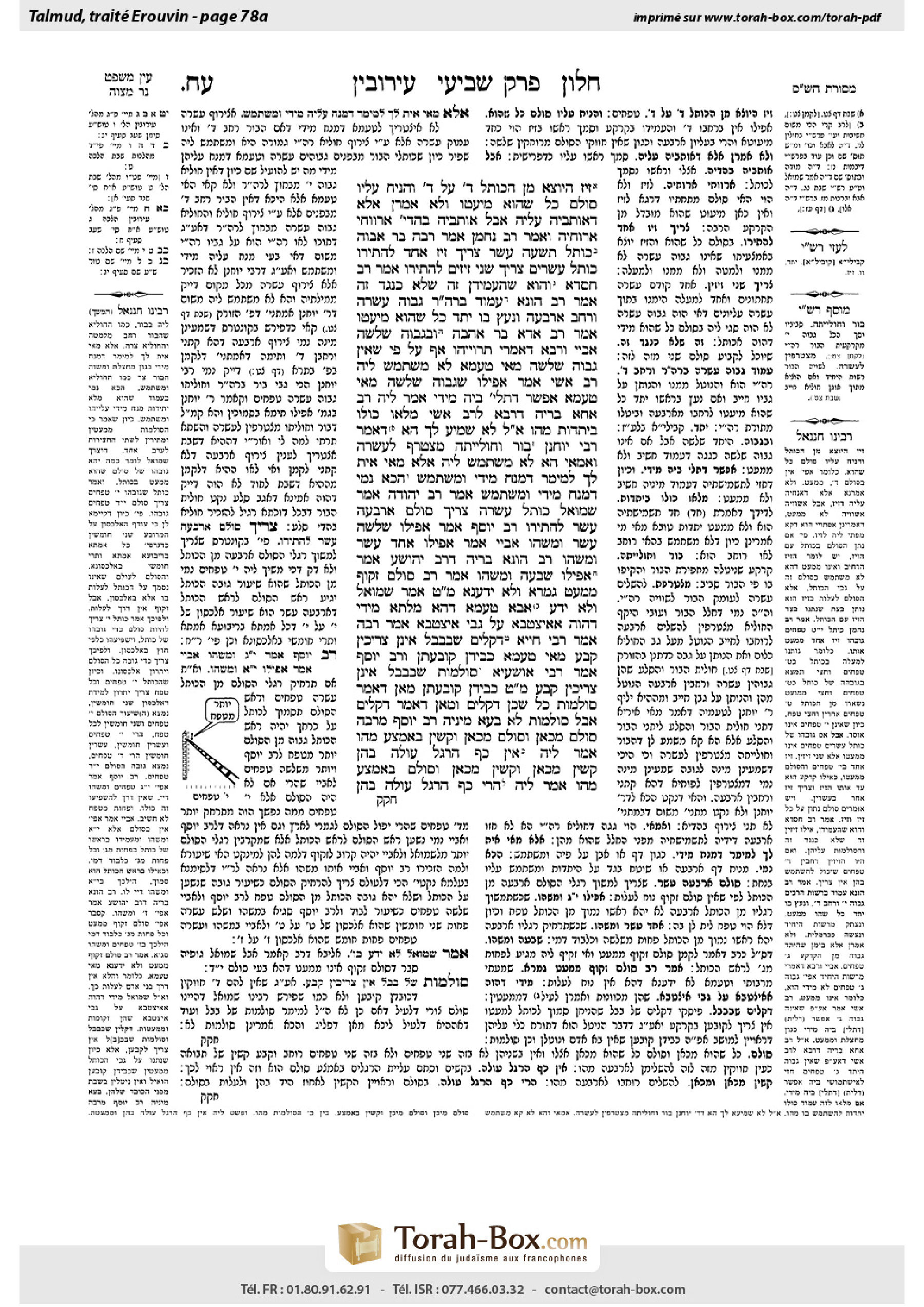
Eruvin 78a: Talmud study for Daf Yomi
Study the Talmud for Daf Yomi with scanned pages, Hebrew text, English translations from Sefaria and AI-generated French translations.
Passage selection and English or AI-generated French translation are available where the scan has annotations. Daf Study is independent of Torah-Box and Sefaria.
Browse Eruvin · עירובין · All tractatesEruvin 78a text and translations
This page of Eruvin includes the Aramaic text, an English translation and an AI-generated French translation, alongside the scan above.
עירובין ע״ח א · Aramaic and Hebrew text
זִיז הַיּוֹצֵא מִן הַכּוֹתֶל אַרְבָּעָה עַל אַרְבָּעָה, וְהִנִּיחַ עָלָיו סוּלָּם כׇּל שֶׁהוּא — מִיעֲטוֹ.
וְלָא אֲמַרַן אֶלָּא דְּאוֹתְבֵיהּ עֲלֵיהּ, אֲבָל אוֹתְבֵיהּ בַּהֲדֵיהּ אַרְווֹחֵי אַרְוְחֵיהּ.
וְאָמַר רַב נַחְמָן אָמַר רַבָּה בַּר אֲבוּהּ: כּוֹתֶל תִּשְׁעָה עָשָׂר — צָרִיךְ זִיז אֶחָד לְהַתִּירוֹ.
כּוֹתֶל עֶשְׂרִים — צָרִיךְ שְׁנֵי זִיזִים לְהַתִּירוֹ. אָמַר רַב חִסְדָּא: וְהוּא שֶׁהֶעֱמִידָן זֶה שֶׁלֹּא כְּנֶגֶד זֶה.
אָמַר רַב הוּנָא: עַמּוּד בִּרְשׁוּת הָרַבִּים, גָּבוֹהַּ עֲשָׂרָה וְרָחָב אַרְבָּעָה, וְנָעַץ בּוֹ יָתֵד כׇּל שֶׁהוּא — מִיעֲטוֹ.
אָמַר רַב אַדָּא בַּר אַהֲבָה: וּבְגָבוֹהַּ שְׁלֹשָׁה. אַבָּיֵי וְרָבָא דְּאָמְרִי תַּרְוַיְיהוּ: אַף עַל פִּי שֶׁאֵין גָּבוֹהַּ שְׁלֹשָׁה.
מַאי טַעְמָא: לָא מִשְׁתַּמֵּשׁ לֵיהּ.
רַב אָשֵׁי אָמַר: אֲפִילּוּ שֶׁגָּבוֹהַּ שְׁלֹשָׁה, מַאי טַעְמָא: אֶפְשָׁר דְּתָלֵי בֵּיהּ מִידֵּי.
אֲמַר לֵיהּ רַב אַחָא בְּרֵיהּ דְּרָבָא לְרַב אָשֵׁי: מִלְּאוֹ כּוּלּוֹ בִּיתֵדוֹת מַהוּ?
אֲמַר לֵיהּ: לָא שְׁמִיעַ לָךְ הָא דְּאָמַר רַבִּי יוֹחָנָן: בּוֹר וְחוּלְיָיתָהּ מִצְטָרֵף לַעֲשָׂרָה.
וְאַמַּאי, הָא לָא מִשְׁתַּמֵּשׁ לֵיהּ? אֶלָּא מַאי אִית לָךְ לְמֵימַר — דְּמַנַּח מִידֵּי וּמִשְׁתַּמֵּשׁ, הָכָא נָמֵי דְּמַנַּח מִידֵּי וּמִשְׁתַּמֵּשׁ.
אָמַר רַב יְהוּדָה אָמַר שְׁמוּאֵל: כּוֹתֶל עֲשָׂרָה — צָרִיךְ סוּלָּם אַרְבָּעָה עָשָׂר לְהַתִּירוֹ. רַב יוֹסֵף אָמַר: אֲפִילּוּ שְׁלֹשָׁה עָשָׂר וּמַשֶּׁהוּ.
אַבָּיֵי אָמַר: אֲפִילּוּ אַחַד עָשָׂר וּמַשֶּׁהוּ.
רַב הוּנָא בְּרֵיהּ דְּרַב יְהוֹשֻׁעַ אָמַר: אֲפִילּוּ שִׁבְעָה וּמַשֶּׁהוּ.
אָמַר רַב: סוּלָּם זָקוּף — מְמַעֵט. גְּמָרָא, וְלָא יָדַעְנָא מַאי טַעְמָא.
אָמַר שְׁמוּאֵל: וְלָא יָדַע אַבָּא טַעְמָא דְּהָא מִלְּתָא?! מִידֵּי דְּהָוֵה אַאִיצְטְבָא עַל גַּבֵּי אִיצְטְבָא.
אָמַר רַבָּה אָמַר רַבִּי חִיָּיא: דְּקָלִים שֶׁבְּבָבֶל — אֵינָן צְרִיכִין קֶבַע. מַאי טַעְמָא: כְּבֵידָן קוֹבַעְתָּן.
וְרַב יוֹסֵף אָמַר רַבִּי אוֹשַׁעְיָא: סוּלָּמוֹת שֶׁבְּבָבֶל — אֵינָן צְרִיכִין קֶבַע. מַאי טַעְמָא: כְּבֵידָן קוֹבַעְתָּן.
מַאן דְּאָמַר סוּלָּמוֹת, כׇּל שֶׁכֵּן דְּקָלִים. וּמַאן דְּאָמַר דְּקָלִים, אֲבָל סוּלָּמוֹת לָא.
בְּעָא מִינֵּיהּ רַב יוֹסֵף מֵרַבָּה: סוּלָּם מִכָּאן וְסוּלָּם מִכָּאן וְקַשִּׁין בָּאֶמְצַע, מַהוּ?
אֲמַר לֵיהּ: אֵין כַּף הָרֶגֶל עוֹלָה בָּהֶן.
קַשִּׁין מִכָּאן וְקַשִּׁין מִכָּאן וְסוּלָּם בָּאֶמְצַע, מַהוּ? אֲמַר לֵיהּ: הֲרֵי כַּף הָרֶגֶל עוֹלָה בָּהֶן.
Eruvin 78a · English translation
If a projection four by four handbreadths in area extends from a wall, and one placed a ladder of any width against it, if the rungs of the ladder are less than three handbreadths apart, he has diminished the height of the wall by means of this ladder and projection.
The Gemara qualifies this statement: And we said this only in a case where one placed the ladder directly against the projection, so that the ladder serves as a passage to it. However, if he placed it adjacent to the projection, he has merely widened the projection, while the ladder remains separate from it. Consequently, the projection does not have any connection to the ground, and a projection that is not within three handbreadths of the ground does not diminish the height of a wall.
And Rav Naḥman said that Rabba bar Avuh said: If a wall between two courtyards is nineteen handbreadths high, it requires one projection to render the use of the wall permitted. If there is a single projection in the middle of the wall, with a ladder of any width resting against it, it is considered a passageway between the courtyards, as the projection is within ten handbreadths of the top of the wall.
However, if the wall is twenty handbreadths high, it requires two projections to render the use of the wall permitted, one within ten handbreadths of the ground, and the other within ten handbreadths of the top of the wall. Rav Ḥisda said: And this applies only where he positioned the projections not directly one above the other, so that it is possible to use a ladder to climb from one projection to the other.
Rav Huna said: If a pillar in the public domain is ten handbreadths high and four handbreadths wide, so that it is considered a private domain, and one drove a stake of any size into the top of it, he has diminished its area. The usable area is now less than four handbreadths, and therefore the pillar is no longer considered a private domain.
Rav Adda bar Ahava said: This applies only if the stake is at least three handbreadths high. If it is less than three handbreadths high, it is considered part of the top of the pillar, based on the principle of lavud. This is in contrast to Abaye and Rava, who both say: Even if the stake is not three handbreadths high, the pillar is no longer considered a private domain.
What is the reason for the opinion of Abaye and Rava? It is that the pillar is no longer fit to be used, as a surface of four by four handbreadths is suitable for use only when it is level. If it has even a small projection, it is no longer usable.
Rav Ashi said: Even a stake three handbreadths high does not diminish the area of the pillar. What is the reason for this? It is that it is possible to hang an item on it. Although it is no longer possible to rest objects on top of the pillar, it is still useful in some way.
Rav Aḥa, son of Rava, said to Rav Ashi: According to your opinion, if he filled it entirely with stakes, i.e., if he drove so many stakes into the top of the post that it was completely filled, what is the halakha?
Rav Ashi said to him: Did you not hear that which Rabbi Yoḥanan said? He said that a pit and its embankment of stone around the edge join together to complete the measure of ten handbreadths. Similarly, the width of the embankment joins with the diameter of the pit to complete the measure of four by four handbreadths necessary to define the pit as a private domain.
There, too, one can raise the question: But why? He cannot use the embankment, as most of the area is the empty space of the pit. Rather, what have you to say, i.e., how can you solve this problem? The solution is that he places an item, e.g., a board, over the mouth of the pit, and then he can make use of it. Here, too, he places an item over the stakes and can make use of the pillar.
Rav Yehuda said that Shmuel said: If a wall is ten handbreadths high, it requires a ladder fourteen handbreadths high, so that one can place the ladder at a diagonal against the wall. The ladder then functions as a passageway and thereby renders the use of the wall permitted. Rav Yosef said: Even a ladder with a height of thirteen handbreadths and a bit is enough, as it is sufficient if the ladder reaches within one handbreadth of the top of the wall.
Abaye said: Even a ladder that is only eleven handbreadths and a bit suffices, as the ladder will still reach a height of over seven handbreadths, i.e., within three handbreadths of the top of the wall.
Rav Huna, son of Rav Yehoshua, said: Even if the ladder is only seven handbreadths and a bit it is sufficient, as he can stand the ladder upright against the wall. Since it will reach within three handbreadths of the top of the wall, the principle of lavud applies. Therefore, even a ladder placed in this manner is considered a valid passageway between the two courtyards.
Similarly, Rav said: An upright ladder effectively diminishes the height of a wall, as it creates a passageway. I received this teaching as a tradition, but I do not know what the reason is, as people do not generally climb ladders positioned in this manner.
Shmuel said: Does Abba, i.e., Rav, actually not know the reason for this matter? The reason here is just as it is in the case of a platform above another platform. Even though it is not easy to climb, since it provides steps that can be climbed, albeit with difficulty, it is considered a valid passageway.
Rabba said that Rabbi Ḥiyya said: The trunks of palm trees in Babylonia that were placed next to a wall between two courtyards so that people could climb on them and pass from one courtyard to another do not need to be established permanently and attached to the ground; rather, they serve to diminish the wall as they are. What is the reason for this? It is that their heaviness establishes them as connected to the ground. Although it is permitted to handle them, nevertheless, since their weight makes them difficult to move, they are considered fixed in place.
And similarly, Rav Yosef said that Rabbi Oshaya said: Ladders in Babylonia do not need to be established and fixed permanently in place. What is the reason for this? It is that their heaviness establishes them, as the ladders in Babylonia were typically large and heavy.
The Gemara comments: With regard to the one who said that Babylonian ladders do not need to be fixed in place, all the more so would he agree that the trunks of palm trees, which are placed there from the outset for this purpose, are considered fixed, as both are extremely heavy and also designed to remain in place. On the other hand, the one who said that the trunks of palm trees need not be fixed permanently in the ground, spoke only with regard to palm trees. However, as for ladders, no, they are not considered fixed in place. A ladder, even a heavy one, is designed to be moved from place to place.
Rav Yosef raised a dilemma before Rabba: If there is a narrow ladder measuring less than two handbreadths wide on one side, and a similarly narrow ladder on the other side, and there are rungs of woven straw in the middle between them which would not support a person’s weight, what is the halakha? Are the two ladders considered a single unit, forming a ladder four handbreadths wide, which serves to diminish the height of a wall?
Rabba said to him: The sole of the foot cannot climb upon them. A person usually places his foot in the middle of a ladder. Since the middle of this ladder is made of straw, then although it appears to be four handbreadths wide, it is not fit for use and does not diminish the height of the wall.
Rav Yosef continued to ask: And what if there were rungs of straw on one side and rungs of straw on the other side, and a narrow ladder less than four handbreadths wide in the middle, and their combined width is four handbreadths? What is the halakha in this case? Rabba said to him: The sole of the foot can climb upon them, and the ladder appears to be four handbreadths wide. Therefore, it serves to diminish the height of the wall.
Eruvin 78a · Traduction française (IA)
Si une projection de quatre par quatre tefachim de surface s'étend d'une muraille, et qu'on place une échelle de toute largeur contre elle, et que les barres de l'échelle sont espacées de moins de trois tefachim, on a diminué la hauteur de la muraille grâce à cette échelle et à cette projection.
La Guemara précise cette déclaration : Nous avons dit cela uniquement dans le cas où l'échelle est placée directement contre la projection, de sorte que l'échelle sert de passage vers celle-ci. Cependant, si l'on la place à côté de la projection, on a simplement élargi la projection, tandis que l'échelle reste séparée d'elle. Ainsi, la projection ne possède aucun lien avec le sol, et une projection qui n'est pas à moins de trois tefachim du sol ne diminue pas la hauteur d'une muraille.
Et Rav Naḥman a dit que Rabba bar Avuh a dit : Si une muraille entre deux courtyards est de dix-neuf tefachim de haut, elle exige une projection pour permettre l'utilisation de la muraille. Si une seule projection est au milieu de la muraille, avec une échelle de toute largeur reposant contre elle, elle est considérée comme un passage entre les courtyards, car la projection est à moins de dix tefachim du sommet de la muraille.
Cependant, si la muraille est de vingt tefachim de haut, elle exige deux projections pour permettre l'utilisation de la muraille, une à moins de dix tefachim du sol et l'autre à moins de dix tefachim du sommet de la muraille. Rav Ḥisda a dit : Et cela s'applique uniquement dans le cas où les projections ne sont pas placées directement l'une au-dessus de l'autre, de sorte qu'il est possible d'utiliser une échelle pour monter d'une projection à l'autre.
Rav Huna a dit : Si un pilier dans le domaine public est de dix tefachim de haut et de quatre tefachim de large, de sorte qu'il est considéré comme un domaine privé, et qu'on a planté un pieu de toute taille sur le sommet de celui-ci, on a diminué son aire. L'aire utilisable est maintenant inférieure à quatre tefachim, et par conséquent le pilier n'est plus considéré comme un domaine privé.
Rav Adda bar Ahava a dit : Cela s'applique uniquement si le pieu est d'au moins trois tefachim de haut. Si le pieu est inférieur à trois tefachim de haut, il est considéré comme faisant partie du sommet du pilier, selon le principe de lavud. Cela contraste avec l'opinion d'Abaye et de Rava, qui disent tous les deux : Même si le pieu n'est pas de trois tefachim de haut, le pilier n'est plus considéré comme un domaine privé.
Quelle est la raison de l'opinion d'Abaye et de Rava ? C'est que le pilier n'est plus adapté à l'usage, car une surface de quatre par quatre tefachim est utilisable uniquement lorsqu'elle est plate. Si elle a même une petite saillie, elle n'est plus utilisable.
Rav Ashi a dit : Même un pieu de trois tefachim de haut ne diminue pas l'aire du pilier. Quelle est la raison de cela ? C'est que l'on peut accrocher un objet à lui. Bien qu'il ne soit plus possible de poser des objets sur le sommet du pilier, il reste utile d'une certaine manière.
Rav Aḥa, fils de Rava, a dit à Rav Ashi : Selon votre opinion, si on remplissait entièrement le pilier de pieux, c'est-à-dire si on plantait autant de pieux sur le sommet du poteau qu'il était possible, quelle serait la halakha ?
Rav Ashi a dit à lui : N'avez-vous pas entendu ce que Rabbi Yoḥanan a dit ? Il a dit qu'un puits et son talus de pierre autour de l'orifice se joignent pour former la mesure de dix tefachim. De même, la largeur du talus se joint au diamètre du puits pour former la mesure de quatre par quatre tefachim nécessaire pour définir le puits comme un domaine privé.
Il en est de même là-bas : on peut poser la question : Mais pourquoi ? On ne peut pas utiliser le talus, car la plupart de la surface est l'espace vide du puits. Et alors, que dites-vous, c'est-à-dire comment pouvez-vous résoudre ce problème ? La solution est qu'on place un objet, par exemple une planche, sur l'orifice du puits, et alors on peut l'utiliser. De même ici, on place un objet sur les pieux et peut utiliser le pilier.
Rav Yehuda a dit que Shmuel a dit : Si une muraille est de dix tefachim de haut, elle exige une échelle de quatorze tefachim de haut, de sorte qu'on puisse placer l'échelle diagonalement contre la muraille. L'échelle fonctionne alors comme un passage et permet ainsi l'utilisation de la muraille. Rav Yosef a dit : Même une échelle de treize tefachim et un peu est suffisante, car elle est suffisante si l'échelle atteint à moins d'un tefachim du sommet de la muraille.
Abaye a dit : Même une échelle de onze tefachim et un peu suffit, car l'échelle atteindra encore une hauteur de plus de sept tefachim, c'est-à-dire à moins de trois tefachim du sommet de la muraille.
Rav Huna, fils de Rav Yehoshua, a dit : Même si l'échelle est de sept tefachim et un peu, elle est suffisante, car on peut placer l'échelle verticalement contre la muraille. Puisqu'elle atteindra à moins de trois tefachim du sommet de la muraille, le principe de lavud s'applique. Par conséquent, même une échelle placée ainsi est considérée comme un passage valide entre les deux courtyards.
De même, Rav a dit : Une échelle verticale diminue effectivement la hauteur d'une muraille, car elle crée un passage. J'ai reçu cette enseignement comme une tradition, mais je ne sais pas quelle est la raison, car les gens ne montent généralement pas d'échelles placées ainsi.
Shmuel a dit : Abba, c'est-à-dire Rav, ne sait-il pas la raison de cette affaire ? La raison ici est la même que dans le cas d'une plateforme au-dessus d'une autre plateforme. Même si ce n'est pas facile de monter, puisque cela fournit des marches qui peuvent être montées, même avec difficulté, il est considéré comme un passage valide.
Rabba a dit que Rabbi Ḥiyya a dit : Les troncs de palmiers en Babylonie qui étaient placés contre un mur entre deux courtyards de sorte que les gens pussent monter dessus et passer d’un courtyard à l’autre n’ont pas besoin d’être établis de manière permanente et fixés au sol ; plutôt, ils servent à diminuer le mur tel qu’ils sont. Quelle est la raison de cela ? C’est que leur poids les établit comme étant connectés au sol. Bien qu’il soit permis de les manipuler, néanmoins, puisque leur poids les rend difficiles à déplacer, ils sont considérés comme fixés en place.
Et de même, Rav Yosef a dit que Rabbi Oshaya a dit : Les échafaudages en Babylonie n’ont pas besoin d’être établis et fixés de manière permanente. Quelle est la raison de cela ? C’est que leur poids les établit, car les échafaudages en Babylonie étaient généralement larges et lourds.
La Guemara commente : En ce qui concerne celui qui a dit que les échafaudages en Babylonie n’ont pas besoin d’être fixés en place, tout autant que cela, il serait d’accord que les troncs de palmier, qui sont placés dès le départ à cet effet, sont considérés comme fixés, car les deux sont extrêmement lourds et conçus pour rester en place. D’un autre côté, celui qui a dit que les troncs de palmier n’ont pas besoin d’être fixés de manière permanente au sol, a parlé uniquement des palmiers. Cependant, concernant les échafaudages, non, ils ne sont pas considérés comme fixés en place. Un échafaudage, même lourd, est conçu pour être déplacé d’un endroit à un autre.
Rav Yosef a soulevé un dilemme devant Rabba : Si il y a un échafaudage étroit mesurant moins de deux tefachim de large sur un côté, et un échafaudage similairement étroit sur l’autre côté, et des barreaux de paille tissée au milieu entre eux qui ne pourraient pas supporter le poids d’une personne, quelle est la halakha ? Les deux échafaudages sont-ils considérés comme une seule unité, formant un échafaudage de quatre tefachim de large, qui sert à diminuer la hauteur d’un mur ?
Rabba a répondu à lui : La semelle du pied ne peut pas monter dessus. Une personne place généralement son pied au milieu d’un échafaudage. Puisque le milieu de cet échafaudage est fait de paille, alors que bien qu’il semble avoir quatre tefachim de large, il n’est pas adapté à l’usage et ne diminue pas la hauteur du mur.
Rav Yosef a continué à poser une question : Et si les barreaux étaient faits de paille sur un côté et de paille sur l’autre côté, et un échafaudage étroit de moins de quatre tefachim de large au milieu, et leur largeur combinée est de quatre tefachim, quelle est la halakha dans ce cas ? Rabba a répondu à lui : La semelle du pied peut monter dessus, et l’échafaudage semble avoir quatre tefachim de large. Par conséquent, il sert à diminuer la hauteur du mur.
Traduction française générée par IA à partir de l’édition anglaise de Sefaria. Vérifie toujours un passage avec le texte source.
Text from Sefaria: William Davidson Edition - Vocalized Aramaic (CC BY NC); William Davidson Edition - English (CC BY NC).