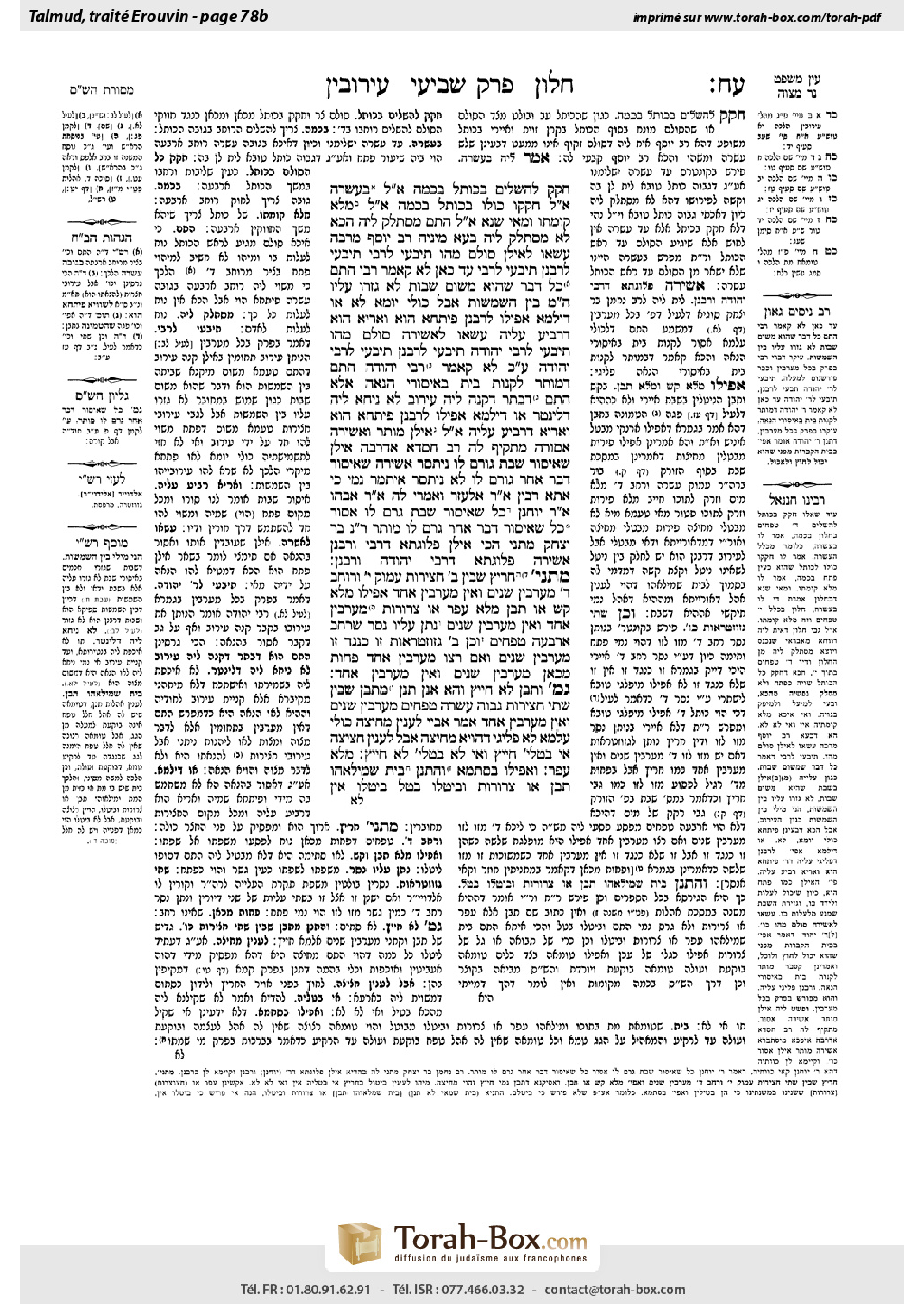
Eruvin 78b: Talmud study for Daf Yomi
Study the Talmud for Daf Yomi with scanned pages, Hebrew text, English translations from Sefaria and AI-generated French translations.
Passage selection and English or AI-generated French translation are available where the scan has annotations. Daf Study is independent of Torah-Box and Sefaria.
Browse Eruvin · עירובין · All tractatesEruvin 78b text and translations
This page of Eruvin includes the Aramaic text, an English translation and an AI-generated French translation, alongside the scan above.
עירובין ע״ח ב · Aramaic and Hebrew text
חָקַק לְהַשְׁלִים בַּכּוֹתֶל, בְּכַמָּה? אֲמַר לֵיהּ: בַּעֲשָׂרָה.
אֲמַר לֵיהּ: חֲקָקוֹ כּוּלּוֹ בַּכּוֹתֶל, בְּכַמָּה? אֲמַר לֵיהּ: מְלֹא קוֹמָתוֹ. וּמַאי שְׁנָא? אֲמַר לֵיהּ: הָתָם מִסְתַּלֵּק לֵיהּ, הָכָא לָא מִסְתַּלֵּק לֵיהּ.
בְּעָא מִינֵּיהּ רַב יוֹסֵף מֵרַבָּה: עֲשָׂאוֹ לָאִילָן סוּלָּם, מַהוּ?
תִּיבְּעֵי לְרַבִּי, תִּיבְּעֵי לְרַבָּנַן.
תִּיבְּעֵי לְרַבִּי: עַד כָּאן לָא קָאָמַר רַבִּי הָתָם כׇּל דָּבָר שֶׁהוּא מִשּׁוּם שְׁבוּת לֹא גָּזְרוּ עָלָיו — הָנֵי מִילֵּי בֵּין הַשְּׁמָשׁוֹת, אֲבָל כּוּלֵּי יוֹמָא — לָא.
אוֹ דִילְמָא אֲפִילּוּ לְרַבָּנַן: פִּיתְחָא הוּא, וְאַרְיָא הוּא דִּרְבִיעַ עֲלֵיהּ.
עֲשָׂאוֹ לַאֲשֵׁירָה סוּלָּם, מַהוּ? תִּיבְּעֵי לְרַבִּי יְהוּדָה, תִּיבְּעֵי לְרַבָּנַן.
תִּיבְּעֵי לְרַבִּי יְהוּדָה: עַד כָּאן לָא קָאָמַר רַבִּי יְהוּדָה הָתָם דְּמוּתָּר לִקְנוֹת בַּיִת בְּאִיסּוּרֵי הֲנָאָה, אֶלָּא הָתָם, דְּבָתַר דִּקְנָה לֵיהּ עֵירוּב לָא נִיחָא לֵיהּ דְּלִינְּטַר.
אוֹ דִילְמָא אֲפִילּוּ לְרַבָּנַן: פִּיתְחָא הוּא, וְאַרְיָא דִּרְבִיעַ עֲלֵיהּ.
אֲמַר לֵיהּ: אִילָן מוּתָּר, וַאֲשֵׁירָה אֲסוּרָה. מַתְקֵיף לַהּ רַב חִסְדָּא: אַדְּרַבָּה, אִילָן שֶׁאִיסּוּר שַׁבָּת גּוֹרֵם לוֹ — נִיתְּסַר.
אֲשֵׁירָה שֶׁאִיסּוּר דָּבָר אַחֵר גּוֹרֵם לוֹ — לָא נִיתְּסַר.
אִיתְּמַר נָמֵי, כִּי אֲתָא רָבִין, אָמַר רַבִּי אֶלְעָזָר, וְאָמְרִי לַהּ אָמַר רַבִּי אֲבָהוּ אָמַר רַבִּי יוֹחָנָן: כֹּל שֶׁאִיסּוּר שַׁבָּת גָּרַם לוֹ — אָסוּר, כֹּל שֶׁאִיסּוּר דָּבָר אַחֵר גָּרַם לוֹ — מוּתָּר.
רַב נַחְמָן בַּר יִצְחָק מַתְנֵי הָכִי: אִילָן — פְּלוּגְתָּא דְּרַבִּי וְרַבָּנַן. אֲשֵׁירָה — פְּלוּגְתָּא דְּרַבִּי יְהוּדָה וְרַבָּנַן.
מַתְנִי׳ חָרִיץ שֶׁבֵּין שְׁתֵּי חֲצֵירוֹת, עָמוֹק עֲשָׂרָה וְרוֹחַב אַרְבָּעָה — מְעָרְבִין שְׁנַיִם, וְאֵין מְעָרְבִין אֶחָד. אֲפִילּוּ מָלֵא קַשׁ אוֹ תֶּבֶן. מָלֵא עָפָר אוֹ צְרוֹרוֹת — מְעָרְבִין אֶחָד, וְאֵין מְעָרְבִין שְׁנַיִם.
נָתַן עָלָיו נֶסֶר שֶׁרָחָב אַרְבָּעָה טְפָחִים, וְכֵן שְׁתֵּי גְזוּזְטְרָאוֹת זוֹ כְּנֶגֶד זוֹ — מְעָרְבִין שְׁנַיִם, וְאִם רָצוּ מְעָרְבִין אֶחָד. פָּחוֹת מִכָּאן — מְעָרְבִין שְׁנַיִם, וְאֵין מְעָרְבִין אֶחָד.
גְּמָ׳ וְתֶבֶן לָא חָיֵיץ? וְהָא אֲנַן תְּנַן: מַתְבֵּן שֶׁבֵּין שְׁתֵּי חֲצֵירוֹת גָּבוֹהַּ עֲשָׂרָה טְפָחִים — מְעָרְבִין שְׁנַיִם וְאֵין מְעָרְבִין אֶחָד!
אָמַר אַבָּיֵי: לְעִנְיַן מְחִיצָה — כּוּלֵּי עָלְמָא לָא פְּלִיגִי דְּהָוְיָא מְחִיצָה, אֲבָל לְעִנְיַן חֲצִיצָה, אִי בַּטְּלֵיהּ — חָיֵיץ, וְאִי לָא בַּטְּלֵיהּ — לָא חָיֵיץ.
מָלֵא עָפָר. וַאֲפִילּוּ בִּסְתָמָא? וְהָתְנַן: בַּיִת שֶׁמִּילְּאָהוּ תֶּבֶן אוֹ צְרוֹרוֹת וּבִיטְּלוֹ — בָּטֵל.
בִּיטְּלוֹ — אִין,
Eruvin 78b · English translation
Rav Yosef further asked: If the ladder resting against the wall was less than four handbreadths wide, and one dug out grooves in the wall as extensions of the rungs of the ladder to complete the measure, how high must this hollowed-out section be to consider the ladder a valid passageway between the two courtyards? Rabba said to him: If it is ten handbreadths high and four handbreadths wide, it is considered a passageway.
Rav Yosef said to him: If there was no ladder, and one dug out the entire ladder in the wall, so that all the steps are grooves in the wall, how much must he hollow out? Rabba said to him: Those steps must reach the full height of the wall. Rav Yosef asked: And what is the difference in this case? Why must the steps reach higher in this case than in the case where the hollowed-out section was merely an extension of an existing ladder? Rabba said to him: There, where there is a ladder, it is easy to climb to the top of the wall; however, here, where there are only grooves in the wall, it is not easy to climb. If one cannot reach the top of the wall, the steps are not considered a passageway between the courtyards.
Rav Yosef raised a dilemma before Rabba: If one designated a tree as a ladder, what is the halakha? Given that it is prohibited to climb a tree on Shabbat, if a tree stands next to a wall and it is easy to climb, is it considered with regard to the halakhot of Shabbat as an opening in the wall that can serve as a passageway between the two courtyards?
Let the dilemma be raised according to the opinion of Rabbi Yehuda HaNasi, who maintains that a joining of Shabbat boundaries [eiruv teḥumin] placed in a tree is valid; and let the dilemma be raised according to the opinion of the Rabbis, who disagree.
The Gemara elaborates: Let the dilemma be raised according to the previously stated opinion of Rabbi Yehuda HaNasi. Rabbi Yehuda HaNasi only stated there that with regard to anything that is prohibited on Shabbat due to a rabbinic decree [shevut], the Sages did not prohibit it during twilight. Therefore, in Rabbi Yehuda HaNasi’s opinion, it is permitted to use an eiruv that was deposited in a tree, as the use of a tree is prohibited on Shabbat by rabbinic decree. However, this applies only in that case, as the eiruv takes effect during the twilight period. Since there is doubt with regard to whether that period is considered day or night, the decree is not in force, and the eiruv is therefore valid. However, in this case, where the opening must be valid for the entire day, Rabbi Yehuda HaNasi would not rule that the decree does not apply. Since it is prohibited by rabbinic decree to climb a tree on Shabbat, a tree cannot be considered a valid passageway.
Or perhaps it may be argued that even according to the opinion of the Rabbis, this tree is considered an opening. They may have said that a joining of Shabbat boundaries placed in a tree is not valid only because the eiruv must actually be accessible during twilight, and in that case it is not, due to the rabbinic decree. However, in this case, where it is not necessary to make actual use of the tree, they would agree that a tree that serves as a ladder is a valid entrance, but a lion crouches upon it. Just as a lion crouching at an opening does not thereby nullify its status as an entrance, although in practice no one can pass through it, so too, in the case of the tree, the prohibition against climbing it does not nullify its status as a passageway.
Rav Yosef further inquired: If one designated a tree worshipped as part of idolatrous rites [asheira], from which it is forbidden to derive benefit, as a ladder, what is the halakha? Is it considered a valid passageway in the wall with regard to the halakhot of Shabbat? Here, too, let the dilemma be raised according to the opinion of Rabbi Yehuda, and let the dilemma be raised according to the opinion of the Rabbis.
The Gemara elaborates: Let the dilemma be raised according to the previously stated opinion of Rabbi Yehuda. Rabbi Yehuda only stated there that it is permitted to acquire, i.e., make use of, a house for the purposes of establishing an eiruv even if it is among the items from which it is prohibited to derive benefit, such as a grave. This statement applies only there, with regard to acquiring an eiruv in that location, since after the eiruv has acquired a place of residence for him, it is not important to him that it is guarded. He requires the grave only for the moment of the acquisition of the eiruv, and what happens to it afterward is of no consequence to him. However, here, since one desires the continued presence of the ladder, it is possible that even Rabbi Yehuda would agree that one may not rely on an asheira, as one may not climb and make use of it, since it is prohibited to derive benefit from it.
Or perhaps it may be argued that even though according to the opinion of the Rabbis it is prohibited to use a grave to acquire an eiruv, here they would agree that the asheira is an opening, but a lion crouches upon it, and this does not nullify its status as an opening.
Rabba said to him: A tree is permitted for use as a ladder, but an asheira is prohibited. Rav Ḥisda strongly objects to this: On the contrary, a tree, with regard to which a Shabbat prohibition causes it to be prohibited, should be prohibited, so that it will not be said that a Shabbat prohibition has been disregarded in a case involving the halakhot of Shabbat.
And the converse is also true: An asheira, with regard to which something else, a halakha unrelated to the halakhot of Shabbat, causes it to be prohibited, should not be prohibited. Rather, it should be considered an opening with regard to Shabbat.
Indeed, it was also stated: When Ravin came from Eretz Yisrael to Babylonia, he said that Rabbi Elazar said, and some say that Rabbi Abbahu said that Rabbi Yoḥanan said: Anything with regard to which a prohibition of Shabbat causes it to be prohibited is prohibited; and conversely, anything with regard to which something else causes it to be prohibited is permitted.
However, in contrast to Rav Yosef, Rav Naḥman bar Yitzḥak taught as follows: These questions are indeed dependent on the known disputes. Whether a tree serving as a ladder constitutes a valid opening is the subject of a dispute between Rabbi Yehuda HaNasi and the Rabbis; Rabbi Yehuda HaNasi permits it and the Rabbis prohibit it. The debate with regard to whether or not an asheira is considered an opening is the subject of a dispute between Rabbi Yehuda, who permits using items from which it is prohibited to derive benefit for the sake of an eiruv, and the Rabbis, who prohibit making an eiruv with such items.
MISHNA: With regard to a ditch between two courtyards that is ten handbreadths deep and four handbreadths wide, it is considered a full-fledged partition, and the residents of the courtyard establish two eiruvin, one for each courtyard, but they may not establish one eiruv. Even if the ditch is filled with straw or hay, it is not regarded as sealed and is therefore not nullified. However, if the ditch is filled with dirt or pebbles, the residents establish one eiruv, but they may not establish two eiruvin, as the ditch is nullified and considered nonexistent.
If one placed a board four handbreadths wide across the ditch so that he could cross it, and similarly, if two balconies [gezuztraot] in two different courtyards are opposite one another, and one placed a board four handbreadths wide between them, the residents of the courtyards or balconies establish two eiruvin, and if they desire, they may establish one, as the board serves as an opening and a passageway between them. If the width of the plank is less than four handbreadths, the residents establish two eiruvin, but they may not establish one eiruv.
GEMARA: The Gemara wonders: Does hay not constitute a proper filling to seal the ditch? Didn’t we learn in the following mishna: With regard to a haystack ten handbreadths high that stands between two courtyards, the residents of the two courtyards establish two eiruvin, but they may not establish one eiruv. This indicates that hay can create a valid partition.
Abaye said that the matter should be understood as follows: With regard to a partition, everyone agrees that hay is a partition and that it divides between the courtyards as long as it is placed there. But with regard to filling the ditch so that it is considered sealed, one must distinguish between two cases: If one explicitly nullified the hay and decided to leave it there, it fills and seals the ditch; however, if he did not nullify it but intends to remove the hay from the ditch, it does not fill it, and the ditch is not considered sealed.
It is written in the mishna: If the ditch is filled with dirt or pebbles, it is considered sealed. The Gemara asks: Does this apply even if one did not specify his intention to leave it there? Didn’t we learn in a mishna with regard to the ritual impurity of a corpse: If there is a house that one filled with hay or pebbles, and he nullified the hay or pebbles and decided to leave them in the house, then the house (Rambam) is nullified and is no longer considered a house with partitions? Generally, a house containing a corpse is ritually impure on the inside but does not impart impurity to the surrounding area. However, in this case, the house is considered an enclosed grave that imparts ritual impurity to its surroundings.
And one can infer from the mishna: If he nullified the hay or pebbles, yes, the house is nullified and considered sealed.
Eruvin 78b · Traduction française (IA)
Rav Yosef demanda encore : Si une échelle appuyée contre un mur mesurait moins de quatre tefachim de large, et qu'on creusait des rainures dans le mur comme prolongement des barres de l'échelle pour compléter la mesure, combien cette section creusée devait-elle être haute pour considérer l'échelle comme un passage valide entre les deux courtyards ? Rabba répondit à lui : Si elle mesure dix tefachim de haut et quatre tefachim de large, elle est considérée comme un passage.
Rav Yosef dit à lui : Si l'échelle n'existait pas, et qu'on creusait l'échelle entière dans le mur, de sorte que toutes les marches soient des rainures dans le mur, combien devait-on creuser ? Rabba répondit à lui : Ces marches doivent atteindre la hauteur totale du mur. Rav Yosef demanda : Et quelle est la différence dans ce cas ? Pourquoi les marches doivent-elles atteindre plus haut dans ce cas que dans le cas où la section creusée était simplement une extension d'une échelle existante ? Rabba répondit à lui : Là, où il y a une échelle, il est facile de monter jusqu'en haut du mur ; cependant, ici, où il n'y a que des rainures dans le mur, il n'est pas facile de monter. Si l'on ne peut pas atteindre le haut du mur, les marches ne sont pas considérées comme un passage entre les courtyards.
Rav Yosef souleva un dilemme devant Rabba : Si l'on désignait un arbre comme une échelle, quelle est la halakha ? Sachant que l'on interdit de monter un arbre le sabbat, si un arbre est situé à côté d'un mur et qu'il est facile de monter, est-il considéré, en ce qui concerne les halakhot du sabbat, comme une ouverture dans le mur pouvant servir de passage entre les deux courtyards ?
Le dilemme doit être soulevé selon l'opinion de Rabbi Yehuda HaNasi, qui considère que l'eiruv teḥumin placé dans un arbre est valide ; et le dilemme doit être soulevé selon l'opinion des Rabbins, qui s'y opposent.
La Guemara développe : Le dilemme doit être soulevé selon l'opinion précédemment évoquée de Rabbi Yehuda HaNasi. Rabbi Yehuda HaNasi a seulement affirmé là que concernant toute chose interdite le sabbat en raison d'un décret rabbinique [shevut], les Sages n'ont pas interdit son utilisation à l'approche du crépuscule. Ainsi, selon l'opinion de Rabbi Yehuda HaNasi, il est permis d'utiliser un eiruv déposé dans un arbre, car l'utilisation d'un arbre est interdite le sabbat par un décret rabbinique. Cependant, cela s'applique uniquement à ce cas, car l'eiruv prend effet pendant la période du crépuscule. Puisque l'on doute de savoir si cette période est considérée comme jour ou nuit, le décret n'est pas en vigueur, et l'eiruv est donc valide. Cependant, dans ce cas, où l'ouverture doit être valide toute la journée, Rabbi Yehuda HaNasi ne jugerait pas que le décret ne s'applique pas. Puisque l'interdiction de monter un arbre le sabbat est un décret rabbinique, un arbre ne peut pas être considéré comme un passage valide.
Ou peut-être peut-on argumenter que même selon l'opinion des Rabbins, cet arbre est considéré comme une ouverture. Ils pourraient avoir dit que l'union des limites du sabbat placée dans un arbre n'est pas valide uniquement parce que l'eiruv doit être accessible pendant la période du crépuscule, et dans ce cas, il ne l'est pas en raison du décret rabbinique. Cependant, dans ce cas, où il n'est pas nécessaire d'utiliser réellement l'arbre, ils pourraient convenir que l'arbre servant d'échcale est une entrée valide, mais un lion s'y tient. Tout comme un lion s'abritant dans une ouverture n'annule pas son statut d'entrée, même si personne ne peut passer à travers, de même, dans le cas de l'arbre, l'interdiction de monter ne nullifie pas son statut d'ouverture.
Rav Yosef demanda encore : Si l'on désignait un arbre utilisé dans des rites idolâtres [asheira], d'où il est interdit d'extraire un bénéfice, comme une échelle, quelle est la halakha ? Est-il considéré comme un passage valide dans le mur en ce qui concerne les halakhot du sabbat ? Ici aussi, le dilemme doit être soulevé selon l'opinion de Rabbi Yehuda, et le dilemme doit être soulevé selon l'opinion des Rabbins.
La Guemara développe : Le dilemme doit être soulevé selon l'opinion précédemment évoquée de Rabbi Yehuda. Rabbi Yehuda a seulement affirmé là qu'il est permis d'acquérir, c'est-à-dire d'utiliser, une maison pour établir un eiruv même si elle est parmi les objets d'où il est interdit d'extraire un bénéfice, comme une tombe. Cette déclaration s'applique uniquement là, concernant l'acquisition d'un eiruv à cet endroit, car après que l'eiruv a acquis un lieu de résidence pour lui, il n'est plus important à lui que ce lieu soit gardé. Il a besoin de la tombe uniquement pour le moment de l'acquisition de l'eiruv, et ce qui en advient après n'a plus d'importance pour lui. Cependant, ici, puisque l'on désire la présence continue de l'échelle, il est possible que même Rabbi Yehuda serait d'accord pour dire qu'on ne peut pas compter sur l'asheira, car on ne peut pas monter et utiliser, car il est interdit d'en tirer un bénéfice.
Ou peut-être peut-on soutenir que même si selon l'opinion des Rabbins il est interdit d'utiliser une tombe pour acquérir un eiruv, ici ils accepteraient que l'asheira est une ouverture, mais un lion s'y tient, et cela ne nullifie pas son statut d'ouverture.
Rabba répondit à lui : L'arbre est permis pour être utilisé comme échelle, mais l'asheira est interdite. Rav Ḥisda s'oppose fermement à cela : Au contraire, un arbre, concernant lequel une interdiction du sabbat l'interdit, devrait être interdit, afin qu'on ne dise pas qu'une interdiction du sabbat a été ignorée dans un cas concernant les halakhot du sabbat.
Et l'inverse est également vrai : L'asheira, concernant laquelle quelque chose d'autre, une halakha non liée aux halakhot du sabbat, l'interdit, ne devrait pas être interdite. Plutôt, elle devrait être considérée comme une ouverture concernant le sabbat.
En effet, cela a également été dit : Quand Ravin est venu de la Terre d'Israël vers Babylone, il a dit que Rabbi Elazar a dit, et certains disent que Rabbi Abbahu a dit que Rabbi Yoḥanan a dit : Tout ce concernant lequel une interdiction du sabbat l'interdit est interdit ; et inversement, tout ce concernant lequel quelque chose d'autre l'interdit est permis.
Cependant, contrairement à Rava Yosef, Rava Naḥman bar Yitzḥak enseigna ainsi : Ces questions sont effectivement dépendantes des disputes connues. La question de savoir si un arbre servant de échelle constitue une ouverture valide est l'objet d'une dispute entre Rabbi Yehuda HaNasi et les Sages ; Rabbi Yehuda HaNasi permet cela et les Sages l'interdisent. La question concernant savoir si une ashera est considérée comme une ouverture est l'objet d'une dispute entre Rabbi Yehuda, qui permet l'utilisation d'objets dont il est interdit de tirer un bénéfice à l'effet d'un eiruv, et les Sages, qui interdisent de former un eiruv avec de tels objets.
MICHNA : Concernant un fossé entre deux courtyards, dix tefachim de profondeur et quatre tefachim de largeur, il est considéré comme une véritable séparation, et les habitants du courtyard établissent deux eiruvin, un pour chaque courtyard, mais ils ne peuvent pas établir un seul eiruv. Même si le fossé est rempli de foin ou de paille, il n'est pas considéré comme scellé et donc n'est pas annulé. Cependant, si le fossé est rempli de terre ou de cailloux, les habitants établissent un seul eiruv, mais ils ne peuvent pas établir deux eiruvin, car le fossé est considéré comme annulé et comme inexistant.
Si l'on place une planche de quatre tefachim de large sur le fossé afin de pouvoir traverser, et de même, si deux balcons [gezuztraot] dans deux courtyards différents sont face à face, et l'on place une planche de quatre tefachim de large entre eux, les habitants des courtyards ou des balcons établissent deux eiruvin, et s'ils le souhaitent, ils peuvent établir un seul eiruv, car la planche sert d'ouverture et de passage entre eux. Si la largeur de la planche est inférieure à quatre tefachim, les habitants établissent deux eiruvin, mais ils ne peuvent pas établir un seul eiruv.
GUEMARA : La Guemara se demande : Le foin ne constitue-t-il pas un bon remplissage pour sceller le fossé ? N'avons-nous pas appris dans la mishna suivante : Concernant un tas de foin dix tefachim de haut qui se trouve entre deux courtyards, les habitants des deux courtyards établissent deux eiruvin, mais ils ne peuvent pas établir un seul eiruv. Cela indique que le foin peut créer une véritable séparation.
Abaye dit que la question doit être comprise ainsi : Concernant une séparation, tout le monde convient que le foin est une séparation et qu'il divise entre les courtyards tant qu'il est placé là. Cependant, concernant le remplissage du fossé afin qu'il soit considéré comme scellé, il faut distinguer deux cas : Si l'on a explicitement annulé le foin et décidé de le laisser là, il remplit et scelle le fossé ; cependant, si l'on n'a pas annulé le foin mais l'intention de le retirer du fossé, il ne le remplit pas, et le fossé n'est pas considéré comme scellé.
Il est écrit dans la mishna : Si le fossé est rempli de terre ou de cailloux, il est considéré comme scellé. La Guemara demande : Cela s'applique-t-il même si l'on n'a pas spécifié son intention de le laisser là ? N'avons-nous pas appris dans une mishna concernant l'impureté rituelle d'un cadavre : Si une maison a été remplie de foin ou de cailloux, et qu'on a annulé le foin ou les cailloux et décidé de les laisser dans la maison, alors la maison (selon le Rambam) est annulée et n'est plus considérée comme une maison avec des séparations ? Généralement, une maison contenant un cadavre est impure rituellement à l'intérieur mais ne transmet pas l'impureté à l'extérieur. Cependant, dans ce cas, la maison est considérée comme une tombe close qui transmet l'impureté rituelle à son environnement.
Et l'on peut en déduire de la Michna : Si l'on a annulé le foin ou les cailloux, oui, la maison est annulée et considérée comme scellée.
Traduction française générée par IA à partir de l’édition anglaise de Sefaria. Vérifie toujours un passage avec le texte source.
Text from Sefaria: William Davidson Edition - Vocalized Aramaic (CC BY NC); William Davidson Edition - English (CC BY NC).