Eruvin 79a: Talmud study for Daf Yomi
Study the Talmud for Daf Yomi with scanned pages, Hebrew text, English translations from Sefaria and AI-generated French translations.
Passage selection and English or AI-generated French translation are available where the scan has annotations. Daf Study is independent of Torah-Box and Sefaria.
Browse Eruvin · עירובין · All tractatesEruvin 79a text and translations
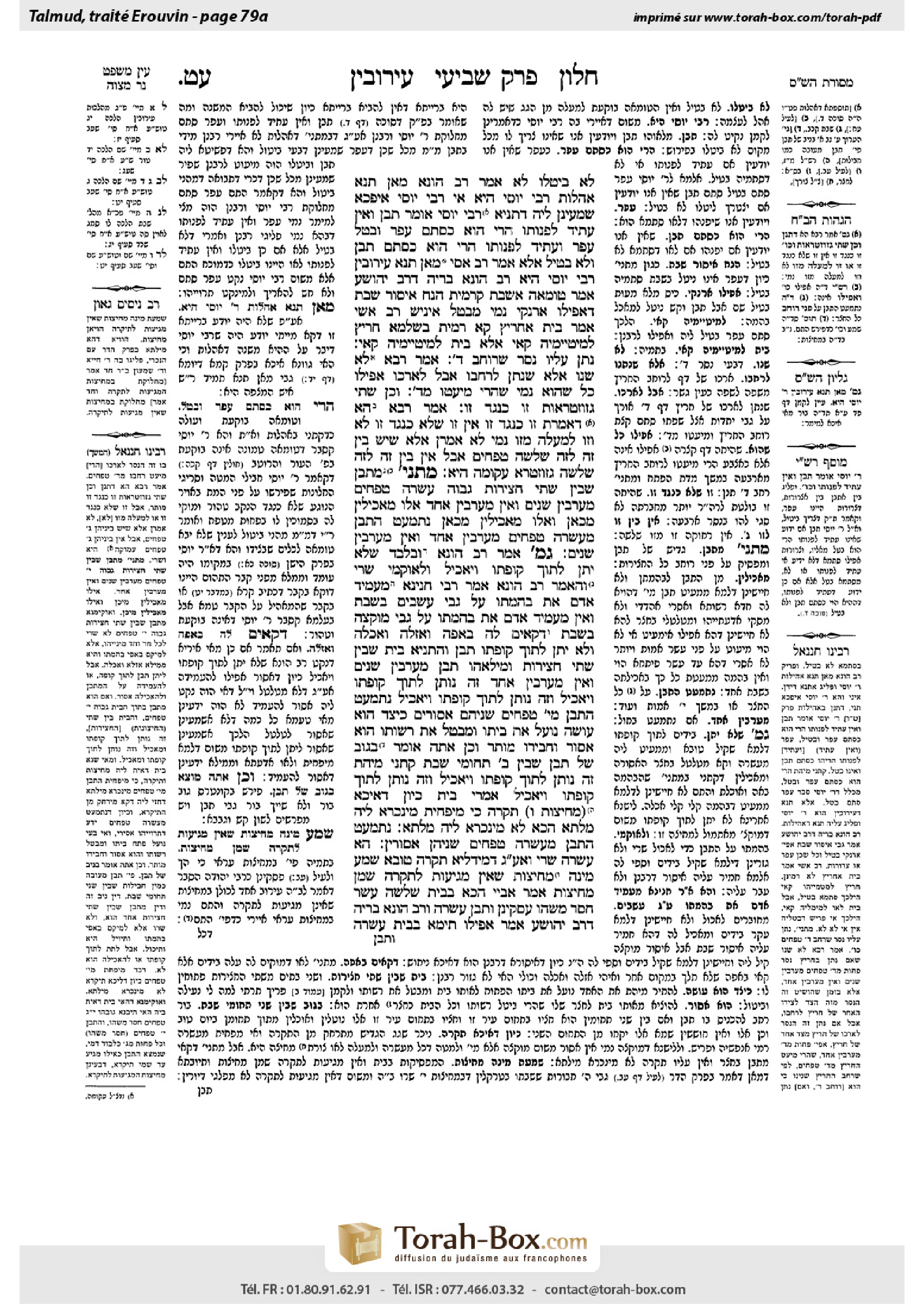
This page of Eruvin includes the Aramaic text, an English translation and an AI-generated French translation, alongside the scan above.
עירובין ע״ט א · Aramaic and Hebrew text
לֹא בִּיטְּלוֹ — לָא. אָמַר רַב הוּנָא: מַאן תָּנָא אֹהָלוֹת — רַבִּי יוֹסֵי הִיא.
אִי רַבִּי יוֹסֵי אִיפְּכָא שָׁמְעִינַן לֵיהּ. דְּתַנְיָא, רַבִּי יוֹסֵי אוֹמֵר: תֶּבֶן וְאֵין עָתִיד לְפַנּוֹתוֹ — הֲרֵי הוּא כִּסְתַם עָפָר, וּבָטֵל. עָפָר וְעָתִיד לְפַנּוֹתוֹ — הֲרֵי הוּא כִּסְתַם תֶּבֶן, וְלֹא בָּטֵיל.
אֶלָּא אָמַר רַב אַסִּי: מַאן תְּנָא עֵירוּבִין — רַבִּי יוֹסֵי הִיא.
רַב הוּנָא בְּרֵיהּ דְּרַב יְהוֹשֻׁעַ אָמַר: טוּמְאָה אַשַּׁבָּת קָרָמֵית?! הַנַּח אִיסּוּר שַׁבָּת, דַּאֲפִילּוּ אַרְנְקִי נָמֵי מְבַטֵּל אִינִישׁ.
רַב אָשֵׁי אָמַר: בַּיִת אַחָרִיץ קָא רָמֵית?! בִּשְׁלָמָא חָרִיץ לְמִיטְיְימֵיהּ קָאֵי. אֶלָּא בַּיִת, לְמִיטְיְימֵיהּ קָאֵי?
נָתַן עָלָיו נֶסֶר שֶׁרוֹחַב אַרְבָּעָה. אָמַר רָבָא: לֹא שָׁנוּ אֶלָּא שֶׁנָּתַן לְרׇחְבּוֹ, אֲבָל לְאׇרְכּוֹ — אֲפִילּוּ כָּל שֶׁהוּא נָמֵי, שֶׁהֲרֵי מִיעֲטוֹ מֵאַרְבָּעָה.
וְכֵן שְׁתֵּי גְזוּזְטְרָאוֹת זוֹ כְּנֶגֶד זוֹ. אָמַר רָבָא: הָא דְּאָמְרַתְּ זוֹ כְּנֶגֶד זוֹ — אִין, זוֹ שֶׁלֹּא כְּנֶגֶד זוֹ — לֹא, וְזוֹ לְמַעְלָה מִזּוֹ נָמֵי, לָא אֲמַרַן אֶלָּא שֶׁיֵּשׁ בֵּין זֶה לָזֶה שְׁלֹשָׁה טְפָחִים, אֲבָל אֵין בֵּין זֶה לָזֶה שְׁלֹשָׁה — גְּזוּזְטְרָא עֲקוּמָּה הִיא.
מַתְנִי׳ מַתְבֵּן שֶׁבֵּין שְׁתֵּי חֲצֵירוֹת גָּבוֹהַּ עֲשָׂרָה טְפָחִים — מְעָרְבִין שְׁנַיִם, וְאֵין מְעָרְבִין אֶחָד. אֵלּוּ מַאֲכִילִין מִכָּאן, וְאֵלּוּ מַאֲכִילִין מִכָּאן. נִתְמַעֵט הַתֶּבֶן מֵעֲשָׂרָה טְפָחִים, — מְעָרְבִין אֶחָד, וְאֵין מְעָרְבִין שְׁנַיִם.
גְּמָ׳ אָמַר רַב הוּנָא: וּבִלְבַד שֶׁלֹּא יִתֵּן לְתוֹךְ קוּפָּתוֹ וְיַאֲכִיל.
וּלְאוֹקֹמֵי שְׁרֵי? וְהָאָמַר רַב הוּנָא אָמַר רַבִּי חֲנִינָא: מַעֲמִיד אָדָם אֶת בְּהֶמְתּוֹ עַל גַּבֵּי עֲשָׂבִים בְּשַׁבָּת. וְאֵין מַעֲמִיד אָדָם אֶת בְּהֶמְתּוֹ עַל גַּבֵּי מוּקְצֶה בְּשַׁבָּת.
דְּקָאֵים לַהּ בְּאַפַּהּ וְאָזְלָה וְאָכְלָה.
וְלֹא יִתֵּן לְתוֹךְ קוּפָּתוֹ תֶּבֶן? וְהָתַנְיָא: בַּיִת שֶׁבֵּין שְׁתֵּי חֲצֵירוֹת וּמִילְּאָהוּ תֶּבֶן — מְעָרְבִין שְׁנַיִם וְאֵין מְעָרְבִין אֶחָד. זֶה נוֹתֵן לְתוֹךְ קוּפָּתוֹ וְיַאֲכִיל, וְזֶה נוֹתֵן לְתוֹךְ קוּפָּתוֹ וְיַאֲכִיל. נִתְמַעֵט הַתֶּבֶן מֵעֲשָׂרָה טְפָחִים — שְׁנֵיהֶם אֲסוּרִים.
כֵּיצַד הוּא עוֹשֶׂה? נוֹעֵל אֶת בֵּיתוֹ וּמְבַטֵּל אֶת רְשׁוּתוֹ, הוּא אָסוּר וַחֲבֵירוֹ מוּתָּר.
וְכֵן אַתָּה אוֹמֵר בְּגוֹב שֶׁל תֶּבֶן שֶׁבֵּין שְׁנֵי תְּחוּמֵי שַׁבָּת. קָתָנֵי מִיהַת: זֶה נוֹתֵן לְתוֹךְ קוּפָּתוֹ וְיַאֲכִיל, וְזֶה נוֹתֵן לְתוֹךְ קוּפָּתוֹ וְיַאֲכִיל.
אָמְרִי: בַּיִת, כֵּיוָן דְּאִיכָּא (מְחִיצּוֹת וְ)תִּקְרָה, כִּי מִיפְּחִית — מִינַּכְרָא לֵיהּ מִלְּתָא. הָכָא — לָא מִינַּכְרָא לֵיהּ מִלְּתָא.
נִתְמַעֵט הַתֶּבֶן מֵעֲשָׂרָה טְפָחִים שְׁנֵיהֶן אֲסוּרִין. הָא עֲשָׂרָה — שְׁרֵי, וְאַף עַל גַּב דְּמִידַּלְיָא תִּקְרָה טוּבָא. שְׁמַע מִינַּהּ: מְחִיצּוֹת שֶׁאֵין מַגִּיעוֹת לַתִּקְרָה — שְׁמָן מְחִיצּוֹת.
אָמַר אַבָּיֵי: הָכָא בְּבַיִת שְׁלֹשָׁה עָשָׂר חָסֵר מַשֶּׁהוּ עָסְקִינַן, וְתֶבֶן עֲשָׂרָה.
וְרַב הוּנָא בְּרֵיהּ דְּרַב יְהוֹשֻׁעַ אָמַר: אֲפִילּוּ תֵּימָא בְּבֵית עֲשָׂרָה
Eruvin 79a · English translation
However, if he did not nullify it, no, the house retains the status of a house, although it is filled with hay. Rav Huna said: Who is the tanna who taught tractate Oholot? It is Rabbi Yosei, and the tanna of the mishna does not accept his opinion.
The Gemara asks: If that mishna is in accordance with the opinion of Rabbi Yosei, there is a difficulty, since we heard him say the opposite, as it was taught in the Tosefta that Rabbi Yosei says: In a case where there is a house full of hay and the owner does not intend to remove, it is considered as though it were filled with indeterminate dirt, and it is therefore nullified. However, if the house was full of dirt that he intends to remove, it is considered as though it were filled with indeterminate hay, and it is therefore not nullified. Apparently, the decisive factor for Rabbi Yosei is not the specific material in the house, but whether or not the owner intends to remove it.
Rather, Rav Asi said: Who is the tanna who taught tractate Eiruvin? It is Rabbi Yosei, who does not accept the opinion of the tanna of tractate Oholot.
Rav Huna, son of Rav Yehoshua, said: Are you raising a contradiction between the halakhot of ritual impurity and the halakhot of Shabbat? These two areas of halakha cannot be compared. Leave aside the prohibition of Shabbat. With regard to Shabbat, a person nullifies even a pouch full of money. The pouch may not be moved on Shabbat and is therefore considered fixed in place. However, hay, which may be moved even on Shabbat, is not considered to be fixed in the ditch. With regard to ritual impurity, by contrast, the nullification must be permanent.
Rav Ashi said: And are you raising a contradiction between the halakha that governs a house and that which governs a ditch? Granted in the case of a ditch, it typically stands to be permanently filled. As there is no doubt that one’s intention is to fill the ditch, the assumption is that anything placed inside a ditch will remain there. However, does a house stand to be permanently filled? Of course it does not. Presumably, the hay and dirt will be removed. Consequently, additional proof is necessary in order to conclude that the owner of the house intends to seal it permanently.
The mishna states: If one placed a plank that is four handbreadths wide across a ditch that separates two courtyards, the plank is considered an entrance. Rava said: They taught this halakha only in a case where one placed the plank along the width of the ditch. But if one positioned a plank along its length, even if the plank is of minimum width, it is also considered an entrance and reduces the ditch, as he reduced the opening to less than four handbreadths. The ditch was originally only four handbreadths wide. Therefore, if one places a plank of any width along its length, it becomes less than four handbreadths wide and no longer constitutes a partition.
The mishna continues: And similarly, if two balconies are opposite each other, and one placed a plank four handbreadths wide between them, the residents of the two courtyards may establish a single eiruv, as the plank is considered an entrance from one courtyard to the other. Rava said: That which you said: If the two balconies are opposite each other, yes, carrying between them is permitted by means of a plank; by inference, if they are not opposite each other, no, carrying is not permitted in this manner, and in a case where one balcony is above the other as well, it is prohibited, as it is not an entrance because it is too dangerous to walk from one to the other by means of the plank. We said the prohibition in these cases only where there is a disparity of at least three handbreadths between this balcony and that balcony. However, if there is a difference of less than three handbreadths between this balcony and that balcony, it is considered a single crooked balcony. Two balconies separated by a gap of less than three handbreadths are considered joined, based on the principle of lavud.
MISHNA: With regard to a haystack that is positioned between two courtyards and is ten handbreadths high, it has the status of a partition, and therefore the residents of the courtyards may establish two eiruvin, and they may not establish one eiruv. These, the inhabitants of one courtyard, may feed their animals from here, from one side of the haystack, and those, the inhabitants of the other courtyard, may feed their animals from there, from the other side of the haystack. There is no concern that the haystack might become too small to serve as a partition. If the height of the hay was reduced to less than ten handbreadths across its entire length, its legal status is no longer that of a partition. Consequently, the residents of both courtyards establish one eiruv, and they do not establish two eiruvin.
GEMARA: With regard to the mishna’s statement that the inhabitants of the two courtyards are permitted to place their animals next to the haystack and feed them, Rav Huna said: And this is the halakha provided that one does not actually put hay into his basket and feed his animals. In that case, there is concern that one might inadvertently reduce the height of the partition to less than ten handbreadths, which would constitute a breach between the courtyards and invalidate both eiruvin.
The Gemara asks: And if the actual handling of the hay is prohibited, is it permitted to stand one’s animal next to the haystack and let it eat? Didn’t Rav Huna say that Rabbi Ḥanina said: A person may stand his animal on a patch of grass on Shabbat, as he will certainly be careful not to pull out grass for the animal, due to the severity of the Torah prohibition involved. However, a person may not stand his animal on set-aside items on Shabbat. As the prohibition of set-aside is rabbinic in origin, he might forget and move the set-aside objects himself. The same reasoning should apply in the case of the haystack. If it is prohibited by rabbinic decree to remove hay from the stack manually, it should likewise be prohibited to position one’s animal alongside the stack.
The Gemara answers: The mishna is not referring to a case where one directly brings the animal and places it alongside the haystack. Rather, it is dealing with a situation where one stands in front of the animal so that it cannot go elsewhere, and it goes and eats from the haystack of its own accord. In that case, the rabbinic decree does not apply.
The Gemara asks a question with regard to Rav Huna’s statement itself: And may one not put hay into his basket and feed his animal? Wasn’t it taught in a baraita: In the case of a house that is positioned between two courtyards and the residents filled it with hay, they establish two eiruvin, but they do not establish one eiruv, as the hay is considered a partition that divides the house. The resident of this courtyard puts hay into his basket and feeds his animal, and the resident of that courtyard puts hay into his basket and feeds his animal. If the hay was reduced to a height less than ten handbreadths, it is prohibited for residents of both to carry in their respective courtyards.
How, then, does the resident of one of the courtyards act if he seeks to permit use of the other courtyard to its resident? He locks his house and renounces his right to carry in the courtyard in favor of the other person. Consequently, it is prohibited for him to carry from his house into the courtyard, and it is permitted for the other resident to do so.
And you say likewise with regard to a pit [gov] of hay that is positioned between two Shabbat limits. The residents of each area may feed their animals from the common hay, as there is no concern lest the animals go beyond the limit. In any case, the baraita teaches: The resident of this courtyard puts hay into his basket and feeds his animal, and the resident of that courtyard puts hay into his basket and feeds his animal. This halakha poses a difficulty to Rav Huna’s opinion.
The Gemara answers: We can say that in the case of a house, since it has walls and a ceiling, when the height of the haystack is reduced the matter is conspicuous. The height disparity between the haystack and the ceiling is obvious. Consequently, when the haystack is reduced to less than ten handbreadths, people will stop carrying in the courtyard. Here, however, with regard to the hay in the pit, the difference in height is not conspicuous. The height of the hay in the pit could become diminished to the extent that the partition is nullified without anyone noticing.
It is stated in the baraita: If the height of the hay was reduced to less than ten handbreadths it is prohibited to carry in both courtyards. The Gemara infers from the phrasing of the baraita: If the hay was at least ten handbreadths high, it is permitted to carry there, even though the ceiling is much higher than the hay. Conclude from it that the legal status of ten-handbreadth partitions that do not reach the ceiling is that of standard partitions, which was the subject of a dispute elsewhere. Apparently, this baraita proves that they have the status of partitions in all respects.
Abaye said: Here, we are dealing with the case of a house that is slightly less than thirteen handbreadths high and the hay is ten handbreadths high. The haystack is less than three handbreadths from the ceiling, and based on the principle of lavud, they are considered joined as though the partitions reach the ceiling.
And Rav Huna, son of Rav Yehoshua, said: Even if you say that the baraita is dealing with a house ten handbreadths high,
Eruvin 79a · Traduction française (IA)
Cependant, si l'on n'a pas annulé cela, la maison conserve le statut d'une maison, même si elle est remplie de foin. Rav Huna a dit : Qui est le tanna qui a enseigné le tractat Oholot ? C'est Rabbi Yosei, et le tanna de la mitsna ne suit pas son avis.
La Guemara pose la question : Si cette mitsna est en accord avec l'opinion de Rabbi Yosei, il y a une difficulté, car nous avons entendu qu'il disait l'opposé, comme il a été enseigné dans la Tosefta que Rabbi Yosei dit : Dans un cas où il y a une maison pleine de foin et que l'propriétaire n'a pas l'intention de retirer, cela est considéré comme si c'était rempli de terre indéterminée, et il est donc annulé. Cependant, si la maison était pleine de terre qu'il prévoit de retirer, cela est considéré comme si c'était rempli de foin indéterminé, et il n'est donc pas annulé. Apparemment, pour Rabbi Yosei, le facteur décisif n'est pas le matériau spécifique dans la maison, mais si l'propriétaire a l'intention de le retirer ou non.
Au contraire, Rav Asi a dit : Qui est le tanna qui a enseigné le tractat Eiruvin ? C'est Rabbi Yosei, qui ne suit pas l'opinion du tanna du tractat Oholot.
Rav Huna, fils de Rav Yéhoshua, a dit : Élevez-vous une contradiction entre les halakhot de l'impureté rituelle et celles du Shabbat ? Ces deux domaines de halakha ne peuvent pas être comparés. Oubliez la prohibition du Shabbat. En ce qui concerne le Shabbat, une personne annule même un sac rempli d'argent. Le sac ne peut pas être déplacé le Shabbat et est donc considéré comme fixe. Cependant, le foin, qui peut être déplacé même le Shabbat, n'est pas considéré comme fixe dans le fossé. En ce qui concerne l'impureté rituelle, par contraste, l'annulation doit être permanente.
Rav Ashi a dit : Et vous élevez-vous une contradiction entre la halakha qui régit une maison et celle qui régit un fossé ? C'est évident dans le cas d'un fossé, il est généralement supposé être permanentement rempli. Comme il n'y a aucun doute que l'intention est de remplir le fossé, on suppose que tout ce qui est placé à l'intérieur restera là. Cependant, une maison est-elle supposée être permanentement remplie ? Bien sûr, non. On suppose que le foin et la terre seront retirés. Par conséquent, une preuve supplémentaire est nécessaire afin de conclure que l'propriétaire de la maison a l'intention de sceller définitivement.
La mitsva dit : Si l'on place un planche de quatre tefachim de large sur un fossé qui sépare deux courtyards, la planche est considérée comme une entrée. Rava a dit : Ils ont enseigné cette halakha uniquement dans le cas où l'on place la planche sur la largeur du fossé. Cependant, si l'on positionne une planche sur sa longueur, même si la planche est de la largeur minimale, elle est également considérée comme une entrée et réduit le fossé, car il a réduit l'ouverture à moins de quatre tefachim. Le fossé était initialement seulement de quatre tefachim de large. Par conséquent, si l'on place une planche de toute largeur sur sa longueur, elle devient inférieure à quatre tefachim de large et ne constitue plus un mur de séparation.
La mitsva continue : Et de même, si deux balcons sont face à face, et qu'on place une planche de quatre tefachim de large entre eux, les habitants des deux courtyards peuvent établir un seul eiruv, car la planche est considérée comme une entrée d'un courtyard à l'autre. Rava a dit : Ce que vous avez dit : Si les deux balcons sont face à face, oui, le transport entre eux est permis par une planche ; par conséquent, si ils ne sont pas face à face, non, le transport n'est pas permis ainsi, et dans le cas où un balcon est au-dessus de l'autre également, il est interdit, car ce n'est pas une entrée car il est trop dangereux de marcher d'un à l'autre par la planche. Nous avons dit l'interdiction dans ces cas uniquement lorsque la différence entre ce balcon et celui-ci est d'au moins trois tefachim. Cependant, si la différence est inférieure à trois tefachim entre ce balcon et celui-ci, il est considéré comme un seul balcon courbe. Deux balcons séparés par une distance inférieure à trois tefachim sont considérés comme joints, selon le principe de lavud.
MITSVA : En ce qui concerne un tas de foin placé entre deux courtyards et mesurant dix tefachim de haut, il a le statut d'un mur de séparation, et donc les habitants des courtyards peuvent établir deux eiruvin, et ils ne peuvent pas établir un seul eiruv. Ces habitants d'un courtyard peuvent nourrir leurs animaux d'ici, d'un côté du tas de foin, et ceux, les habitants de l'autre courtyard, peuvent nourrir leurs animaux d'ici, de l'autre côté du tas de foin. Il n'y a pas de crainte que le tas de foin devienne trop petit pour servir de mur de séparation. Si la hauteur du foin est réduite à moins de dix tefachim sur toute sa longueur, son statut légal n'est plus celui d'un mur de séparation. Par conséquent, les habitants des deux courtyards établissent un seul eiruv, et ils ne les établissent pas deux.
GUEMARA : En ce qui concerne la déclaration de la Michna que les habitants des deux courtyards sont autorisés à placer leurs animaux près du tas de foin et à les nourrir, Rav Huna a dit : Et cela est la halakha à condition qu'on ne mette effectivement du foin dans son panier et qu'on nourrisse ses animaux. Dans ce cas, il y a une crainte que l'on réduise accidentellement la hauteur du mur de séparation à moins de dix tefachim, ce qui constituerait une rupture entre les courtyards et invaliderait les deux eiruvin.
La Guemara pose la question : Et si la manipulation du foin est interdite, est-il permis de placer son animal près du tas de foin et de le laisser manger ? N'a-t-il pas dit Rav Huna que Rabbi Ḥanina a dit : Une personne peut placer son animal sur un tapis de pelouse le Shabbat, car il sera certainement prudent de ne pas arracher de pelouse pour l'animal, en raison de la gravité de la prohibition divine. Cependant, une personne ne peut pas placer son animal sur des objets mis de côté le Shabbat. Comme la prohibition des objets mis de côté est d'origine rabbinique, il pourrait oublier et déplacer lui-même les objets mis de côté. Le même raisonnement s'applique au cas du tas de foin. Si l'enlèvement du foin du tas est interdit par décret rabbinique, il devrait également être interdit de placer son animal à côté du tas.
La Guemara répond : La Michna ne parle pas d'un cas où l'on apporte directement l'animal et on le place à côté du tas de foin. Elle parle plutôt d'un cas où l'on se tient devant l'animal de sorte qu'il ne puisse pas s'éloigner, et il va et mange tout seul du tas de foin. Dans ce cas, le décret rabbinique ne s'applique pas.
La Guemara pose une question concernant l'expression même de la déclaration de Rav Huna : Et peut-on ne pas mettre du foin dans son panier et nourrir son animal ? N'avait-il pas été enseigné dans une baraïta : Dans le cas d'une maison située entre deux courtyards et dont les habitants ont rempli de foin, ils établissent deux eiruvin, mais ils n'établissent pas un seul eiruv, car le foin est considéré comme une partition qui divise la maison. L'habitant de ce courtil met du foin dans son panier et nourrit son animal, et l'habitant de l'autre courtil met du foin dans son panier et nourrit son animal. Si le foin est réduit à une hauteur inférieure à dix handbreadths, il est interdit aux habitants des deux courtyards de porter dans leurs courtyards respectifs.
Comment, alors, l'habitant d'un des courtyards agit-il s'il veut permettre l'utilisation du courtil à son habitant ? Il verrouille sa maison et renonce à son droit de porter dans le courtil en faveur de l'autre personne. Ainsi, il est interdit à lui de porter de sa maison dans le courtil, et il est permis à l'autre habitant de le faire.
Et vous dites de même concernant un trou [gov] de foin situé entre deux limites de Shabbat. Les habitants de chaque zone peuvent nourrir leurs animaux avec le foin commun, car il n'y a pas de crainte que les animaux sortent de la limite. En tout cas, la baraïta enseigne : L'habitant de ce courtil met du foin dans son panier et nourrit son animal, et l'habitant de l'autre courtil met du foin dans son panier et nourrit son animal. Cette halakha pose un problème pour l'opinion de Rav Huna.
La Guemara répond : Nous pouvons dire que dans le cas d'une maison, puisqu'elle a des murs et un toit, lorsque la hauteur du tas de foin est réduite, cela est évident. La différence de hauteur entre le tas de foin et le toit est manifeste. Ainsi, lorsque le tas de foin est réduit à moins de dix handbreadths, les gens arrêteront de porter dans le courtil. Ici cependant, concernant le foin dans le trou, la différence de hauteur n'est pas évidente. La hauteur du foin dans le trou pourrait diminuer jusqu'à un point où la partition est annulée sans que personne ne s'en aperçoive.
Il est dit dans la baraïta : Si la hauteur du foin est réduite à moins de dix handbreadths, il est interdit de porter dans les deux courtyards. La Guemara déduit de la formulation de la baraïta : Si le foin est au moins à dix handbreadths de haut, il est permis de porter là, même si le toit est beaucoup plus haut que le foin. On en conclut que le statut juridique des partitions de dix handbreadths qui n'atteignent pas le toit est celui des partitions normales, ce qui était la matière d'un débat ailleurs. Apparemment, cette baraïta prouve qu'elles ont le statut de partitions en tous points.
Abaye dit : Ici, nous sommes en présence du cas d'une maison dont la hauteur est légèrement inférieure à treize handbreadths et le foin mesure dix handbreadths. Le tas de foin est à moins de trois handbreadths du plafond, et selon le principe de lavud, ils sont considérés comme joints comme si les cloisons atteignaient le plafond.
Et Rav Huna, fils de Rav Yéhoshua, dit : Même si vous dites que la baraïta traite d'une maison dont la hauteur est de dix handbreadths,
Traduction française générée par IA à partir de l’édition anglaise de Sefaria. Vérifie toujours un passage avec le texte source.
Text from Sefaria: William Davidson Edition - Vocalized Aramaic (CC BY NC); William Davidson Edition - English (CC BY NC).