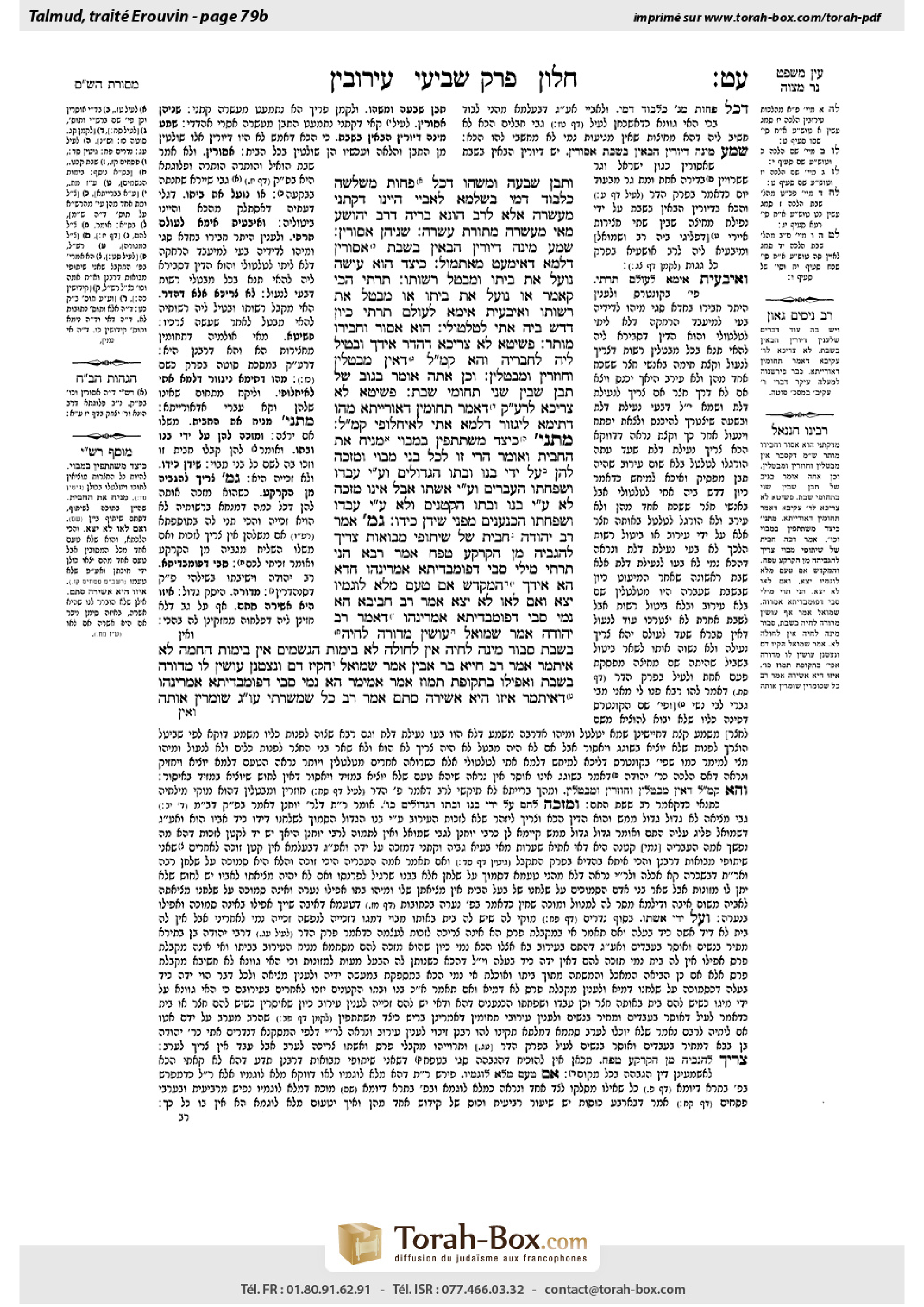
Eruvin 79b: Talmud study for Daf Yomi
Study the Talmud for Daf Yomi with scanned pages, Hebrew text, English translations from Sefaria and AI-generated French translations.
Passage selection and English or AI-generated French translation are available where the scan has annotations. Daf Study is independent of Torah-Box and Sefaria.
Browse Eruvin · עירובין · All tractatesEruvin 79b text and translations
This page of Eruvin includes the Aramaic text, an English translation and an AI-generated French translation, alongside the scan above.
עירובין ע״ט ב · Aramaic and Hebrew text
וְתֶבֶן שִׁבְעָה וּמַשֶּׁהוּ, דְּכׇל פָּחוֹת מִשְּׁלֹשָׁה כְּלָבוּד דָּמֵי.
בִּשְׁלָמָא לְאַבָּיֵי, הַיְינוּ דְּקָתָנֵי ״מֵעֲשָׂרָה״, אֶלָּא לְרַב הוּנָא בְּרֵיהּ דְּרַב יְהוֹשֻׁעַ מַאי ״מֵעֲשָׂרָה״?
מִתּוֹרַת עֲשָׂרָה.
שְׁנֵיהֶן אֲסוּרִין. שְׁמַע מִינַּהּ דָּיוֹרִין הַבָּאִין בְּשַׁבָּת אֲסוּרִין?
דִּלְמָא דְּאִימְּעַט מֵאֶתְמוֹל.
כֵּיצַד הוּא עוֹשֶׂה? נוֹעֵל אֶת בֵּיתוֹ וּמְבַטֵּל רְשׁוּתוֹ. תַּרְתֵּי?! הָכִי קָאָמַר: אוֹ נוֹעֵל אֶת בֵּיתוֹ אוֹ מְבַטֵּל אֶת רְשׁוּתוֹ.
וְאִיבָּעֵית אֵימָא: לְעוֹלָם תַּרְתֵּי, כֵּיוָן דְּדָשׁ בֵּיהּ — אָתֵי לְטַלְטוֹלֵי.
הוּא אָסוּר וַחֲבֵירוֹ מוּתָּר. פְּשִׁיטָא? לָא צְרִיכָא, דַּהֲדַר אִידַּךְ וּבַטֵּיל לֵיהּ לְחַבְרֵיהּ, וְהָא קָא מַשְׁמַע לַן: דְּאֵין מְבַטְּלִין וְחוֹזְרִין וּמְבַטְּלִין.
וְכֵן אַתָּה אוֹמֵר בְּגוֹב שֶׁל תֶּבֶן שֶׁבֵּין שְׁנֵי תְּחוּמֵי שַׁבָּת. פְּשִׁיטָא! לָא צְרִיכָא לְרַבִּי עֲקִיבָא דְּאָמַר: תְּחוּמִין דְּאוֹרָיְיתָא, מַהוּ דְּתֵימָא: לִיגְזוֹר דִּלְמָא אָתֵי לְאִיחַלּוֹפֵי, קָא מַשְׁמַע לַן.
מַתְנִי׳ כֵּיצַד מִשְׁתַּתְּפִין בְּמָבוֹי? מַנִּיחַ אֶת הֶחָבִית, וְאוֹמֵר: הֲרֵי זוֹ לְכׇל בְּנֵי מָבוֹי, וּמְזַכֶּה לָהֶן עַל יְדֵי בְּנוֹ וּבִתּוֹ הַגְּדוֹלִים, וְעַל יְדֵי עַבְדּוֹ וְשִׁפְחָתוֹ הָעִבְרִים, וְעַל יְדֵי אִשְׁתּוֹ.
אֲבָל אֵינוֹ מְזַכֶּה לֹא עַל יְדֵי בְּנוֹ וּבִתּוֹ הַקְּטַנִּים, וְלֹא עַל יְדֵי עַבְדּוֹ וְשִׁפְחָתוֹ הַכְּנַעֲנִים, מִפְּנֵי שֶׁיָּדָן כְּיָדוֹ.
גְּמָ׳ אָמַר רַב יְהוּדָה: חָבִית שֶׁל שִׁיתּוּפֵי מְבוֹאוֹת צָרִיךְ לְהַגְבִּיהַּ מִן הַקַּרְקַע טֶפַח.
אָמַר רָבָא: הָנֵי תַּרְתֵּי מִילֵּי, סָבֵי דְפוּמְבְּדִיתָא אַמְרִינְהוּ: חֲדָא — הָא. אִידַּךְ — הַמְקַדֵּשׁ, אִם טָעַם מְלֹא לוּגְמָיו — יָצָא, וְאִם לָאו — לֹא יָצָא.
אָמַר רַב חֲבִיבָא: הָא נָמֵי סָבֵי דְפוּמְבְּדִיתָא אַמְרִינְהוּ, דְּאָמַר רַב יְהוּדָה אָמַר שְׁמוּאֵל: עוֹשִׂין מְדוּרָה לַחַיָּה בְּשַׁבָּת.
סְבוּר מִינָּה: לְחַיָּה — אִין, לְחוֹלֶה — לָא. בִּימוֹת הַגְּשָׁמִים — אִין, בִּימוֹת הַחַמָּה — לָא.
אִיתְּמַר, אָמַר רַב חִיָּיא בַּר אָבִין אָמַר שְׁמוּאֵל: הִקִּיז דָּם וְנִצְטַנֵּן — עוֹשִׂין לוֹ מְדוּרָה בְּשַׁבָּת, וַאֲפִילּוּ בִּתְקוּפַת תַּמּוּז.
אָמַר אַמֵּימָר: הָא נָמֵי סָבֵי דְפוּמְבְּדִיתָא אַמְרִינְהוּ, דְּאִיתְּמַר: אֵיזוֹ הִיא אֲשֵׁירָה סְתָם?
אָמַר רַב: כׇּל שֶׁכּוֹמָרִין שׁוֹמְרִין אוֹתָהּ
Eruvin 79b · English translation
and the hay in the house is slightly more than seven handbreadths high it is considered a full-fledged partition that reaches the ceiling, as objects separated by any gap of less than three handbreadths are considered joined, based on the principle of lavud.
The Gemara comments. Granted, according to the opinion of Abaye, that is why the baraita teaches: If the height of the haystack was reduced to less than ten handbreadths. However, according to Rav Huna, son of Rav Yehoshua, what is the meaning of: Less than ten? Even at the outset it was never as high as ten handbreadths.
The Gemara answers: It means that it was reduced to less than the law of ten handbreadths. As long as the hay is slightly more than seven handbreadths high, it is regarded as ten handbreadths high, in accordance with the principle of lavud. Once its height is reduced to less than seven handbreadths, the halakha of a partition ten handbreadths high is no longer in effect.
The same baraita taught that if the height of the hay was reduced to less than ten handbreadths, it is prohibited to carry in both. The Gemara comments: Should we learn from this that residents who arrive on Shabbat prohibit the other residents from carrying? At the onset of Shabbat, both sets of residents were permitted to use the hay and the house, but once the hay was reduced on Shabbat it is as though new residents had been added to each of the courtyards, and it is prohibited for all of them to carry. Why not say that since at the beginning of Shabbat it was permitted to carry in the domain, they are permitted to do so for its duration?
The Gemara rejects this contention: Perhaps the baraita is referring to a case where the hay was already reduced on the previous day, before Shabbat began. In that case, it was never permitted to carry at all.
The baraita continues: How, then, does the resident of one of the courtyards act if he seeks to permit use of the other courtyard to its resident? He locks his house and renounces his right to carry in the courtyard in favor of the other person. The Gemara is surprised by this ruling: Does he require these two steps? One should suffice. The Gemara answers: This is what the tanna of the baraita is saying: Either he locks his house or he renounces his right to the courtyard.
And if you wish, say a different explanation instead. Actually, both actions are required in this case, even though one of them would ordinarily suffice. The reason is: Since he is accustomed to using the courtyard, he will come to carry. Consequently, the Sages were stringent with a person in this position and obligated him to implement an additional change so that he will not forget and come to carry when it is prohibited.
It was taught in the baraita: If one locks his house and renounces his rights to the courtyard, it is prohibited for him to carry, and it is permitted for the other person to carry. The Gemara raises a difficulty: Isn’t this obvious? Why was it necessary to state this halakha? The Gemara answers: It was necessary only in a case where the other person then renounced his right in favor of the first person. And the baraita teaches us that one may not renounce his rights in favor of the other, and then have the latter renounce his own rights in favor of the former.
It was further taught in the baraita: And you can say likewise with regard to a pit of hay that is situated between two Shabbat limits. The inhabitants of each area may feed their animals from the common hay. The Gemara raises a difficulty: Isn’t this obvious? The same principle that is in effect with regard to a haystack between courtyards should apply here as well. The Gemara answers: It was necessary to state this halakha only according to the opinion of Rabbi Akiva, who said that the principle of Shabbat boundaries is by Torah law. Lest you say that let us issue a decree and prohibit it, lest people come to exchange objects from one boundary to another, which would violate a Torah prohibition; therefore, the baraita teaches us that no distinction is made between the cases, and no decree of this kind is issued.
MISHNA: How does one merge the courtyards that open into the alleyway, if a person wishes to act on behalf of all the residents of the alleyway? He places a barrel filled with his own food and says: This is for all the residents of the alleyway. For this gift to be acquired by the others, someone must accept it on their behalf, and the tanna therefore teaches that he may confer possession to them even by means of his adult son or daughter, and likewise by means of his Hebrew slave or maidservant, whom he does not own, and by means of his wife. These people may acquire the eiruv on behalf of all the residents of the alleyway.
However, he may not confer possession by means of his minor son or daughter, nor by means of his Canaanite slave or maidservant, because they cannot effect acquisition, as ownership of objects that come into their possession is as if those objects came into his possession. Consequently, the master or father cannot confer possession to the slave or minor respectively on behalf of others as their acquisition is ineffective and the object remains in his own possession.
GEMARA: Rav Yehuda said: With regard to a barrel for the merging of alleyways, the one acquiring it on behalf of the alleyway’s residents must raise it a handbreadth from the ground, as he must perform a valid act of acquisition on their behalf.
Rava said: The elders of Pumbedita, Rav Yehuda and his students, stated these two matters. One was this mentioned above with regard to lifting the barrel; and the other was: With regard to one who recites kiddush over wine on Shabbat or a Festival, if he tasted a mouthful of wine, he fulfilled his obligation; however, if he did not taste a mouthful, he did not fulfill his obligation.
Rav Ḥaviva said: In addition to the aforementioned pair of teachings, the elders of Pumbedita stated this too, as Rav Yehuda said that Shmuel said: One builds a fire for a woman in childbirth on Shabbat.
The Gemara comments that the Sages thought to infer from here: For a woman in childbirth, yes, one builds a fire, due to her highly precarious state; for a sick person, no, one does not build a fire. Likewise, in the rainy season, when the danger of catching cold is ever present, yes, one builds a fire; in the summer, no, one may not.
The Gemara adds that which was stated: Rav Ḥiyya bar Avin said that Shmuel said: With regard to one who let blood and caught cold, one builds a fire for him on Shabbat, even during the season of Tammuz, i.e., the summer. Clearly, Rav Yehuda’s ruling is limited neither to a woman in childbirth nor to the rainy season.
Ameimar said: This too was stated by the elders of Pumbedita, as it was stated that the amora’im disagreed with regard to which tree is presumed to be a tree designated for idolatry [asheira], even though no one actually saw it worshipped.
Rav said: It is any tree that idolatrous priests guard.
Eruvin 79b · Traduction française (IA)
et le foin dans la maison est légèrement plus haut que sept paumes, il est considéré comme une cloison complète qui atteint le plafond, car les objets séparés par un espace inférieur à trois paumes sont considérés comme joints, selon le principe de lavud.
La Guemara commente : Cela est évident selon l'opinion d'Abaye, c'est pourquoi la baraïta enseigne : Si la hauteur du tas de foin était réduite à moins de dix paumes. Cependant, selon Rav Huna, fils de Rav Yéhoshua, quelle est la signification de : Moins de dix ? Même au début, il n'était jamais aussi haut que dix paumes.
La Guemara répond : Cela signifie qu'il a été réduit à moins de la loi des dix paumes. Tant que le foin est légèrement plus haut que sept paumes, il est considéré comme haut de dix paumes, conformément au principe de lavud. Une fois que sa hauteur est réduite à moins de sept paumes, la halakha de la cloison de dix paumes ne s'applique plus.
La même baraïta enseigne que si la hauteur du foin était réduite à moins de dix paumes, il est interdit de porter dans les deux courtyards. La Guemara commente : Devons-nous en tirer la conclusion que les résidents qui arrivent le sabbat interdisent aux autres résidents de porter ? Au début du sabbat, les deux groupes de résidents étaient autorisés à utiliser le foin et la maison, mais une fois que le foin avait été réduit le sabbat, cela semblait comme si de nouveaux résidents avaient été ajoutés à chaque cour, et il était interdit à tous d'y porter. Pourquoi ne pas dire que puisque au début du sabbat il était permis de porter dans le domaine, ils sont autorisés à le faire durant toute la durée du sabbat ?
La Guemara rejette cette argumentation : Peut-être que la baraïta fait référence à un cas où le foin avait déjà été réduit la veille, avant que le sabbat ne commence. Dans ce cas, il n'était jamais permis de porter du tout.
La baraïta continue : Comment alors agit le résident d'un des courtyards s'il souhaite permettre l'utilisation du deuxième courtyard à son résident ? Il verrouille sa maison et renonce à son droit de porter en faveur de l'autre personne. La Guemara est surprise par cette décision : N'a-t-il pas besoin de ces deux étapes ? Une seule suffirait. La Guemara répond : C'est ce que dit le tanna de la baraïta : Soit il verrouille sa maison, soit il renonce à son droit sur le courtyard.
Et si vous le souhaitez, proposez une autre explication. En réalité, les deux actions sont nécessaires dans ce cas, même si l'une d'entre elles suffirait normalement. La raison est : Puisqu'il est habitué à utiliser le courtyard, il viendra à porter. Par conséquent, les Sages ont été stricts avec une personne dans cette situation et l'ont obligé à mettre en œuvre un changement supplémentaire afin qu'il ne vienne pas à porter lorsqu'il est interdit.
Il a été enseigné dans la baraïta : Si l'on verrouille sa maison et qu'on renonce à ses droits sur le courtyard, il est interdit de porter, et il est permis à l'autre personne de porter. La Guemara soulève une difficulté : N'est-ce pas évident ? Pourquoi a-t-il fallu énoncer cette halakha ? La Guemara répond : C'était nécessaire uniquement dans le cas où la personne suivante renonçait à ses droits en faveur de la première. Et la baraïta nous enseigne que l'on ne peut pas renoncer à ses droits en faveur de l'autre, et ensuite que l'autre renonce à ses propres droits en faveur de la première.
Il a été enseigné davantage dans la baraïta : Et vous pouvez dire de même concernant un tas de foin situé entre deux limites de sabbat. Les habitants de chaque zone peuvent nourrir leurs animaux avec le foin commun. La Guemara soulève une difficulté : N'est-ce pas évident ? Le même principe qui s'applique concernant un tas de foin entre des courtyards devrait s'appliquer ici également. La Guemara répond : Il a fallu énoncer cette halakha uniquement selon l'opinion de Rabbi Akiva, qui disait que le principe des limites de sabbat est de droit divin. De peur que vous disiez : Faisons un décret et interdisons cela, de peur que les gens viennent à échanger des objets d'une limite à l'autre, ce qui violerait une interdiction divine ; par conséquent, la baraïta nous enseigne qu'il n'y a pas de distinction entre les cas et aucun tel décret n'est émis.
MICHNA : Comment un homme peut-il fusionner les courtyards qui donnent sur un passage, si un homme souhaite agir au nom de tous les résidents du passage ? Il place un tonneau rempli de son propre aliment et dit : Cela est pour tous les résidents du passage. Pour que cela soit acquis par les autres, quelqu'un doit l'accepter à leur place, et le tanna enseigne donc qu'il peut conférer la possession à eux même par le biais de son fils ou de sa fille adulte, ainsi que par le biais de son esclave ou de sa servante juive, qu'il ne possède pas, et par le biais de sa femme. Ces personnes peuvent acquérir l'eiruv au nom de tous les résidents du passage.
Cependant, il ne peut pas conférer la possession par le biais de son fils ou de sa fille mineurs, ni par le biais de son esclave ou de sa servante cananéenne, car ils ne peuvent pas effectuer l'acquisition, car la possession des objets qui entrent en leur possession est comme si ces objets entraient en possession de celui-ci. Par conséquent, le maître ou le père ne peut pas conférer la possession à l'esclave ou au mineur au nom des autres, car leur acquisition est inefficace et l'objet reste en sa propre possession.
GUEMARA : Rav Yéhuda a dit : Concernant un tonneau pour la fusion des passages, celui qui l'acquiert au nom des résidents des passages doit le soulever d'un paume du sol, car il doit effectuer un acte valide d'acquisition à leur nom.
Rava a dit : Les anciens de Pumbedita, Rav Yehuda et ses élèves, ont énoncé ces deux points. L'un était celui mentionné ci-dessus concernant le soulevement du tonneau ; l'autre était : Concernant celui qui récite le kaddish sur le vin le sabbat ou un festival, s'il a goûté une bouchée de vin, il a accompli son obligation ; cependant, s'il n'a pas goûté une bouchée, il n'a pas accompli son obligation.
Rav Ḥaviva a dit : En plus des enseignements mentionnés précédemment, les anciens de Pumbedita ont également dit cela, comme Rav Yehuda a rapporté que Shmuel a dit : On allume un feu pour une femme en travail le sabbat.
La Guemara commente que les Sages pensaient en déduire ceci : Pour une femme en travail, oui, on allume un feu, en raison de son état très précaire ; pour une personne malade, non, on ne fait pas allumer de feu. De même, pendant la saison des pluies, lorsque le danger de prendre froid est toujours présent, oui, on allume un feu ; en été, non, on ne peut pas.
La Guemara ajoute ce qui a été dit : Rav Ḥiyya bar Avin a dit que Shmuel a dit : Concernant celui qui a perdu du sang et a pris froid, on allume un feu pour lui le sabbat, même pendant la saison de Tammuz, c'est-à-dire l'été. Évidemment, la décision de Rav Yehuda n'est pas limitée à une femme en travail ni à la saison des pluies.
Ameimar a dit : Cela a également été dit par les anciens de Pumbedita, comme il a été dit que les amoraïm étaient en désaccord concernant l'arbre supposé être un arbre destiné à l'idolâtrie [asheira], même si personne n'avait vu qu'on le vénérait.
Rav a dit : C'est tout arbre que les prêtres idolâtres gardent.
Traduction française générée par IA à partir de l’édition anglaise de Sefaria. Vérifie toujours un passage avec le texte source.
Text from Sefaria: William Davidson Edition - Vocalized Aramaic (CC BY NC); William Davidson Edition - English (CC BY NC).