Eruvin 80a: Talmud study for Daf Yomi
Study the Talmud for Daf Yomi with scanned pages, Hebrew text, English translations from Sefaria and AI-generated French translations.
Passage selection and English or AI-generated French translation are available where the scan has annotations. Daf Study is independent of Torah-Box and Sefaria.
Browse Eruvin · עירובין · All tractatesEruvin 80a text and translations
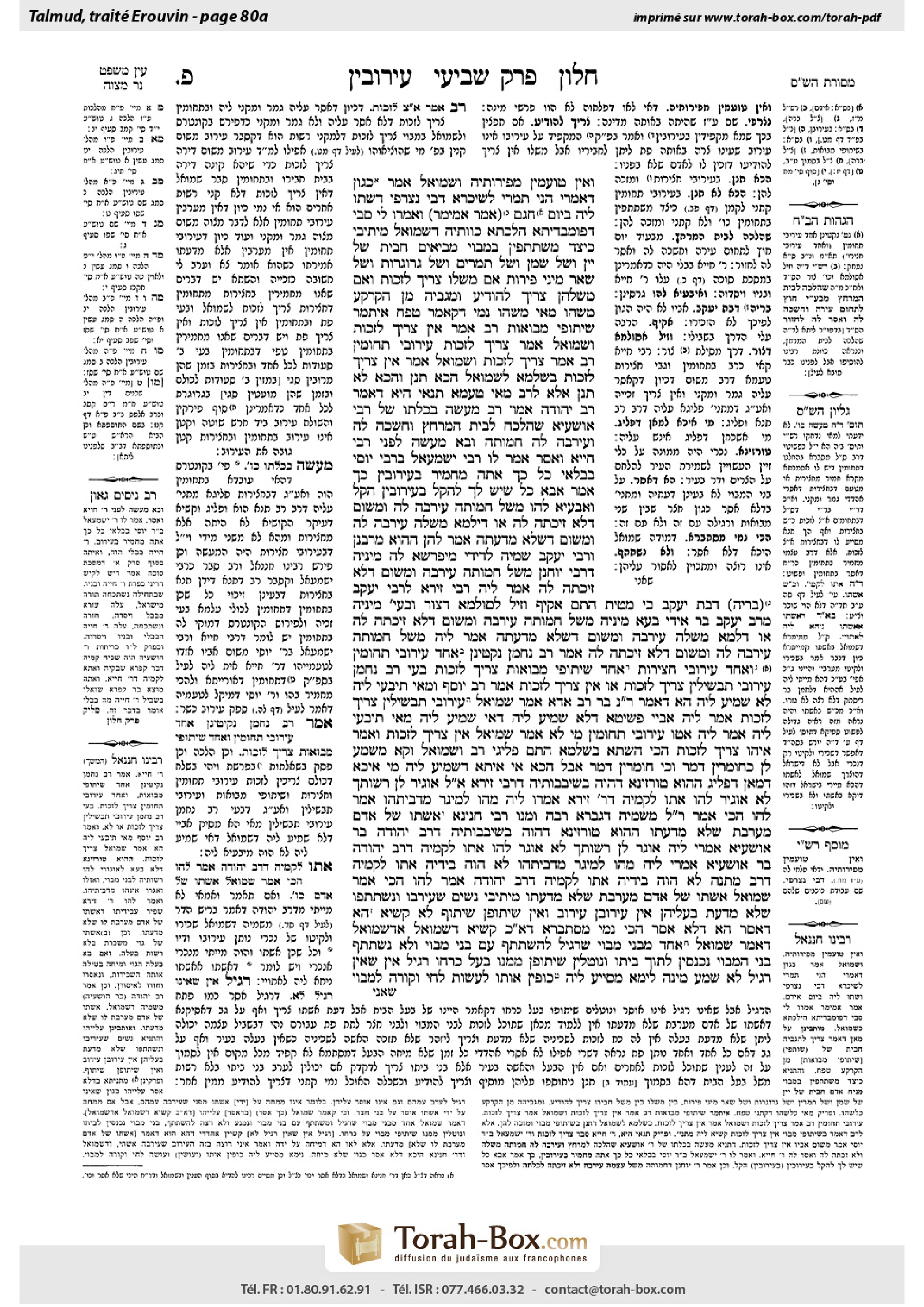
This page of Eruvin includes the Aramaic text, an English translation and an AI-generated French translation, alongside the scan above.
עירובין פ׳ א · Aramaic and Hebrew text
וְאֵין טוֹעֲמִין מִפֵּירוֹתֶיהָ.
וּשְׁמוּאֵל אָמַר: כְּגוֹן דְּאָמְרִי ״הָנֵי תַּמְרֵי לְשִׁיכְרָא דְּבֵי נִצְרְפֵי דְּשָׁתוּ לֵיהּ בְּיוֹם חַגָּם״. (אָמַר אַמֵּימָר:) וַאֲמַרוּ לִי סָבֵי דְפוּמְבְּדִיתָא: הִלְכְתָא כְּווֹתֵיהּ דִּשְׁמוּאֵל.
מֵיתִיבִי: כֵּיצַד מִשְׁתַּתְּפִין בְּמָבוֹי — מְבִיאִים חָבִית שֶׁל יַיִן וְשֶׁל שֶׁמֶן וְשֶׁל תְּמָרִים וְשֶׁל גְּרוֹגְרוֹת וְשֶׁל שְׁאָר מִינֵי פֵּירוֹת.
אִם מִשֶּׁלּוֹ — צָרִיךְ לְזַכּוֹת. וְאִם מִשֶּׁלָּהֶן — צָרִיךְ לְהוֹדִיעַ. וּמַגְבִּיהַּ מִן הַקַּרְקַע מַשֶּׁהוּ! מַאי ״מַשֶּׁהוּ״ נָמֵי דְּקָאָמַר? טֶפַח.
אִיתְּמַר: שִׁיתּוּפֵי מְבוֹאוֹת, רַב אָמַר: אֵין צָרִיךְ לְזַכּוֹת, וּשְׁמוּאֵל אָמַר: צָרִיךְ לְזַכּוֹת. עֵירוּבֵי תְחוּמִין, רַב אָמַר: צָרִיךְ לְזַכּוֹת, וּשְׁמוּאֵל אָמַר: אֵין צָרִיךְ לְזַכּוֹת.
בִּשְׁלָמָא לִשְׁמוּאֵל — הָכָא תְּנַן, וְהָכָא לָא תְּנַן. אֶלָּא לְרַב מַאי טַעְמָא?
תַּנָּאֵי הִיא, דְּאָמַר רַב יְהוּדָה אָמַר רַב: מַעֲשֶׂה בְּכַלָּתוֹ שֶׁל רַבִּי אוֹשַׁעְיָא שֶׁהָלְכָה לְבֵית הַמֶּרְחָץ, וְחָשְׁכָה לָהּ, וְעֵירְבָה לָהּ חֲמוֹתָהּ.
וּבָא מַעֲשֶׂה לִפְנֵי רַבִּי חִיָּיא — וְאָסַר. אָמַר לוֹ רַבִּי יִשְׁמָעֵאל בְּרַבִּי יוֹסֵי: בַּבְלַאי, כׇּל כָּךְ אַתָּה מַחְמִיר בְּעֵירוּבִין?! כָּךְ אָמַר אַבָּא: כֹּל שֶׁיֵּשׁ לְךָ לְהָקֵל בְּעֵירוּבִין — הָקֵל.
וְאִבַּעְיָא לְהוּ: מִשֶּׁל חֲמוֹתָהּ עֵירְבָה לָהּ, וּמִשּׁוּם דְּלֹא זִיכְּתָה לָהּ. אוֹ דִילְמָא: מִשֶּׁלָּהּ עֵירְבָה לָהּ, וּמִשּׁוּם דְּשֶׁלֹּא מִדַּעְתָּהּ?
אָמַר לָהֶן הַהוּא מֵרַבָּנַן, וְרַבִּי יַעֲקֹב שְׁמֵיהּ: לְדִידִי מִיפָּרְשָׁא לַהּ מִינֵּיהּ דְּרַבִּי יוֹחָנָן — מִשֶּׁל חֲמוֹתָהּ עֵירְבָה, וּמִשּׁוּם דְּלֹא זִיכְּתָה לָהּ.
אֲמַר לֵיהּ רַבִּי זֵירָא לְרַבִּי יַעֲקֹב (בְּרֵיהּ) דְּבַת יַעֲקֹב: כִּי מָטֵית הָתָם, אַקֵּיף וְזִיל לְסוּלָּמָא דְצוֹר, וּבַעְיָא מִינֵּיהּ מֵרַב יַעֲקֹב בַּר אִידִי.
בְּעָא מִינֵּיהּ: מִשֶּׁל חֲמוֹתָהּ עֵירְבָה, וּמִשּׁוּם דְּלֹא זִיכְּתָה לָהּ, אוֹ דִּלְמָא: מִשֶּׁלָּהּ עֵירְבָה, וּמִשּׁוּם דְּשֶׁלֹּא מִדַּעְתָּהּ?
אֲמַר לֵיהּ: מִשֶּׁל חֲמוֹתָהּ עֵירְבָה לָהּ, וּמִשּׁוּם דְּלֹא זִיכְּתָה לָהּ.
אָמַר רַב נַחְמָן: נָקְטִינַן, אֶחָד עֵירוּבֵי תְחוּמִין, וְאֶחָד עֵירוּבֵי חֲצֵירוֹת, אֶחָד שִׁיתּוּפֵי מְבוֹאוֹת צָרִיךְ לְזַכּוֹת. בָּעֵי רַב נַחְמָן: עֵירוּבֵי תַבְשִׁילִין צָרִיךְ לְזַכּוֹת, אוֹ אֵין צָרִיךְ לְזַכּוֹת?
אָמַר רַב יוֹסֵף: וּמַאי תִּיבְּעֵי לֵיהּ? לָא שְׁמִיעַ לֵיהּ הָא דְּאָמַר רַב נַחְמָן בַּר רַב אַדָּא אָמַר שְׁמוּאֵל: עֵירוּבֵי תַבְשִׁילִין צָרִיךְ לְזַכּוֹת. אֲמַר לֵיהּ אַבָּיֵי: פְּשִׁיטָא דְּלָא שְׁמִיעַ לֵיהּ. דְּאִי שְׁמִיעַ לֵיהּ, מַאי תִּיבְּעֵי לֵיהּ?
אֲמַר לֵיהּ: אַטּוּ עֵירוּבֵי תְחוּמִין מִי לָא אָמַר שְׁמוּאֵל: אֵין צָרִיךְ לְזַכּוֹת, וְאָמַר אִיהוּ: צָרִיךְ לְזַכּוֹת.
הָכִי הַשְׁתָּא?! בִּשְׁלָמָא הָתָם פְּלִיגִי רַב וּשְׁמוּאֵל, וְקָא מַשְׁמַע לַן כְּחוּמְרִין דְּמָר וְכִי חוּמְרִין דְּמָר, אֲבָל הָכָא, אִי אִיתָא דִּשְׁמִיעַ לֵיהּ מִי אִיכָּא דְּמַאן דִּפְלִיג?
הָהוּא טוּרְזִינָא דַּהֲוָה בְּשִׁיבָבוּתֵיהּ דְּרַבִּי זֵירָא, אֲמַרוּ לֵיהּ: אוֹגַיר לַן רְשׁוּתָךְ, לָא אוֹגַיר לְהוּ. אֲתוֹ לְקַמֵּיהּ דְּרַבִּי זֵירָא אֲמַרוּ לֵיהּ: מַהוּ, לְמֵיגַר מִדְּבֵיתְהוּ?
אֲמַר לְהוּ: הָכִי אָמַר רֵישׁ לָקִישׁ מִשְּׁמֵיהּ דְּגַבְרָא רַבָּה, וּמַנּוּ רַבִּי חֲנִינָא: אִשְׁתּוֹ שֶׁל אָדָם מְעָרֶבֶת שֶׁלֹּא מִדַּעְתּוֹ.
הָהוּא טוּרְזִינָא דַּהֲוָה בְּשִׁיבָבוּתֵיהּ דְּרַב יְהוּדָה בַּר אוֹשַׁעְיָא, אָמְרִי לֵיהּ: אוֹגַר לַן רְשׁוּתָךְ, לָא אוֹגַר לְהוּ. אֲתוֹ לְקַמֵּיהּ דְּרַב יְהוּדָה בַּר אוֹשַׁעְיָא, אָמְרִי לֵיהּ: מַהוּ לְמֵיגַר מִדְּבֵיתְהוּ, לָא הֲוָה בִּידֵיהּ. אֲתוֹ לְקַמֵּיהּ דְּרַב מַתְנָה, לָא הֲוָה בִּידֵיהּ. אֲתוֹ לְקַמֵּיהּ דְּרַב יְהוּדָה, אֲמַר לְהוּ: הָכִי אָמַר שְׁמוּאֵל: אִשְׁתּוֹ שֶׁל אָדָם מְעָרֶבֶת שֶׁלֹּא מִדַּעְתּוֹ.
מֵיתִיבִי: נָשִׁים שֶׁעֵירְבוּ וְנִשְׁתַּתְּפוּ שֶׁלֹּא מִדַּעַת בַּעֲלֵיהֶן, אֵין עֵירוּבָן עֵירוּב, וְאֵין שִׁיתּוּפָן שִׁיתּוּף!
לָא קַשְׁיָא: הָא — דְּאָסַר, הָא — דְּלָא אָסַר.
הָכִי נָמֵי מִסְתַּבְּרָא, דְּאִם כֵּן קַשְׁיָא דִּשְׁמוּאֵל אַדִּשְׁמוּאֵל, דְּאָמַר שְׁמוּאֵל: אֶחָד מִבְּנֵי מָבוֹי שֶׁרָגִיל לְהִשְׁתַּתֵּף עִם בְּנֵי מָבוֹי, וְלֹא נִשְׁתַּתֵּף — בְּנֵי הַמָּבוֹי נִכְנָסִין לְתוֹךְ בֵּיתוֹ וְנוֹטְלִין שִׁיתּוּפָן מִמֶּנּוּ בְּעַל כׇּרְחוֹ.
רָגִיל אִין, שֶׁאֵין רָגִיל לָא. שְׁמַע מִינַּהּ.
לֵימָא מְסַיַּיע לֵיהּ: כּוֹפִין אוֹתוֹ לַעֲשׂוֹת לֶחִי וְקוֹרָה לַמָּבוֹי.
Eruvin 80a · English translation
and whose fruit they do not taste. This tree is evidently consecrated to the cult.
And Shmuel said: For example, if they say: These dates are for the beer of the temple of Nitzrefei, which they drink on the day of their festival, then this is enough to establish the tree as an asheira. Ameimar said: And the elders of Pumbedita said to me with regard to this issue: The halakha is in accordance with the opinion of Shmuel.
The Gemara returns to Rav Yehuda’s ruling that the barrel used for merging the alleyway must be raised a handbreadth from the ground. The Gemara raises an objection from a baraita: How does one merge an alleyway? One brings a barrel of wine, or oil, or dates, or dried figs, or any other type of produce for merging the alleyway.
If one contributed a barrel of his own, he must confer possession to all the other residents by means of another person who acquires it on their behalf. And if the barrel is theirs, he must at least inform them that he is merging the alleyway. And the one acquiring it on behalf of the others raises the barrel a minimal amount from the ground. Apparently, the barrel need not be raised a handbreadth. The Gemara answers: Here too, what is this minimal amount of which the tanna of the baraita spoke? This expression means a handbreadth, but no less.
It is stated that the amora’im disagreed with regard to the acquisition of a merging of alleyways. Rav said: It is not necessary to confer possession of the food used in merging the alleyway to all the residents of the alleyway; and Shmuel said: It is necessary to confer possession to them. They likewise disagreed with regard to a joining of Shabbat boundaries, but the opinions are reversed. Rav said: It is necessary to confer possession of the food to all those who wish to be included in the eiruv, and Shmuel said: It is not necessary to confer possession to them.
The Gemara raises a difficulty: Granted, according to the opinion of Shmuel, his reasoning is clear, as here, with regard to a merging of the alleyways, we learned in the mishna that he must confer possession, whereas there, with regard to a joining of Shabbat boundaries, we did not learn that this is the halakha. However, according to Rav, what is the reason that he differentiates between the cases in this manner?
The Gemara answers: This is the subject of a dispute between the tanna’im, as Rav Yehuda said that Rav said: There was an incident involving the daughter-in-law of Rabbi Oshaya, who went before Shabbat to the bathhouse, which was located beyond the Shabbat boundary, and it grew dark before she was able to return, and her mother-in-law established a joining of Shabbat boundaries for her so that she could return home.
And the incident came before Rabbi Ḥiyya for a ruling as to whether the eiruv is valid, and he ruled that it was not valid and prohibited her return. Rabbi Yishmael, son of Rabbi Yosei, said to him: Babylonian, are you so stringent with regard to an eiruv? This is what my father said: Any case where you have the ability to be lenient with regard to an eiruv, be lenient.
And a dilemma was raised before the Sages: Did the mother-in-law establish the eiruv for her daughter-in-law with the mother-in-law’s food, and Rabbi Ḥiyya prohibited it because she did not confer possession to her, i.e., she merely prepared the eiruv but did not confer possession of the food, and an eiruv of this kind is not effective? Or perhaps she established the eiruv for her with the daughter-in-law’s own food, but the eiruv was invalid because it was prepared without her knowledge?
One of the Sages, named Rabbi Ya’akov, said to them: It was personally explained to me by Rabbi Yoḥanan that the mother-in-law established the eiruv for her with the mother-in-law’s food, and Rabbi Ḥiyya prohibited it because she did not confer possession of the food to her.
Rabbi Zeira said to Rabbi Ya’akov, son of the daughter of Ya’akov: When you go there, to Eretz Yisrael, take a roundabout route, i.e., do not travel by the shortest path, and go to the Ladder of Tyre and raise this dilemma before Rav Ya’akov bar Idi.
Rabbi Ya’akov did so and raised a dilemma before him: With regard to that incident, did the mother-in-law establish the eiruv for her daughter-in-law from the mother-in-law’s food, and Rabbi Ḥiyya prohibited it because she did not confer possession of the food to her? Or perhaps she established the eiruv for her with the daughter-in-law’s own food, but the eiruv was invalidated because it was prepared without her knowledge?
Rav Ya’akov bar Idi said to him: The mother-in-law established the eiruv for her with the mother-in-law’s food, and Rabbi Ḥiyya prohibited it because she did not confer possession of the food to her. Like his master and uncle, Rabbi Ḥiyya, Rav also maintains that possession of the food must be conferred upon those who wish to be included in a joining of Shabbat boundaries.
Rav Naḥman said: We hold based on tradition that with regard to all of them, joining of Shabbat boundaries, joining of courtyards, and merging of alleyways, it is necessary to confer possession. After issuing this statement, Rav Naḥman raised a dilemma concerning an issue that was not sufficiently clear to him: With regard to a joining of cooked foods [eiruv tavshilin], which must be prepared in order to permit cooking for Shabbat on a Festival that occurs on a Friday, is it necessary to confer possession, or is it not necessary to confer possession?
Rav Yosef said: What is his dilemma? Did he not hear that which Rav Naḥman bar Rav Adda said that Shmuel said: With regard to a joining of cooked foods, it is necessary to confer possession? Abaye said to Rav Yosef: It is obvious that he did not hear that ruling, as had he heard it, why would he have raised this dilemma?
Rav Yosef said to him: Didn’t Shmuel say, with regard to a joining of Shabbat boundaries, that it is not necessary to confer possession, and Rav Naḥman nonetheless said that it is necessary to confer possession? Perhaps here too Rav Naḥman did not accept Shmuel’s ruling.
Abaye replied: How can you compare the two cases? Granted, there, with regard to a merging of alleyways and a joining of Shabbat boundaries, Rav and Shmuel disagree, and Rav Naḥman teaches us that the halakha is in accordance with the stringency of this master and the stringency of that master, i.e., his ruling is based on both opinions. However, here, with regard to a joining of cooked foods, if it is so, if he actually heard Shmuel’s ruling, is there anyone who disputes it? If one of his teachers issued an uncontested ruling, it is presumably an established halakha.
A certain gentile superintendent [turzina] lived in Rabbi Zeira’s neighborhood. The neighbors said to him: Rent your domain to us so that we may carry on Shabbat. However, he would not rent it to them. They came before Rabbi Zeira and asked him: What is the halakha if we seek to rent the domain from his wife without her husband’s knowledge?
Rabbi Zeira said to them: Reish Lakish said as follows in the name of a great man, and who is this great man? It is Rabbi Ḥanina. He stated: A man’s wife may establish an eiruv without his knowledge. According to this principle, the superintendent’s wife could indeed rent out the domain without his knowledge.
The Gemara relates a similar incident: A certain superintendent lived in the neighborhood of Rav Yehuda bar Oshaya. The neighbors said to him: Rent your domain to us so that we may establish an eiruv and carry on Shabbat, but he would not rent it to them. They came before Rav Yehuda bar Oshaya and said to him: What is the halakha if we seek to rent it from his wife? He did not have a ready answer at hand. They subsequently came before Rav Mattana, and he too did not have an answer at hand. They came before Rav Yehuda, who said to them that Shmuel said as follows: A man’s wife may establish an eiruv without his knowledge, and the same applies to renting out his property.
The Gemara raises an objection from a baraita: Women who joined the courtyards or merged the alleyways without the knowledge of their husbands, their eiruv is not a valid eiruv, and their merging of alleyways is not a valid merging. How can Shmuel rule against an explicit baraita?
The Gemara answers: This is not difficult. In this case, where Shmuel said that a wife may establish an eiruv without her husband’s knowledge, he was referring to a situation where the husband would prohibit his neighbors from carrying if he did not join their eiruv, and the halakha is therefore lenient, as a wife may establish an eiruv on his behalf. However, in that case, the baraita, which states that his wife may not establish an eiruv without his knowledge, is referring to a situation where he would not prohibit his neighbors from carrying.
The Gemara adds: So too, it is reasonable that this is the correct interpretation, as if you do not say this, there is a contradiction between this ruling of Shmuel and another ruling of Shmuel. As Shmuel said: With regard to one of the residents of an alleyway who was accustomed to join in a merging of alleyways with the other residents of the alleyway, but one Shabbat he did not join in a merging of alleyways with them, the other residents of the alleyway may enter his house and take his contribution to their merging of alleyways from him even against his will.
The Gemara infers: If he was accustomed to join in their merging of the alleyway, yes, they may enter his house to collect his contribution, but if he was not accustomed to do so, no, they may not do so. Clearly, it is not possible in all cases to compel a person to participate in a merging of alleyways against his will. The Gemara concludes: Indeed, conclude from it that it is so.
The Gemara suggests: Let us say that the following baraita supports him. The residents of an alleyway may compel anyone who lives in the alleyway to erect a side post and a cross beam for the alleyway. This teaching indicates that with regard to these Shabbat enactments, a person’s wishes are not taken into account; rather, others may act on his behalf even against his will.
Eruvin 80a · Traduction française (IA)
et dont ils ne goûtent pas les fruits. Cet arbre est manifestement consacré au culte.
Et Shmuel a dit : Par exemple, si on dit : Ces dattes sont pour la bière du temple de Nitzrefei, qu'ils boivent le jour de leur fête, alors cela suffit à établir l'arbre comme une ashera. Ameimar a dit : Et les anciens de Pumbedita m'ont dit à ce sujet : La halakha suit l'opinion de Shmuel.
La Guemara revient sur la décision de Rav Yehuda selon laquelle le tonneau utilisé pour l'union de l'allée doit être élevé d'une tefach du sol. La Guemara émet un doute en vertu d'une baraïta : Comment unifie-t-on une allée ? On apporte un tonneau de vin, ou d'huile, ou de dattes, ou de figues sèches, ou tout autre type de produit pour l'unir.
Si l'on a contribué un tonneau de son propre compte, il doit conférer la possession à tous les autres habitants par l'intermédiaire d'une autre personne qui l'acquiert à leur place. Et si le tonneau est leur propriété, il doit au moins les informer qu'il unifie l'allée. Et celui qui l'acquiert à leur place l'élève d'une quantité minimale du sol. Apparemment, le tonneau n'a pas besoin d'être élevé d'une tefach. La Guemara répond : Ici aussi, quelle est cette quantité minimale dont parle le tanna de la baraïta ? Cette expression signifie une tefach, mais pas moins.
Il est dit que les amoraïm ont désaccordé sur l'acquisition d'une unification d'allée. Rav a dit : Il n'est pas nécessaire de conférer la possession du produit utilisé pour l'unir à tous les habitants de l'allée ; et Shmuel a dit : Il est nécessaire de conférer la possession à eux. Ils ont également désaccordé sur l'unification des limites de Shabbat, mais les opinions sont inversées. Rav a dit : Il est nécessaire de conférer la possession du produit à tous ceux qui souhaitent être inclus dans l'eiruv, et Shmuel a dit : Il n'est pas nécessaire de conférer la possession à eux.
La Guemara émet un doute : D'accord, selon l'opinion de Shmuel, son raisonnement est clair, car ici, concernant l'unification d'allée, nous avons appris dans la mitsna qu'il doit conférer la possession, alors que là, concernant l'unification des limites de Shabbat, nous n'avons pas appris que c'est la halakha. Cependant, selon Rav, quelle est la raison qu'il distingue entre les cas ainsi ?
La Guemara répond : C'est la matière d'un désaccord entre les tannaïm, car Rav Yehuda a dit que Rav a dit : Il y avait un incident concernant la belle-fille de Rabbi Oshaya, qui s'est rendue à la maison de bain avant le Shabbat, située au-delà de la limite du Shabbat, et il faisait nuit avant qu'elle ne puisse revenir, et sa belle-mère a établi une union des limites du Shabbat pour elle afin qu'elle puisse rentrer chez elle.
Et l'incident a été soumis à Rabbi Ḥiyya pour un avis sur la validité de l'eiruv, et il a décidé qu'il n'était pas valide et interdisait son retour. Rabbi Yishmael, fils de Rabbi Yosei, a dit à lui : Babu, es-tu si strict concernant un eiruv ? C'est ce que mon père a dit : Tout cas où tu as la possibilité d'être leniant concernant un eiruv, sois leniant.
Et un dilemme a été soulevé devant les Sages : La belle-mère a-t-elle établi l'eiruv pour sa belle-fille avec la nourriture de la belle-mère, et Rabbi Ḥiyya l'a interdit parce qu'elle n'a pas conféré la possession à elle, c'est-à-dire qu'elle a simplement préparé l'eiruv sans conférer la possession du produit, et un eiruv de ce genre n'est pas efficace ? Ou peut-être qu'elle a établi l'eiruv pour elle avec la nourriture de la belle-fille, mais l'eiruv était invalide car il a été préparé sans son accord ?
Un des Sages, nommé Rabbi Ya’akov, a dit à eux : C'est moi-même que Rabbi Yoḥanan a expliqué personnellement que la belle-mère avait établi l'eiruv pour sa belle-fille avec la nourriture de la belle-mère, et Rabbi Ḥiyya l'avait interdit parce qu'elle n'avait pas conféré la possession de la nourriture à elle.
Rabbi Zeira a dit à Rabbi Ya’akov, fils de la fille de Ya’akov : Quand tu vas là-bas, en Terre d'Israël, prends un chemin détourné, c'est-à-dire ne voyage pas par le chemin le plus court, et va à l'Échelle de Tyr et souleve ce dilemme devant Rav Ya’akov bar Idi.
Rabbi Ya’akov a fait ainsi et a soulevé un dilemme devant lui : Concernant cet incident, la belle-mère a-t-elle établi l'eiruv pour sa belle-fille avec la nourriture de la belle-mère, et Rabbi Ḥiyya l'a interdit parce qu'elle n'avait pas conféré la possession de la nourriture à elle ? Ou peut-être qu'elle l'avait établi pour elle avec la nourriture de la belle-fille, mais l'eiruv était invalide car il avait été préparé sans son accord ?
Rav Ya’akov bar Idi a dit à lui : La belle-mère avait établi l'eiruv pour sa belle-fille avec la nourriture de la belle-mère, et Rabbi Ḥiyya l'avait interdit parce qu'elle n'avait pas conféré la possession de la nourriture à elle. Comme son maître et son oncle, Rabbi Ḥiyya, Rav aussi maintient que la possession de la nourriture doit être conférée à ceux qui souhaitent être inclus dans l'union des limites du Shabbat.
Rav Naḥman a dit : Nous tenons selon la tradition que concernant tous ceux-ci, l'union des limites du Shabbat, l'union des courtyards et l'unification des allées, il est nécessaire de conférer la possession. Après avoir émis cette déclaration, Rav Naḥman a soulevé un dilemme concernant un sujet qui ne lui était pas suffisamment clair : Concernant l'union des aliments cuits [eiruv tavshilin], qui doit être préparé afin de permettre la cuisson du Shabbat lors d'un festival qui tombe un vendredi, est-il nécessaire de conférer la possession, ou n'est-il pas nécessaire de conférer la possession ?
Rav Yosef a dit : Quel est son dilemme ? N'a-t-il pas entendu ce que Rav Naḥman bar Rav Adda a dit que Shmuel a dit : Concernant l'union des aliments cuits, il est nécessaire de conférer la possession ? Abaye a dit à Rav Yosef : C'est évident qu'il n'a pas entendu cette décision, car s'il l'avait entendue, pourquoi aurait-il soulevé ce dilemme ?
Rav Yosef dit à lui : N’a-t-il pas dit Shmuel, concernant la jonction des limites de Shabbat, que ce n’est pas nécessaire de conférer la possession, et Rav Naḥman n’a-t-il pas dit tout de même que c’est nécessaire de conférer la possession ? Peut-être que Rav Naḥman n’a pas non plus accepté la décision de Shmuel ici.
Abaye répondit : Comment pouvez-vous comparer ces deux cas ? En effet, là, concernant la fusion des cours et la jonction des limites de Shabbat, Rav et Shmuel s’opposent, et Rav Naḥman nous apprend que la halakha suit la stricteur de ce maître et de celui-ci, c’est-à-dire que sa décision s’appuie sur les deux opinions. Cependant, ici, concernant la jonction des aliments cuits, si c’est le cas, si il a effectivement entendu la décision de Shmuel, y a-t-il quelqu’un qui la conteste ? Si l’un de ses maîtres a rendu une décision non contestée, il est probablement une halakha établie.
Un certain administrateur gentil [turzina] habitait dans le quartier de Rabbi Zeira. Les voisins lui dirent : Vendez-nous votre domaine afin que nous puissions porter sur Shabbat. Cependant, il ne voulait pas le vendre. Ils vinrent devant Rabbi Zeira et lui demandèrent : Quelle est la halakha si nous cherchons à louer le domaine de sa femme sans la connaissance de son mari ?
Rabbi Zeira dit à eux : Reish Lakish a dit ainsi en nom d’un grand homme, et qui est ce grand homme ? C’est Rabbi Ḥanina. Il a déclaré : Une femme peut établir un eiruv sans la connaissance de son mari. Selon ce principe, la femme de l’administrateur pouvait effectivement louer le domaine sans sa connaissance.
La Guemara rapporte un incident similaire : Un certain administrateur habitait dans le quartier de Rav Yehuda bar Oshaya. Les voisins lui dirent : Louez-nous votre domaine afin que nous puissions établir un eiruv et porter sur Shabbat, mais il ne voulait pas le louer. Ils vinrent devant Rav Yehuda bar Oshaya et lui dirent : Quelle est la halakha si nous cherchons à le louer de sa femme ? Il n’avait pas une réponse immédiate. Ils vinrent ensuite devant Rav Mattana, et lui non plus n’avait pas de réponse. Ils vinrent devant Rav Yehuda, qui dit à eux que Shmuel a dit ainsi : Une femme peut établir un eiruv sans la connaissance de son mari, et la même chose s’applique à la location de ses biens.
La Guemara soulève un objet à partir d’une baraïta : Les femmes qui ont joint les cours ou fusionné les allées sans la connaissance de leurs maris, leur eiruv n’est pas un eiruv valide, et leur fusion des allées n’est pas une fusion valide. Comment Shmuel peut-il contrarier une baraïta explicite ?
La Guemara répond : Ce n’est pas difficile. Dans ce cas, où Shmuel a dit qu’une femme peut établir un eiruv sans la connaissance de son mari, il faisait référence à un cas où le mari interdirait à ses voisins de porter s’il ne rejoignait pas leur eiruv, et la halakha est donc leniente, car une femme peut établir un eiruv à son sujet. Cependant, dans ce cas, la baraïta, qui dit qu’une femme ne peut pas établir un eiruv sans la connaissance de son mari, fait référence à un cas où il ne ferait pas interdire à ses voisins de porter.
La Guemara ajoute : De même, il est raisonnable que cette soit l’interprétation correcte, car si vous ne dites pas cela, il y a une contradiction entre cette décision de Shmuel et une autre décision de Shmuel. Car Shmuel a dit : Concernant l’un des habitants d’une allée qui était habitué à joindre la fusion des allées avec les autres habitants de l’allée, mais un Shabbat il n’a pas joignu la fusion des allées avec eux, les autres habitants de l’allée peuvent entrer chez lui et prendre sa contribution à leur fusion des allées même contre sa volonté.
La Guemara déduit : S’il était habitué à joindre leur fusion des allées, oui, ils peuvent entrer chez lui pour récupérer sa contribution, mais s’il n’était pas habitué à le faire, non, ils ne peuvent pas le faire. Évidemment, il n’est pas possible dans tous les cas de contraindre une personne à participer à une fusion des allées contre sa volonté. La Guemara conclut : En effet, concluez-en qu’il en est ainsi.
La Guemara suggère : Disons que la baraïta suivante le soutient. Les habitants d’une allée peuvent contraindre quiconque y habite à ériger un poteau latéral et une traverse pour l’allée. Cet enseignement indique que concernant ces édicts de Shabbat, les souhaits d’une personne ne sont pas pris en compte ; plutôt, d’autres peuvent agir à son sujet même contre sa volonté.
Traduction française générée par IA à partir de l’édition anglaise de Sefaria. Vérifie toujours un passage avec le texte source.
Text from Sefaria: William Davidson Edition - Vocalized Aramaic (CC BY NC); William Davidson Edition - English (CC BY NC).