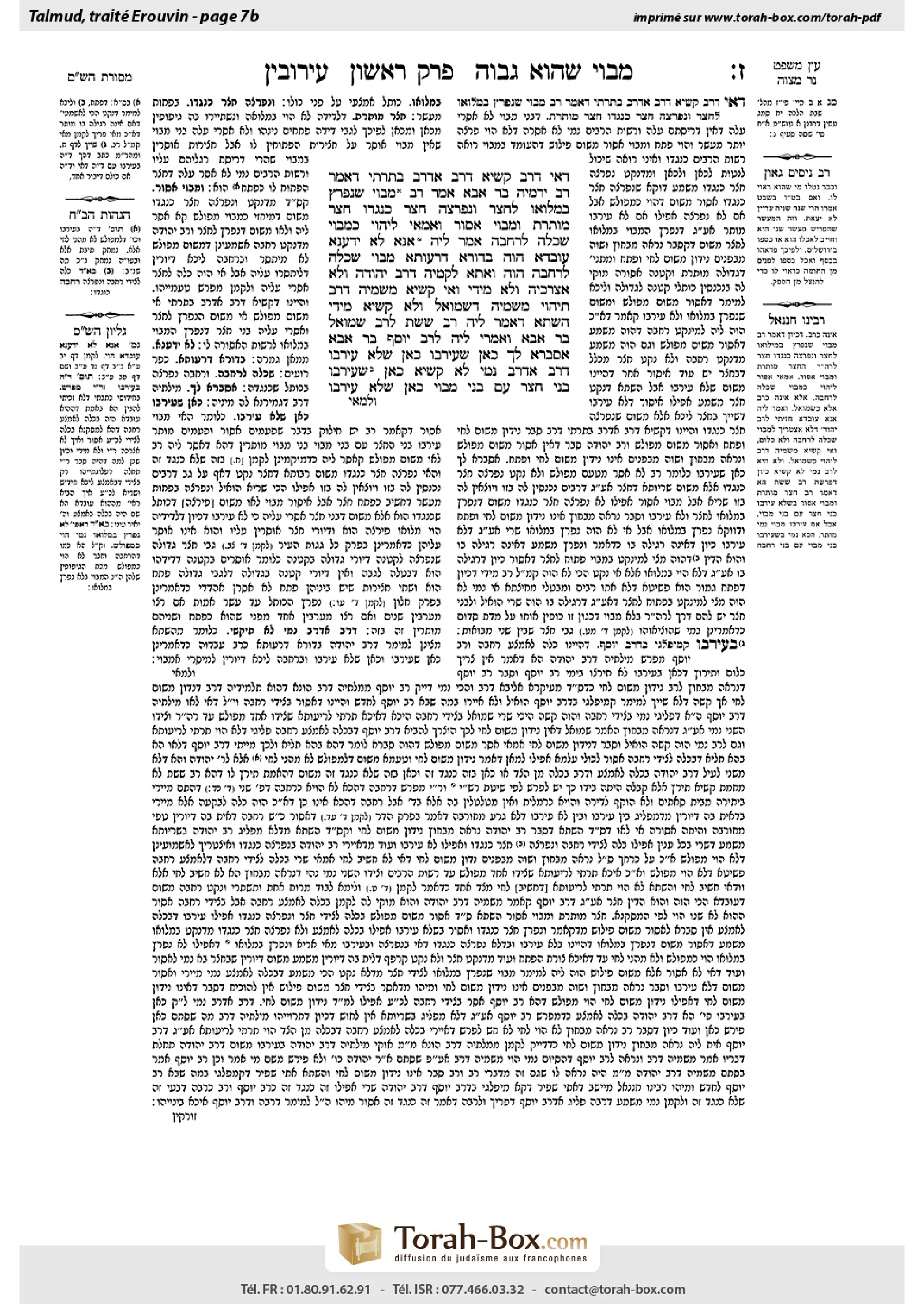
Eruvin 7b: Talmud study for Daf Yomi
Study the Talmud for Daf Yomi with scanned pages, Hebrew text, English translations from Sefaria and AI-generated French translations.
Passage selection and English or AI-generated French translation are available where the scan has annotations. Daf Study is independent of Torah-Box and Sefaria.
Browse Eruvin · עירובין · All tractatesEruvin 7b text and translations
This page of Eruvin includes the Aramaic text, an English translation and an AI-generated French translation, alongside the scan above.
עירובין ז׳ ב · Aramaic and Hebrew text
דְּאִי דְּרַב — קַשְׁיָא דְּרַב אַדְּרַב בְּתַרְתֵּי: דְּאָמַר רַב יִרְמְיָה בַּר אַבָּא אָמַר רַב: מָבוֹי שֶׁנִּפְרַץ בִּמְלוֹאוֹ לֶחָצֵר, וְנִפְרְצָה חָצֵר כְּנֶגְדּוֹ — חָצֵר מוּתֶּרֶת וּמָבוֹי אָסוּר. וְאַמַּאי? לֶיהֱוֵי כְּמָבוֹי שֶׁכָּלֶה לִרְחָבָה!
אֲמַר לֵיהּ: אֲנָא לָא יָדַעְנָא, עוֹבָדָא הֲוָה בְּדוּרָא דְּרָעֲוָתָא מָבוֹי שֶׁכָּלֶה לִרְחָבָה הֲוָה, וַאֲתָא לְקַמֵּיהּ דְּרַב יְהוּדָה וְלָא אַצְרְכֵיהּ וְלָא מִידֵּי. וְאִי קַשְׁיָא מִשְּׁמֵיהּ דְּרַב — תֶּיהְוֵי מִשְּׁמֵיהּ דִּשְׁמוּאֵל, וְלָא קַשְׁיָא מִידֵּי.
הַשְׁתָּא דַּאֲמַר לֵיהּ רַב שֵׁשֶׁת לְרַב שְׁמוּאֵל בַּר אַבָּא, וְאָמְרִי לֵיהּ לְרַב יוֹסֵף בַּר אַבָּא: אַסְבְּרָא לָךְ, כָּאן — שֶׁעֵירְבוּ, כָּאן — שֶׁלֹּא עֵירְבוּ.
דְּרַב אַדְּרַב נָמֵי לָא קַשְׁיָא: כָּאן — שֶׁעֵירְבוּ בְּנֵי חָצֵר עִם בְּנֵי מָבוֹי, כָּאן — שֶׁלֹּא עֵירְבוּ.
Eruvin 7b · English translation
For if it is a ruling of Rav, the apparent contradiction between one statement of Rav and another statement of Rav poses a difficulty in two ways. The first is with regard to the fact that this alleyway opens into the public domain on two opposite sides, and the second is based on that which Rav Yirmeya bar Abba said that Rav said: If an alleyway was breached along the entire length of its back wall into a courtyard, and likewise the courtyard was breached opposite it into the public domain, it is permitted to carry in the courtyard, and it is prohibited to carry in the alleyway, since this alleyway is now open on two opposite sides to the public domain. Why should this be the ruling? In this case, let it be like an alleyway that terminates in a backyard, where Rav Yehuda ruled that nothing further is needed to permit carrying.
Rav Yosef said to Abaye: I do not know in accordance with which of his teachers Rav Yehuda issued this ruling. All I know is that there was an incident in a shepherds’ village where an alleyway terminated in a backyard, and the matter came before Rav Yehuda for a ruling, and he did not require anything to render it permitted to carry in the alleyway. And if, as you say, it is difficult if we say that he issued his ruling in the name of Rav, let it be suggested that he issued it in the name of his other teacher, Shmuel, and then there will be no difficulty.
The Gemara comments: Now that Rav Sheshet said to Rav Shmuel bar Abba, and some say that he said to Rav Yosef bar Abba: I will explain to you Rav’s statement with regard to an alleyway that was breached along the entire length of its back wall into a courtyard. One must make a distinction based on the nature of the case: Here it is referring to a case where the residents of the courtyard established an eiruv together. In that case, Rav permits carrying in the alleyway and is not concerned with the breach into the courtyard, as the courtyard and the alleyway are treated as a single domain. There it is referring to a case where the residents did not establish an eiruv together. In that case, Rav prohibits carrying in the alleyway, because the alleyway now has new residents, i.e., the residents of the courtyard, who did not participate in the eiruv, and they prevent the residents of the alleyway from carrying.
Consequently, it can be said that Rav Yehuda’s statement with regard to an alleyway that terminates in a backyard is in accordance with the opinion of Rav, as the apparent contradiction between one statement of Rav and another statement of Rav also poses no difficulty. Here, where Rav Yehuda permits carrying in an alleyway that terminates in a backyard, he is referring to a case where the residents of the courtyard and the residents of the alleyway established a joint eiruv, whereas here, where Rav prohibits carrying in an alleyway that was breached along the entire length of its back wall into a courtyard, he is referring to a case where the residents of the courtyard and the residents of the alleyway did not establish a joint eiruv.
Eruvin 7b · Traduction française (IA)
Si c'est une décision de Rav, le paradoxe apparent entre une déclaration de Rav et une autre déclaration de Rav constitue une difficulté de deux manières. La première concerne le fait que ce passage s'ouvre sur le domaine public de deux côtés opposés, et la seconde s'appuie sur ce que Rav Yirmeya bar Abba a dit que Rav a dit : Si un passage a été percé le long de toute la longueur de son mur arrière vers un jardin, et que de même le jardin a été percé en face de ce passage vers le domaine public, il est permis de porter dans le jardin et interdit de porter dans le passage, car ce passage est maintenant ouvert sur deux côtés opposés vers le domaine public. Pourquoi cette décision ? Dans ce cas, qu'il soit comme un passage qui se termine dans un jardin arrière, où Rav Yehuda a décidé que rien n'était nécessaire pour permettre le port dans le passage.
Rav Yosef a dit à Abaye : Je ne sais pas selon quel de ses maîtres Rav Yehuda a rendu cette décision. Tout ce que je sais, c'est qu'il y avait un incident dans un village de bergers où un passage se terminait dans un jardin arrière, et la question a été soumise à Rav Yehuda pour une décision, et il n'a pas exigé de chose supplémentaire pour permettre le port dans le passage. Et si, comme vous dites, c'est difficile si nous disons qu'il a rendu cette décision en son nom, qu'on propose qu'il l'ait rendue en nom de son autre maître, Shmuel, et alors il n'y aurait pas de difficulté.
La Guemara commente : Maintenant que Rav Sheshet a dit à Rav Shmuel bar Abba, et certains disent qu'il a dit à Rav Yosef bar Abba : Je vais vous expliquer la déclaration de Rav concernant un passage percé le long de toute la longueur de son mur arrière vers un jardin. On doit faire une distinction selon la nature du cas : ici, il s'agit d'un cas où les habitants du jardin ont établi un eiruv ensemble. Dans ce cas, Rav permet le port dans le passage et ne s'occupe pas de la percée vers le jardin, car le jardin et le passage sont traités comme un seul domaine. Là, il s'agit d'un cas où les habitants n'ont pas établi un eiruv ensemble. Dans ce cas, Rav interdit le port dans le passage, car le passage a maintenant de nouveaux habitants, c'est-à-dire les habitants du jardin, qui n'ont pas participé à l'eiruv, et ils empêchent les habitants du passage de porter.
Par conséquent, on peut dire que la déclaration de Rav Yehuda concernant un passage qui se termine dans un jardin arrière s'inscrit dans l'opinion de Rav, car le paradoxe apparent entre une déclaration de Rav et une autre déclaration de Rav ne constitue pas de difficulté. Ici, où Rav Yehuda permet le port dans un passage qui se termine dans un jardin arrière, il s'agit d'un cas où les habitants du jardin et les habitants du passage ont établi un eiruv commun, tandis que là, où Rav interdit le port dans un passage percé le long de toute la longueur de son mur arrière vers un jardin, il s'agit d'un cas où les habitants du jardin et les habitants du passage n'ont pas établi un eiruv commun.
Traduction française générée par IA à partir de l’édition anglaise de Sefaria. Vérifie toujours un passage avec le texte source.
Text from Sefaria: William Davidson Edition - Vocalized Aramaic (CC BY NC); William Davidson Edition - English (CC BY NC).