Eruvin 8a: Talmud study for Daf Yomi
Study the Talmud for Daf Yomi with scanned pages, Hebrew text, English translations from Sefaria and AI-generated French translations.
Passage selection and English or AI-generated French translation are available where the scan has annotations. Daf Study is independent of Torah-Box and Sefaria.
Browse Eruvin · עירובין · All tractatesEruvin 8a text and translations
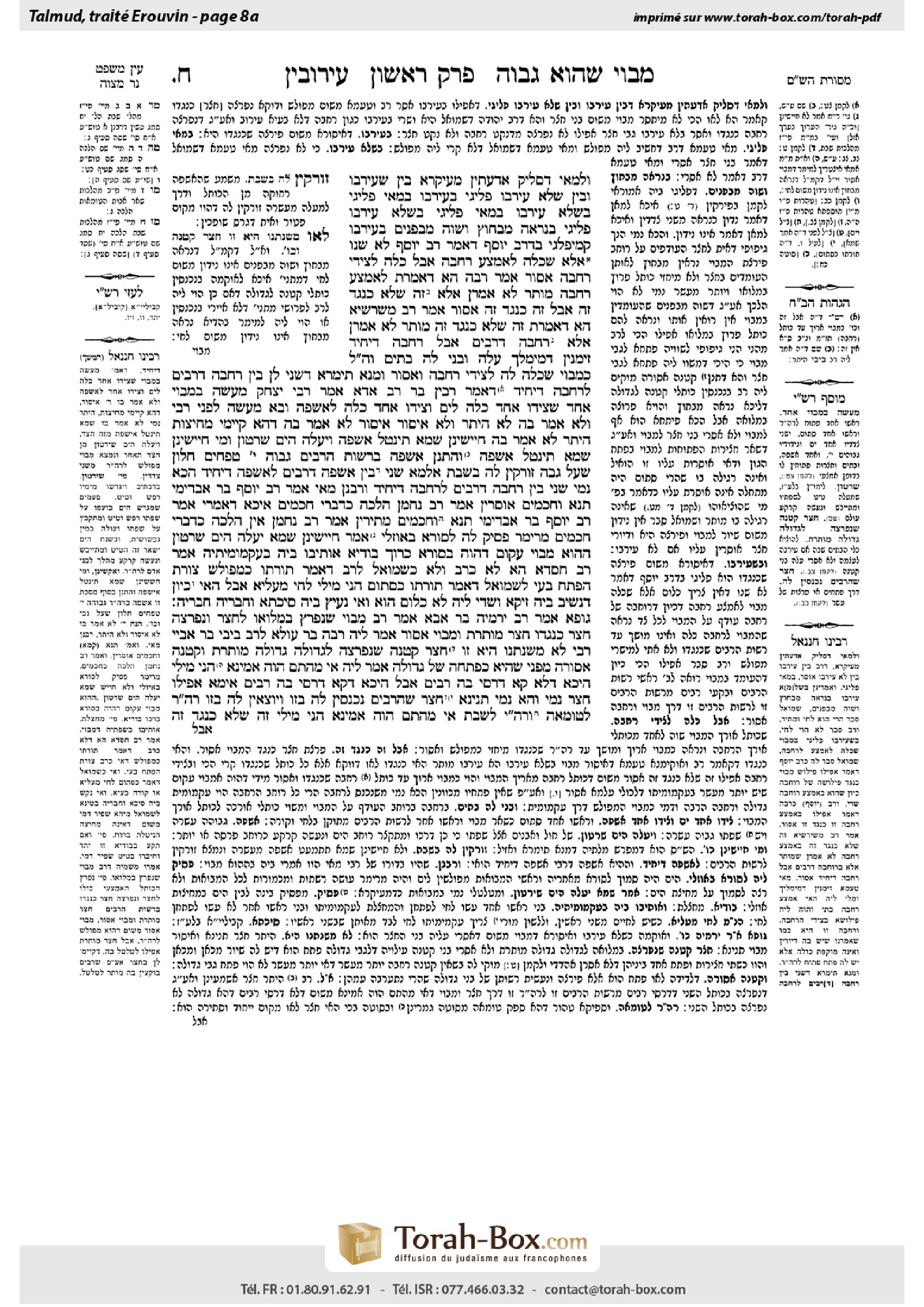
This page of Eruvin includes the Aramaic text, an English translation and an AI-generated French translation, alongside the scan above.
עירובין ח׳ א · Aramaic and Hebrew text
וּלְמַאי דִּסְלֵיק אַדַּעְתִּין מֵעִיקָּרָא בֵּין שֶׁעֵירְבוּ וּבֵין שֶׁלֹּא עֵירְבוּ פְּלִיגִי: בְּעֵירְבוּ בְּמַאי פְּלִיגִי, בְּשֶׁלֹּא עֵירְבוּ בְּמַאי פְּלִיגִי?
בְּשֶׁלֹּא עֵירְבוּ — פְּלִיגִי בְּנִרְאֶה מִבַּחוּץ וְשָׁוֶה מִבִּפְנִים.
בְּעֵירְבוּ — קָמִיפַּלְגִי בִּדְרַב יוֹסֵף. דְּאָמַר רַב יוֹסֵף: לֹא שָׁנוּ אֶלָּא שֶׁכָּלֶה לְאֶמְצַע רְחָבָה, אֲבָל כָּלֶה לְצִידֵּי רְחָבָה — אָסוּר.
אָמַר רַבָּה: הָא דְּאָמְרַתְּ ״לְאֶמְצַע רְחָבָה מוּתָּר״, לָא אֲמַרַן אֶלָּא זֶה שֶׁלֹּא כְּנֶגֶד זֶה, אֲבָל זֶה כְּנֶגֶד זֶה — אָסוּר.
אָמַר רַב מְשַׁרְשְׁיָא: הָא דְּאָמְרַתְּ ״זֶה שֶׁלֹּא כְּנֶגֶד זֶה מוּתָּר״, לָא אֲמַרַן אֶלָּא רְחָבָה דְרַבִּים, אֲבָל רְחָבָה דְיָחִיד, זִימְנִין דְּמִימְּלַךְ עֲלַהּ וּבְנֵי לַהּ בָּתִּים, וְהָוֵי לַהּ כְּמָבוֹי שֶׁכָּלֶה לֵהּ לְצִידֵּי רְחָבָה וְאָסוּר.
וּמְנָא תֵּימְרָא דְּשָׁנֵי לַן בֵּין רְחָבָה דְרַבִּים לִרְחָבָה דְיָחִיד — דְּאָמַר רָבִין בַּר רַב אַדָּא, אָמַר רַבִּי יִצְחָק: מַעֲשֶׂה בְּמָבוֹי אֶחָד שֶׁצִּידּוֹ אֶחָד כָּלֶה לַיָּם וְצִידּוֹ אֶחָד כָּלֶה לְאַשְׁפָּה, וּבָא מַעֲשֶׂה לִפְנֵי רַבִּי, וְלֹא אָמַר בָּהּ לֹא הֶיתֵּר וְלֹא אִיסּוּר.
אִיסּוּר לָא אֲמַר בַּהּ — דְּהָא קָיְימִי מְחִיצּוֹת. הֶיתֵּר לָא אֲמַר בַּהּ — חָיְישִׁינַן שֶׁמָּא תִּינָּטֵל אַשְׁפָּה, וְיַעֲלֶה הַיָּם שִׂרְטוֹן.
וּמִי חָיְישִׁינַן שֶׁמָּא תִּינָּטֵל אַשְׁפָּה? וְהָתְנַן: אַשְׁפָּה בִּרְשׁוּת הָרַבִּים גָּבוֹהַּ עֲשָׂרָה טְפָחִים, חַלּוֹן שֶׁעַל גַּבָּהּ — זוֹרְקִין לָהּ בְּשַׁבָּת.
אַלְמָא שָׁנֵי בֵּין אַשְׁפָּה דְרַבִּים לְאַשְׁפָּה דְיָחִיד.
הָכָא נָמֵי, שָׁנֵי בֵּין רְחָבָה דְרַבִּים לִרְחָבָה דְיָחִיד.
וְרַבָּנַן מַאי?
אָמַר רַב יוֹסֵף בַּר אַבְדִּימִי, תָּנָא: וַחֲכָמִים אוֹסְרִין; אָמַר רַב נַחְמָן: הֲלָכָה כְּדִבְרֵי חֲכָמִים. אִיכָּא דְּאָמְרִי: אָמַר רַב יוֹסֵף בַּר אַבְדִּימִי, תָּנָא: וַחֲכָמִים מַתִּירִין; אָמַר רַב נַחְמָן: אֵין הֲלָכָה כְּדִבְרֵי חֲכָמִים.
מָרִימָר פָּסֵיק לַהּ לְסוּרָא בְּאוּזְלֵי. אָמַר: חָיְישִׁינַן שֶׁמָּא יַעֲלֶה הַיָּם שִׂרְטוֹן.
הָהוּא מָבוֹי עָקוֹם דַּהֲוָה בְּסוּרָא, כְּרוּךְ בּוּדְיָא אוֹתִיבוּ בֵּיהּ בְּעַקְמוּמִיתֵיהּ. אָמַר רַב חִסְדָּא: הָא לָא כְּרַב וְלָא כִּשְׁמוּאֵל. לְרַב דְּאָמַר תּוֹרָתוֹ כִּמְפוּלָּשׁ — צוּרַת הַפֶּתַח בָּעֵי. לִשְׁמוּאֵל דְּאָמַר תּוֹרָתוֹ כְּסָתוּם — הָנֵי מִילֵּי לֶחִי מְעַלְּיָא. אֲבָל הַאי, כֵּיוָן דְּנָשֵׁיב בֵּיהּ זִיקָא וְשָׁדֵי לֵיהּ — לֹא כְּלוּם הוּא.
וְאִי נָעֵיץ בֵּיהּ סִיכְּתָא וְחַבְּרֵיהּ — חַבְּרֵיהּ.
גּוּפָא, אָמַר רַב יִרְמְיָה בַּר אַבָּא אָמַר רַב: מָבוֹי שֶׁנִּפְרַץ בִּמְלוֹאוֹ לְחָצֵר, וְנִפְרְצָה חָצֵר כְּנֶגְדּוֹ — חָצֵר מוּתֶּרֶת, וּמָבוֹי אָסוּר.
אֲמַר לֵיהּ רַבָּה בַּר עוּלָּא לְרַב בִּיבִי בַּר אַבָּיֵי: רַבִּי, לֹא מִשְׁנָתֵנוּ הִיא זוֹ? ״חָצֵר קְטַנָּה שֶׁנִּפְרְצָה לִגְדוֹלָה — גְּדוֹלָה מוּתֶּרֶת וּקְטַנָּה אֲסוּרָה, מִפְּנֵי שֶׁהִיא כְּפִתְחָהּ שֶׁל גְּדוֹלָה״.
אֲמַר לֵיהּ: אִי מֵהָתָם הֲוָה אָמֵינָא: הָנֵי מִילֵּי הֵיכָא דְּלָא קָא דָרְסִי בָּהּ רַבִּים, אֲבָל הֵיכָא דְּקָא דָרְסִי בַּהּ רַבִּים — אֵימָא אֲפִילּוּ חָצֵר נָמֵי.
וְהָא נָמֵי תְּנֵינָא: חָצֵר שֶׁהָרַבִּים נִכְנָסִין לָהּ בָּזוֹ וְיוֹצְאִין לָהּ בְּזוֹ, רְשׁוּת הָרַבִּים לַטּוּמְאָה, וּרְשׁוּת הַיָּחִיד לַשַּׁבָּת.
אִי מֵהָתָם הֲוָה אָמֵינָא: הָנֵי מִילֵּי, זֶה שֶׁלֹּא כְּנֶגֶד זֶה.
Eruvin 8a · English translation
And with regard to what first entered our minds, that Rav and Shmuel disagree both in the case where the residents of the alleyway and the residents of the yard established an eiruv together, as well as in the case where they did not establish an eiruv together, explanation is necessary. The Gemara seeks to explicate on what point they disagree in the case where they established a joint eiruv, and on what point they disagree in the case where they did not establish a joint eiruv. That is to say, what is the crux of the argument in these two cases?
The Gemara explains: In the case where they did not establish a joint eiruv, Rav and Shmuel disagree concerning the halakha governing an alleyway that appears closed from the outside. Outside the alleyway there is a wider courtyard, so that from the perspective of those standing in the courtyard, the breach at the end of the alleyway seems like an entrance, and the alleyway appears to be closed, but appears to be even from the inside. From the perspective of those inside the alleyway, the breach is even with the walls of the alleyway, so that the breach does not look like an entrance, and the alleyway appears to be open. The dispute revolves around the question of whether an alleyway of this kind is considered open or closed. According to the authority who says that it is considered a closed alleyway, one is permitted to carry within an alleyway that terminates in a backyard in this manner.
And in the case where they established a joint eiruv, they disagree about the principle stated by Rav Yosef. For Rav Yosef said: The allowance to carry in an alleyway that terminates in a backyard was only taught in a case where the alleyway terminates in the middle of the backyard, so that when viewed from the yard, the alleyway appears to be closed. But if it terminates on one of the sides of the backyard, so that the alleyway and yard appear continuous, carrying in the alleyway is prohibited.
Rabba took the discussion one step further and said: That which you say: Where the alleyway terminates in the middle of the backyard, carrying is permitted, this was only stated with regard to a case where the breach in the back wall of the alleyway into the yard and the breach in the facing wall of the yard into the public domain are not opposite one another. But if the two breaches are opposite one another, carrying within the alleyway is prohibited.
Rav Mesharshiya continued this line of thought and said: That which you say: If the two breaches are not opposite one another, carrying within the alleyway is permitted, this was only stated with regard to the case where the backyard belongs to many people. But if the yard belongs to a single individual, he might sometime change his mind about it and build houses in that part of the yard that is wider than the alleyway, and then the alleyway will become like an alleyway that terminates on one of the sides of the backyard, which is prohibited. If the owner of the yard closes off one side of the yard with houses, the alleyway will no longer terminate in the middle of the yard, but on one of its sides, in which case carrying will be forbidden. Consequently, although the houses have not yet been built, adjustments must be made in the alleyway to permit carrying, so that no problems should arise in the future.
Rav Mesharshiya adds: And from where do you say that we distinguish between a backyard that belongs to many people and a backyard that belongs to a single individual? As Ravin bar Rav Adda said that Rabbi Yitzḥak said: There was an incident involving a certain alleyway, where one of its sides terminated in the sea and one of its sides terminated in a refuse heap, resulting in an alleyway closed on both sides. And the incident came before Rabbi Yehuda HaNasi, so that he may rule on whether these partitions are sufficient or whether some additional construction is necessary, and he did not say anything about it, neither permission nor prohibition.
The Gemara clarifies: Rabbi Yehuda HaNasi did not state a ruling indicating a prohibition to carry in the alleyway, for partitions, i.e., the sea and the refuse heap, indeed stand, and the alleyway is closed off on both sides. However, he also did not state a ruling granting permission to carry in the alleyway, for we are concerned that perhaps the refuse heap will be removed from its present spot, leaving one side of the alleyway open. And, alternatively, perhaps the sea will raise up sand, and the sandbank will intervene between the end of the alleyway and the sea, so that the sea can no longer be considered a partition for the alleyway.
The Gemara continues: Are we really concerned that perhaps the refuse heap will be removed? But didn’t we learn in a mishna: A refuse heap in the public domain that is ten handbreadths high, so that it has the status of a private domain, and there is a window above the pile of refuse, i.e., the window is in a house adjacent to the refuse heap, we may throw refuse from the window onto the heap on Shabbat. Carrying on Shabbat from one private domain, i.e., the house, to another, i.e., the refuse heap, is permitted. We are not concerned that someone might remove some of the refuse, thus lowering the heap until it is no longer a private domain, such that throwing refuse upon it is prohibited. This seems to present a contradiction, for in some cases we are concerned that the refuse heap might be removed, but in other cases we are not.
Apparently, we distinguish between a public refuse heap and a private refuse heap, such that in the case of a private refuse heap we cannot assume that it will remain in place permanently, as it is likely to be emptied at some point.
Here, too, we distinguish between a backyard belonging to many people, where buildings are not likely to be added, and a backyard belonging to a single individual, where he might consider making changes and add buildings.
The case involving an alleyway opening on one side to the sea and on the other side to a refuse heap was brought before Rabbi Yehuda HaNasi, who did not rule on the matter. The Gemara inquires: And the Rabbis of Rabbi Yehuda HaNasi’s generation, what was their opinion with regard to this case? The fact that we are told that Rabbi Yehuda HaNasi did not want to issue a ruling indicates that his colleagues disagreed with him.
Rav Yosef bar Avdimi said: It was taught in a baraita: And the Rabbis prohibit carrying in such an alleyway. Rav Naḥman said: The halakha is in accordance with the statement of the Rabbis. There are some who state a different version of the previous statements as follows: Rav Yosef bar Avdimi said: It was taught in a baraita: And the Rabbis permit carrying in such an alleyway. Rav Naḥman said: The halakha is not in accordance with the opinion of the Rabbis.
The Gemara relates: Mareimar would block off the ends of the alleyways of Sura, which opened to a river, with nets to serve as partitions. He said: Just as we are concerned that perhaps the sea will raise up sand, so too, we are concerned that the river will raise up sand, and hence we cannot rely on its banks to serve as partitions.
The Gemara further relates: With regard to a certain crooked L-shaped alleyway that was in Sura, the residents of the place rolled up a mat and placed it at the turn to serve as a side post to permit carrying within it. Rav Ḥisda said: This was done neither in accordance with the opinion of Rav nor in accordance with that of Shmuel. The Gemara explains: According to Rav, who said that the halakha of a crooked L-shaped alleyway is like that of an alleyway that is open on two opposite sides, it requires an opening in the form of a doorway. And even according to Shmuel, who said that its halakha is like that of an alleyway that is closed at one side, so that carrying is permitted by means of a side post, this applies only to a case where a proper side post was erected. But with regard to this mat, once the wind blows upon it, it throws it over; it is regarded as nothing and is totally ineffective.
The Gemara comments: But if a peg was inserted into the mat, and thus the mat was properly attached to the wall, it is considered attached and serves as an effective side post.
The Gemara examines Rav Yirmeya bar Abba’s statement cited in the course of the previous discussion. As to the matter itself, Rav Yirmeya bar Abba said that Rav said: An alleyway that was breached along the entire length of its back wall into a courtyard, and likewise the courtyard was breached on its opposite side into the public domain, the courtyard is permitted for carrying, and the alleyway is prohibited for carrying.
Rabba bar Ulla said to Rav Beivai bar Abaye: My Master, is this case not the same as our Mishna? A smaller courtyard that was breached along the entire length of one of its walls into a larger courtyard, the larger one is permitted for carrying, and the smaller one is prohibited, because the breach is regarded as the entrance to the larger courtyard. With regard to the larger courtyard, the breach running the entire length of the smaller courtyard is considered like an entrance in one of its walls, for the breach is surrounded on both sides by the remaining portions of the wall of the larger courtyard, and therefore carrying is permitted. With regard to the smaller courtyard, however, one wall is missing in its entirety, and therefore carrying is forbidden. This seems to be exactly the same as the case of an alleyway that was breached along the entire length of its back wall into a courtyard.
He, Rav Beivai bar Abaye, said to him, Rabba bar Ulla: If this was learned from there alone, I would have said that we must distinguish between the cases: The Mishna’s ruling only applies in a place where many people do not tread. The breach between the smaller and larger courtyard will not cause more people to pass through the larger courtyard, and therefore it remains a unit of its own. But in a place where many people tread, i.e., in the case where a courtyard is breached on one side into an alleyway and on the other side into the public domain, you might say that carrying is prohibited even in the courtyard as well, owing to the people passing through it from the alleyway to the public domain.
The Gemara raises a difficulty: But didn’t we already learn this as well, that the mere fact that many people tread through a courtyard does not forbid carrying, for we learned in the Tosefta: A courtyard that was properly surrounded by partitions, into which many people enter on this side and exit on that side, is considered a public domain with regard to the halakhot of ritual impurity, so that in cases of doubt, we say that the person or article is pure, but it is still a private domain with regard to the halakhot of Shabbat. Therefore, we see that with regard to Shabbat, the sole criterion is the existence of partitions, and the fact that many people pass through the courtyard does not impair its status as a private domain.
The Gemara refutes this argument: If this was derived there alone, I would have said that this only applies in a case where the two breaches are not opposite one another,
Eruvin 8a · Traduction française (IA)
Et concernant ce qui nous a d'abord traversé l'esprit, à savoir que Rav et Shmuel sont en désaccord à la fois dans le cas où les habitants de la cour et les habitants du jardin ont établi un eiruv ensemble, et dans le cas où ils n'ont pas établi un eiruv ensemble, une explication est nécessaire. La Guemara cherche à clarifier sur quel point ils sont en désaccord dans le cas où un eiruv a été établi ensemble, et sur quel point dans le cas où un eiruv n'a pas été établi. C'est-à-dire, quelle est la question centrale de ce débat dans ces deux cas ?
La Guemara explique : Dans le cas où un eiruv n'a pas été établi ensemble, Rav et Shmuel s'opposent concernant la halakha régissant une cour qui semble fermée depuis l'extérieur. En dehors de la cour, il y a un jardin plus large, de sorte que, du point de vue de ceux qui se trouvent dans le jardin, l'ouverture à la fin de la cour semble être une entrée, et la cour semble être fermée, mais cela semble même depuis l'intérieur. Du point de vue de ceux qui sont à l'intérieur de la cour, l'ouverture est même avec les murs de la cour, de sorte que l'ouverture ne semble pas être une entrée, et la cour semble être ouverte. Le débat porte sur la question de savoir si une cour de ce genre est considérée comme ouverte ou fermée. Selon l'autorité qui affirme qu'elle est considérée comme une cour fermée, on est autorisé à transporter dans une cour qui se termine dans un jardin de cette manière.
Et dans le cas où un eiruv a été établi ensemble, ils s'opposent concernant le principe énoncé par Rav Yosef. Car Rav Yosef a dit : L'autorisation de transporter dans une cour qui se termine dans un jardin a été enseignée uniquement dans le cas où la cour se termine au milieu du jardin, de sorte que, vu depuis le jardin, la cour semble être fermée. Mais si elle se termine sur l'un des côtés du jardin, de sorte que la cour et le jardin semblent continus, le transport dans la cour est interdit.
Rabba poussa la discussion plus loin et dit : Ce que vous dites, à savoir que lorsque la cour se termine au milieu du jardin, le transport est autorisé, cela a été dit uniquement dans le cas où les ouvertures dans le mur arrière de la cour vers le jardin et l'ouverture dans le mur opposé du jardin vers le domaine public ne sont pas face à face. Mais si les deux ouvertures sont face à face, le transport dans la cour est interdit.
Rav Mesharshiya poursuivit cette ligne de pensée et dit : Ce que vous dites, à savoir que si les deux ouvertures ne sont pas face à face, le transport dans la cour est autorisé, cela a été dit uniquement dans le cas où le jardin appartient à plusieurs personnes. Mais si le jardin appartient à une seule personne, il pourrait un jour changer d'avis et construire des maisons dans la partie du jardin plus large que la cour, et alors la cour deviendrait comme une cour qui se termine sur l'un des côtés du jardin, ce qui est interdit. Si l'propriétaire du jardin ferme un côté du jardin avec des maisons, la cour ne se terminera plus au milieu du jardin, mais sur l'un de ses côtés, dans ce cas le transport serait interdit. Ainsi, même si les maisons n'ont pas encore été construites, des ajustements doivent être faits dans la cour pour autoriser le transport, afin d'éviter tout problème à l'avenir.
Rav Mesharshiya ajoute : D'où dites-vous que nous distinguons entre un jardin qui appartient à plusieurs personnes et un jardin qui appartient à une seule personne ? Comme Ravin bar Rav Adda a dit que Rabbi Yitzḥak a dit : Il y avait un cas concernant une certaine cour, où l'un de ses côtés se terminait dans la mer et l'autre dans un tas de détritus, ce qui a rendu la cour fermée des deux côtés. Et ce cas est venu devant Rabbi Yehuda HaNasi, de sorte qu'il pouvait décider si ces cloisons sont suffisantes ou si une construction supplémentaire est nécessaire, et il n'a pas dit rien à ce sujet, ni autorisation ni interdiction.
La Guemara clarifie : Rabbi Yehuda HaNasi n'a pas donné un avis indiquant une interdiction de transporter dans la cour, car les cloisons, c'est-à-dire la mer et le tas de détritus, sont effectivement présentes, et la cour est fermée des deux côtés. Cependant, il n'a pas non plus donné un avis autorisant le transport dans la cour, car nous craignons que le tas de détritus puisse être enlevé de son emplacement actuel, laissant un côté de la cour ouvert. De plus, alternativement, peut-être la mer pourrait élever du sable, et la digue pourrait intervenir entre la fin de la cour et la mer, de sorte que la mer ne pourrait plus être considérée comme une cloison pour la cour.
La Guemara continue : Sommes-nous vraiment préoccupés que le tas de détritus puisse être enlevé ? Mais n'avons-nous pas appris dans une mitsna : Un tas de détritus dans le domaine public qui est haut de dix paumes, de sorte qu'il a le statut d'un domaine privé, et il y a une fenêtre au-dessus du tas de détritus, c'est-à-dire la fenêtre est dans une maison adjacente au tas de détritus, nous pouvons jeter des détritus depuis la fenêtre sur le tas le sabbat. Le transport le sabbat d'un domaine privé, c'est-à-dire la maison, vers un autre, c'est-à-dire le tas de détritus, est autorisé. Nous ne craignons pas que quelqu'un enlève une partie des détritus, réduisant ainsi le tas jusqu'à ce qu'il ne soit plus un domaine privé, de sorte que jeter des détritus dessus serait interdit. Cela semble présenter une contradiction, car dans certains cas nous craignons que le tas de détritus puisse être enlevé, mais dans d'autres cas nous ne le craignons pas.
Apparemment, nous distinguons entre un tas de détritus public et un tas de détritus privé, de sorte que dans le cas d'un tas de détritus privé nous ne pouvons pas supposer qu'il restera en place de manière permanente, car il est probable qu'il soit vidé à un moment donné.
Ici aussi, nous distinguons entre un jardin appartenant à plusieurs personnes, où les constructions ne sont pas susceptibles d'être ajoutées, et un jardin appartenant à une seule personne, où il pourrait envisager des modifications et ajouter des constructions.
Le cas d'un passage étroit s'ouvrant d'un côté sur la mer et de l'autre sur une montagne de détritus a été soumis à Rabbi Yehuda HaNasi, qui n'a pas rendu de décision. La Guemara interroge : Et les Rabbins de la génération de Rabbi Yehuda HaNasi, quelle était leur opinion concernant ce cas ? Le fait que nous soyons informés que Rabbi Yehuda HaNasi n'avait pas souhaité rendre de décision indique que ses collègues étaient d'avis contraire.
Rav Yosef bar Avdimi a dit : Il a été enseigné dans une baraïta : Et les Rabbins interdisent le transport dans un tel passage étroit. Rav Naḥman a dit : La halakha suit l'opinion des Rabbins. Certains affirment une version différente des déclarations précédentes comme suit : Rav Yosef bar Avdimi a dit : Il a été enseigné dans une baraïta : Et les Rabbins autorisent le transport dans un tel passage étroit. Rav Naḥman a dit : La halakha ne suit pas l'opinion des Rabbins.
La Guemara rapporte : Mareimar bloquait les extrémités des passages étroits de Sura, qui s'ouvraient sur un fleuve, avec des filets pour servir de cloisons. Il a dit : Aussi bien que nous ayons peur que la mer soulève du sable, ainsi que le fleuve soulève du sable, et donc nous ne pouvons pas nous fier sur ses rives pour servir de cloisons.
La Guemara ajoute : Concernant un passage étroit en L courbe qui était à Sura, les habitants du lieu roulaient un tapis et le posaient au virage pour servir de poteau latéral afin d'autoriser le transport à l'intérieur. Rav Ḥisda a dit : Cela n'a été fait ni conformément à l'opinion de Rav ni conformément à celle de Shmuel. La Guemara explique : Selon Rav, qui a dit que la halakha d'un passage étroit en L courbe est comme celle d'un passage étroit s'ouvrant sur deux côtés opposés, il exige une ouverture sous forme de porte. Et même selon Shmuel, qui a dit que sa halakha est comme celle d'un passage étroit clos d'un côté, de sorte que le transport est autorisé par le biais d'un poteau latéral, cela s'applique uniquement à un cas où un poteau latéral adéquat a été érigé. Concernant ce tapis, une fois que le vent souffle dessus, il le jette ; il est considéré comme nul et totalement inefficace.
La Guemara commente : Mais si un clou avait été inséré dans le tapis, et ainsi le tapis avait été correctement fixé au mur, il serait considéré comme fixé et servirait de poteau latéral efficace.
La Guemara examine la déclaration de Rav Yirmeya bar Abba citée lors de la discussion précédente. En ce qui concerne la question elle-même, Rav Yirmeya bar Abba a dit que Rav a dit : Un passage étroit percé le long de toute la longueur de son mur arrière dans une cour, et de même la cour était percée sur son côté opposé dans le domaine public, la cour est autorisée au transport, et le passage étroit est interdit au transport.
Rabba bar Ulla a dit à Rav Beivai bar Abaye : Mon maître, ce cas n'est-il pas identique à notre Michna ? Une petite cour percée le long de toute la longueur d'un de ses murs dans une grande cour, la grande cour est autorisée au transport, et la petite cour est interdite, car la percée est considérée comme l'entrée de la grande cour. Concernant la grande cour, la percée le long de la petite cour est considérée comme une entrée dans l'un de ses murs, car la percée est entourée des deux côtés par les parties restantes du mur de la grande cour, et donc le transport est autorisé. Concernant la petite cour, cependant, un mur est entièrement manquant, et donc le transport est interdit. Cela semble être exactement le même cas qu'un passage étroit percé le long de toute la longueur de son mur arrière dans une cour.
Rav Beivai bar Abaye a dit à Rabba bar Ulla : Si cela avait été appris uniquement là, je l'aurais dit que nous devons distinguer les cas : La décision de la Michna s'applique uniquement dans un lieu où peu de personnes marchent. La percée entre la petite et la grande cour ne provoquera pas plus de personnes à traverser la grande cour, et donc elle reste une unité à part. Mais dans un lieu où beaucoup de personnes marchent, c'est-à-dire dans le cas où une cour est percée d'un côté dans un passage étroit et de l'autre dans le domaine public, vous pourriez dire que le transport est interdit même dans la cour, en raison des personnes passant par elle du passage étroit vers le domaine public.
La Guemara soulève une difficulté : Mais n'avons-nous pas déjà appris cela aussi, que le simple fait que beaucoup de personnes marchent dans une cour ne l'interdit pas, car nous avons appris dans la Tosefta : Une cour entourée correctement par des cloisons, dans laquelle beaucoup de personnes entrent d'un côté et en sortent de l'autre, est considérée comme un domaine public concernant les halakhot de l'impureté rituelle, de sorte que, en cas de doute, nous disons que la personne ou l'objet est pur, mais elle reste une cour privée concernant les halakhot du Shabbat. Ainsi, nous voyons que concernant le Shabbat, le seul critère est l'existence des cloisons, et le fait que beaucoup de personnes passent par la cour n'altère pas son statut de cour privée.
La Guemara réfute cet argument : Si cela avait été tiré uniquement là, je l'aurais dit que cela s'applique uniquement dans un cas où les deux percées ne sont pas opposées l'une à l'autre,
Traduction française générée par IA à partir de l’édition anglaise de Sefaria. Vérifie toujours un passage avec le texte source.
Text from Sefaria: William Davidson Edition - Vocalized Aramaic (CC BY NC); William Davidson Edition - English (CC BY NC).